
Chapter 8 Methods of Analysis Constant Current Sources
- Slides: 35
Chapter 8 Methods of Analysis
Constant Current Sources • Maintains same current in branch of circuit – Doesn’t matter how components are connected external to the source • Direction of current source indicates direction of current flow in branch 2
Constant Current Sources • Voltage across current source – Depends on how other components are connected 3
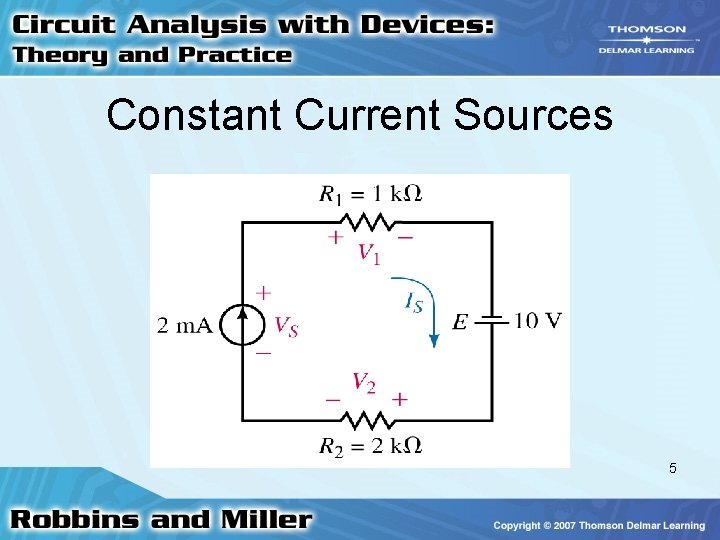
Constant Current Sources • Series circuit – Current must be same everywhere in circuit • Current source in a series circuit – Value of the current for that circuit • For the circuit shown – I = 2 m. A 4
Constant Current Sources 5
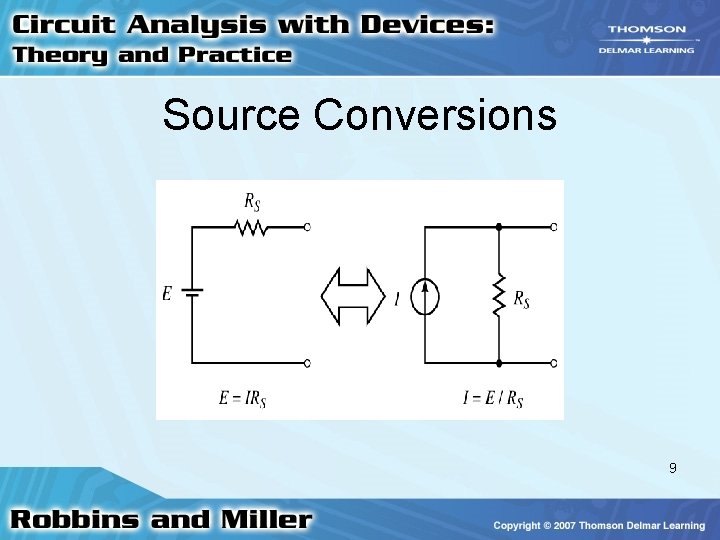
Source Conversions • Circuit analysis – Sometimes convenient to convert between voltage sources and current sources • To convert from a voltage source to a current source – Calculate current from E/RS 6
Source Conversions • RS does not change • Place current source and resistor in parallel 7
Source Conversions • Can also convert from a current source to a voltage source • E = I • RS • Place voltage source in series with resistor 8
Source Conversions 9
Source Conversions • A load connected to a voltage source or its equivalent current – Should have same voltage and current for either source 10
Source Conversions • Although sources are equivalent – Currents and voltages within sources may differ • Sources are only equivalent external to terminals 11
Current Sources in Parallel and Series • Current sources in parallel – Simply add together algebraically • Magnitude and direction of resultant source – Add currents in one direction – Subtract currents in opposite direction 12
Current Sources in Parallel and Series • Current sources with different values – Never place in series – This violates KCL 13
Branch Current Analysis • For circuits having more than one source – Use different methods of analysis – Begin by arbitrarily assigning current directions in each branch – Label polarities of the voltage drops across all resistors 14
Branch Current Analysis • Write KVL around all loops • Apply KCL at enough nodes so all branches have been included • Solve resulting equations 15
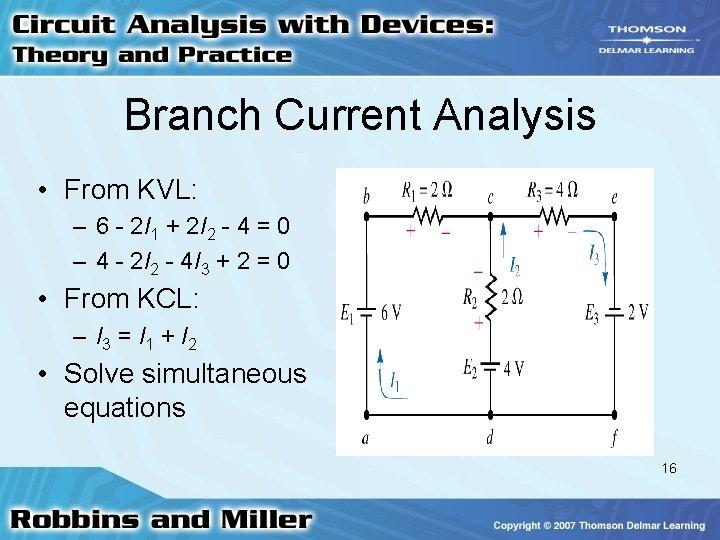
Branch Current Analysis • From KVL: – 6 - 2 I 1 + 2 I 2 - 4 = 0 – 4 - 2 I 2 - 4 I 3 + 2 = 0 • From KCL: – I 3 = I 1 + I 2 • Solve simultaneous equations 16
Mesh Analysis • Arbitrarily assign a clockwise current to each interior closed loop (Mesh) • Indicate voltage polarities across all resistors • Write KVL equations 17
Mesh Analysis • Solve resulting simultaneous equations • Branch currents determined by: – Algebraically combining loop currents common to branch 18
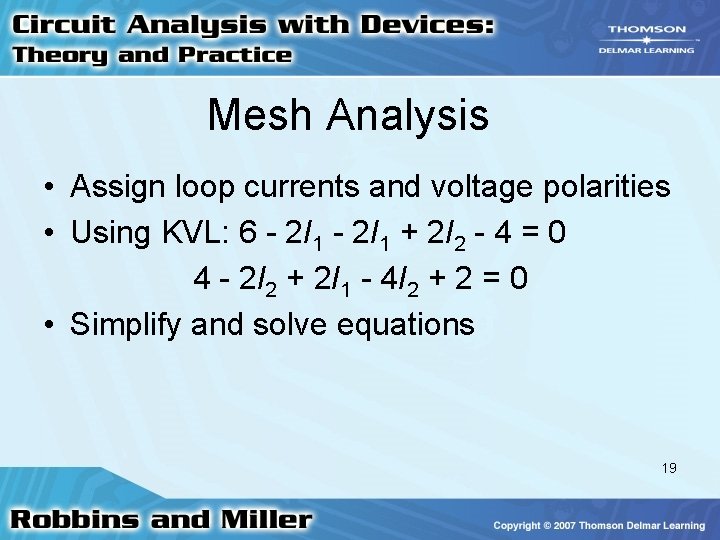
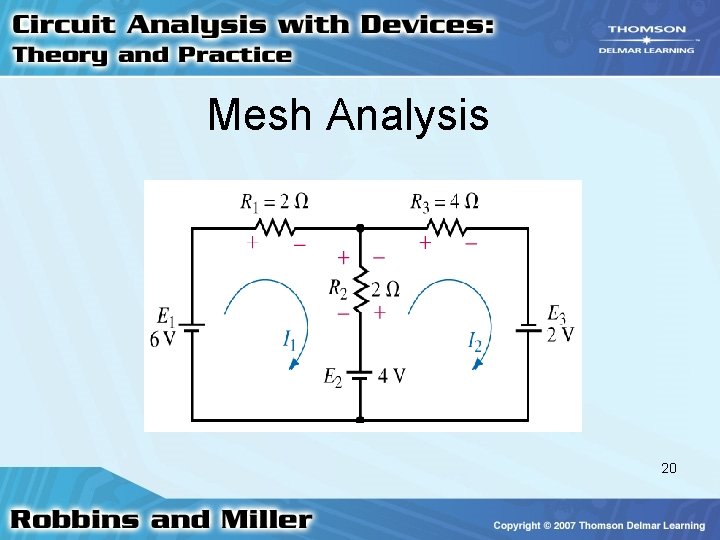
Mesh Analysis • Assign loop currents and voltage polarities • Using KVL: 6 - 2 I 1 + 2 I 2 - 4 = 0 4 - 2 I 2 + 2 I 1 - 4 I 2 + 2 = 0 • Simplify and solve equations 19
Mesh Analysis 20
Format Approach • Mutual resistors represent resistors shared between two loops • R 12 represents resistor in loop 1 that is shared by loop 1 and loop 2 • Coefficients along principal diagonal will be positive 21
Format Approach • All other coefficients will be negative • Terms will be symmetrical about principal diagonal 22
Format Approach • Convert current sources into equivalent voltage sources • Assign clockwise currents to each independent closed loop • Write simultaneous linear equations – Use format outline or matrix method 23
Format Approach • Solve resulting simultaneous equations or matrix equations • Use a calculator or software program to solve 24
Nodal Analysis • Assign a reference node within circuit and indicate node as ground • Convert voltage sources to current sources 25
Nodal Analysis • Assign voltages V 1, V 2, etc. to remaining nodes • Arbitrarily assign a current direction to each branch where there is no current source 26
Nodal Analysis • Apply KCL to all nodes except reference node • Rewrite each current in terms of voltage • Solve resulting equations for voltages 27
Format Approach • Mutual conductance – Common to two nodes • Mutual conductance G 23 – Conductance at Node 2 – Common to Node 3 • Conductances at certain nodes are positive 28
Format Approach • Mutual conductances are negative • Equations are written correctly – Terms will be symmetrical about principal diagonal 29
Format Approach • Convert voltage sources into equivalent current sources • Label reference node as ground • Label remaining nodes as V 1, V 2, etc. 30
Format Approach • Write linear equation for each node or in matrix form • Solve resulting equations for voltages • Method of solution is same as for mesh 31
Delta-Wye Conversion • Resistors connected to a point of Y – Obtained by finding product of resistors connected to same point in Delta – Divide by sum of all Delta resistors 32
Delta-Wye Conversion • Given a Delta circuit with resistors of 30, 60, and 90 – Resulting Y circuit will have resistors of 10, 15, and 30 33
Wye-Delta Conversions • A Delta resistor is found: – Taking sum of all two-product combinations of Y resistor values – Divide by resistance of Y directly opposite resistor being calculated 34
Wye-Delta Conversions • For a Y circuit having resistances of 2. 4, 3. 6, and 4. 8 – Resulting Delta resistors will be 7. 8, 10. 4, and 15. 6 35