
Chapter 8 Metamorphism and Metamorphic Rocks Metamorphism The

- Slides: 36
Chapter 8 Metamorphism and Metamorphic Rocks
Metamorphism The transition of one rock into another by temperatures and/or pressures unlike those in which it formed Metamorphic rocks are produced from • Igneous rocks • Sedimentary rocks • Other metamorphic rocks
Metamorphism progresses incrementally from low-grade to high-grade During metamorphism the rock must remain essentially solid
Metamorphism Metamorphic settings • Contact or thermal metamorphism – driven by a rise in temperature within the host rock • Hydrothermal metamorphism – chemical alterations from hot, ion-rich water • Regional metamorphism – Occurs during mountain building – Produces the greatest volume of metamorphic rock – Rocks usually display zones of contact and/or hydrothermal metamorphism
Agents of metamorphism Heat • The most important agent • Recrystallization results in new, stable minerals • Two sources of heat – Contact metamorphism – heat from magma – An increase in temperature with depth due to the geothermal gradient
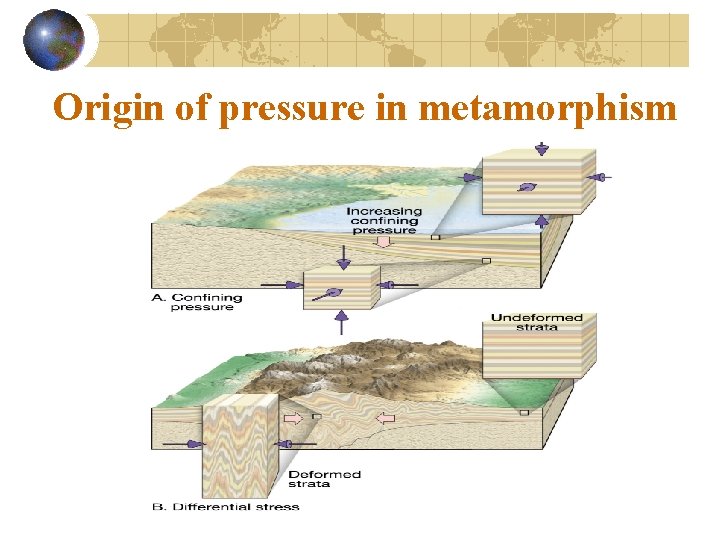
Agents of metamorphism Pressure (stress) • Increases with depth • Confining pressure applies forces equally in all directions • Rocks may also be subjected to differential stress which is unequal in different directions
Origin of pressure in metamorphism
Agents of metamorphism Chemically active fluids • Mainly water with other volatile components • Enhances migration of ions • Aids in recrystallization of existing minerals Sources of fluids – Pore spaces of sedimentary rocks – Fractures in igneous rocks – Hydrated minerals such as clays and micas
Agents of metamorphism The importance of parent rock • Most metamorphic rocks have the same overall chemical composition as the parent rock from which they formed • Mineral makeup determines, to a large extent, the degree to which each metamorphic agent will cause change
Metamorphic textures Texture refers to the size, shape, and arrangement of grains within a rock Foliation – any planar arrangement of mineral grains or structural features within a rock
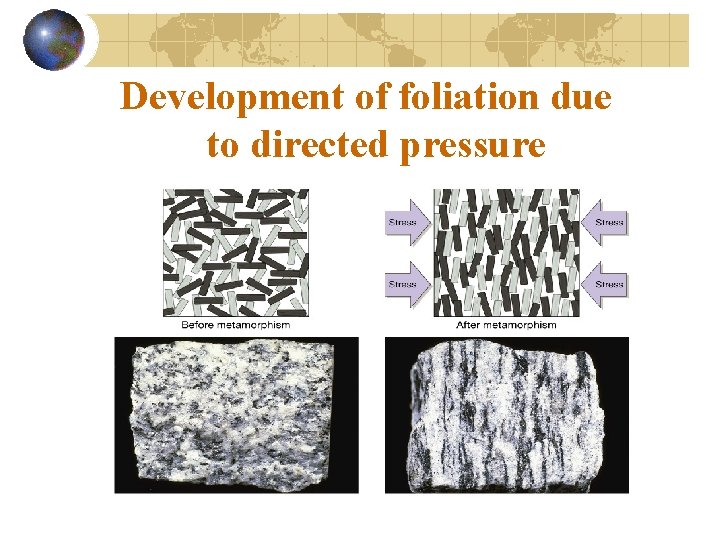
Metamorphic textures Foliation can form in various ways including – Rotation of platy and/or elongated minerals – Recrystallization of minerals in the direction of preferred orientation – Changing the shape of equidimensional grains into elongated shapes that are aligned
Development of foliation due to directed pressure
Metamorphic textures Those metamorphic rocks that lack foliation are referred to as nonfoliated – Develop in environments where deformation is minimal – Typically composed of minerals that exhibit equidimensional crystals
Metamorphic textures Porphyroblastic textures – Large grains, called porphyroblasts, surrounded by a fine-grained matrix of other minerals – Porphyroblasts are typically garnet, staurolite, and/or andalusite
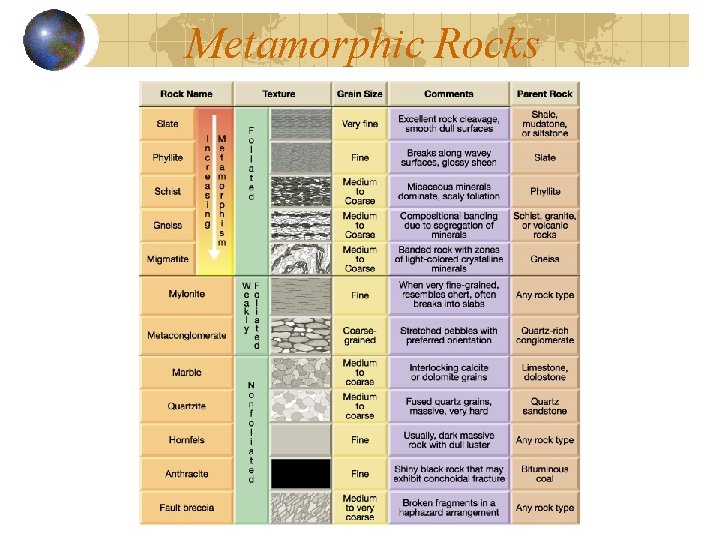
Metamorphic Rocks
Common metamorphic rocks Foliated rocks • Slate – Very fine-grained – Excellent rock cleavage – Most often generated from low-grade metamorphism of shale, mudstone, or siltstone
Common metamorphic rocks Foliated rocks • Phyllite – Gradation in the degree of metamorphism between slate and schist – Platy minerals not large enough to be identified with the unaided eye – Glossy sheen and wavy surfaces – Composed mainly of fine crystals of muscovite and/or chlorite
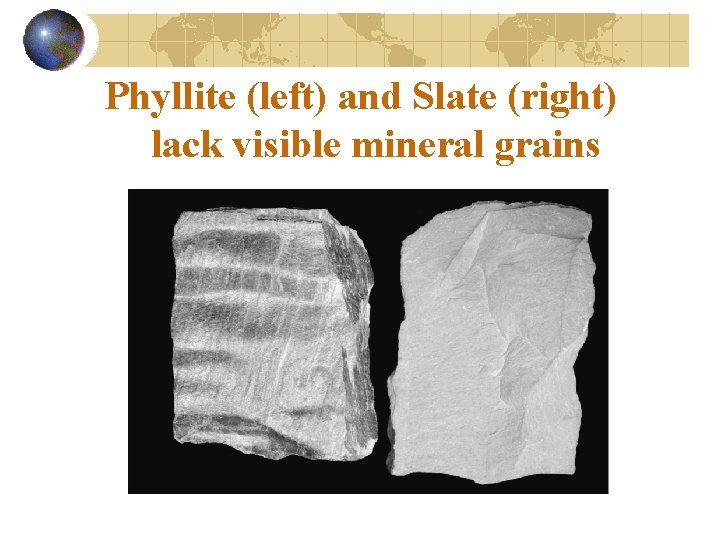
Phyllite (left) and Slate (right) lack visible mineral grains
Common metamorphic rocks Foliated rocks • Schist – Medium- to coarse-grained – Platy minerals predominate – Commonly include the micas – To indicate composition, mineral names are used (such as mica schist)
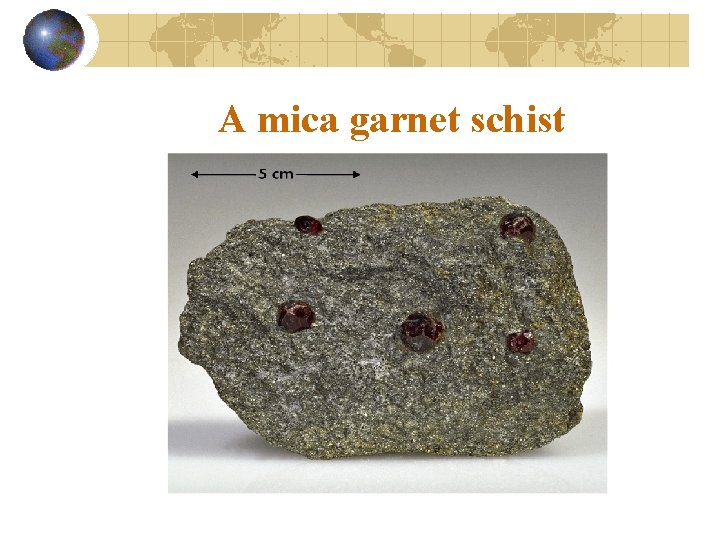
A mica garnet schist
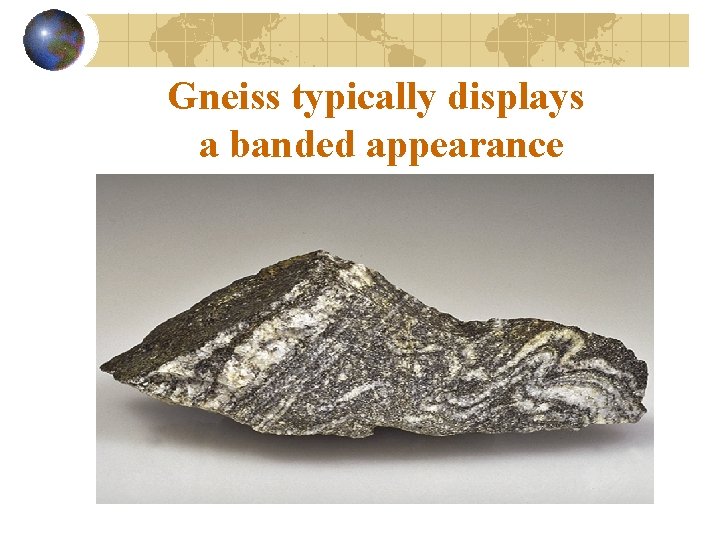
Common metamorphic rocks Foliated rocks • Gneiss – Medium- to coarse-grained – Banded appearance – High-grade metamorphism – Often composed of white or light-colored feldspar-rich layers with bands of dark ferromagnesian minerals
Gneiss typically displays a banded appearance
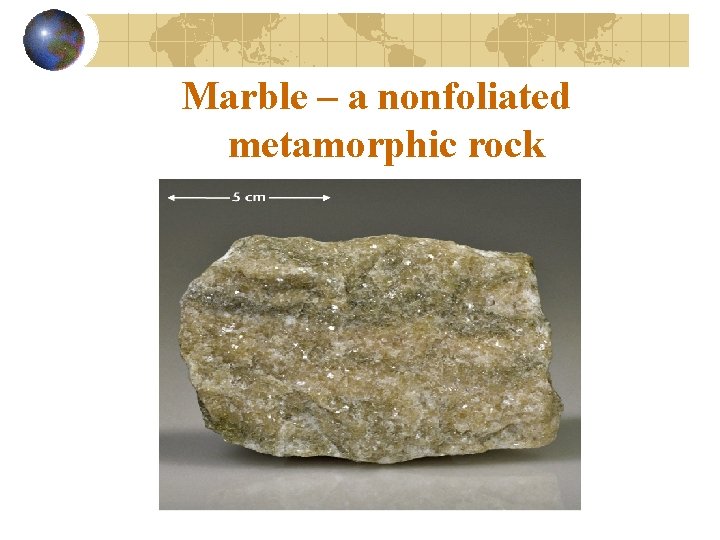
Common metamorphic rocks Nonfoliated rocks • Marble – Coarse, crystalline – Parent rock was limestone or dolostone – Composed essentially of calcite or dolomite crystals – Used as a decorative and monument stone – Exhibits a variety of colors
Marble – a nonfoliated metamorphic rock
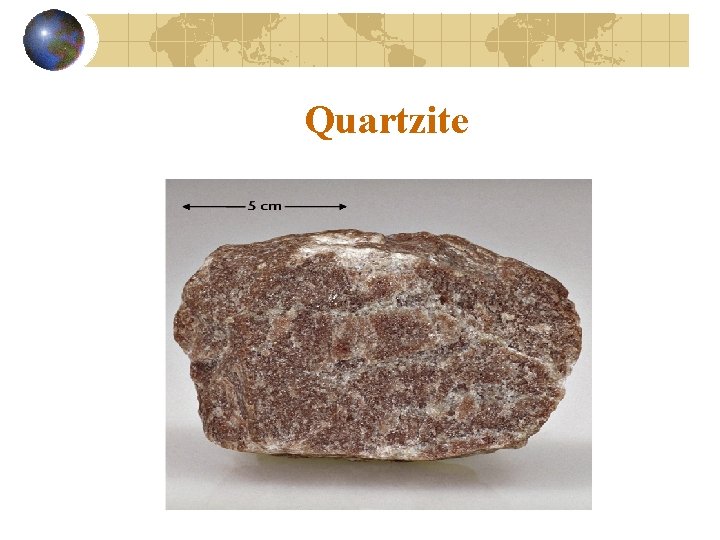
Common metamorphic rocks Nonfoliated rocks • Quartzite – Formed from a parent rock of quartz-rich sandstone – Quartz grains are fused together
Quartzite
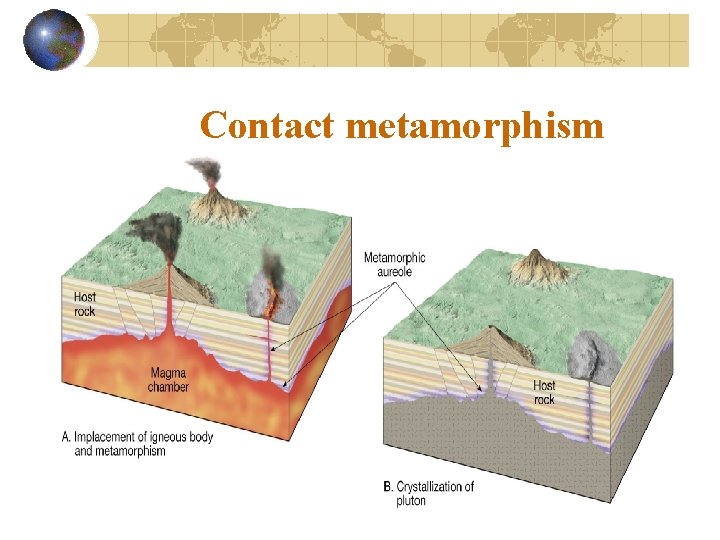
Metamorphic environments Contact or thermal metamorphism • Occurs due to a rise in temperature when magma invades a host rock • A zone of alteration called an aureole forms in the rock surrounding the magma • Most easily recognized when it occurs at the surface, or in a near-surface environment
Contact metamorphism
Metamorphic environments Hydrothermal metamorphism • Chemical alteration caused when hot, ionrich fluids circulate through fissures and cracks that develop in rock • Most widespread along the axis of the mid -ocean ridge system
Metamorphic environments Regional metamorphism • Produces the greatest quantity of metamorphic rock • Associated with mountain building
Metamorphic environments Other metamorphic environments • Burial metamorphism – Associated with very thick sedimentary strata – Required depth varies from one location to another depending on the prevailing geothermal gradient • Impact metamorphism – Occurs when high speed projectiles called meteorites strike Earth’s surface – Products are called impactites
Metamorphism and plate tectonics Most metamorphism occurs along convergent plate boundaries • Compressional stresses deform the edges of the plate • Formation of the Earth’s major mountain belts including the Alps, Himalayas, and Appalachians
Metamorphism and plate tectonics Large-scale metamorphism also occurs along subduction zones at convergent boundaries • Several metamorphic environments exist here • Important site of magma generation
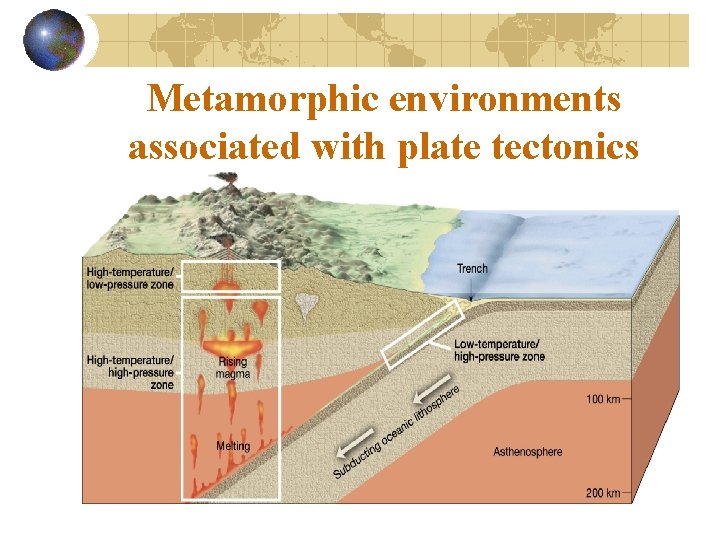
Metamorphism and plate tectonics Metamorphism at subduction zones • Mountainous terrains along subduction zones exhibit distinct linear belts of metamorphic rocks – High-pressure, low-temperature zones nearest the trench – High-temperature, low-pressure zones further inland in the region of igneous activity
Metamorphic environments associated with plate tectonics