
Chapter 8 Memory Testing and BuiltIn SelfTest EE
Chapter 8 Memory Testing and Built-In Self-Test EE 141 VLSI Test Principles and Architectures 1 Ch. 8 - Memory Testing & BIST -
What is this chapter about? q Basic concepts of memory testing and BIST q Memory fault models and test algorithms q Memory fault simulation and test algorithm generation § RAMSES: fault simulator § TAGS: test algorithm generator q Memory BIST § BRAINS: BIST generator EE 141 VLSI Test Principles and Architectures 2 Ch. 8 - Memory Testing & BIST -
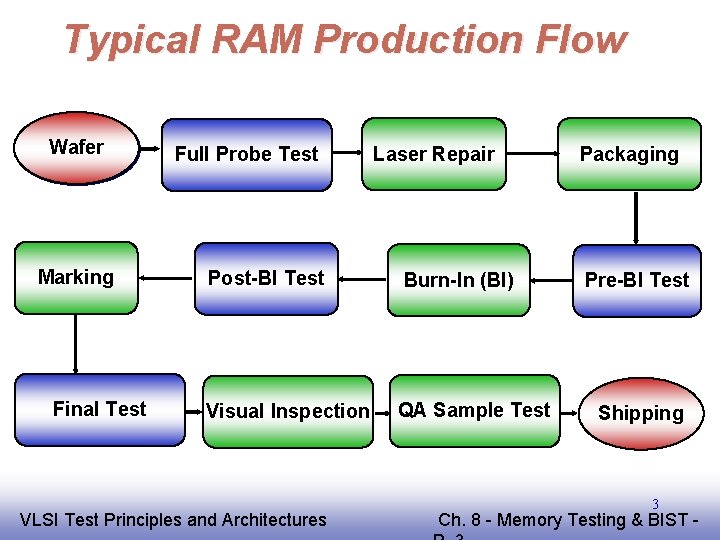
Typical RAM Production Flow Wafer Marking Final Test Full Probe Test Laser Repair Post-BI Test Burn-In (BI) Visual Inspection QA Sample Test EE 141 VLSI Test Principles and Architectures Packaging Pre-BI Test Shipping 3 Ch. 8 - Memory Testing & BIST -

Off-Line Testing of RAM Parametric Test: DC & AC q Reliability Screening q § Long-cycle testing § Burn-in: static & dynamic BI q Functional Test § Device characterization – Failure analysis § Fault modeling – Simple but effective (accurate & realistic? ) § Test algorithm generation – Small number of test patterns (data backgrounds) – High fault coverage – Short test time EE 141 VLSI Test Principles and Architectures 4 Ch. 8 - Memory Testing & BIST -
DRAM Functional Model EE 141 VLSI Test Principles and Architectures 5 Ch. 8 - Memory Testing & BIST -
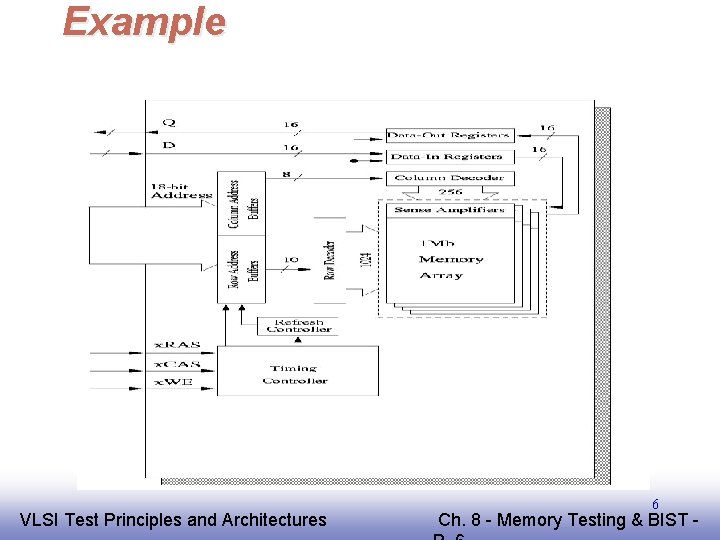
Example EE 141 VLSI Test Principles and Architectures 6 Ch. 8 - Memory Testing & BIST -
Functional Fault Models Classical fault models are not sufficient to represent all important failure modes in RAM. q Sequential ATPG is not possible for RAM. q Functional fault models are commonly used for memories: q § They define functional behavior of faulty memories. q New fault models are being proposed to cover new defects and failures in modern memories: § New process technologies § New devices EE 141 VLSI Test Principles and Architectures 7 Ch. 8 - Memory Testing & BIST -
Static RAM Fault Models: SAF/TF q Stuck-At Fault (SAF) § Cell (line) SA 0 or SA 1 – A stuck-at fault (SAF) occurs when the value of a cell or line is always 0 (a stuck-at-0 fault) or always 1 (a stuck-at -1 fault). – A test that detects all SAFs guarantees that from each cell, a 0 and a 1 must be read. q Transition Fault (TF) § Cell fails to transit from 0 to 1 or 1 to 0 in specified time period. – A cell has a transition fault (TF) if it fails to transit from 0 to 1 (a < /0> TF) or from 1 to 0 (a < /1> TF). EE 141 VLSI Test Principles and Architectures 8 Ch. 8 - Memory Testing & BIST -
Static RAM Fault Models: AF q Address-Decoder Fault (AF) § An address decoder fault (AF) is a functional fault in the address decoder that results in one of four kinds of abnormal behavior: – Given a certain address, no cell will be accessed – A certain cell is never accessed by any address – Given a certain address, multiple cells are accessed – A certain cell can be accessed by multiple addresses EE 141 VLSI Test Principles and Architectures 9 Ch. 8 - Memory Testing & BIST -
Static RAM Fault Models: SOF q Stuck-Open Fault (SOF) § A stuck-open fault (SOF) occurs when the cell cannot be accessed due to, e. g. , a broken word line. § A read to this cell will produce the previously read value. EE 141 VLSI Test Principles and Architectures 10 Ch. 8 - Memory Testing & BIST -
RAM Fault Models: CF q Coupling Fault (CF) § A coupling fault (CF) between two cells occurs when the logic value of a cell is influenced by the content of, or operation on, another cell. § State Coupling Fault (CFst) – Coupled (victim) cell is forced to 0 or 1 if coupling (aggressor) cell is in given state. § Inversion Coupling Fault (CFin) – Transition in coupling cell complements (inverts) coupled cell. § Idempotent Coupling Fault (CFid) – Coupled cell is forced to 0 or 1 if coupling cell transits from 0 to 1 or 1 to 0. EE 141 VLSI Test Principles and Architectures 11 Ch. 8 - Memory Testing & BIST -
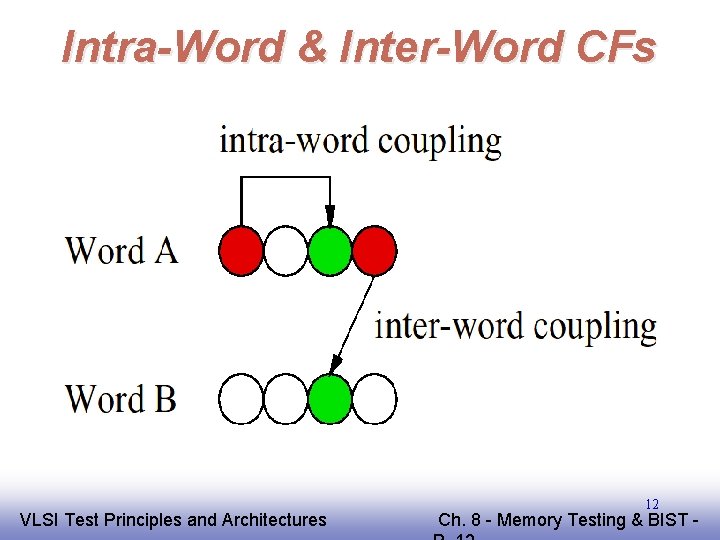
Intra-Word & Inter-Word CFs EE 141 VLSI Test Principles and Architectures 12 Ch. 8 - Memory Testing & BIST -
RAM Fault Models: DF q Disturb Fault (DF) § Victim cell forced to 0 or 1 if we (successively) read or write aggressor cell (may be the same cell): – Hammer test § Read Disturb Fault (RDF) – There is a read disturb fault (RDF) if the cell value will flip when being read (successively). EE 141 VLSI Test Principles and Architectures 13 Ch. 8 - Memory Testing & BIST -
RAM Fault Models: DRF q Data Retention Fault (DRF) § DRAM – Refresh Fault – Leakage Fault § SRAM – Leakage Fault l Static Data Losses---defective pull-up EE 141 VLSI Test Principles and Architectures 14 Ch. 8 - Memory Testing & BIST -
Test Time Complexity (100 MHz) EE 141 VLSI Test Principles and Architectures 15 Ch. 8 - Memory Testing & BIST -
RAM Test Algorithm q A test algorithm (or simply test) is a finite sequence of test elements: § A test element contains a number of memory operations (access commands) – Data pattern (background) specified for the Read and Write operation – Address (sequence) specified for the Read and Write operations q A march test algorithm is a finite sequence of march elements: § A march element is specified by an address order and a finite number of Read/Write operations EE 141 VLSI Test Principles and Architectures 16 Ch. 8 - Memory Testing & BIST -
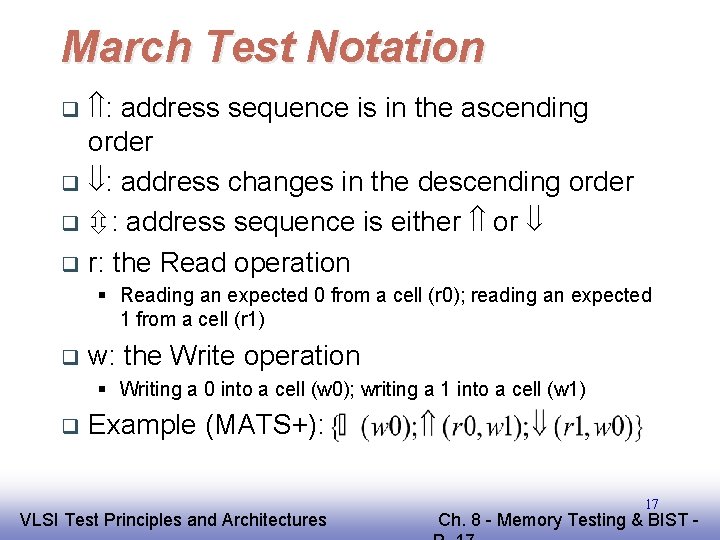
March Test Notation : address sequence is in the ascending order q : address changes in the descending order q : address sequence is either or q r: the Read operation q § Reading an expected 0 from a cell (r 0); reading an expected 1 from a cell (r 1) q w: the Write operation § Writing a 0 into a cell (w 0); writing a 1 into a cell (w 1) q Example (MATS+): EE 141 VLSI Test Principles and Architectures 17 Ch. 8 - Memory Testing & BIST -
![Classical Test Algorithms: MSCAN q Zero-One Algorithm [Breuer & Friedman 1976] § Also known](http://slidetodoc.com/presentation_image_h/cdc403e4d00aa30553d7bf7b0ea980c5/image-18.jpg "Classical Test Algorithms: MSCAN q Zero-One Algorithm [Breuer & Friedman 1976] § Also known")
Classical Test Algorithms: MSCAN q Zero-One Algorithm [Breuer & Friedman 1976] § Also known as MSCAN § SAF is detected if the address decoder is correct (not all AFs are covered): – Theorem: A test detects all AFs if it contains the march elements (ra, …, wb) and (rb, …, wa), and the memory is initialized to the proper value before each march element § Solid background (pattern) § Complexity is 4 N EE 141 VLSI Test Principles and Architectures 18 Ch. 8 - Memory Testing & BIST -
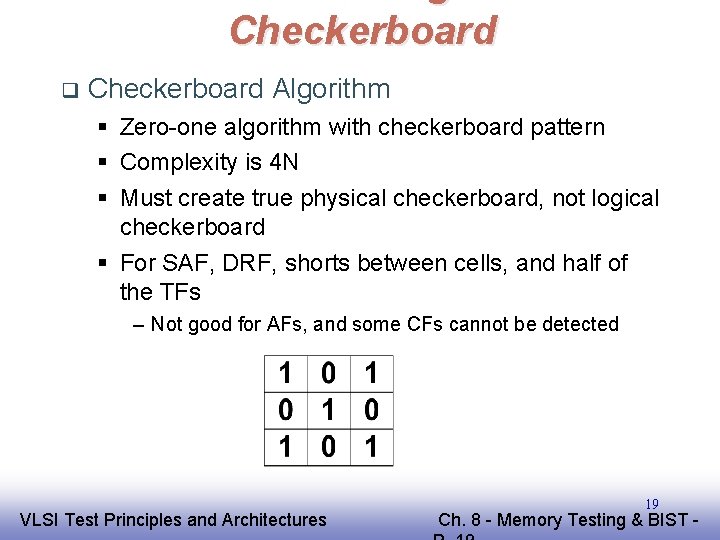
Checkerboard q Checkerboard Algorithm § Zero-one algorithm with checkerboard pattern § Complexity is 4 N § Must create true physical checkerboard, not logical checkerboard § For SAF, DRF, shorts between cells, and half of the TFs – Not good for AFs, and some CFs cannot be detected EE 141 VLSI Test Principles and Architectures 19 Ch. 8 - Memory Testing & BIST -
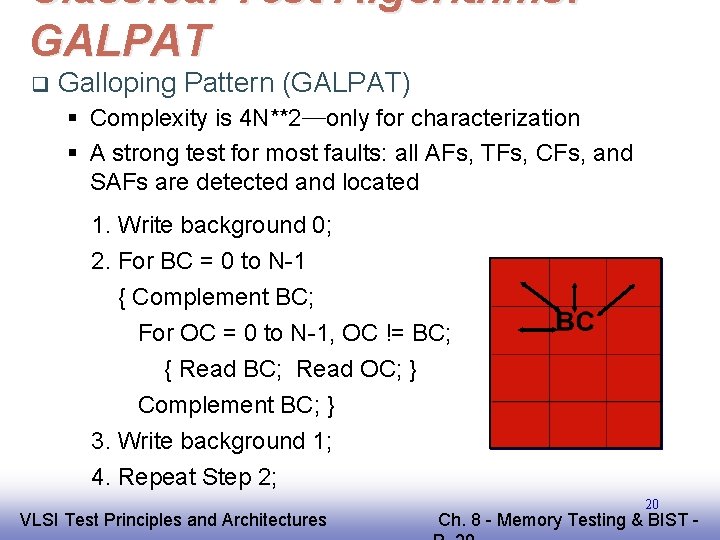
Classical Test Algorithms: GALPAT q Galloping Pattern (GALPAT) § Complexity is 4 N**2─only for characterization § A strong test for most faults: all AFs, TFs, CFs, and SAFs are detected and located 1. Write background 0; 2. For BC = 0 to N-1 { Complement BC; For OC = 0 to N-1, OC != BC; { Read BC; Read OC; } Complement BC; } 3. Write background 1; 4. Repeat Step 2; EE 141 VLSI Test Principles and Architectures 20 Ch. 8 - Memory Testing & BIST -
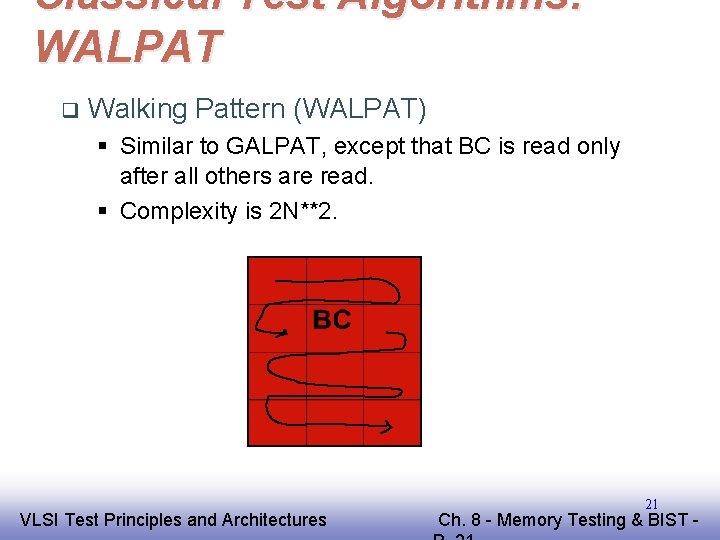
Classical Test Algorithms: WALPAT q Walking Pattern (WALPAT) § Similar to GALPAT, except that BC is read only after all others are read. § Complexity is 2 N**2. EE 141 VLSI Test Principles and Architectures 21 Ch. 8 - Memory Testing & BIST -
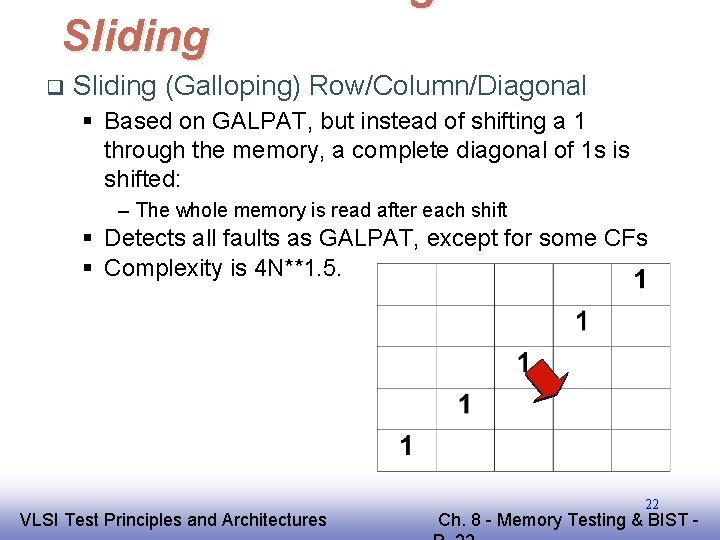
Classical Test Algorithms: Sliding q Sliding (Galloping) Row/Column/Diagonal § Based on GALPAT, but instead of shifting a 1 through the memory, a complete diagonal of 1 s is shifted: – The whole memory is read after each shift § Detects all faults as GALPAT, except for some CFs § Complexity is 4 N**1. 5. EE 141 VLSI Test Principles and Architectures 22 Ch. 8 - Memory Testing & BIST -
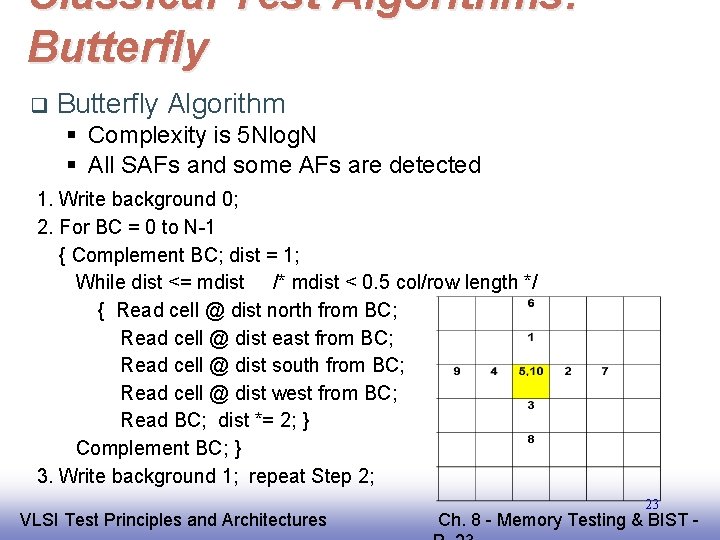
Classical Test Algorithms: Butterfly q Butterfly Algorithm § Complexity is 5 Nlog. N § All SAFs and some AFs are detected 1. Write background 0; 2. For BC = 0 to N-1 { Complement BC; dist = 1; While dist <= mdist /* mdist < 0. 5 col/row length */ { Read cell @ dist north from BC; Read cell @ dist east from BC; Read cell @ dist south from BC; Read cell @ dist west from BC; Read BC; dist *= 2; } Complement BC; } 3. Write background 1; repeat Step 2; EE 141 VLSI Test Principles and Architectures 23 Ch. 8 - Memory Testing & BIST -
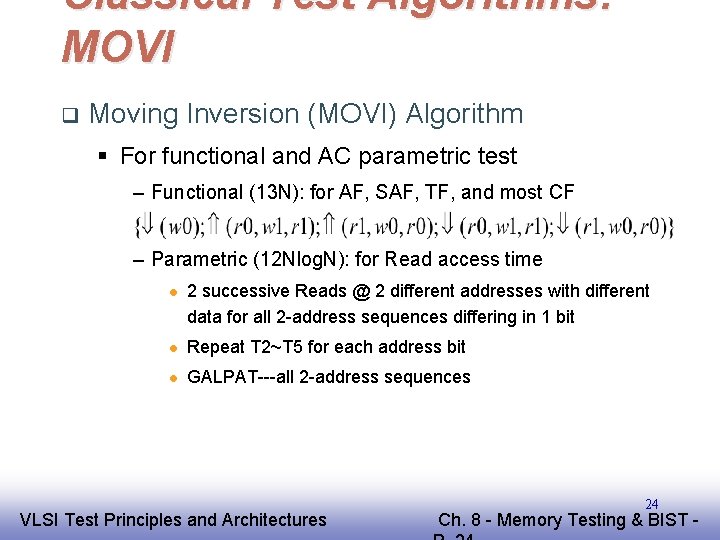
Classical Test Algorithms: MOVI q Moving Inversion (MOVI) Algorithm § For functional and AC parametric test – Functional (13 N): for AF, SAF, TF, and most CF – Parametric (12 Nlog. N): for Read access time l 2 successive Reads @ 2 different addresses with different data for all 2 -address sequences differing in 1 bit l Repeat T 2~T 5 for each address bit l GALPAT---all 2 -address sequences EE 141 VLSI Test Principles and Architectures 24 Ch. 8 - Memory Testing & BIST -
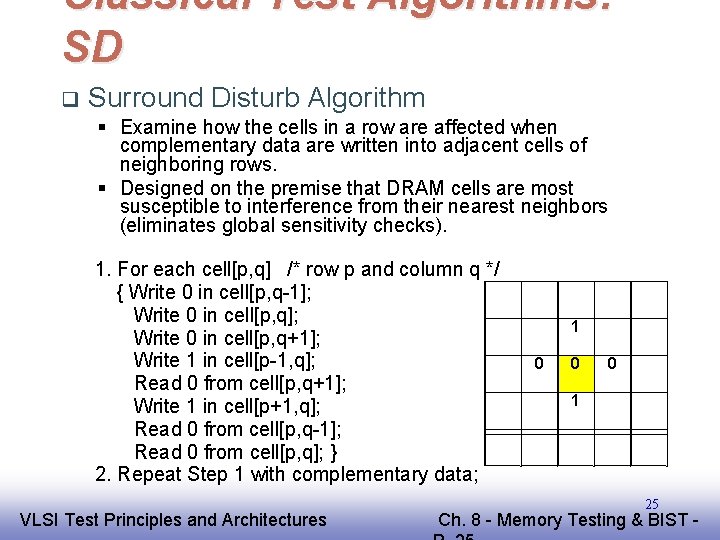
Classical Test Algorithms: SD q Surround Disturb Algorithm § Examine how the cells in a row are affected when complementary data are written into adjacent cells of neighboring rows. § Designed on the premise that DRAM cells are most susceptible to interference from their nearest neighbors (eliminates global sensitivity checks). 1. For each cell[p, q] /* row p and column q */ { Write 0 in cell[p, q-1]; Write 0 in cell[p, q+1]; Write 1 in cell[p-1, q]; Read 0 from cell[p, q+1]; Write 1 in cell[p+1, q]; Read 0 from cell[p, q-1]; Read 0 from cell[p, q]; } 2. Repeat Step 1 with complementary data; EE 141 VLSI Test Principles and Architectures 1 0 0 0 1 25 Ch. 8 - Memory Testing & BIST -
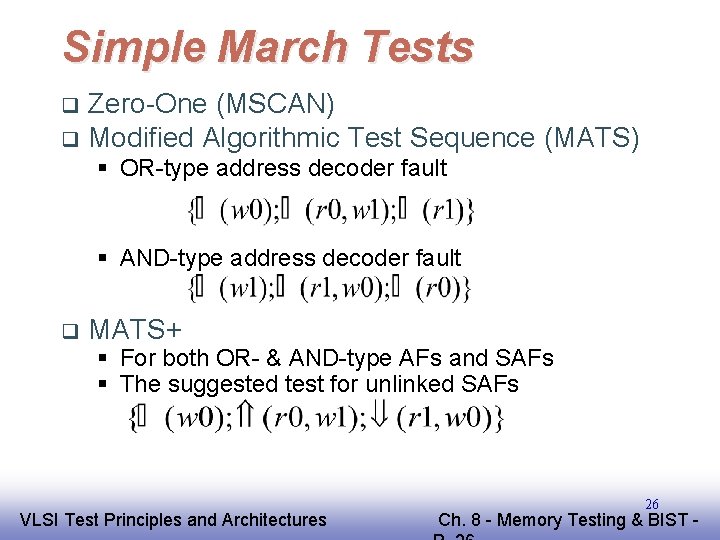
Simple March Tests Zero-One (MSCAN) q Modified Algorithmic Test Sequence (MATS) q § OR-type address decoder fault § AND-type address decoder fault q MATS+ § For both OR- & AND-type AFs and SAFs § The suggested test for unlinked SAFs EE 141 VLSI Test Principles and Architectures 26 Ch. 8 - Memory Testing & BIST -
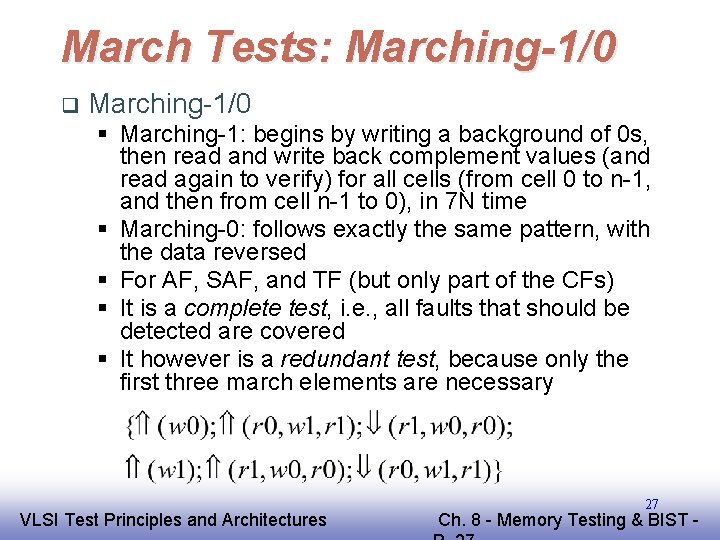
March Tests: Marching-1/0 q Marching-1/0 § Marching-1: begins by writing a background of 0 s, then read and write back complement values (and read again to verify) for all cells (from cell 0 to n-1, and then from cell n-1 to 0), in 7 N time § Marching-0: follows exactly the same pattern, with the data reversed § For AF, SAF, and TF (but only part of the CFs) § It is a complete test, i. e. , all faults that should be detected are covered § It however is a redundant test, because only the first three march elements are necessary EE 141 VLSI Test Principles and Architectures 27 Ch. 8 - Memory Testing & BIST -
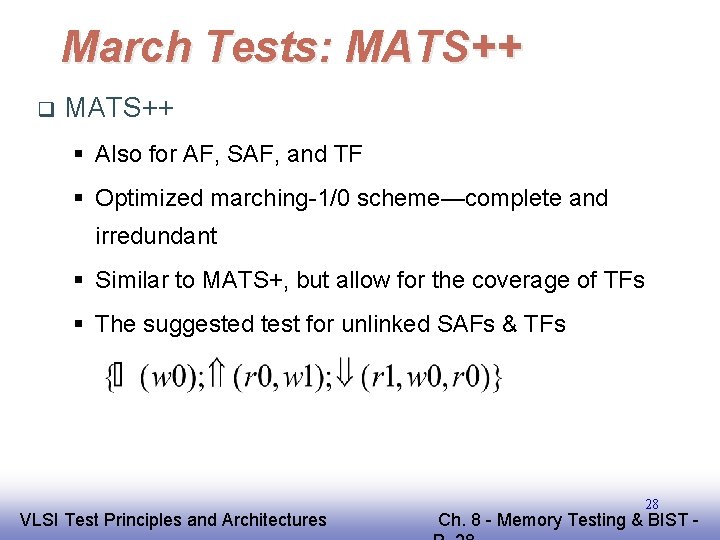
March Tests: MATS++ q MATS++ § Also for AF, SAF, and TF § Optimized marching-1/0 scheme—complete and irredundant § Similar to MATS+, but allow for the coverage of TFs § The suggested test for unlinked SAFs & TFs EE 141 VLSI Test Principles and Architectures 28 Ch. 8 - Memory Testing & BIST -
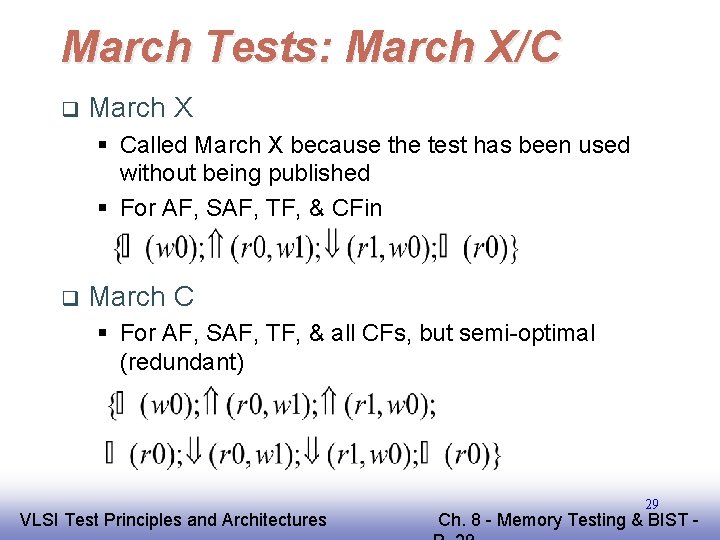
March Tests: March X/C q March X § Called March X because the test has been used without being published § For AF, SAF, TF, & CFin q March C § For AF, SAF, TF, & all CFs, but semi-optimal (redundant) EE 141 VLSI Test Principles and Architectures 29 Ch. 8 - Memory Testing & BIST -
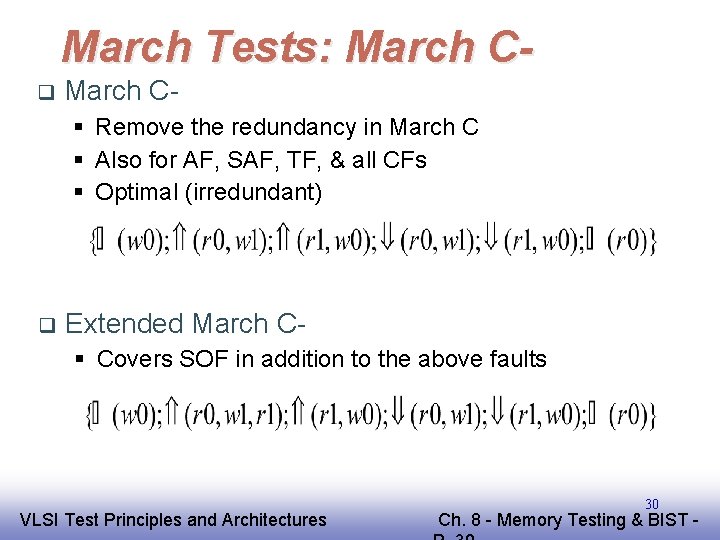
March Tests: March Cq March C§ Remove the redundancy in March C § Also for AF, SAF, TF, & all CFs § Optimal (irredundant) q Extended March C§ Covers SOF in addition to the above faults EE 141 VLSI Test Principles and Architectures 30 Ch. 8 - Memory Testing & BIST -
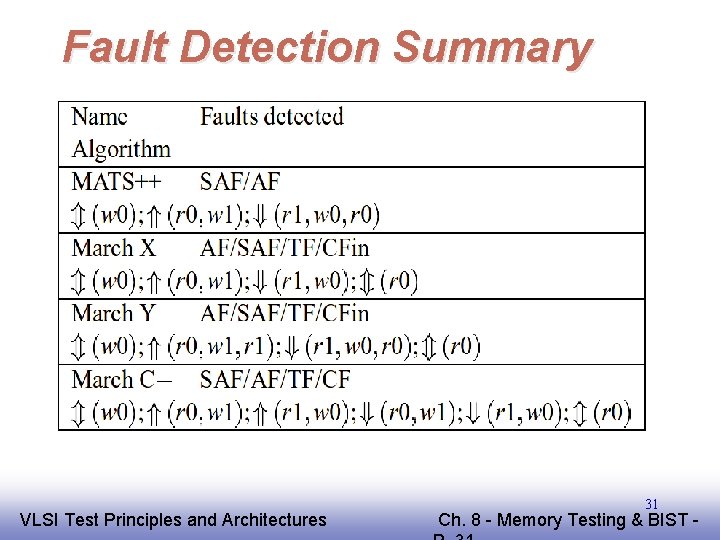
Fault Detection Summary EE 141 VLSI Test Principles and Architectures 31 Ch. 8 - Memory Testing & BIST -
Comparison of March Tests EE 141 VLSI Test Principles and Architectures 32 Ch. 8 - Memory Testing & BIST -
Word-Oriented Memory q. A word-oriented memory has Read/Write operations that access the memory cell array by a word instead of a bit. q Word-oriented memories can be tested by applying a bit-oriented test algorithm repeatedly with a set of different data backgrounds: § The repeating procedure multiplies the testing time EE 141 VLSI Test Principles and Architectures 33 Ch. 8 - Memory Testing & BIST -
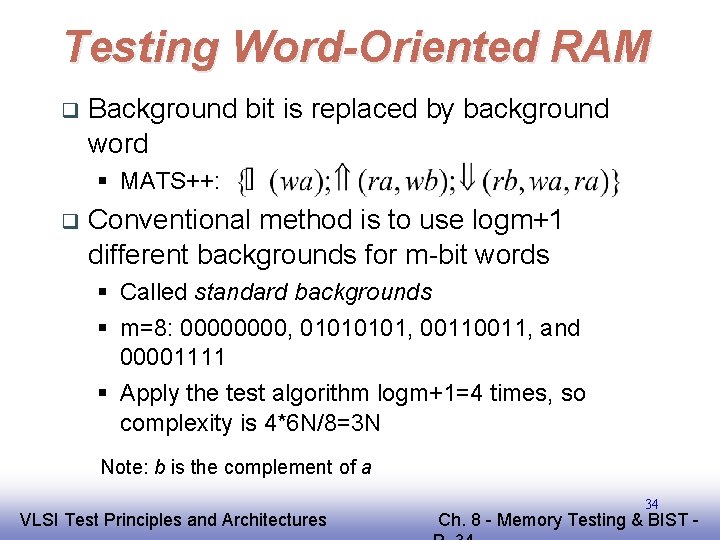
Testing Word-Oriented RAM q Background bit is replaced by background word § MATS++: q Conventional method is to use logm+1 different backgrounds for m-bit words § Called standard backgrounds § m=8: 0000, 0101, 0011, and 00001111 § Apply the test algorithm logm+1=4 times, so complexity is 4*6 N/8=3 N Note: b is the complement of a EE 141 VLSI Test Principles and Architectures 34 Ch. 8 - Memory Testing & BIST -
Cocktail-March Algorithms q Motivation: § Repeating the same algorithm for all logm+1 backgrounds is redundant so far as intra-word coupling faults are concerned § Different algorithms target different faults. q Approaches: 1. Use multiple backgrounds in a single algorithm run 2. Merge and forge different algorithms and backgrounds into a single algorithm q Good for word-oriented Ref: memories Wu et al. , IEEE TCAD, 04/02 EE 141 VLSI Test Principles and Architectures 35 Ch. 8 - Memory Testing & BIST -
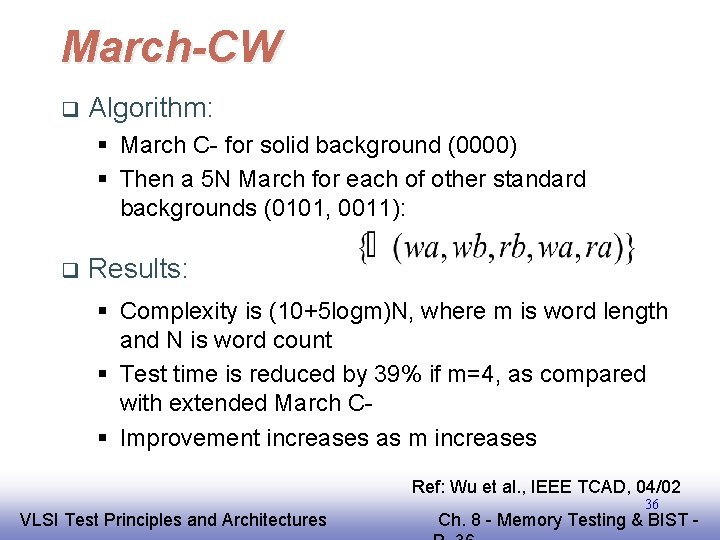
March-CW q Algorithm: § March C- for solid background (0000) § Then a 5 N March for each of other standard backgrounds (0101, 0011): q Results: § Complexity is (10+5 logm)N, where m is word length and N is word count § Test time is reduced by 39% if m=4, as compared with extended March C§ Improvement increases as m increases Ref: Wu et al. , IEEE TCAD, 04/02 EE 141 VLSI Test Principles and Architectures 36 Ch. 8 - Memory Testing & BIST -
Multi-Port Memory Fault Models q Cell Faults: § Single cell faults: SAF, TF, RDF § Two-cell coupling faults – Inversion coupling fault (CFin) – State coupling fault (CFst) – Idempotent coupling fault (CFid) q Port Faults: § Stuck-open fault (SOF) § Address decoder fault (AF) § Multi-port fault (MPF) EE 141 VLSI Test Principles and Architectures 37 Ch. 8 - Memory Testing & BIST -
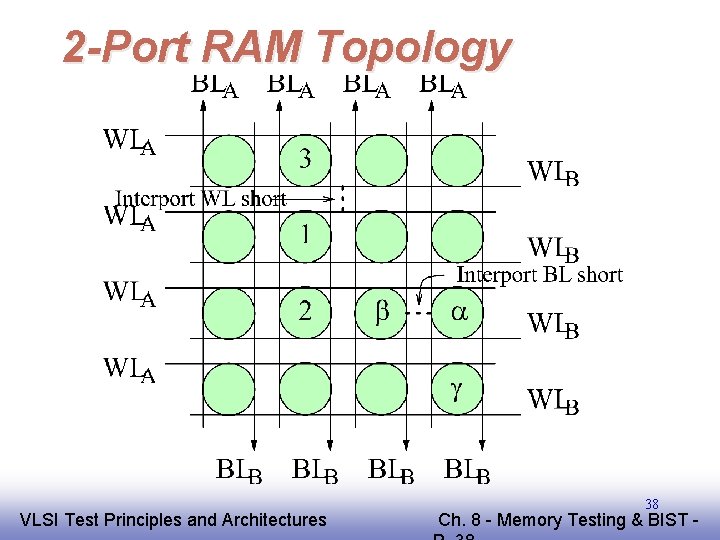
2 -Port RAM Topology EE 141 VLSI Test Principles and Architectures 38 Ch. 8 - Memory Testing & BIST -
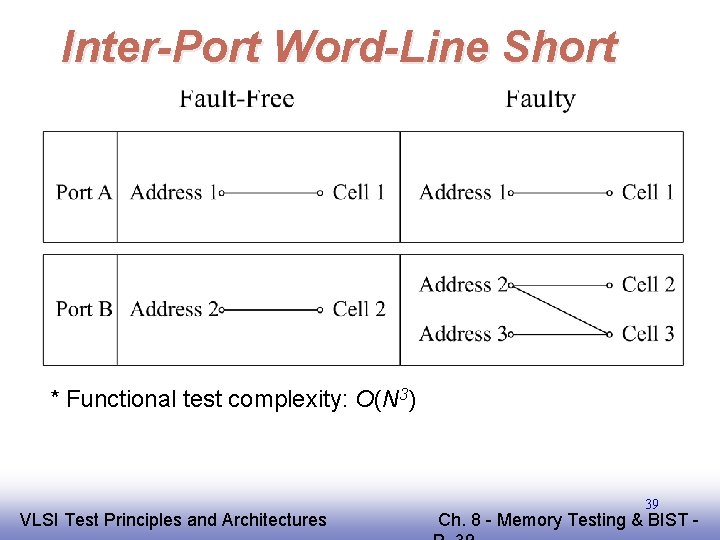
Inter-Port Word-Line Short * Functional test complexity: O(N 3) EE 141 VLSI Test Principles and Architectures 39 Ch. 8 - Memory Testing & BIST -
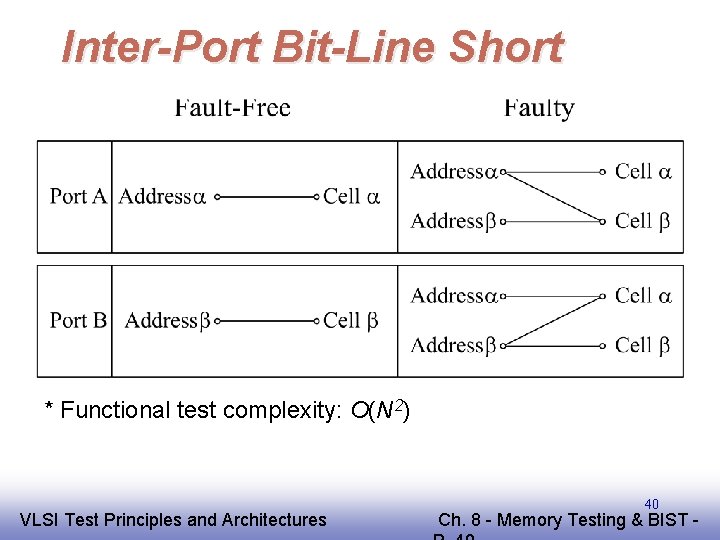
Inter-Port Bit-Line Short * Functional test complexity: O(N 2) EE 141 VLSI Test Principles and Architectures 40 Ch. 8 - Memory Testing & BIST -
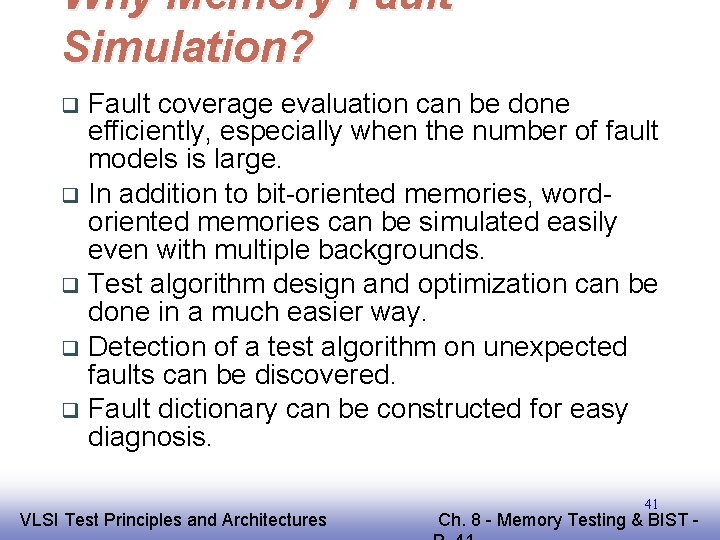
Why Memory Fault Simulation? Fault coverage evaluation can be done efficiently, especially when the number of fault models is large. q In addition to bit-oriented memories, wordoriented memories can be simulated easily even with multiple backgrounds. q Test algorithm design and optimization can be done in a much easier way. q Detection of a test algorithm on unexpected faults can be discovered. q Fault dictionary can be constructed for easy diagnosis. q EE 141 VLSI Test Principles and Architectures 41 Ch. 8 - Memory Testing & BIST -
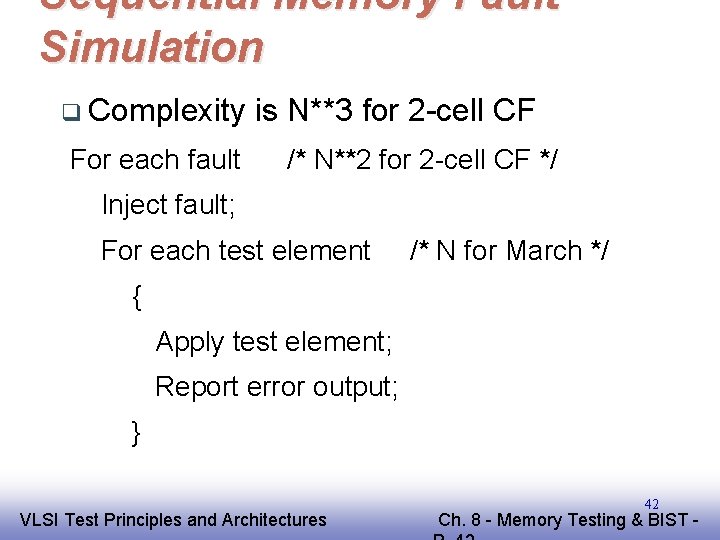
Sequential Memory Fault Simulation q Complexity For each fault is N**3 for 2 -cell CF /* N**2 for 2 -cell CF */ Inject fault; For each test element /* N for March */ { Apply test element; Report error output; } EE 141 VLSI Test Principles and Architectures 42 Ch. 8 - Memory Testing & BIST -
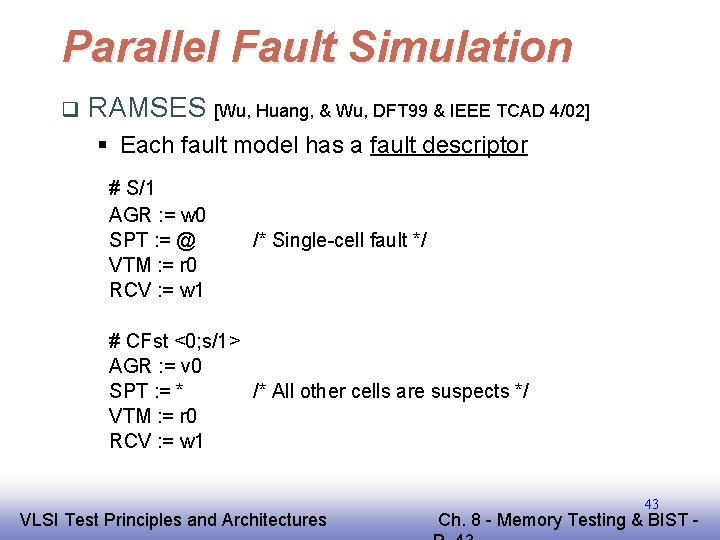
Parallel Fault Simulation q RAMSES [Wu, Huang, & Wu, DFT 99 & IEEE TCAD 4/02] § Each fault model has a fault descriptor # S/1 AGR : = w 0 SPT : = @ VTM : = r 0 RCV : = w 1 /* Single-cell fault */ # CFst <0; s/1> AGR : = v 0 SPT : = * /* All other cells are suspects */ VTM : = r 0 RCV : = w 1 EE 141 VLSI Test Principles and Architectures 43 Ch. 8 - Memory Testing & BIST -
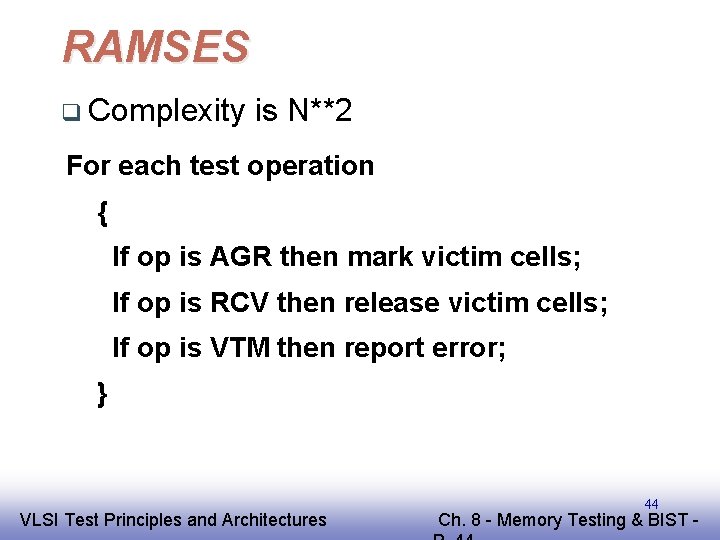
RAMSES q Complexity is N**2 For each test operation { If op is AGR then mark victim cells; If op is RCV then release victim cells; If op is VTM then report error; } EE 141 VLSI Test Principles and Architectures 44 Ch. 8 - Memory Testing & BIST -
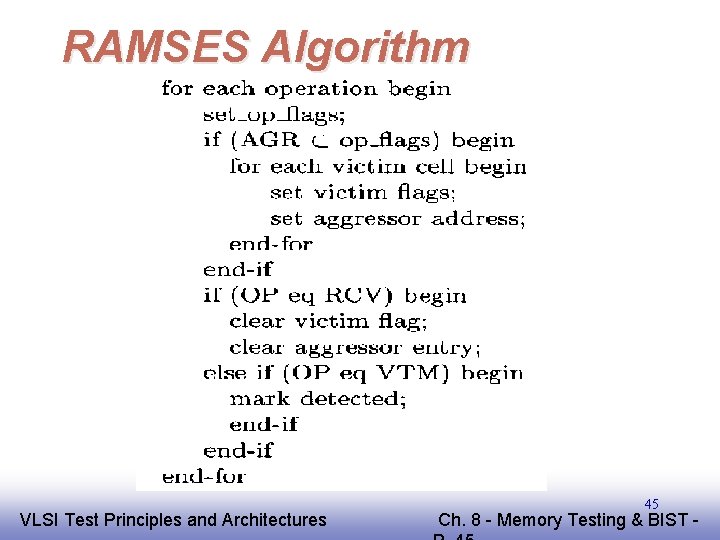
RAMSES Algorithm EE 141 VLSI Test Principles and Architectures 45 Ch. 8 - Memory Testing & BIST -
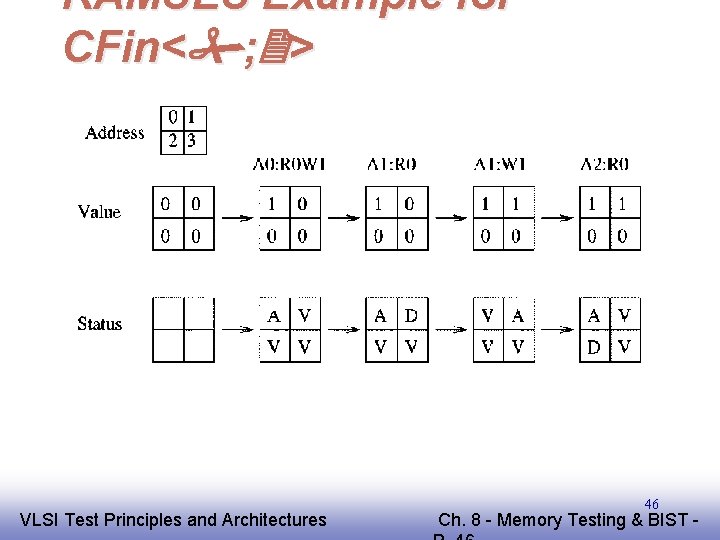
RAMSES Example for CFin< ; > EE 141 VLSI Test Principles and Architectures 46 Ch. 8 - Memory Testing & BIST -
Coverage of March Tests ☞ Extended March C- has 100% coverage of SOF EE 141 VLSI Test Principles and Architectures 47 Ch. 8 - Memory Testing & BIST -
Test Algorithm Generation Goals Given a set of target fault models, generate a test with 100% fault coverage q Given a set of target fault models and a test length constraint, generate a test with the highest fault coverage q Priority setting for fault models q § Test length/test time can be reduced q Diagnostic test generation § Need longer test to distinguish faults EE 141 VLSI Test Principles and Architectures 48 Ch. 8 - Memory Testing & BIST -
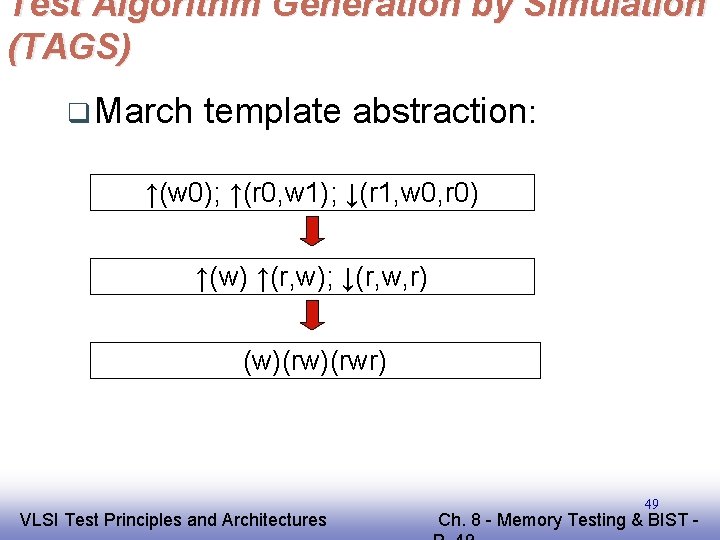
Test Algorithm Generation by Simulation (TAGS) q March template abstraction: ↑(w 0); ↑(r 0, w 1); ↓(r 1, w 0, r 0) ↑(w) ↑(r, w); ↓(r, w, r) (w)(rwr) EE 141 VLSI Test Principles and Architectures 49 Ch. 8 - Memory Testing & BIST -
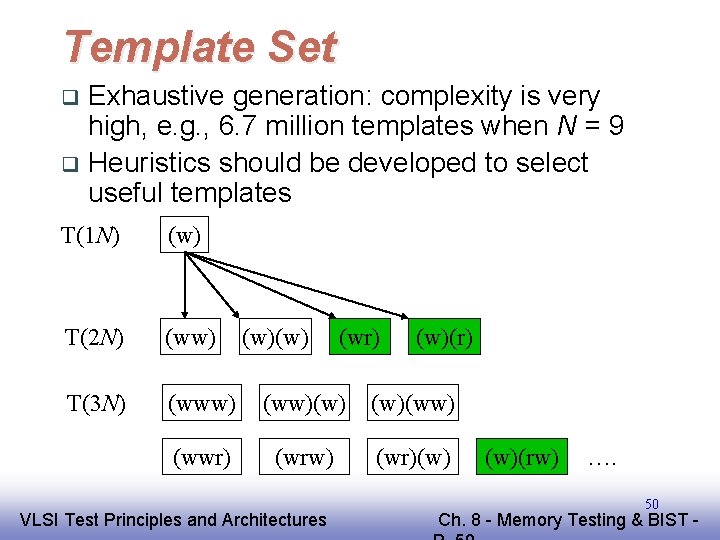
Template Set Exhaustive generation: complexity is very high, e. g. , 6. 7 million templates when N = 9 q Heuristics should be developed to select useful templates q T(1 N) (w) T(2 N) (ww) T(3 N) (www) (ww)(w) (w)(ww) (wwr) (wrw) (wr)(w) (w)(w) EE 141 VLSI Test Principles and Architectures (wr) (w)(rw) …. 50 Ch. 8 - Memory Testing & BIST -
TAGS Procedure 1. 2. 3. 4. 5. 6. 7. Initialize test length as 1 N, T(1 N) = {(w)}; Increase test length by 1 N: apply generation options; Apply filter options; Assign address orders and data backgrounds; Fault simulation using RAMSES; Drop ineffective tests; Repeat 2 -6 using the new template set until constraints met; EE 141 VLSI Test Principles and Architectures 51 Ch. 8 - Memory Testing & BIST -
Template Generation/Filtering q Generation § § heuristics: (r) insertion (…r), (r…) expansion (w) insertion (…w), (w…) expansion q Filtering heuristics: § Consecutive read: (…rr…) § Repeated read: (r)(r) § Tailing single write: …(w) EE 141 VLSI Test Principles and Architectures 52 Ch. 8 - Memory Testing & BIST -
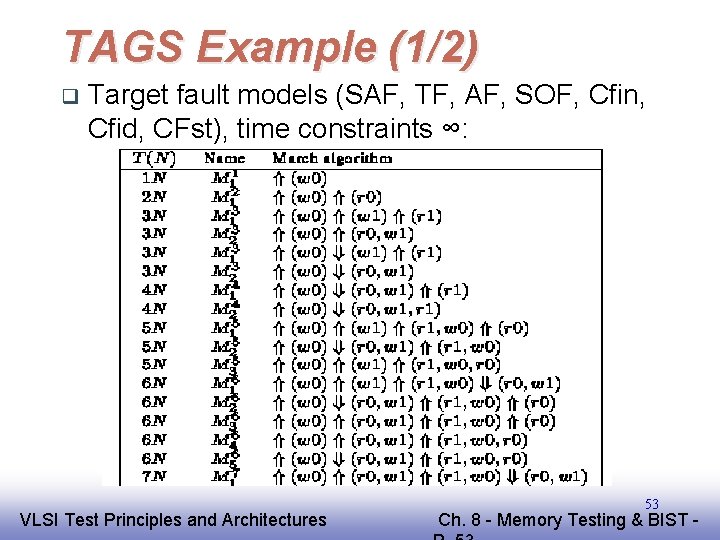
TAGS Example (1/2) q Target fault models (SAF, TF, AF, SOF, Cfin, Cfid, CFst), time constraints ∞: EE 141 VLSI Test Principles and Architectures 53 Ch. 8 - Memory Testing & BIST -
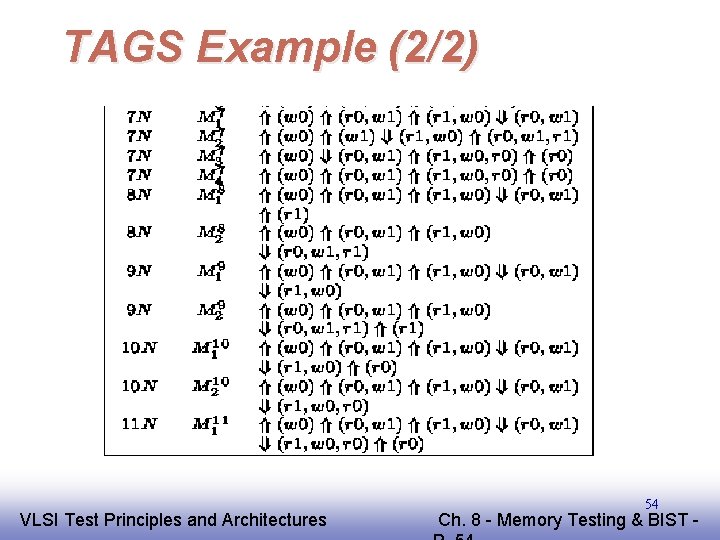
TAGS Example (2/2) EE 141 VLSI Test Principles and Architectures 54 Ch. 8 - Memory Testing & BIST -
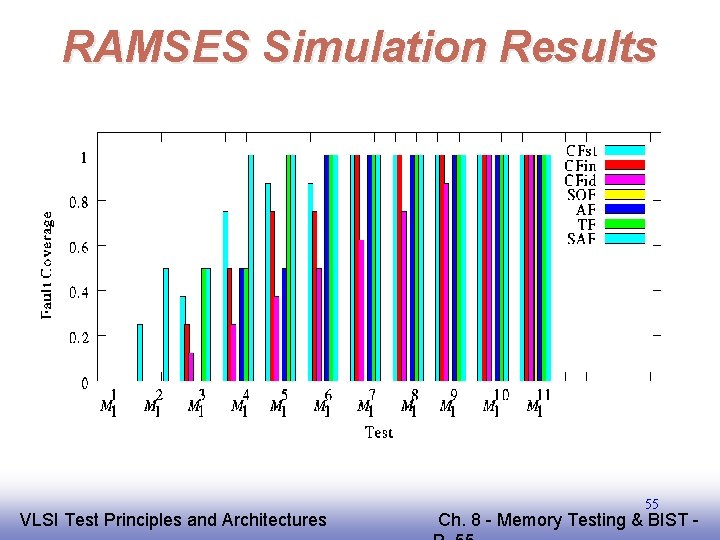
RAMSES Simulation Results EE 141 VLSI Test Principles and Architectures 55 Ch. 8 - Memory Testing & BIST -
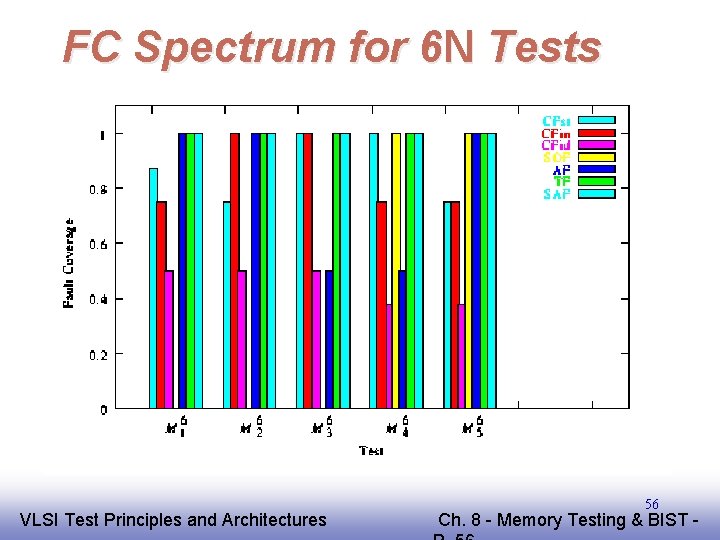
FC Spectrum for 6 N Tests EE 141 VLSI Test Principles and Architectures 56 Ch. 8 - Memory Testing & BIST -
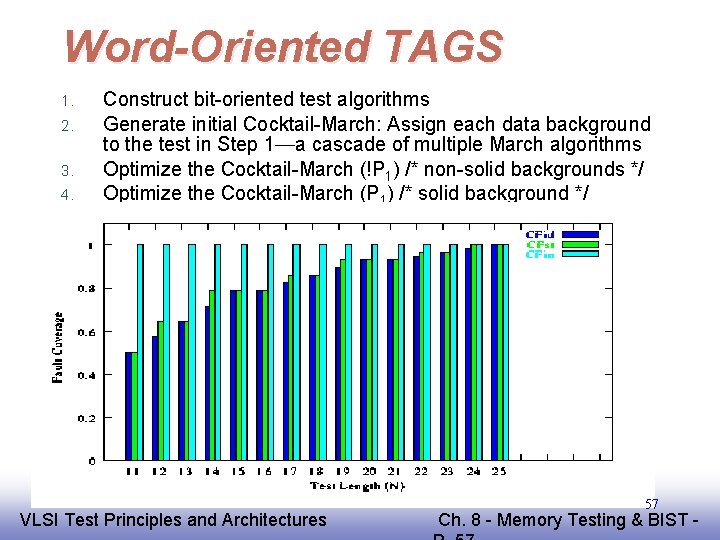
Word-Oriented TAGS 1. 2. 3. 4. Construct bit-oriented test algorithms Generate initial Cocktail-March: Assign each data background to the test in Step 1─a cascade of multiple March algorithms Optimize the Cocktail-March (!P 1) /* non-solid backgrounds */ Optimize the Cocktail-March (P 1) /* solid background */ EE 141 VLSI Test Principles and Architectures 57 Ch. 8 - Memory Testing & BIST -
3. Cocktail March Optimization (!P 1) For each non-solid data background P (P != P 1) a) Generate a new Cocktail–March test by replacing the March algorithm having P as its background with a shorter one from the set of algorithms generated in Step 1. b) Run RAMSES for the new Cocktail–March. c) Repeat 3(a) and 3(b) until the FC drops and cannot be recovered by any other test algorithm of the same length. d) Store the test algorithm candidates used in the previous step. EE 141 VLSI Test Principles and Architectures 58 Ch. 8 - Memory Testing & BIST -
4. Cocktail March Optimization (P 1) a) b) c) Generate a new Cocktail–March test by replacing the March algorithm having P 1 as its background with a shorter one from the test set generated in Step 1. Repeat with every test candidate for other backgrounds. Run RAMSES for the new Cocktail–March. Repeat 4(a) and 4(b) for all candidate test algorithms from 3(d) until the FC drops and cannot be recovered by any other test algorithm of the same length or by selecting other candidates. EE 141 VLSI Test Principles and Architectures 59 Ch. 8 - Memory Testing & BIST -
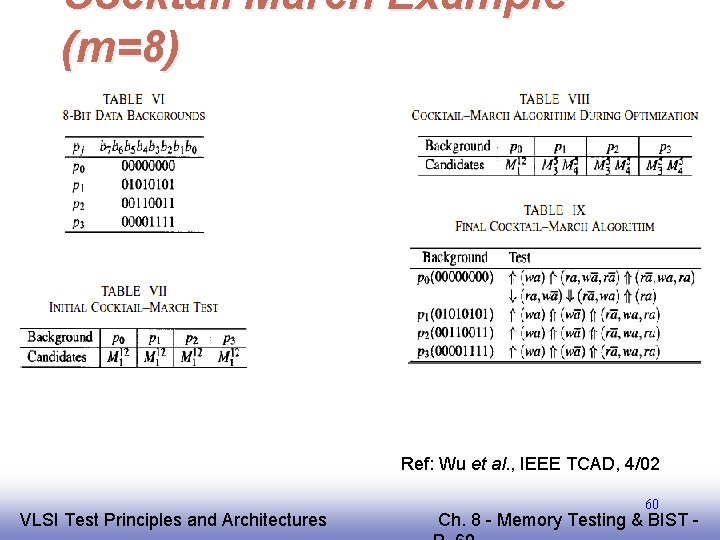
Cocktail March Example (m=8) Ref: Wu et al. , IEEE TCAD, 4/02 EE 141 VLSI Test Principles and Architectures 60 Ch. 8 - Memory Testing & BIST -
What Can BIST do? q What are the functional faults to be covered? § Static and dynamic § Operation modes q What are the defects to be covered? § Opens, shorts, timing parameters, voltages, currents, etc. q q q Can it support fault location and redundancy repair? Can it support BI? Can it support on-chip redundancy analysis and repair? Does it allow characterization test as well as mass production test? Can it really replace ATE (and laser repair machine)? § Programmability, speed, timing accuracy, threshold range, parallelism, etc. EE 141 VLSI Test Principles and Architectures 61 Ch. 8 - Memory Testing & BIST -
Typical RAM BIST Approaches q Methodology § Processor-based BIST – Programmable § Hardwired BIST – Fast – Compact § Hybrid q Interface § Serial (scan, 1149. 1) § Parallel (embedded controller; hierarchical) q Patterns (address sequence) § March & March-like § Pseudorandom § Others EE 141 VLSI Test Principles and Architectures 62 Ch. 8 - Memory Testing & BIST -
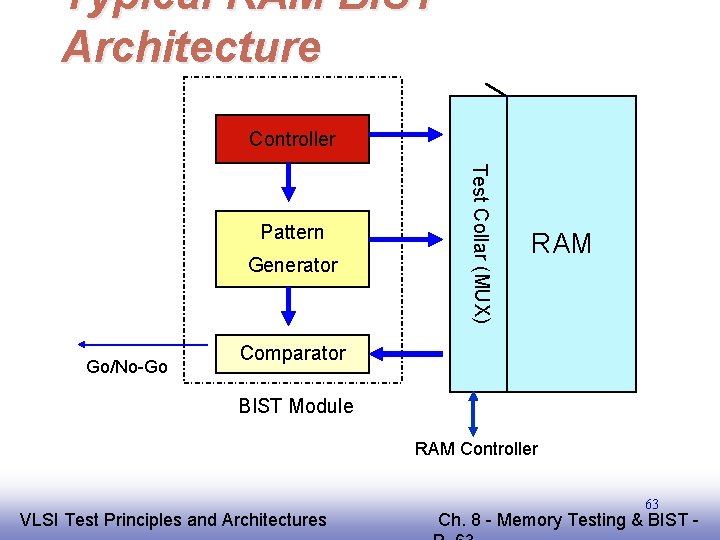
Typical RAM BIST Architecture Controller Generator Go/No-Go Test Collar (MUX) Pattern RAM Comparator BIST Module RAM Controller EE 141 VLSI Test Principles and Architectures 63 Ch. 8 - Memory Testing & BIST -
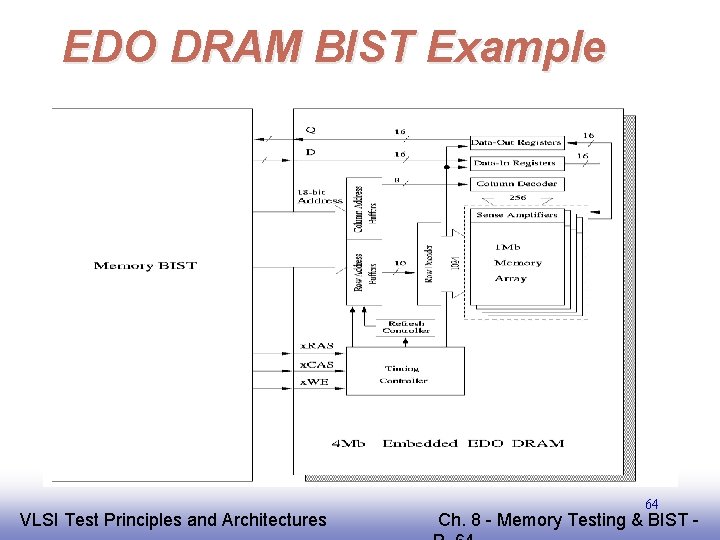
EDO DRAM BIST Example EE 141 VLSI Test Principles and Architectures 64 Ch. 8 - Memory Testing & BIST -
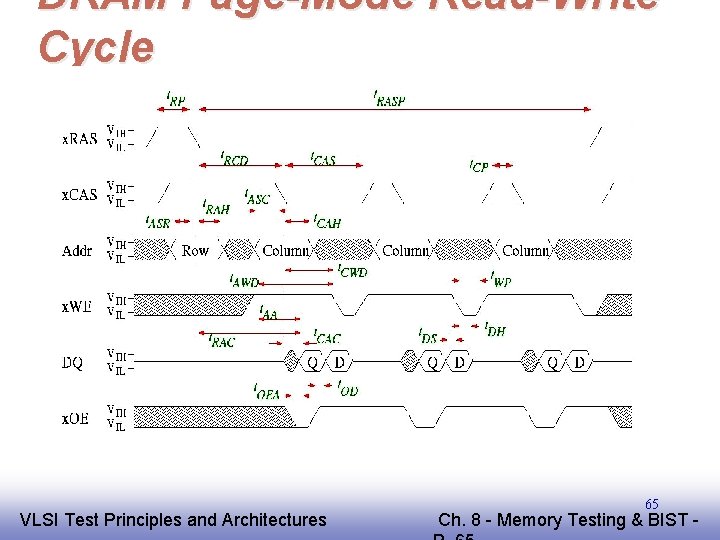
DRAM Page-Mode Read-Write Cycle EE 141 VLSI Test Principles and Architectures 65 Ch. 8 - Memory Testing & BIST -
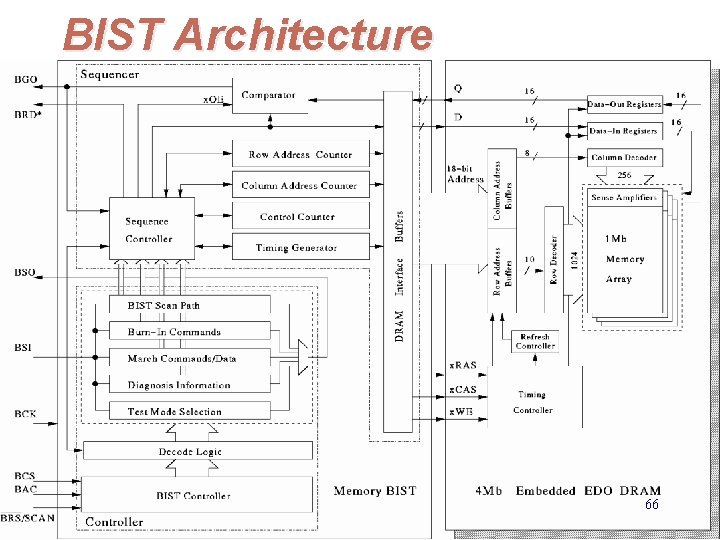
BIST Architecture EE 141 VLSI Test Principles and Architectures 66 Ch. 8 - Memory Testing & BIST -
BIST External I/O q q q q MBS (Memory BIST Selection): controller test collar (normal/test mode selection) MBC (Memory BIST Control): Controller input MCK (Memory BIST Clock) MBR (Memory BIST Reset) MSI (Memory BIST Scan In): for test commands and scan test inputs MSO (Memory BIST Scan Out): for diagnostic data and scan test outputs MBO (Memory BIST Output): error indicator MRD (Memory BIST Output Ready): BIST completion flag EE 141 VLSI Test Principles and Architectures 67 Ch. 8 - Memory Testing & BIST -
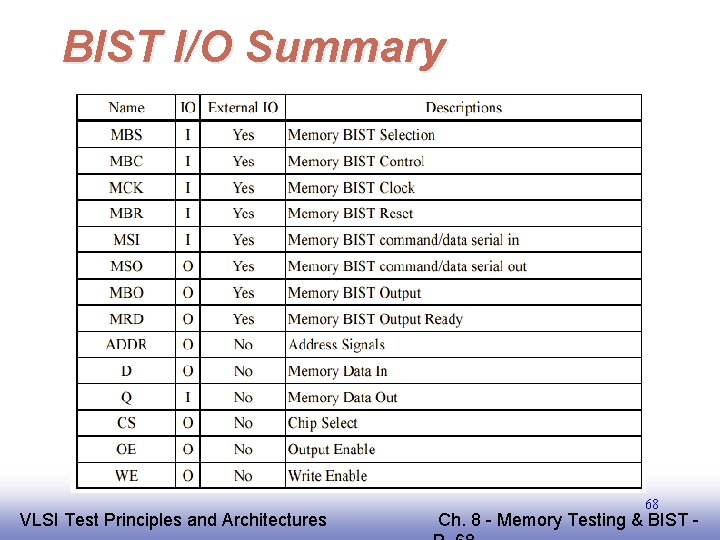
BIST I/O Summary EE 141 VLSI Test Principles and Architectures 68 Ch. 8 - Memory Testing & BIST -
Controller and Sequencer q Controller § § § q Microprogram Hardwired Shared CPU core IEEE 1149. 1 TAP PLD Sequencer (Pattern Generator) § § Counter LFSR LUT PLD EE 141 VLSI Test Principles and Architectures 69 Ch. 8 - Memory Testing & BIST -
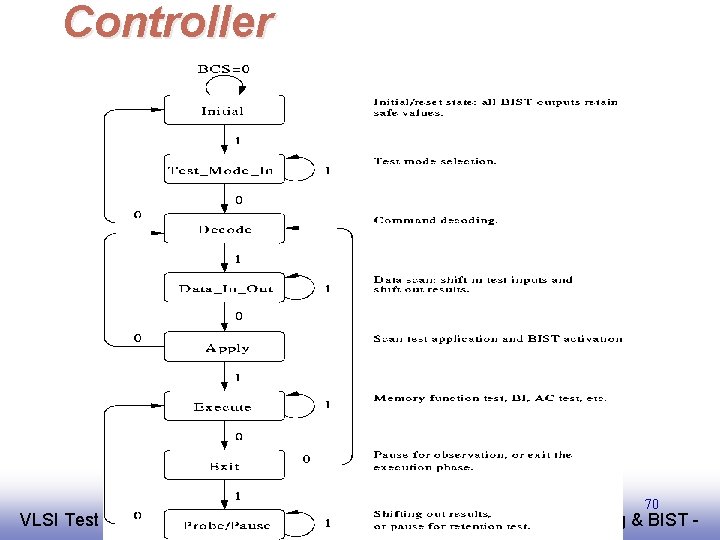
Controller EE 141 VLSI Test Principles and Architectures 70 Ch. 8 - Memory Testing & BIST -
Sequencer EE 141 VLSI Test Principles and Architectures 71 Ch. 8 - Memory Testing & BIST -

Sequencer States EE 141 VLSI Test Principles and Architectures 72 Ch. 8 - Memory Testing & BIST -
BIST Test Modes 1. Scan-Test Mode 2. RAM-BIST Mode 1. Functional faults 2. Timing faults (setup/hold times, rise/fall times, etc. ) 3. Data retention faults 3. RAM-Diagnosis Mode 4. RAM-BI Mode EE 141 VLSI Test Principles and Architectures 73 Ch. 8 - Memory Testing & BIST -
BIST Controller Commands EE 141 VLSI Test Principles and Architectures 74 Ch. 8 - Memory Testing & BIST -
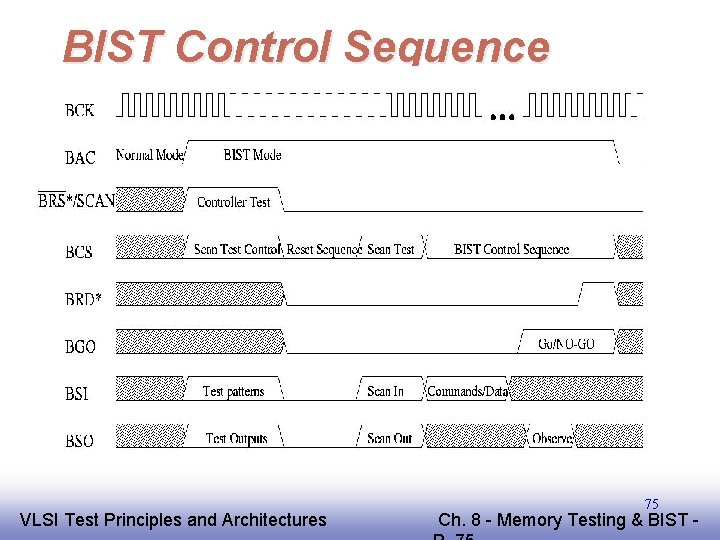
BIST Control Sequence EE 141 VLSI Test Principles and Architectures 75 Ch. 8 - Memory Testing & BIST -
RAM BIST Compiler q Use of RAM cores is increasing § SRAM, DRAM, flash RAM § Multiple cores q RAM BIST compiler is the trend q BRAINS (BIST for RAM in Seconds) § § Proposed BIST Architecture Memory Modeling Command Sequence Generation Configuration of the Proposed BIST EE 141 VLSI Test Principles and Architectures 76 Ch. 8 - Memory Testing & BIST -
BRAINS Output Specification q Synthesizable BIST design § At-speed testing § Programmable March algorithms § Optional diagnosis support – BISD q Activation q Test sequence bench q Synthesis script EE 141 VLSI Test Principles and Architectures 77 Ch. 8 - Memory Testing & BIST -
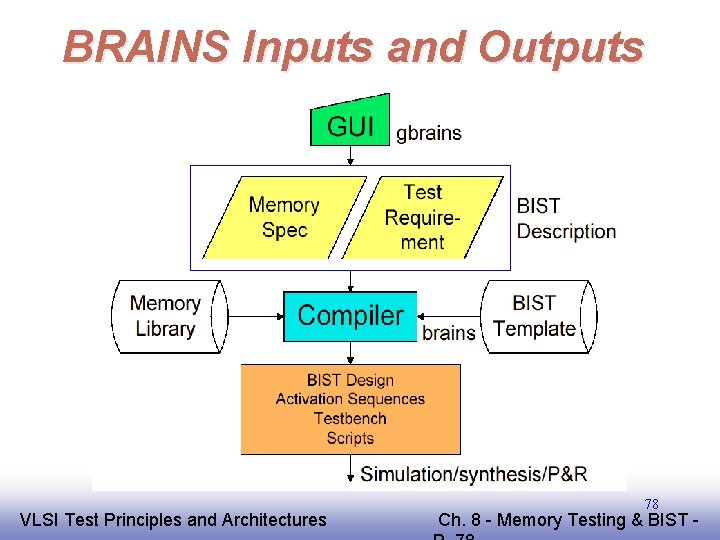
BRAINS Inputs and Outputs EE 141 VLSI Test Principles and Architectures 78 Ch. 8 - Memory Testing & BIST -
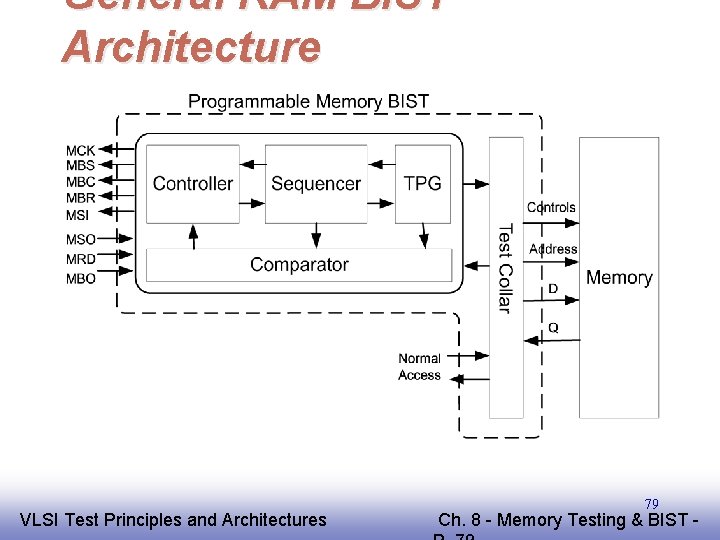
General RAM BIST Architecture EE 141 VLSI Test Principles and Architectures 79 Ch. 8 - Memory Testing & BIST -
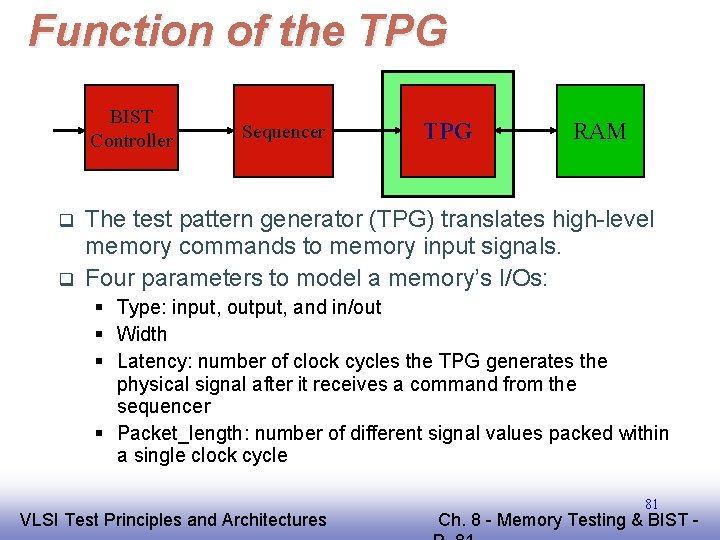
Function of the TPG BIST Controller q q Sequencer TPG RAM The test pattern generator (TPG) translates high-level memory commands to memory input signals. Four parameters to model a memory’s I/Os: § Type: input, output, and in/out § Width § Latency: number of clock cycles the TPG generates the physical signal after it receives a command from the sequencer § Packet_length: number of different signal values packed within a single clock cycle EE 141 VLSI Test Principles and Architectures 81 Ch. 8 - Memory Testing & BIST -
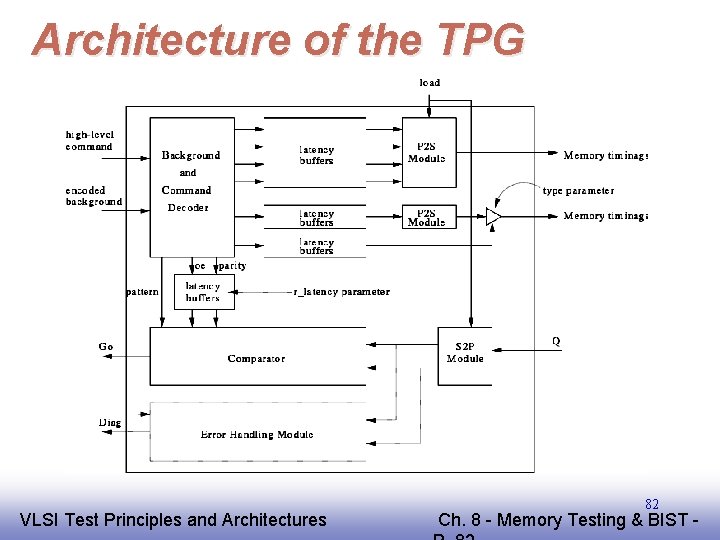
Architecture of the TPG EE 141 VLSI Test Principles and Architectures 82 Ch. 8 - Memory Testing & BIST -
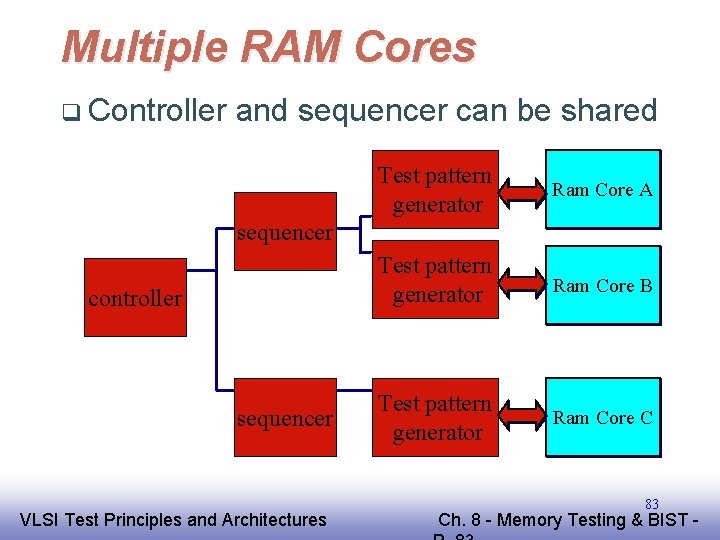
Multiple RAM Cores q Controller and sequencer can be shared Test pattern generator Ram Core A Test pattern generator Ram Core B Test pattern generator Ram Core C sequencer controller sequencer EE 141 VLSI Test Principles and Architectures 83 Ch. 8 - Memory Testing & BIST -
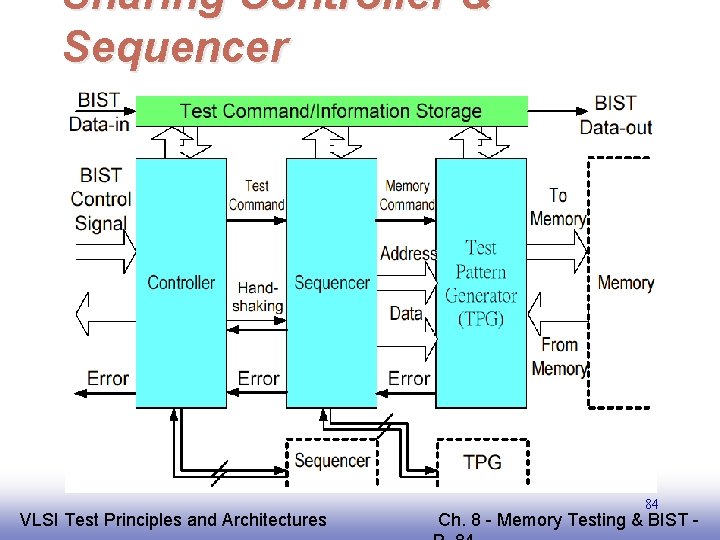
Sharing Controller & Sequencer EE 141 VLSI Test Principles and Architectures 84 Ch. 8 - Memory Testing & BIST -
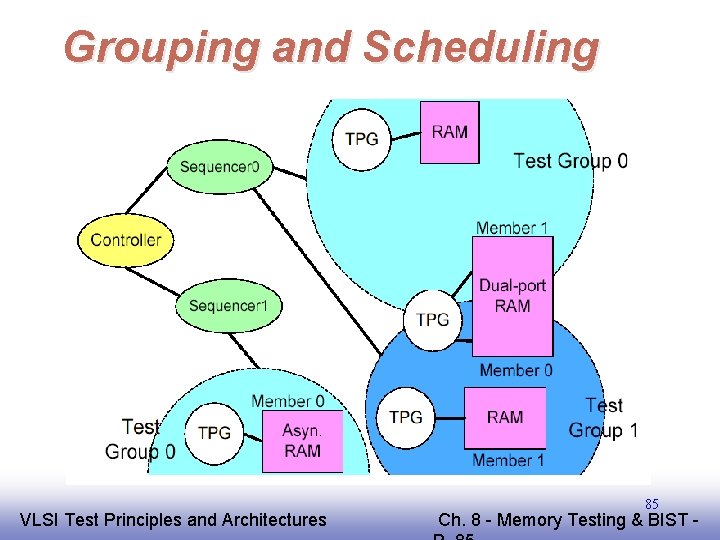
Grouping and Scheduling EE 141 VLSI Test Principles and Architectures 85 Ch. 8 - Memory Testing & BIST -
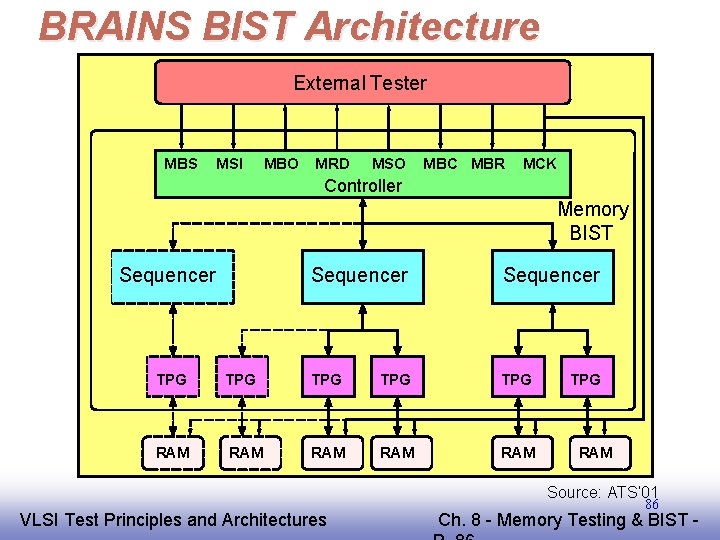
BRAINS BIST Architecture External Tester MBS MSI MBO MRD MSO MBC MBR MCK Controller Memory BIST Sequencer TPG TPG TPG RAM RAM RAM TPG RAM Source: ATS’ 01 EE 141 VLSI Test Principles and Architectures 86 Ch. 8 - Memory Testing & BIST -
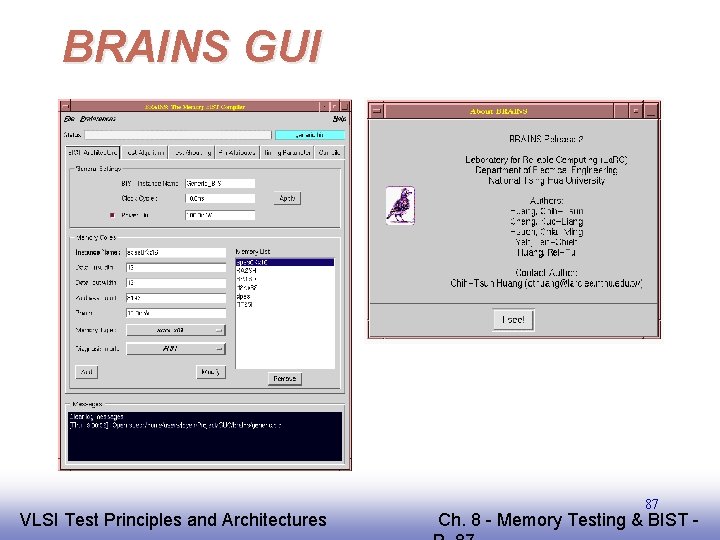
BRAINS GUI EE 141 VLSI Test Principles and Architectures 87 Ch. 8 - Memory Testing & BIST -
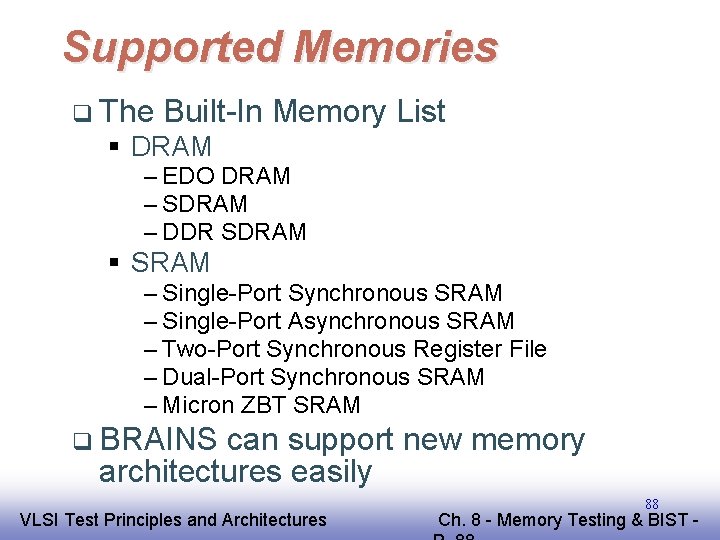
Supported Memories q The Built-In Memory List § DRAM – EDO DRAM – SDRAM – DDR SDRAM § SRAM – Single-Port Synchronous SRAM – Single-Port Asynchronous SRAM – Two-Port Synchronous Register File – Dual-Port Synchronous SRAM – Micron ZBT SRAM q BRAINS can support new memory architectures easily EE 141 VLSI Test Principles and Architectures 88 Ch. 8 - Memory Testing & BIST -
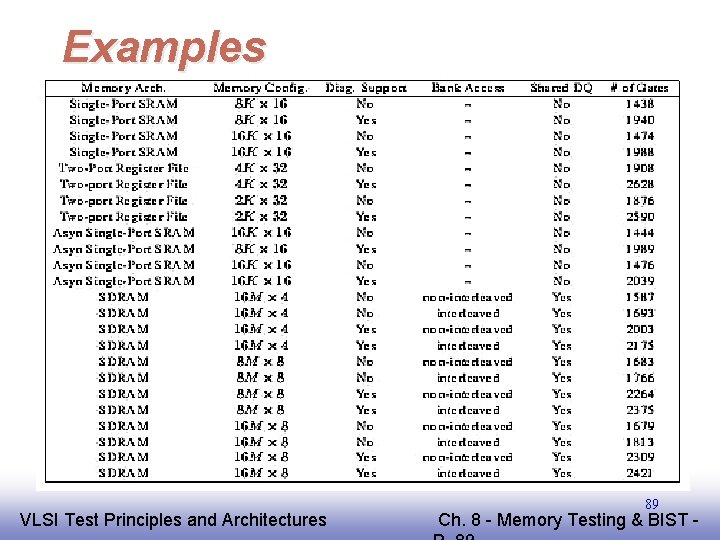
Examples EE 141 VLSI Test Principles and Architectures 89 Ch. 8 - Memory Testing & BIST -
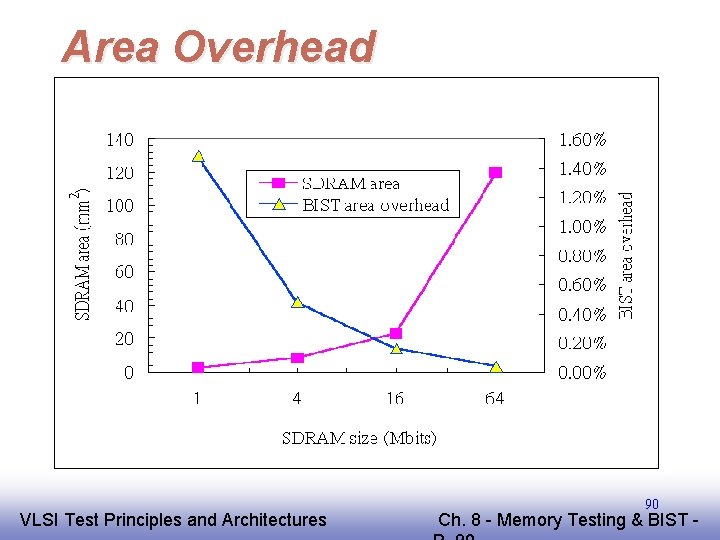
Area Overhead EE 141 VLSI Test Principles and Architectures 90 Ch. 8 - Memory Testing & BIST -
Concluding Remarks q BIST is considered the best solution for testing embedded memories: § Low cost § Effective and efficient q Further improvement can be expected to extend the scope of RAM BIST: § § § Timing/delay faults and disturb faults BISD and BISR CAM BIST and flash BIST/BISD/BISR compiler Wafer-level BI and test – Known good die EE 141 VLSI Test Principles and Architectures 91 Ch. 8 - Memory Testing & BIST -
- Slides: 90