
Chapter 8 Memory Management Dr Amjad Ali Background
Chapter 8: Memory Management Dr. Amjad Ali
Background n Program must be brought (from disk) into memory and placed within a process for it to be run n Main memory and registers are only storage CPU can access directly n Memory unit only sees a stream of addresses + read requests, or address + data and write requests n Register access in one CPU clock (or less) n Cache sits between main memory and CPU registers n Protection of memory required to ensure correct operation
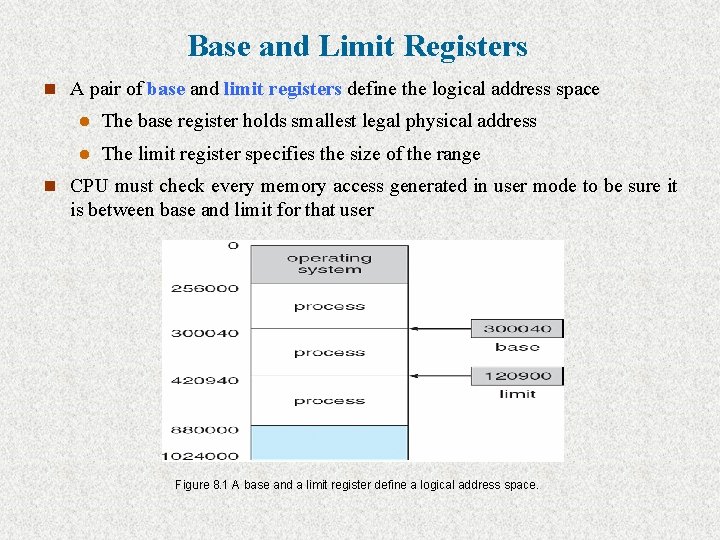
Base and Limit Registers n A pair of base and limit registers define the logical address space l The base register holds smallest legal physical address l The limit register specifies the size of the range n CPU must check every memory access generated in user mode to be sure it is between base and limit for that user Figure 8. 1 A base and a limit register define a logical address space.

Hardware Address Protection with Base and Limit Registers Figure 8. 2 Hardware address protection with base and limit registers.
Address Binding n Programs on disk, ready to be brought into memory to execute form an input queue n Addresses represented in different ways at different stages of a program’s life l Addresses in the source program are generally symbolic (such as the variable count) l Compiler binds these symbolic addresses to re-locatable addresses(such as 14 bytes from the beginning of this module). l Linkage editor or loader in turn binds re-locatable addresses to absolute addresses (such as 74014) l Each binding is a mapping from one address space to another
Binding of Instructions and Data to Memory n Address binding of instructions and data to memory addresses can happen at three different stages n Compile time: If you know at compile time where the process will reside in memory, then absolute code can be generated. For example, if you know that a user process will reside starting at location R, then the generated compiler code will start at that location and extend up from there. If, at some later time, the starting location changes, then it will be necessary to recompile this code. l The MS-DOS. COM-format programs are bound at compile time.
Binding of Instructions and Data to Memory n Load time: If it is not known at compile time where the process will reside in memory, then the compiler must generate re-locatable code. In this case, final binding is delayed until load time. If the starting address changes, we need only reload the user code to incorporate this changed value. n Execution time: If the process can be moved during its execution from one memory segment to another, then binding must be delayed until run time. l Special hardware must be available for this scheme to work l Most general-purpose operating systems use this method.
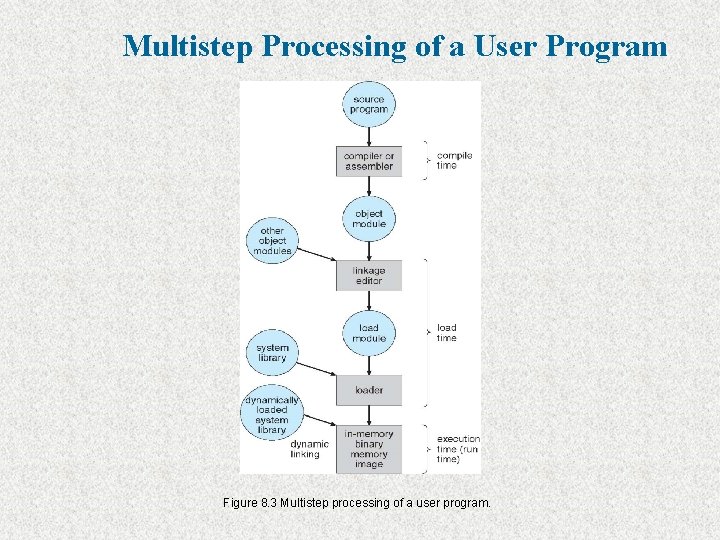
Multistep Processing of a User Program Figure 8. 3 Multistep processing of a user program.
Dynamic Loading 1/3 n In our discussion so far, it has been necessary for the entire program and all data of a process to be in physical memory for the process to execute. l The size of a process has thus been limited to the size of physical memory. l To obtain better memory-space utilization, we can use dynamic loading. n With dynamic loading, a routine is not loaded until it is called. All routines are kept on disk in a re-locatable load format. The main program is loaded into memory and is executed. l When a routine needs to call another routine, the calling routine first checks to see whether the other routine has been loaded. If it has not, the re-locatable linking loader is called to load the desired routine into memory and to update the program’s address tables to reflect this change. l Then control is passed to the newly loaded routine.
Dynamic Loading 2/3 n Dynamically linked libraries are system libraries that are linked to user programs when the programs are run. n Some operating systems support only static linking, in which system libraries are treated like any other object module and are combined by the loader into the binary program image. n Dynamic linking, in contrast, is similar to dynamic loading. In which, linking, rather than loading, is postponed until execution time. l This feature is usually used with system libraries, such as language subroutine libraries. Without this facility, each program on a system must include a copy of its language library (or at least the routines referenced by the program) in the executable image. l This requirement wastes both disk space and main memory.
Dynamic Loading 3/3 n With dynamic linking, a stub is included in the image for each library routine reference. The stub is a small piece of code that indicates how to locate the appropriate memory-resident library routine or how to load the library if the routine is not already present. l When the stub is executed, it checks to see whether the needed routine is already in memory. If it is not, the program loads the routine into memory.
Overlays n Overlays l Partition the program into mutually exclusive partitions l Load the first partition l After its execution, replace it with the next partition 4 As the code and data of the first is no longer needed.
Logical vs. Physical Address Space n The concept of a logical address space that is bound to a separate physical address space is central to proper memory management l Logical address – generated by the CPU; also referred to as virtual address l Physical address – address seen by the memory unit n Logical and physical addresses are the same in compile-time and load-time address-binding schemes; logical (virtual) and physical addresses differ in execution-time address-binding scheme n Logical address space is the set of all logical addresses generated by a program n Physical address space is the set of all physical addresses corresponding to the set of logical addresses
Memory-Management Unit (MMU) n Hardware device that maps virtual to physical address at run time n Many methods possible n To start, consider simple scheme where the value in the relocation register is added to every address generated by a user process at the time it is sent to memory l Base register now called relocation register 4 MS-DOS on Intel 80 x 86 used 4 relocation registers n The user program deals with logical addresses; it never sees the real physical addresses l Execution-time binding occurs when reference is made to location in memory l Logical address bound to physical addresses
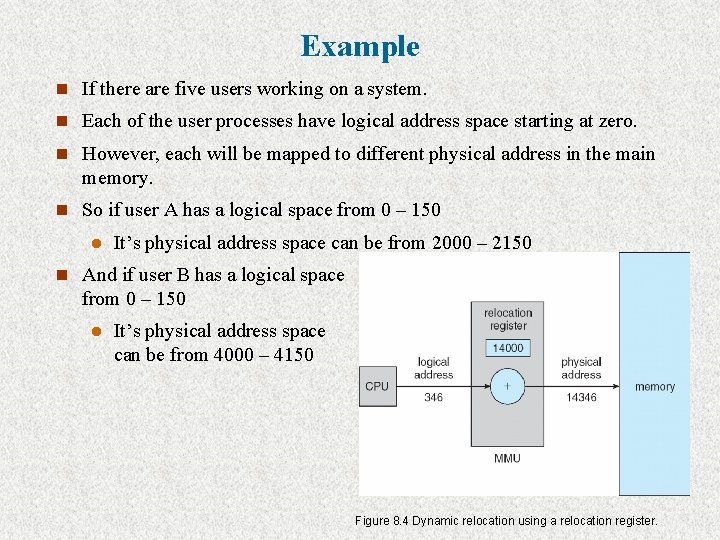
Example n If there are five users working on a system. n Each of the user processes have logical address space starting at zero. n However, each will be mapped to different physical address in the main memory. n So if user A has a logical space from 0 – 150 l It’s physical address space can be from 2000 – 2150 n And if user B has a logical space from 0 – 150 l It’s physical address space can be from 4000 – 4150 Figure 8. 4 Dynamic relocation using a relocation register.
Dynamic Linking n Static linking – System libraries are treated like any other object module and are combined by the loader into the binary program image n Dynamic linking –linking postponed until execution time l Without this facility, all programs on a system need to have a copy of their language library included in the executable image 4 This requirement wastes both disk space and main memory n With dynamic linking a small piece of code, stub, used to locate the appropriate memory-resident library routine n Stub replaces itself with the address of the routine, and executes the routine n Operating system checks if routine is in processes’ memory address l If not in address space, add to address space n Dynamic linking is particularly useful for libraries n Consider applicability to patching system libraries l Versioning may be needed
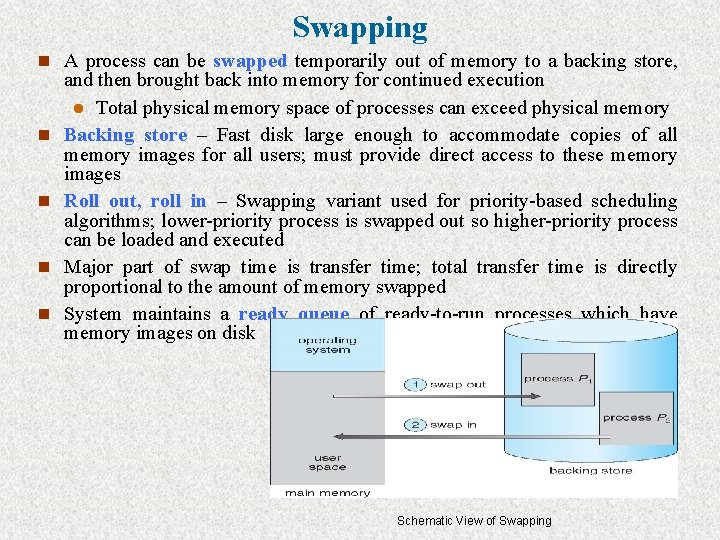
Swapping n A process can be swapped temporarily out of memory to a backing store, n n and then brought back into memory for continued execution l Total physical memory space of processes can exceed physical memory Backing store – Fast disk large enough to accommodate copies of all memory images for all users; must provide direct access to these memory images Roll out, roll in – Swapping variant used for priority-based scheduling algorithms; lower-priority process is swapped out so higher-priority process can be loaded and executed Major part of swap time is transfer time; total transfer time is directly proportional to the amount of memory swapped System maintains a ready queue of ready-to-run processes which have memory images on disk Schematic View of Swapping
Context Switch Time including Swapping n If next processes to be put on CPU is not in memory, need to swap out a process and swap in target process n Context switch time in such system can be very high n 100 MB process swapping to backing store (i. e. , standard hard disk) with transfer rate of 50 MB/sec 100/50 = 2 sec l Assuming an average latency of 8 millisecond, the swap time is 2008 milliseconds l The total swap time for swap in and swap out is 2016 milliseconds
Contiguous Allocation n Main memory must support both OS and user processes n Limited resource, must allocate efficiently n Contiguous allocation is one early method n Main memory is usually divided into two partitions: l Resident operating system l User processes n Each process contained in single contiguous section of memory n Relocation registers used to protect user processes from each other, and from changing operating-system code and data l Base register contains value of smallest physical address l Limit register contains range of logical addresses – each logical address must be less than the limit register
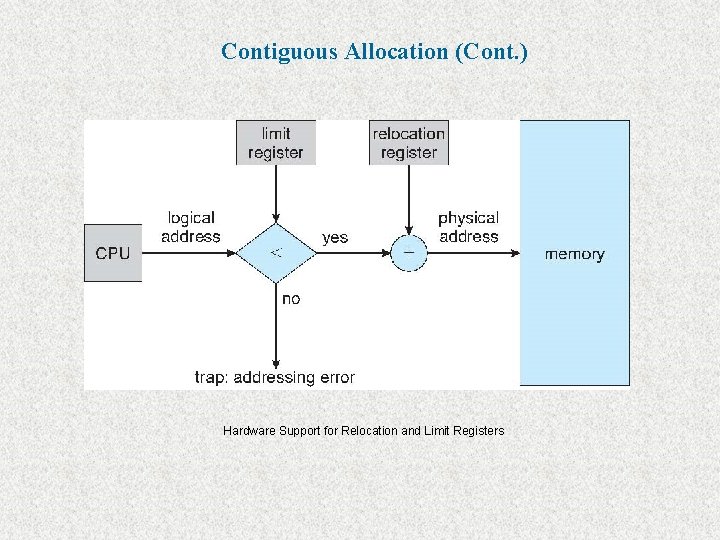
Contiguous Allocation (Cont. ) Hardware Support for Relocation and Limit Registers
Memory Allocation n Multiple-partition allocation l Degree of multiprogramming limited by number of partitions l Hole – block of available memory; holes of various size are scattered throughout memory l When a process arrives, it is allocated memory from a hole large enough to accommodate it l Process exiting frees its partition, adjacent free partitions combined l Operating system maintains information about a) allocated partitions b) free partitions (hole)
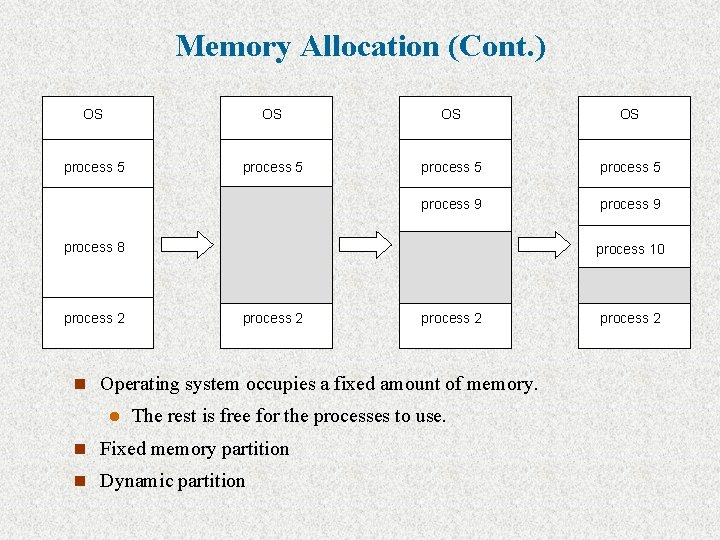
Memory Allocation (Cont. ) OS OS process 5 process 9 process 8 process 2 process 10 process 2 n Operating system occupies a fixed amount of memory. l The rest is free for the processes to use. n Fixed memory partition n Dynamic partition process 2
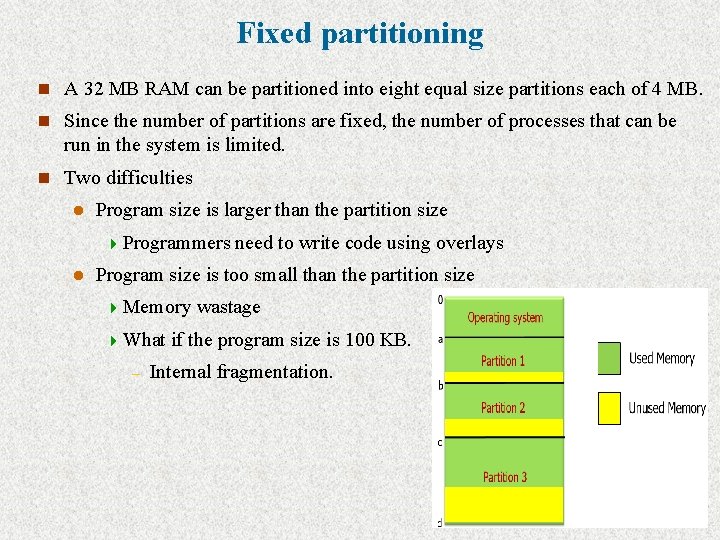
Fixed partitioning n A 32 MB RAM can be partitioned into eight equal size partitions each of 4 MB. n Since the number of partitions are fixed, the number of processes that can be run in the system is limited. n Two difficulties l Program size is larger than the partition size 4 Programmers l need to write code using overlays Program size is too small than the partition size 4 Memory 4 What – wastage if the program size is 100 KB. Internal fragmentation.
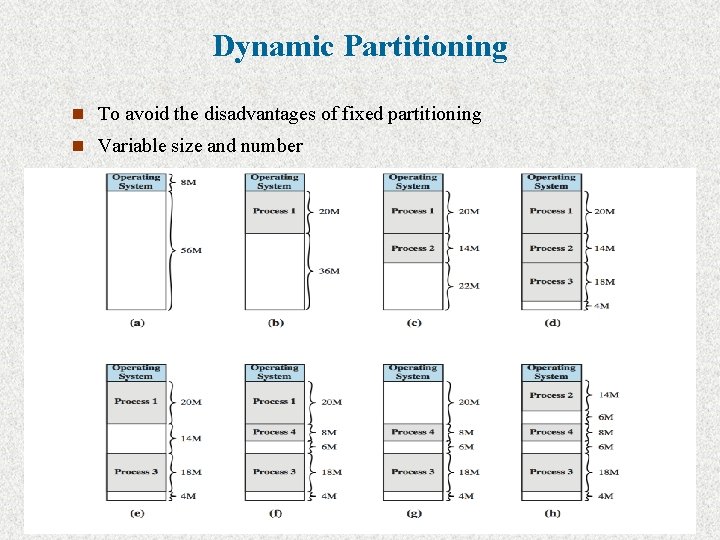
Dynamic Partitioning n To avoid the disadvantages of fixed partitioning n Variable size and number
Dynamic Storage-Allocation Problem n First-fit: Allocate the first hole that is big enough n Best-fit: Allocate the smallest hole that is big enough; must search entire list, unless ordered by size l Produces the smallest leftover hole n Worst-fit: Allocate the largest hole n Next-fit ? ?
Fragmentation n External Fragmentation – Both first-fit and best-fit suffer from external fragmentation. l Memory space exists to satisfy a request, but it is not contiguous . n Internal Fragmentation – Allocated memory may be slightly larger than requested memory; this size difference is memory internal to a partition, but not being used. n Reduce external fragmentation by compaction l Shuffle memory contents to place all free memory together in one large block l Compaction is possible only if relocation is dynamic, and is done at execution time
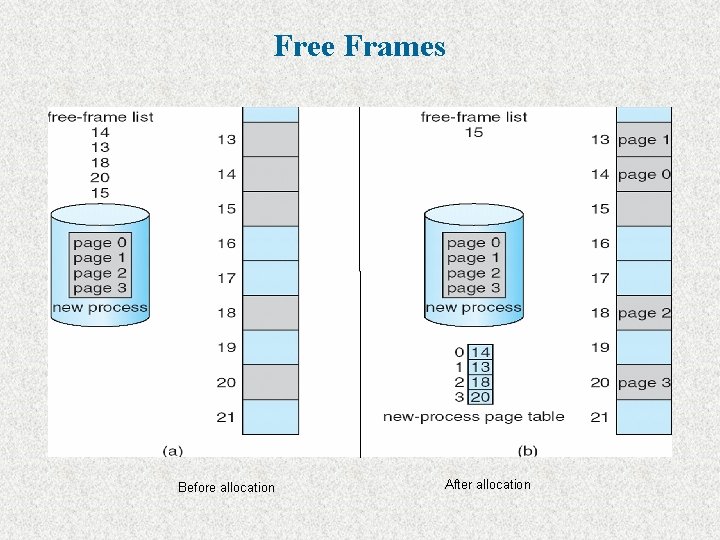
Paging n Paging is a memory-management scheme that permits the physical-address space of a process to be noncontiguous l Avoids external fragmentation l Avoids problem of varying sized onto the backing store n Divide physical memory into fixed-sized blocks called frames l Size is power of 2, between 512 bytes and 16 Mbytes n Divide logical memory into blocks of same size called pages l Keep track of all free frames l To run a program of size N pages, need to find N free frames and load program l Set up a page table to translate logical to physical addresses l Backing store likewise split into pages n Still have Internal fragmentation
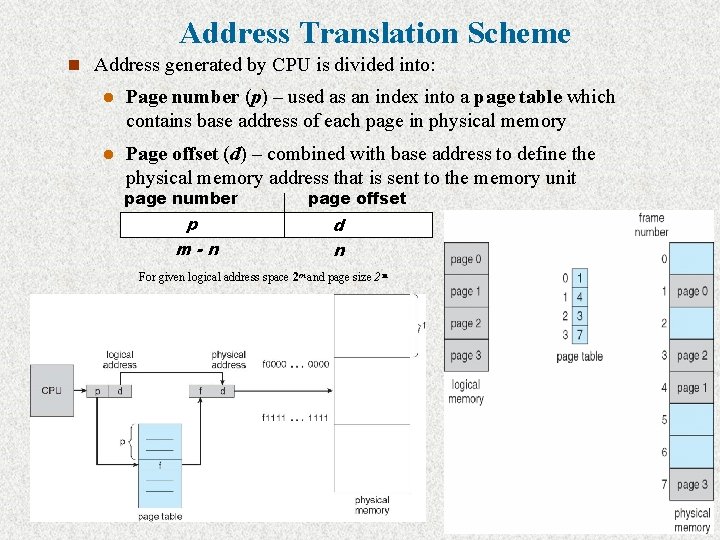
Address Translation Scheme n Address generated by CPU is divided into: l Page number (p) – used as an index into a page table which contains base address of each page in physical memory l Page offset (d) – combined with base address to define the physical memory address that is sent to the memory unit page number p m-n page offset d n For given logical address space 2 m and page size 2 n
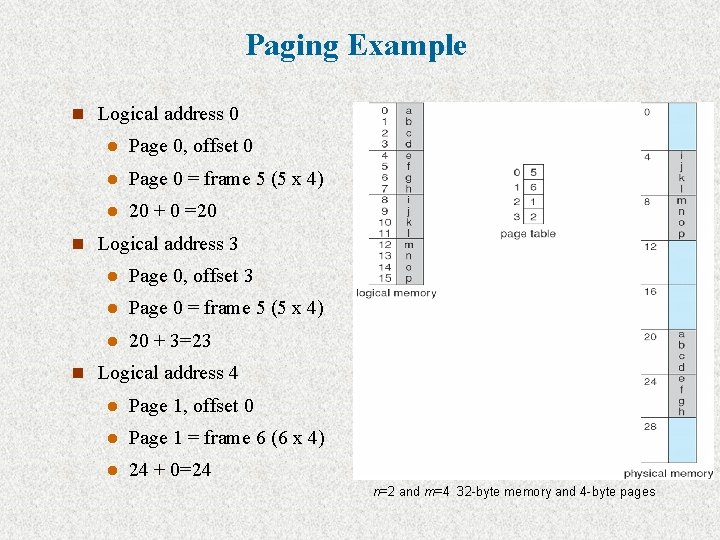
Paging Example n Logical address 0 l Page 0, offset 0 l Page 0 = frame 5 (5 x 4) l 20 + 0 =20 n Logical address 3 l Page 0, offset 3 l Page 0 = frame 5 (5 x 4) l 20 + 3=23 n Logical address 4 l Page 1, offset 0 l Page 1 = frame 6 (6 x 4) l 24 + 0=24 n=2 and m=4 32 -byte memory and 4 -byte pages
Paging (Cont. ) n Calculating internal fragmentation l Page size = 2, 048 bytes l Process size = 72, 766 bytes l 35 pages + 1, 086 bytes l Internal fragmentation of 2, 048 - 1, 086 = 962 bytes l Worst case fragmentation = 1 frame – 1 byte l On average fragmentation = 1 / 2 frame size l So small page sizes desirable? 4 Overhead increases to track each page table entry n Process view and physical memory now very different n By implementation process can only access its own memory
Free Frames Before allocation After allocation
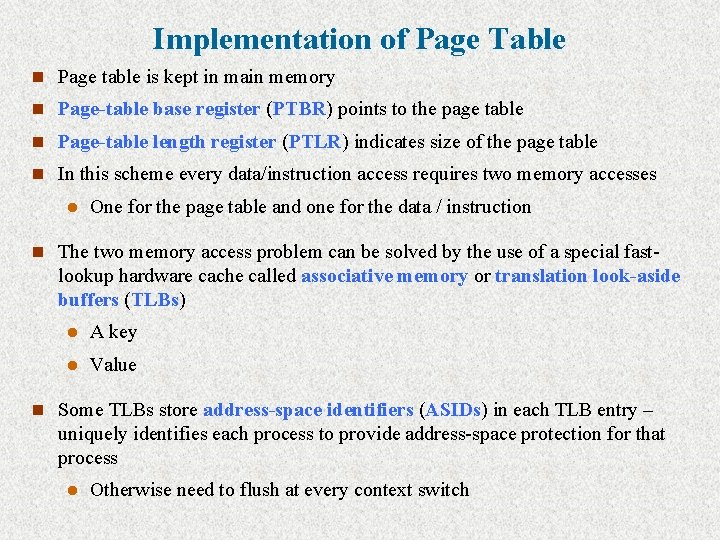
Implementation of Page Table n Page table is kept in main memory n Page-table base register (PTBR) points to the page table n Page-table length register (PTLR) indicates size of the page table n In this scheme every data/instruction access requires two memory accesses l One for the page table and one for the data / instruction n The two memory access problem can be solved by the use of a special fast- lookup hardware cache called associative memory or translation look-aside buffers (TLBs) l A key l Value n Some TLBs store address-space identifiers (ASIDs) in each TLB entry – uniquely identifies each process to provide address-space protection for that process l Otherwise need to flush at every context switch
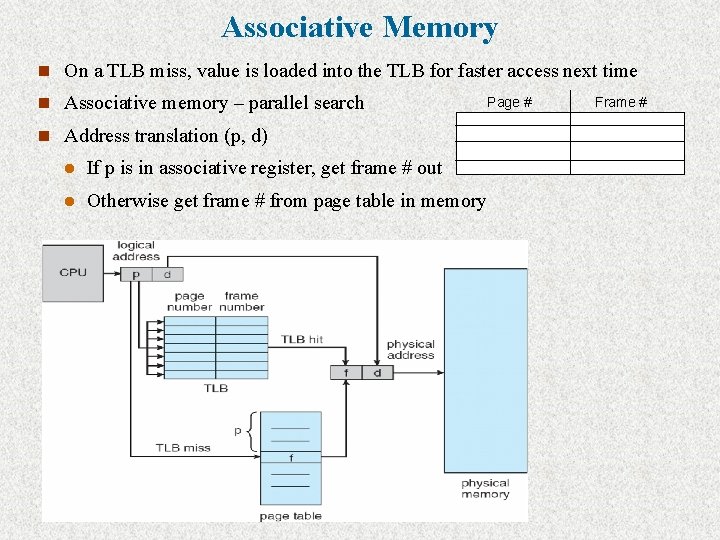
Associative Memory n On a TLB miss, value is loaded into the TLB for faster access next time n Associative memory – parallel search Page # n Address translation (p, d) l If p is in associative register, get frame # out l Otherwise get frame # from page table in memory Frame #
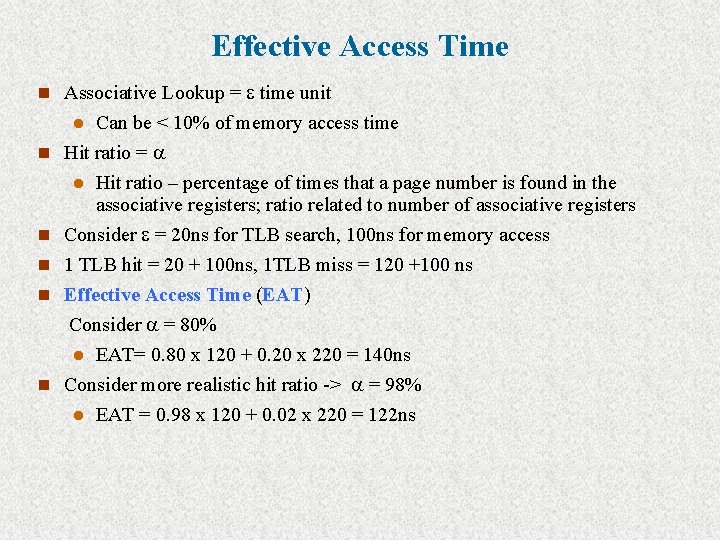
Effective Access Time n Associative Lookup = time unit Can be < 10% of memory access time Hit ratio = l Hit ratio – percentage of times that a page number is found in the associative registers; ratio related to number of associative registers Consider = 20 ns for TLB search, 100 ns for memory access 1 TLB hit = 20 + 100 ns, 1 TLB miss = 120 +100 ns Effective Access Time (EAT) Consider = 80% l EAT= 0. 80 x 120 + 0. 20 x 220 = 140 ns Consider more realistic hit ratio -> = 98% l EAT = 0. 98 x 120 + 0. 02 x 220 = 122 ns l n n n
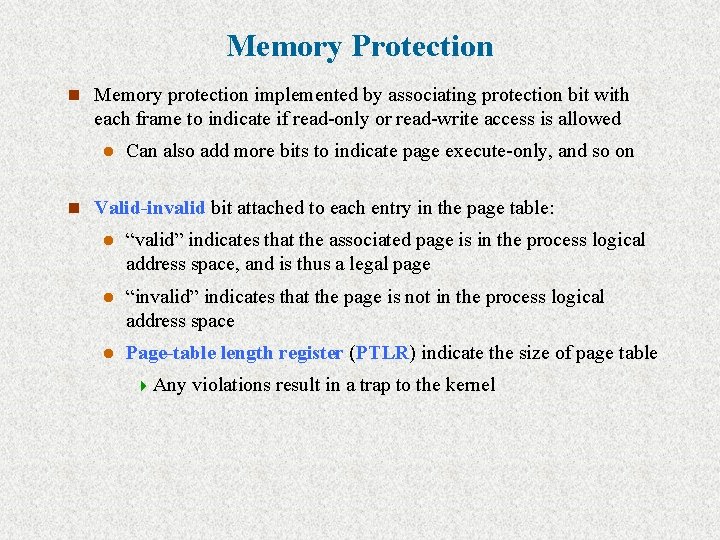
Memory Protection n Memory protection implemented by associating protection bit with each frame to indicate if read-only or read-write access is allowed l Can also add more bits to indicate page execute-only, and so on n Valid-invalid bit attached to each entry in the page table: l “valid” indicates that the associated page is in the process logical address space, and is thus a legal page l “invalid” indicates that the page is not in the process logical address space l Page-table length register (PTLR) indicate the size of page table 4 Any violations result in a trap to the kernel
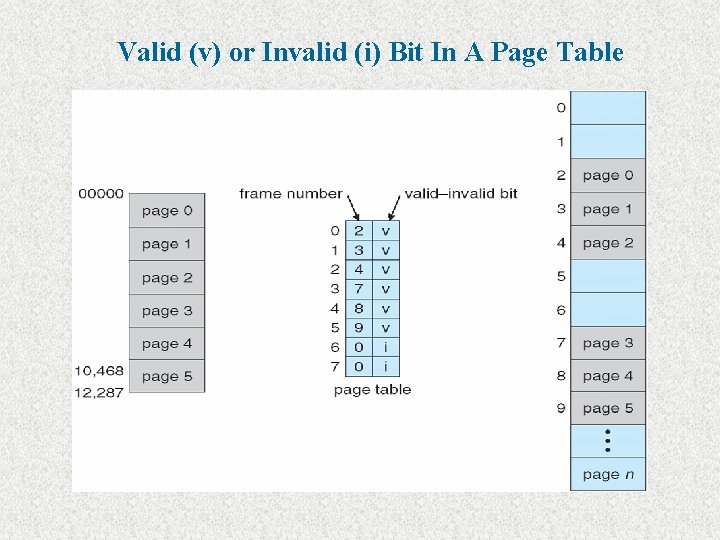
Valid (v) or Invalid (i) Bit In A Page Table
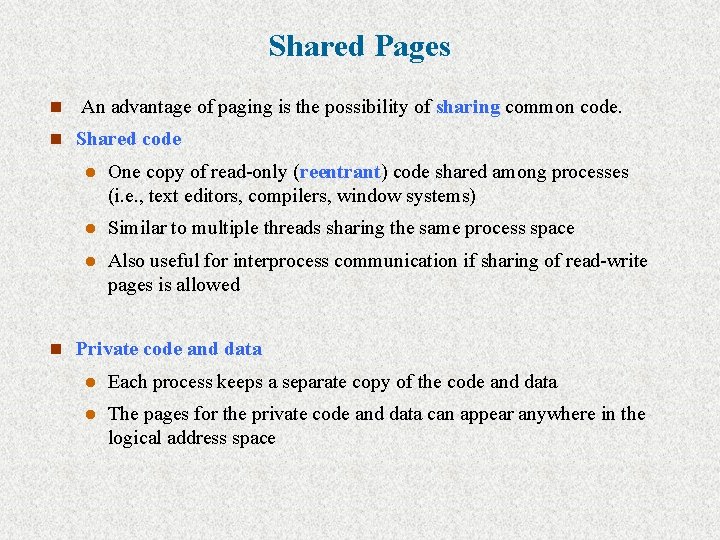
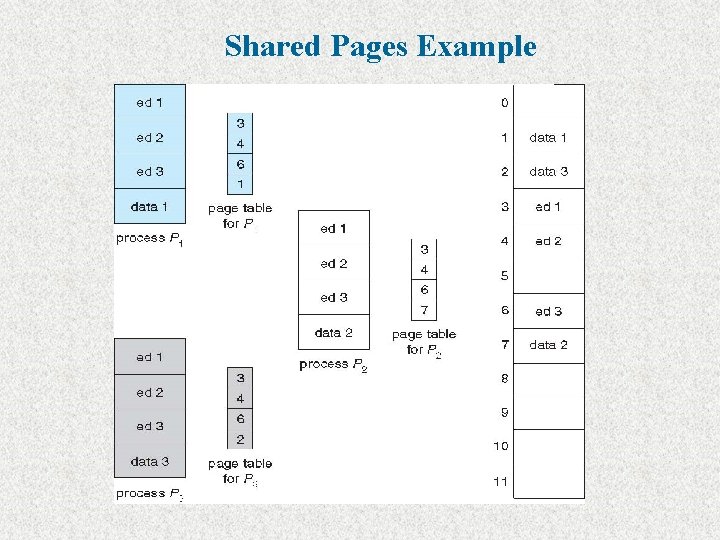
Shared Pages n An advantage of paging is the possibility of sharing common code. n Shared code l One copy of read-only (reentrant) code shared among processes (i. e. , text editors, compilers, window systems) l Similar to multiple threads sharing the same process space l Also useful for interprocess communication if sharing of read-write pages is allowed n Private code and data l Each process keeps a separate copy of the code and data l The pages for the private code and data can appear anywhere in the logical address space
Shared Pages Example
Structure of the Page Table n Memory structures for paging can get huge using straight-forward methods l Consider a 32 -bit logical address space as on modern computers l Page size of 4 KB (212) l Page table would have 1 million entries (232 / 212) l If each entry is 4 bytes 4 Upto 4 MB of physical address space / memory for page table alone is required – That amount of memory used to cost a lot n Don’t want to allocate the page table contiguously in main memory l Solution: Divide the page table into smaller pieces. n There are several ways to accomplish this division: l Hierarchical Paging l Hashed Page Tables l Inverted Page Tables
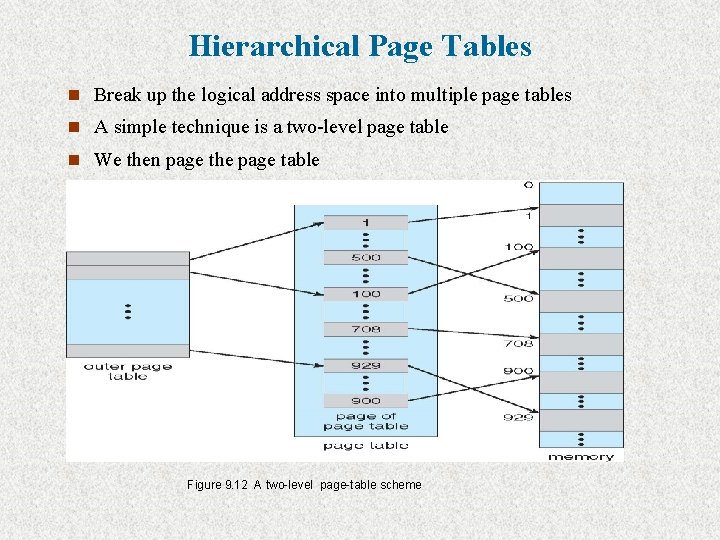
Hierarchical Page Tables n Break up the logical address space into multiple page tables n A simple technique is a two-level page table n We then page the page table Figure 9. 12 A two-level page-table scheme
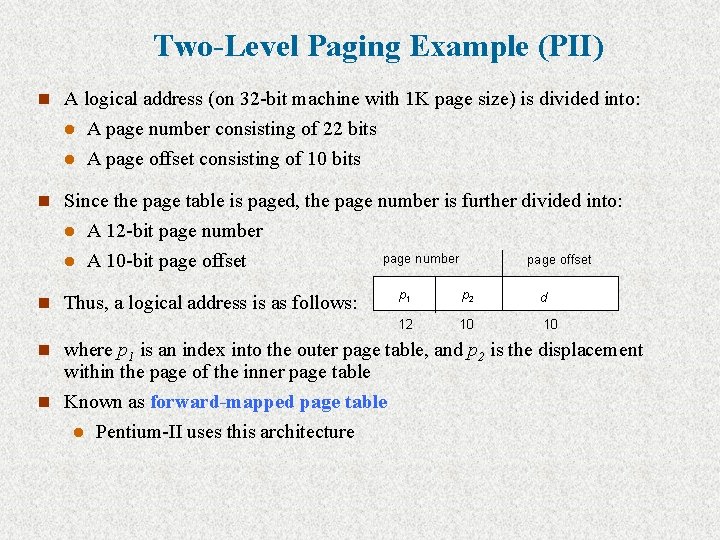
Two-Level Paging Example (PII) n A logical address (on 32 -bit machine with 1 K page size) is divided into: A page number consisting of 22 bits l A page offset consisting of 10 bits l n Since the page table is paged, the page number is further divided into: A 12 -bit page number l A 10 -bit page offset l page number n Thus, a logical address is as follows: page offset p 1 p 2 12 10 d 10 n where p 1 is an index into the outer page table, and p 2 is the displacement within the page of the inner page table n Known as forward-mapped page table l Pentium-II uses this architecture
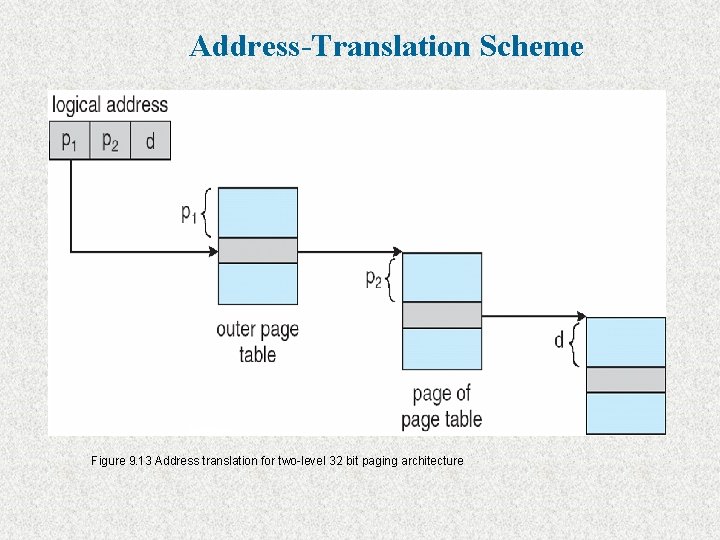
Address-Translation Scheme Figure 9. 13 Address translation for two-level 32 bit paging architecture
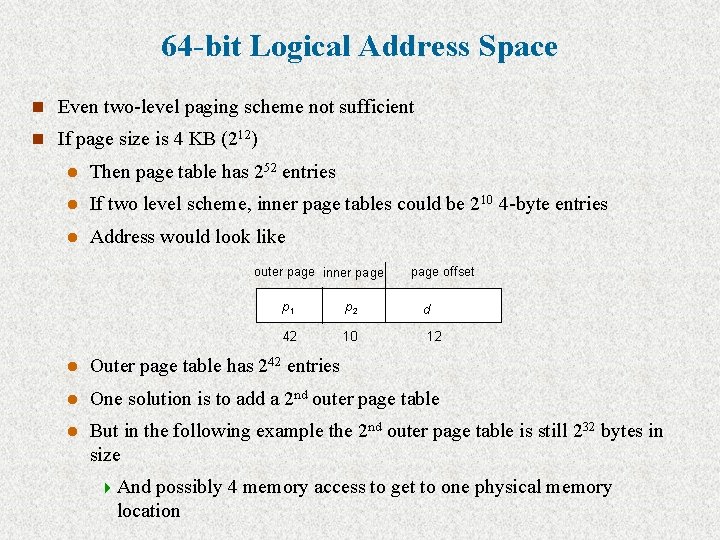
64 -bit Logical Address Space n Even two-level paging scheme not sufficient n If page size is 4 KB (212) l Then page table has 252 entries l If two level scheme, inner page tables could be 210 4 -byte entries l Address would look like outer page inner page p 1 p 2 42 10 page offset d 12 l Outer page table has 242 entries l One solution is to add a 2 nd outer page table l But in the following example the 2 nd outer page table is still 232 bytes in size 4 And possibly 4 memory access to get to one physical memory location
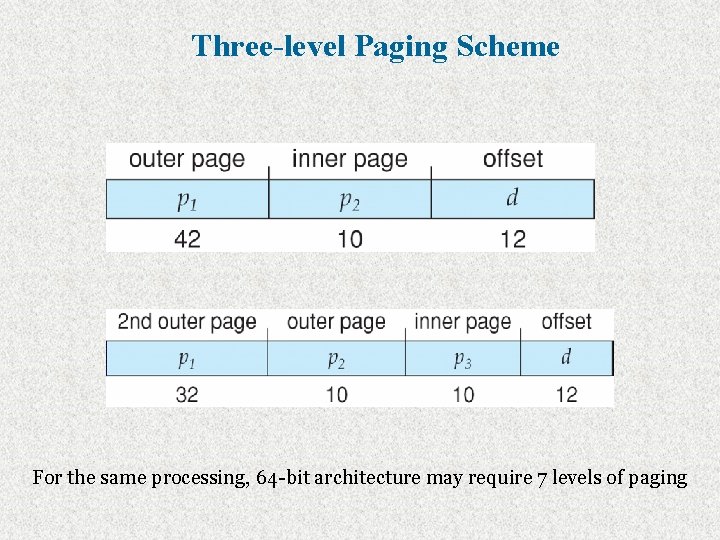
Three-level Paging Scheme For the same processing, 64 -bit architecture may require 7 levels of paging
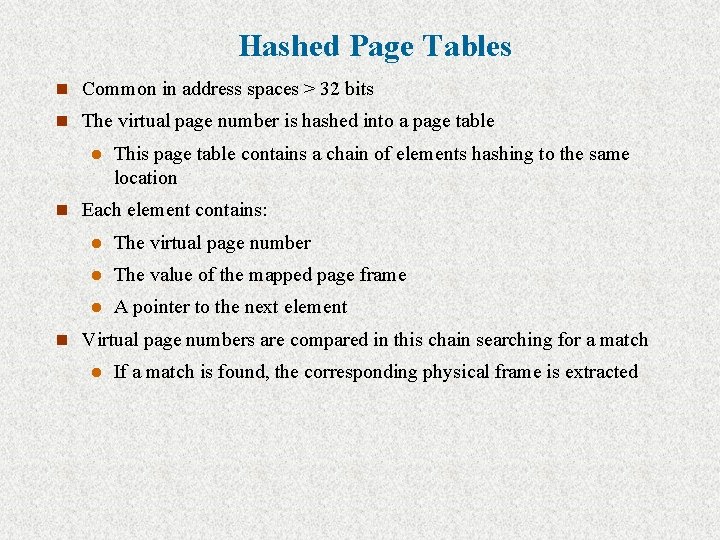
Hashed Page Tables n Common in address spaces > 32 bits n The virtual page number is hashed into a page table l This page table contains a chain of elements hashing to the same location n Each element contains: l The virtual page number l The value of the mapped page frame l A pointer to the next element n Virtual page numbers are compared in this chain searching for a match l If a match is found, the corresponding physical frame is extracted
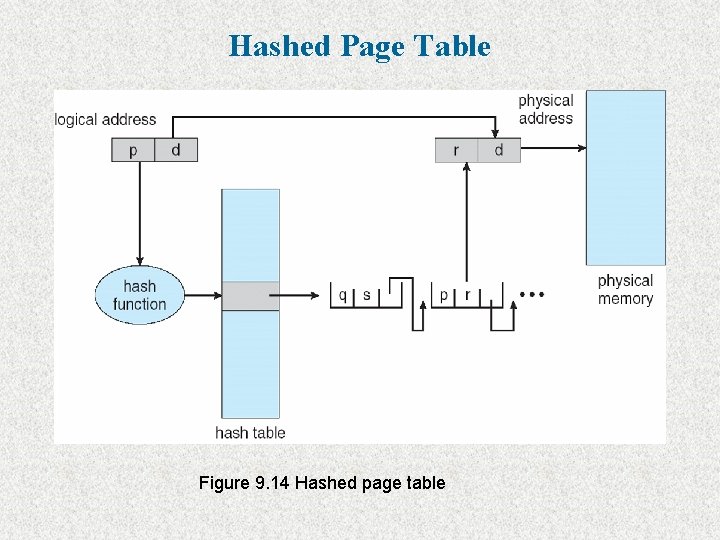
Hashed Page Table Figure 9. 14 Hashed page table
Inverted Page Table n Usually one process has an associated page table. n Rather than each process having a page table and keeping track of all possible logical pages, track all physical pages n One entry for each real page of memory n Entry consists of the virtual address of the page stored in that real memory location, with information about the process that owns that page n Decreases memory needed to store each page table, but increases time needed to search the table when a page reference occurs n Use hash table to limit the search to one — or at most a few — page -table entries l TLB can accelerate access
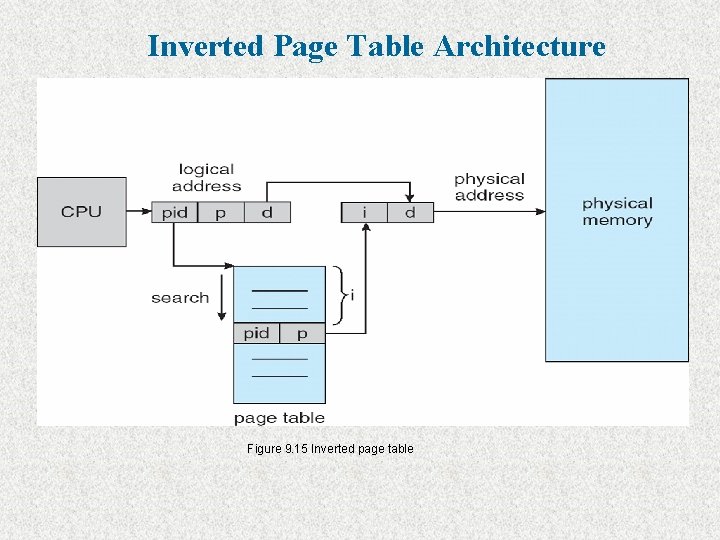
Inverted Page Table Architecture Figure 9. 15 Inverted page table
- Slides: 48