
Chapter 8 Mechanical Failure ISSUES TO ADDRESS How

- Slides: 34
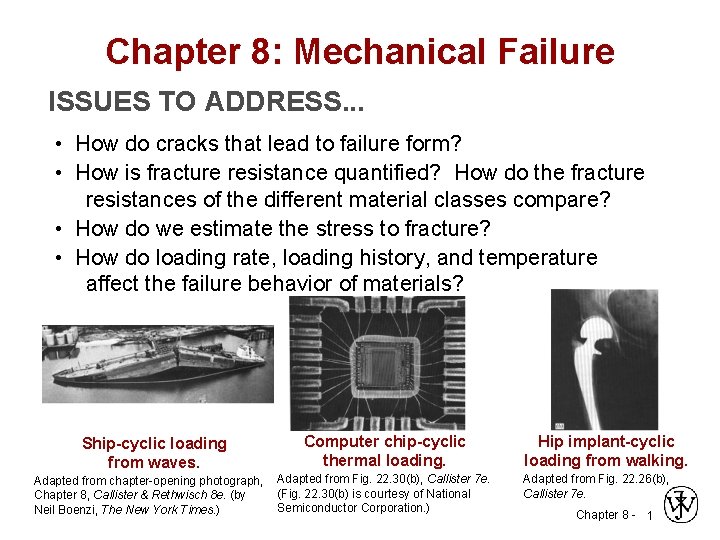
Chapter 8: Mechanical Failure ISSUES TO ADDRESS. . . • How do cracks that lead to failure form? • How is fracture resistance quantified? How do the fracture resistances of the different material classes compare? • How do we estimate the stress to fracture? • How do loading rate, loading history, and temperature affect the failure behavior of materials? Ship-cyclic loading from waves. Adapted from chapter-opening photograph, Chapter 8, Callister & Rethwisch 8 e. (by Neil Boenzi, The New York Times. ) Computer chip-cyclic thermal loading. Adapted from Fig. 22. 30(b), Callister 7 e. (Fig. 22. 30(b) is courtesy of National Semiconductor Corporation. ) Hip implant-cyclic loading from walking. Adapted from Fig. 22. 26(b), Callister 7 e. Chapter 8 - 1
Fracture mechanisms • Ductile fracture – Accompanied by significant plastic deformation • Brittle fracture – Little or no plastic deformation – Catastrophic Chapter 8 - 2
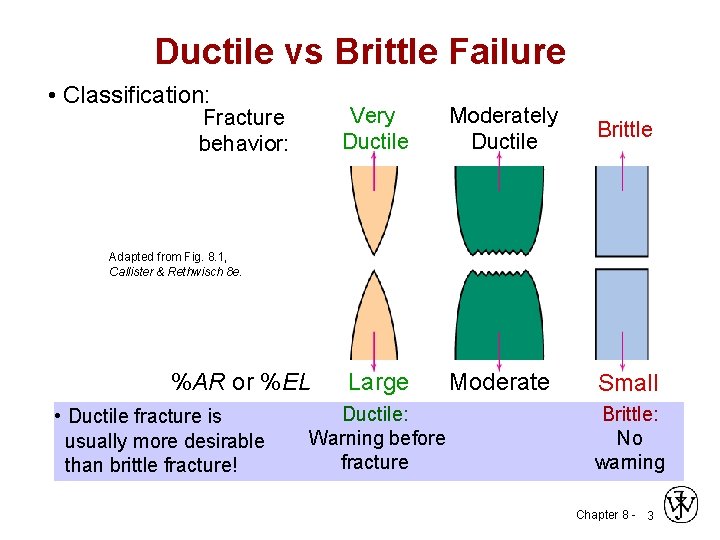
Ductile vs Brittle Failure • Classification: Fracture behavior: Very Ductile Moderately Ductile Brittle Large Moderate Small Adapted from Fig. 8. 1, Callister & Rethwisch 8 e. %AR or %EL • Ductile fracture is usually more desirable than brittle fracture! Ductile: Warning before fracture Brittle: No warning Chapter 8 - 3
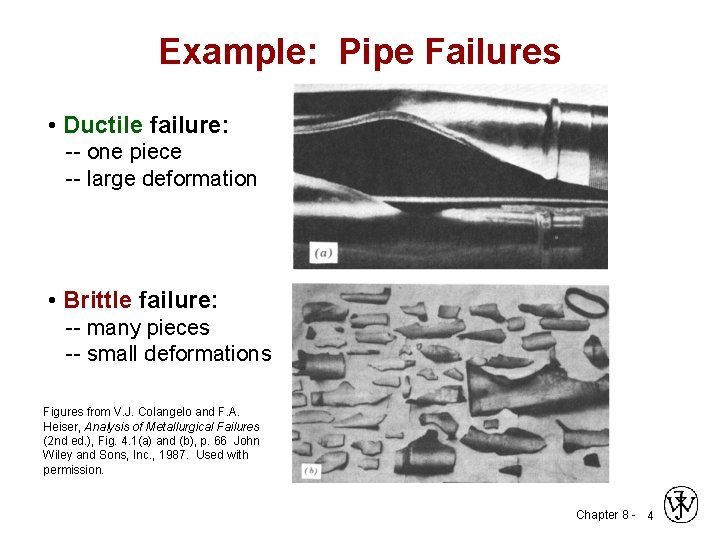
Example: Pipe Failures • Ductile failure: -- one piece -- large deformation • Brittle failure: -- many pieces -- small deformations Figures from V. J. Colangelo and F. A. Heiser, Analysis of Metallurgical Failures (2 nd ed. ), Fig. 4. 1(a) and (b), p. 66 John Wiley and Sons, Inc. , 1987. Used with permission. Chapter 8 - 4
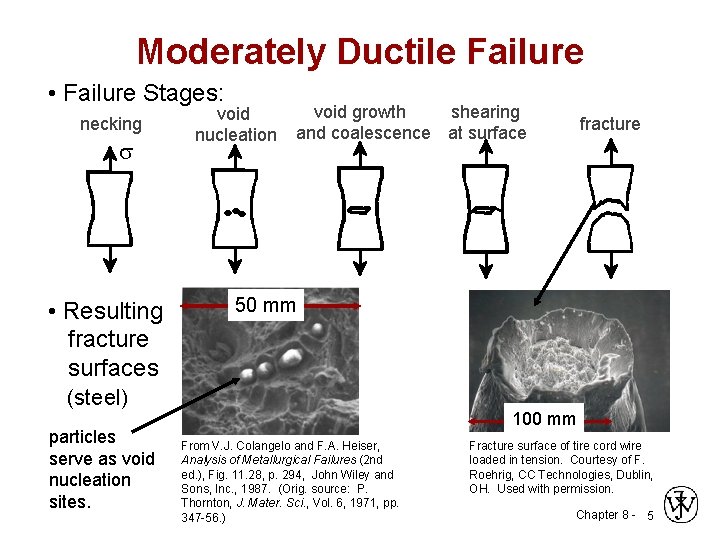
Moderately Ductile Failure • Failure Stages: necking • Resulting fracture surfaces void nucleation shearing void growth and coalescence at surface 50 50 mm mm (steel) particles serve as void nucleation sites. fracture 100 mm From V. J. Colangelo and F. A. Heiser, Analysis of Metallurgical Failures (2 nd ed. ), Fig. 11. 28, p. 294, John Wiley and Sons, Inc. , 1987. (Orig. source: P. Thornton, J. Mater. Sci. , Vol. 6, 1971, pp. 347 -56. ) Fracture surface of tire cord wire loaded in tension. Courtesy of F. Roehrig, CC Technologies, Dublin, OH. Used with permission. Chapter 8 - 5
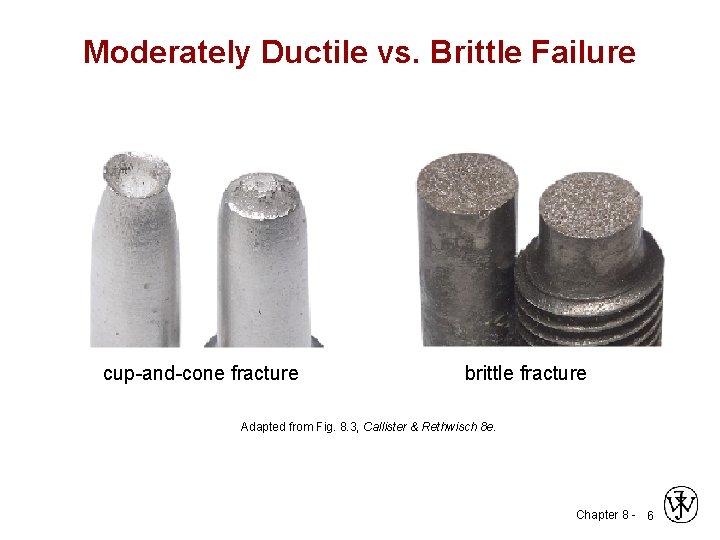
Moderately Ductile vs. Brittle Failure cup-and-cone fracture brittle fracture Adapted from Fig. 8. 3, Callister & Rethwisch 8 e. Chapter 8 - 6
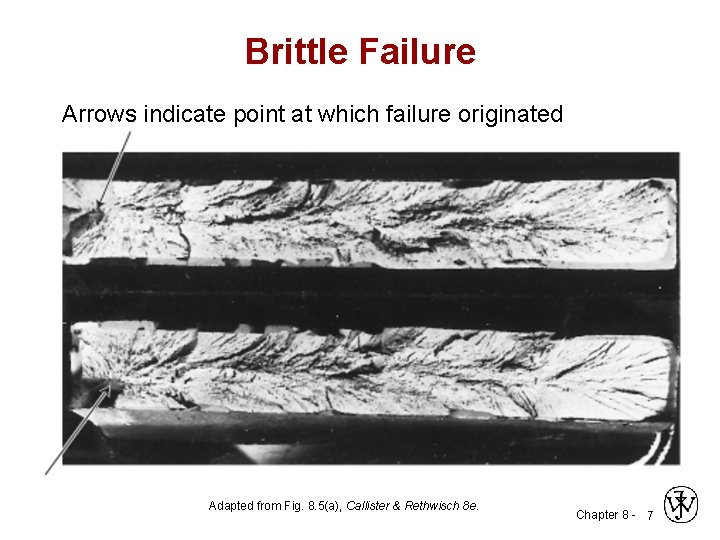
Brittle Failure Arrows indicate point at which failure originated Adapted from Fig. 8. 5(a), Callister & Rethwisch 8 e. Chapter 8 - 7
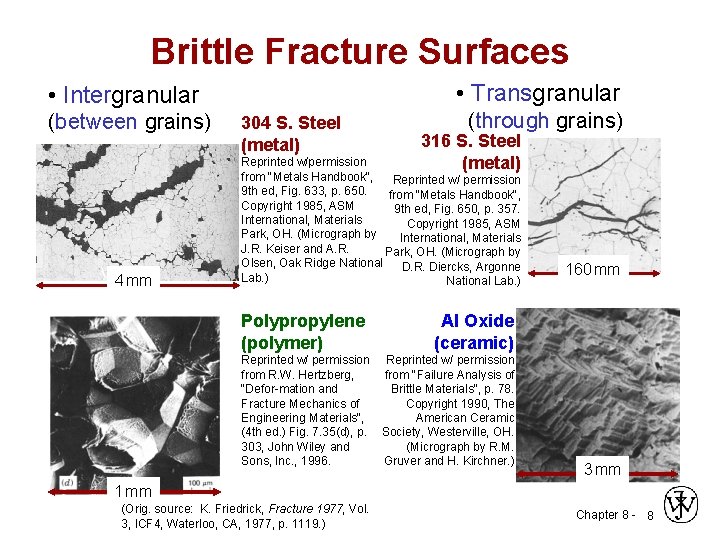
Brittle Fracture Surfaces • Transgranular • Intergranular (between grains) 4 mm 304 S. Steel (metal) (through grains) 316 S. Steel (metal) Reprinted w/permission from "Metals Handbook", Reprinted w/ permission 9 th ed, Fig. 633, p. 650. from "Metals Handbook", Copyright 1985, ASM 9 th ed, Fig. 650, p. 357. International, Materials Copyright 1985, ASM Park, OH. (Micrograph by International, Materials J. R. Keiser and A. R. Park, OH. (Micrograph by Olsen, Oak Ridge National D. R. Diercks, Argonne Lab. ) National Lab. ) Polypropylene (polymer) 160 mm Al Oxide (ceramic) Reprinted w/ permission from R. W. Hertzberg, from "Failure Analysis of "Defor-mation and Brittle Materials", p. 78. Fracture Mechanics of Copyright 1990, The Engineering Materials", American Ceramic (4 th ed. ) Fig. 7. 35(d), p. Society, Westerville, OH. 303, John Wiley and (Micrograph by R. M. Sons, Inc. , 1996. Gruver and H. Kirchner. ) 3 mm 1 mm (Orig. source: K. Friedrick, Fracture 1977, Vol. 3, ICF 4, Waterloo, CA, 1977, p. 1119. ) Chapter 8 - 8
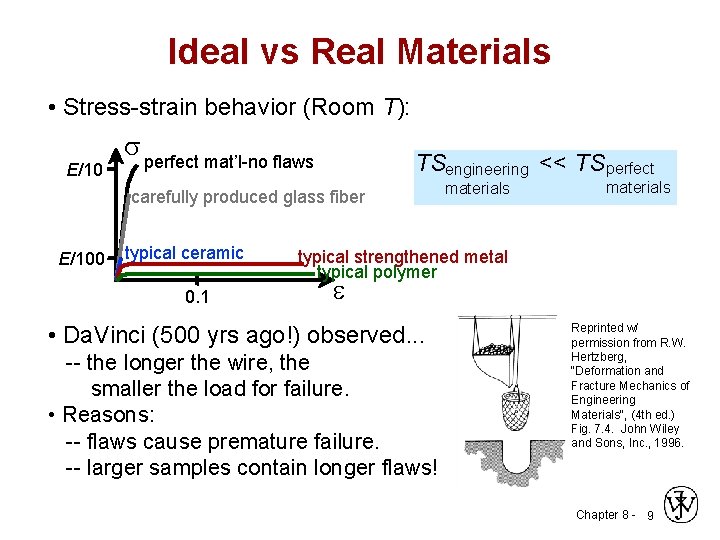
Ideal vs Real Materials • Stress-strain behavior (Room T): E/10 perfect mat’l-no flaws TSengineering << TS perfect carefully produced glass fiber E/100 typical ceramic 0. 1 materials typical strengthened metal typical polymer e • Da. Vinci (500 yrs ago!) observed. . . -- the longer the wire, the smaller the load for failure. • Reasons: -- flaws cause premature failure. -- larger samples contain longer flaws! Reprinted w/ permission from R. W. Hertzberg, "Deformation and Fracture Mechanics of Engineering Materials", (4 th ed. ) Fig. 7. 4. John Wiley and Sons, Inc. , 1996. Chapter 8 - 9
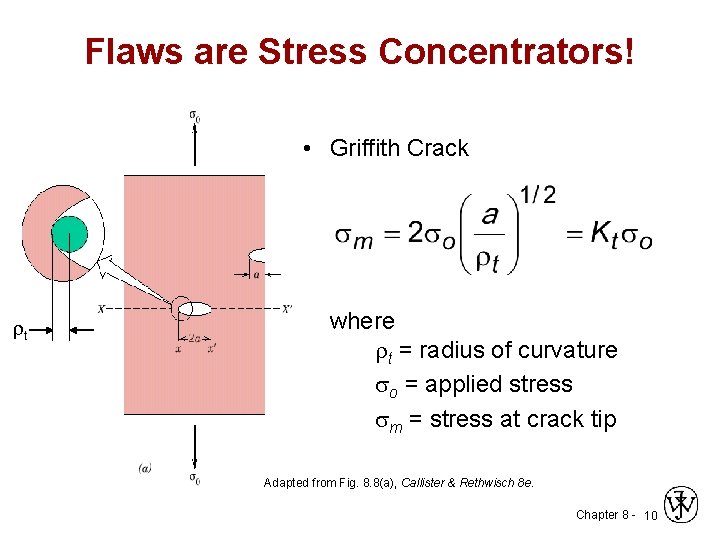
Flaws are Stress Concentrators! • Griffith Crack t where t = radius of curvature o = applied stress m = stress at crack tip Adapted from Fig. 8. 8(a), Callister & Rethwisch 8 e. Chapter 8 - 10
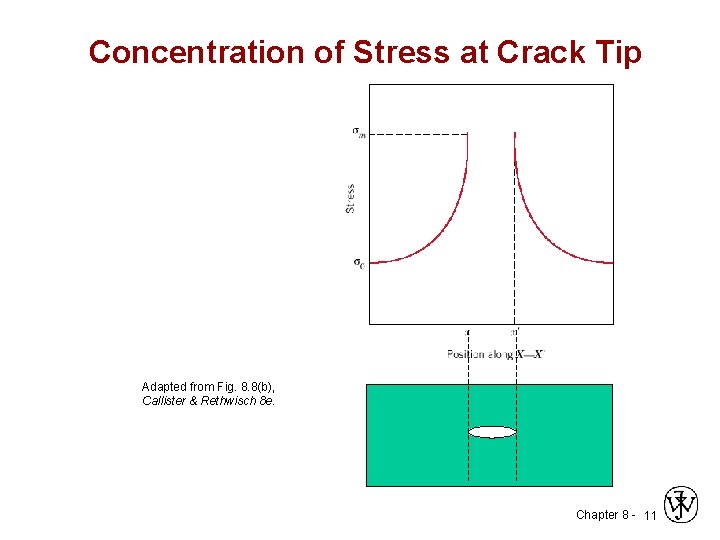
Concentration of Stress at Crack Tip Adapted from Fig. 8. 8(b), Callister & Rethwisch 8 e. Chapter 8 - 11
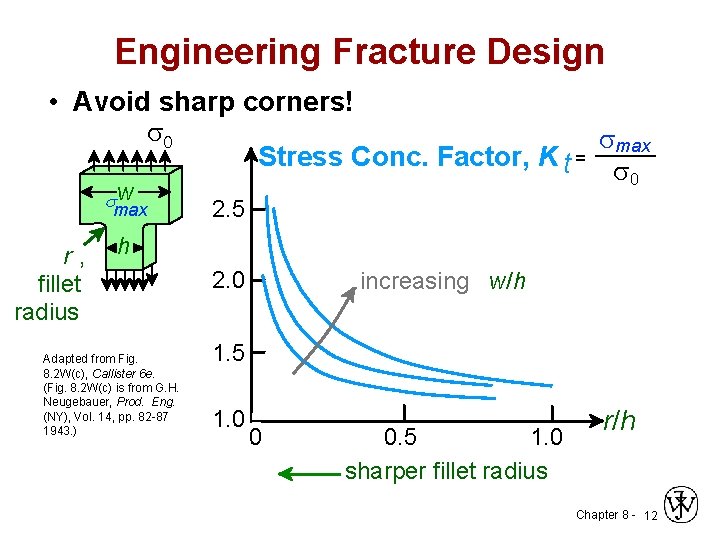
Engineering Fracture Design • Avoid sharp corners! max Stress Conc. Factor, K t = 0 w smax r, fillet radius 2. 5 h Adapted from Fig. 8. 2 W(c), Callister 6 e. (Fig. 8. 2 W(c) is from G. H. Neugebauer, Prod. Eng. (NY), Vol. 14, pp. 82 -87 1943. ) 2. 0 increasing w/h 1. 5 1. 0 0 0. 5 1. 0 sharper fillet radius r/h Chapter 8 - 12
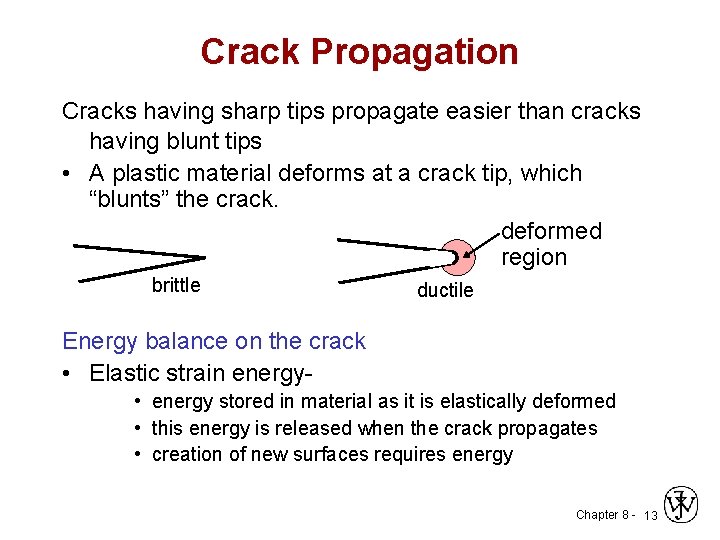
Crack Propagation Cracks having sharp tips propagate easier than cracks having blunt tips • A plastic material deforms at a crack tip, which “blunts” the crack. deformed region brittle ductile Energy balance on the crack • Elastic strain energy • energy stored in material as it is elastically deformed • this energy is released when the crack propagates • creation of new surfaces requires energy Chapter 8 - 13
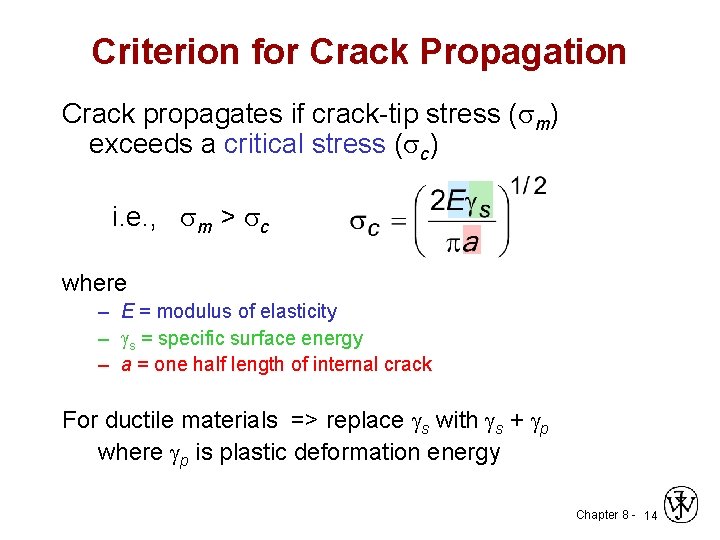
Criterion for Crack Propagation Crack propagates if crack-tip stress ( m) exceeds a critical stress ( c) i. e. , m > c where – E = modulus of elasticity – s = specific surface energy – a = one half length of internal crack For ductile materials => replace s with s + p where p is plastic deformation energy Chapter 8 - 14
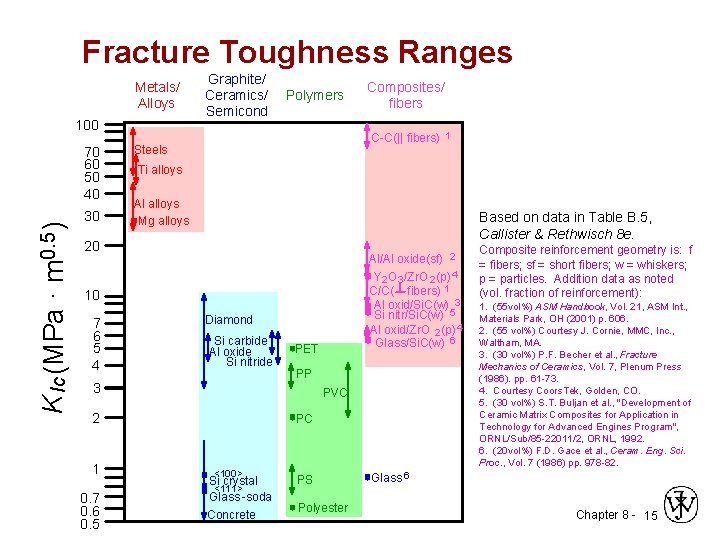
Fracture Toughness Ranges Metals/ Alloys 100 K Ic (MPa · m 0. 5 ) 70 60 50 40 30 Graphite/ Ceramics/ Semicond Polymers C-C(|| fibers) 1 Steels Ti alloys Al alloys Mg alloys Based on data in Table B. 5, Callister & Rethwisch 8 e. 20 Al/Al oxide(sf) 2 Y 2 O 3 /Zr. O 2 (p) 4 C/C( fibers) 1 Al oxid/Si. C(w) 3 Si nitr/Si. C(w) 5 Al oxid/Zr. O 2 (p) 4 Glass/Si. C(w) 6 10 7 6 5 4 Diamond Si carbide Al oxide Si nitride 3 0. 7 0. 6 0. 5 PET PP PVC 2 1 Composites/ fibers PC <100> Si crystal <111> Glass -soda Concrete PS Polyester Composite reinforcement geometry is: f = fibers; sf = short fibers; w = whiskers; p = particles. Addition data as noted (vol. fraction of reinforcement): 1. (55 vol%) ASM Handbook, Vol. 21, ASM Int. , Materials Park, OH (2001) p. 606. 2. (55 vol%) Courtesy J. Cornie, MMC, Inc. , Waltham, MA. 3. (30 vol%) P. F. Becher et al. , Fracture Mechanics of Ceramics, Vol. 7, Plenum Press (1986). pp. 61 -73. 4. Courtesy Coors. Tek, Golden, CO. 5. (30 vol%) S. T. Buljan et al. , "Development of Ceramic Matrix Composites for Application in Technology for Advanced Engines Program", ORNL/Sub/85 -22011/2, ORNL, 1992. 6. (20 vol%) F. D. Gace et al. , Ceram. Eng. Sci. Proc. , Vol. 7 (1986) pp. 978 -82. Glass 6 Chapter 8 - 15
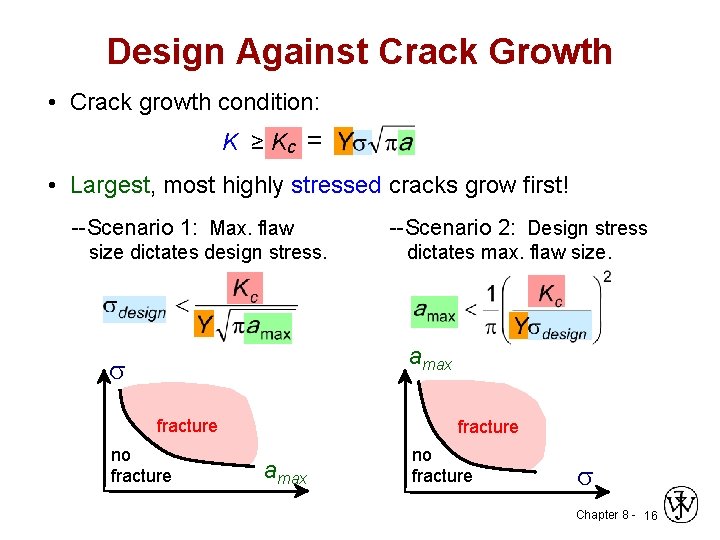
Design Against Crack Growth • Crack growth condition: K ≥ Kc = • Largest, most highly stressed cracks grow first! --Scenario 1: Max. flaw size dictates design stress. --Scenario 2: Design stress dictates max. flaw size. amax fracture no fracture amax no fracture Chapter 8 - 16
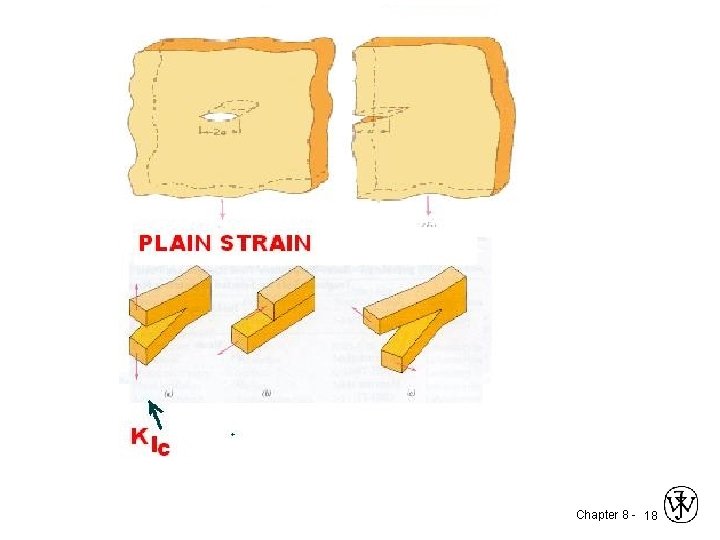
Chapter 8 - 17
Chapter 8 - 18
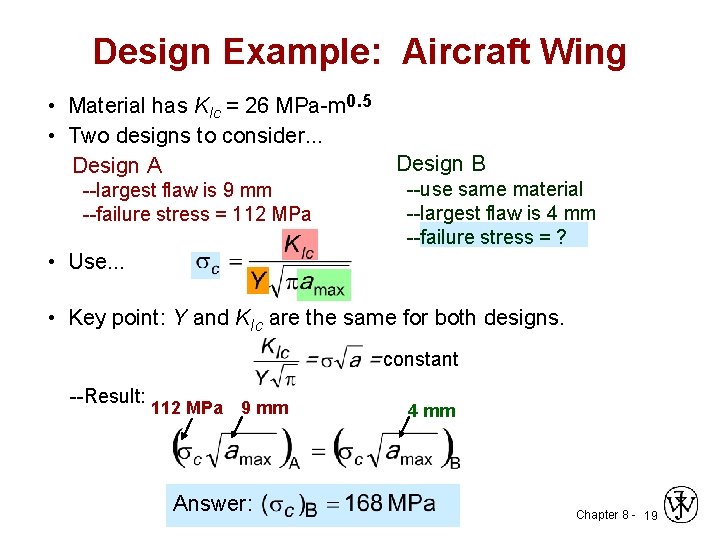
Design Example: Aircraft Wing • Material has KIc = 26 MPa-m 0. 5 • Two designs to consider. . . Design A --largest flaw is 9 mm --failure stress = 112 MPa Design B --use same material --largest flaw is 4 mm --failure stress = ? • Use. . . • Key point: Y and KIc are the same for both designs. constant --Result: 112 MPa 9 mm Answer: 4 mm Chapter 8 - 19
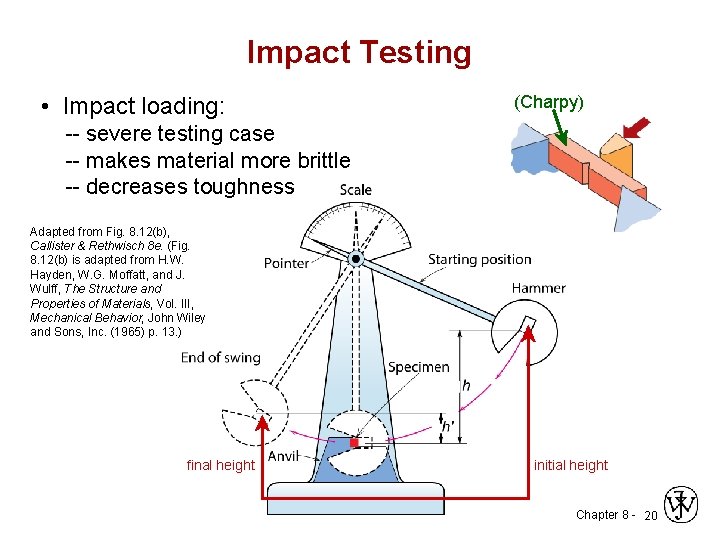
Impact Testing • Impact loading: (Charpy) -- severe testing case -- makes material more brittle -- decreases toughness Adapted from Fig. 8. 12(b), Callister & Rethwisch 8 e. (Fig. 8. 12(b) is adapted from H. W. Hayden, W. G. Moffatt, and J. Wulff, The Structure and Properties of Materials, Vol. III, Mechanical Behavior, John Wiley and Sons, Inc. (1965) p. 13. ) final height initial height Chapter 8 - 20
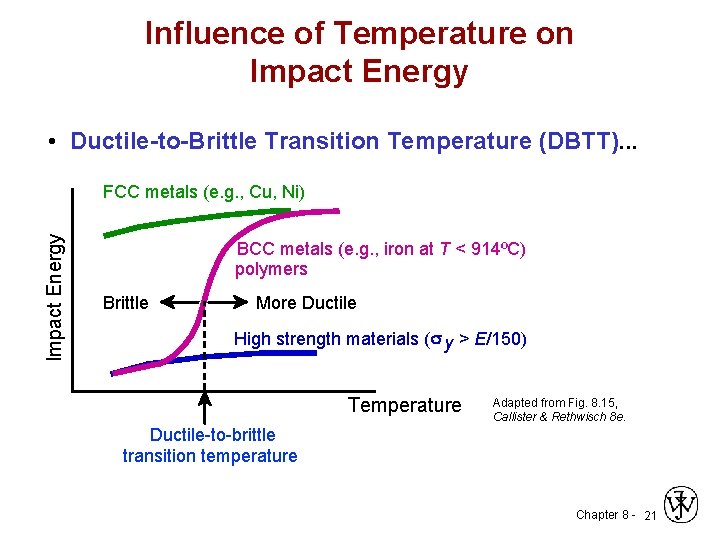
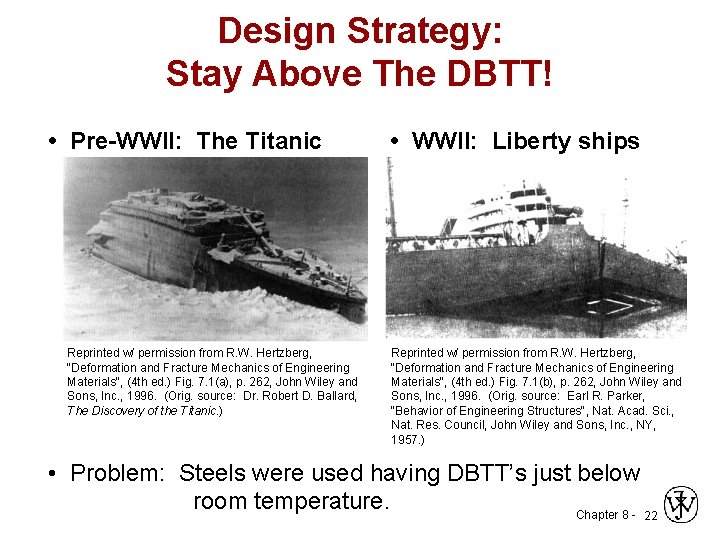
Influence of Temperature on Impact Energy • Ductile-to-Brittle Transition Temperature (DBTT). . . Impact Energy FCC metals (e. g. , Cu, Ni) BCC metals (e. g. , iron at T < 914ºC) polymers Brittle More Ductile High strength materials ( y > E/150) Temperature Adapted from Fig. 8. 15, Callister & Rethwisch 8 e. Ductile-to-brittle transition temperature Chapter 8 - 21
Design Strategy: Stay Above The DBTT! • Pre-WWII: The Titanic Reprinted w/ permission from R. W. Hertzberg, "Deformation and Fracture Mechanics of Engineering Materials", (4 th ed. ) Fig. 7. 1(a), p. 262, John Wiley and Sons, Inc. , 1996. (Orig. source: Dr. Robert D. Ballard, The Discovery of the Titanic. ) • WWII: Liberty ships Reprinted w/ permission from R. W. Hertzberg, "Deformation and Fracture Mechanics of Engineering Materials", (4 th ed. ) Fig. 7. 1(b), p. 262, John Wiley and Sons, Inc. , 1996. (Orig. source: Earl R. Parker, "Behavior of Engineering Structures", Nat. Acad. Sci. , Nat. Res. Council, John Wiley and Sons, Inc. , NY, 1957. ) • Problem: Steels were used having DBTT’s just below room temperature. Chapter 8 - 22
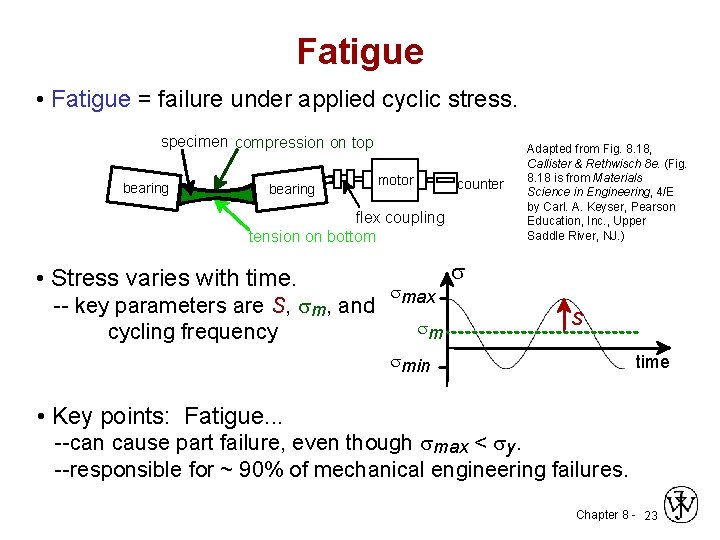
Fatigue • Fatigue = failure under applied cyclic stress. specimen compression on top bearing motor counter flex coupling tension on bottom • Stress varies with time. -- key parameters are S, m, and cycling frequency max m Adapted from Fig. 8. 18, Callister & Rethwisch 8 e. (Fig. 8. 18 is from Materials Science in Engineering, 4/E by Carl. A. Keyser, Pearson Education, Inc. , Upper Saddle River, NJ. ) S min time • Key points: Fatigue. . . --can cause part failure, even though max < y. --responsible for ~ 90% of mechanical engineering failures. Chapter 8 - 23
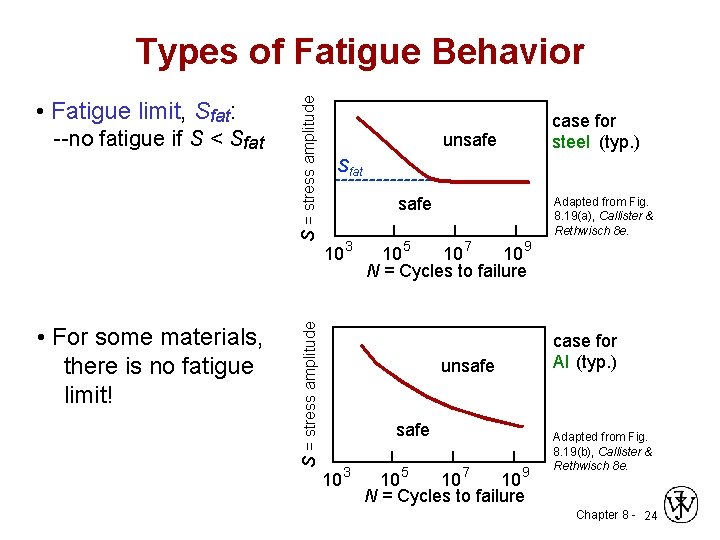
--no fatigue if S < Sfat • For some materials, there is no fatigue limit! S = stress amplitude • Fatigue limit, Sfat: S = stress amplitude Types of Fatigue Behavior unsafe case for steel (typ. ) Sfat safe 10 3 Adapted from Fig. 8. 19(a), Callister & Rethwisch 8 e. 10 5 10 7 10 9 N = Cycles to failure unsafe 10 3 10 5 10 7 10 9 N = Cycles to failure case for Al (typ. ) Adapted from Fig. 8. 19(b), Callister & Rethwisch 8 e. Chapter 8 - 24
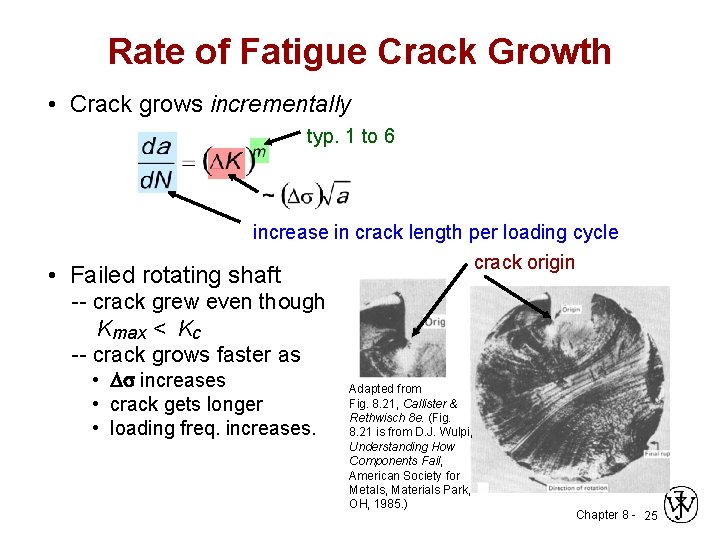
Rate of Fatigue Crack Growth • Crack grows incrementally typ. 1 to 6 increase in crack length per loading cycle crack origin • Failed rotating shaft -- crack grew even though Kmax < Kc -- crack grows faster as • D increases • crack gets longer • loading freq. increases. Adapted from Fig. 8. 21, Callister & Rethwisch 8 e. (Fig. 8. 21 is from D. J. Wulpi, Understanding How Components Fail, American Society for Metals, Materials Park, OH, 1985. ) Chapter 8 - 25
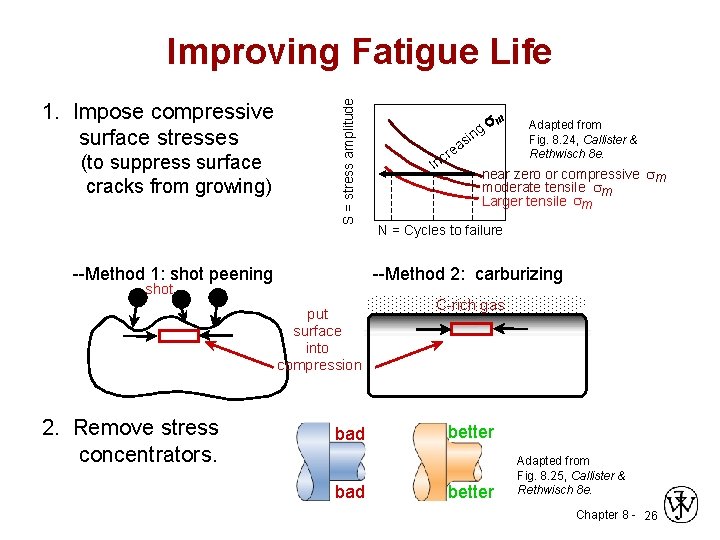
1. Impose compressive surface stresses (to suppress surface cracks from growing) S = stress amplitude Improving Fatigue Life --Method 1: shot peening cr In m Adapted from Fig. 8. 24, Callister & Rethwisch 8 e. near zero or compressive m moderate tensile m Larger tensile m N = Cycles to failure --Method 2: carburizing shot put surface into compression 2. Remove stress concentrators. ing s ea bad C-rich gas better Adapted from Fig. 8. 25, Callister & Rethwisch 8 e. Chapter 8 - 26
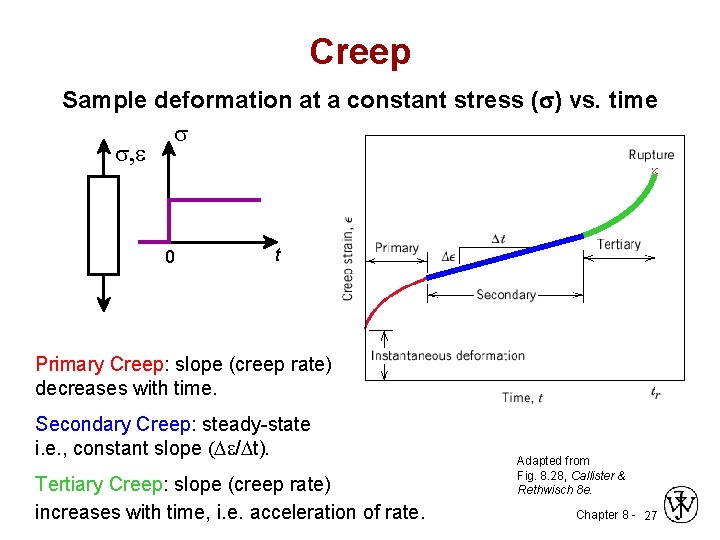
Creep Sample deformation at a constant stress ( ) vs. time , e 0 t Primary Creep: slope (creep rate) decreases with time. Secondary Creep: steady-state i. e. , constant slope (De/Dt). Tertiary Creep: slope (creep rate) increases with time, i. e. acceleration of rate. Adapted from Fig. 8. 28, Callister & Rethwisch 8 e. Chapter 8 - 27
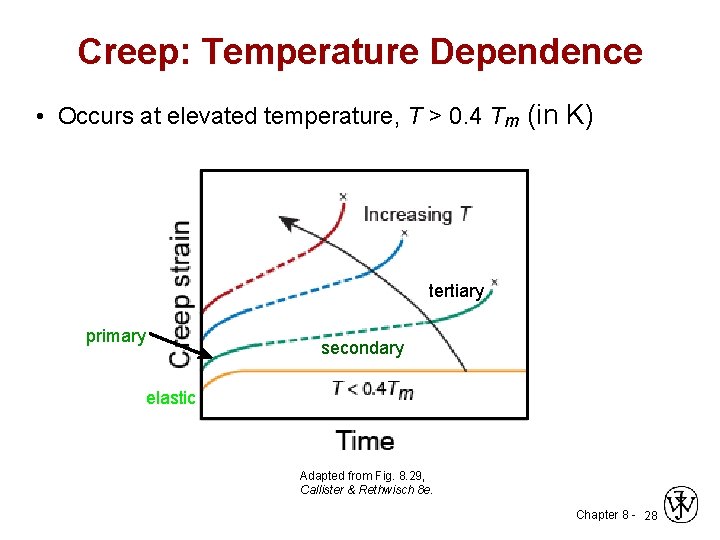
Creep: Temperature Dependence • Occurs at elevated temperature, T > 0. 4 Tm (in K) tertiary primary secondary elastic Adapted from Fig. 8. 29, Callister & Rethwisch 8 e. Chapter 8 - 28
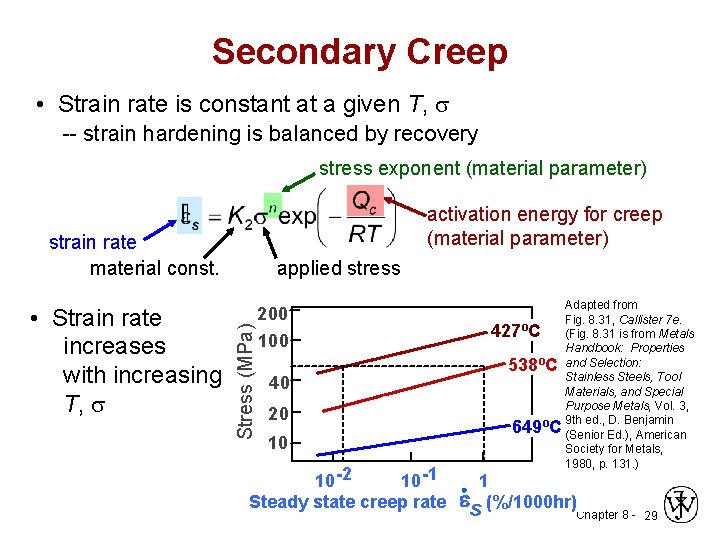
Secondary Creep • Strain rate is constant at a given T, -- strain hardening is balanced by recovery stress exponent (material parameter) activation energy for creep (material parameter) strain rate material const. Stress (MPa) • Strain rate increases with increasing T, applied stress 200 100 40 20 10 10 -2 10 -1 Steady state creep rate 427ºC 538ºC 649ºC Adapted from Fig. 8. 31, Callister 7 e. (Fig. 8. 31 is from Metals Handbook: Properties and Selection: Stainless Steels, Tool Materials, and Special Purpose Metals, Vol. 3, 9 th ed. , D. Benjamin (Senior Ed. ), American Society for Metals, 1980, p. 131. ) 1 es (%/1000 hr) Chapter 8 - 29
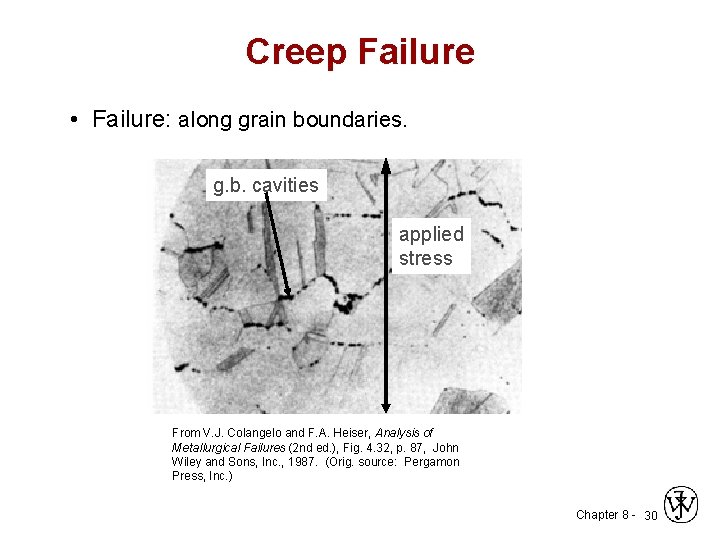
Creep Failure • Failure: along grain boundaries. g. b. cavities applied stress From V. J. Colangelo and F. A. Heiser, Analysis of Metallurgical Failures (2 nd ed. ), Fig. 4. 32, p. 87, John Wiley and Sons, Inc. , 1987. (Orig. source: Pergamon Press, Inc. ) Chapter 8 - 30
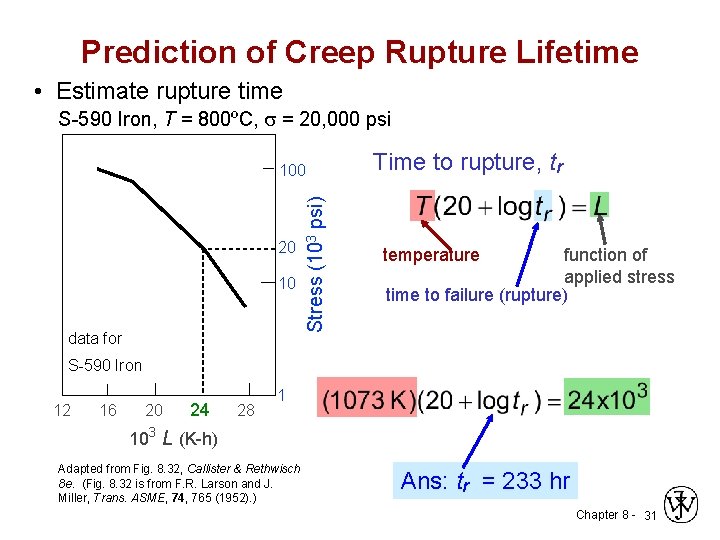
Prediction of Creep Rupture Lifetime • Estimate rupture time S-590 Iron, T = 800ºC, = 20, 000 psi 20 10 data for Stress (103 psi) 100 Time to rupture, tr function of applied stress time to failure (rupture) temperature S-590 Iron 12 16 20 24 28 1 103 L (K-h) Adapted from Fig. 8. 32, Callister & Rethwisch 8 e. (Fig. 8. 32 is from F. R. Larson and J. Miller, Trans. ASME, 74, 765 (1952). ) Ans: tr = 233 hr Chapter 8 - 31
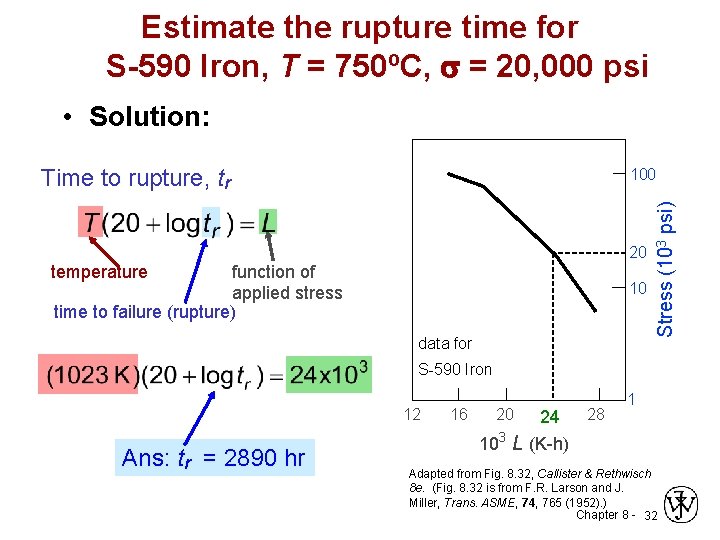
Estimate the rupture time for S-590 Iron, T = 750ºC, = 20, 000 psi • Solution: Time to rupture, tr 20 function of applied stress time to failure (rupture) temperature 10 data for Stress (103 psi) 100 S-590 Iron 12 Ans: tr = 2890 hr 16 20 24 28 1 103 L (K-h) Adapted from Fig. 8. 32, Callister & Rethwisch 8 e. (Fig. 8. 32 is from F. R. Larson and J. Miller, Trans. ASME, 74, 765 (1952). ) Chapter 8 - 32
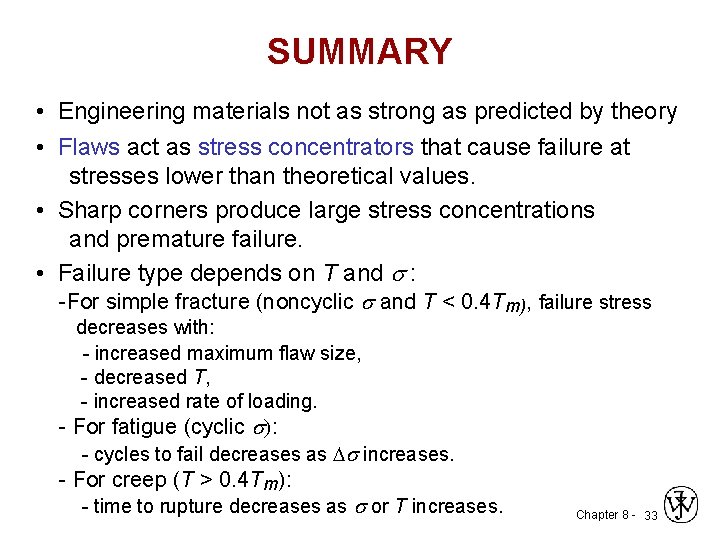
SUMMARY • Engineering materials not as strong as predicted by theory • Flaws act as stress concentrators that cause failure at stresses lower than theoretical values. • Sharp corners produce large stress concentrations and premature failure. • Failure type depends on T and s : -For simple fracture (noncyclic s and T < 0. 4 Tm), failure stress decreases with: - increased maximum flaw size, - decreased T, - increased rate of loading. - For fatigue (cyclic s): - cycles to fail decreases as Ds increases. - For creep (T > 0. 4 Tm): - time to rupture decreases as s or T increases. Chapter 8 - 33
ANNOUNCEMENTS Reading: Core Problems: Self-help Problems: Chapter 8 - 34