
CHAPTER 8 MANAGING BEHAVIOR WITH CHANGES IN THE
CHAPTER 8 MANAGING BEHAVIOR WITH CHANGES IN THE ORGANIZATION 1
Organizational Change n Why managing change is important ? Organization must learn to change faster to survive and growth. The ability to manage change determines success. Your ability to flexibly change with the diversifying global environment will affect your career success. People with outdated skill are often retrained, unemployed, or underemployed. 2
n Force to change An organization interacts with its external and internal environment. Some of the external environmental forces include increased global competition, government laws, economic conditions, and technological advances. Some of the internal organizational forces for change include redefined purpose and strategies, financial position, and reorganization. 3
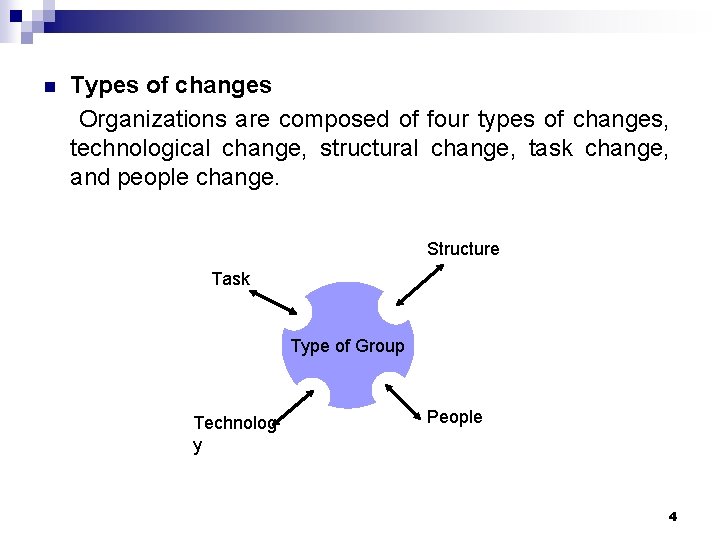
n Types of changes Organizations are composed of four types of changes, technological change, structural change, task change, and people change. Structure Task Type of Group Technolog y People 4
n Technological change, in the modern society computer has been used in place of typewriter, and it is always changed with modern software and hardware. Technology is a commonly used as method of increasing productivity to gain competitive leverage. n Structural Change Structure refers to changing the type of departments used, control model, type of authority used, and so forth. 5

n Task and People change Task refers to the day-to-day things that employees do to perform their jobs. Tasks change with technology and structural changes. As task change, people’s skills must change. Employee retraining is an ongoing process. In some cases, organization must hire new people with the necessary skills. 6
n Stages in the change process People go through four distinct stages in the change process; denial, resistance, exploration and commitment. ¨ Denial. When people first hear by the grapevine that change is coming, they deny that it will happen at all, ‘’it will affect the others, but not me” reaction is common. ¨ Resistance. Once people get over the initial shock and realize that change is going to be a reality, they resist the change. The next section examines resistance to change and how to overcome it. 7
n Exploration. When the change beings implemented, employee explore the change, often through training, and better understand how it will affect them. Training is an organizational development techniques for the change of organization. n Commitment. Through exploration employee determine their level of commitment to making the change a success. 8
n Overcoming the change ¨ Develop a positive climate for change: Develop and maintain good human relation. ¨ Encourage interest in improvement: Encourage employees to do their best. ¨ Plan: Implementing change successfully takes good planning. ¨ Give facts: Get all facts and plan how you will present them to the employee. ¨ Clear state why the change is needed and how it will affect employees: As part of giving the facts, you need to remember that employees want and need to know why the change is needed and how it will affect them both positively and negatively. 9
n n Create a win-win situation: Recall the goal of human relations is to meet the employees’ needs while achieving organizational objectives. Provide support: Allow employees to express their feelings in a positive way. Stay calm: Emotional people tend to be defensive. When you are emotional, you may hear, but you don’t listen well because you are resistant to change. Avoid direct confrontation: Confrontation tends to make people emotional and more resistant to change. 10
- Slides: 10