
Chapter 8 Management Information Systems 8e Chapter 8
- Slides: 36
Chapter 8 Management Information Systems 8/e Chapter 8 Telecommunications and Networks TELECOMMUNICATIONS AND NETWORKS 8. 1 © 2004 by Prentice Hall
Management Information Systems 8/e Chapter 8 Telecommunications and Networks OBJECTIVES • What technologies are used in telecommunications systems? • What telecommunications transmission media should our organization use? • How should our organization design its networks? 8. 2 © 2004 by Prentice Hall
Management Information Systems 8/e Chapter 8 Telecommunications and Networks OBJECTIVES • What alternative network services are available to our organization? • What telecommunications applications can be used for electronic commerce and electronic business? 8. 3 © 2004 by Prentice Hall
Management Information Systems 8/e Chapter 8 Telecommunications and Networks MANAGEMENT CHALLENGES 8. 4 • Managing LANs • Managing bandwidth © 2004 by Prentice Hall
Management Information Systems 8/e Chapter 8 Telecommunications and Networks COMPONENTS AND FUNCTIONS OF A TELECOMMUNICATIONS SYSTEM Telecommunications: 8. 5 • Communication of information by electronic means • Includes digital data transmission as well as voice transmission © 2004 by Prentice Hall
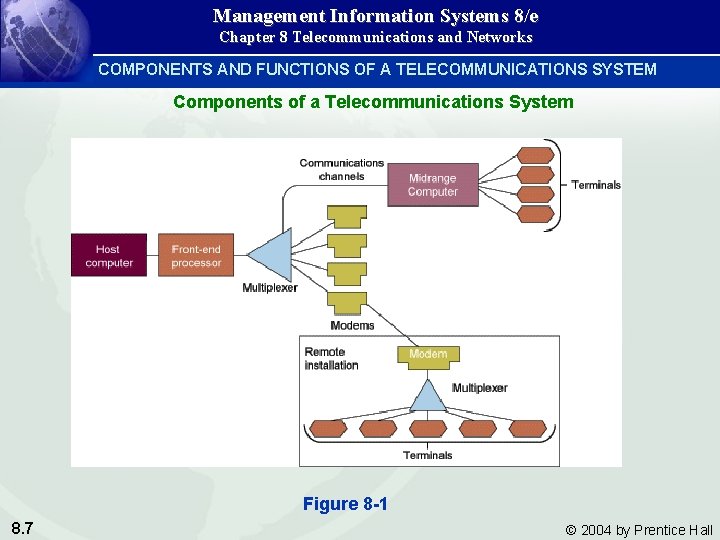
Management Information Systems 8/e Chapter 8 Telecommunications and Networks COMPONENTS AND FUNCTIONS OF A TELECOMMUNICATIONS SYSTEM Telecommunications System Components 8. 6 • Computers to process information • Terminals or any input/output devices that send or receive data • Communications processors • Communications software © 2004 by Prentice Hall
Management Information Systems 8/e Chapter 8 Telecommunications and Networks COMPONENTS AND FUNCTIONS OF A TELECOMMUNICATIONS SYSTEM Components of a Telecommunications System Figure 8 -1 8. 7 © 2004 by Prentice Hall
Management Information Systems 8/e Chapter 8 Telecommunications and Networks COMPONENTS AND FUNCTIONS OF A TELECOMMUNICATIONS SYSTEM Functions of Telecommunications Systems 8. 8 • Transmit information • Establish interface between sender and the receiver • Route messages along most efficient paths © 2004 by Prentice Hall
Management Information Systems 8/e Chapter 8 Telecommunications and Networks COMPONENTS AND FUNCTIONS OF A TELECOMMUNICATIONS SYSTEM Functions of Telecommunications Systems 8. 9 • Perform elementary processing of information • Perform editorial tasks on data • Convert message speed or format • Control flow of information © 2004 by Prentice Hall
Management Information Systems 8/e Chapter 8 Telecommunications and Networks COMPONENTS AND FUNCTIONS OF A TELECOMMUNICATIONS SYSTEM Types of Signals: Analog and Digital Analog signal 8. 10 • Continuous waveform • Passes through communications medium • Used for voice communications © 2004 by Prentice Hall
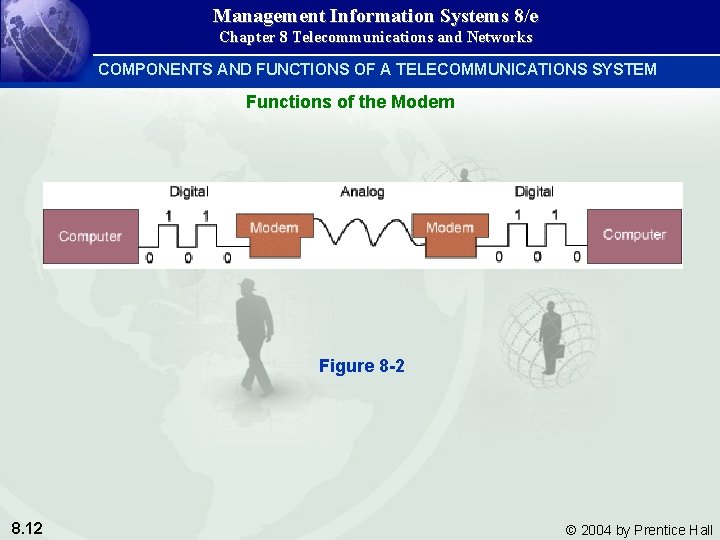
Management Information Systems 8/e Chapter 8 Telecommunications and Networks COMPONENTS AND FUNCTIONS OF A TELECOMMUNICATIONS SYSTEM Types of Signals: Analog and Digital signal • Discrete waveform • Transmits data coded into two discrete states as 1 -bits and 0 -bits Used for data communications • Modem • 8. 11 Translates computer’s digital signals into analog and vice versa © 2004 by Prentice Hall
Management Information Systems 8/e Chapter 8 Telecommunications and Networks COMPONENTS AND FUNCTIONS OF A TELECOMMUNICATIONS SYSTEM Functions of the Modem Figure 8 -2 8. 12 © 2004 by Prentice Hall
Management Information Systems 8/e Chapter 8 Telecommunications and Networks COMPONENTS AND FUNCTIONS OF A TELECOMMUNICATIONS SYSTEM Communications Channels • Twisted wire: Telephone systems • Coaxial cable: Cable television • Fiber optics and optical networks: Dense wave division multiplexing (DWDM) 8. 13 © 2004 by Prentice Hall
Management Information Systems 8/e Chapter 8 Telecommunications and Networks COMPONENTS AND FUNCTIONS OF A TELECOMMUNICATIONS SYSTEM Communications Channels 8. 14 • Wireless transmission: Microwave, • Transmission speed: Baud, Satellites, Paging systems, Cellular telephones, Personal communication Services, Personal digital assistants, Mobile data networks bandwidth © 2004 by Prentice Hall
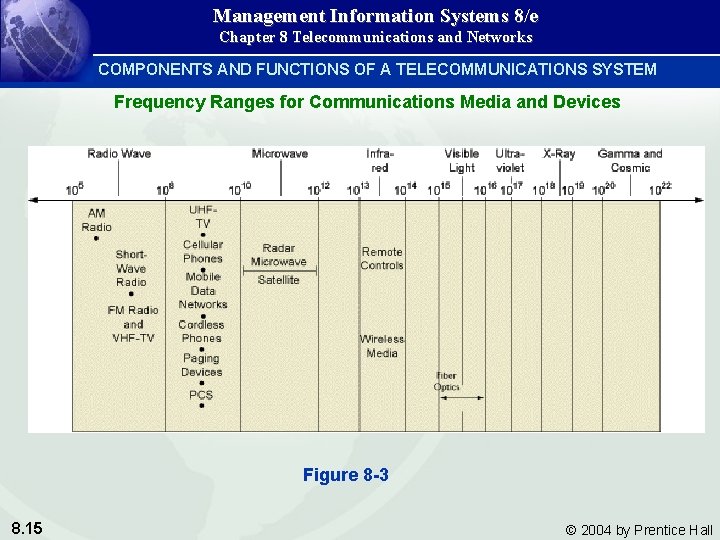
Management Information Systems 8/e Chapter 8 Telecommunications and Networks COMPONENTS AND FUNCTIONS OF A TELECOMMUNICATIONS SYSTEM Frequency Ranges for Communications Media and Devices Figure 8 -3 8. 15 © 2004 by Prentice Hall
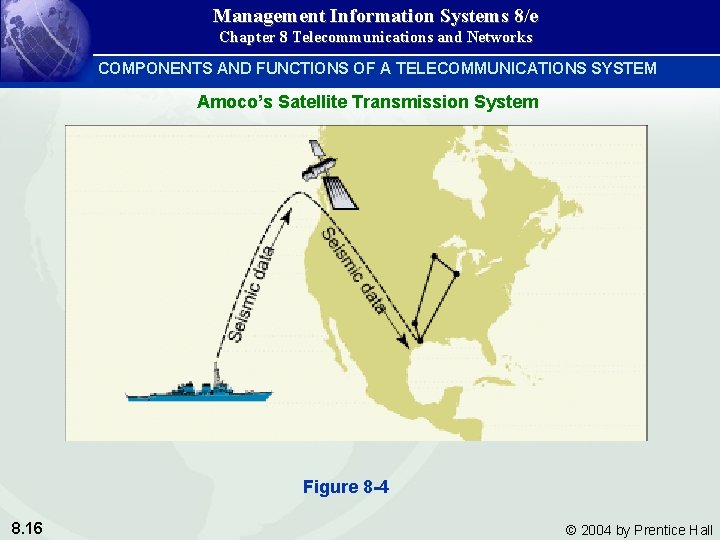
Management Information Systems 8/e Chapter 8 Telecommunications and Networks COMPONENTS AND FUNCTIONS OF A TELECOMMUNICATIONS SYSTEM Amoco’s Satellite Transmission System Figure 8 -4 8. 16 © 2004 by Prentice Hall
Management Information Systems 8/e Chapter 8 Telecommunications and Networks COMPONENTS AND FUNCTIONS OF A TELECOMMUNICATIONS SYSTEM Communications Processors and Software 8. 17 • Front-end processor: Manages • Concentrator: Collects and temporarily • Controller: Supervises communication • Multiplexer: Enables single communications for the host computer stores messages traffic communication channel to carry data transmissions © 2004 by Prentice Hall
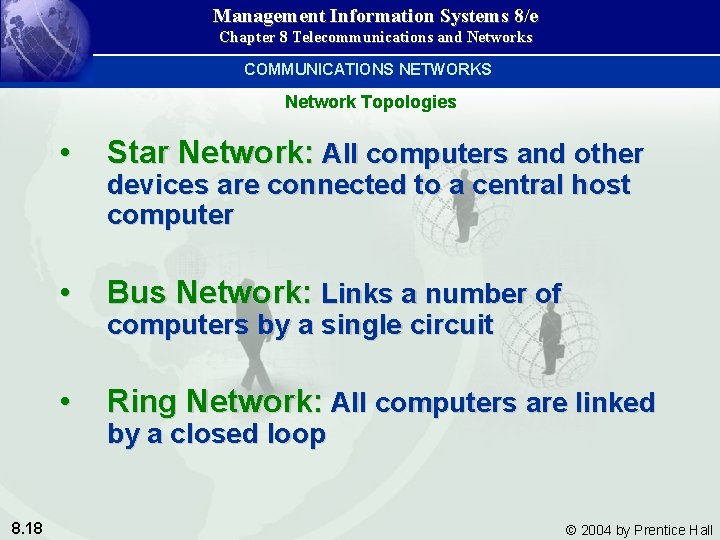
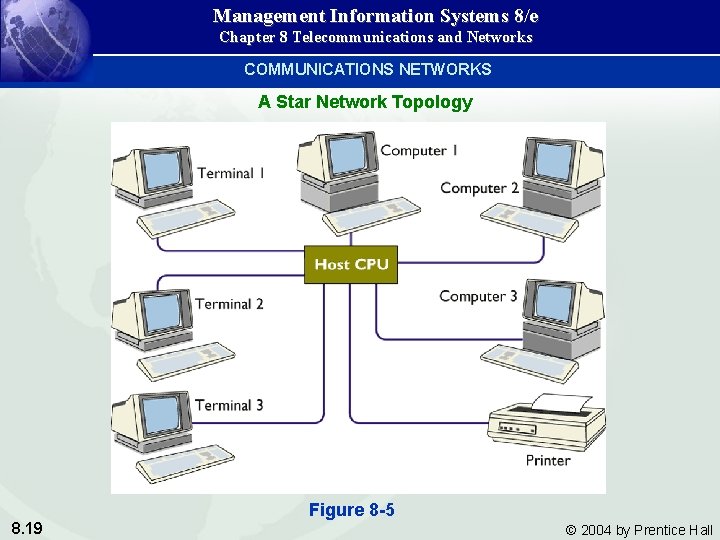
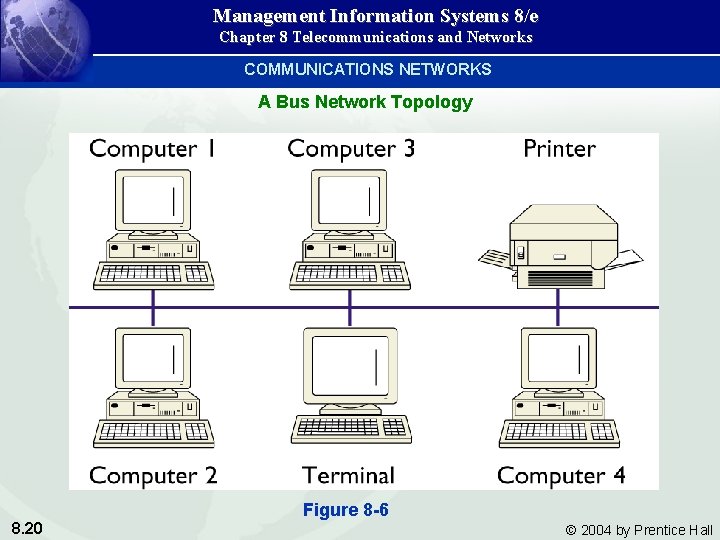
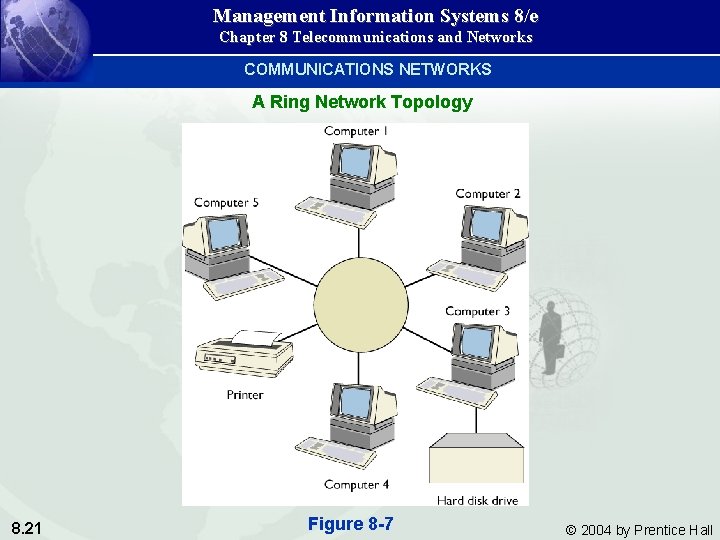
Management Information Systems 8/e Chapter 8 Telecommunications and Networks COMMUNICATIONS NETWORKS Network Topologies 8. 18 • Star Network: All computers and other • Bus Network: Links a number of • Ring Network: All computers are linked devices are connected to a central host computers by a single circuit by a closed loop © 2004 by Prentice Hall
Management Information Systems 8/e Chapter 8 Telecommunications and Networks COMMUNICATIONS NETWORKS A Star Network Topology 8. 19 Figure 8 -5 © 2004 by Prentice Hall
Management Information Systems 8/e Chapter 8 Telecommunications and Networks COMMUNICATIONS NETWORKS A Bus Network Topology 8. 20 Figure 8 -6 © 2004 by Prentice Hall
Management Information Systems 8/e Chapter 8 Telecommunications and Networks COMMUNICATIONS NETWORKS A Ring Network Topology 8. 21 Figure 8 -7 © 2004 by Prentice Hall
Management Information Systems 8/e Chapter 8 Telecommunications and Networks COMMUNICATIONS NETWORKS Private Branch Exchanges, Local Area Networks (LANs), and Wide Area Networks (WANs) Private Branch Exchanges 8. 22 • Central switching system • Handle firm’s voice and digital communications © 2004 by Prentice Hall
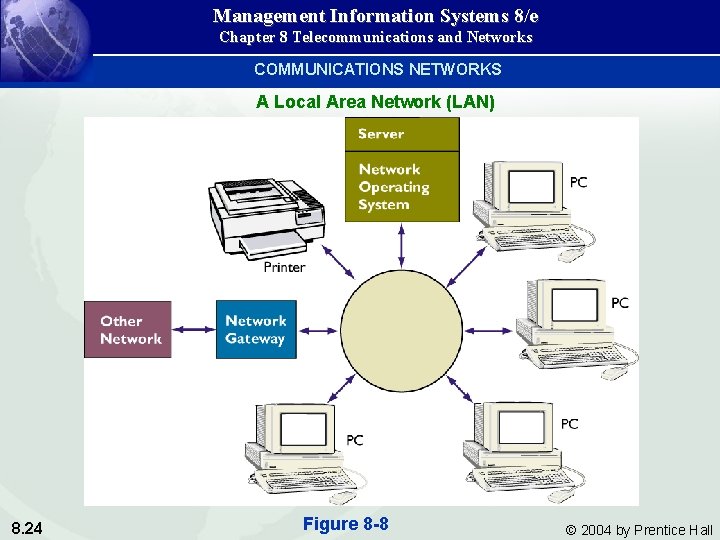
Management Information Systems 8/e Chapter 8 Telecommunications and Networks COMMUNICATIONS NETWORKS Private Branch Exchanges, Local Area Networks (LANs), and Wide Area Networks (WANs) Local Area Networks 8. 23 • Require their own dedicated channels • Encompass a limited distance • Gateway, router, Network Operating System (NOS), peer-to-peer © 2004 by Prentice Hall
Management Information Systems 8/e Chapter 8 Telecommunications and Networks COMMUNICATIONS NETWORKS A Local Area Network (LAN) 8. 24 Figure 8 -8 © 2004 by Prentice Hall
Management Information Systems 8/e Chapter 8 Telecommunications and Networks COMMUNICATIONS NETWORKS Private Branch Exchanges, Local Area Networks (LANs), and Wide Area Networks (WANs) Wireless LANs 8. 25 • Wi-Fi (802. 11 b) standard: Up to 11 Mbps, low cost, high-speed mobile Internet access, links work groups • Bluetooth standard: Up to 720 Kbps, small personal area networks © 2004 by Prentice Hall
Management Information Systems 8/e Chapter 8 Telecommunications and Networks COMMUNICATIONS NETWORKS Private Branch Exchanges, Local Area Networks (LANs), and Wide Area Networks (WANs) 8. 26 • Span large geographical distance • Consist of variety of cable, satellite, and microwave technologies • Switched lines, dedicated lines © 2004 by Prentice Hall
Management Information Systems 8/e Chapter 8 Telecommunications and Networks COMMUNICATIONS NETWORKS Network Services and Broadband Technologies Value-Added Networks (VANs) • Private, multipath, data-only, third-party-managed network Other Network Services 8. 27 • Packet switching, Frame Relay, Asynchronous transfer mode (ATM) • Integrated Services Digital Network (ISDN), Digital subscriber line (DSL), Cable modems, T 1 line Broadband © 2004 by Prentice Hall
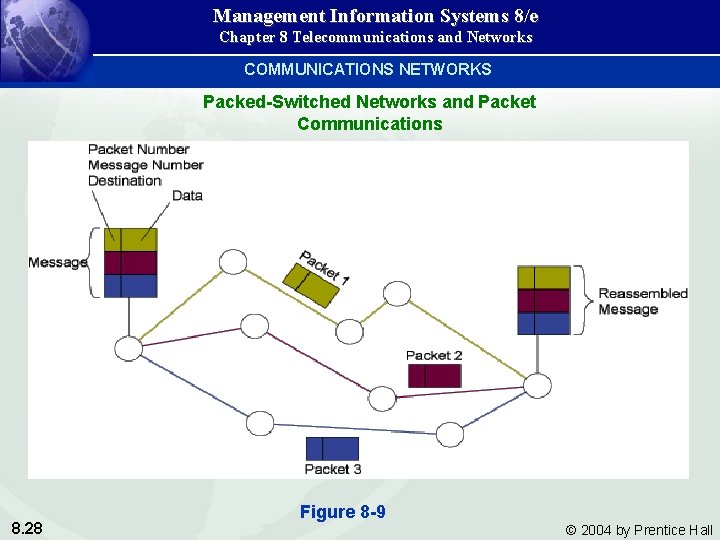
Management Information Systems 8/e Chapter 8 Telecommunications and Networks COMMUNICATIONS NETWORKS Packed-Switched Networks and Packet Communications 8. 28 Figure 8 -9 © 2004 by Prentice Hall
Management Information Systems 8/e Chapter 8 Telecommunications and Networks COMMUNICATIONS NETWORKS Network Convergence Converged network • Enables voice, video and data to run over a single network Unified messaging • 8. 29 System combining voice messages, email, and fax © 2004 by Prentice Hall
Management Information Systems 8/e Chapter 8 Telecommunications and Networks ELECTRONIC COMMERCE AND ELECTRONIC BUSINESS TECHNOLOGIES Electronic Commerce and Electronic Business Technologies Electronic Mail and Groupware • E-mail: Eliminates telephone tag and costly long-distance telephone charges • Groupware: Enables work groups at different locations to participate in discussion forums and work on shared documents and projects 8. 30 © 2004 by Prentice Hall
Management Information Systems 8/e Chapter 8 Telecommunications and Networks ELECTRONIC COMMERCE AND ELECTRONIC BUSINESS TECHNOLOGIES Electronic Commerce and Electronic Business Technologies Voice Mail and Fax • Voice mail: Digitizes spoken message and transmits it over a network • Fax: Digitizes and transmits documents over telephone lines 8. 31 © 2004 by Prentice Hall
Management Information Systems 8/e Chapter 8 Telecommunications and Networks ELECTRONIC COMMERCE AND ELECTRONIC BUSINESS TECHNOLOGIES Electronic Commerce and Electronic Business Technologies Teleconferencing, data conferencing, and videoconferencing • Teleconferencing: Ability to confer with a group of people simultaneously 8. 32 • Data conferencing: Two or more users • Videoconferencing: Participants are can edit and modify data files simultaneously able to see each other over video screens © 2004 by Prentice Hall
Management Information Systems 8/e Chapter 8 Telecommunications and Networks ELECTRONIC COMMERCE AND ELECTRONIC BUSINESS TECHNOLOGIES Electronic Commerce and Electronic Business Technologies Digital information services, distance learning and E-Learning • Distance learning: Education or training delivered over a distance to individuals in one or more locations • E-learning: Instruction delivered online using the Internet or private networks 8. 33 © 2004 by Prentice Hall
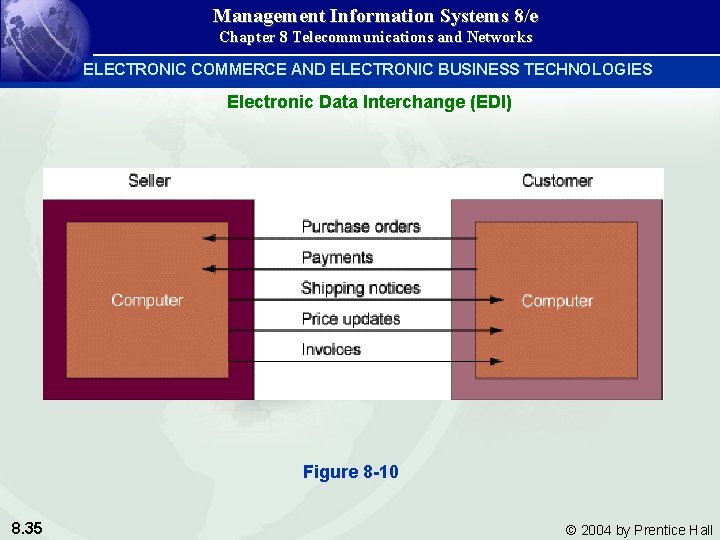
Management Information Systems 8/e Chapter 8 Telecommunications and Networks ELECTRONIC COMMERCE AND ELECTRONIC BUSINESS TECHNOLOGIES Electronic Data Interchange (EDI) • 8. 34 Direct computer-to-computer exchange between two organizations of standard business transaction documents © 2004 by Prentice Hall
Management Information Systems 8/e Chapter 8 Telecommunications and Networks ELECTRONIC COMMERCE AND ELECTRONIC BUSINESS TECHNOLOGIES Electronic Data Interchange (EDI) Figure 8 -10 8. 35 © 2004 by Prentice Hall
Chapter 8 Management Information Systems 8/e Chapter 8 Telecommunications and Networks TELECOMMUNICATIONS AND NETWORKS 8. 36 © 2004 by Prentice Hall