
Chapter 8 Making Decisions and Problem Solving Making
Chapter 8 Making Decisions and Problem Solving
Making Good Decisions – Prepare 8 -2 • Decision making is the process of deciding among various alternatives • Identifying your goals – Every decision needs to start with your short and long-term goals in mind Mc. Graw-Hill © 2011 by The Mc. Graw-Hill Companies, Inc. All rights reserved.
8 -3 Making Good Decisions – Organize • Considering and assessing your alternatives – Develop a list of flexible alternatives • Use freewriting techniques – Assess your alternatives • Determine the possible outcomes of each • Determine the probability that those outcomes will take place • Compare the alternatives, taking into account the potential outcomes of each Mc. Graw-Hill © 2011 by The Mc. Graw-Hill Companies, Inc. All rights reserved.
8 -4 Making Good Decisions – Work • Making and carrying out the decision – Choosing among alternatives • Give the decision time • Make a mental movie, acting out the various alternatives • Toss a coin • Ask for advice • Learn to view indecision as a decision • Go with your gut feeling – The final step of decision making is to carry it out Mc. Graw-Hill © 2011 by The Mc. Graw-Hill Companies, Inc. All rights reserved.
Making Good Decisions - Evaluate 8 -5 • Considering the outcomes • Did you make the right decision? – Consider the results – Reevaluate and consider alternatives if you find you are not happy with your initial decision • It’s not a bad thing to change your mind Mc. Graw-Hill © 2011 by The Mc. Graw-Hill Companies, Inc. All rights reserved.
Making Good Decisions - Rethink 8 -6 • Reconsidering your goals and options – There is no single decision that is best – there are often many routes to the same goal • Ask yourself: – Are my decisions still producing the desired consequences? – Are my decisions still appropriate? – Are they consistent with what I want to get out of life? Mc. Graw-Hill © 2011 by The Mc. Graw-Hill Companies, Inc. All rights reserved.
Problem Solving 8 -7 • The process of generating alternatives while working on a problem • What is the problem? – What are the initial facts? – What is it that you need to solve? – What is the most critical aspect of the problem to be solved? – What can be ignored? Mc. Graw-Hill © 2011 by The Mc. Graw-Hill Companies, Inc. All rights reserved.
Problem Solving 8 -8 • Strategies – Break the problem down into smaller parts – Work backward – Use a chart or graph to redefine the problem – Consider the opposite – Use analogies – Take a different perspective – Forget about it for a while Mc. Graw-Hill © 2011 by The Mc. Graw-Hill Companies, Inc. All rights reserved.
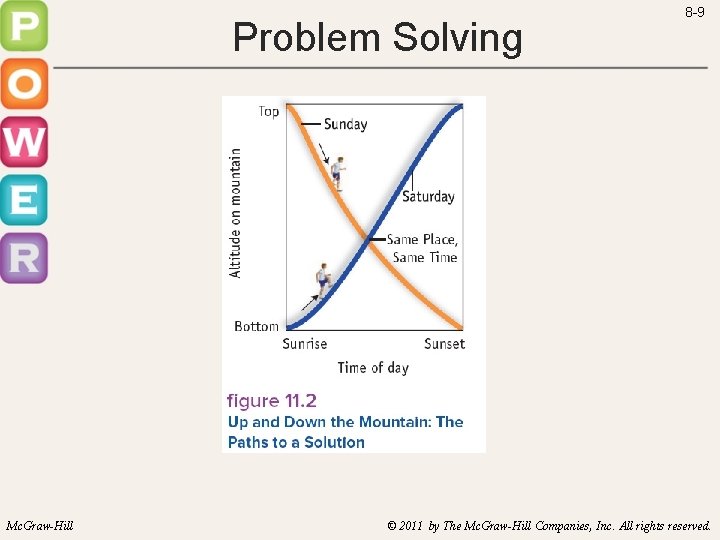
Problem Solving Mc. Graw-Hill 8 -9 © 2011 by The Mc. Graw-Hill Companies, Inc. All rights reserved.
Problem Solving 8 -10 • Assess potential solutions • Is there a way to refine the solution? Are there alternative approaches? • There is often no perfect solution Mc. Graw-Hill © 2011 by The Mc. Graw-Hill Companies, Inc. All rights reserved.
Problems in Critical Thinking 8 -11 • Don’t assume that labeling something explains the problem • Don’t accept vague generalities • Don’t confuse opinion with fact • Avoid jumping to conclusions • Be skeptical of “common sense” • Don’t assume that one event causes another just because they occur one after the other Mc. Graw-Hill © 2011 by The Mc. Graw-Hill Companies, Inc. All rights reserved.
- Slides: 11