
CHAPTER 8 MAGNETOSTATIC FIELD MAGNETIC FORCE MAGNETIC MATERIAL
- Slides: 43
CHAPTER 8 MAGNETOSTATIC FIELD (MAGNETIC FORCE, MAGNETIC MATERIAL AND INDUCTANCE) 8. 1 FORCE ON A MOVING POINT CHARGE 8. 2 FORCE ON A FILAMENTARY CURRENT 8. 3 FORCE BETWEEN TWO FILAMENTARY CURRENT 8. 4 MAGNETIC MATERIAL 8. 5 MAGNETIC BOUNDARY CONDITIONS 8. 6 SELF INDUCTANCE AND MUTUAL INDUCTANCE 8. 7 MAGNETIC ENERGY DENSITY 1
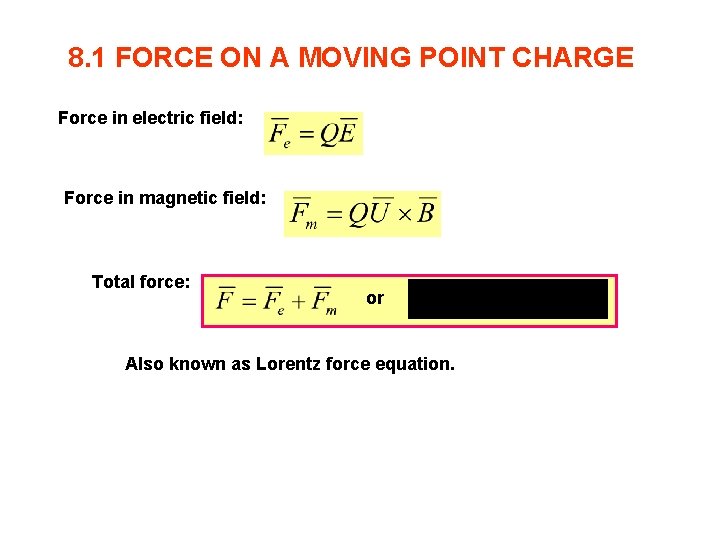
8. 1 FORCE ON A MOVING POINT CHARGE Force in electric field: Force in magnetic field: Total force: or Also known as Lorentz force equation.
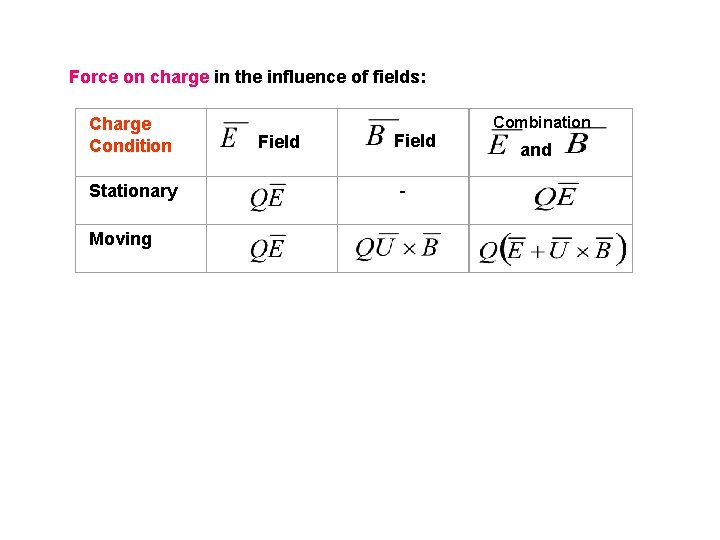
Force on charge in the influence of fields: Charge Condition Stationary Moving Field - Combination and
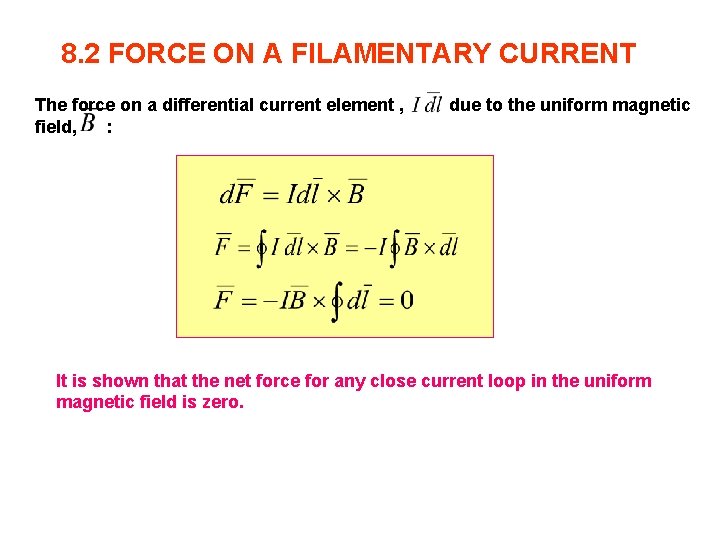
8. 2 FORCE ON A FILAMENTARY CURRENT The force on a differential current element , field, : due to the uniform magnetic It is shown that the net force for any close current loop in the uniform magnetic field is zero.
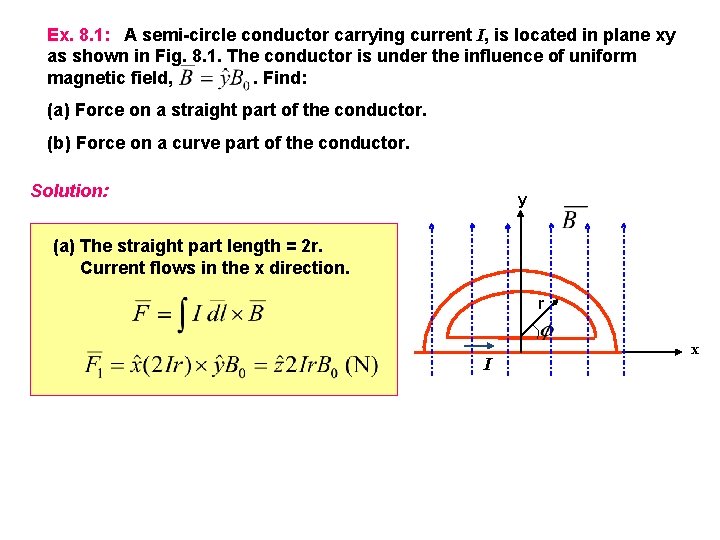
Ex. 8. 1: A semi-circle conductor carrying current I, is located in plane xy as shown in Fig. 8. 1. The conductor is under the influence of uniform magnetic field, . Find: (a) Force on a straight part of the conductor. (b) Force on a curve part of the conductor. Solution: y (a) The straight part length = 2 r. Current flows in the x direction. r I x
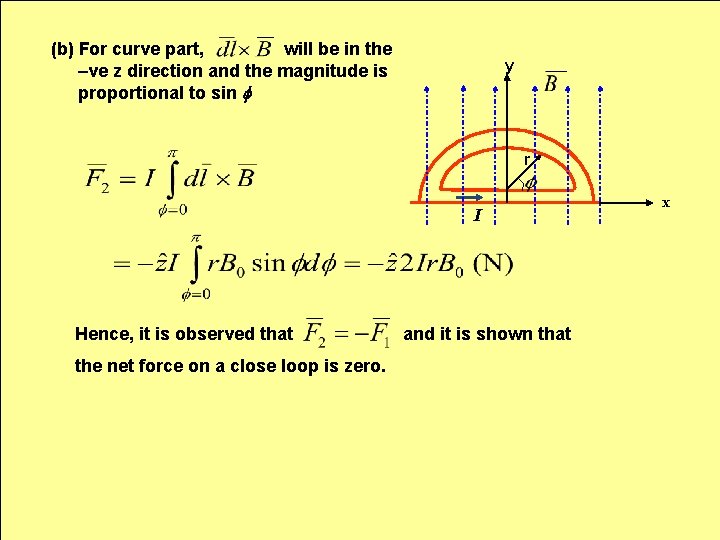
(b) For curve part, will be in the –ve z direction and the magnitude is proportional to sin y r I Hence, it is observed that the net force on a close loop is zero. and it is shown that x
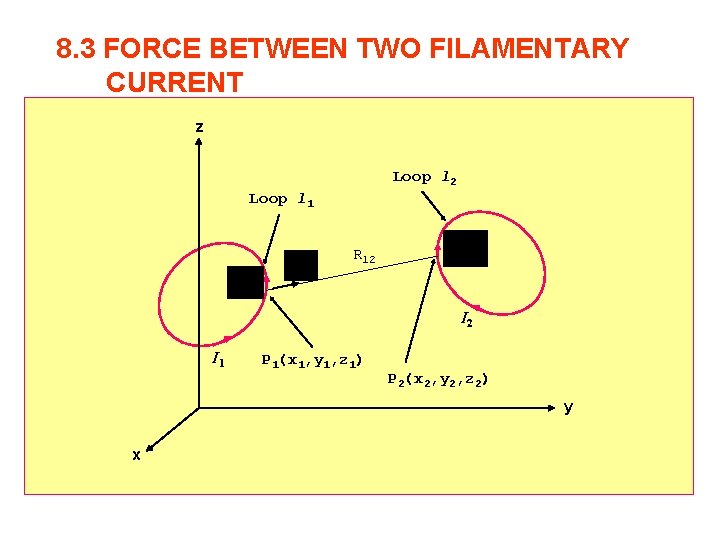
8. 3 FORCE BETWEEN TWO FILAMENTARY CURRENT z Loop l 2 Loop l 1 R 12 I 1 P 1(x 1, y 1, z 1) P 2(x 2, y 2, z 2) y x
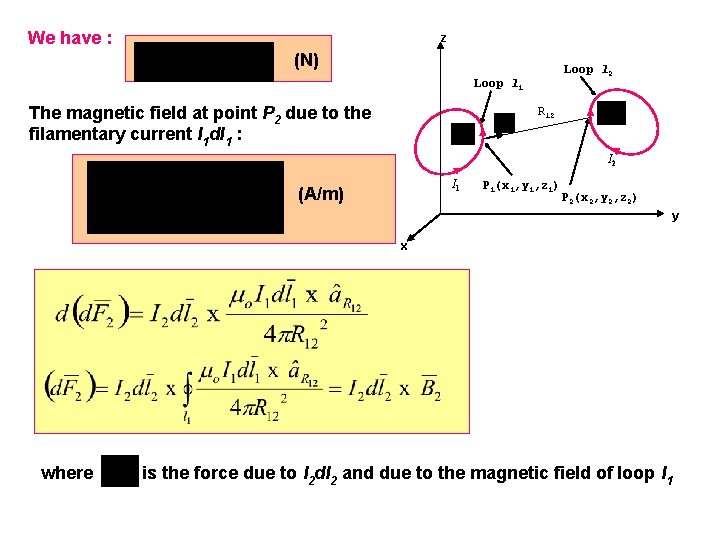
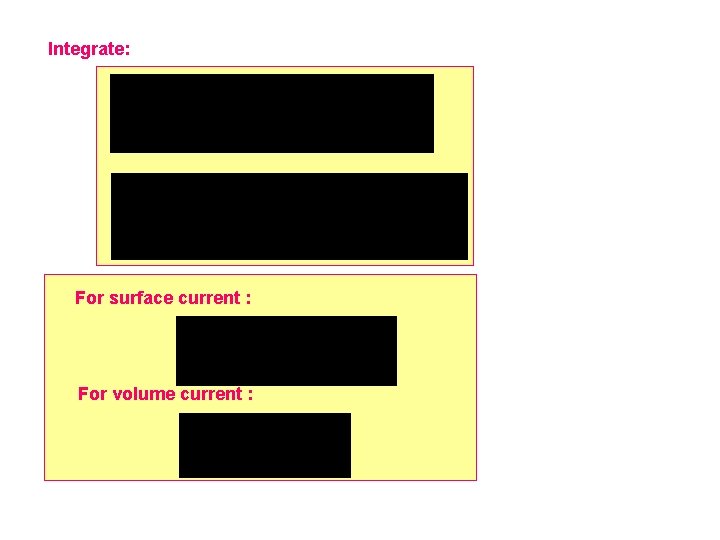
We have : z (N) Loop l 2 Loop l 1 The magnetic field at point P 2 due to the filamentary current I 1 dl 1 : R 12 I 1 (A/m) P 1(x 1, y 1, z 1) P 2(x 2, y 2, z 2) y x where is the force due to I 2 dl 2 and due to the magnetic field of loop l 1
Integrate: For surface current : For volume current :
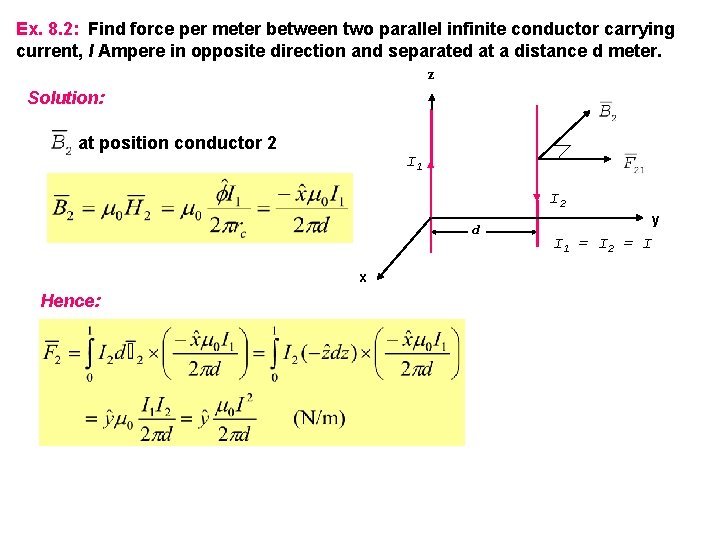
Ex. 8. 2: Find force per meter between two parallel infinite conductor carrying current, I Ampere in opposite direction and separated at a distance d meter. z Solution: at position conductor 2 I 1 I 2 d x Hence: y I 1 = I 2 = I
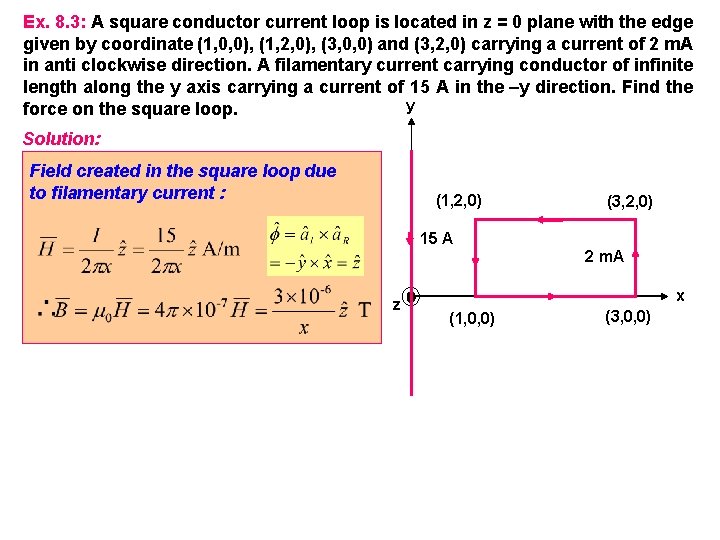
Ex. 8. 3: A square conductor current loop is located in z = 0 plane with the edge given by coordinate (1, 0, 0), (1, 2, 0), (3, 0, 0) and (3, 2, 0) carrying a current of 2 m. A in anti clockwise direction. A filamentary current carrying conductor of infinite length along the y axis carrying a current of 15 A in the –y direction. Find the y force on the square loop. Solution: Field created in the square loop due to filamentary current : (1, 2, 0) (3, 2, 0) 15 A 2 m. A z x (1, 0, 0) (3, 0, 0)
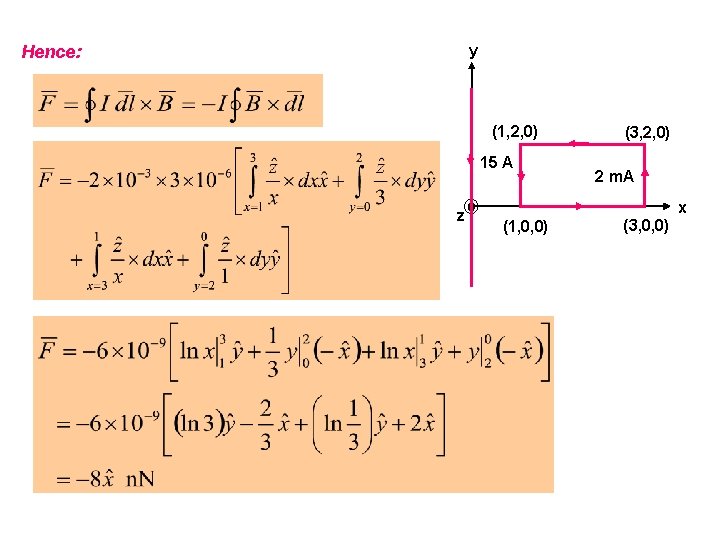
Hence: y (1, 2, 0) 15 A z (1, 0, 0) (3, 2, 0) 2 m. A (3, 0, 0) x
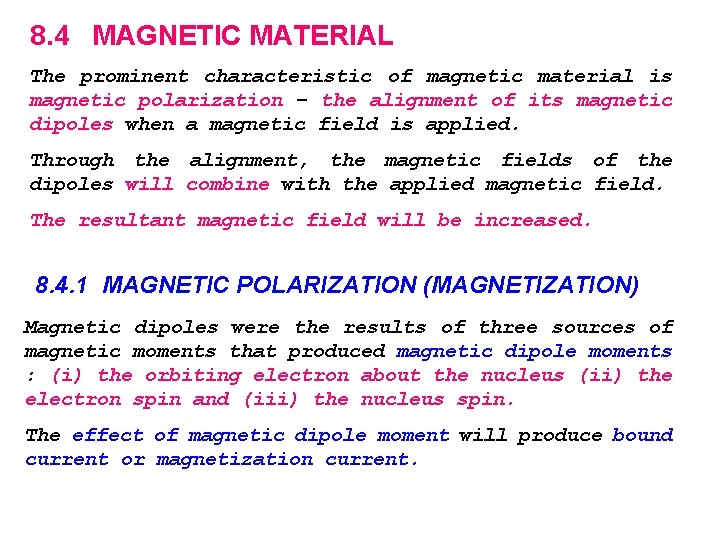
8. 4 MAGNETIC MATERIAL The prominent characteristic of magnetic material is magnetic polarization – the alignment of its magnetic dipoles when a magnetic field is applied. Through the alignment, the magnetic fields of the dipoles will combine with the applied magnetic field. The resultant magnetic field will be increased. 8. 4. 1 MAGNETIC POLARIZATION (MAGNETIZATION) Magnetic dipoles were the results of three sources of magnetic moments that produced magnetic dipole moments : (i) the orbiting electron about the nucleus (ii) the electron spin and (iii) the nucleus spin. The effect of magnetic dipole moment will produce bound current or magnetization current.
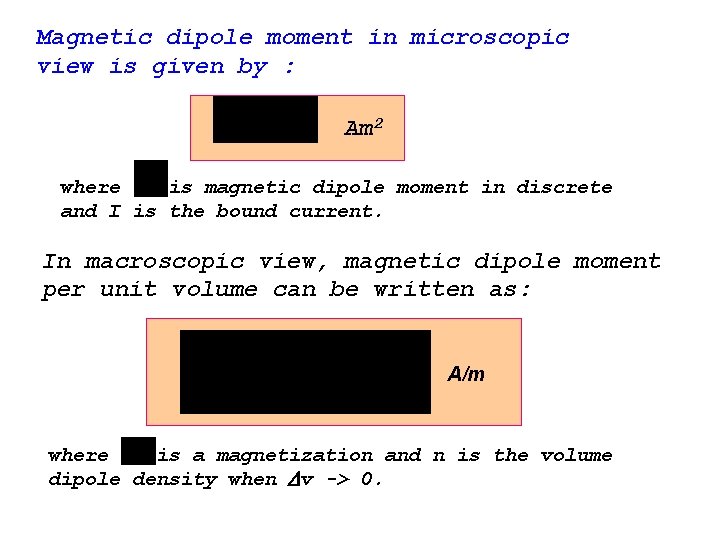
Magnetic dipole moment in microscopic view is given by : Am 2 where is magnetic dipole moment in discrete and I is the bound current. In macroscopic view, magnetic dipole moment per unit volume can be written as: A/m where is a magnetization and n is the volume dipole density when v -> 0.
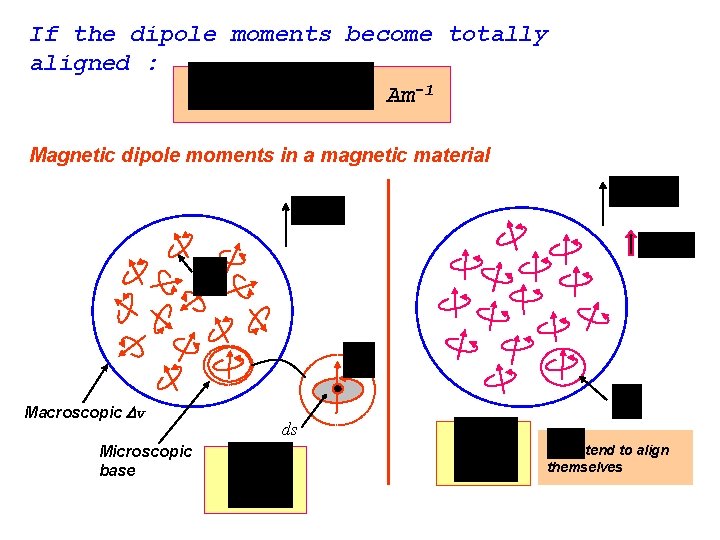
If the dipole moments become totally aligned : Am-1 Magnetic dipole moments in a magnetic material Macroscopic v Microscopic base ds tend to align themselves
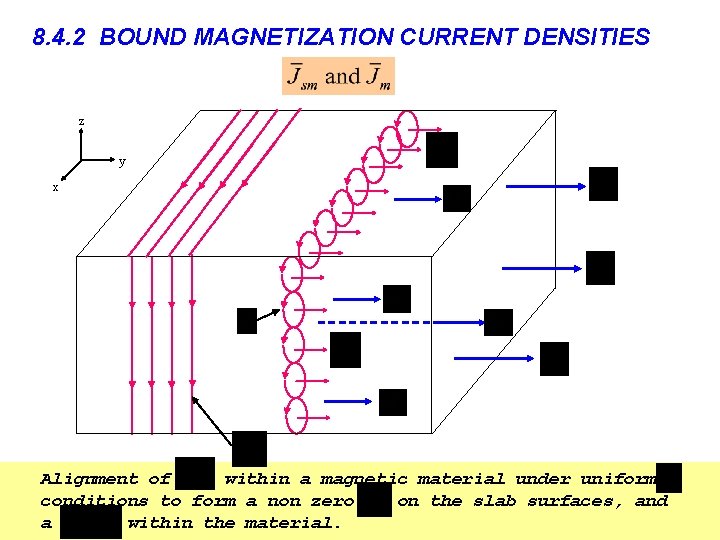
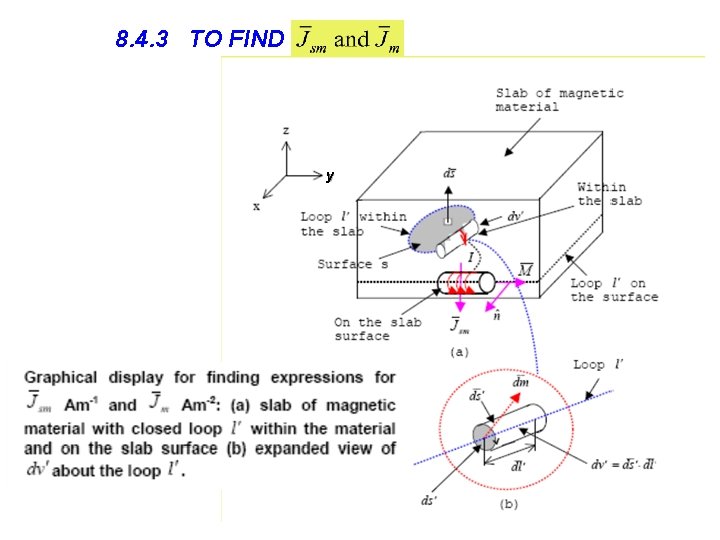
8. 4. 2 BOUND MAGNETIZATION CURRENT DENSITIES z y x Alignment of within a magnetic material under uniform conditions to form a non zero on the slab surfaces, and a within the material.
8. 4. 3 TO FIND y
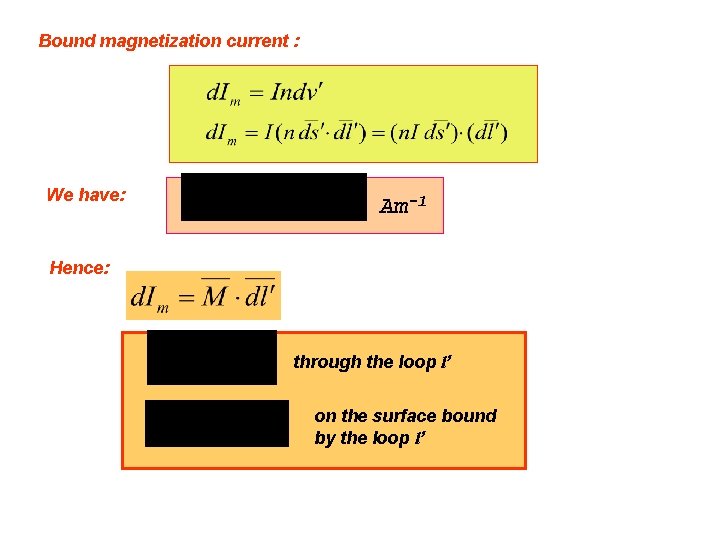
Bound magnetization current : We have: Am-1 Hence: through the loop l’ on the surface bound by the loop l’
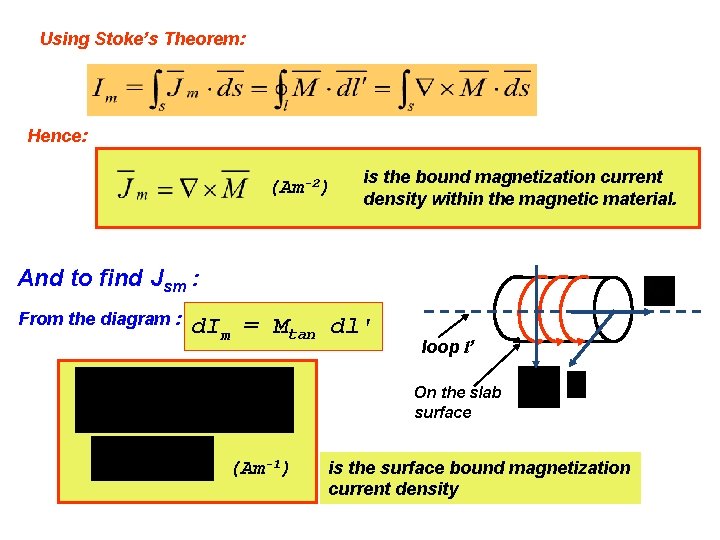
Using Stoke’s Theorem: Hence: (Am-2) is the bound magnetization current density within the magnetic material. And to find Jsm : From the diagram : d. Im = Mtan dl' loop l’ On the slab surface (Am-1) is the surface bound magnetization current density
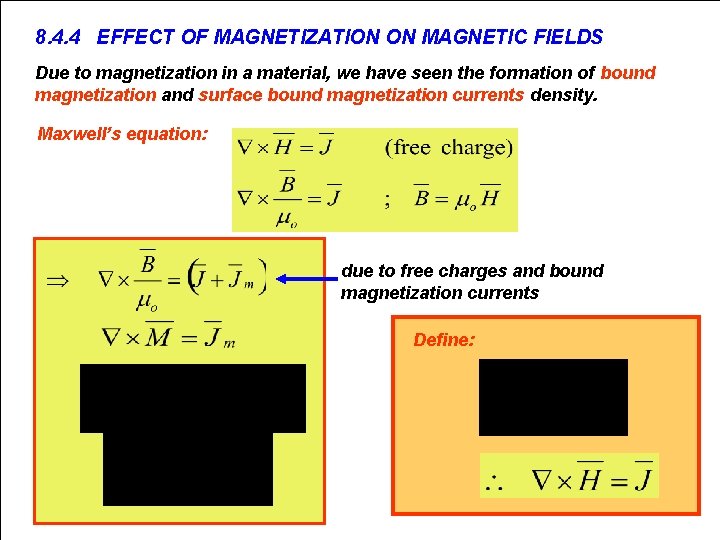
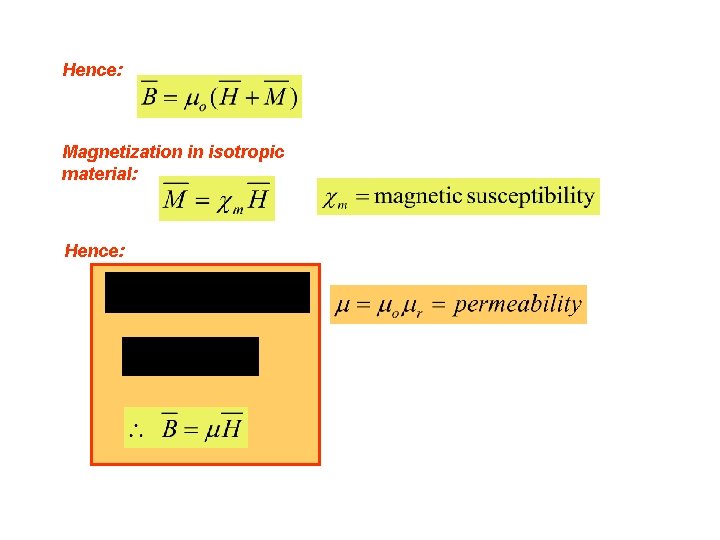
8. 4. 4 EFFECT OF MAGNETIZATION ON MAGNETIC FIELDS Due to magnetization in a material, we have seen the formation of bound magnetization and surface bound magnetization currents density. Maxwell’s equation: due to free charges and bound magnetization currents Define:
Hence: Magnetization in isotropic material: Hence:
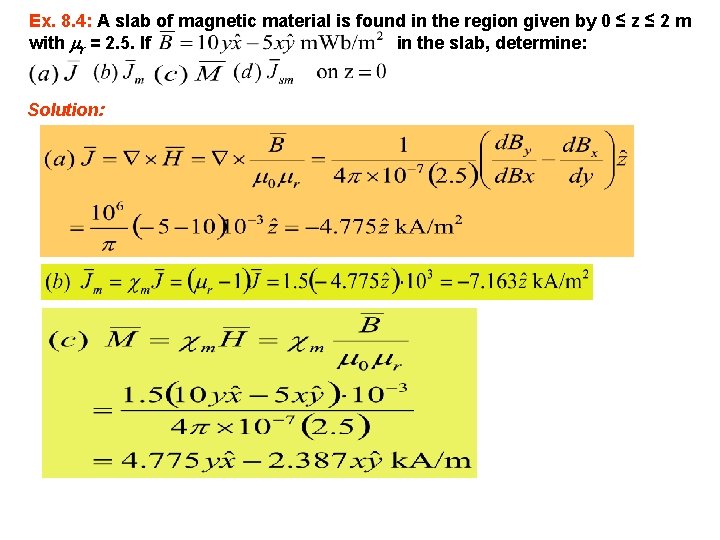
Ex. 8. 4: A slab of magnetic material is found in the region given by 0 ≤ z ≤ 2 m with r = 2. 5. If in the slab, determine: Solution:
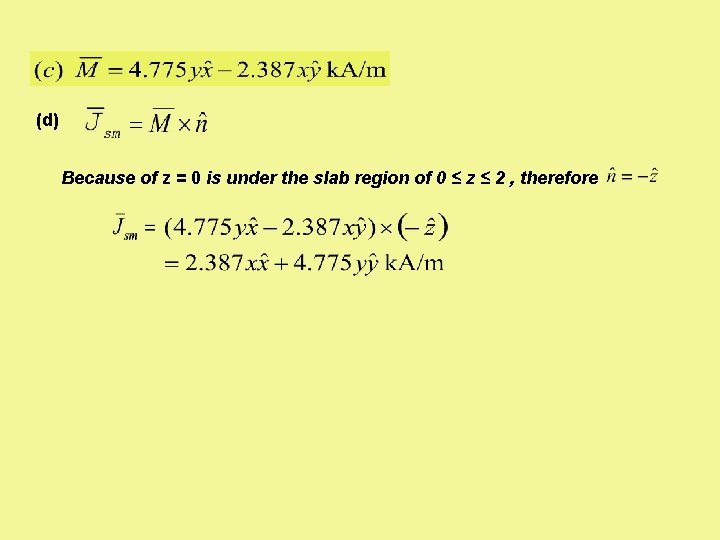
(d) Because of z = 0 is under the slab region of 0 ≤ z ≤ 2 , therefore
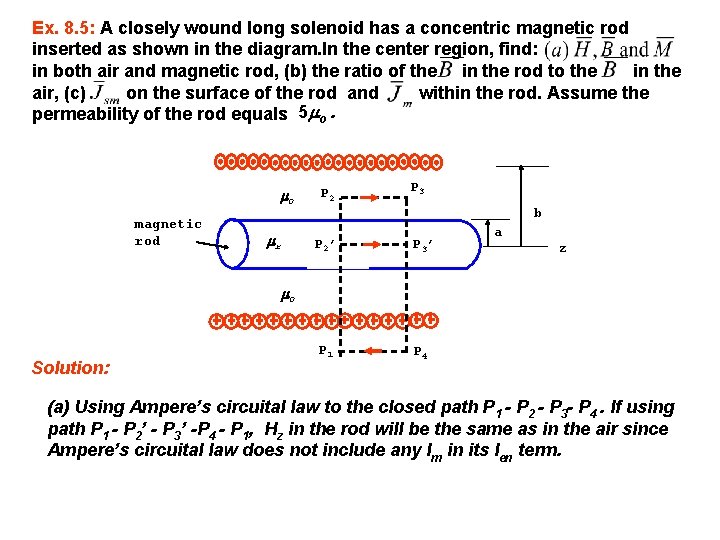
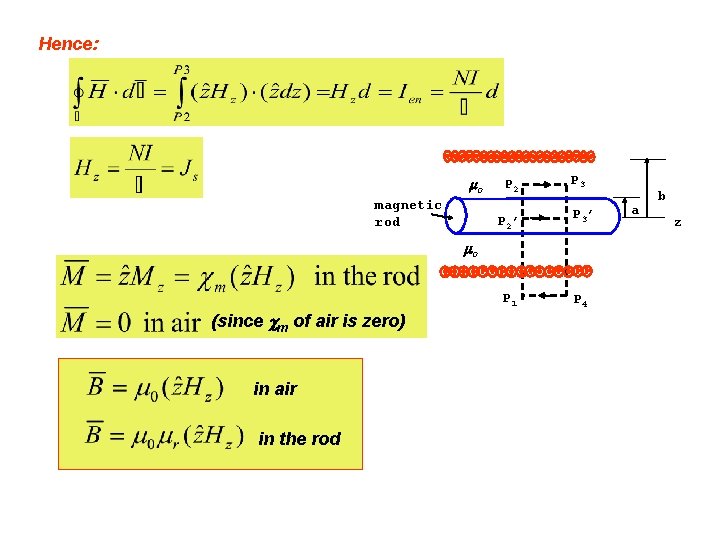
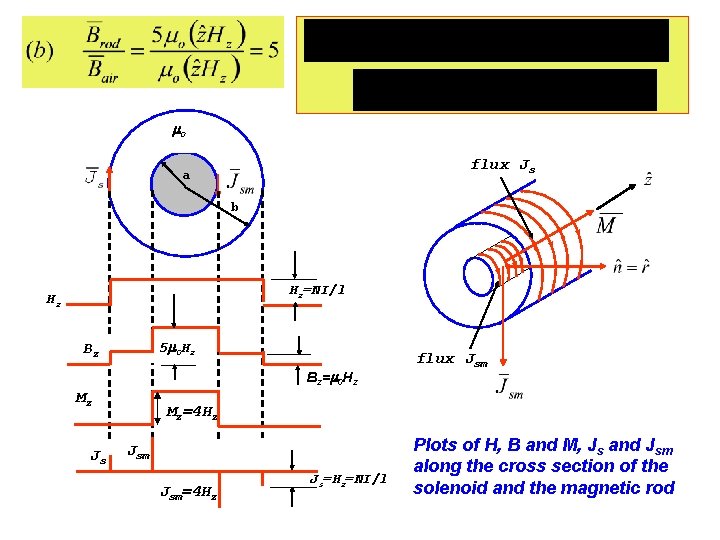
Ex. 8. 5: A closely wound long solenoid has a concentric magnetic rod inserted as shown in the diagram. In the center region, find: in both air and magnetic rod, (b) the ratio of the in the rod to the in the air, (c) on the surface of the rod and within the rod. Assume the permeability of the rod equals 5 o. 0 magnetic rod r P 2 P 3 b P 2’ P 3’ P 1 P 4 a z 0 Solution: (a) Using Ampere’s circuital law to the closed path P 1 - P 2 - P 3 - P 4. If using path P 1 - P 2’ - P 3’ -P 4 - P 1, Hz in the rod will be the same as in the air since Ampere’s circuital law does not include any Im in its Ien term.
Hence: 0 magnetic rod P 2 P 3 P 2’ P 3’ P 1 P 4 0 (since m of air is zero) in air in the rod a b z
0 flux Js aa b Hz=NI/l Hz 5 0 Hz Bz Bz= 0 Hz Mz Js flux Jsm Mz=4 Hz Jsm=4 Hz Js=Hz=NI/l Plots of H, B and M, Js and Jsm along the cross section of the solenoid and the magnetic rod
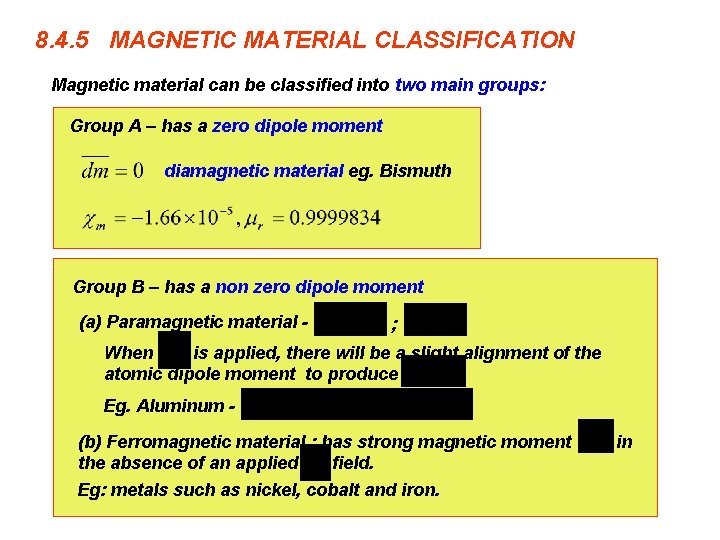
8. 4. 5 MAGNETIC MATERIAL CLASSIFICATION Magnetic material can be classified into two main groups: Group A – has a zero dipole moment diamagnetic material eg. Bismuth Group B – has a non zero dipole moment (a) Paramagnetic material - ; When is applied, there will be a slight alignment of the atomic dipole moment to produce Eg. Aluminum (b) Ferromagnetic material : has strong magnetic moment the absence of an applied field. Eg: metals such as nickel, cobalt and iron. in
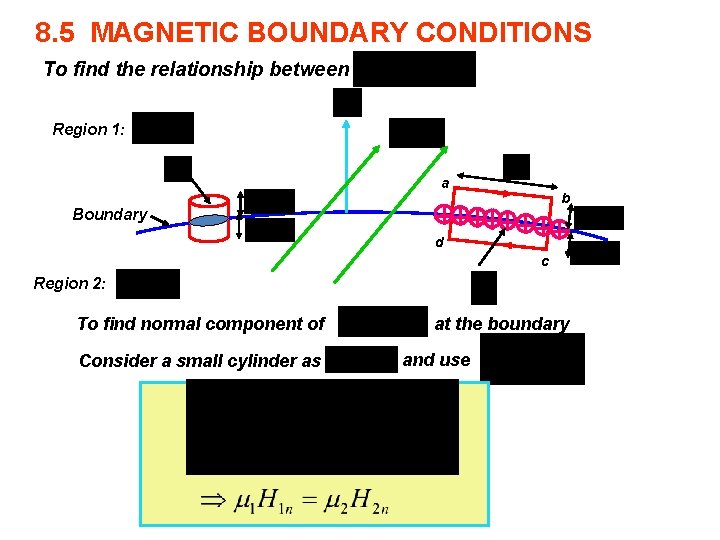
8. 5 MAGNETIC BOUNDARY CONDITIONS To find the relationship between Region 1: a b Boundary d c Region 2: To find normal component of Consider a small cylinder as at the boundary and use
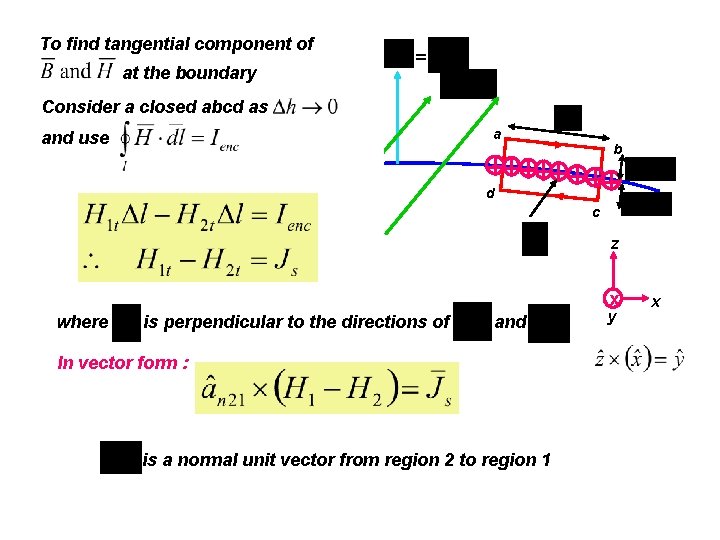
To find tangential component of at the 1: boundary Region = Consider a closed abcd as a and use b Boundary d c Region 2: z x where is perpendicular to the directions of and In vector form : is a normal unit vector from region 2 to region 1 y x
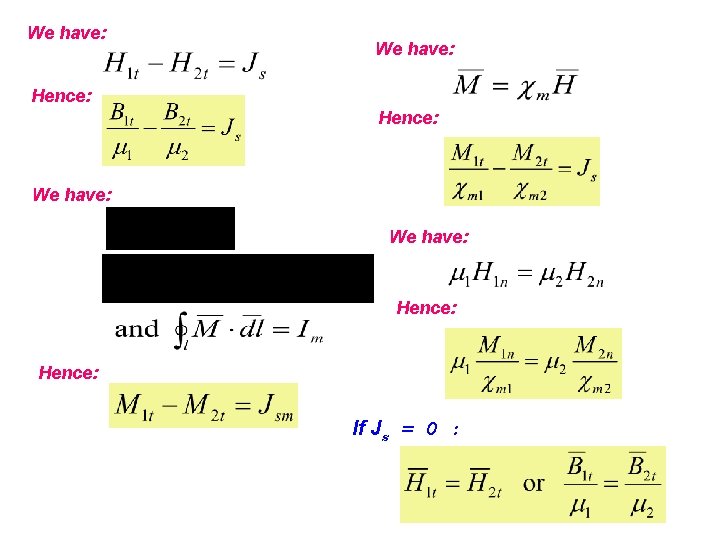
We have: Hence: If Js = 0 :
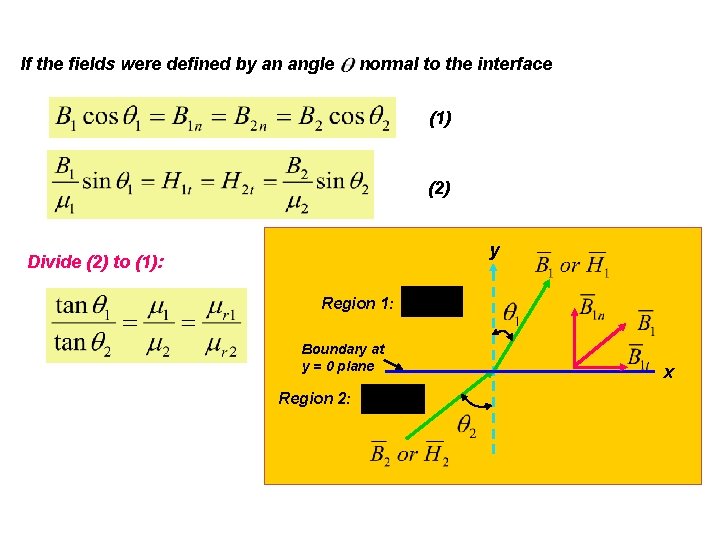
If the fields were defined by an angle normal to the interface (1) (2) y Divide (2) to (1): Region 1: Boundary at y = 0 plane Region 2: x
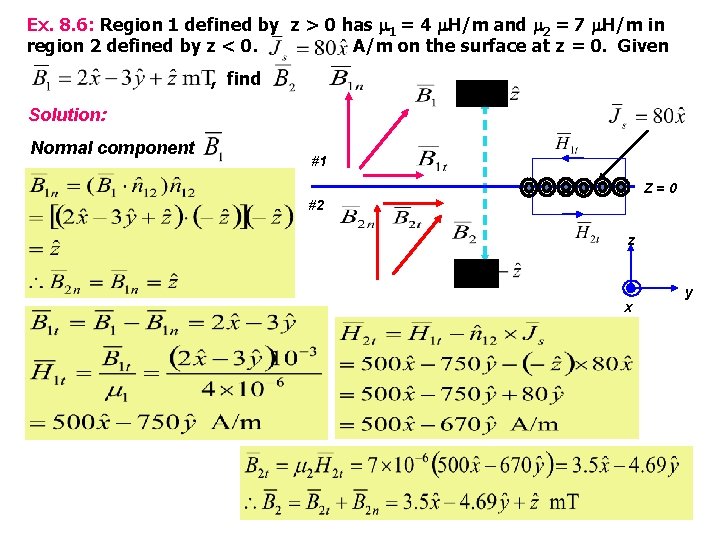
Ex. 8. 6: Region 1 defined by z > 0 has 1 = 4 H/m and 2 = 7 H/m in region 2 defined by z < 0. A/m on the surface at z = 0. Given , find Solution: Normal component #1 Z=0 #2 z x y
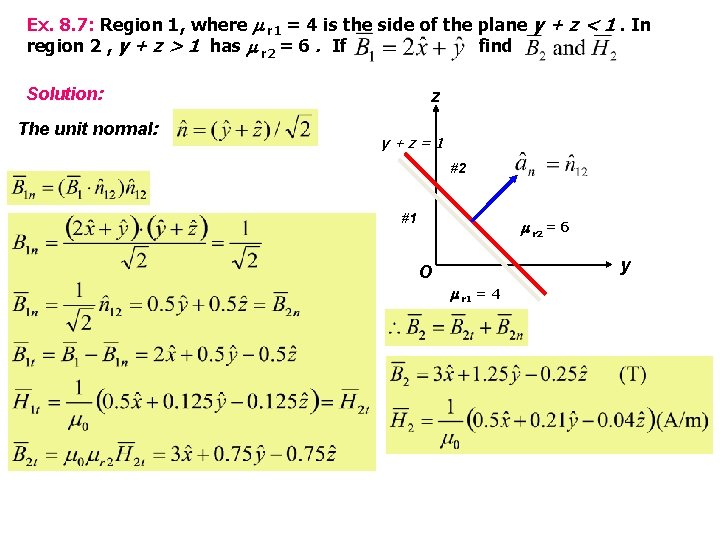
Ex. 8. 7: Region 1, where r 1 = 4 is the side of the plane y + z < 1. In region 2 , y + z > 1 has r 2 = 6. If find Solution: The unit normal: z y+z=1 #2 #1 r 2 = 6 y O r 1 = 4
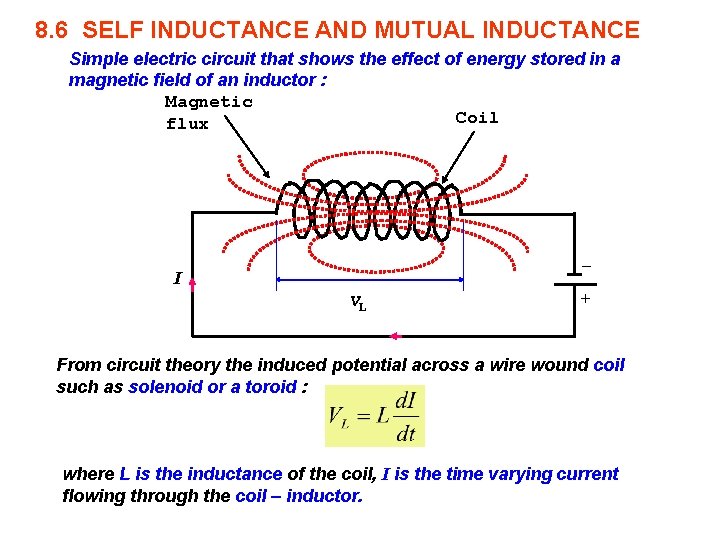
8. 6 SELF INDUCTANCE AND MUTUAL INDUCTANCE Simple electric circuit that shows the effect of energy stored in a magnetic field of an inductor : Magnetic Coil flux _ I VL + From circuit theory the induced potential across a wire wound coil such as solenoid or a toroid : where L is the inductance of the coil, I is the time varying current flowing through the coil – inductor.
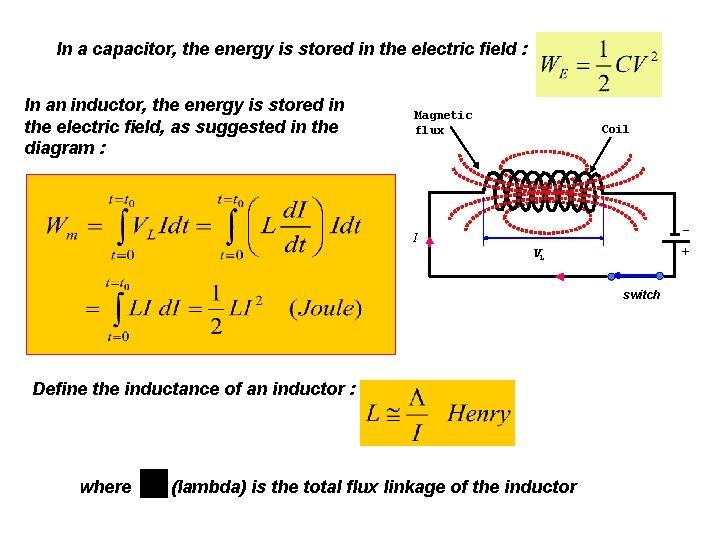
In a capacitor, the energy is stored in the electric field : In an inductor, the energy is stored in the electric field, as suggested in the diagram : Magnetic flux Coil _ I + VL switch Define the inductance of an inductor : where (lambda) is the total flux linkage of the inductor
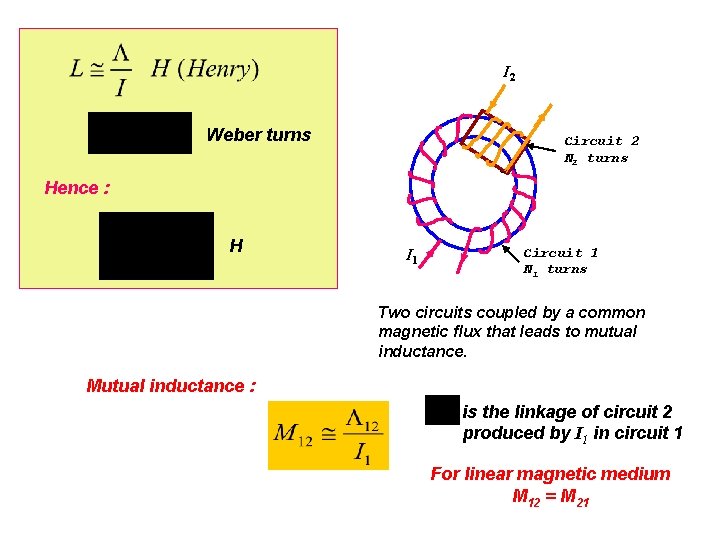
I 2 Weber turns Circuit 2 N 2 turns Hence : H I 1 Circuit 1 N 1 turns Two circuits coupled by a common magnetic flux that leads to mutual inductance. Mutual inductance : is the linkage of circuit 2 produced by I 1 in circuit 1 For linear magnetic medium M 12 = M 21
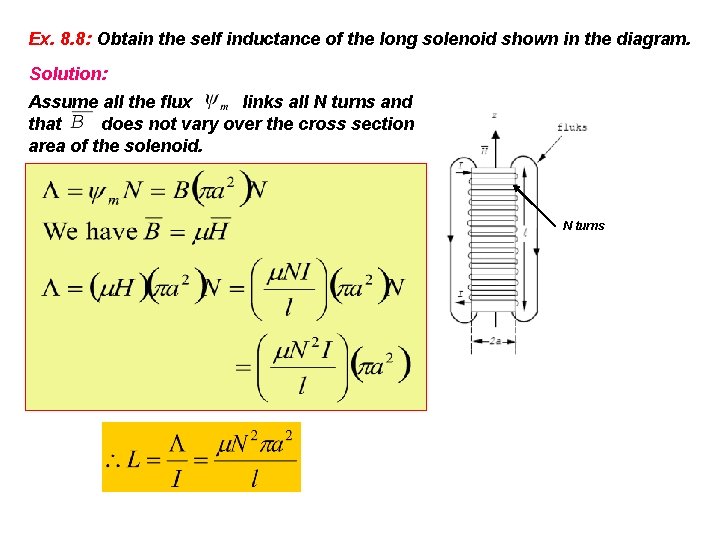
Ex. 8. 8: Obtain the self inductance of the long solenoid shown in the diagram. Solution: Assume all the flux links all N turns and that does not vary over the cross section area of the solenoid. flux N turns
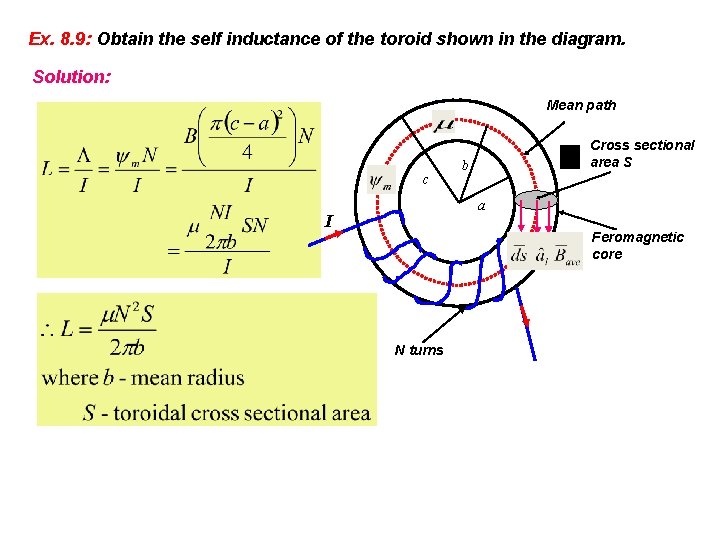
Ex. 8. 9: Obtain the self inductance of the toroid shown in the diagram. Solution: Mean path c Cross sectional area S b a I Feromagnetic core N turns
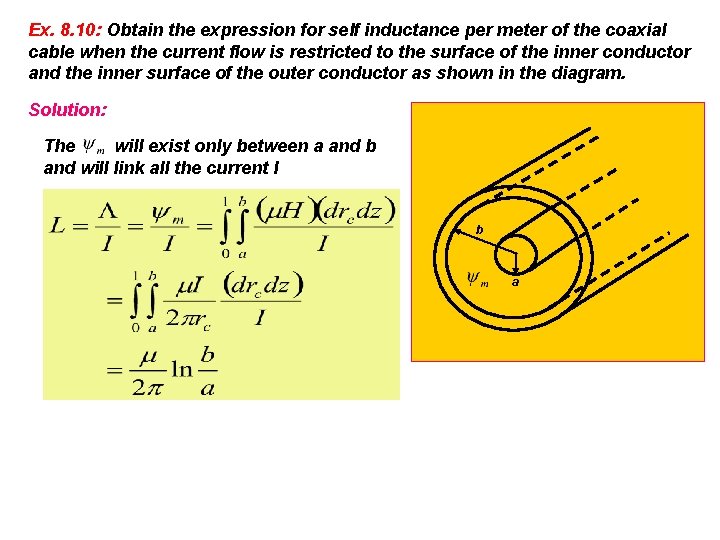
Ex. 8. 10: Obtain the expression for self inductance per meter of the coaxial cable when the current flow is restricted to the surface of the inner conductor and the inner surface of the outer conductor as shown in the diagram. Solution: The will exist only between a and b and will link all the current I b a
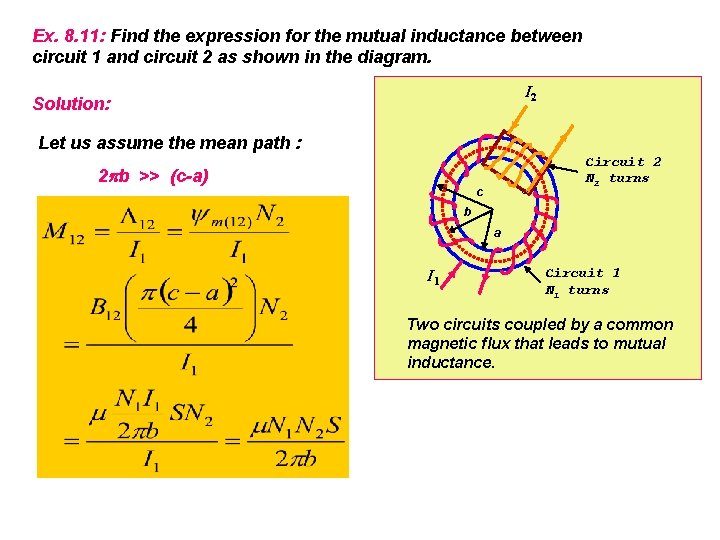
Ex. 8. 11: Find the expression for the mutual inductance between circuit 1 and circuit 2 as shown in the diagram. I 2 Solution: Let us assume the mean path : 2 b >> (c-a) Circuit 2 N 2 turns c b a I 1 Circuit 1 N 1 turns Two circuits coupled by a common magnetic flux that leads to mutual inductance.
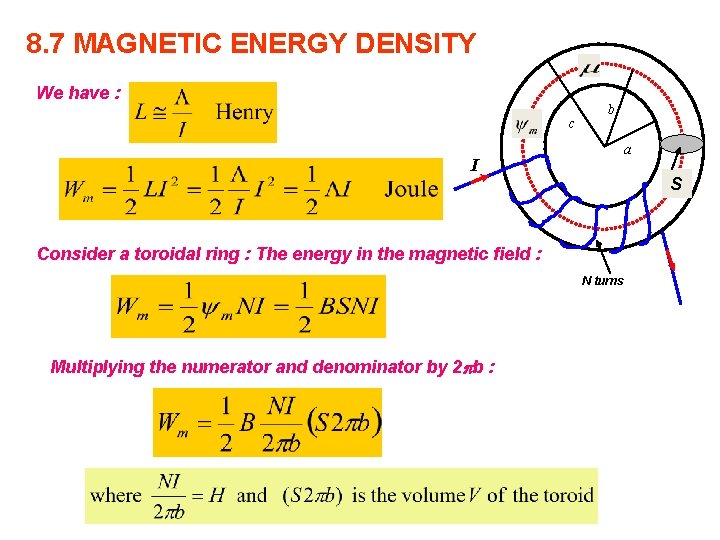
8. 7 MAGNETIC ENERGY DENSITY We have : c I b a S Consider a toroidal ring : The energy in the magnetic field : N turns Multiplying the numerator and denominator by 2 b :
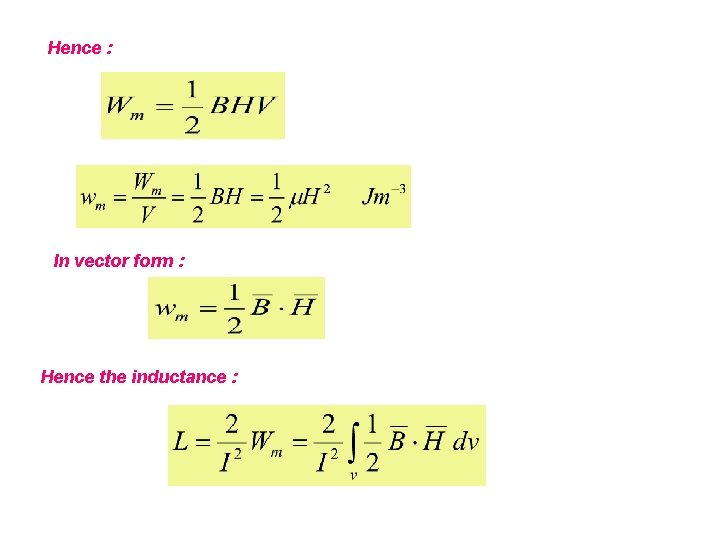
Hence : In vector form : Hence the inductance :
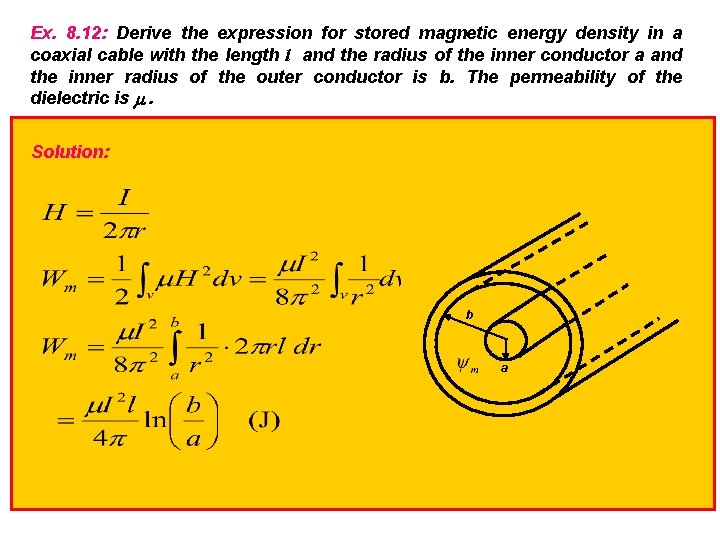
Ex. 8. 12: Derive the expression for stored magnetic energy density in a coaxial cable with the length l and the radius of the inner conductor a and the inner radius of the outer conductor is b. The permeability of the dielectric is . Solution: b a