
Chapter 8 Louisiana from Colony to Territory to
- Slides: 40
Chapter 8: Louisiana from Colony to Territory to State STUDY PRESENTATION © 2015 Clairmont Press
Section 1: The United States Purchases Louisiana Section 2: The Territorial Period: Leadership and Challenges Section 3: Statehood and Early Government
Section 1: The United States Purchases Louisiana Ø Essential Question: • What events led to the Louisiana Purchase? 3
Section 1: The United States Purchases Louisiana What terms do I need to know? Ø • • • Pinckney’s Treaty abolition Treaty of San Ildefonso Louisiana Purchase Adams-Onís Treaty 4
Introduction Ø Ø Ø Migrants of English descent began coming to Louisiana in larger numbers after 1787. Even those who did not settle permanently in Louisiana began to depend on the Mississippi River as a transportation route for the goods they grew and produced. The Americans and the Spanish disagreed about the borders that separated Spain and the United States and were sometimes uncooperative when US citizens wanted to use the port at New Orleans. 5
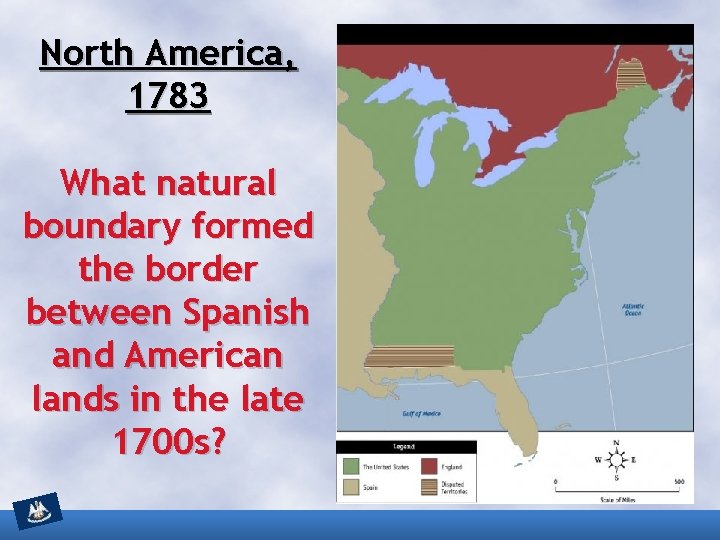
North America, 1783 What natural boundary formed the border between Spanish and American lands in the late 1700 s?
Pinckney’s Treaty Ø Ø Ø By the 1790 s, the Mississippi was a vital trade route for Americans because the connection of the MS River made importing and exporting more profitable. In 1795, representative Thomas Pinckney negotiated Pinckney’s Treaty, which gave Americans the right to trade and deposit goods in New Orleans. The Spanish tried to close the river to American trade in 1802, but international events stopped this. 7
International Events and Intrigue Ø Ø France’s involvement in numerous wars led to the rise of Napoleon Bonaparte. Despite the abolition (official ending) of slavery in Saint-Domingue, Bonaparte wanted to regain control of the island reinstate slavery to make money for his military campaigns. Bonaparte also wished to reestablish control over Louisiana because the trade of the MS River would serve as a supply depot for St. Domingue. This wish resulted in the Treaty of San Ildefonso, which organized the transfer of Louisiana back to French control in 1800. Napoleon sent 30, 000 soldiers to Saint-Domingue to end the slave revolt and reinstitute slavery, but his plan was a disastrous failure because majority of the soldiers died of disease. 8
The Louisiana Purchase Ø Ø Ø Napoleon’s failure to control St. Domingue made Louisiana useless to France. Since the late 1790 s, Americans had been interested in getting permanent access to the Mississippi River and the port of New Orleans since Spain kept closing access to the river down. President Thomas Jefferson sent James Monroe to join Robert Livingston in France to organize the purchase of New Orleans. 9
A Surprising Offer Ø Ø Ø In 1803, Monroe and Livingston were shocked when they were offered the opportunity to purchase all of Louisiana. Without the ability to easily contact President Jefferson, the men took a risk and agreed to the deal. They accepted the offer and negotiated a price of $15, 000. 10
The Treaty Ø Ø Ø The terms of the treaty were sent to Washington for approval. Jefferson pushed for a fast ratification of the terms. On October 19, 1803, the United States ratified the treaty for the Louisiana Purchase Details 11
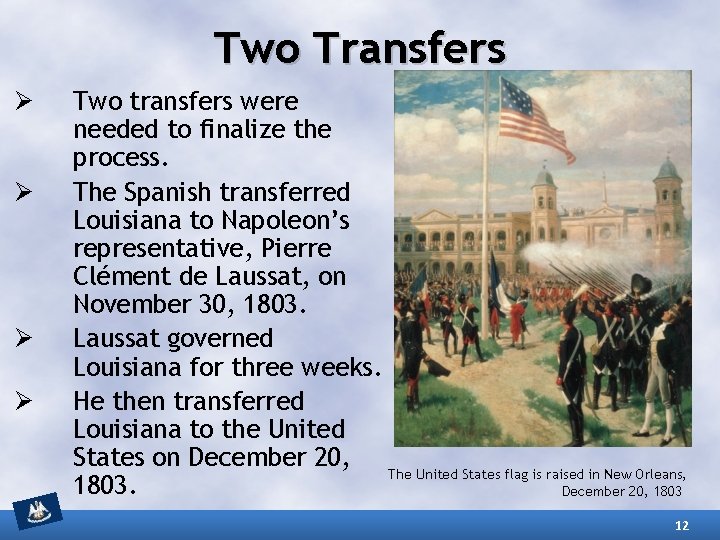
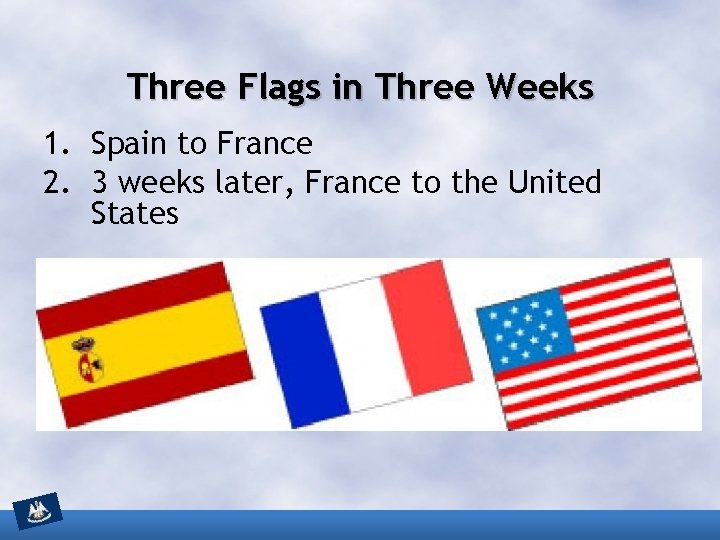
Two Transfers Ø Ø Two transfers were needed to finalize the process. The Spanish transferred Louisiana to Napoleon’s representative, Pierre Clément de Laussat, on November 30, 1803. Laussat governed Louisiana for three weeks. He then transferred Louisiana to the United States on December 20, The United States flag is raised in New Orleans, 1803. December 20, 1803 12
Three Flags in Three Weeks 1. Spain to France 2. 3 weeks later, France to the United States
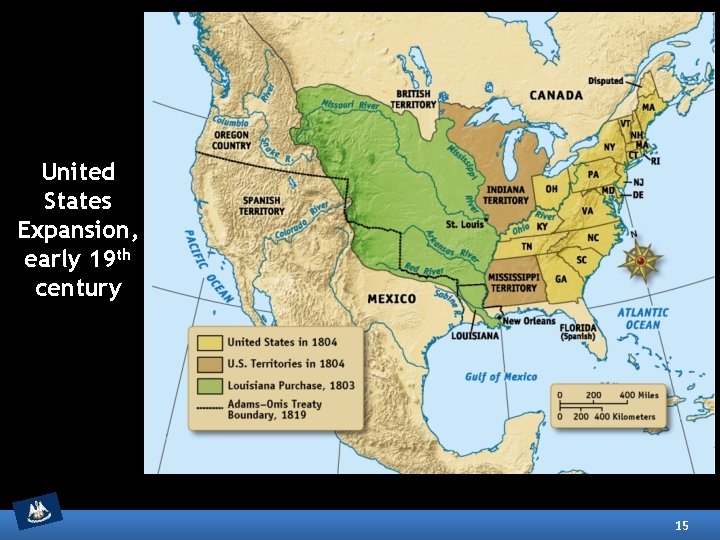
The Territory Ø Ø Ø Before the Purchase, the territory of the United States was 434, 000 acres of land. The Adams-Onís Treaty (1819) clarified how much land was added to the United States, which was 530, 000 acres. These new lands would make up all or part of fifteen states. Once the interest was paid on the loan, the U. S. paid $23, 537, 872 for Louisiana. Because of the Purchase, the U. S. became a potential world power. 14
United States Expansion, early 19 th century 15
Section 2: The Territorial Period: Leadership and Challenges Ø Essential Question: • What challenges faced the leaders during Louisiana’s period as a territory? 16
Section 2: The Territorial Period: Leadership and Challenges Ø What terms do I need to know? • filibustering • dueling • manumission 17
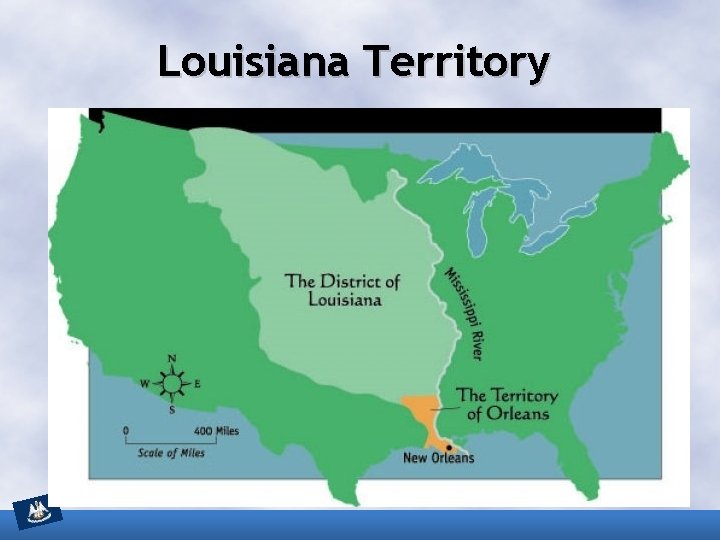
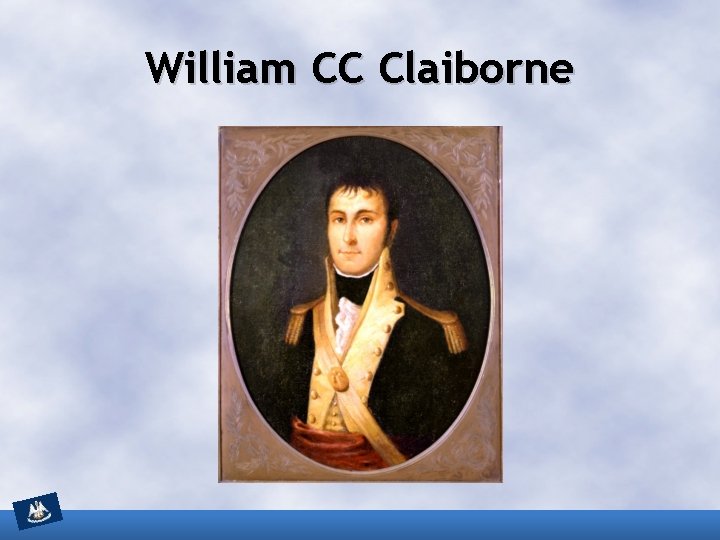
Introduction Ø Ø Ø The Louisiana Purchase happened so quickly, that President Jefferson had to act rapidly to find a leader for Louisiana. After 3 men turned down the job, William Charles Cole Claiborne accepted the job. General James Wilkinson was Claiborne’s military commander for Louisiana. Many people were unsure Claiborne was the right man for the job because he spoke no French or Spanish, meaning that he could not communicate with the majority of the population. Louisiana was made a US territory in 1804 and would remain a territory for eight years. (Louisiana went from a colony to a U. S. territory. ) 18
Louisiana Territory
Ø Ø Ø Administrative Challenges and Changes When Louisiana became a territory, Claiborne divided it into twelve administrative units. As a result of the influence of representatives that had lived in Louisiana long before the Purchase, Louisiana is the only American state with parishes rather than counties. Laws also reflected compromise between American ideas and Louisiana’s French and Spanish past. 20
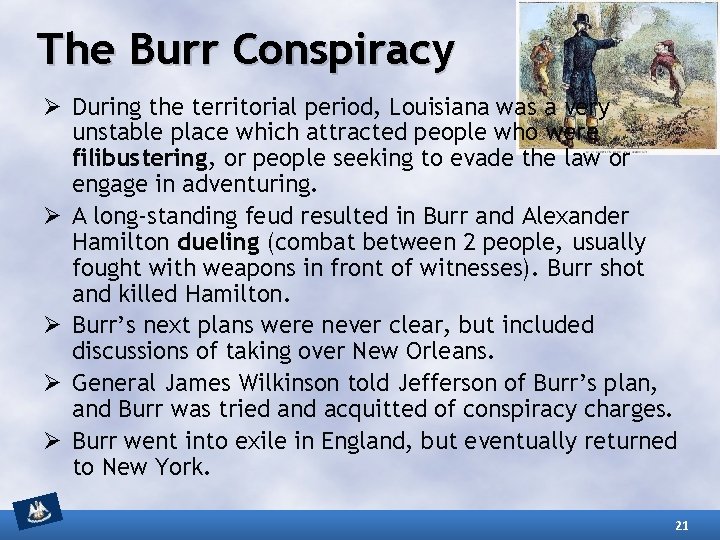
The Burr Conspiracy Ø During the territorial period, Louisiana was a very unstable place which attracted people who were filibustering, or people seeking to evade the law or engage in adventuring. Ø A long-standing feud resulted in Burr and Alexander Hamilton dueling (combat between 2 people, usually fought with weapons in front of witnesses). Burr shot and killed Hamilton. Ø Burr’s next plans were never clear, but included discussions of taking over New Orleans. Ø General James Wilkinson told Jefferson of Burr’s plan, and Burr was tried and acquitted of conspiracy charges. Ø Burr went into exile in England, but eventually returned to New York. 21
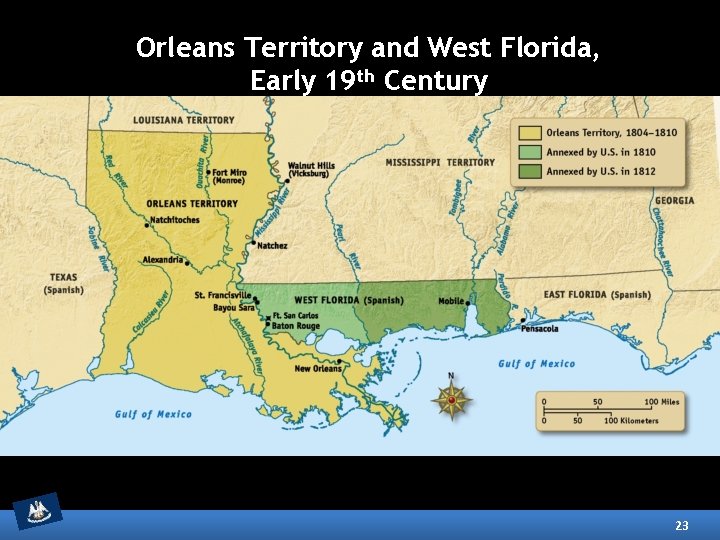
West Florida Rebellion Ø Ø There was unrest along the borders of the area known then as Spanish West Florida. Anglo migrants wanted to become part of the U. S. In 1810, they revolted against the Spanish. The rebels declared themselves an independent republic called the Republic of West Florida. The U. S. , however, declared West Florida part of the Louisiana Territory three months later. (The U. S. annexed it. ) 22
Orleans Territory and West Florida, Early 19 th Century 23
Free People of Color and Slaves Ø Free people of color presented the Americans with an unfamiliar situation. Ø After 1804 the government made it illegal to import slaves into Louisiana from anywhere other than the U. S. This led to a rise in the importance of the domestic slave trade. Ø A new slave code in 1806 still allowed for manumission (masters setting their slaves free), but self-purchase was no longer available to slaves. Ø In 1809, 9, 000 refugees set sail for Louisiana from Cuba. 3, 000 of those refugees were slaves. Ø Though it was illegal now to import slaves, Claiborne made an exception for these stranded slaves. (violation of 1804 ban on slave import to Louisiana) Ø This 1809 wave of immigration nearly doubled the size of New Orleans. 24
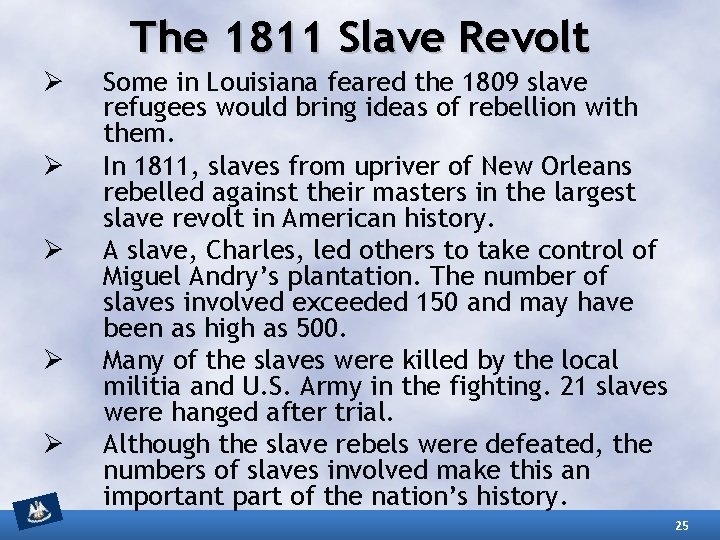
The 1811 Slave Revolt Ø Ø Ø Some in Louisiana feared the 1809 slave refugees would bring ideas of rebellion with them. In 1811, slaves from upriver of New Orleans rebelled against their masters in the largest slave revolt in American history. A slave, Charles, led others to take control of Miguel Andry’s plantation. The number of slaves involved exceeded 150 and may have been as high as 500. Many of the slaves were killed by the local militia and U. S. Army in the fighting. 21 slaves were hanged after trial. Although the slave rebels were defeated, the numbers of slaves involved make this an important part of the nation’s history. 25
Section 3: Statehood and Early Government Ø Essential Question: • What were some of the challenges Louisiana faced during the first few years of statehood? 26
Section 3: Statehood and Early Government What terms do I need to know? Ø • • impressment Battle of New Orleans electoral college corrupt bargain 27
Introduction Ø Ø Louisiana became the eighteenth state in the United States on April 30, 1812. Less than three months later, President James Monroe declared war on Great Britain, beginning the War of 1812. 28
The War of 1812 Ø Ø The war between Britain and the United States began because of issues that had never been resolved at the end of the American Revolution. One source of tension between the two nations was Britain’s practice of impressment, which is when captured American sailors were forced into service for the British navy. Despite two years of fighting, by mid-1814 very little territorial control had been gained or lost by either side. After two years of fighting, both sides entered into negotiations to set the terms for peace. 29
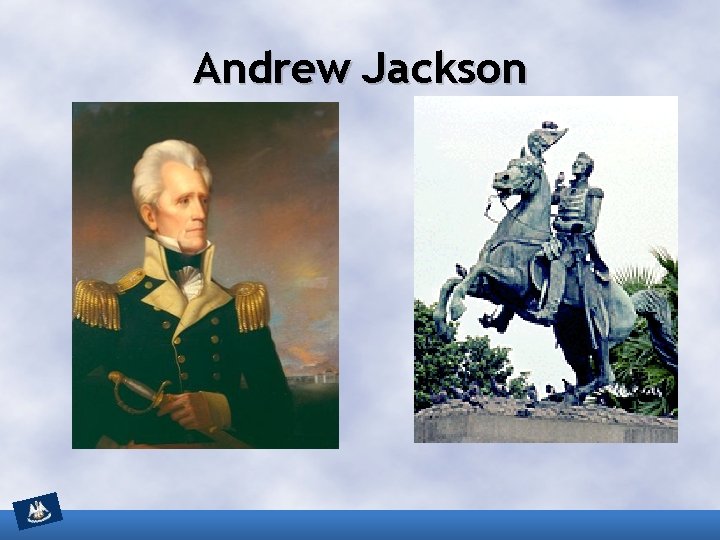
Andrew Jackson and the Battle of New Orleans Ø Ø Ø Andrew Jackson had a deep personal resentment towards the British. He looked at the War of 1812 as an opportunity for vengeance. He became a major general in the Tennessee militia leading his troops in the War of 1812. Victory against the Creek nation earned Jackson the title of major general in the U. S. Army. He was then ordered to take his troops towards New Orleans in 1814 in anticipation of a British attack. Place d’Armes, New Orleans Chalmette Battlefield 30
Advantages and Disadvantages for Both Sides Ø Ø The British were stuck between the Mississippi River and a cypress swamp, which left little room for them to maneuver against the American forces. The British troops’ poor location gave Jackson and his forces an advantage. Jackson, however, had half the number of troops and they were poorly dressed with inferior weapons. Still, Jackson merged the soldiers with local militia and volunteers, also enlisting a group of pirates led by Jean Lafitte since they needed ammunition and powder. 31
The Fighting Begins Ø Ø The major battle between the British and the Americans is the Battle of New Orleans, which occurred on January 8, 1815. Many things went wrong for the British. Pakenham and his troops were in a field approaching the Americans when the early-morning fog disappeared. This made the British easy targets for the Americans. 32
An American Victory Ø Ø Ø British casualties reached two thousand, including Pakenham, who was killed. Jackson reported only seven killed and six wounded. The British surrendered to Jackson rose to national fame as the hero of the Battle of New Orleans. Ironically, Britain and the U. S. had signed a peace treaty on December 24, 1814, before the battle. Some historians refer to the War of 1812 as the “Second War for American Independence. ” 33
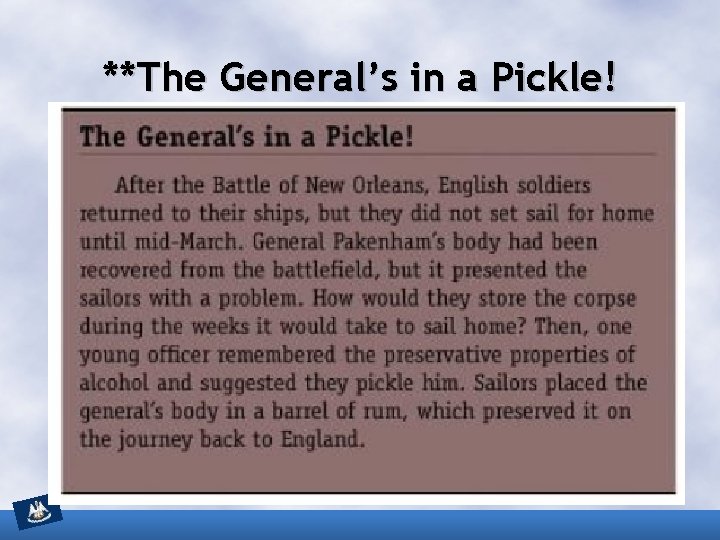
**The General’s in a Pickle!
Andrew Jackson
William CC Claiborne
Early Statehood: Distinctive but American Ø Ø Ø Creoles felt they had little in common with the Americans who migrated to Louisiana after 1812. Creoles and Americans had to work together when necessary, the Battle of New Orleans being an example of this. Louisiana wrote it’s first Constitution and voted Claiborne as the first official governor. After Claiborne, the office of governor shifted regularly between a Creole and an American. Politics in Louisiana kept this distinctive aspect until the 1820 s. 37
The Rise of Andrew Jackson and the Corrupt Bargain Ø Ø The four major candidates in the presidential election of 1824 were John Quincy Adams, William H. Crawford, Henry Clay, and Andrew Jackson won the popular vote but not the Electoral College (the group that formally elects the president and vice president). The decision of who would be president went to the House of Representatives, which chose Adams to be president. Adams named Clay Secretary of State, which led many to believe they had made a Corrupt Bargain. Electoral College: search Elections of 1824 and 1828 38
The Rise of Andrew Jackson and the Corrupt Bargain (continued) Ø Ø Voter turnout tripled for the presidential election of 1828, and Andrew Jackson won by a landslide. His two terms were marked by controversies, but he remained a hero of the common man. Jackson changed the way Americans felt about the country’s politics. After 1824, Louisiana’s voters became much more interested in national affairs. 39
Image Credits Slide 1: Chris Miceli on Wikimedia Commons, Public Domain; Slide 2: Ken Thomas (alligator); Jillian. E (Chicot State Park); City of Monroe, LA; Albert Herring (Mardi Gras), Lael Butler (pelican); Jesper Rautell Balle (cajun meal); Susan Adams (Chemin-a-Haut State Park) on Wikimedia Commons; Image Credits Slide: Edd Prince on Wikimedia Commons; maps copyright Clairmont Press; all others public domain Shown here: Fontainebleau State Park Return to Main Menu 40