
Chapter 8 LongLived Tangible and Intangible Assets The
Chapter 8 Long-Lived Tangible and Intangible Assets: The Source of Operating Capacity BUS 780
Long-Lived Operational Assets Long-lived operational assets include: § Tangible Assets: land, buildings, factory plants, computers, machinery, etc. § Intangible assets: patents, copyrights, franchises, goodwill, organization costs, trade names, trademarks, etc. § Natural Resources: oil and gas reserves, timber, mineral deposits. Long-Lived Tangible and Intangible Assets 2
Tangible Assets: Property, Plant and Equipment (PPE) § Tangible assets are productive assets deriving their value from the use of them in operations. § Tangible assets are: t. Assets used in operations (not for resale). t. Long-term in Nature (Economic Life > one year). t. Possess physical substance. t$ must be material. Long-Lived Tangible and Intangible Assets 3
Intangible Assets -a. with future economic benefits, b. no physical substance, c. with high degree of uncertainty concerning the future benefit. Long-Lived Tangible and Intangible Assets 4
Objectives of the Chapter 1. 2. 3. 1. To understand the concept of expensing versus capitalizing expenditures. 2. To learn the valuation of long-lived assets at acquisition. 3. To learn the cost allocation process of long-lived assets after acquisition (i. e. , depreciation, amortization) including changes in estimates of depreciation. Long-Lived Tangible and Intangible Assets 5
Objectives of the Chapter (Contd. ) 4. To learn the accounting treatment for asset impairment of long-lived assets. 5. To understand the accounting treatment for the disposition of long-lived assets. Long-Lived Tangible and Intangible Assets 6
1. Expense Vs. Capitalize Expenditures n n When an expenditure occurs, accountants have to decide whether the expenditure should be debited into an expense account (expense) or to an asset account (capitalize). If the expenditure is expensed, it becomes a period expense and will be deducted from the income of the current year. Long-Lived Tangible and Intangible Assets 7
Expense Vs. Capitalize Expenditures (Contd. ) n n Expense an expenditure may have tax benefit (thus, increase cash flows) if it is tax deductible but it will reduce the current year’s income. If an expenditure is capitalized, it will be reported on the balance sheet as an asset and will be subject to depreciation or amortization in the future years. Long-Lived Tangible and Intangible Assets 8
Expense Vs. Capitalize Expenditures (contd. ) n The Impact of expenditure capitalization: u a. The expenditure will be recognized as an asset and will not reduce current year’s income. u b. the cost allocation of the asset over the life of the asset (i. e. , depreciation expense) will reduce future year’s income. Long-Lived Tangible and Intangible Assets 9
Improper Capitalization Examples. World. Com “World. Com Inc. consistently met Wall Street's targets for earnings during 2000 and the first three quarters of 2001. But the company now says it improperly capitalized $3. 8 billion dollars of expenses to inflate profits, in what could be the largest accounting fraud ever. ” (Wall Street Journal, 8/5/2002) Long-Lived Tangible and Intangible Assets 10
Improper Capitalization – World. Com (Contd. ) n n According to Stickney and Weil (2006), the impact of the improper capitalization of costs that World. Com paid to other carriers of the telecommunication lines results in an increase of earnings by $53. 1 billion and $17. 1 billion in 2000 and 2001, respectively. The restated earnings of World. Com indicated a net loss of $48. 9 billion and $15. 6 billion for 2000 and 2001, respectively. Long-Lived Tangible and Intangible Assets 11
Improper Capitalization- Global Crossing (WSJ, 7/1/2002) Mr. Olofson's (Finance Executive of Global Crossing) August, 2001 letter says the company may have improperly capitalized the real-estate lease on its Madison, N. J. , headquarters building. ” Long-Lived Tangible and Intangible Assets 12
Improper Capitalization -Global Crossing (contd. ) "This is just another example of Global Crossing's methods of meeting its numbers, …, " said Paul Murphy, his attorney at O'Neill Lysaght & Sun. “ “ Global Crossing also used “swap” transactions (i. e. , trading same amounts of telecom capacity with another telecom corp. and recorded the trade as revenue and the costs as capital expenditures). ” Long-Lived Tangible and Intangible Assets 13
Accounting Scandals-Time Warner (WSJ, 3/22/2005) “the SEC found that AOL had improperly capitalized certain advertising costs that should have been expensed, inflating revenue for six of eight quarters in fiscal 1995 and 1996. ” “The Securities and Exchange Commission slapped Time Warner Inc. with a $300 million fine, its second-biggest fine in history. ” Long-Lived Tangible and Intangible Assets 14
Accounting Scandals –Delphi (WSJ, 3/7/2005) “According to Delphi, the company used several improper accounting methods during this time. In some cases, it prematurely recognized revenue for technology contracts and rebates when it should have spread them over the life of the contract. ” Long-Lived Tangible and Intangible Assets 15
Accounting Scandals –Delphi (Cont. ) “Other times it improperly capitalized expenses over time, rather than recognizing them immediately. It also boosted cash flow from operations and pretax earnings by claiming it sold assets and inventory that it had actually agreed to buy back later. ” Long-Lived Tangible and Intangible Assets 16
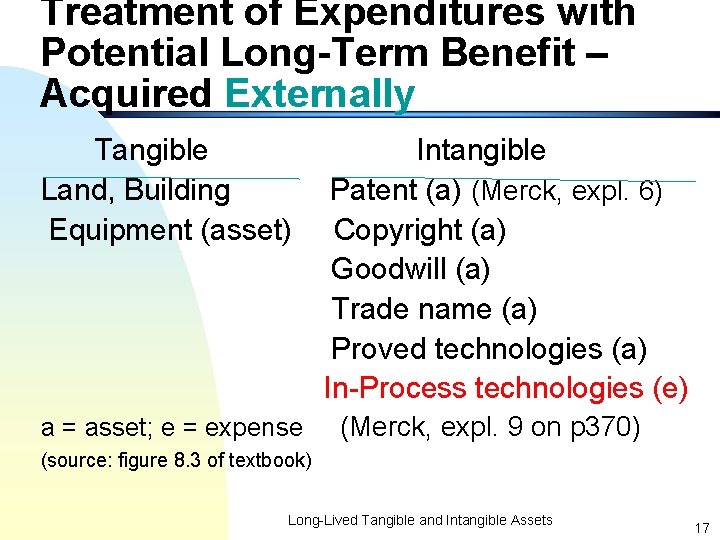
Treatment of Expenditures with Potential Long-Term Benefit – Acquired Externally Tangible Land, Building Equipment (asset) a = asset; e = expense Intangible Patent (a) (Merck, expl. 6) Copyright (a) Goodwill (a) Trade name (a) Proved technologies (a) In-Process technologies (e) (Merck, expl. 9 on p 370) (source: figure 8. 3 of textbook) Long-Lived Tangible and Intangible Assets 17
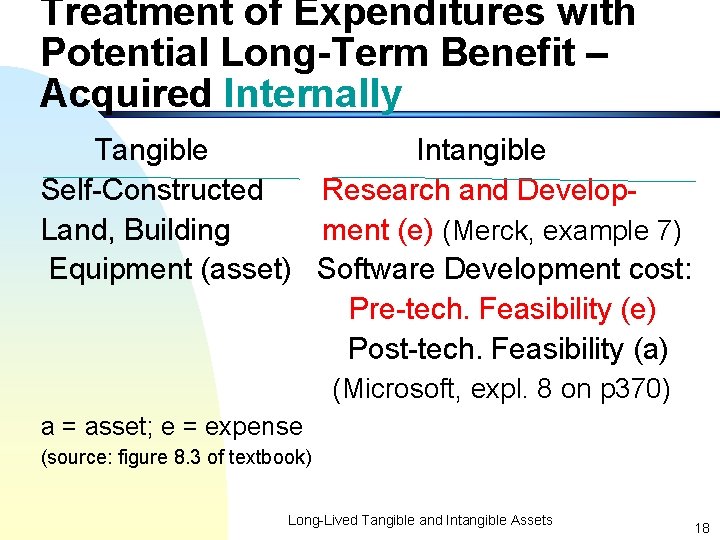
Treatment of Expenditures with Potential Long-Term Benefit – Acquired Internally Tangible Intangible Self-Constructed Research and Develop. Land, Building ment (e) (Merck, example 7) Equipment (asset) Software Development cost: Pre-tech. Feasibility (e) Post-tech. Feasibility (a) (Microsoft, expl. 8 on p 370) a = asset; e = expense (source: figure 8. 3 of textbook) Long-Lived Tangible and Intangible Assets 18
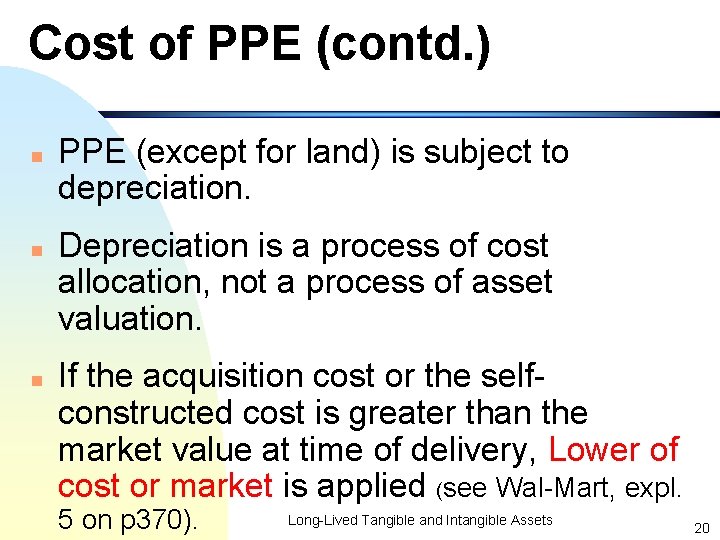
Cost of PPE (contd. ) n n n PPE (except for land) is subject to depreciation. Depreciation is a process of cost allocation, not a process of asset valuation. If the acquisition cost or the selfconstructed cost is greater than the market value at time of delivery, Lower of cost or market is applied (see Wal-Mart, expl. 5 on p 370). Long-Lived Tangible and Intangible Assets 20
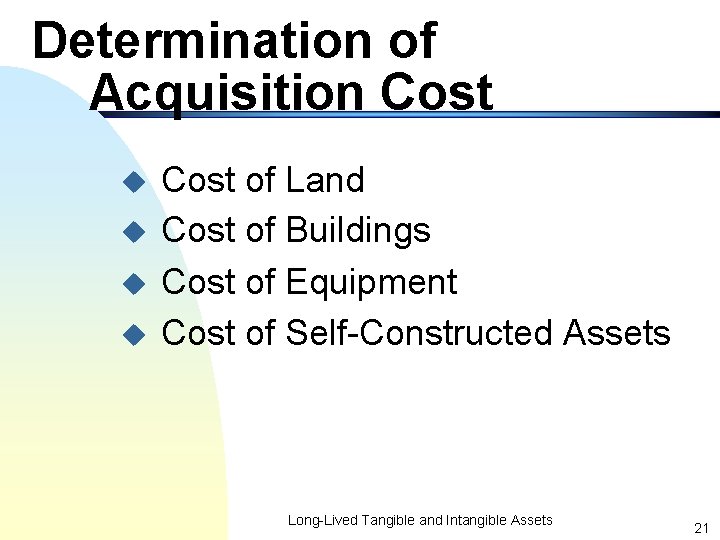
Determination of Acquisition Cost u u Cost of Land Cost of Buildings Cost of Equipment Cost of Self-Constructed Assets Long-Lived Tangible and Intangible Assets 21
Cost of Land (held for operation, not for resale) n Any cost occurred before the land is ready for its intended use should be capitalized as cost of land. Long-Lived Tangible and Intangible Assets 22
Cost of Land (contd. ) n Cost of land includes: 1. Purchase price. 2. Title search fee. 3. Closing fee. 4. Clearing fee. 5. Back property taxes (unpaid by previous owner). 6. Net razing cost of an old building. 7. Land improvements with unlimited (permanent in nature) life. (landscaping, pavements, street lights, etc. ) 8. Assessment by city for drainage project. Long-Lived Tangible and Intangible Assets 23
Cost of Buildings n Cost of Buildings includes: 1. contract price(including materials, labor, etc. ), 2. cost of remodeling, 3. Architect’s fee, 4. building permits, 5. surveying cost before construction, 6. interest cost (for self-constructed building), 7. excavation cost before construction. * Costs of strike or accidents are expensed. Long-Lived Tangible and Intangible Assets 24
Cost of Equipment n Any cost occurred to acquire and to bring the equipment to the location and condition for its intended use. Long-Lived Tangible and Intangible Assets 25
Cost of Equipment (contd. ) n n Cost of Equipment includes: 1. purchase price, 2. freight-in, 3. insurance in transit, and 4. foundation cost, installation cost, cost of test runs and assembling cost. Not including: Cash discount lost, unnecessary storage cost and hauling charges from storage for delivery of equipment. Long-Lived Tangible and Intangible Assets 26
Example 12 on p 372 of the textbook 1. 2. 3. 4. 5. General Motors incurs the following costs in searching and acquiring the land building: 1. Purchase price of land building, $1, 000. 2. Fees paid to lawyers related to the purchase, $10, 000. 3. Transfer taxes paid to the city, $2, 000. 4. Salaries earned by management personnel during the search for the site and the negotiation of its purchase, $8, 000. Long-Lived Tangible and Intangible Assets 27
Example (contd. ) 1. 2. 3. 4. 5. Operating expenditures for company automobiles used during the search, $75. 6. Depreciation charges for company automobiles used during the search, $65. 7. Fees paid to engineer for a repot on the structural soundness of the building, $15, 000. 8. Uninsured costs to repair automobiles damaged in an car accident during the search, $3, 000. 9. Profits lost on sales the company failed to make because, during the search, management paid insufficient attention to a potential new customer, $20, 000. Long-Lived Tangible and Intangible Assets 28
Example (contd. ) 1. 2. What is the cost of land Building? 1. Cost of both land building: items 1 to 6 2. Cost of building: item 7 3. Items 8 and 9 ? Cost of both land building should be allocated to cost of land cost of building, respectively, based on the relative market value of land building. Long-Lived Tangible and Intangible Assets 29
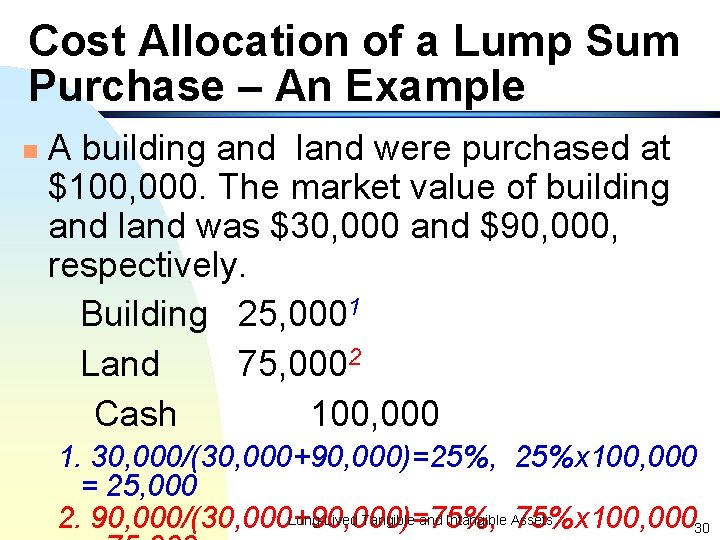
Cost Allocation of a Lump Sum Purchase – An Example n A building and land were purchased at $100, 000. The market value of building and land was $30, 000 and $90, 000, respectively. Building 25, 0001 Land 75, 0002 Cash 100, 000 1. 30, 000/(30, 000+90, 000)=25%, 25%x 100, 000 = 25, 000 Long-Lived Tangible and Intangible Assets 2. 90, 000/(30, 000+90, 000)=75%, 75%x 100, 00030
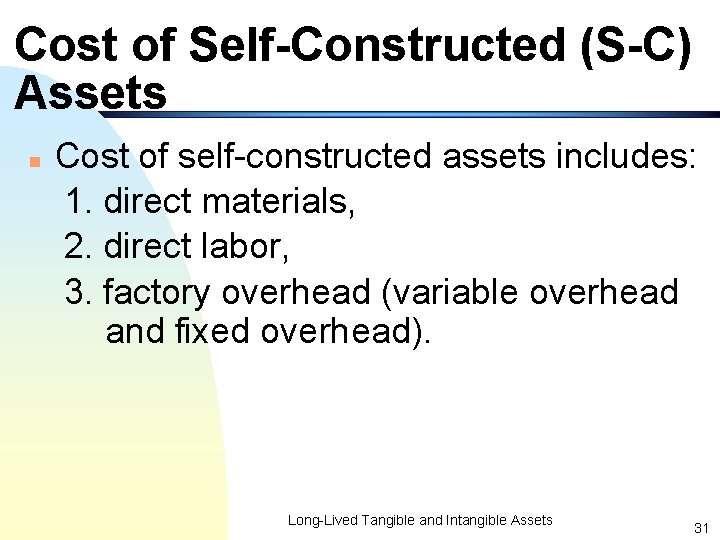
Cost of Self-Constructed (S-C) Assets n Cost of self-constructed assets includes: 1. direct materials, 2. direct labor, 3. factory overhead (variable overhead and fixed overhead). Long-Lived Tangible and Intangible Assets 31
Interest Costs During Construction n n Background of SFAS No. 34 (effective in 1979) Only capitalize the interest on funds borrowed for construction. Long-Lived Tangible and Intangible Assets 32
Interest Costs During Construction (contd. ) n Interest can only be capitalized for qualifying assets which must meet the following criteria: 1. Assets are constructed for firm’s own use or constructed as discrete projects for sale or lease to others (i. e. , ships, real estate developments). 2. Capitalization will make a difference on the earnings per share. Long-Lived Tangible and Intangible Assets 33
Interest Costs During Construction (contd. ) § Capitalization period: Starting when: 1. Expenditures for the assets have been made; 2. Construction activities are in progress; and 3. Interest cost is being occurred. Ending when: F Assets are substantially completed and ready for intended use. Long-Lived Tangible and Intangible Assets 34
Example – interest capitalization for self-constructed asset § The labor, material and overhead totaled $2, 400, 000 for the construction of a building in 2006. In addition, during 20 X 6, total interest expense was $1, 845, 000 of which $159, 500 was capitalized as the cost of the selfconstructed building and $1, 685, 500 was charged to expense. Long-Lived Tangible and Intangible Assets 35
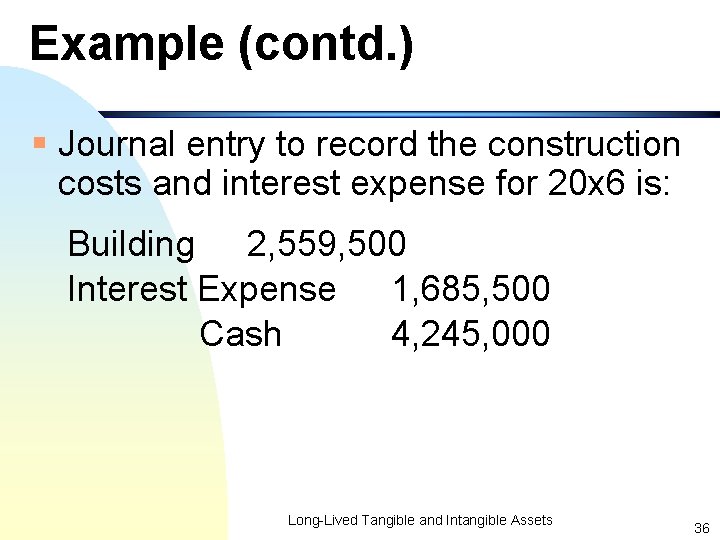
Example (contd. ) § Journal entry to record the construction costs and interest expense for 20 x 6 is: Building 2, 559, 500 Interest Expense 1, 685, 500 Cash 4, 245, 000 Long-Lived Tangible and Intangible Assets 36
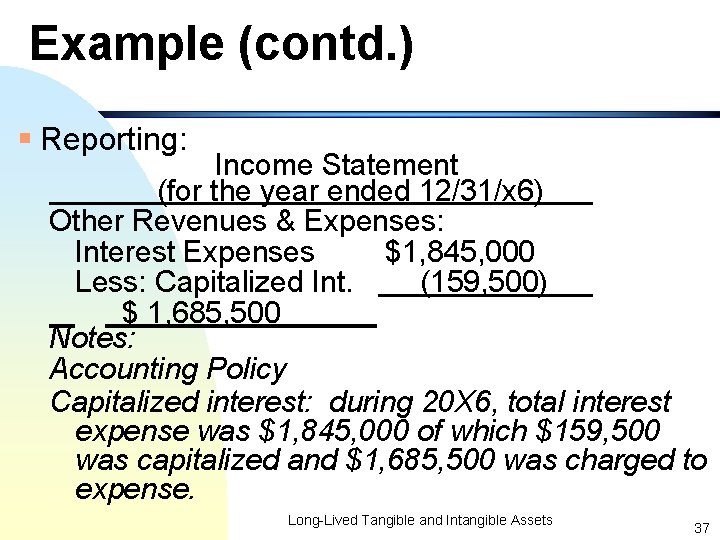
Example (contd. ) § Reporting: Income Statement (for the year ended 12/31/x 6) Other Revenues & Expenses: Interest Expenses $1, 845, 000 Less: Capitalized Int. (159, 500) $ 1, 685, 500 Notes: Accounting Policy Capitalized interest: during 20 X 6, total interest expense was $1, 845, 000 of which $159, 500 was capitalized and $1, 685, 500 was charged to expense. Long-Lived Tangible and Intangible Assets 37
Acquisition Cost for Intangibles Acquisition cost plus any other costs that are necessary to make the intangible assets ready for the intended uses (i. e. , purchase price, legal fees, …) u If intangible assets are developed internally, all the R&D costs are expensed. Long-Lived Tangible and Intangible Assets 38
3. Cost Allocation of Long-Lived Assets Over the Life of the Assets § A firm consumes the services of long-lived assets to generate revenue, the cost of these assets should be expensed over time to match the revenue generated (in compliance with the matching principle). § The process of allocating the depreciable cost (cost – the salvage value) of assets over the estimated economic life is called depreciation (amortization) for tangible (intangible) assets. Long-Lived Tangible and Intangible Assets 39
Cost Allocation of Long-Lived Assets Over the Life of the Assets (contd. ) § For intangible assets, the salvage value is zero. § For tangible assets, the salvage value could be either positive, zero or even negative (i. e. , dismantling a nuclear power plant). Long-Lived Tangible and Intangible Assets 40
Depreciation and Earnings Quality § The estimation of service life and salvage value is at the discretion of managers (see the case of Waste Management on p 378). § The choice of depreciation method is also at the discretion of mangers. § Earnings would be affected when different depreciation methods or different estimates were used. Long-Lived Tangible and Intangible Assets 41
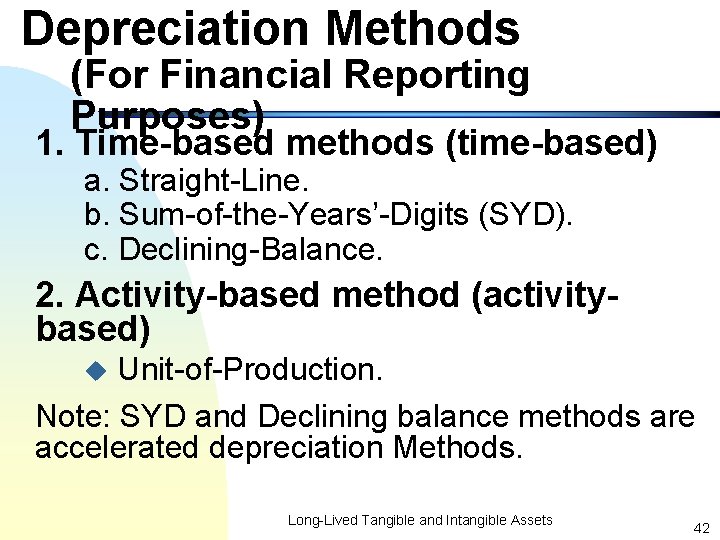
Depreciation Methods (For Financial Reporting Purposes) 1. Time-based methods (time-based) a. Straight-Line. b. Sum-of-the-Years’-Digits (SYD). c. Declining-Balance. 2. Activity-based method (activitybased) Unit-of-Production. Note: SYD and Declining balance methods are accelerated depreciation Methods. u Long-Lived Tangible and Intangible Assets 42
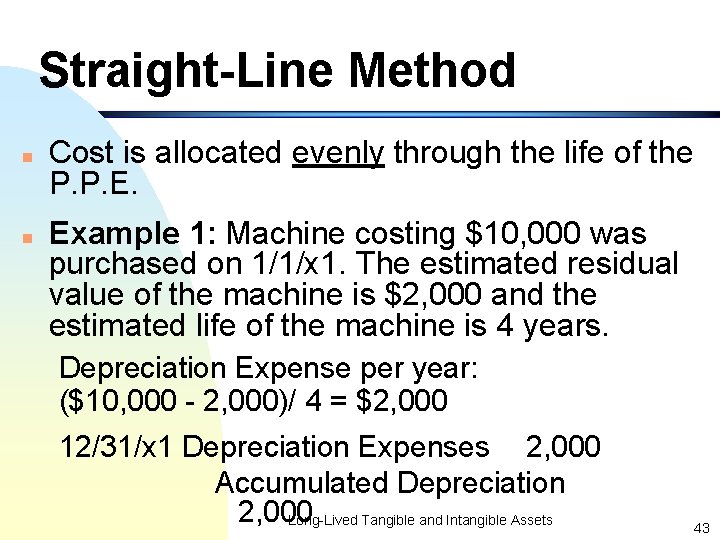
Straight-Line Method n n Cost is allocated evenly through the life of the P. P. E. Example 1: Machine costing $10, 000 was purchased on 1/1/x 1. The estimated residual value of the machine is $2, 000 and the estimated life of the machine is 4 years. Depreciation Expense per year: ($10, 000 - 2, 000)/ 4 = $2, 000 12/31/x 1 Depreciation Expenses 2, 000 Accumulated Depreciation 2, 000 Long-Lived Tangible and Intangible Assets 43
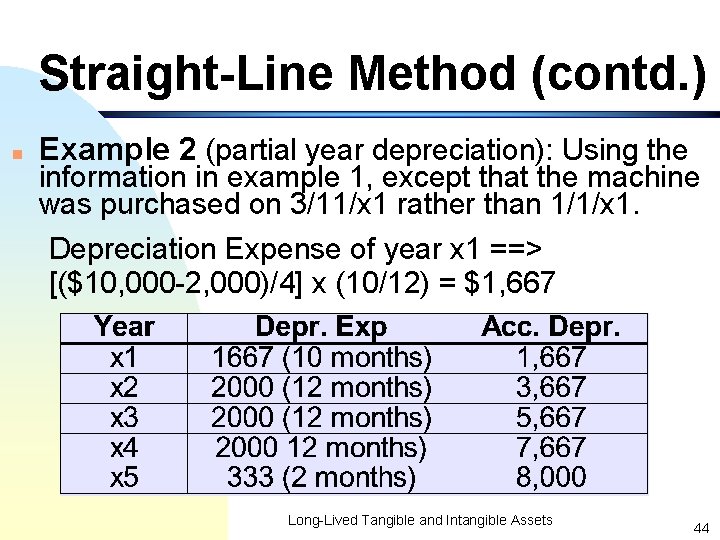
Straight-Line Method (contd. ) n Example 2 (partial year depreciation): Using the information in example 1, except that the machine was purchased on 3/11/x 1 rather than 1/1/x 1. Depreciation Expense of year x 1 ==> [($10, 000 -2, 000)/4] x (10/12) = $1, 667 Long-Lived Tangible and Intangible Assets 44
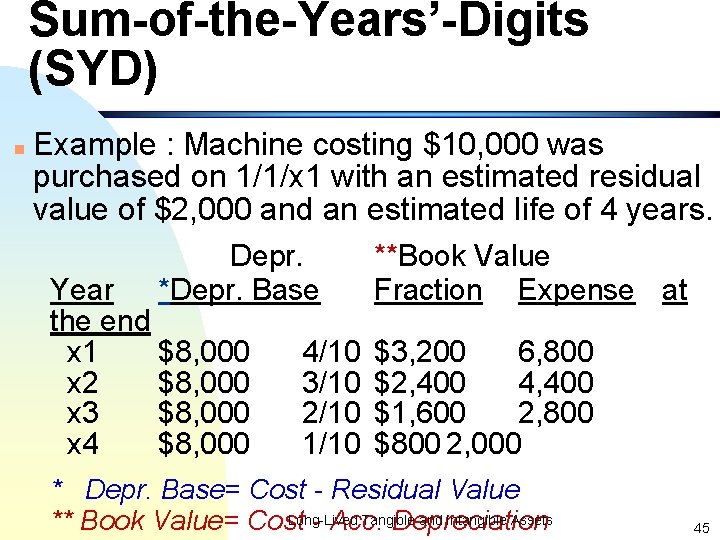
Sum-of-the-Years’-Digits (SYD) n Example : Machine costing $10, 000 was purchased on 1/1/x 1 with an estimated residual value of $2, 000 and an estimated life of 4 years. Depr. *Depr. Base Year the end x 1 $8, 000 x 2 $8, 000 x 3 $8, 000 x 4 $8, 000 4/10 3/10 2/10 1/10 **Book Value Fraction Expense at $3, 200 6, 800 $2, 400 4, 400 $1, 600 2, 800 $800 2, 000 * Depr. Base= Cost - Residual Value Long-Lived Tangible and Intangible Assets ** Book Value= Cost - Acc. Depreciation 45
Declining-Balance Method n Depreciation Exp. = constant rate book value at the beginning of the period u. Residual value is not considered in the computation. u. Assets cannot be depreciated below the residual value. u. The constant rate is expressed as a function of a straight-line annual depreciation rate. Long-Lived Tangible and Intangible Assets 46
Double Declining-Balance Method n Example : Machine costing $10, 000 purchased on 1/1/x 1, with a residual value of $2, 000 and an estimated life of 4 years. A double declining-balance method is used to depreciate the machine. Thus, the constant rate is twice of the S-L Depr. Rate (2 x 25% = 50%). Long-Lived Tangible and Intangible Assets 47
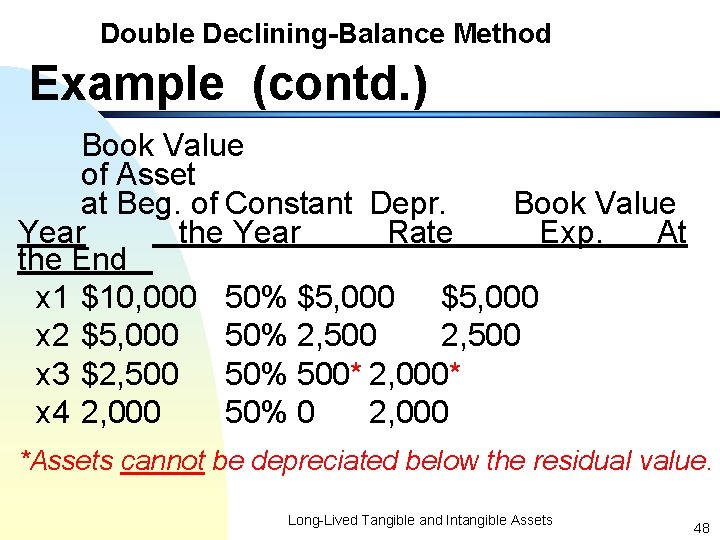
Double Declining-Balance Method Example (contd. ) Book Value of Asset at Beg. of Constant Depr. Book Value Year the Year Rate Exp. At the End x 1 $10, 000 50% $5, 000 x 2 $5, 000 50% 2, 500 x 3 $2, 500 50% 500* 2, 000* x 4 2, 000 50% 0 2, 000 *Assets cannot be depreciated below the residual value. Long-Lived Tangible and Intangible Assets 48
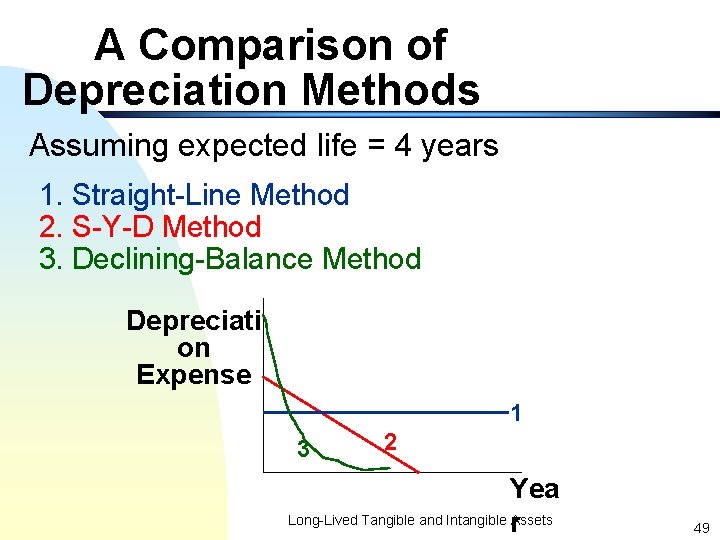
A Comparison of Depreciation Methods Assuming expected life = 4 years 1. Straight-Line Method 2. S-Y-D Method 3. Declining-Balance Method Depreciati on Expense 1 3 2 Yea Long-Lived Tangible and Intangible r Assets 49
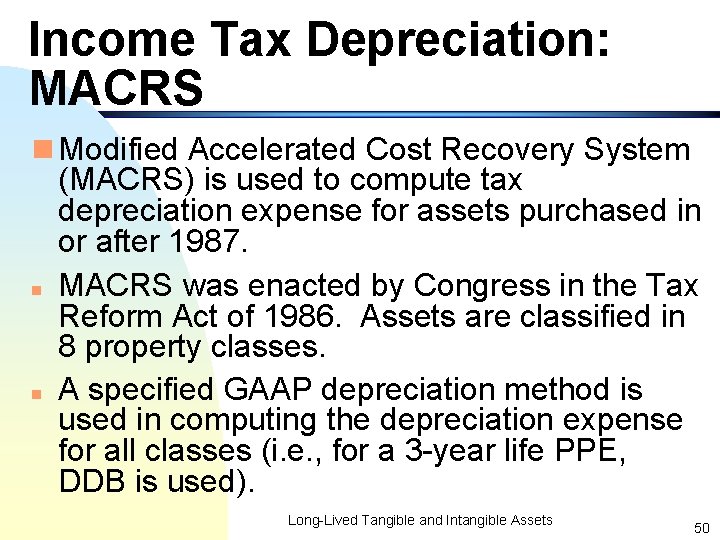
Income Tax Depreciation: MACRS n Modified Accelerated Cost Recovery System (MACRS) is used to compute tax depreciation expense for assets purchased in or after 1987. n MACRS was enacted by Congress in the Tax Reform Act of 1986. Assets are classified in 8 property classes. n A specified GAAP depreciation method is used in computing the depreciation expense for all classes (i. e. , for a 3 -year life PPE, DDB is used). Long-Lived Tangible and Intangible Assets 50
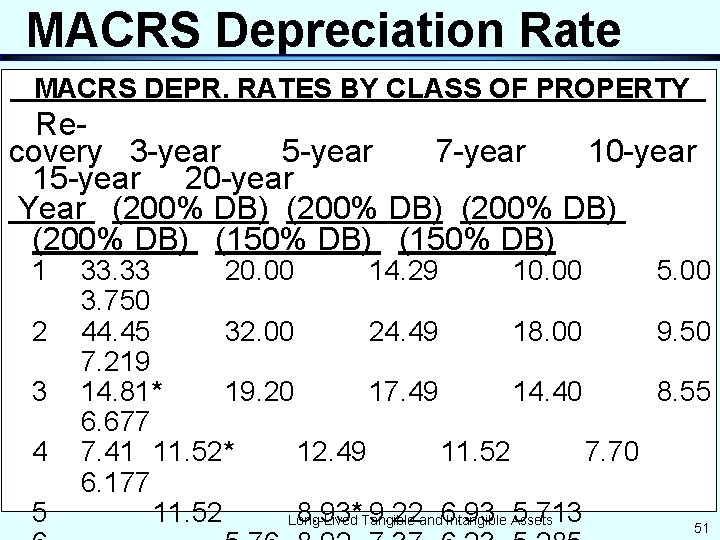
MACRS Depreciation Rate MACRS DEPR. RATES BY CLASS OF PROPERTY Recovery 3 -year 5 -year 7 -year 10 -year 15 -year 20 -year Year (200% DB) (150% DB) 1 2 3 4 5 . 33. 33 20. 00 14. 29 10. 00 5. 00 3. 750 44. 45 32. 00 24. 49 18. 00 9. 50 7. 219 14. 81* 19. 20 17. 49 14. 40 8. 55 6. 677 7. 41 11. 52* 12. 49 11. 52 7. 70 6. 177 11. 52 8. 93*Tangible 9. 22 and 6. 93 5. 713 Long-Lived Intangible Assets 51
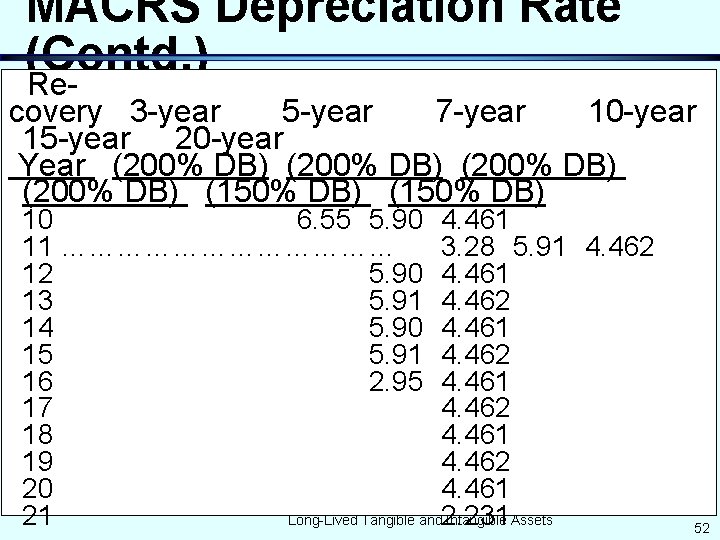
MACRS Depreciation Rate (Contd. ) Re- covery 3 -year 5 -year 7 -year 10 -year 15 -year 20 -year Year (200% DB) (150% DB) 10 6. 55 5. 90 4. 461 11 ……………… 3. 28 5. 91 4. 462 12 5. 90 4. 461 13 5. 91 4. 462 14 5. 90 4. 461 15 5. 91 4. 462 16 2. 95 4. 461 17 4. 462 18 4. 461 19 4. 462 20 4. 461 21 Long-Lived Tangible and 2. 231 Intangible Assets 52
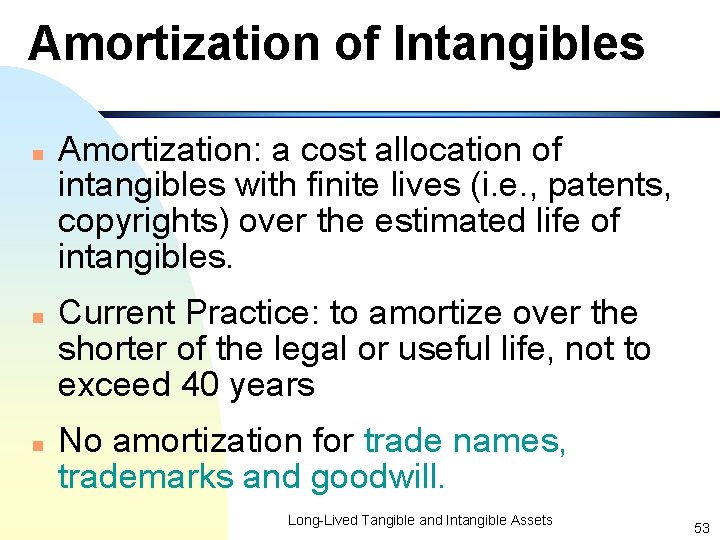
Amortization of Intangibles n n n Amortization: a cost allocation of intangibles with finite lives (i. e. , patents, copyrights) over the estimated life of intangibles. Current Practice: to amortize over the shorter of the legal or useful life, not to exceed 40 years No amortization for trade names, trademarks and goodwill. Long-Lived Tangible and Intangible Assets 53
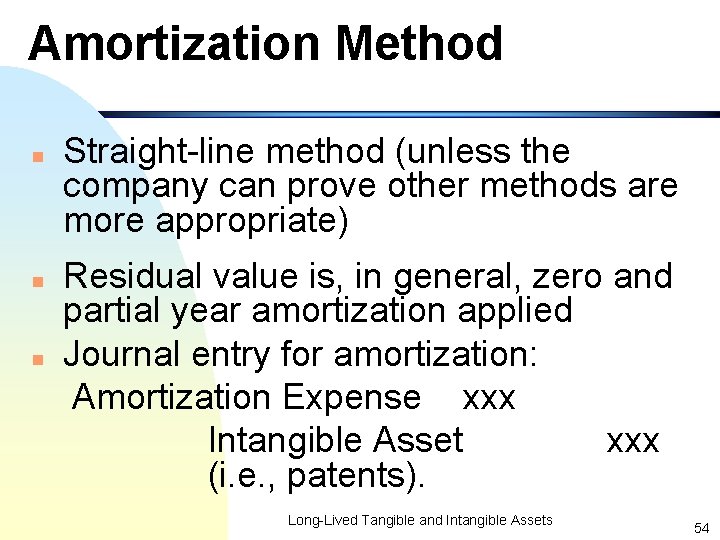
Amortization Method n n n Straight-line method (unless the company can prove other methods are more appropriate) Residual value is, in general, zero and partial year amortization applied Journal entry for amortization: Amortization Expense xxx Intangible Asset xxx (i. e. , patents). Long-Lived Tangible and Intangible Assets 54
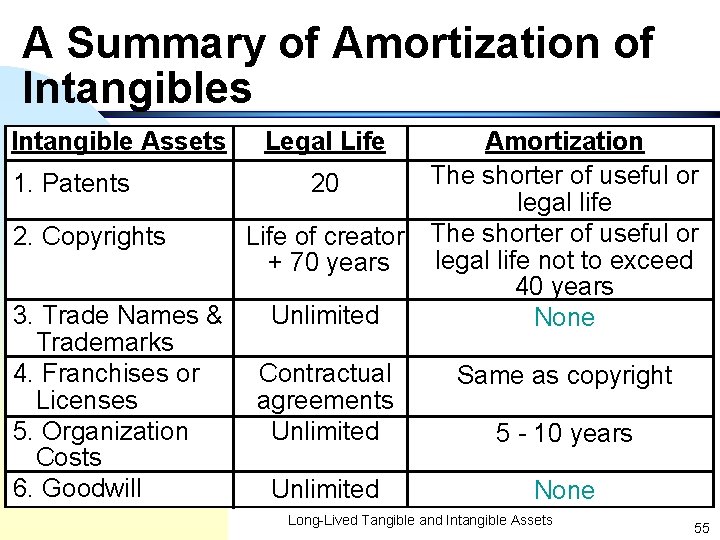
A Summary of Amortization of Intangibles Intangible Assets Legal Life Amortization The shorter of useful or 1. Patents 20 legal life 2. Copyrights Life of creator The shorter of useful or legal life not to exceed + 70 years 40 years 3. Trade Names & Unlimited None Trademarks 4. Franchises or Contractual Same as copyright Licenses agreements 5. Organization Unlimited 5 - 10 years Costs 6. Goodwill Unlimited None Long-Lived Tangible and Intangible Assets 55
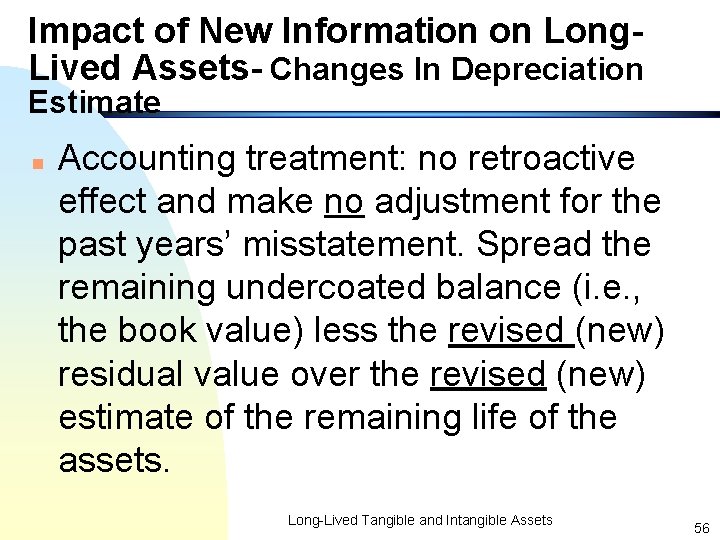
Impact of New Information on Long. Lived Assets- Changes In Depreciation Estimate n Accounting treatment: no retroactive effect and make no adjustment for the past years’ misstatement. Spread the remaining undercoated balance (i. e. , the book value) less the revised (new) residual value over the revised (new) estimate of the remaining life of the assets. Long-Lived Tangible and Intangible Assets 56
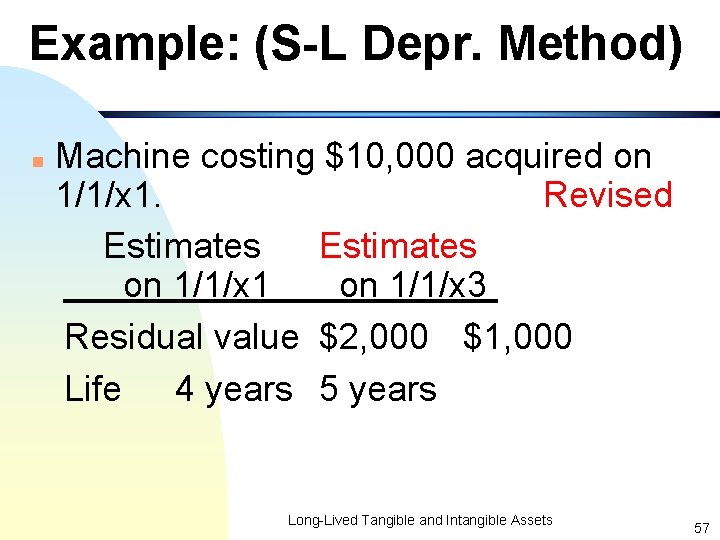
Example: (S-L Depr. Method) n Machine costing $10, 000 acquired on 1/1/x 1. Revised Estimates on 1/1/x 1 on 1/1/x 3 Residual value $2, 000 $1, 000 Life 4 years 5 years Long-Lived Tangible and Intangible Assets 57
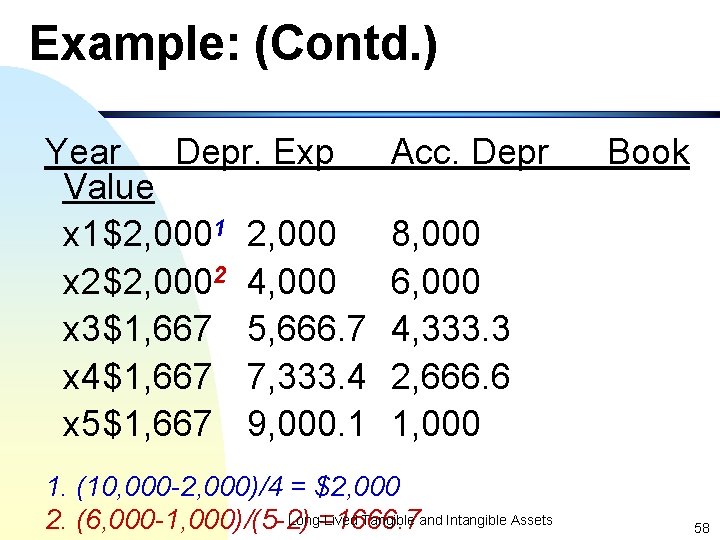
Example: (Contd. ) Year Depr. Exp Value x 1$2, 0001 2, 000 x 2$2, 0002 4, 000 x 3$1, 667 5, 666. 7 x 4$1, 667 7, 333. 4 x 5$1, 667 9, 000. 1 Acc. Depr Book 8, 000 6, 000 4, 333. 3 2, 666. 6 1, 000 1. (10, 000 -2, 000)/4 = $2, 000 Long-Lived Tangible and Intangible Assets 2. (6, 000 -1, 000)/(5 -2) =1666. 7 58
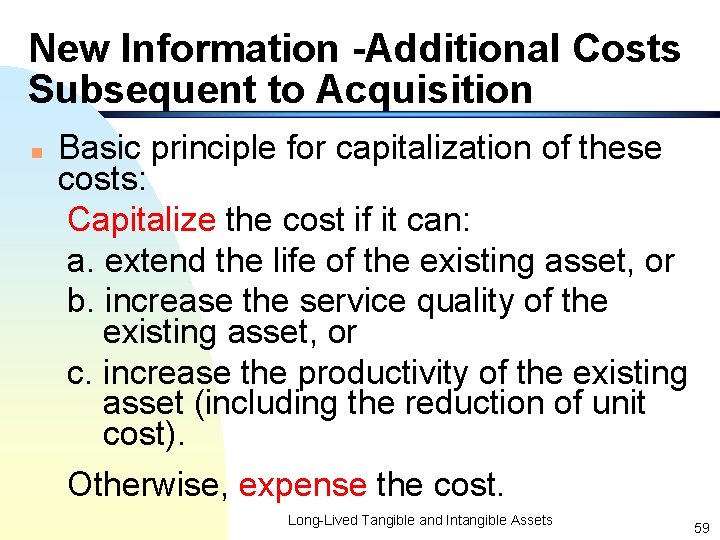
New Information -Additional Costs Subsequent to Acquisition n Basic principle for capitalization of these costs: Capitalize the cost if it can: a. extend the life of the existing asset, or b. increase the service quality of the existing asset, or c. increase the productivity of the existing asset (including the reduction of unit cost). Otherwise, expense the cost. Long-Lived Tangible and Intangible Assets 59
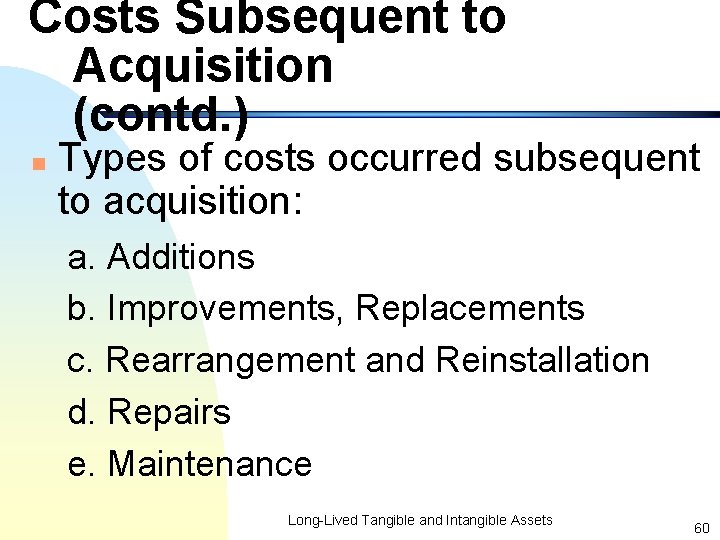
Costs Subsequent to Acquisition (contd. ) n Types of costs occurred subsequent to acquisition: a. Additions b. Improvements, Replacements c. Rearrangement and Reinstallation d. Repairs e. Maintenance Long-Lived Tangible and Intangible Assets 60
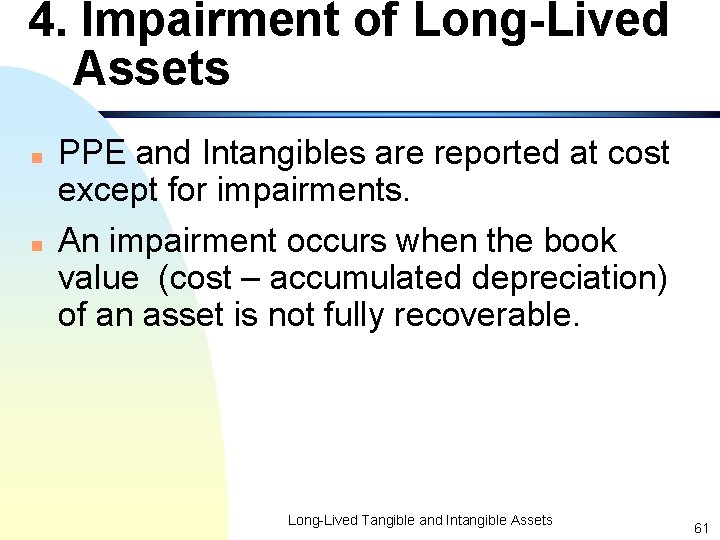
4. Impairment of Long-Lived Assets n n PPE and Intangibles are reported at cost except for impairments. An impairment occurs when the book value (cost – accumulated depreciation) of an asset is not fully recoverable. Long-Lived Tangible and Intangible Assets 61
Operational Assets Held for Use – Tangible Assets and Finite-Life Intangibles (Patents, etc) n GAAP requires test for impairment only when events or changes in circumstances indicate that the book value of this asset may not recoverable. Long-Lived Tangible and Intangible Assets 62
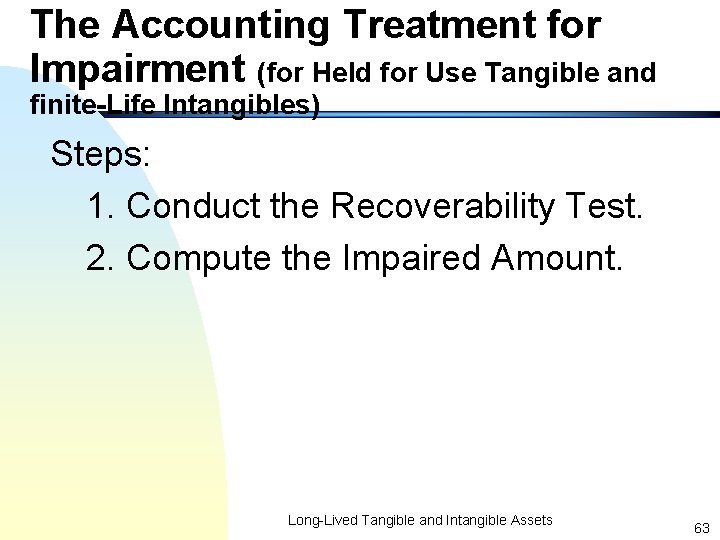
The Accounting Treatment for Impairment (for Held for Use Tangible and finite-Life Intangibles) Steps: 1. Conduct the Recoverability Test. 2. Compute the Impaired Amount. Long-Lived Tangible and Intangible Assets 63
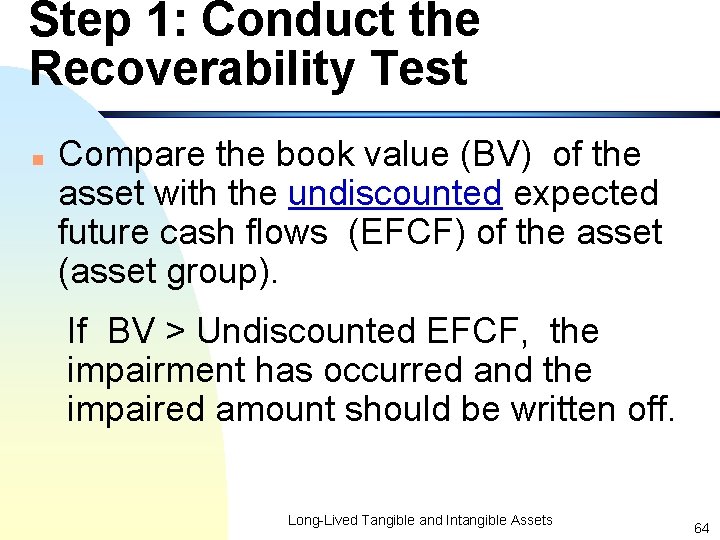
Step 1: Conduct the Recoverability Test n Compare the book value (BV) of the asset with the undiscounted expected future cash flows (EFCF) of the asset (asset group). If BV > Undiscounted EFCF, the impairment has occurred and the impaired amount should be written off. Long-Lived Tangible and Intangible Assets 64
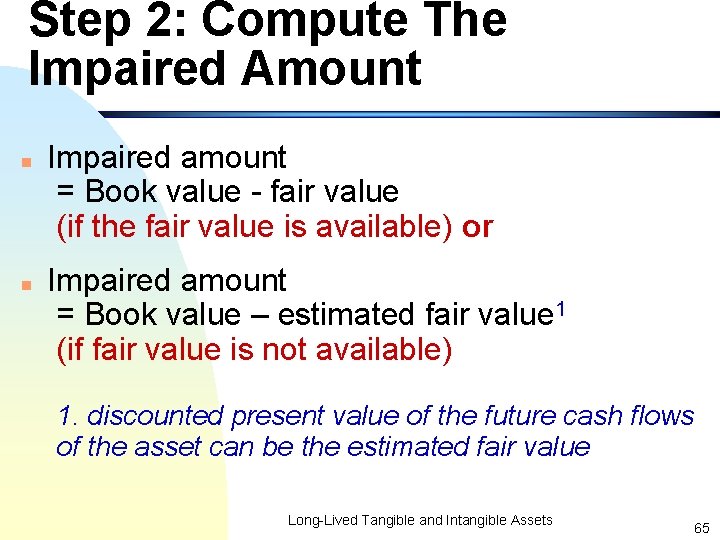
Step 2: Compute The Impaired Amount n n Impaired amount = Book value - fair value (if the fair value is available) or Impaired amount = Book value – estimated fair value 1 (if fair value is not available) 1. discounted present value of the future cash flows of the asset can be the estimated fair value Long-Lived Tangible and Intangible Assets 65
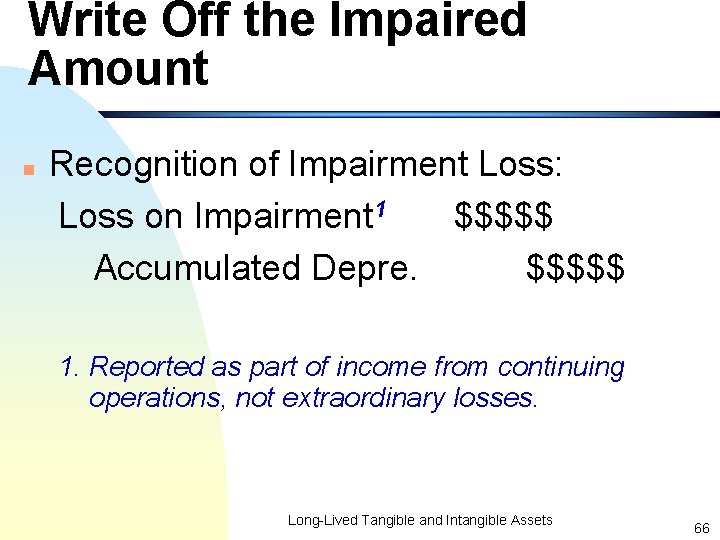
Write Off the Impaired Amount n Recognition of Impairment Loss: Loss on Impairment 1 $$$$$ Accumulated Depre. $$$$$ 1. Reported as part of income from continuing operations, not extraordinary losses. Long-Lived Tangible and Intangible Assets 66
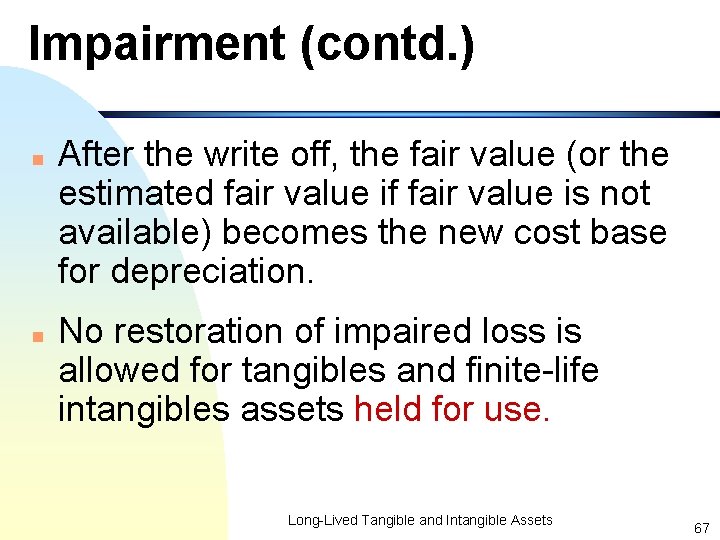
Impairment (contd. ) n n After the write off, the fair value (or the estimated fair value if fair value is not available) becomes the new cost base for depreciation. No restoration of impaired loss is allowed for tangibles and finite-life intangibles assets held for use. Long-Lived Tangible and Intangible Assets 67
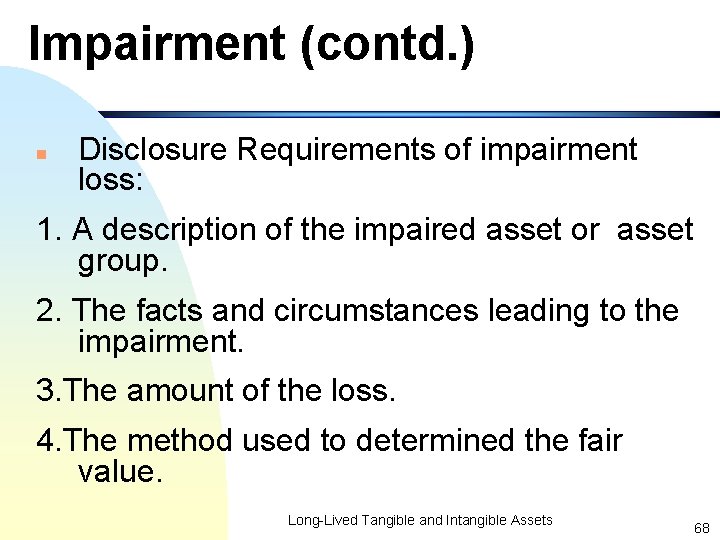
Impairment (contd. ) n Disclosure Requirements of impairment loss: 1. A description of the impaired asset or asset group. 2. The facts and circumstances leading to the impairment. 3. The amount of the loss. 4. The method used to determined the fair value. Long-Lived Tangible and Intangible Assets 68
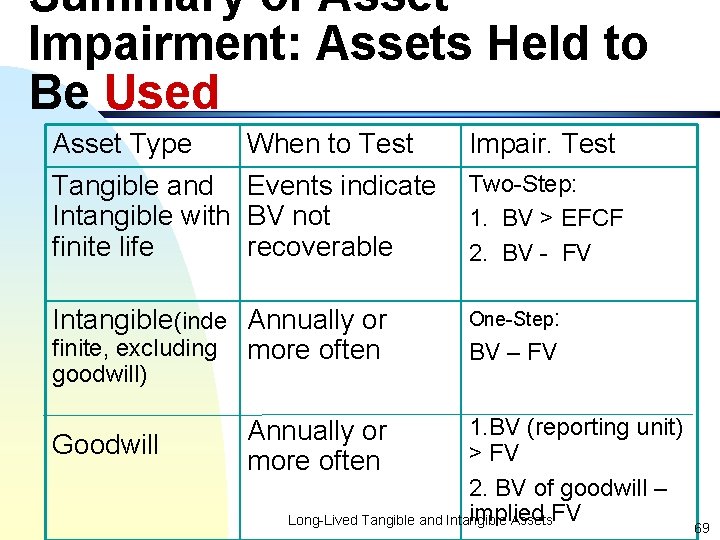
Summary of Asset Impairment: Assets Held to Be Used Asset Type When to Test Impair. Test Tangible and Events indicate Intangible with BV not finite life recoverable Two-Step: 1. BV > EFCF 2. BV - FV Intangible(inde Annually or finite, excluding more often One-Step: goodwill) Goodwill BV – FV 1. BV (reporting unit) > FV 2. BV of goodwill – implied Long-Lived Tangible and Intangible Assets. FV Annually or more often 69
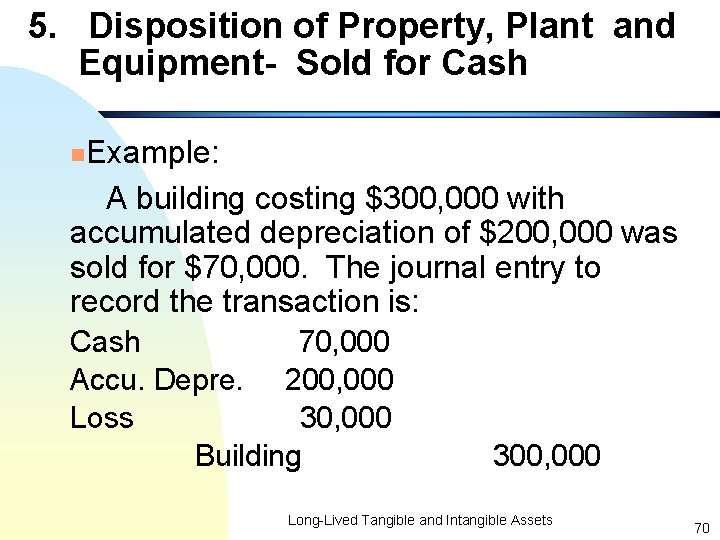
5. Disposition of Property, Plant and Equipment- Sold for Cash n. Example: A building costing $300, 000 with accumulated depreciation of $200, 000 was sold for $70, 000. The journal entry to record the transaction is: Cash 70, 000 Accu. Depre. 200, 000 Loss 30, 000 Building 300, 000 Long-Lived Tangible and Intangible Assets 70
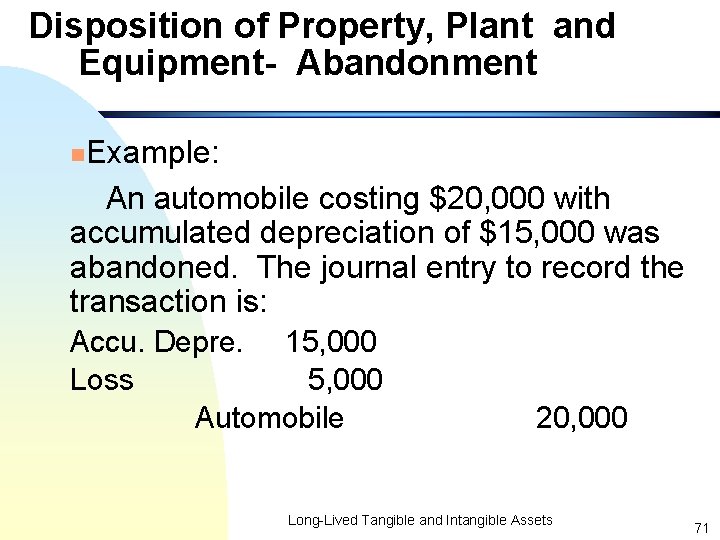
Disposition of Property, Plant and Equipment- Abandonment n. Example: An automobile costing $20, 000 with accumulated depreciation of $15, 000 was abandoned. The journal entry to record the transaction is: Accu. Depre. 15, 000 Loss 5, 000 Automobile 20, 000 Long-Lived Tangible and Intangible Assets 71
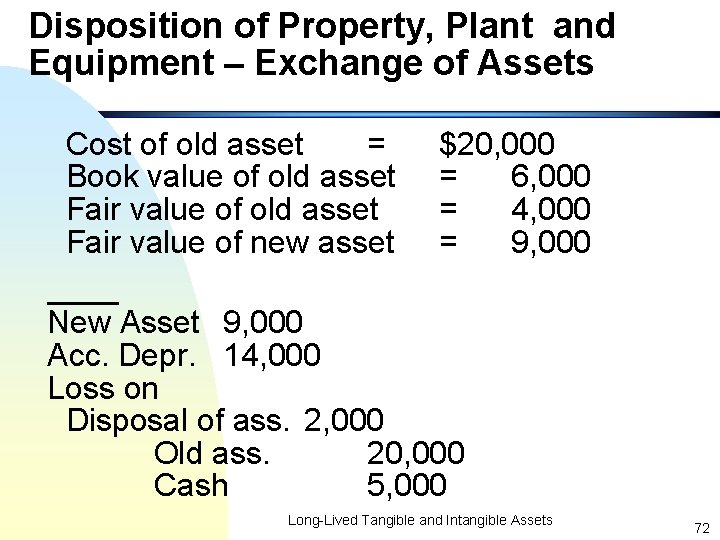
Disposition of Property, Plant and Equipment – Exchange of Assets Cost of old asset = Book value of old asset Fair value of new asset $20, 000 = 6, 000 = 4, 000 = 9, 000 New Asset 9, 000 Acc. Depr. 14, 000 Loss on Disposal of ass. 2, 000 Old ass. 20, 000 Cash 5, 000 Long-Lived Tangible and Intangible Assets 72
- Slides: 71