
CHAPTER 8 LOCATION AND SIZING SUBSTATION 1 CONTENT

CHAPTER 8 LOCATION AND SIZING SUBSTATION 1
CONTENT • SUBSTATION LOCATION • THE RATING OF A SUBSTATION ◦ Square Shape ◦ Hexagonally Shape • • SUBSTATION SERVICE AREA WITH N PRIMARY FEEDRS VOLTAGE DROP CALCULATION 2

SUBSTATION LOCATION v SELECTING LOCATION FOR SUBSTATION • As much as feasible close to the load center of its service area, proper voltage regulation can be obtainable without taking extensive measures. • Provides proper access for incoming subs-transmission lines and outgoing primary feeder. • Provide enough space for the future substation expansion. • The selected substation should not be opposed by land use regulations, local ordinances, and neighbors. • The selected substation location should help to minimize the number of customers affected by any service discontinuity. • Other considerations, such as adaptability, emergency. 3

SUBSTATION LOCATION v Steps 1. of the rule to a service area map Draw a straight line between a proposed substation site and each of its neighbors 2. Perpendicularly bisect each of those line 3. The set of all the perpendicular bisectors a round a substation defines its service territory. 4. The target load for this substation will be the sum of all loads in its service territory. 4
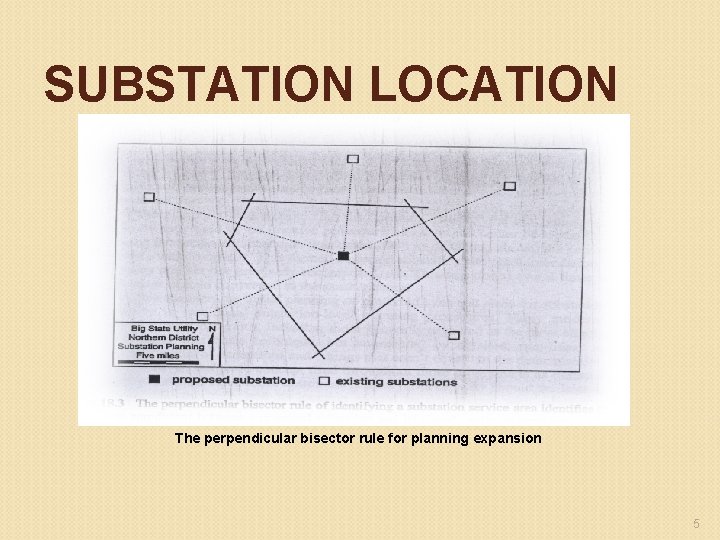
SUBSTATION LOCATION The perpendicular bisector rule for planning expansion 5
THE RATING OF A SUBSTATION The additional capacity requirements of a system with increasing load density can be met by: ◦ Either holding the service area of a given substation constant and increasing its capacity ◦ Developing new substations and thereby holding the rating of the given substations constant. 6
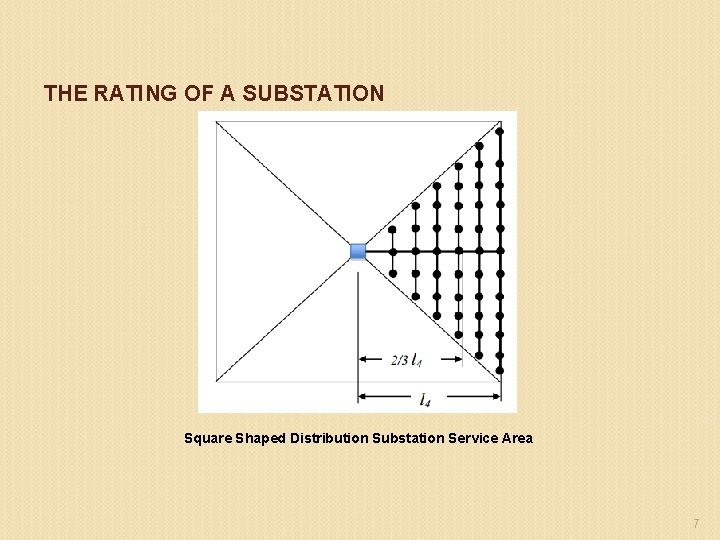
THE RATING OF A SUBSTATION Square Shaped Distribution Substation Service Area 7
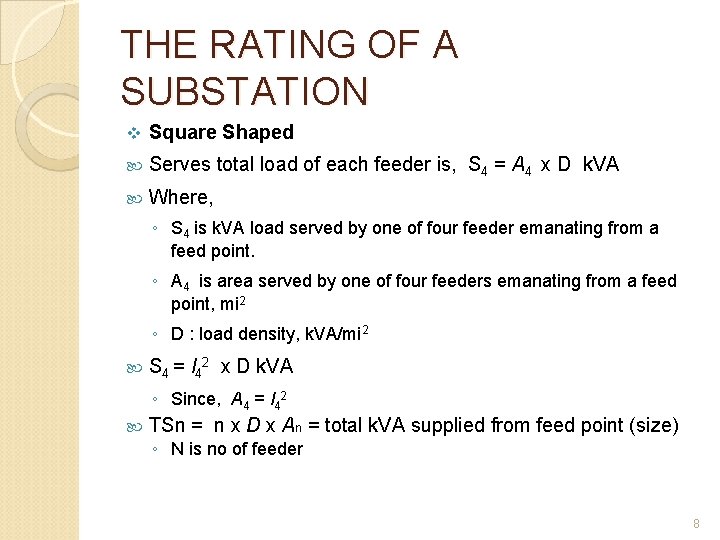
THE RATING OF A SUBSTATION v Square Shaped Serves total load of each feeder is, S 4 = A 4 x D k. VA Where, ◦ S 4 is k. VA load served by one of four feeder emanating from a feed point. ◦ A 4 is area served by one of four feeders emanating from a feed point, mi 2 ◦ D : load density, k. VA/mi 2 S 4 = l 42 x D k. VA ◦ Since, A 4 = l 42 TSn = n x D x An = total k. VA supplied from feed point (size) ◦ N is no of feeder 8
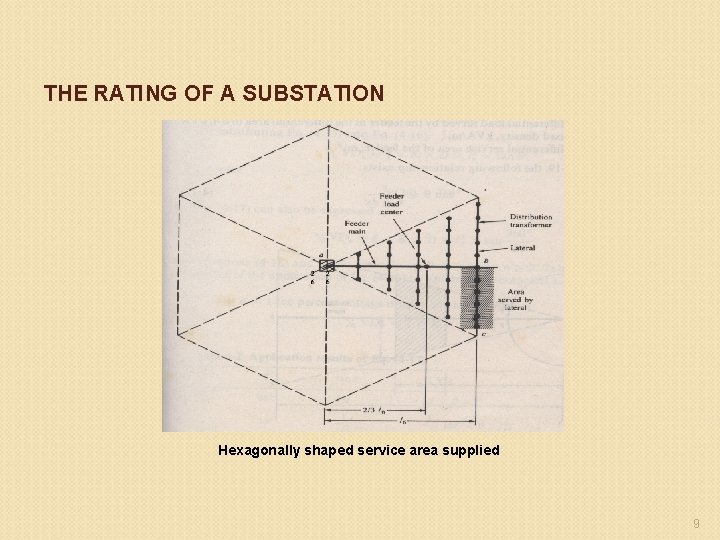
THE RATING OF A SUBSTATION Hexagonally shaped service area supplied 9
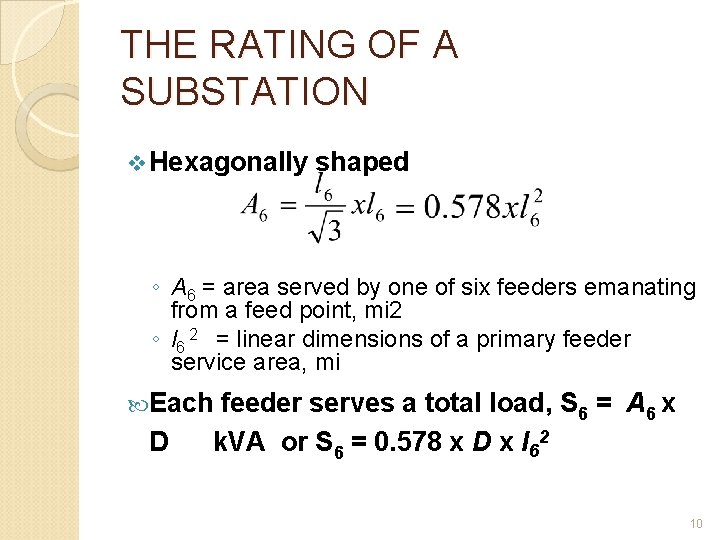
THE RATING OF A SUBSTATION v Hexagonally shaped ◦ A 6 = area served by one of six feeders emanating from a feed point, mi 2 ◦ l 6 2 = linear dimensions of a primary feeder service area, mi Each D feeder serves a total load, S 6 = A 6 x k. VA or S 6 = 0. 578 x D x l 62 10
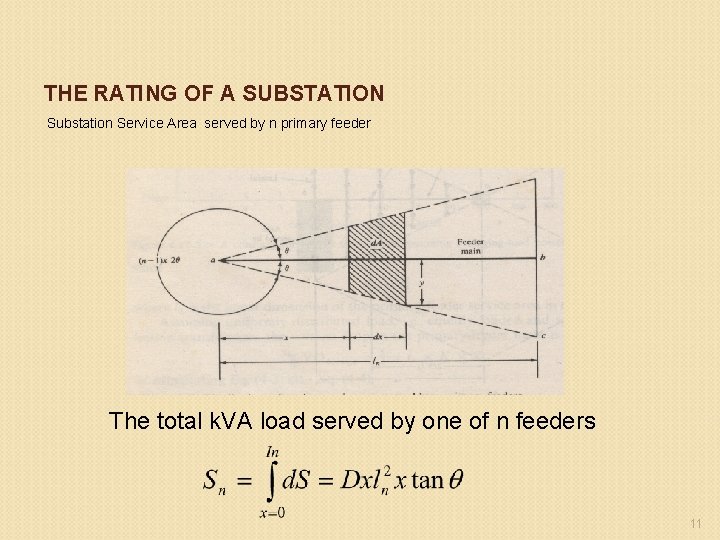
THE RATING OF A SUBSTATION Substation Service Area served by n primary feeder The total k. VA load served by one of n feeders 11
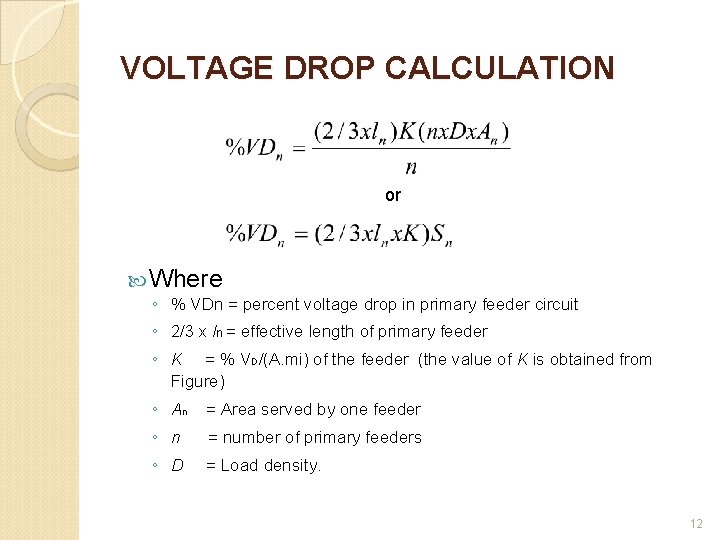
VOLTAGE DROP CALCULATION or Where ◦ % VDn = percent voltage drop in primary feeder circuit ◦ 2/3 x ln = effective length of primary feeder ◦ K = % VD/(A. mi) of the feeder (the value of K is obtained from Figure) ◦ An = Area served by one feeder ◦ n = number of primary feeders ◦ D = Load density. 12
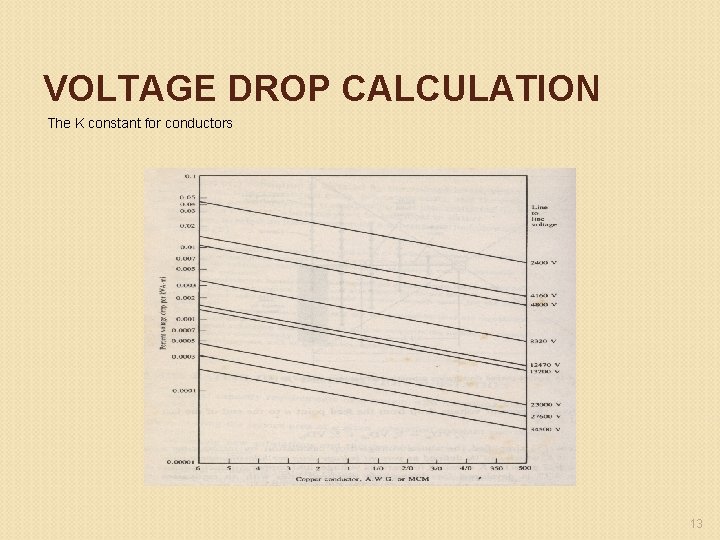
VOLTAGE DROP CALCULATION The K constant for conductors 13
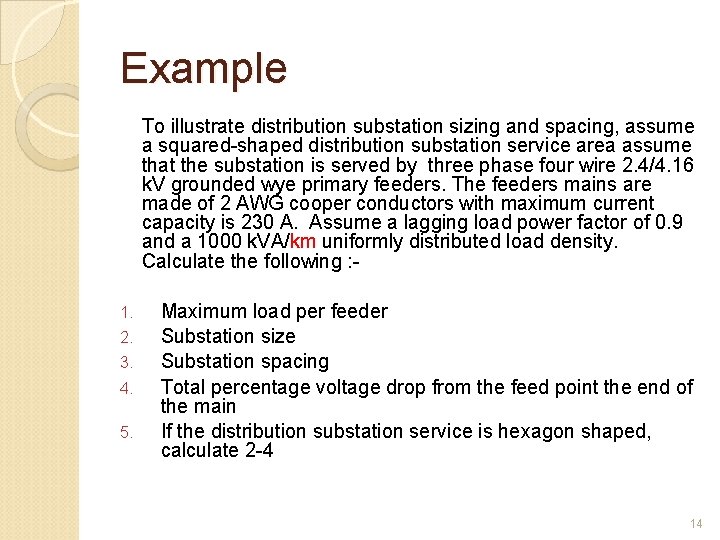
Example To illustrate distribution substation sizing and spacing, assume a squared-shaped distribution substation service area assume that the substation is served by three phase four wire 2. 4/4. 16 k. V grounded wye primary feeders. The feeders mains are made of 2 AWG cooper conductors with maximum current capacity is 230 A. Assume a lagging load power factor of 0. 9 and a 1000 k. VA/km uniformly distributed load density. Calculate the following : 1. 2. 3. 4. 5. Maximum load per feeder Substation size Substation spacing Total percentage voltage drop from the feed point the end of the main If the distribution substation service is hexagon shaped, calculate 2 -4 14
- Slides: 14