
Chapter 8 Lecture Political Geography The Nation State
- Slides: 17
Chapter 8 Lecture Political Geography: The Nation State The Cultural Landscape Eleventh Edition Political Geography Matthew Cartlidge University of Nebraska-Lincoln © 2014 Pearson Education, Inc.
Why Are Nation-states Difficult to Create? • Nation-states and Multinational States – A state that contains more than one ethnicity is a multi-ethnic state. • Multitude of ethnicities in some cases all contribute cultural features to the formation of a single nationality. e. g. United States of America – A multinational state is a country that contains more than one ethnicity with traditions of selfdetermination. e. g. Russia © 2014 Pearson Education, Inc.
Why Are Nation-states Difficult to Create? • Nation-states and Multinational States – Nation-States in Europe • Denmark – 90% of population are ethnic Danes – Nearly all Danes speak Danish » Nearly all world’s Danish speakers live in Denmark • Slovenia – 83% of population are ethnic Slovenes – Nearly all of the world’s Slovenes live in Slovenia © 2014 Pearson Education, Inc.
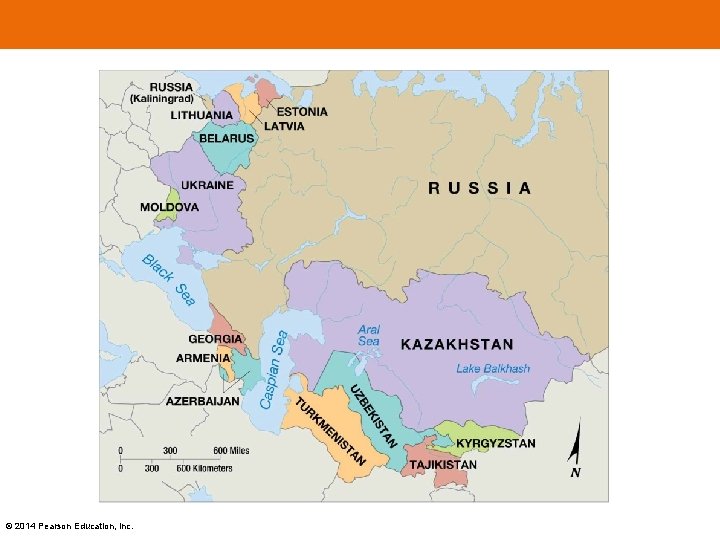
Why Are Nation-states Difficult to Create? • Independent Nation-States in Former Soviet Republics – Former Soviet Union consisted of 15 republics based on its 15 largest ethnicities. – 15 republics became 15 independent states consisting of five groups. © 2014 Pearson Education, Inc.
© 2014 Pearson Education, Inc.
Why Are Nation-states Difficult to Create? • Independent Nation-States in Former Soviet Republics • Three Baltic States – Estonia » Mostly Protestant (Lutheran) » Speak a Uralic language related to Finnish – Latvia » Mostly Protestant (Lutheran) » Speak a language of the Baltic group – Lithuania » Mostly Roman Catholic » Speak a language of the Baltic group within the Balto-Slavic branch of the Indo-European language family © 2014 Pearson Education, Inc.
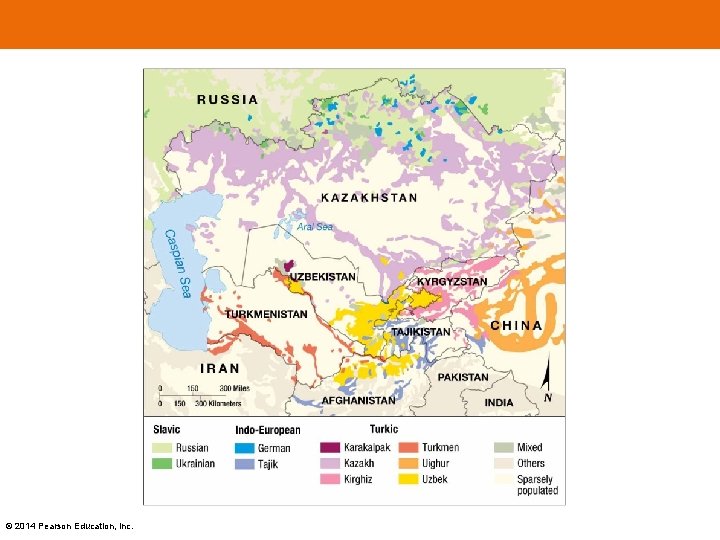
Why Are Nation-states Difficult to Create? • Independent Nation-States in Former Soviet Republics • Three European States 1. 2. 3. – – Belarus Ukraine Moldova Three states speak similar East Slavic languages All are predominantly Orthodox Christians. » Some western Ukrainians are Roman Catholics • Five Central Asian States – © 2014 Pearson Education, Inc. Turkmenistan and Uzbekistan » Predominantly Muslims » Speak an Altaic language
Why Are Nation-states Difficult to Create? • Independent Nation-States in Former Soviet Republics • Five Central Asian States cont’d – Kyrgyzstan » Predominantly Muslims » Speak an Altaic language – Kazakhstan » Predominantly Muslims » Speak an Altaic language – Tajikistan » Predominantly Muslims » Speak a language in the Indic group of the Indo. Iranian branch of Indo-European language family. © 2014 Pearson Education, Inc.
© 2014 Pearson Education, Inc.
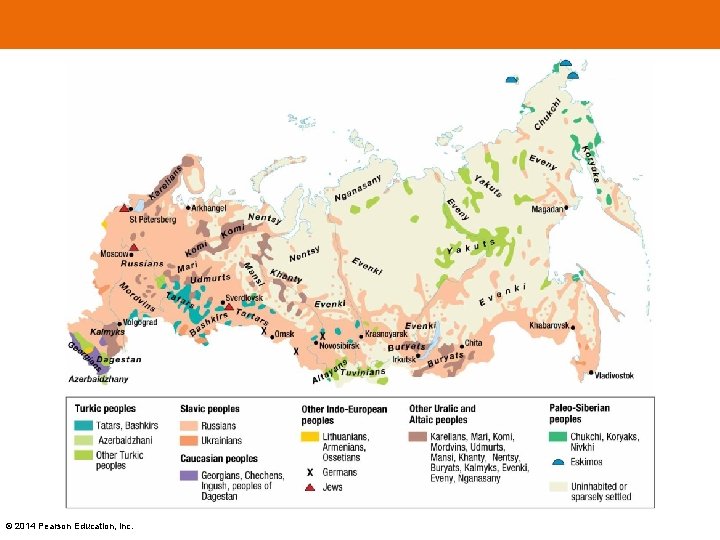
Why Are Nation-states Difficult to Create? • The Largest Multinational State: Russia – Russia’s 39 ethnicities are clustered in two principal locations. 1. Along borders with neighboring states – Buryats and Tuvinian near Mongolia – Chechens, Dagestani, Kabardins, and Ossetians near the Azerbaijan and Georgia 2. Clustered in the center of Russia, especially between the Volga River basin and the Ural Mountains. – Most numerous ethnicities include Bashkirs, Chuvash, and Tatars. © 2014 Pearson Education, Inc.
© 2014 Pearson Education, Inc.
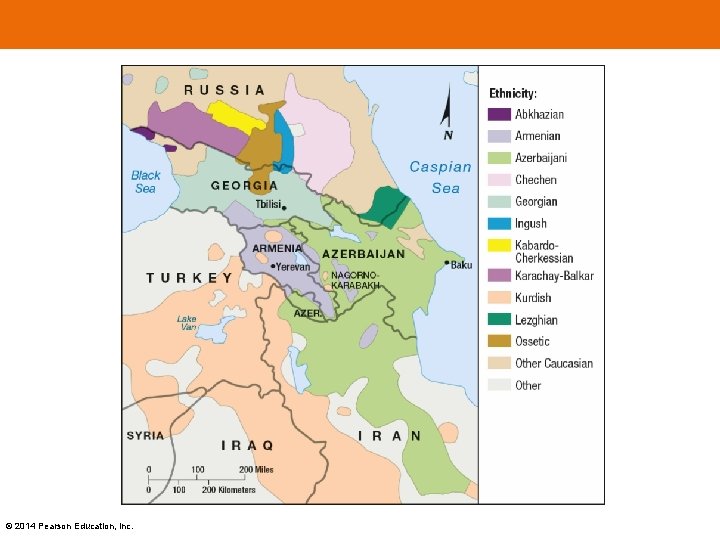
Why Are Nation-states Difficult to Create? • The Largest Multinational State: Russia – Turmoil in the Caucasus • Caucasus region is situated between the Black and Caspian seas. – Home to several ethnicities including Azeris, Armenians, and Georgians. – With the breakup of the region into independent countries, long-simmering conflicts among ethnicities have erupted into armed conflicts. © 2014 Pearson Education, Inc.
© 2014 Pearson Education, Inc.
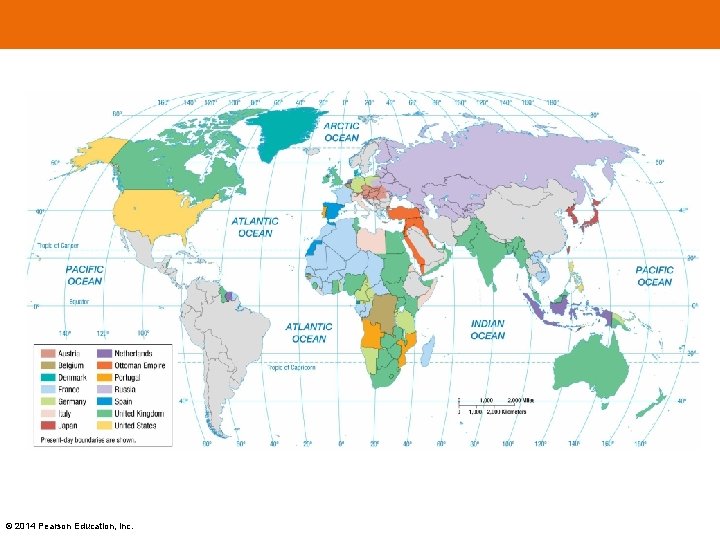
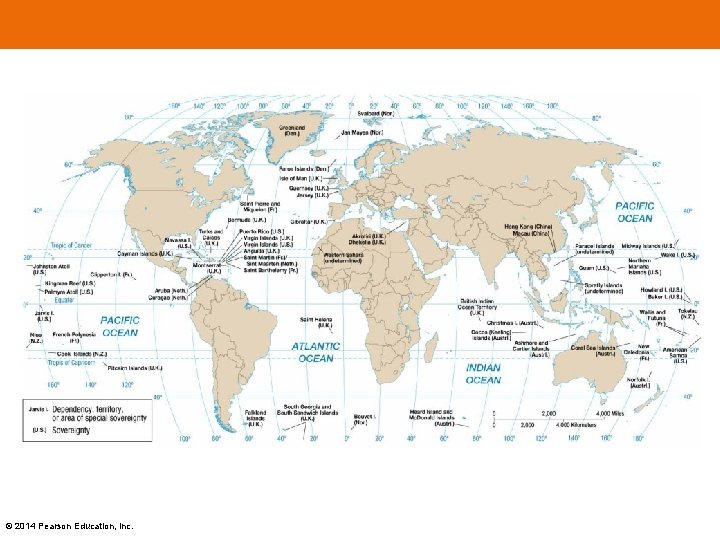
Why Are Nation-states Difficult to Create? • Colonies – Colonialism • A colony is a territory that is legally tied to a sovereign state rather than being completely independent. – Sovereign state may run only its military and foreign policy. – Sovereign state may also control its internal affairs. • European states came to control much of the world through colonialism, an effort by one country to establish settlement in a territory and to impose its political, economic, ad cultural principles on that territory. © 2014 Pearson Education, Inc.
© 2014 Pearson Education, Inc.
Why Are Nation-states Difficult to Create? • Colonies – The Remaining Colonies • U. S. Department of State lists 68 places in the world that it calls dependencies and areas of special sovereignty. – 43 indigenous populations – 25 with no permanent population – Most current colonies are islands in the Pacific Ocean and Caribbean Sea. » Ex. Puerto Rico, a commonwealth of the U. S. , is home to 4 million residents who are U. S. citizens, but they do not participate in U. S. election or have a voting member of Congress. © 2014 Pearson Education, Inc.
© 2014 Pearson Education, Inc.