
Chapter 8 Lecture Outline Prepared by Ashlyn Smith
Chapter 8 Lecture Outline Prepared by Ashlyn Smith Anderson University 1 Copyright © Mc. Graw-Hill Education. Permission required for reproduction or display.

8. 1 Mixtures • Pure substances— elements, covalent compounds, and ionic compounds. • Most matter we come into contact with is a mixture of two or more pure substances. • A heterogeneous mixture does not have a uniform composition throughout the sample. • A homogeneous mixture has a uniform composition throughout the sample. 2
8. 1 Mixtures A. Solutions • A solution is a homogeneous mixture that contains small particles. Liquid solutions are transparent. • Solutions consist of two parts: 1. The solute is the substance present in a lesser amount. 2. The solvent is the substance present in a larger amount. • An aqueous solution has water as the solvent. 3
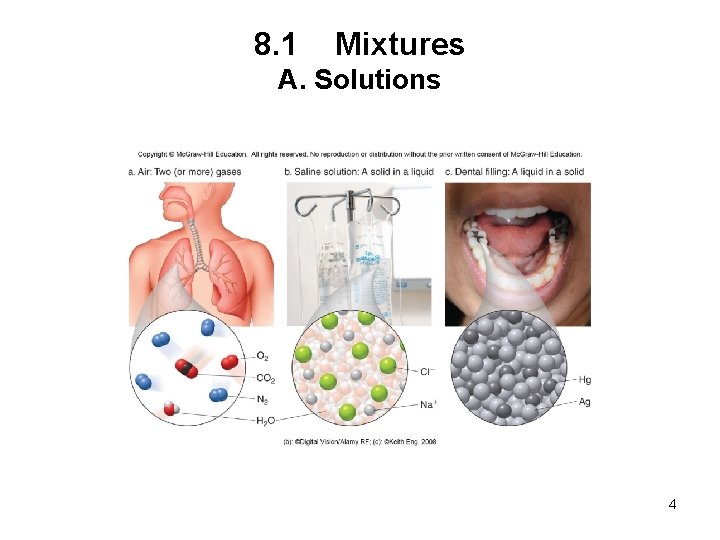
8. 1 Mixtures A. Solutions 4
8. 1 Mixtures B. Colloids and Suspensions • A colloid is a homogeneous mixture with larger particles, often having an opaque appearance. • Particles in a colloid cannot be filtered from its other components. • They do not settle out. • A suspension is a heterogeneous mixture that contains large particles suspended in a liquid. • Particles are so large that they do not dissolve in a liquid. • They can be filtered away from the liquid or separated using a centrifuge. 5
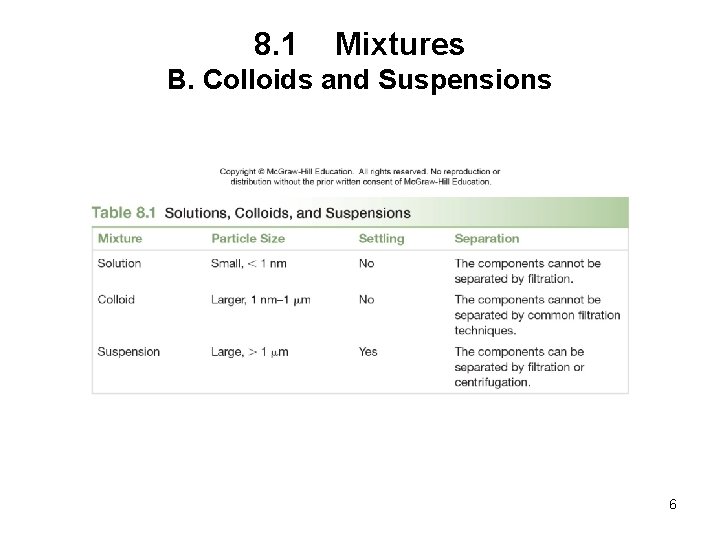
8. 1 Mixtures B. Colloids and Suspensions 6

8. 2 Electrolytes and Nonelectrolytes A. Classification • A substance that conducts an electric current in water is called an electrolyte. Na. Cl(aq) dissociates into Na+(aq) and Cl−(aq) • A substance that does not conduct an electric current in water is called a nonelectrolyte. H 2 O 2 does not dissociate 7
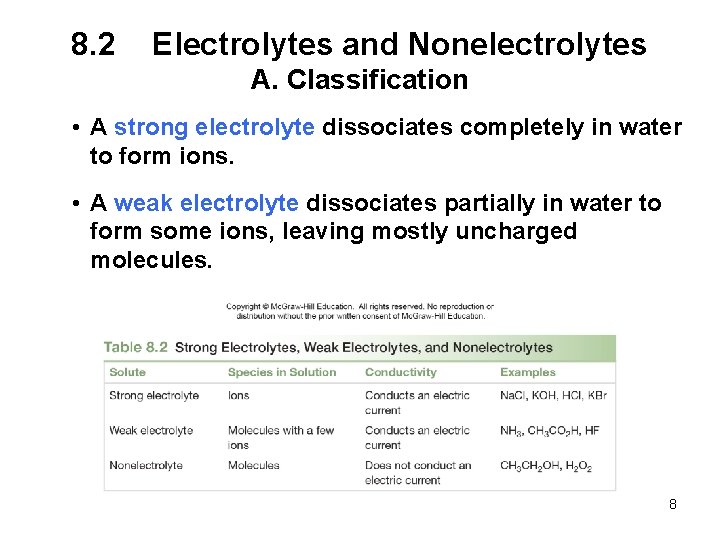
8. 2 Electrolytes and Nonelectrolytes A. Classification • A strong electrolyte dissociates completely in water to form ions. • A weak electrolyte dissociates partially in water to form some ions, leaving mostly uncharged molecules. 8
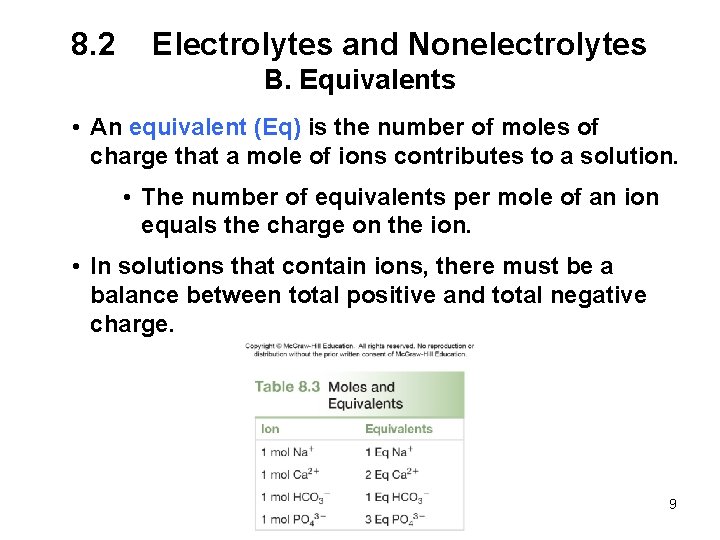
8. 2 Electrolytes and Nonelectrolytes B. Equivalents • An equivalent (Eq) is the number of moles of charge that a mole of ions contributes to a solution. • The number of equivalents per mole of an ion equals the charge on the ion. • In solutions that contain ions, there must be a balance between total positive and total negative charge. 9

8. 2 Electrolytes and Nonelectrolytes B. Equivalents Example If an intravenous aqueous Na. Cl solution contains 154 m. Eq/L of Na+ ions, how many m. Eq of Na+ is a patient given in 800. m. L of solution? Step [1] Identify the known quantities and the desired quantity. 154 m. Eq/L Na+ in solution 800. m. L of solution original quantity ? m. Eq Na+ desired quantity 10
![8. 2 Electrolytes and Nonelectrolytes B. Equivalents Step [2] Write out the conversion factors.](http://slidetodoc.com/presentation_image_h/21949de6175e8f9ea5a8b85847fe0ce1/image-11.jpg "8. 2 Electrolytes and Nonelectrolytes B. Equivalents Step [2] Write out the conversion factors.")
8. 2 Electrolytes and Nonelectrolytes B. Equivalents Step [2] Write out the conversion factors. 1 L or 1000 m. L 1 L 154 m. Eq Na+ or L L 154 m. Eq Na+ Choose these to cancel L and m. L in denominator Step [3] 800. m. L Solve the problem. x 1 L x 154 m. Eq Na+ = 1000 m. L L m. L cancel 123 m. Eq Na+ Answer 11

8. 3 Solubility—General Features • Solubility is the amount of solute that dissolves in a given amount of solvent. • It is usually reported in grams of solute per 100 m. L of solution (g/100 m. L). • A saturated solution contains the maximum number of grams of solute that can dissolve. • An unsaturated solution contains less than the maximum number of grams of solute that can dissolve. 12
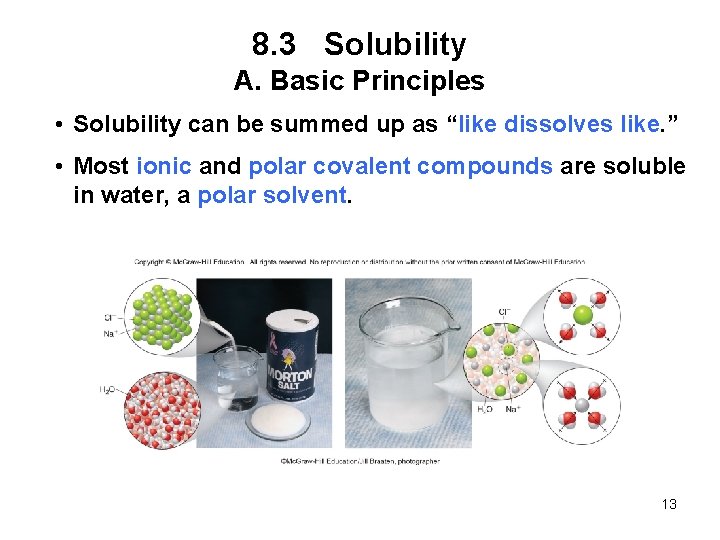
8. 3 Solubility A. Basic Principles • Solubility can be summed up as “like dissolves like. ” • Most ionic and polar covalent compounds are soluble in water, a polar solvent. 13
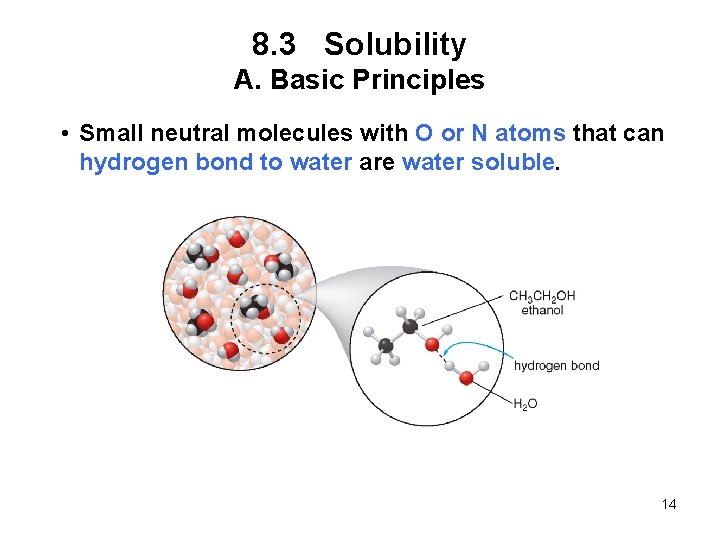
8. 3 Solubility A. Basic Principles • Small neutral molecules with O or N atoms that can hydrogen bond to water are water soluble. 14
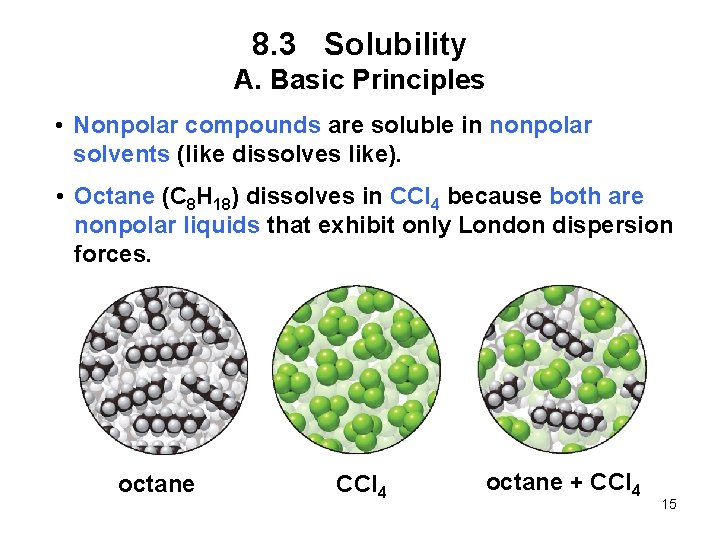
8. 3 Solubility A. Basic Principles • Nonpolar compounds are soluble in nonpolar solvents (like dissolves like). • Octane (C 8 H 18) dissolves in CCl 4 because both are nonpolar liquids that exhibit only London dispersion forces. octane CCl 4 octane + CCl 4 15
8. 3 Solubility A. Basic Principles • When solvation releases more energy than that required to separate particles, the overall process is exothermic (heat is released). • When the separation of particles requires more energy than is released during solvation, the process is endothermic (heat is absorbed). 16
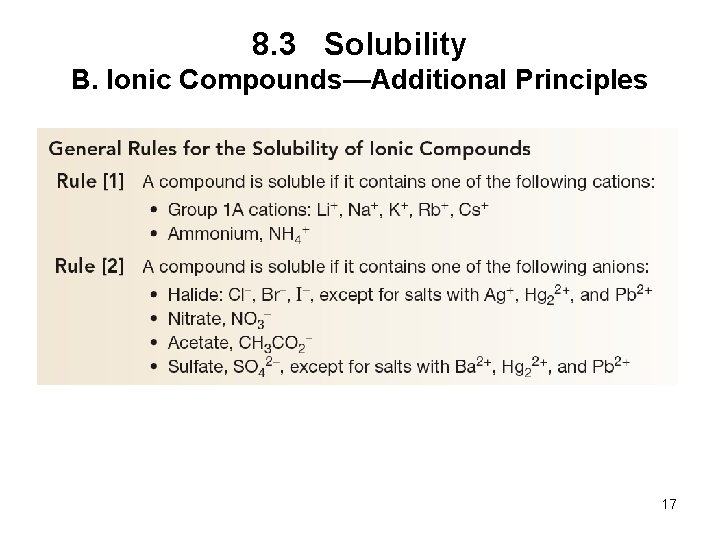
8. 3 Solubility B. Ionic Compounds—Additional Principles 17
8. 4 Solubility-- Effects of T and P A. Temperature (T) Effects • For most ionic and molecular solids, solubility generally increases as temperature increases. • By dissolving a solid in a solvent at high temperature and allowing it to cool slowly, a supersaturated solution can be made. • A supersaturated solution contains more than the predicted maximum amount of solute at a given temperature. • The solubility of a gas decreases with increasing temperature. 18
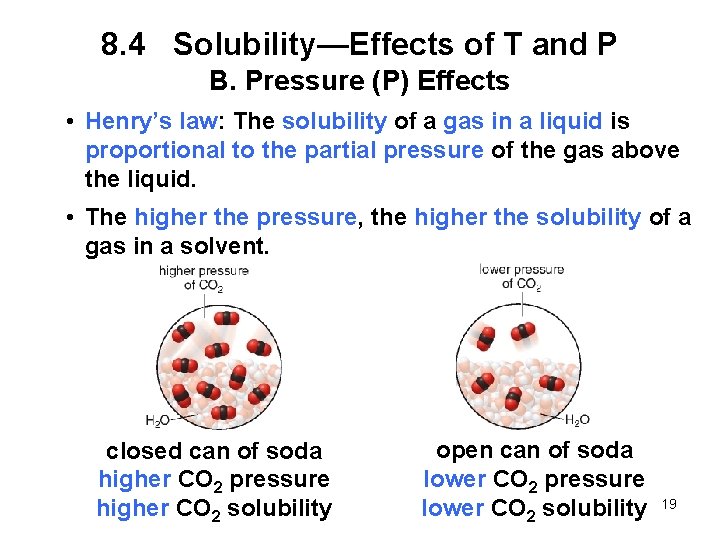
8. 4 Solubility—Effects of T and P B. Pressure (P) Effects • Henry’s law: The solubility of a gas in a liquid is proportional to the partial pressure of the gas above the liquid. • The higher the pressure, the higher the solubility of a gas in a solvent. closed can of soda higher CO 2 pressure higher CO 2 solubility open can of soda lower CO 2 pressure lower CO 2 solubility 19
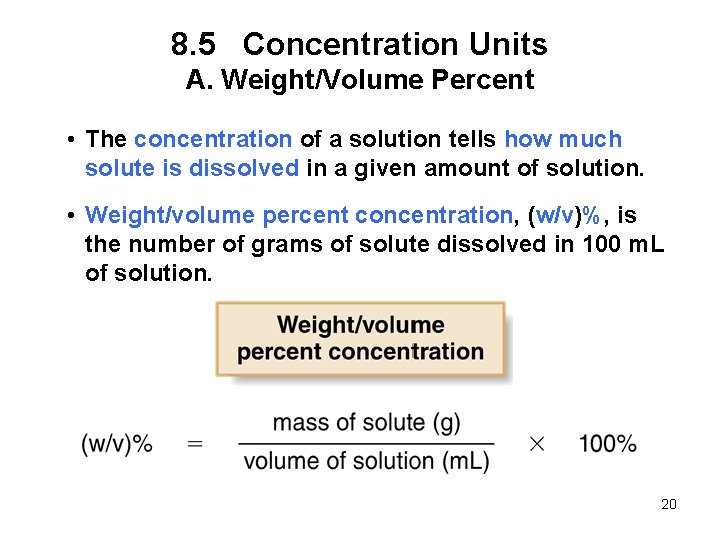
8. 5 Concentration Units A. Weight/Volume Percent • The concentration of a solution tells how much solute is dissolved in a given amount of solution. • Weight/volume percent concentration, (w/v)%, is the number of grams of solute dissolved in 100 m. L of solution. 20

8. 5 Concentration Units A. Weight/Volume Percent For example, vinegar contains 5 g of acetic acid in 100 m. L of solution, so the (w/v)% concentration is: 5 g acetic acid 100 m. L vinegar solution x 100% = 5% (w/v) acetic acid 21
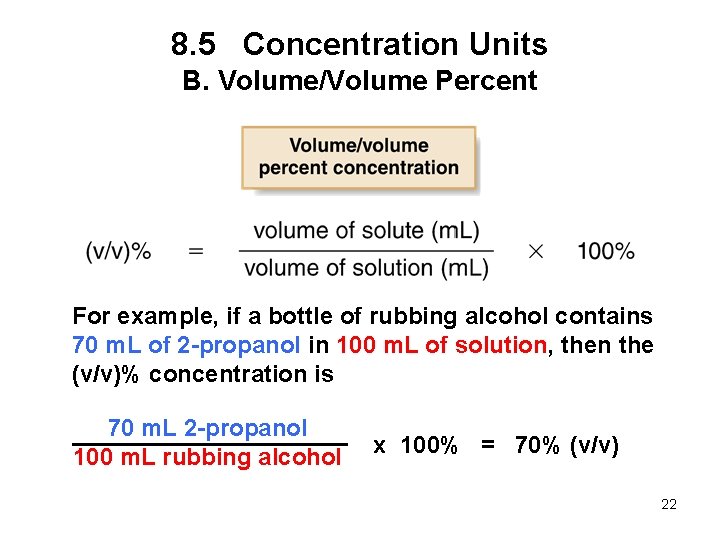
8. 5 Concentration Units B. Volume/Volume Percent For example, if a bottle of rubbing alcohol contains 70 m. L of 2 -propanol in 100 m. L of solution, then the (v/v)% concentration is 70 m. L 2 -propanol 100 m. L rubbing alcohol x 100% = 70% (v/v) 22
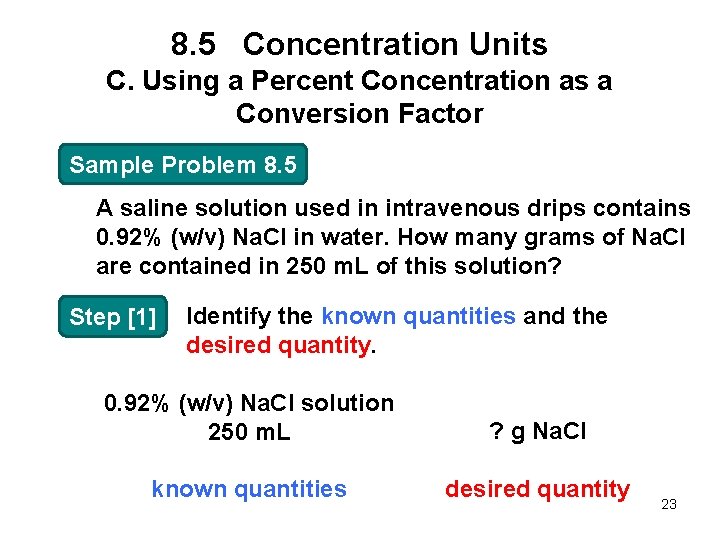
8. 5 Concentration Units C. Using a Percent Concentration as a Conversion Factor Sample Problem 8. 5 A saline solution used in intravenous drips contains 0. 92% (w/v) Na. Cl in water. How many grams of Na. Cl are contained in 250 m. L of this solution? Step [1] Identify the known quantities and the desired quantity. 0. 92% (w/v) Na. Cl solution 250 m. L ? g Na. Cl known quantities desired quantity 23

8. 5 Concentration Units C. Using a Percent Concentration as a Conversion Factor Step [2] Write out the conversion factors. 100 m. L solution 0. 92 g Na. Cl or 0. 92 g Na. Cl 100 m. L solution Choose this one to cancel m. L Step [3] 250 m. L Solve the problem. x 0. 92 g Na. Cl 100 m. L solution Milliliters cancel 2 sig. fig. Answer = 2. 3 g Na. Cl 24
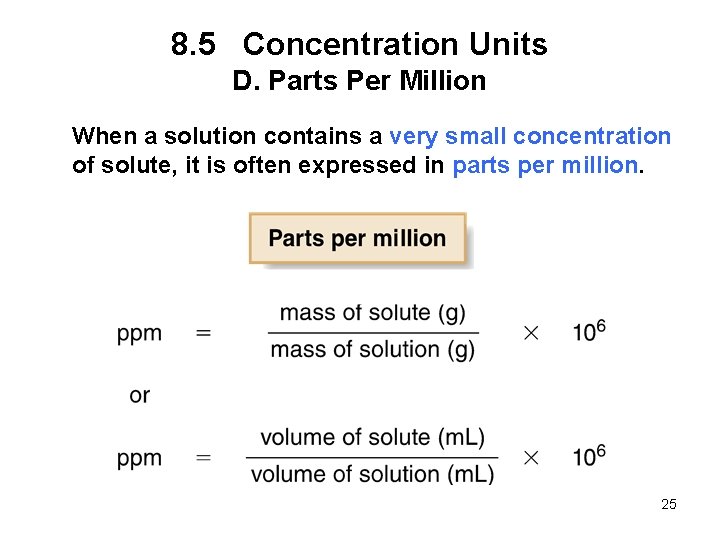
8. 5 Concentration Units D. Parts Per Million When a solution contains a very small concentration of solute, it is often expressed in parts per million. 25
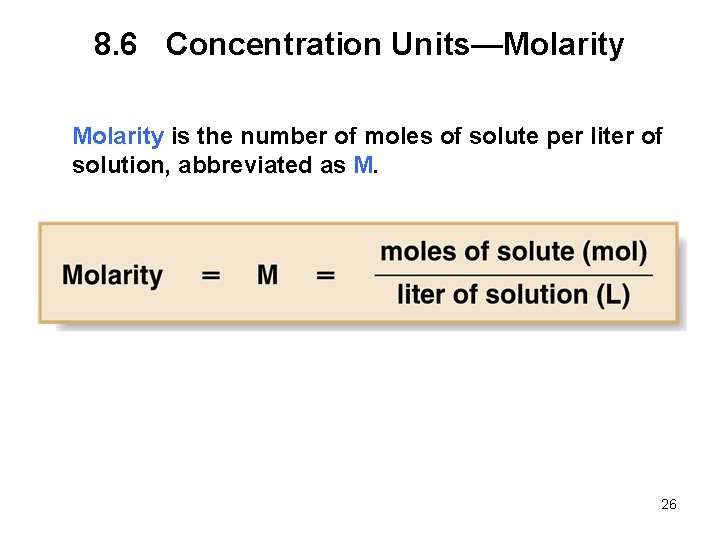
8. 6 Concentration Units—Molarity is the number of moles of solute per liter of solution, abbreviated as M. 26
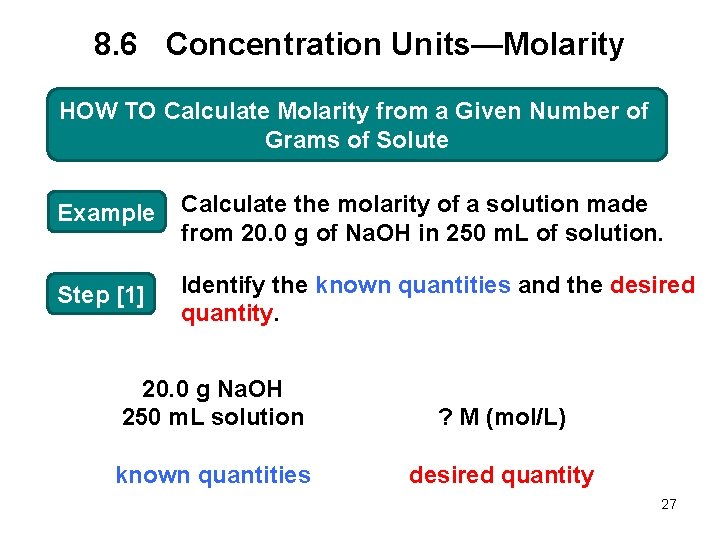
8. 6 Concentration Units—Molarity HOW TO Calculate Molarity from a Given Number of Grams of Solute Example Calculate the molarity of a solution made from 20. 0 g of Na. OH in 250 m. L of solution. Step [1] Identify the known quantities and the desired quantity. 20. 0 g Na. OH 250 m. L solution ? M (mol/L) known quantities desired quantity 27
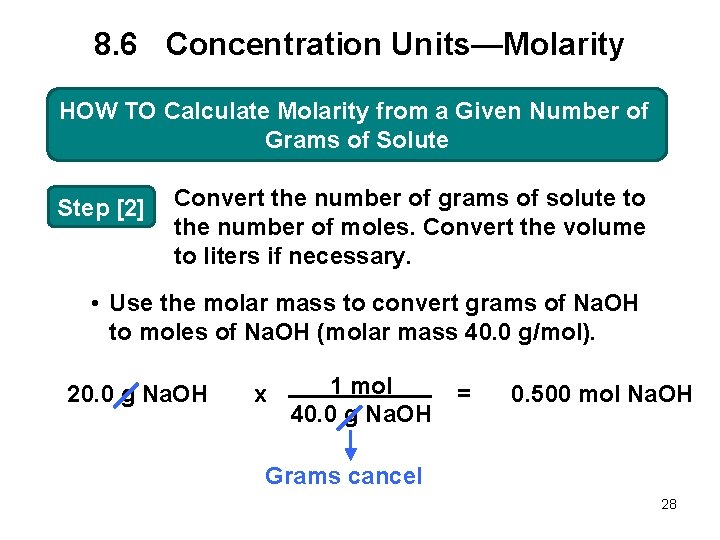
8. 6 Concentration Units—Molarity HOW TO Calculate Molarity from a Given Number of Grams of Solute Step [2] Convert the number of grams of solute to the number of moles. Convert the volume to liters if necessary. • Use the molar mass to convert grams of Na. OH to moles of Na. OH (molar mass 40. 0 g/mol). 20. 0 g Na. OH x 1 mol 40. 0 g Na. OH = 0. 500 mol Na. OH Grams cancel 28
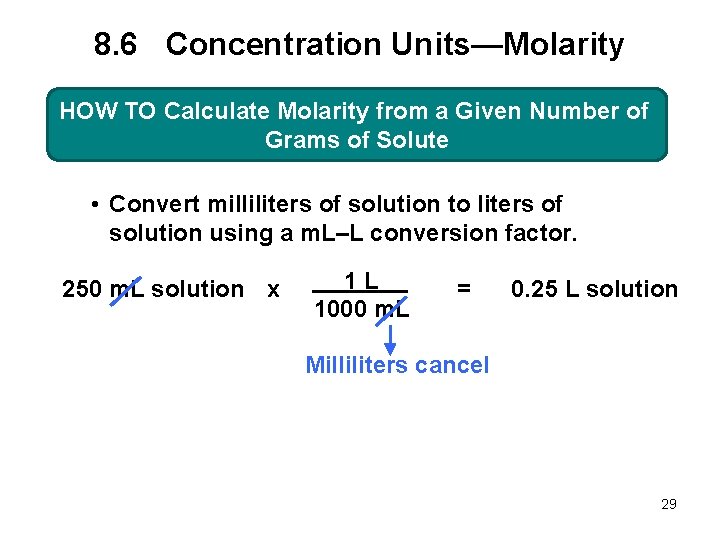
8. 6 Concentration Units—Molarity HOW TO Calculate Molarity from a Given Number of Grams of Solute • Convert milliliters of solution to liters of solution using a m. L–L conversion factor. 250 m. L solution x 1 L 1000 m. L = 0. 25 L solution Milliliters cancel 29
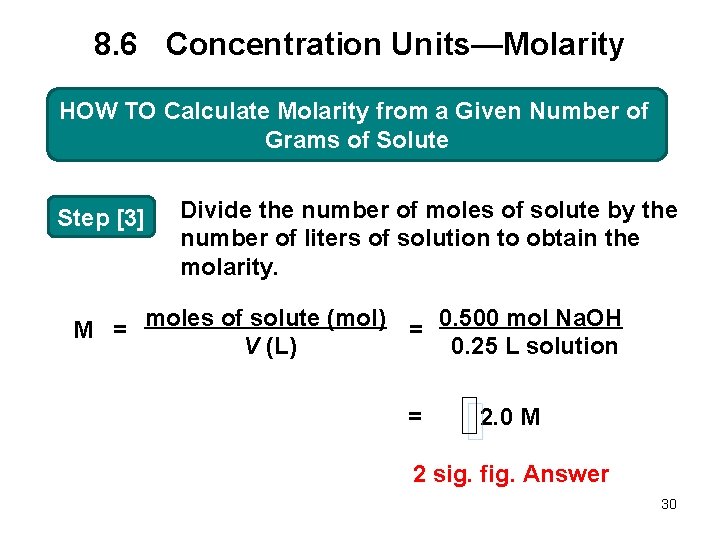
8. 6 Concentration Units—Molarity HOW TO Calculate Molarity from a Given Number of Grams of Solute Step [3] Divide the number of moles of solute by the number of liters of solution to obtain the molarity. M = moles of solute (mol) = 0. 500 mol Na. OH V (L) 0. 25 L solution = 2. 0 M 2 sig. fig. Answer 30

8. 6 Concentration Units—Molarity • Molarity is a conversion factor that relates the number of moles of solute to the volume of solution it occupies. • To calculate the moles of solute, rearrange the equation for molarity: • To calculate the volume of the solution, rearrange the equation for molarity: 31

8. 6 Concentration Units—Molarity Sample Problem 8. 9 What volume in milliliters of a 0. 30 M solution of glucose contains 0. 025 mol of glucose? Step [1] Identify the known quantities and the desired quantity. 0. 30 M 0. 025 mol glucose ? V(L) known quantities desired quantity 32
![8. 6 Concentration Units—Molarity Step [2] Divide the number of moles by molarity to](http://slidetodoc.com/presentation_image_h/21949de6175e8f9ea5a8b85847fe0ce1/image-33.jpg "8. 6 Concentration Units—Molarity Step [2] Divide the number of moles by molarity to")
8. 6 Concentration Units—Molarity Step [2] Divide the number of moles by molarity to obtain the volume in liters. V(L) = moles of solute (mol) M V(L) = = 0. 025 mol glucose 0. 30 mol/L 0. 083 L solution 33
![8. 6 Concentration Units—Molarity Step [3] Use a m. L–L conversion factor to convert](http://slidetodoc.com/presentation_image_h/21949de6175e8f9ea5a8b85847fe0ce1/image-34.jpg "8. 6 Concentration Units—Molarity Step [3] Use a m. L–L conversion factor to convert")
8. 6 Concentration Units—Molarity Step [3] Use a m. L–L conversion factor to convert liters to milliliters. 0. 083 L solution x 1000 m. L = 1 L Liters cancel 83 m. L glucose solution 2 sig. fig. Answer 34
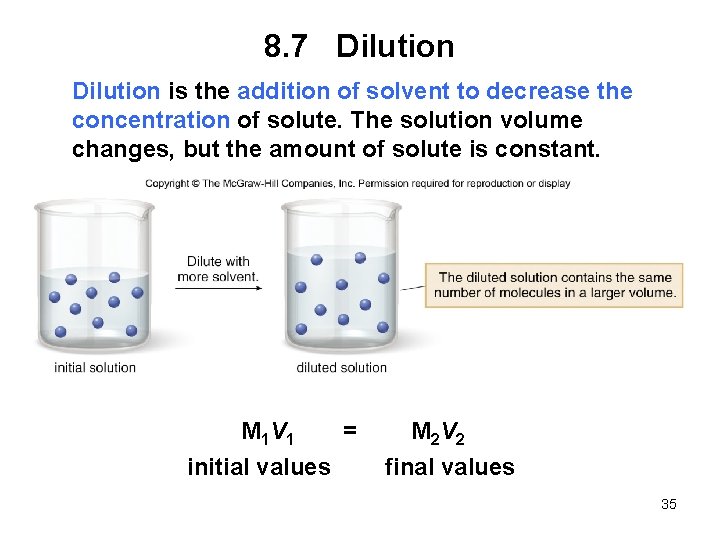
8. 7 Dilution is the addition of solvent to decrease the concentration of solute. The solution volume changes, but the amount of solute is constant. M 1 V 1 = initial values M 2 V 2 final values 35
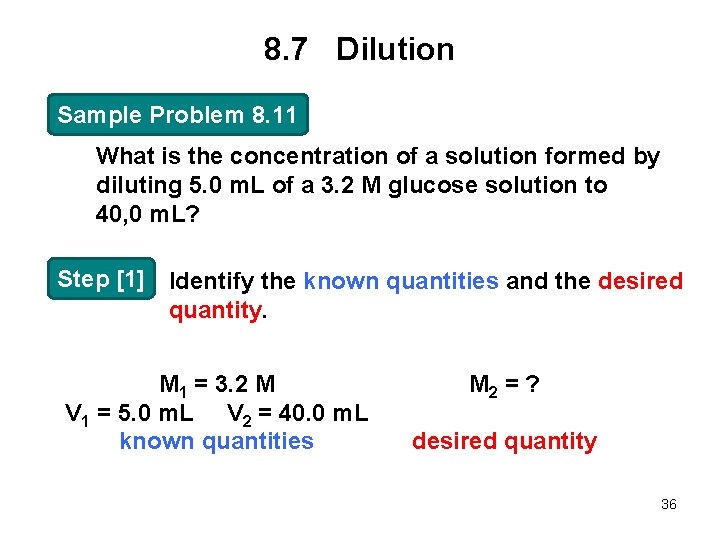
8. 7 Dilution Sample Problem 8. 11 What is the concentration of a solution formed by diluting 5. 0 m. L of a 3. 2 M glucose solution to 40, 0 m. L? Step [1] Identify the known quantities and the desired quantity. M 1 = 3. 2 M V 1 = 5. 0 m. L V 2 = 40. 0 m. L known quantities M 2 = ? desired quantity 36
![8. 7 Dilution Step [2] Write the equation and isolate M 2 on one](http://slidetodoc.com/presentation_image_h/21949de6175e8f9ea5a8b85847fe0ce1/image-37.jpg "8. 7 Dilution Step [2] Write the equation and isolate M 2 on one")
8. 7 Dilution Step [2] Write the equation and isolate M 2 on one side. 37
![8. 7 Dilution Step [3] Solve the Problem. • Substitute three known quantities into](http://slidetodoc.com/presentation_image_h/21949de6175e8f9ea5a8b85847fe0ce1/image-38.jpg "8. 7 Dilution Step [3] Solve the Problem. • Substitute three known quantities into")
8. 7 Dilution Step [3] Solve the Problem. • Substitute three known quantities into the equation and solve for M 2 = M 1 V 2 = (3. 2 M) (5. 0 m. L) (40. 0 m. L) m. L unit cancels = 0. 40 M 2 sig. fig. Answer 38
8. 8 Colligative Properties • Colligative properties are properties of a solution that depend on the concentration of the solute but not its identity. • The number of dissolved solute particles affects the properties of the solution, but the identity of the solute does not. • Colligative properties include the elevation of the boiling point, the lowering of the melting point, and the pressure due to osmosis. 39
8. 8 Colligative Properties A. Boiling Point Elevation • A volatile solute readily escapes into the vapor phase. • A nonvolatile solute does not readily escape, so it has a negligible vapor pressure at a given temperature. • The vapor pressure above a solution of a nonvolatile solute is lower than the vapor pressure of the pure solvent. 40
8. 8 Colligative Properties A. Boiling Point Elevation • Boiling point elevation: A liquid solution that contains a nonvolatile solute has a higher boiling point than the solvent alone. • The amount that the boiling point increases depends only on the number of dissolved particles. • One mole of any nonvolatile solute raises the boiling point of 1 kg of H 2 O the same amount, 0. 51 o. C. 41
8. 8 Colligative Properties B. Freezing Point Depression • Freezing point depression: A liquid solution that contains a nonvolatile solute has a lower freezing point than the solvent alone. • The amount of freezing point depression depends only on the number of dissolved particles. • One mole of any nonvolatile solute lowers the freezing point of 1 kg of H 2 O by the same amount, 1. 86 o. C. 42
8. 9 Osmosis and Dialysis • The membrane that surrounds living cells is a semipermeable membrane. • Semipermeable membranes allow water and small molecules to pass across, but ions and large molecules cannot. • Osmosis is the passage of a solvent, usually water, across a semipermeable membrane from a solution of low solute concentration to a solution of higher solute concentration. 43
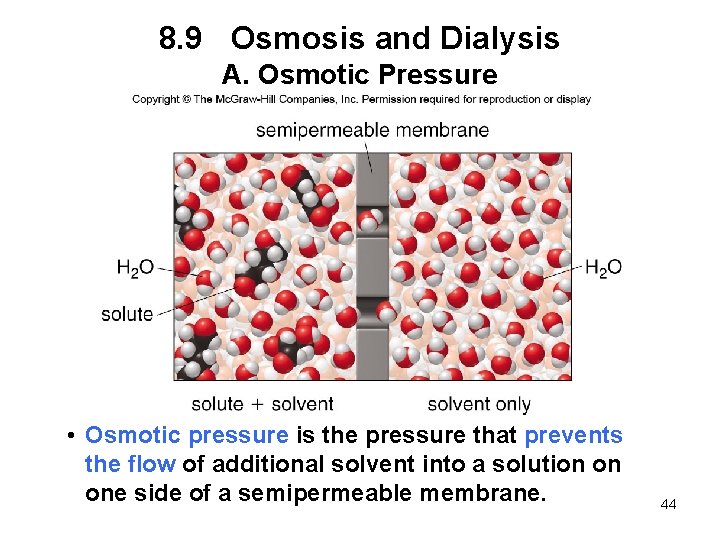
8. 9 Osmosis and Dialysis A. Osmotic Pressure • Osmotic pressure is the pressure that prevents the flow of additional solvent into a solution on one side of a semipermeable membrane. 44
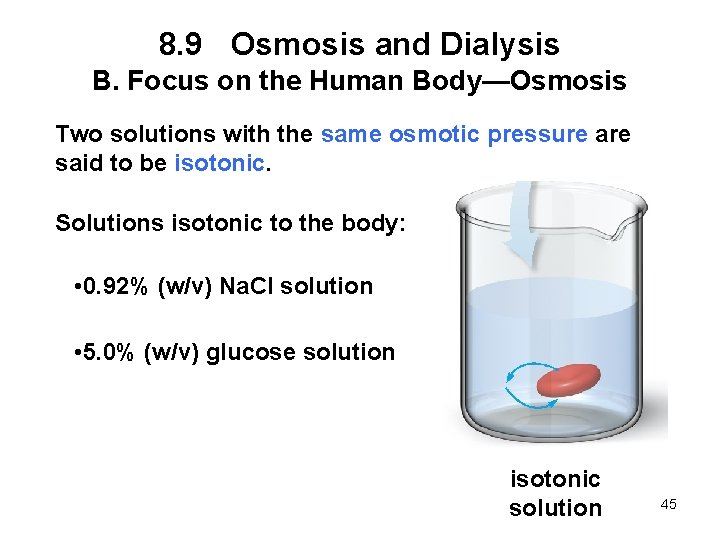
8. 9 Osmosis and Dialysis B. Focus on the Human Body—Osmosis Two solutions with the same osmotic pressure are said to be isotonic. Solutions isotonic to the body: • 0. 92% (w/v) Na. Cl solution • 5. 0% (w/v) glucose solution isotonic solution 45
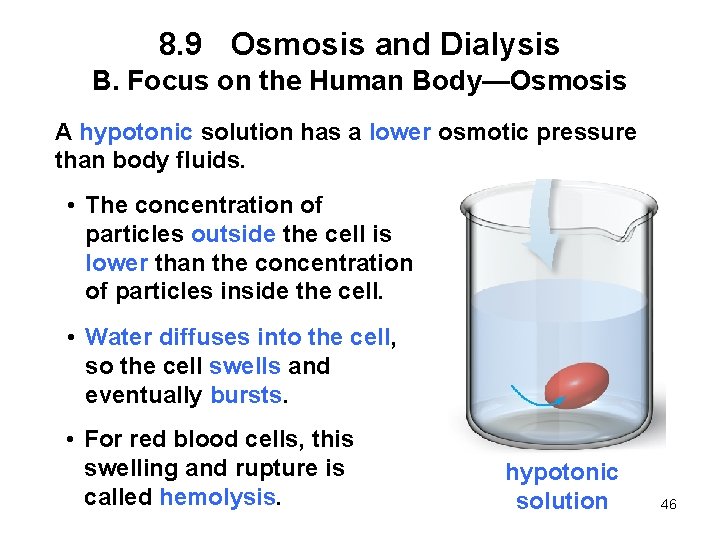
8. 9 Osmosis and Dialysis B. Focus on the Human Body—Osmosis A hypotonic solution has a lower osmotic pressure than body fluids. • The concentration of particles outside the cell is lower than the concentration of particles inside the cell. • Water diffuses into the cell, so the cell swells and eventually bursts. • For red blood cells, this swelling and rupture is called hemolysis. hypotonic solution 46
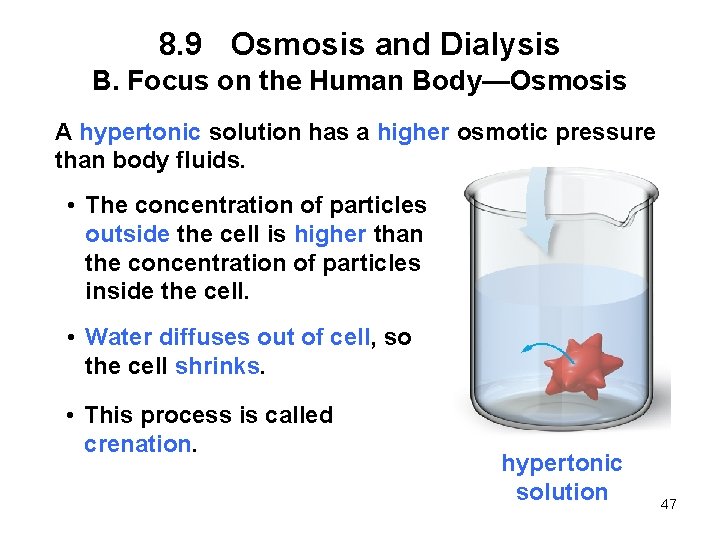
8. 9 Osmosis and Dialysis B. Focus on the Human Body—Osmosis A hypertonic solution has a higher osmotic pressure than body fluids. • The concentration of particles outside the cell is higher than the concentration of particles inside the cell. • Water diffuses out of cell, so the cell shrinks. • This process is called crenation. hypertonic solution 47
8. 9 Colligative Properties C. Focus on Health & Medicine: Dialysis • In the human body, blood is filtered through the kidneys by the process of dialysis. • In dialysis, water, small molecules, and ions can pass through the semipermeable (dialyzing) membrane; only large biological molecules like proteins and starch molecules cannot. • This allows waste products like urea to be removed from the bloodstream and eliminated in the urine. 48
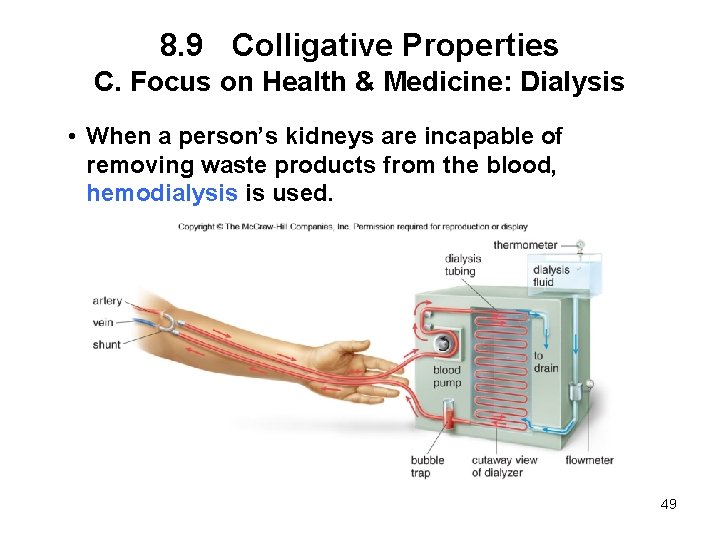
8. 9 Colligative Properties C. Focus on Health & Medicine: Dialysis • When a person’s kidneys are incapable of removing waste products from the blood, hemodialysis is used. 49
- Slides: 49