
Chapter 8 Lecture Earth Science Fourteenth Edition Earthquakes
- Slides: 22
Chapter 8 Lecture Earth Science Fourteenth Edition Earthquakes and Earth’s Interior Jennifer Mangan James Madison University © 2015 Pearson Education, Inc.
Earthquakes • Vibration of Earth produced by the rapid release of energy © 2015 Pearson Education, Inc.
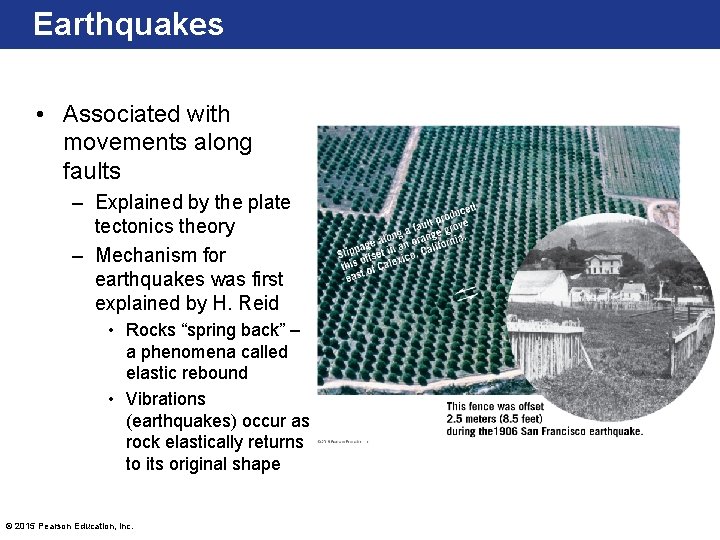
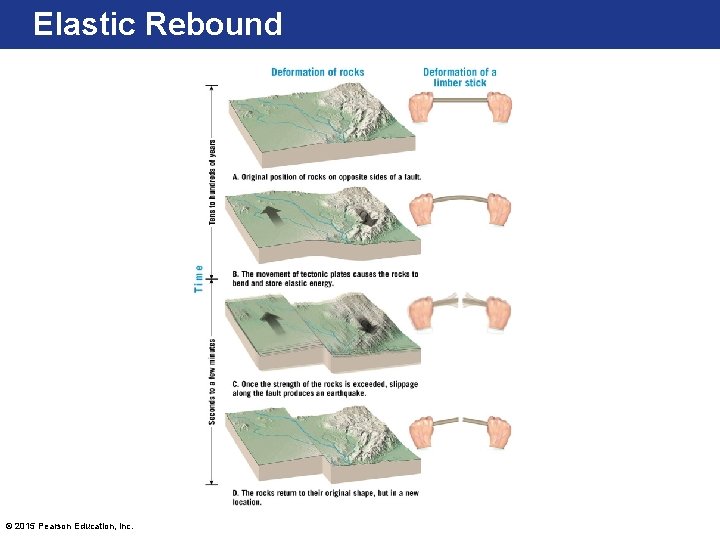
Earthquakes • Associated with movements along faults – Explained by the plate tectonics theory – Mechanism for earthquakes was first explained by H. Reid • Rocks “spring back” – a phenomena called elastic rebound • Vibrations (earthquakes) occur as rock elastically returns to its original shape © 2015 Pearson Education, Inc.
Elastic Rebound © 2015 Pearson Education, Inc.
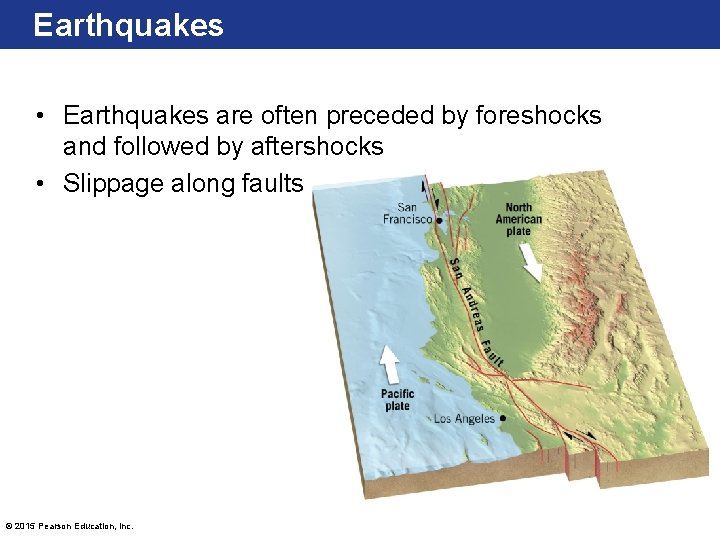
Earthquakes • Earthquakes are often preceded by foreshocks and followed by aftershocks • Slippage along faults © 2015 Pearson Education, Inc.
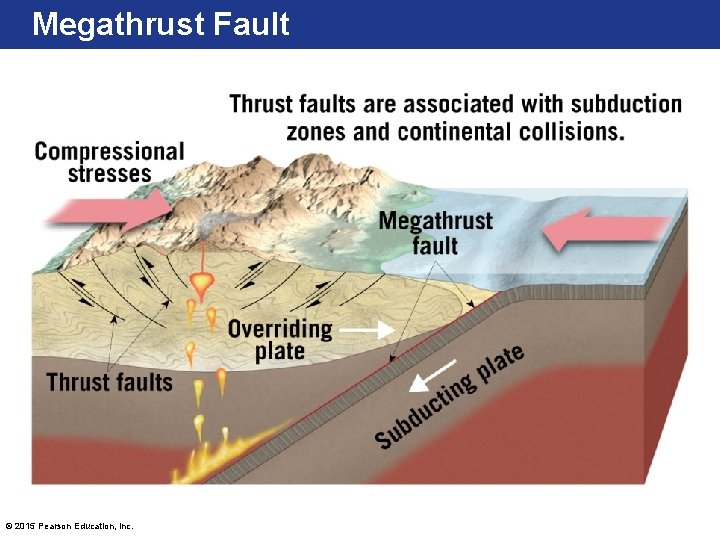
Megathrust Fault © 2015 Pearson Education, Inc.
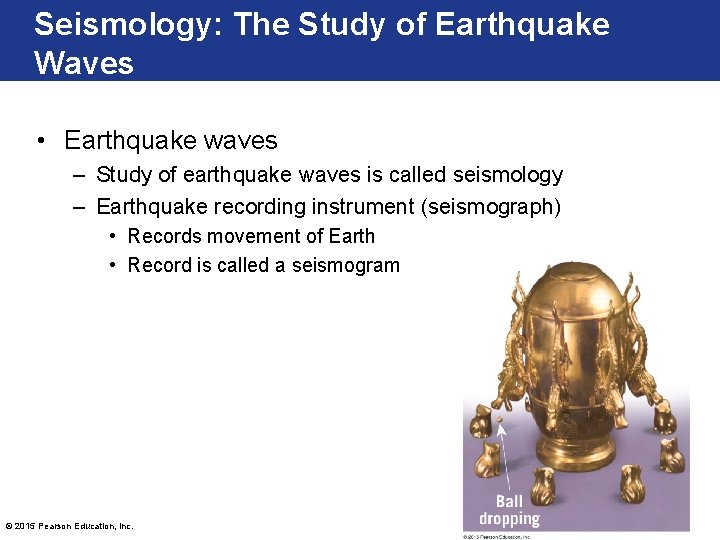
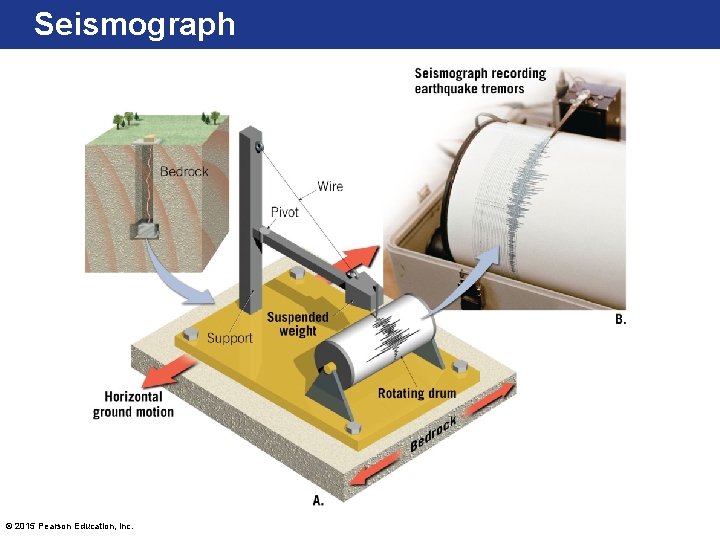
Seismology: The Study of Earthquake Waves • Earthquake waves – Study of earthquake waves is called seismology – Earthquake recording instrument (seismograph) • Records movement of Earth • Record is called a seismogram © 2015 Pearson Education, Inc.
Seismograph © 2015 Pearson Education, Inc.
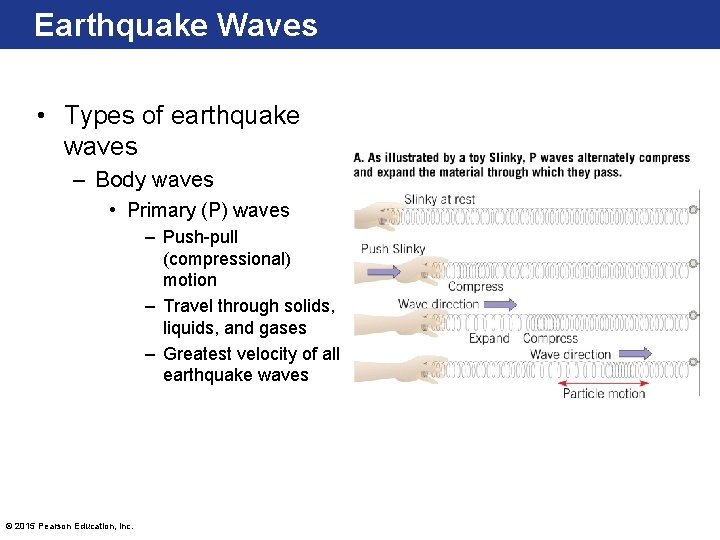
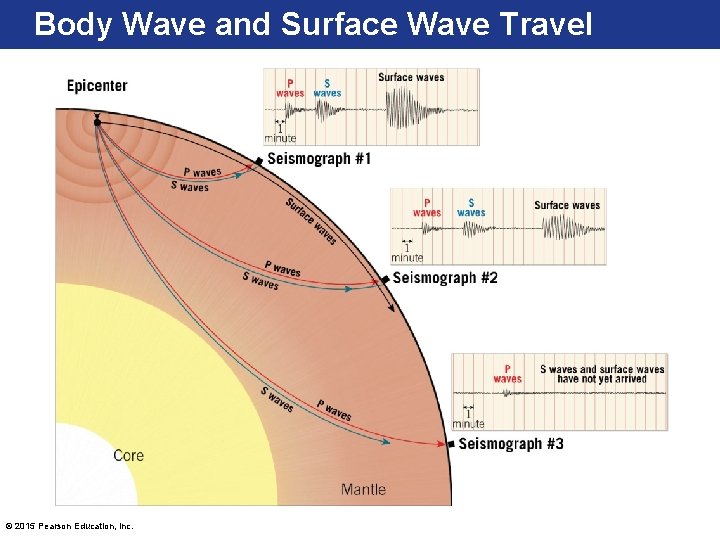
Earthquake Waves • Types of earthquake waves – Body waves • Primary (P) waves – Push-pull (compressional) motion – Travel through solids, liquids, and gases – Greatest velocity of all earthquake waves © 2015 Pearson Education, Inc.
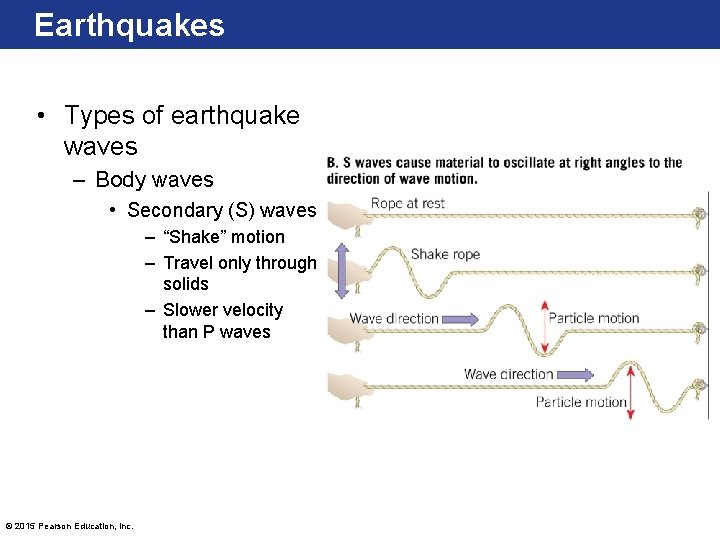
Earthquakes • Types of earthquake waves – Body waves • Secondary (S) waves – “Shake” motion – Travel only through solids – Slower velocity than P waves © 2015 Pearson Education, Inc.
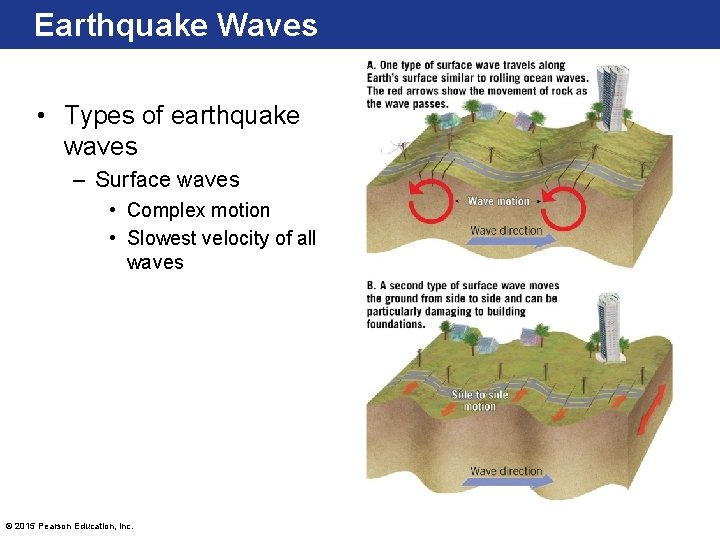
Earthquake Waves • Types of earthquake waves – Surface waves • Complex motion • Slowest velocity of all waves © 2015 Pearson Education, Inc.
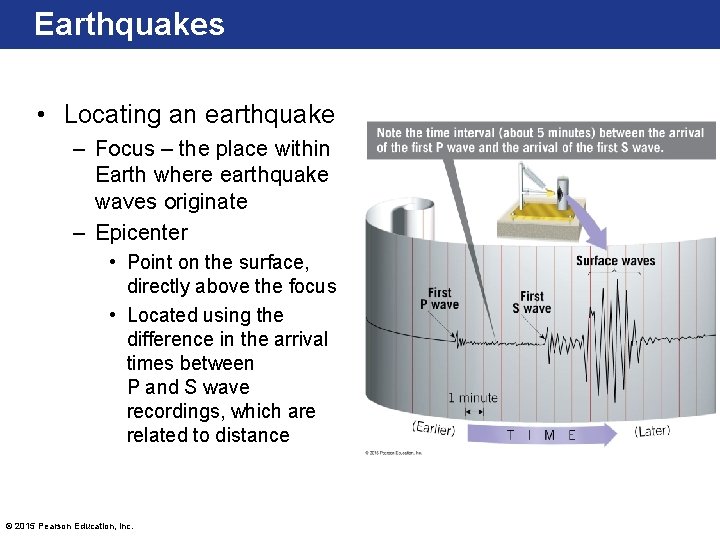
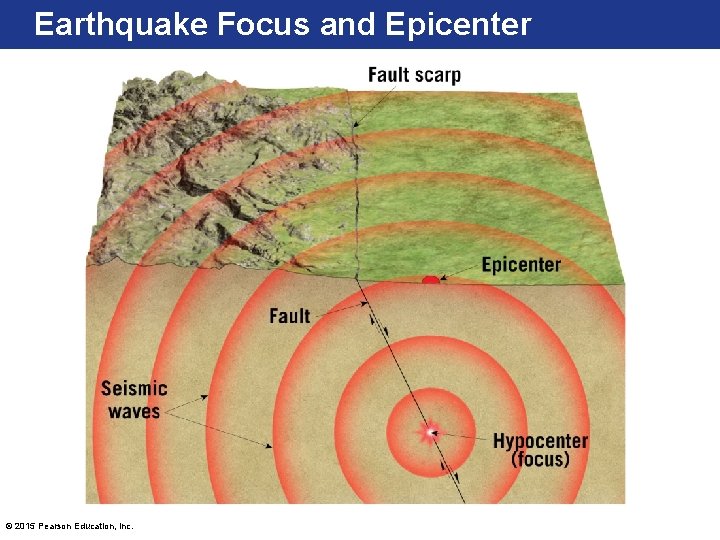
Earthquakes • Locating an earthquake – Focus – the place within Earth where earthquake waves originate – Epicenter • Point on the surface, directly above the focus • Located using the difference in the arrival times between P and S wave recordings, which are related to distance © 2015 Pearson Education, Inc.
Earthquake Focus and Epicenter © 2015 Pearson Education, Inc.
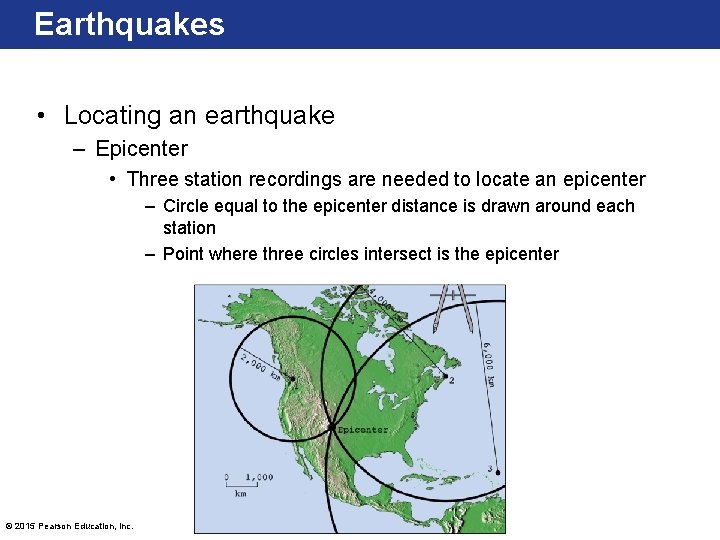
Earthquakes • Locating an earthquake – Epicenter • Three station recordings are needed to locate an epicenter – Circle equal to the epicenter distance is drawn around each station – Point where three circles intersect is the epicenter © 2015 Pearson Education, Inc.
Body Wave and Surface Wave Travel © 2015 Pearson Education, Inc.
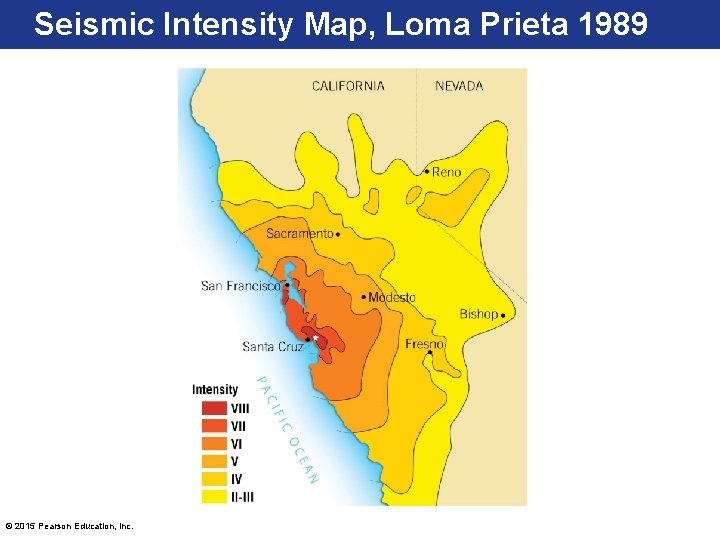
Determining the Size of Earthquakes • Intensity – A measure of the degree of earthquake shaking at a given locale based on the amount of damage – Most often measured by the Modified Mercalli Intensity Scale © 2015 Pearson Education, Inc.
Seismic Intensity Map, Loma Prieta 1989 © 2015 Pearson Education, Inc.
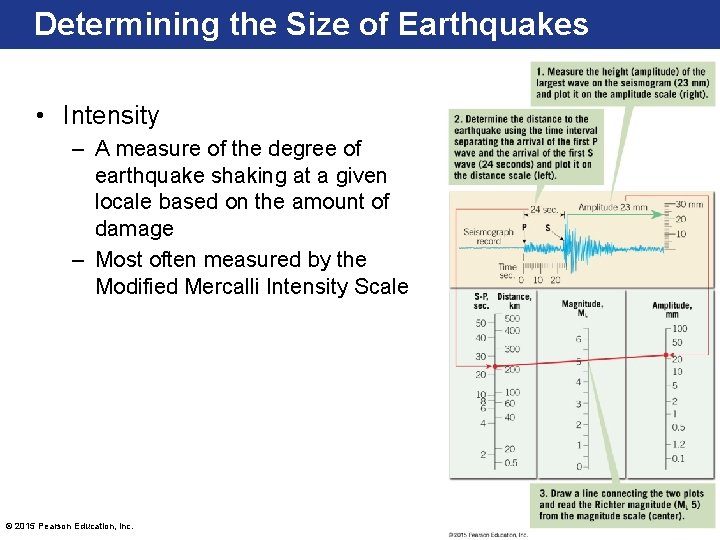
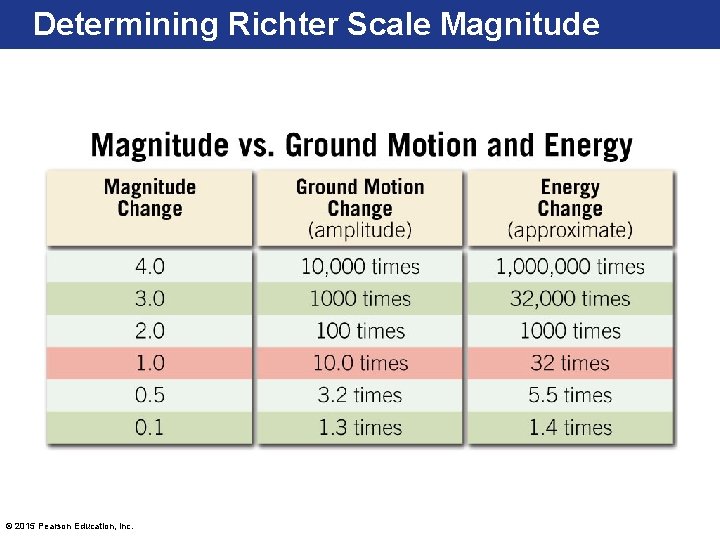
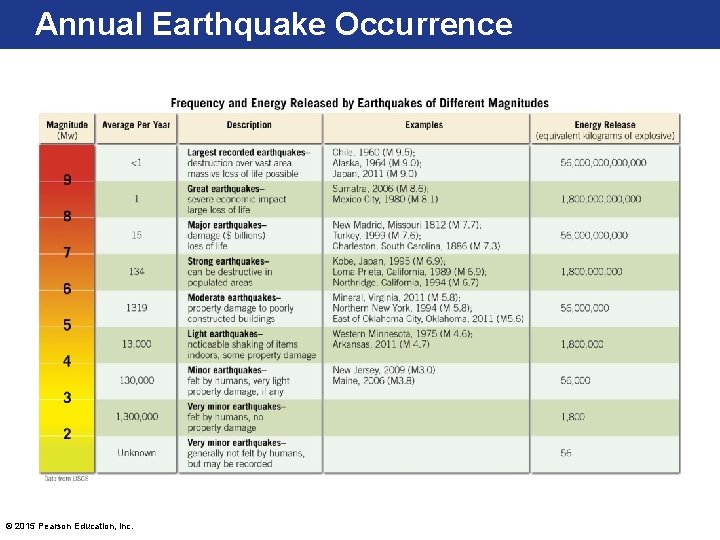
Determining the Size of Earthquakes • Magnitude – Often measured using the Richter scale • Based on the amplitude of the largest seismic wave • Each unit of Richter magnitude equates to roughly a 32 -fold energy increase • Does not estimate adequately the size of very large earthquakes – Concept introduced by Charles Richter in 1935 © 2015 Pearson Education, Inc.
Determining Richter Scale Magnitude © 2015 Pearson Education, Inc.
Determining the Size of Earthquakes • Magnitude – Moment magnitude scale • Measures very large earthquakes • Derived from the amount of displacement that occurs along a fault zone © 2015 Pearson Education, Inc.
Annual Earthquake Occurrence © 2015 Pearson Education, Inc.
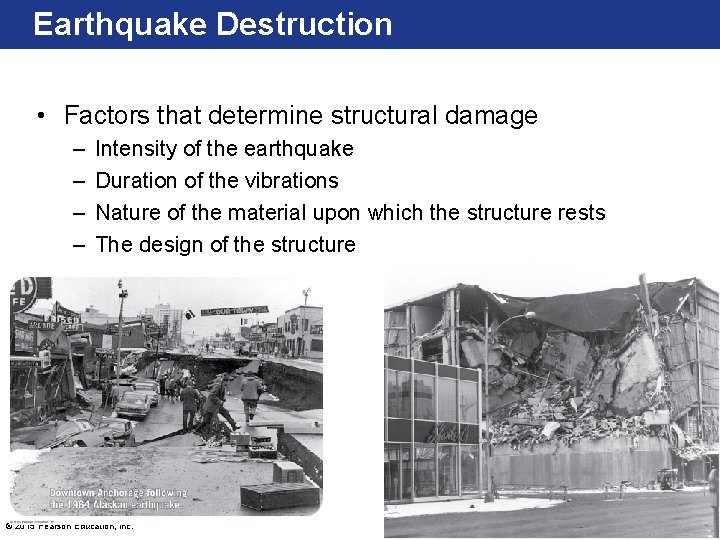
Earthquake Destruction • Factors that determine structural damage – – Intensity of the earthquake Duration of the vibrations Nature of the material upon which the structure rests The design of the structure © 2015 Pearson Education, Inc.