
Chapter 8 Leadership Chapter 8 Stephen P Robbins
Chapter 8 Leadership Chapter 8, Stephen P. Robbins, Mary Coulter, and Nancy Langton, Fundamentals of Management, Fifth Canadian Edition Copyright © 2008 Pearson Education Canada 8 -1
LEARNING OUTLINE Follow this Learning Outline as you read and study this chapter • Managers Vs. Leaders – Contrast leaders and managers • Early Leadership Theories – Discuss what research has shown about leadership traits – Contrast the findings of the four behavioural leadership theories – Explain the dual nature of a leader’s behaviour Chapter 8, Stephen P. Robbins, Mary Coulter, and Nancy Langton, Fundamentals of Management, Fifth Canadian Edition Copyright © 2008 Pearson Education Canada 8 -2
LEARNING OUTLINE (cont’d) Follow this Learning Outline as you read and study this chapter • Contingency Theories of Leadership – Explain how Fiedler’s theory of leadership is a contingency model – Contrast situational leadership theory and the leader participation model – Discuss how path-goal theory explains leadership Chapter 8, Stephen P. Robbins, Mary Coulter, and Nancy Langton, Fundamentals of Management, Fifth Canadian Edition Copyright © 2008 Pearson Education Canada 8 -3
LEARNING OUTLINE (cont’d) Follow this Learning Outline as you read and study this chapter • Cutting-edge Approaches to Leadership – Differentiate between transactional and transformational leaders – Describe charismatic-visionary leadership – Discuss what team leadership involves • Current Leadership Issues – Describe the five sources of a leader’s power – Discuss the issues today’s leaders face Chapter 8, Stephen P. Robbins, Mary Coulter, and Nancy Langton, Fundamentals of Management, Fifth Canadian Edition Copyright © 2008 Pearson Education Canada 8 -4
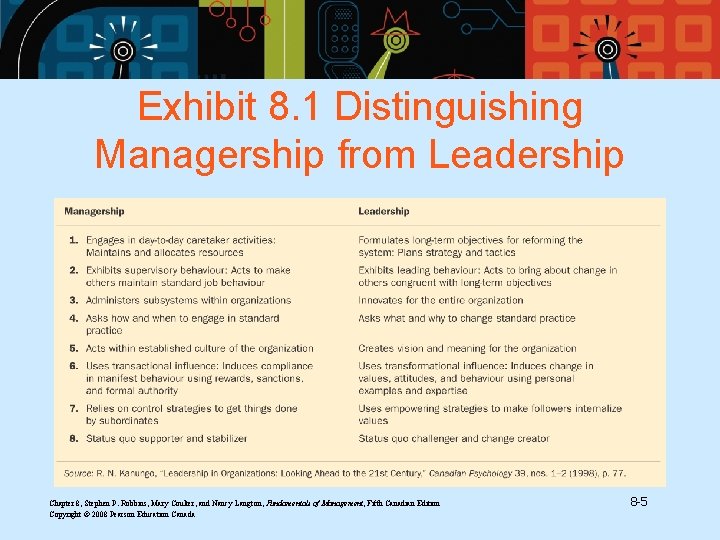
Exhibit 8. 1 Distinguishing Managership from Leadership Chapter 8, Stephen P. Robbins, Mary Coulter, and Nancy Langton, Fundamentals of Management, Fifth Canadian Edition Copyright © 2008 Pearson Education Canada 8 -5
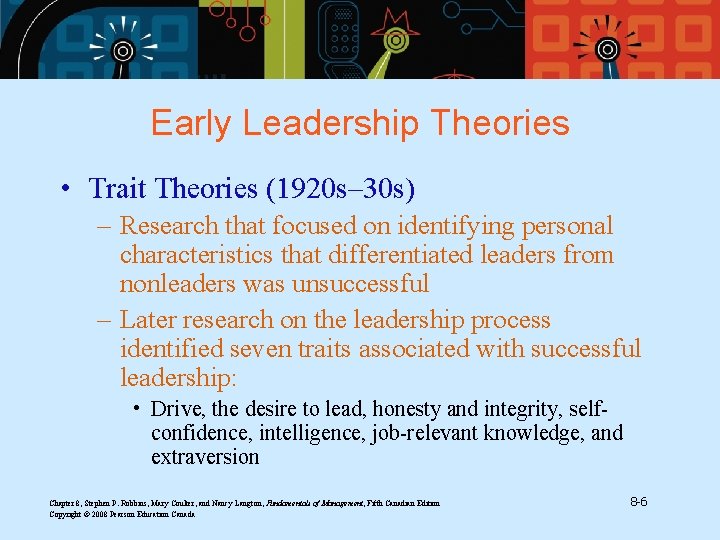
Early Leadership Theories • Trait Theories (1920 s– 30 s) – Research that focused on identifying personal characteristics that differentiated leaders from nonleaders was unsuccessful – Later research on the leadership process identified seven traits associated with successful leadership: • Drive, the desire to lead, honesty and integrity, selfconfidence, intelligence, job-relevant knowledge, and extraversion Chapter 8, Stephen P. Robbins, Mary Coulter, and Nancy Langton, Fundamentals of Management, Fifth Canadian Edition Copyright © 2008 Pearson Education Canada 8 -6
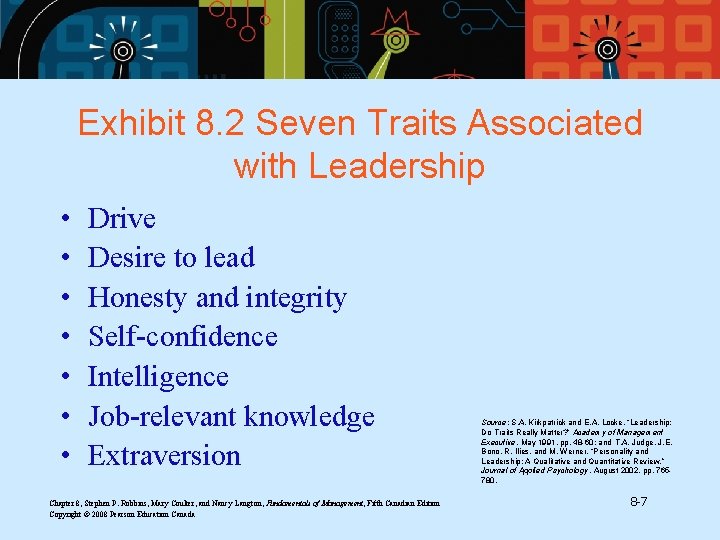
Exhibit 8. 2 Seven Traits Associated with Leadership • • Drive Desire to lead Honesty and integrity Self-confidence Intelligence Job-relevant knowledge Extraversion Chapter 8, Stephen P. Robbins, Mary Coulter, and Nancy Langton, Fundamentals of Management, Fifth Canadian Edition Copyright © 2008 Pearson Education Canada Source: S. A. Kirkpatrick and E. A. Locke, “Leadership: Do Traits Really Matter? ” Academy of Management Executive, May 1991, pp. 48 -60; and T. A. Judge, J. E. Bono, R. Ilies, and M. Werner, “Personality and Leadership: A Qualitative and Quantitative Review, ” Journal of Applied Psychology, August 2002, pp. 765780. 8 -7
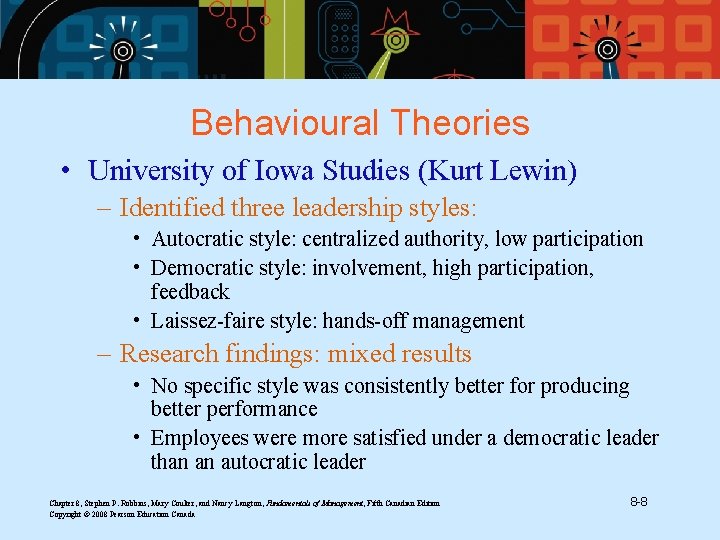
Behavioural Theories • University of Iowa Studies (Kurt Lewin) – Identified three leadership styles: • Autocratic style: centralized authority, low participation • Democratic style: involvement, high participation, feedback • Laissez-faire style: hands-off management – Research findings: mixed results • No specific style was consistently better for producing better performance • Employees were more satisfied under a democratic leader than an autocratic leader Chapter 8, Stephen P. Robbins, Mary Coulter, and Nancy Langton, Fundamentals of Management, Fifth Canadian Edition Copyright © 2008 Pearson Education Canada 8 -8
Behavioural Theories (cont’d) • Ohio State Studies – Identified two dimensions of leader behaviour • Initiating structure: the role of the leader in defining his or her role and the roles of group members • Consideration: the leader’s mutual trust and respect for group members’ ideas and feelings – Research findings: mixed results • High-high leaders generally, but not always, achieved high group task performance and satisfaction • Evidence indicated that situational factors appeared to strongly influence leadership effectiveness Chapter 8, Stephen P. Robbins, Mary Coulter, and Nancy Langton, Fundamentals of Management, Fifth Canadian Edition Copyright © 2008 Pearson Education Canada 8 -9
Behavioural Theories (cont’d) • University of Michigan Studies – Identified two dimensions of leader behaviour • Employee oriented: emphasizing personal relationships • Production oriented: emphasizing task accomplishment – Research findings: • Leaders who are employee oriented are strongly associated with high group productivity and high job satisfaction Chapter 8, Stephen P. Robbins, Mary Coulter, and Nancy Langton, Fundamentals of Management, Fifth Canadian Edition Copyright © 2008 Pearson Education Canada 8 -10
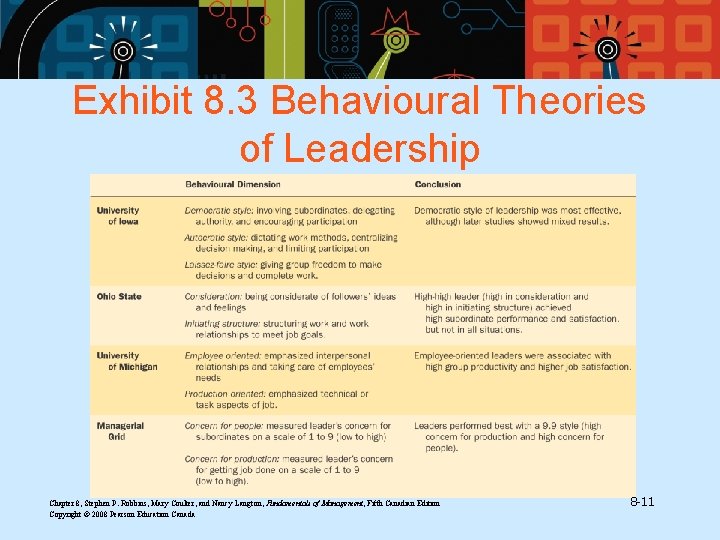
Exhibit 8. 3 Behavioural Theories of Leadership Chapter 8, Stephen P. Robbins, Mary Coulter, and Nancy Langton, Fundamentals of Management, Fifth Canadian Edition Copyright © 2008 Pearson Education Canada 8 -11
Behavioural Theories (cont’d) • Managerial Grid – Appraises leadership styles using two dimensions: • Concern for people • Concern for production Chapter 8, Stephen P. Robbins, Mary Coulter, and Nancy Langton, Fundamentals of Management, Fifth Canadian Edition Copyright © 2008 Pearson Education Canada 8 -12
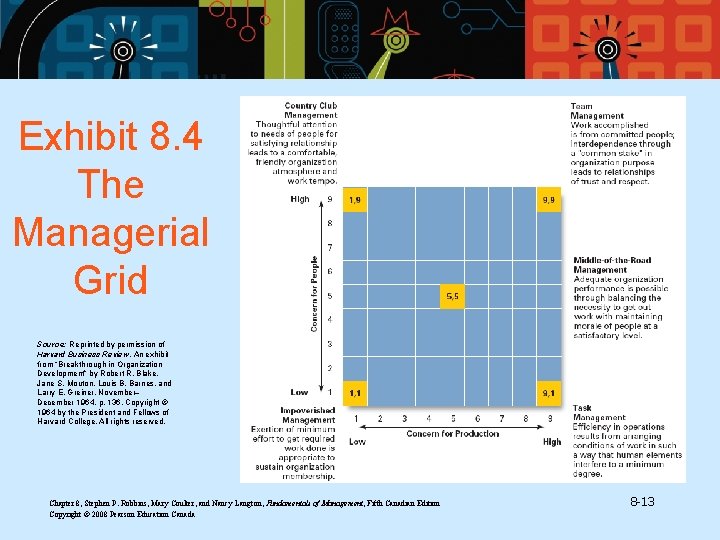
Exhibit 8. 4 The Managerial Grid Source: Reprinted by permission of Harvard Business Review. An exhibit from “Breakthrough in Organization Development” by Robert R. Blake, Jane S. Mouton, Louis B. Barnes, and Larry E. Greiner, November– December 1964, p. 136. Copyright © 1964 by the President and Fellows of Harvard College. All rights reserved. Chapter 8, Stephen P. Robbins, Mary Coulter, and Nancy Langton, Fundamentals of Management, Fifth Canadian Edition Copyright © 2008 Pearson Education Canada 8 -13
Contingency Theories of Leadership • The Fiedler Model – Effective group performance depends upon the match between the leader’s style of interacting with followers and the degree to which the situation allows the leader to control and influence – Assumptions: • Different situations require different leadership styles • Leaders do not readily change leadership styles – Matching the leader to the situation or changing the situation to make it favourable to the leader is required Chapter 8, Stephen P. Robbins, Mary Coulter, and Nancy Langton, Fundamentals of Management, Fifth Canadian Edition Copyright © 2008 Pearson Education Canada 8 -14
Contingency Theories… (cont’d) • The Fiedler Model (cont’d) – Least-preferred co-worker (LPC) questionnaire • Determines leadership style by measuring responses to 18 pairs of contrasting adjectives – High score: a relationship-oriented leadership style – Low score: a task-oriented leadership style – Situational factors in matching leader to the situation: • Leader-member relations • Task structure • Position power Chapter 8, Stephen P. Robbins, Mary Coulter, and Nancy Langton, Fundamentals of Management, Fifth Canadian Edition Copyright © 2008 Pearson Education Canada 8 -15
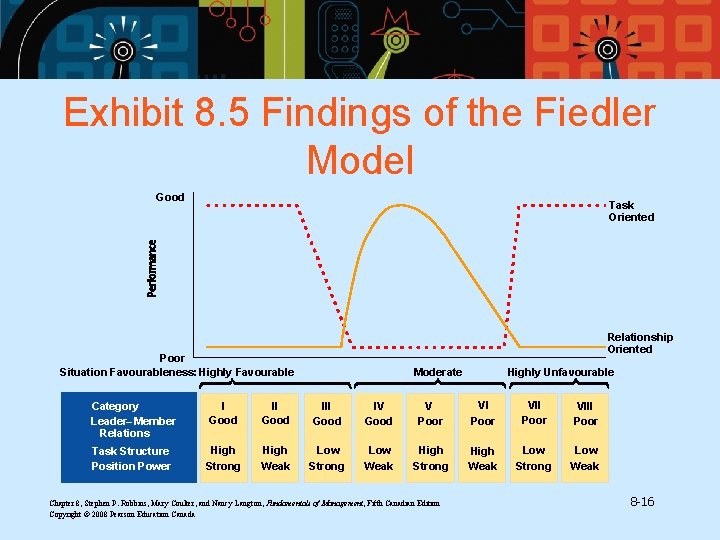
Exhibit 8. 5 Findings of the Fiedler Model Good Task Oriented Relationship Oriented Poor Situation Favourableness: Highly Favourable Moderate Highly Unfavourable Category Leader– Member Relations I Good III Good IV Good V Poor VIII Poor Task Structure Position Power High Strong High Weak Low Strong Low Weak Chapter 8, Stephen P. Robbins, Mary Coulter, and Nancy Langton, Fundamentals of Management, Fifth Canadian Edition Copyright © 2008 Pearson Education Canada 8 -16
Contingency Theories… (cont’d) • Hersey and Blanchard’s Situational Leadership Theory (SLT) – Successful leadership is achieved by selecting a leadership style that matches the level of the followers’ readiness • Acceptance: do followers accept or reject a leader? • Readiness: do followers have the ability and willingness to accomplish a specific task? – Leaders must give up control as followers become more competent Chapter 8, Stephen P. Robbins, Mary Coulter, and Nancy Langton, Fundamentals of Management, Fifth Canadian Edition Copyright © 2008 Pearson Education Canada 8 -17
Contingency Theories… (cont’d) • Hersey and Blanchard’s Situational Leadership Theory (SLT) (cont’d) – Creates four specific leadership styles incorporating Fiedler’s two leadership dimensions: • • Telling: high task–low relationship leadership Selling: high task–high relationship leadership Participating: low task–high relationship leadership Delegating: low task–low relationship leadership Chapter 8, Stephen P. Robbins, Mary Coulter, and Nancy Langton, Fundamentals of Management, Fifth Canadian Edition Copyright © 2008 Pearson Education Canada 8 -18
Contingency Theories… (cont’d) • Hersey and Blanchard’s Situational Leadership Theory (SLT) (cont’d) – Identifies four stages of follower readiness: • • R 1: followers are unable and unwilling R 2: followers are unable but willing R 3: followers are able but unwilling R 4: followers are able and willing Chapter 8, Stephen P. Robbins, Mary Coulter, and Nancy Langton, Fundamentals of Management, Fifth Canadian Edition Copyright © 2008 Pearson Education Canada 8 -19
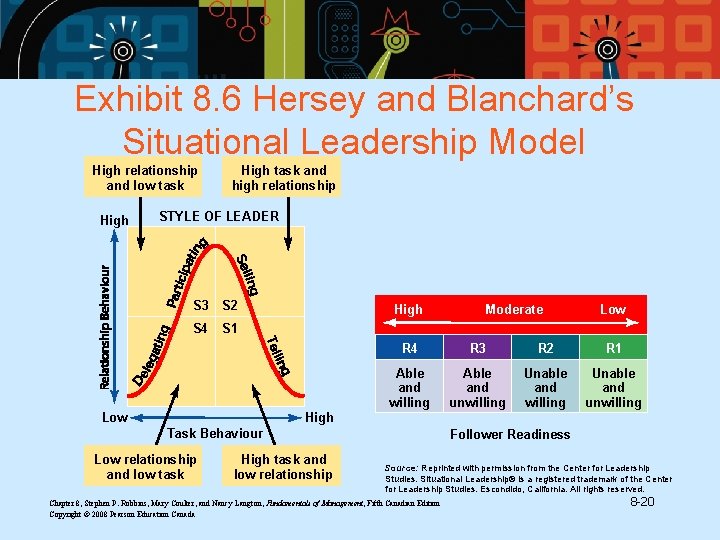
Exhibit 8. 6 Hersey and Blanchard’s Situational Leadership Model High relationship and low task High task and high relationship STYLE OF LEADER S 3 S 2 S 4 High Moderate Low S 1 Low R 4 R 3 R 2 R 1 Able and willing Able and unwilling Unable and unwilling High Task Behaviour Low relationship and low task High task and low relationship Follower Readiness Source: Reprinted with permission from the Center for Leadership Studies. Situational Leadership® is a registered trademark of the Center for Leadership Studies. Escondido, California. All rights reserved. Chapter 8, Stephen P. Robbins, Mary Coulter, and Nancy Langton, Fundamentals of Management, Fifth Canadian Edition Copyright © 2008 Pearson Education Canada 8 -20
Contingency Theories… (cont’d) • Leader Participation Model (Vroom and Yetton) – Leader behaviour must be adjusted to reflect the task structure – Suggests appropriate participation level in decision making Chapter 8, Stephen P. Robbins, Mary Coulter, and Nancy Langton, Fundamentals of Management, Fifth Canadian Edition Copyright © 2008 Pearson Education Canada 8 -21
Contingency Theories… (cont’d) • Leader Participation Model Contingencies: – – – – Decision significance Importance of commitment Leader expertise Likelihood of commitment Group support Group expertise Team competence Chapter 8, Stephen P. Robbins, Mary Coulter, and Nancy Langton, Fundamentals of Management, Fifth Canadian Edition Copyright © 2008 Pearson Education Canada 8 -22
Contingency Theories… (cont’d) • Path-Goal Model – Leader’s job is to assist his or her followers in achieving organizational goals – Leader’s style depends on the situation: • • Directive Supportive Participative Achievement-oriented Chapter 8, Stephen P. Robbins, Mary Coulter, and Nancy Langton, Fundamentals of Management, Fifth Canadian Edition Copyright © 2008 Pearson Education Canada 8 -23
Exhibit 8. 7 Path-Goal Theory Environmental Contingency Factors • Task Structure • Formal Authority System • Work Group Leader Behaviour Outcomes • Directive • Supportive • Participative • Achievement Oriented • Performance • Satisfaction Subordinate Contingency Factors • Locus of Control • Experience • Perceived Ability Chapter 8, Stephen P. Robbins, Mary Coulter, and Nancy Langton, Fundamentals of Management, Fifth Canadian Edition Copyright © 2008 Pearson Education Canada 8 -24
Contemporary Approaches to Leadership • Transactional Leadership – Leaders who guide or motivate their followers in the direction of established goals by clarifying role and task requirements • Transformational Leadership – Leaders who inspire followers to go beyond their own self-interests for the good of the organization – Leaders who have a profound and extraordinary effect on their followers Chapter 8, Stephen P. Robbins, Mary Coulter, and Nancy Langton, Fundamentals of Management, Fifth Canadian Edition Copyright © 2008 Pearson Education Canada 8 -25
Contemporary Approaches to Leadership (cont’d) • Charismatic Leadership – An enthusiastic, self-confident leader whose personality and actions influence people to behave in certain ways – Characteristics of charismatic leaders: • • • Have a vision Are able to articulate the vision Are willing to take risks to achieve the vision Are sensitive to the environment and to follower needs Exhibit behaviours that are out of the ordinary Chapter 8, Stephen P. Robbins, Mary Coulter, and Nancy Langton, Fundamentals of Management, Fifth Canadian Edition Copyright © 2008 Pearson Education Canada 8 -26
Contemporary Approaches to Leadership (cont’d) • Charismatic Leadership (cont’d) – Effects of Charismatic Leadership • Increased motivation, greater satisfaction • More profitable companies • Charismatic leadership may have a downside: – After recent ethics scandals, some agreement that CEOs with less vision, and more ethical and corporate responsibility, might be more desirable Chapter 8, Stephen P. Robbins, Mary Coulter, and Nancy Langton, Fundamentals of Management, Fifth Canadian Edition Copyright © 2008 Pearson Education Canada 8 -27
Contemporary Approaches to Leadership (cont’d) • Visionary Leadership – A leader who creates and articulates a realistic, credible, and attractive vision of the future that improves upon the present situation – Visionary leaders have the ability to: • Explain the vision to others • Express the vision not just verbally but through behaviour • Extend or apply the vision to different leadership contexts Chapter 8, Stephen P. Robbins, Mary Coulter, and Nancy Langton, Fundamentals of Management, Fifth Canadian Edition Copyright © 2008 Pearson Education Canada 8 -28
Contemporary Approaches to Leadership (cont’d) • Team Leadership Characteristics – Having patience to share information – Being able to trust others and to give up authority – Understanding when to intervene • Team Leader’s Job – Managing the team’s external boundary – Facilitating the team process • Coaching, facilitating, handling disciplinary problems, reviewing team and individual performance, training, and communicating Chapter 8, Stephen P. Robbins, Mary Coulter, and Nancy Langton, Fundamentals of Management, Fifth Canadian Edition Copyright © 2008 Pearson Education Canada 8 -29
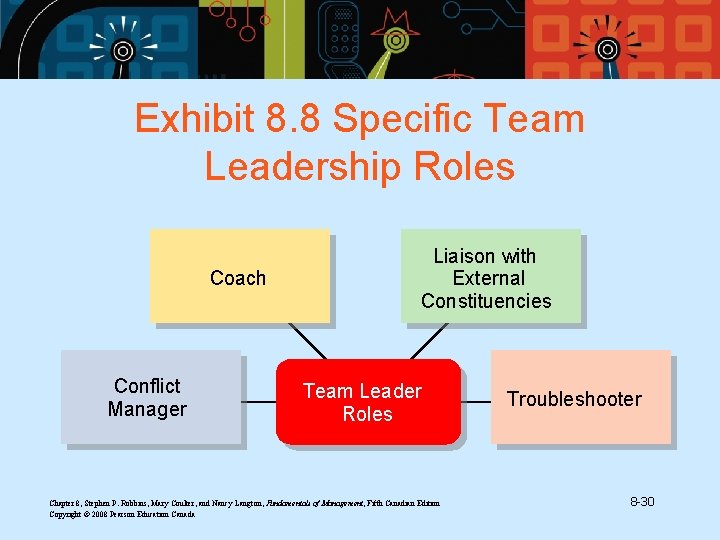
Exhibit 8. 8 Specific Team Leadership Roles Coach Conflict Manager Liaison with External Constituencies Team Leader Roles Chapter 8, Stephen P. Robbins, Mary Coulter, and Nancy Langton, Fundamentals of Management, Fifth Canadian Edition Copyright © 2008 Pearson Education Canada Troubleshooter 8 -30
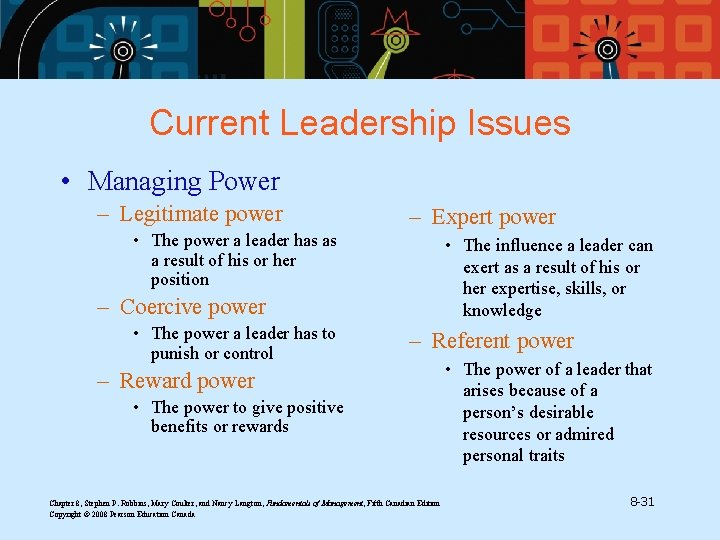
Current Leadership Issues • Managing Power – Legitimate power – Expert power • The power a leader has as a result of his or her position • The influence a leader can exert as a result of his or her expertise, skills, or knowledge – Coercive power • The power a leader has to punish or control – Referent power – Reward power • The power to give positive benefits or rewards Chapter 8, Stephen P. Robbins, Mary Coulter, and Nancy Langton, Fundamentals of Management, Fifth Canadian Edition Copyright © 2008 Pearson Education Canada • The power of a leader that arises because of a person’s desirable resources or admired personal traits 8 -31
Developing Trust • Credibility (of a Leader) – The assessment, by a leader’s followers, of the leader’s honesty, competence, and ability to inspire • Trust – The belief of followers and others in the integrity, character, and ability of a leader • Dimensions of trust: integrity, competence, consistency, loyalty, and openness – Trust is related to increases in job performance, organizational citizenship behaviours, job satisfaction, and organization commitment Chapter 8, Stephen P. Robbins, Mary Coulter, and Nancy Langton, Fundamentals of Management, Fifth Canadian Edition Copyright © 2008 Pearson Education Canada 8 -32
Tips for Managers: Suggestions for Building Trust • • Practise openness Be fair Speak your feelings Tell the truth Show consistency Fulfill your promises Maintain confidences Demonstrate competence Chapter 8, Stephen P. Robbins, Mary Coulter, and Nancy Langton, Fundamentals of Management, Fifth Canadian Edition Copyright © 2008 Pearson Education Canada 8 -33
Providing Moral Leadership • Addresses both the moral content of a leader’s goals and the means used to achieve those goals • Ethical leadership is more than being ethical – Includes reinforcing ethics through organizational mechanisms Chapter 8, Stephen P. Robbins, Mary Coulter, and Nancy Langton, Fundamentals of Management, Fifth Canadian Edition Copyright © 2008 Pearson Education Canada 8 -34
Providing Online Leadership • Challenges of Online Leadership – Communication • Choosing the right words, structure, tone, and style for digital communications – Performance management • Defining, facilitating, and encouraging performance – Trust • Creating a culture where trust is expected, encouraged, and required Chapter 8, Stephen P. Robbins, Mary Coulter, and Nancy Langton, Fundamentals of Management, Fifth Canadian Edition Copyright © 2008 Pearson Education Canada 8 -35
Understanding Gender Differences and Leadership • Research Findings – Males and females use different styles: • Women tend to adopt a more democratic or participative style unless in a male-dominated job • Women tend to use transformational leadership • Men tend to use transactional leadership Chapter 8, Stephen P. Robbins, Mary Coulter, and Nancy Langton, Fundamentals of Management, Fifth Canadian Edition Copyright © 2008 Pearson Education Canada 8 -36
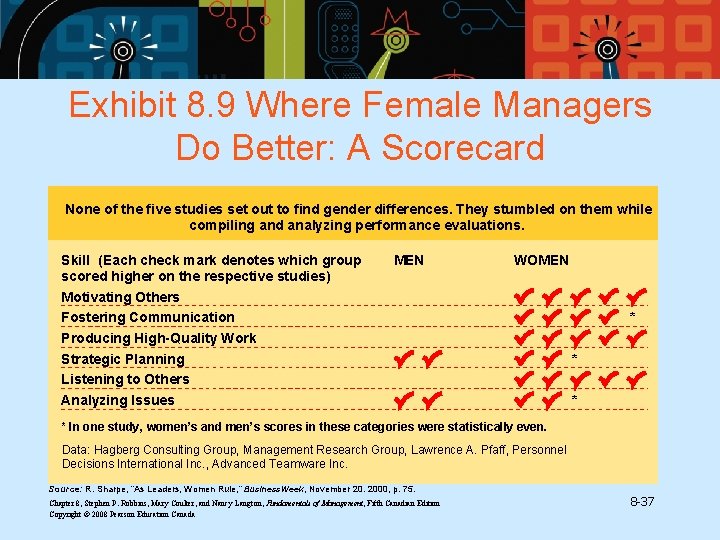
Exhibit 8. 9 Where Female Managers Do Better: A Scorecard None of the five studies set out to find gender differences. They stumbled on them while compiling and analyzing performance evaluations. Skill (Each check mark denotes which group scored higher on the respective studies) MEN WOMEN Motivating Others Fostering Communication Producing High-Quality Work Strategic Planning Listening to Others Analyzing Issues * * In one study, women’s and men’s scores in these categories were statistically even. Data: Hagberg Consulting Group, Management Research Group, Lawrence A. Pfaff, Personnel Decisions International Inc. , Advanced Teamware Inc. Source: R. Sharpe, “As Leaders, Women Rule, ” Business. Week, November 20. 2000, p. 75. Chapter 8, Stephen P. Robbins, Mary Coulter, and Nancy Langton, Fundamentals of Management, Fifth Canadian Edition Copyright © 2008 Pearson Education Canada 8 -37
- Slides: 37