
Chapter 8 Jevons Menger and Foundations of Marginal
- Slides: 29
Chapter 8: Jevons, Menger and Foundations of Marginal Analysis Questions for Review, Discussion and Research 1, 2, 5, 6, 7, 8, 9, 10 - Marginal analysis and the use of mathematic helped forge a new set of analytical techniques for the emerging neoclassical approach
Forerunners of Marginal Analysis 1. Cournot (1838) n Economics of the firm, duoploly 2. Longfield (1834) n Developed marginal productivity theory of distribution 3. Dupuit (1844)
1. Gossen – Same as Longfield plus first articulation of the concept of marginal utility 2. Von Thunen n Applied marginal analysis through calculus and the interdependence of markets with simultaneous equations
Marginal Revolution n Writings of Jevons, Menger and Walras were original inasmuch as their ideas influenced the subsequent development of economic theory in a way that predecessors did not
Critique of Classical Theory of Value 1. Classical model implies Factor Costs of Production → Determine value of product outputs n Jevons and Menger reversed the direction of causation 2. Price determination is not dependant on total or average utility but marginal utility
What is Utility? n n A psychological phenomena with unspecified units of measurement Utility only derived from consumption skip pp. 229 -30
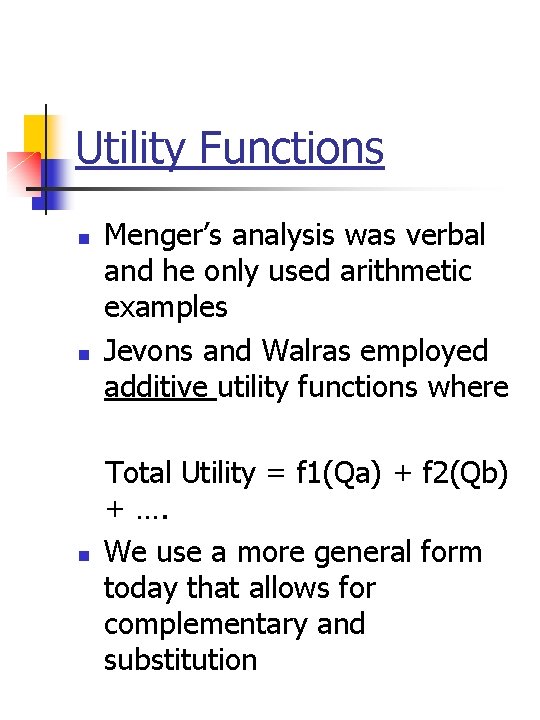
Utility Functions n n n Menger’s analysis was verbal and he only used arithmetic examples Jevons and Walras employed additive utility functions where Total Utility = f 1(Qa) + f 2(Qb) + …. We use a more general form today that allows for complementary and substitution
Theories of Exchange n Used principle of diminishing marginal utility to specify the conditions where consumers maximize utility in the consumption of many products Overhead pp. 231 -32
Valuation of the Factors of Production n n Classical n Relative prices of outputs depends on costs of production and implies that value comes from the past 2) Neoclassical n Value comes from the future when expected satisfaction is enjoyed in the consumption goods and services (especially durables)
n n n Value causation runs from the final pricing of outputs to cost of factor inputs “used up” in the production process Causal relationship defined within the partial equilibrium framework Factors of production are not price determining but price determined
Evaluation of Jevons and Menger n n Always assumed that the supply of outputs was exogenous Their illustrations indicate that value does not depend entirely upon utility or demand but both supply and demand Overhead pp. 234 -35
Lasting Contributions of Menger, Jevons, and Walras n Overhead pp. 239 -40
Was Menger An Early Neoclassical Economist? n Overhead pp. 239
Carl Menger n n n Little influenced by Von Thunen and unaware of Gossen of Mangoldt Founder of a school of thought that concentrates on the subjective, atomistic nature of economics Aggregate, collective ideas could not have adequate explanation ? ? ? upon individual decision making and behaviour
Overhead pp. 293 -94 of other source Overhead pp. 296 -97 of other source
Weiser and the Theory of Imputation n Adopted highly theoretical, deductive approach of Menger Used verbal models and did not use mathematics First to use the term marginal utility
n The price of a factor of production is measured by the marginal utility the factor yields in marginal, or last, final good consumed Overhead pp. 236 -37
Capital Theory of Eugen Bohm-Bawerk n n Builds on Menger’s vision of how a modern capitalist economy is structured Mengers approach sees capital in terms of a time structure of production
n n Production is organized as a sequential process of activities in which goods of a higher order (capital goods) become transformed into goods of the lowest order (consumption goods) Capital goods are heterogeneous and are classified by their position along a time continuum in the production process
n Bohm-Bawerk’s theory of capital was a conscious extension of Menger
Capital Theory of Eugen Bohm-Bawerk Cont’d n For Menger, the rewards to save only if time consuming methods of production are adopted and result in higher levels of productivity and higher levels of consumption in the future
n The introduction of time considerations is his greatest contribution to capital theory and stands in sharp contrast to the instantaneous processes of production in neoclassical theory
n His central proposition was that the production of final goods (consumption products) takes time and that roundabout methods of production are more productive than direct methods
Capital Theory of Eugen Bohm-Bawerk Cont’d n n Primitive economics only use land labour (original means of production) to make goods for “immediate” consumption Capitalist economies emerge when roundabout and more capital intensive methods are employed
n n Time itself becomes an input and the length of the production period for consumer products is itself a variable In Figure 12 -3 the production period is represented on the time axis
Capital Theory of Eugen Bohm-Bawerk Cont’d n Final output increases in absolute terms with a lengthening of the period of production but at a decreasing rate
n More and more capital is used in combination with the original factors so the ratio of capital to land labour rises and the final output at consumption goods grows at a decreasing rate Overhead pp. 311 -13
Austrian Economics in 18 th Century n -Alfred Marshall Principles (pp. 60) states it’s “The most important economic work that has been done on the continent in (the 19 th century) is that of Germans
Later Generation’s of Austrian Economists n Examined in chapter 13