
Chapter 8 IP Addressing Introduction to Networks 8
- Slides: 108
Chapter 8: IP Addressing Introduction to Networks 8. 0 Presentation_ID © 2008 Cisco Systems, Inc. All rights reserved. Cisco Confidential 1
Chapter 8 8. 0 Introduction 8. 1 IPv 4 Network Addresses 8. 2 IPv 6 Network Addresses 8. 3 Connectivity Verification 8. 4 Summary 8. 0 Presentation_ID © 2008 Cisco Systems, Inc. All rights reserved. Cisco Confidential 2
IP Addressing Chapter 8: Objectives In this chapter, you will be able to: § Describe the structure of an IPv 4 address. § Describe the purpose of the subnet mask. § Compare the characteristics and uses of the unicast, broadcast and multicast IPv 4 addresses. § Explain the need for IPv 6 addressing. § Describe the representation of an IPv 6 address. § Describe types of IPv 6 network addresses. § Configure global unicast addresses. 8. 0 Presentation_ID © 2008 Cisco Systems, Inc. All rights reserved. Cisco Confidential 3
IP Addressing Introduction In this chapter, you will be able to (continued): § Describe multicast addresses. § Describe the role of ICMP in an IP network (include IPv 4 and IPv 6) § Use ping and traceroute utilities to test network connectivity 8. 0. 1. 1 Presentation_ID © 2008 Cisco Systems, Inc. All rights reserved. Cisco Confidential 4
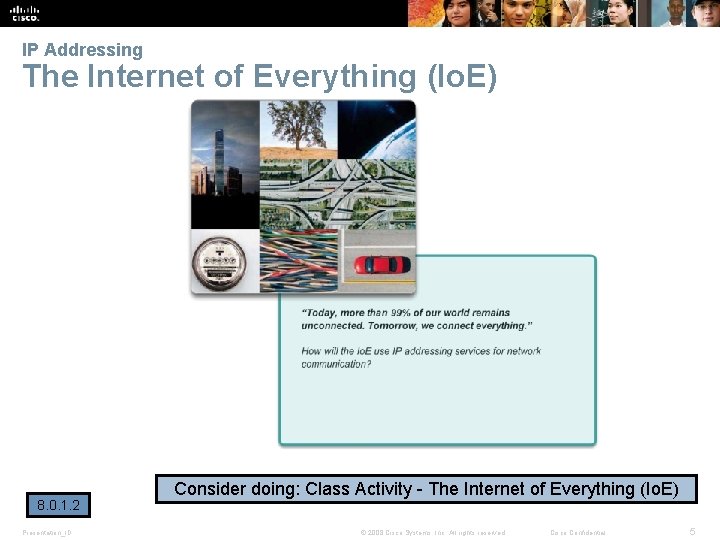
IP Addressing The Internet of Everything (Io. E) 8. 0. 1. 2 Presentation_ID Consider doing: Class Activity - The Internet of Everything (Io. E) © 2008 Cisco Systems, Inc. All rights reserved. Cisco Confidential 5
8. 1 IPv 4 Network Addresses 8. 1. 1 Presentation_ID © 2008 Cisco Systems, Inc. All rights reserved. Cisco Confidential 6
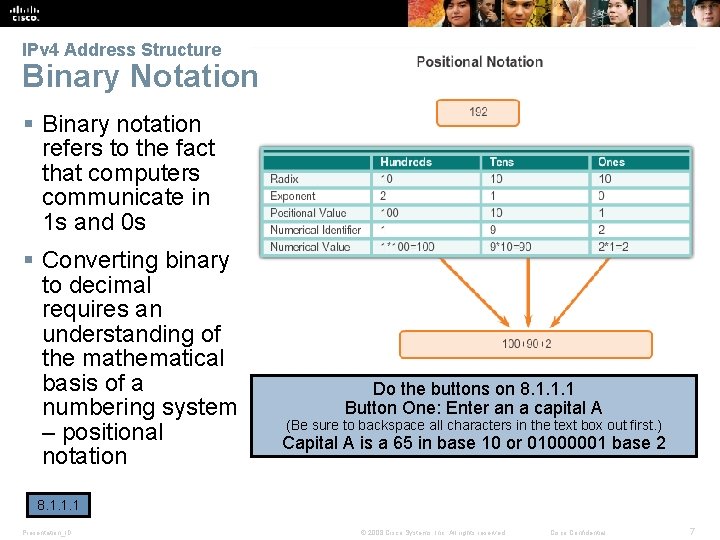
IPv 4 Address Structure Binary Notation § Binary notation refers to the fact that computers communicate in 1 s and 0 s § Converting binary to decimal requires an understanding of the mathematical basis of a numbering system – positional notation Do the buttons on 8. 1. 1. 1 Button One: Enter an a capital A (Be sure to backspace all characters in the text box out first. ) Capital A is a 65 in base 10 or 01000001 base 2 8. 1. 1. 1 Presentation_ID © 2008 Cisco Systems, Inc. All rights reserved. Cisco Confidential 7
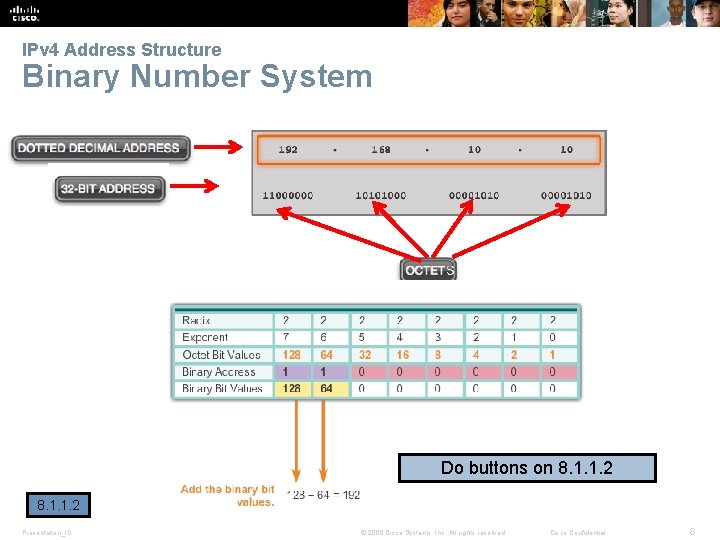
IPv 4 Address Structure Binary Number System Do buttons on 8. 1. 1. 2 Presentation_ID © 2008 Cisco Systems, Inc. All rights reserved. Cisco Confidential 8
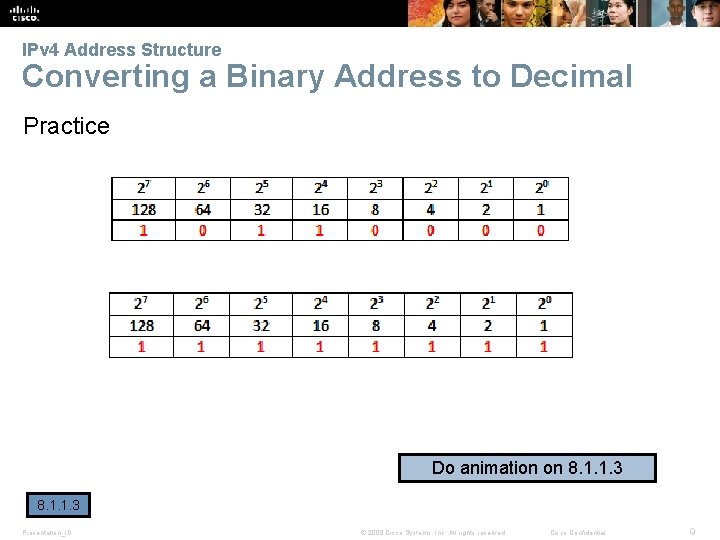
IPv 4 Address Structure Converting a Binary Address to Decimal Practice Do animation on 8. 1. 1. 3 Presentation_ID © 2008 Cisco Systems, Inc. All rights reserved. Cisco Confidential 9
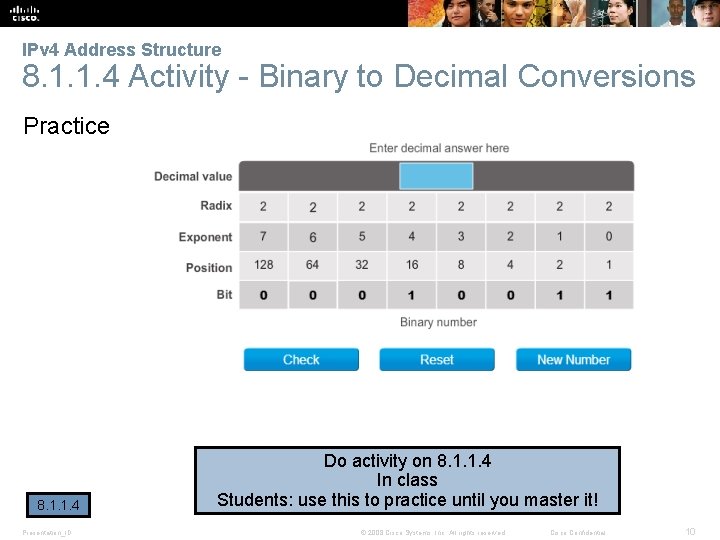
IPv 4 Address Structure 8. 1. 1. 4 Activity - Binary to Decimal Conversions Practice 8. 1. 1. 4 Presentation_ID Do activity on 8. 1. 1. 4 In class Students: use this to practice until you master it! © 2008 Cisco Systems, Inc. All rights reserved. Cisco Confidential 10
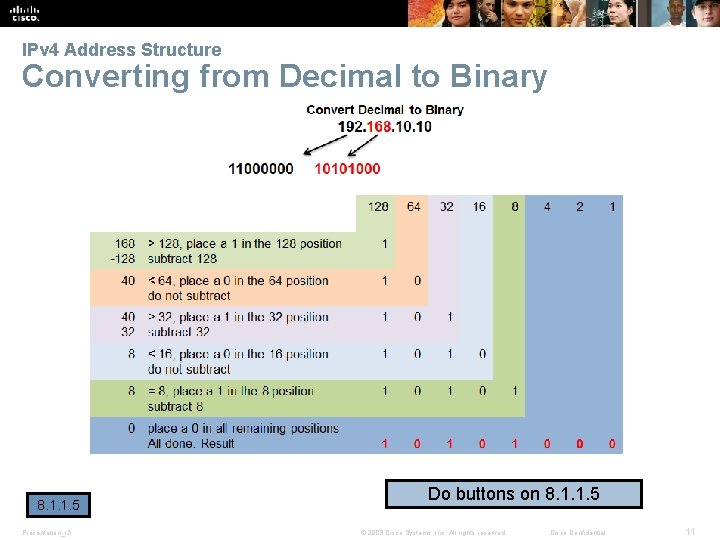
IPv 4 Address Structure Converting from Decimal to Binary 8. 1. 1. 5 Presentation_ID Do buttons on 8. 1. 1. 5 © 2008 Cisco Systems, Inc. All rights reserved. Cisco Confidential 11
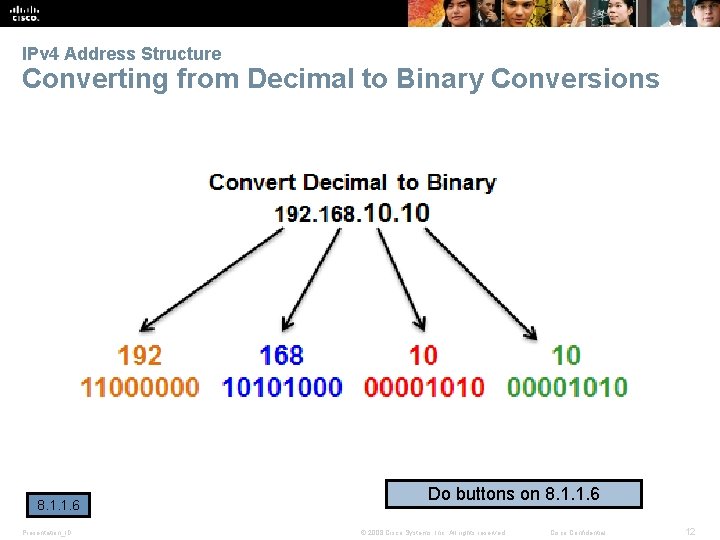
IPv 4 Address Structure Converting from Decimal to Binary Conversions 8. 1. 1. 6 Presentation_ID Do buttons on 8. 1. 1. 6 © 2008 Cisco Systems, Inc. All rights reserved. Cisco Confidential 12
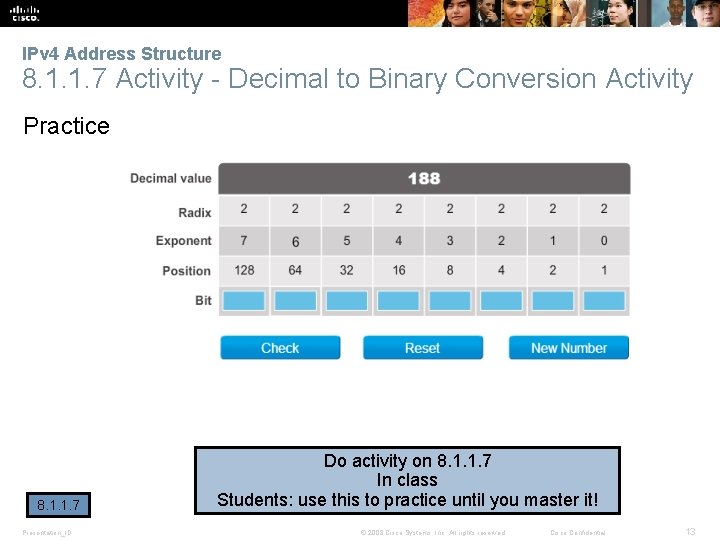
IPv 4 Address Structure 8. 1. 1. 7 Activity - Decimal to Binary Conversion Activity Practice 8. 1. 1. 7 Presentation_ID Do activity on 8. 1. 1. 7 In class Students: use this to practice until you master it! © 2008 Cisco Systems, Inc. All rights reserved. Cisco Confidential 13
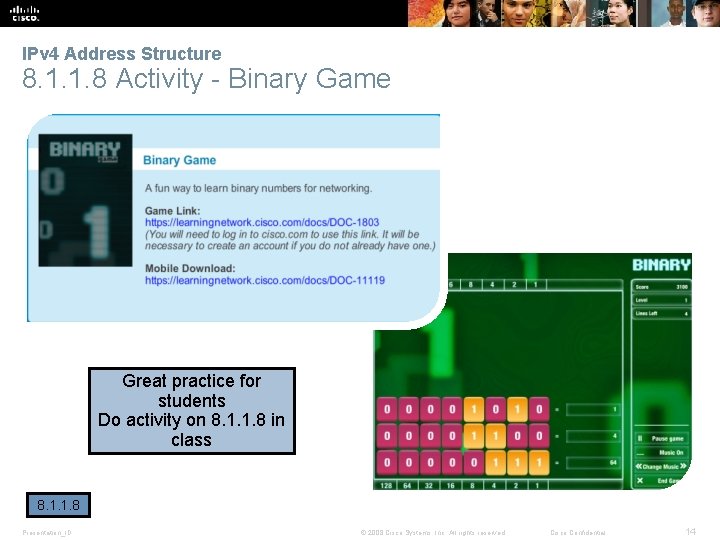
IPv 4 Address Structure 8. 1. 1. 8 Activity - Binary Game Great practice for students Do activity on 8. 1. 1. 8 in class 8. 1. 1. 8 Presentation_ID © 2008 Cisco Systems, Inc. All rights reserved. Cisco Confidential 14
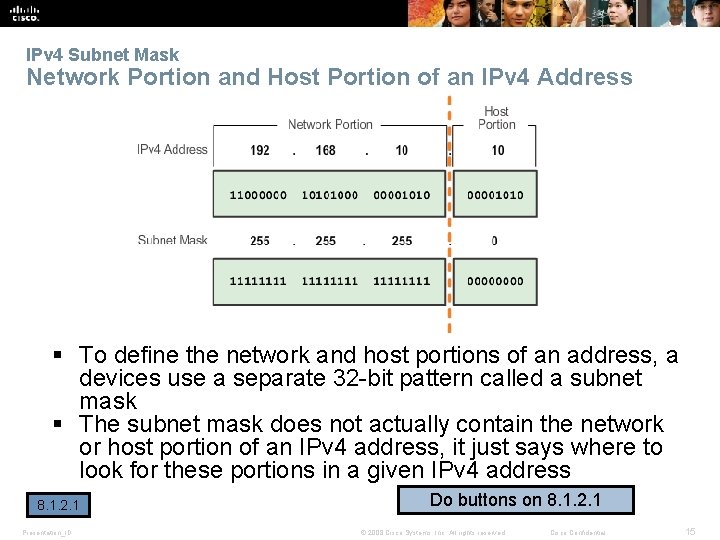
IPv 4 Subnet Mask Network Portion and Host Portion of an IPv 4 Address § To define the network and host portions of an address, a devices use a separate 32 -bit pattern called a subnet mask § The subnet mask does not actually contain the network or host portion of an IPv 4 address, it just says where to look for these portions in a given IPv 4 address 8. 1. 2. 1 Presentation_ID Do buttons on 8. 1. 2. 1 © 2008 Cisco Systems, Inc. All rights reserved. Cisco Confidential 15
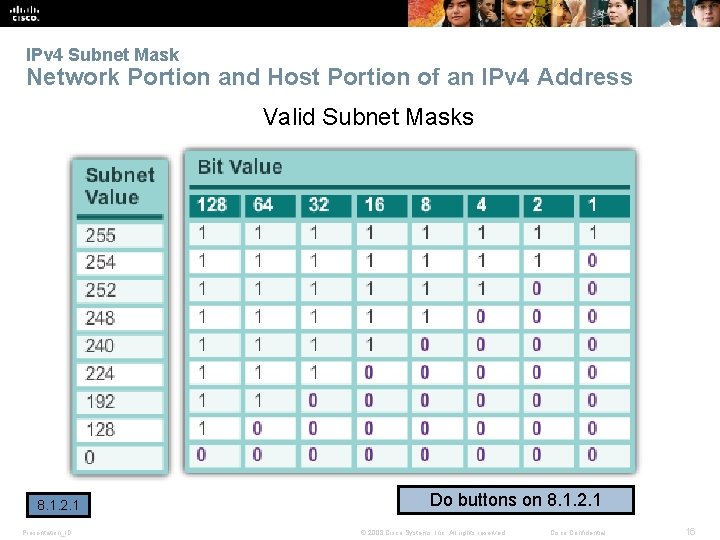
IPv 4 Subnet Mask Network Portion and Host Portion of an IPv 4 Address Valid Subnet Masks 8. 1. 2. 1 Presentation_ID Do buttons on 8. 1. 2. 1 © 2008 Cisco Systems, Inc. All rights reserved. Cisco Confidential 16
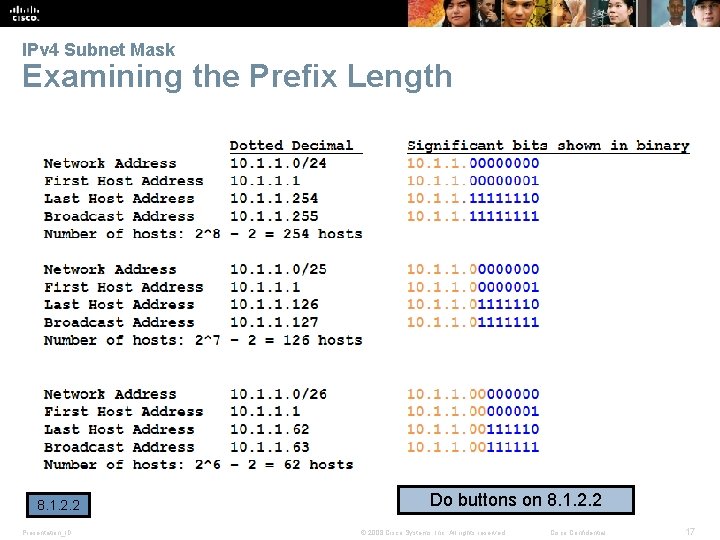
IPv 4 Subnet Mask Examining the Prefix Length 8. 1. 2. 2 Presentation_ID Do buttons on 8. 1. 2. 2 © 2008 Cisco Systems, Inc. All rights reserved. Cisco Confidential 17
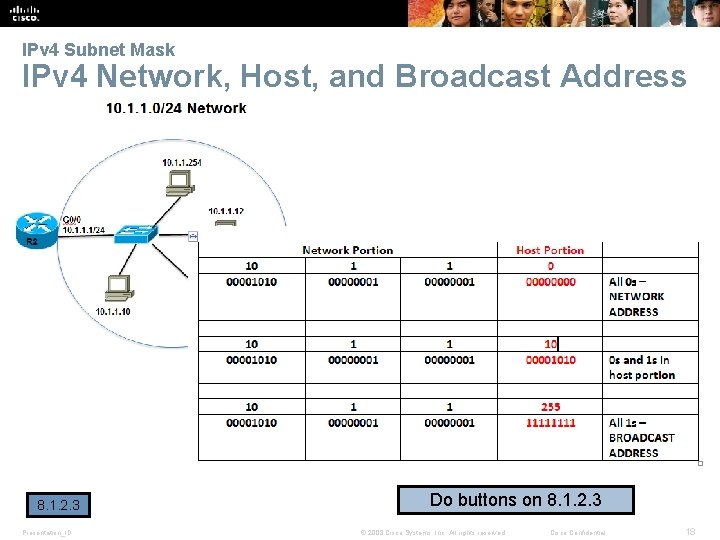
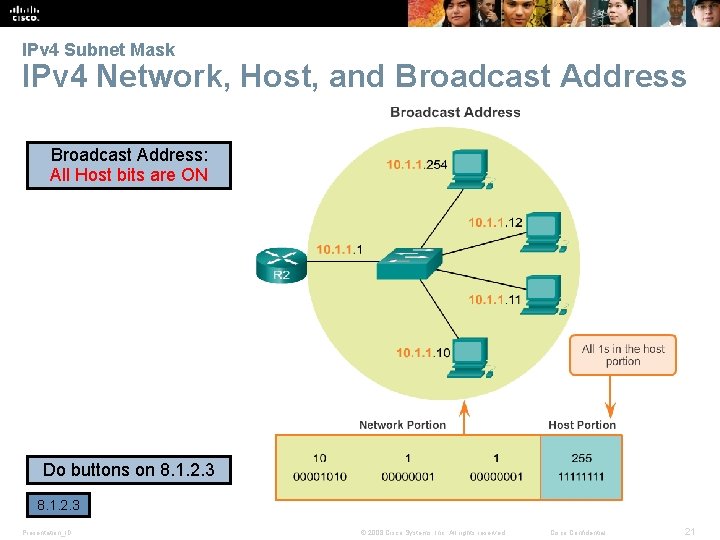
IPv 4 Subnet Mask IPv 4 Network, Host, and Broadcast Address 8. 1. 2. 3 Presentation_ID Do buttons on 8. 1. 2. 3 © 2008 Cisco Systems, Inc. All rights reserved. Cisco Confidential 18
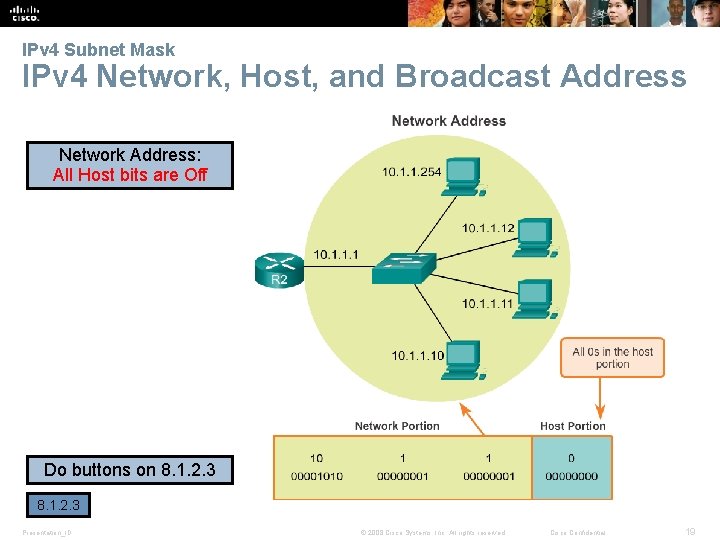
IPv 4 Subnet Mask IPv 4 Network, Host, and Broadcast Address Network Address: All Host bits are Off Do buttons on 8. 1. 2. 3 Presentation_ID © 2008 Cisco Systems, Inc. All rights reserved. Cisco Confidential 19
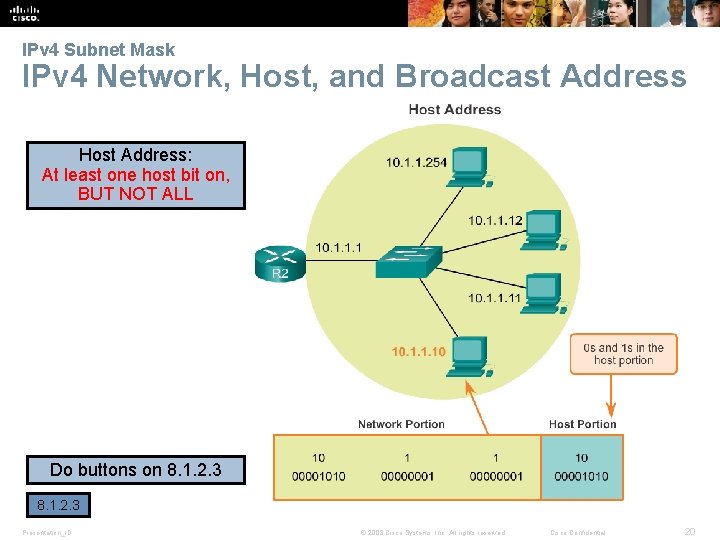
IPv 4 Subnet Mask IPv 4 Network, Host, and Broadcast Address Host Address: At least one host bit on, BUT NOT ALL Do buttons on 8. 1. 2. 3 Presentation_ID © 2008 Cisco Systems, Inc. All rights reserved. Cisco Confidential 20
IPv 4 Subnet Mask IPv 4 Network, Host, and Broadcast Address: All Host bits are ON Do buttons on 8. 1. 2. 3 Presentation_ID © 2008 Cisco Systems, Inc. All rights reserved. Cisco Confidential 21
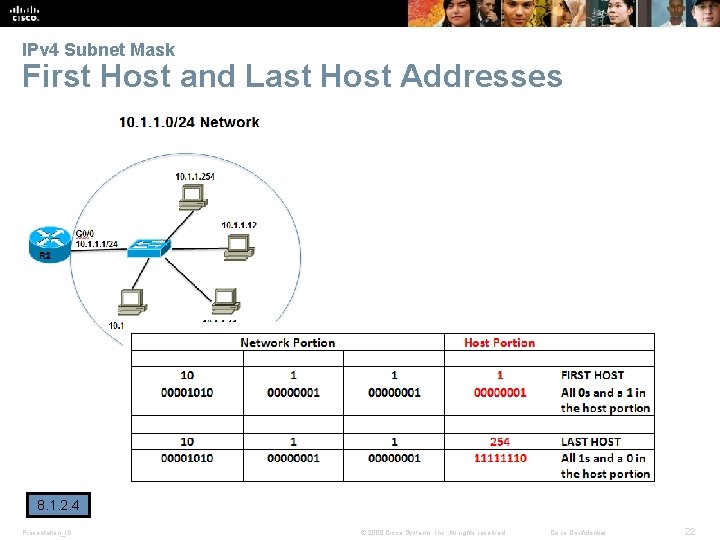
IPv 4 Subnet Mask First Host and Last Host Addresses 8. 1. 2. 4 Presentation_ID © 2008 Cisco Systems, Inc. All rights reserved. Cisco Confidential 22
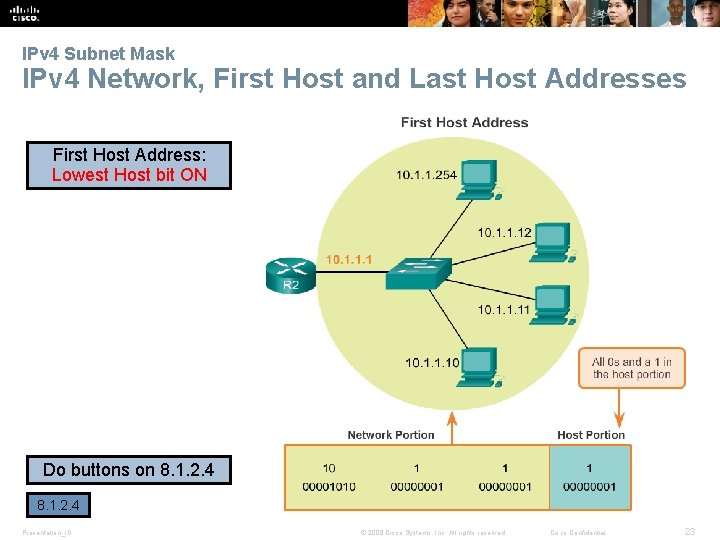
IPv 4 Subnet Mask IPv 4 Network, First Host and Last Host Addresses First Host Address: Lowest Host bit ON Do buttons on 8. 1. 2. 4 Presentation_ID © 2008 Cisco Systems, Inc. All rights reserved. Cisco Confidential 23
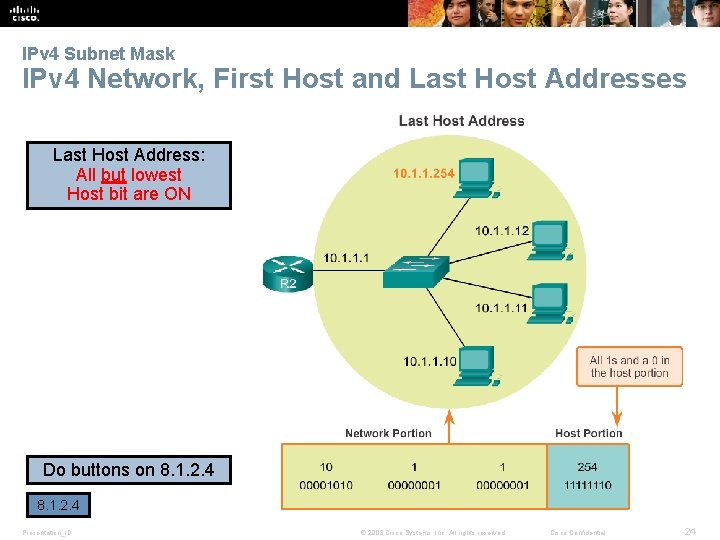
IPv 4 Subnet Mask IPv 4 Network, First Host and Last Host Addresses Last Host Address: All but lowest Host bit are ON Do buttons on 8. 1. 2. 4 Presentation_ID © 2008 Cisco Systems, Inc. All rights reserved. Cisco Confidential 24
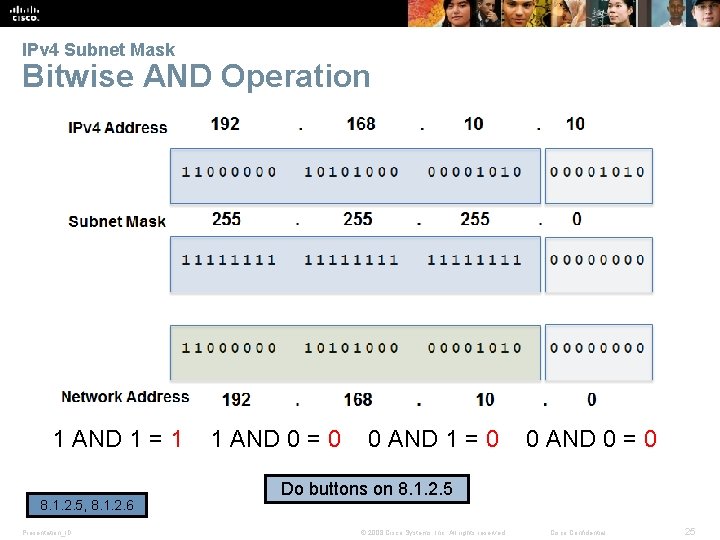
IPv 4 Subnet Mask Bitwise AND Operation 1 AND 1 = 1 8. 1. 2. 5, 8. 1. 2. 6 Presentation_ID 1 AND 0 = 0 0 AND 1 = 0 0 AND 0 = 0 Do buttons on 8. 1. 2. 5 © 2008 Cisco Systems, Inc. All rights reserved. Cisco Confidential 25
IPv 4 Subnet Mask 8. 1. 2. 7 Lab - Using the Windows Calculator with Network Addresses 8. 1. 2. 8 Lab - Converting IPv 4 Addresses to Binary 8. 1. 2. 7, 8. 1. 2. 8 Presentation_ID These are great practice © 2008 Cisco Systems, Inc. All rights reserved. Cisco Confidential 26
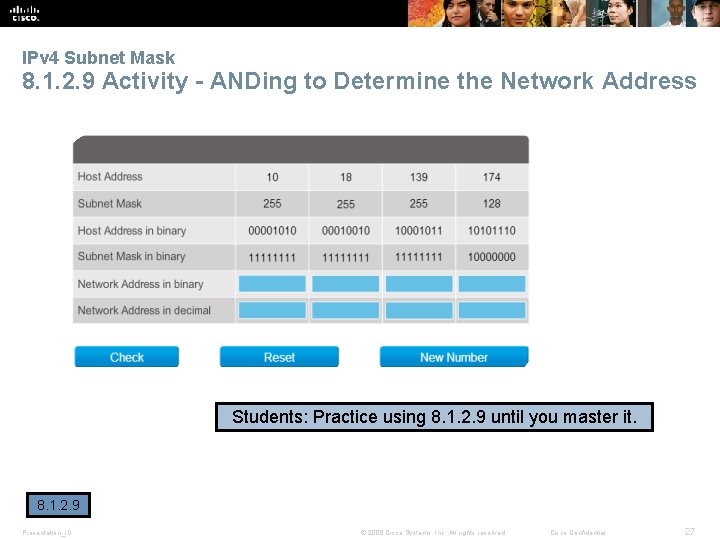
IPv 4 Subnet Mask 8. 1. 2. 9 Activity - ANDing to Determine the Network Address Students: Practice using 8. 1. 2. 9 until you master it. 8. 1. 2. 9 Presentation_ID © 2008 Cisco Systems, Inc. All rights reserved. Cisco Confidential 27
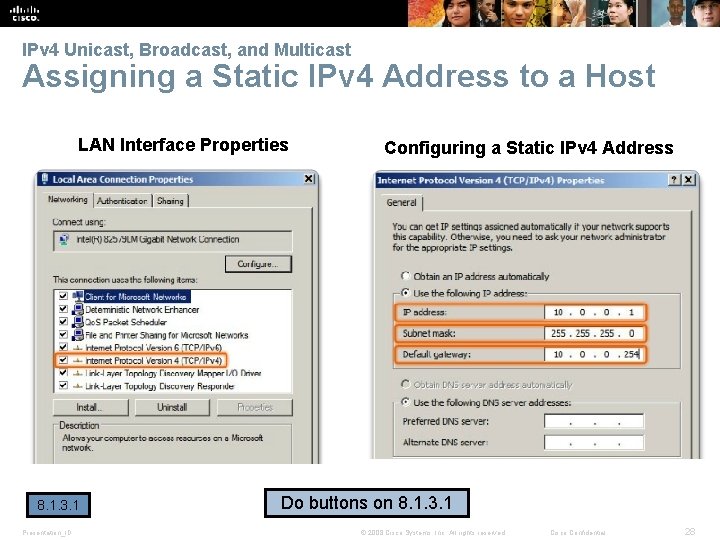
IPv 4 Unicast, Broadcast, and Multicast Assigning a Static IPv 4 Address to a Host LAN Interface Properties 8. 1. 3. 1 Presentation_ID Configuring a Static IPv 4 Address Do buttons on 8. 1. 3. 1 © 2008 Cisco Systems, Inc. All rights reserved. Cisco Confidential 28
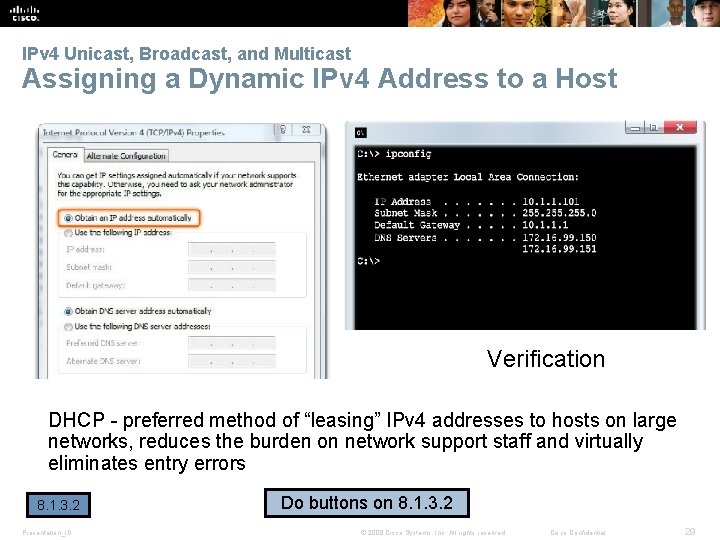
IPv 4 Unicast, Broadcast, and Multicast Assigning a Dynamic IPv 4 Address to a Host Verification DHCP - preferred method of “leasing” IPv 4 addresses to hosts on large networks, reduces the burden on network support staff and virtually eliminates entry errors 8. 1. 3. 2 Presentation_ID Do buttons on 8. 1. 3. 2 © 2008 Cisco Systems, Inc. All rights reserved. Cisco Confidential 29
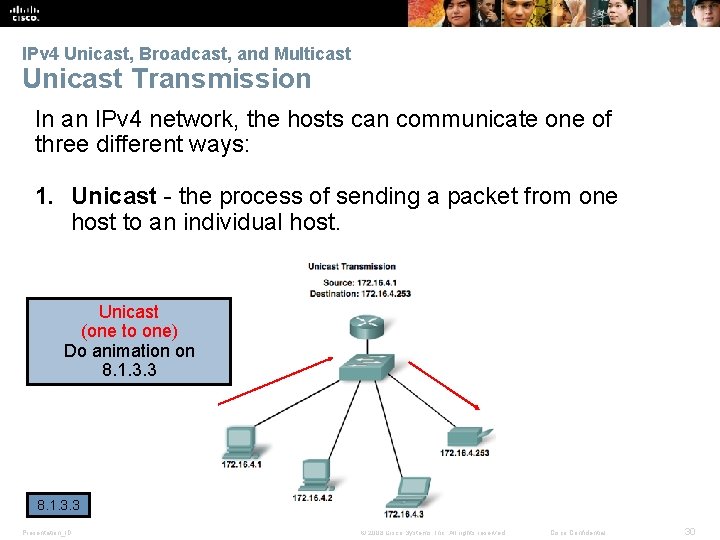
IPv 4 Unicast, Broadcast, and Multicast Unicast Transmission In an IPv 4 network, the hosts can communicate one of three different ways: 1. Unicast - the process of sending a packet from one host to an individual host. Unicast (one to one) Do animation on 8. 1. 3. 3 Presentation_ID © 2008 Cisco Systems, Inc. All rights reserved. Cisco Confidential 30
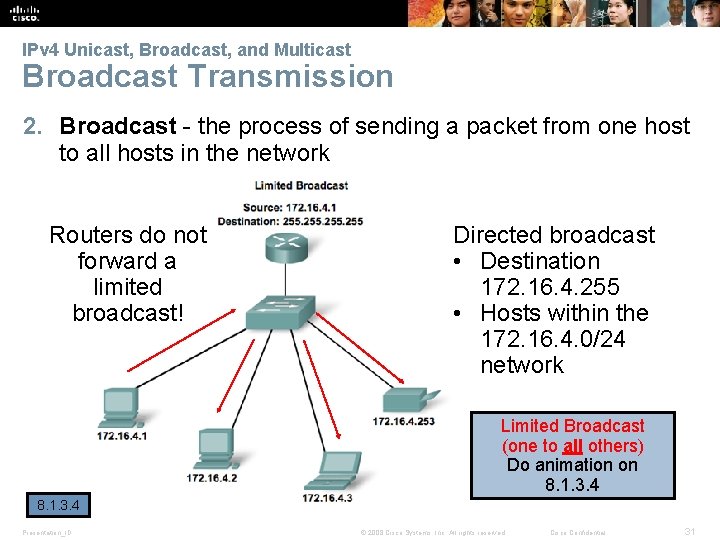
IPv 4 Unicast, Broadcast, and Multicast Broadcast Transmission 2. Broadcast - the process of sending a packet from one host to all hosts in the network Routers do not forward a limited broadcast! Directed broadcast • Destination 172. 16. 4. 255 • Hosts within the 172. 16. 4. 0/24 network Limited Broadcast (one to all others) Do animation on 8. 1. 3. 4 Presentation_ID © 2008 Cisco Systems, Inc. All rights reserved. Cisco Confidential 31
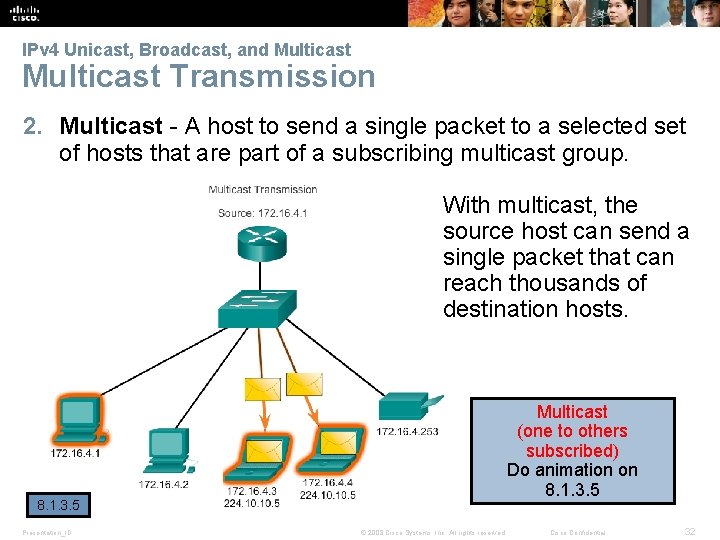
IPv 4 Unicast, Broadcast, and Multicast Transmission 2. Multicast - A host to send a single packet to a selected set of hosts that are part of a subscribing multicast group. With multicast, the source host can send a single packet that can reach thousands of destination hosts. Multicast (one to others subscribed) Do animation on 8. 1. 3. 5 Presentation_ID © 2008 Cisco Systems, Inc. All rights reserved. Cisco Confidential 32
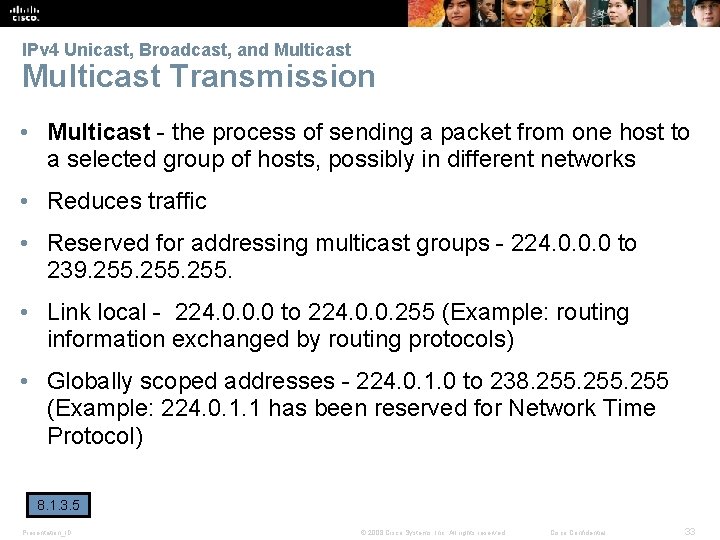
IPv 4 Unicast, Broadcast, and Multicast Transmission • Multicast - the process of sending a packet from one host to a selected group of hosts, possibly in different networks • Reduces traffic • Reserved for addressing multicast groups - 224. 0. 0. 0 to 239. 255. • Link local - 224. 0. 0. 0 to 224. 0. 0. 255 (Example: routing information exchanged by routing protocols) • Globally scoped addresses - 224. 0. 1. 0 to 238. 255 (Example: 224. 0. 1. 1 has been reserved for Network Time Protocol) 8. 1. 3. 5 Presentation_ID © 2008 Cisco Systems, Inc. All rights reserved. Cisco Confidential 33
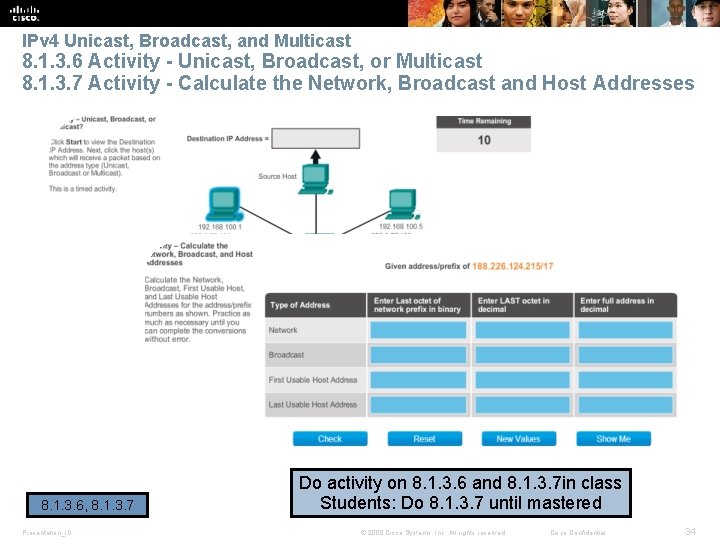
IPv 4 Unicast, Broadcast, and Multicast 8. 1. 3. 6 Activity - Unicast, Broadcast, or Multicast 8. 1. 3. 7 Activity - Calculate the Network, Broadcast and Host Addresses 8. 1. 3. 6, 8. 1. 3. 7 Presentation_ID Do activity on 8. 1. 3. 6 and 8. 1. 3. 7 in class Students: Do 8. 1. 3. 7 until mastered © 2008 Cisco Systems, Inc. All rights reserved. Cisco Confidential 34
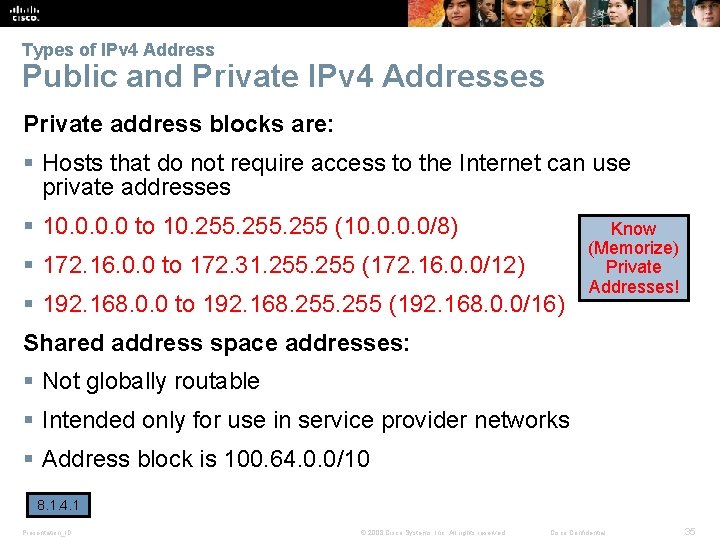
Types of IPv 4 Address Public and Private IPv 4 Addresses Private address blocks are: § Hosts that do not require access to the Internet can use private addresses § 10. 0 to 10. 255 (10. 0/8) § 172. 16. 0. 0 to 172. 31. 255 (172. 16. 0. 0/12) § 192. 168. 0. 0 to 192. 168. 255 (192. 168. 0. 0/16) Know (Memorize) Private Addresses! Shared address space addresses: § Not globally routable § Intended only for use in service provider networks § Address block is 100. 64. 0. 0/10 8. 1. 4. 1 Presentation_ID © 2008 Cisco Systems, Inc. All rights reserved. Cisco Confidential 35
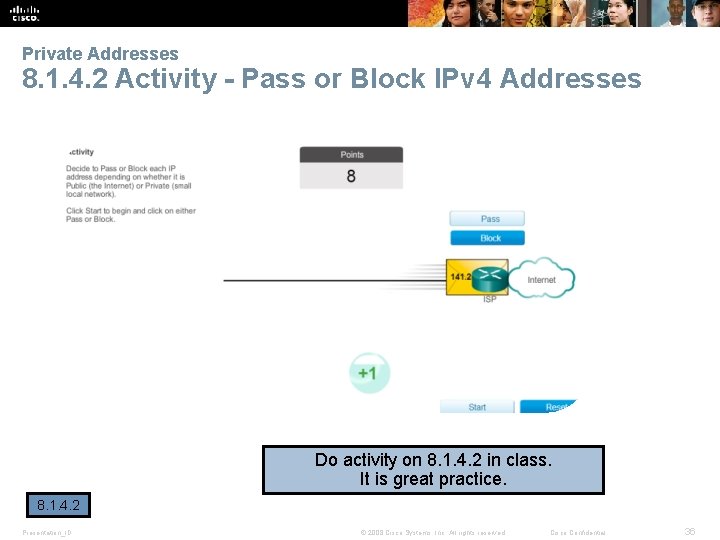
Private Addresses 8. 1. 4. 2 Activity - Pass or Block IPv 4 Addresses Do activity on 8. 1. 4. 2 in class. It is great practice. 8. 1. 4. 2 Presentation_ID © 2008 Cisco Systems, Inc. All rights reserved. Cisco Confidential 36
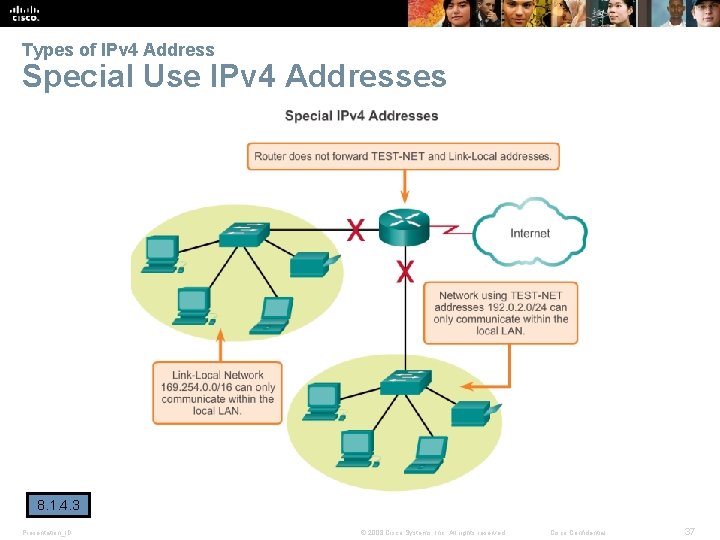
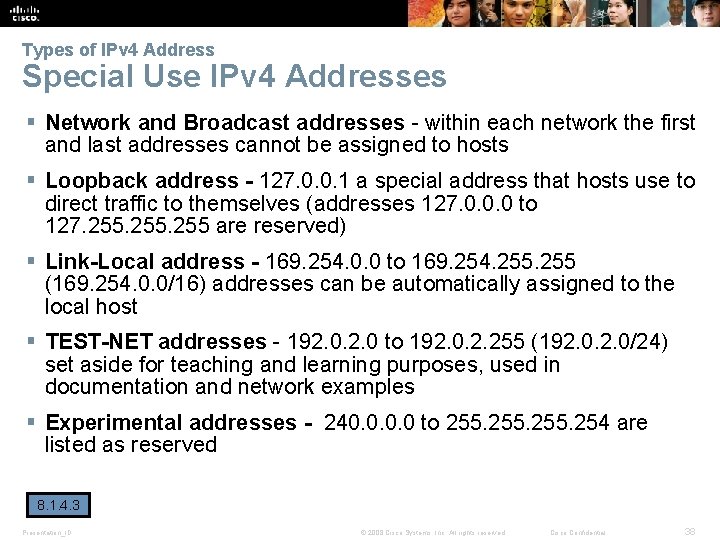
Types of IPv 4 Address Special Use IPv 4 Addresses 8. 1. 4. 3 Presentation_ID © 2008 Cisco Systems, Inc. All rights reserved. Cisco Confidential 37
Types of IPv 4 Address Special Use IPv 4 Addresses § Network and Broadcast addresses - within each network the first and last addresses cannot be assigned to hosts § Loopback address - 127. 0. 0. 1 a special address that hosts use to direct traffic to themselves (addresses 127. 0. 0. 0 to 127. 255 are reserved) § Link-Local address - 169. 254. 0. 0 to 169. 254. 255 (169. 254. 0. 0/16) addresses can be automatically assigned to the local host § TEST-NET addresses - 192. 0 to 192. 0. 2. 255 (192. 0/24) set aside for teaching and learning purposes, used in documentation and network examples § Experimental addresses - 240. 0 to 255. 254 are listed as reserved 8. 1. 4. 3 Presentation_ID © 2008 Cisco Systems, Inc. All rights reserved. Cisco Confidential 38
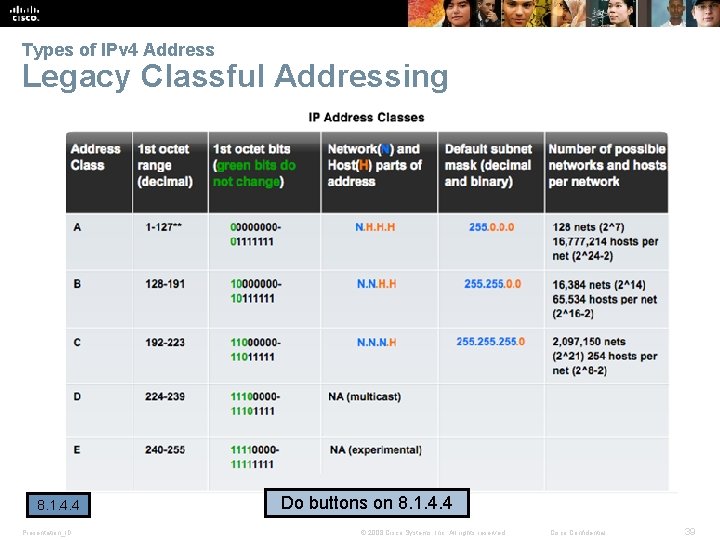
Types of IPv 4 Address Legacy Classful Addressing 8. 1. 4. 4 Presentation_ID Do buttons on 8. 1. 4. 4 © 2008 Cisco Systems, Inc. All rights reserved. Cisco Confidential 39
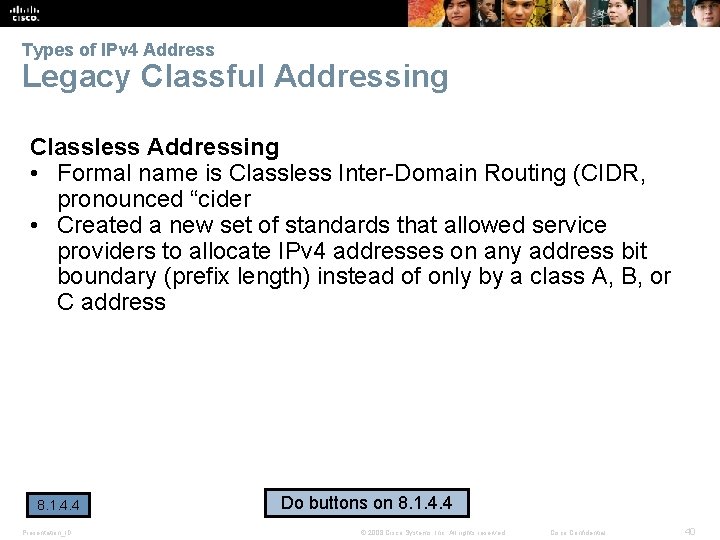
Types of IPv 4 Address Legacy Classful Addressing Classless Addressing • Formal name is Classless Inter-Domain Routing (CIDR, pronounced “cider • Created a new set of standards that allowed service providers to allocate IPv 4 addresses on any address bit boundary (prefix length) instead of only by a class A, B, or C address 8. 1. 4. 4 Presentation_ID Do buttons on 8. 1. 4. 4 © 2008 Cisco Systems, Inc. All rights reserved. Cisco Confidential 40
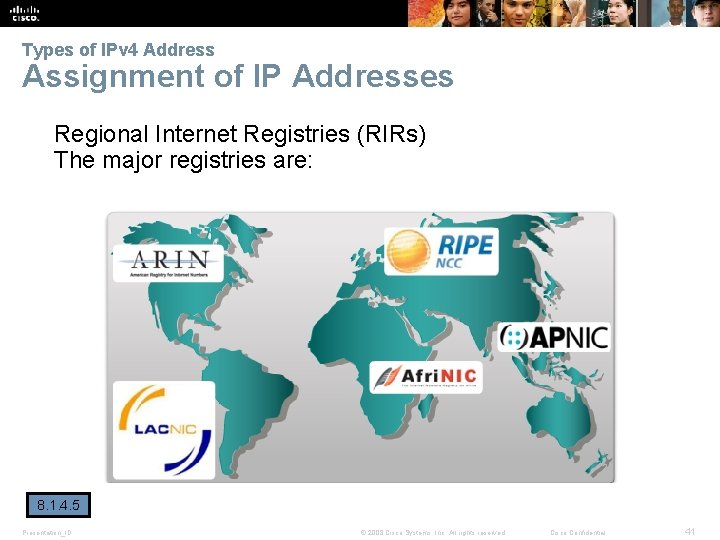
Types of IPv 4 Address Assignment of IP Addresses Regional Internet Registries (RIRs) The major registries are: 8. 1. 4. 5 Presentation_ID © 2008 Cisco Systems, Inc. All rights reserved. Cisco Confidential 41
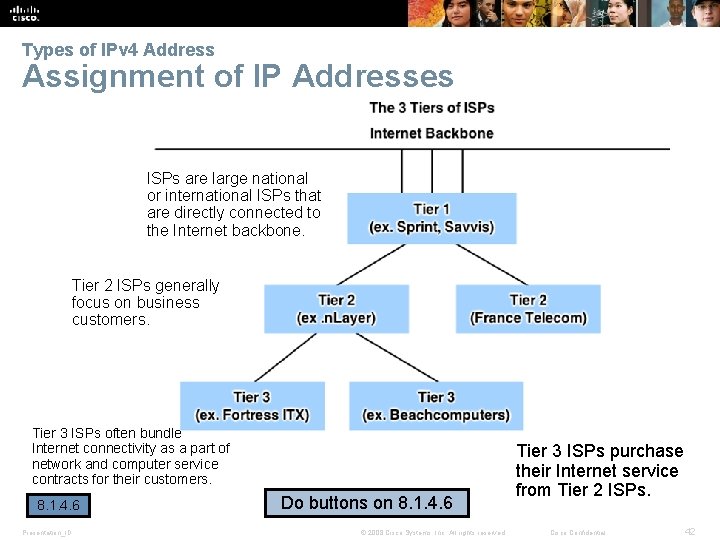
Types of IPv 4 Address Assignment of IP Addresses ISPs are large national or international ISPs that are directly connected to the Internet backbone. Tier 2 ISPs generally focus on business customers. Tier 3 ISPs often bundle Internet connectivity as a part of network and computer service contracts for their customers. 8. 1. 4. 6 Presentation_ID Do buttons on 8. 1. 4. 6 © 2008 Cisco Systems, Inc. All rights reserved. Tier 3 ISPs purchase their Internet service from Tier 2 ISPs. Cisco Confidential 42
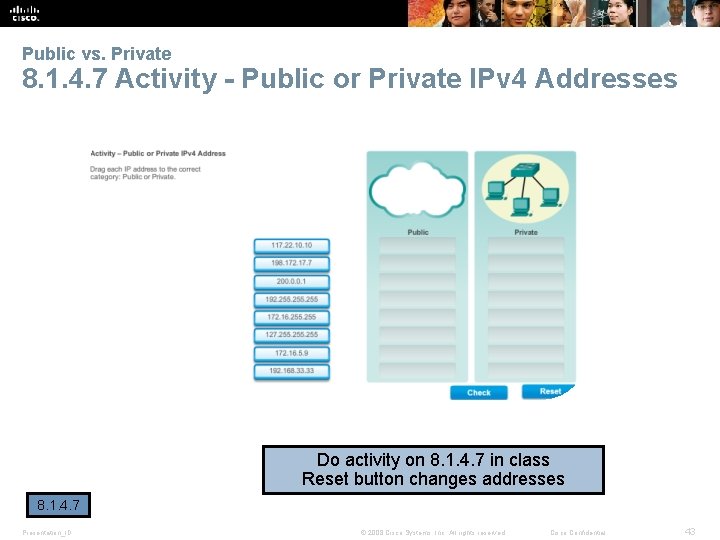
Public vs. Private 8. 1. 4. 7 Activity - Public or Private IPv 4 Addresses Do activity on 8. 1. 4. 7 in class Reset button changes addresses 8. 1. 4. 7 Presentation_ID © 2008 Cisco Systems, Inc. All rights reserved. Cisco Confidential 43
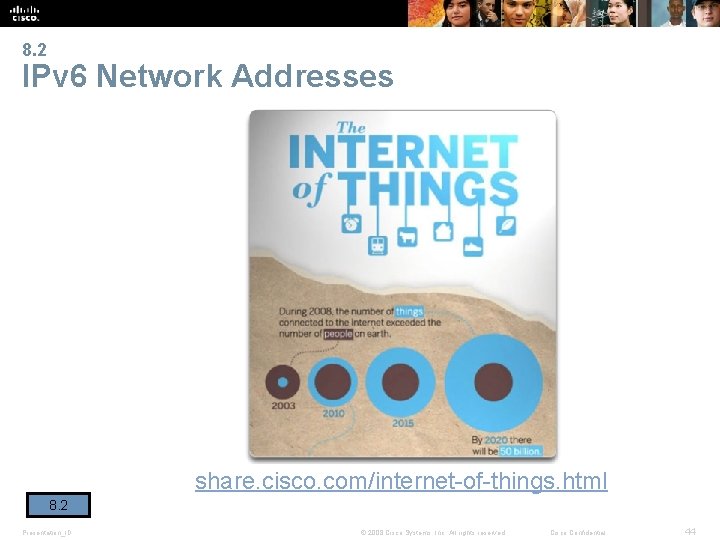
8. 2 IPv 6 Network Addresses share. cisco. com/internet-of-things. html 8. 2 Presentation_ID © 2008 Cisco Systems, Inc. All rights reserved. Cisco Confidential 44
IPv 4 Issues The Need for IPv 6 § IPv 6 is designed to be the successor to IPv 4 § Depletion of IPv 4 address space has been the motivating factor for moving to IPv 6 § Projections show that all five RIRs will run out of IPv 4 addresses between 2015 and 2020 § With an increasing Internet population, a limited IPv 4 address space, issues with NAT and an Internet of things, the time has come to begin the transition to IPv 6! 8. 2. 1. 1 Presentation_ID © 2008 Cisco Systems, Inc. All rights reserved. Cisco Confidential 45
IPv 4 Issues The Need for IPv 6 § IPv 4 has theoretical maximum of 4. 3 billion addresses plus private addresses in combination with NAT § IPv 6 larger 128 -bit address space providing for 340 undecillion addresses § IPv 6 fixes the limitations of IPv 4 and include additional enhancements such as ICMPv 6 8. 2. 1. 1 Presentation_ID © 2008 Cisco Systems, Inc. All rights reserved. Cisco Confidential 46
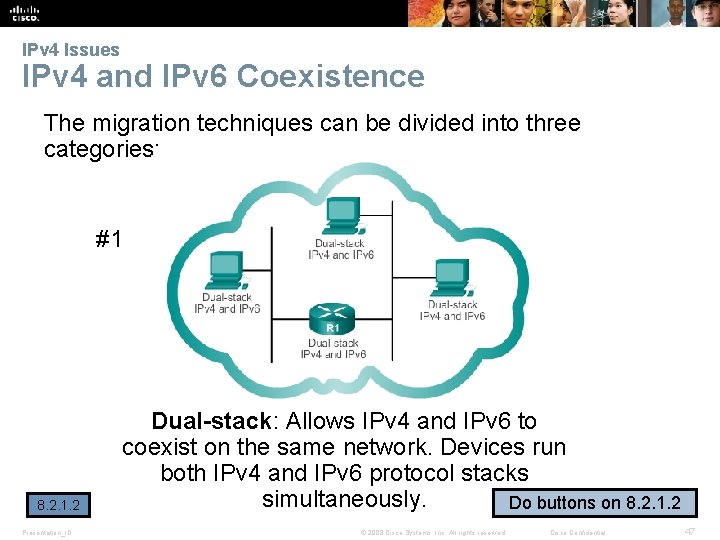
IPv 4 Issues IPv 4 and IPv 6 Coexistence The migration techniques can be divided into three categories: #1 8. 2. 1. 2 Presentation_ID Dual-stack: Allows IPv 4 and IPv 6 to coexist on the same network. Devices run both IPv 4 and IPv 6 protocol stacks simultaneously. Do buttons on 8. 2. 1. 2 © 2008 Cisco Systems, Inc. All rights reserved. Cisco Confidential 47
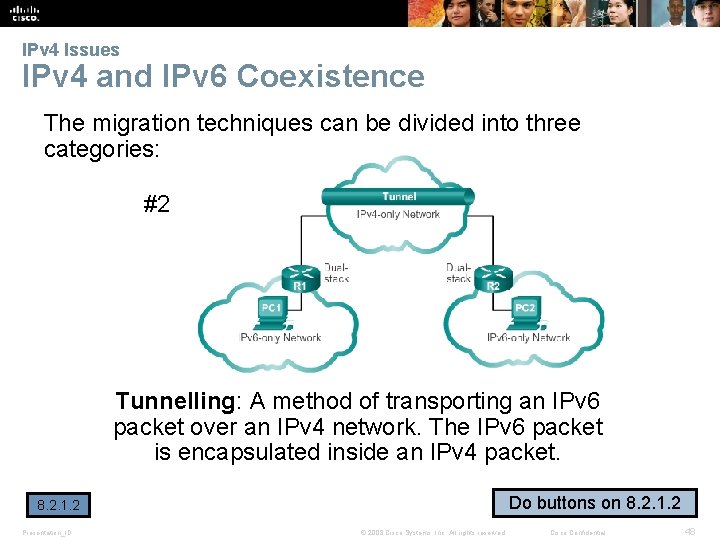
IPv 4 Issues IPv 4 and IPv 6 Coexistence The migration techniques can be divided into three categories: #2 Tunnelling: A method of transporting an IPv 6 packet over an IPv 4 network. The IPv 6 packet is encapsulated inside an IPv 4 packet. Do buttons on 8. 2. 1. 2 Presentation_ID © 2008 Cisco Systems, Inc. All rights reserved. Cisco Confidential 48
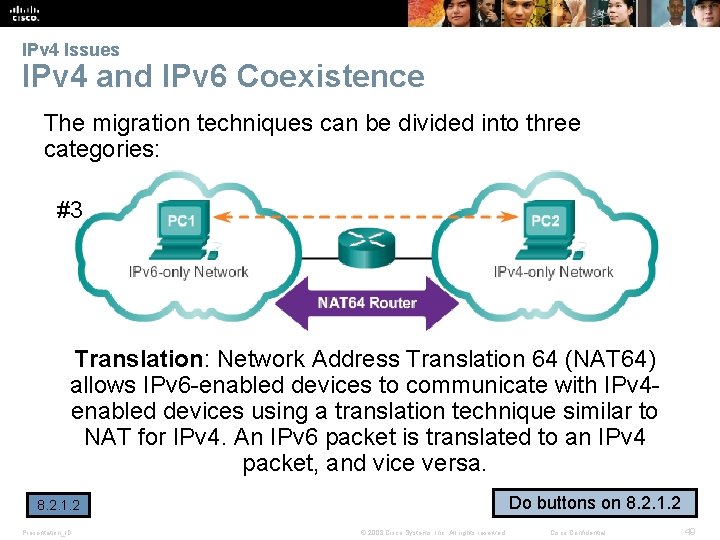
IPv 4 Issues IPv 4 and IPv 6 Coexistence The migration techniques can be divided into three categories: #3 Translation: Network Address Translation 64 (NAT 64) allows IPv 6 -enabled devices to communicate with IPv 4 enabled devices using a translation technique similar to NAT for IPv 4. An IPv 6 packet is translated to an IPv 4 packet, and vice versa. Do buttons on 8. 2. 1. 2 Presentation_ID © 2008 Cisco Systems, Inc. All rights reserved. Cisco Confidential 49
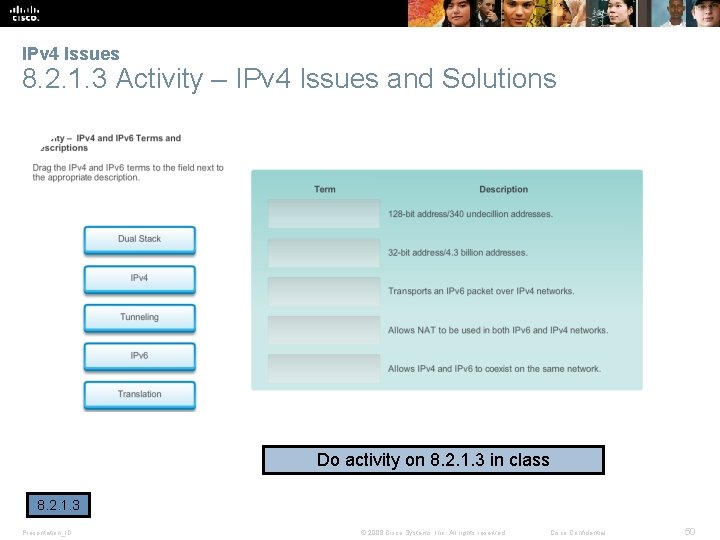
IPv 4 Issues 8. 2. 1. 3 Activity – IPv 4 Issues and Solutions Do activity on 8. 2. 1. 3 in class 8. 2. 1. 3 Presentation_ID © 2008 Cisco Systems, Inc. All rights reserved. Cisco Confidential 50
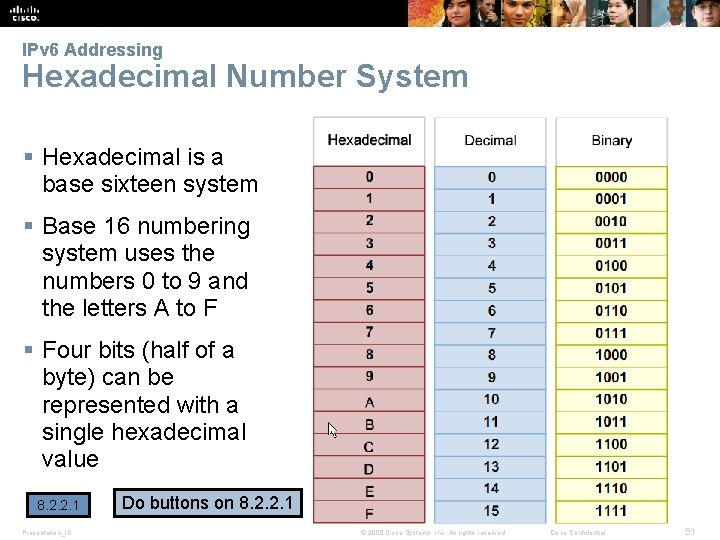
IPv 6 Addressing Hexadecimal Number System § Hexadecimal is a base sixteen system § Base 16 numbering system uses the numbers 0 to 9 and the letters A to F § Four bits (half of a byte) can be represented with a single hexadecimal value 8. 2. 2. 1 Presentation_ID Do buttons on 8. 2. 2. 1 © 2008 Cisco Systems, Inc. All rights reserved. Cisco Confidential 51
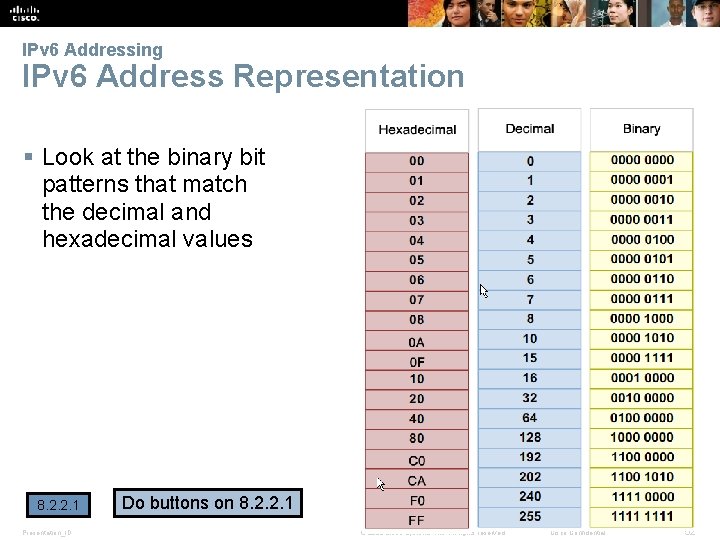
IPv 6 Addressing IPv 6 Address Representation § Look at the binary bit patterns that match the decimal and hexadecimal values 8. 2. 2. 1 Presentation_ID Do buttons on 8. 2. 2. 1 © 2008 Cisco Systems, Inc. All rights reserved. Cisco Confidential 52
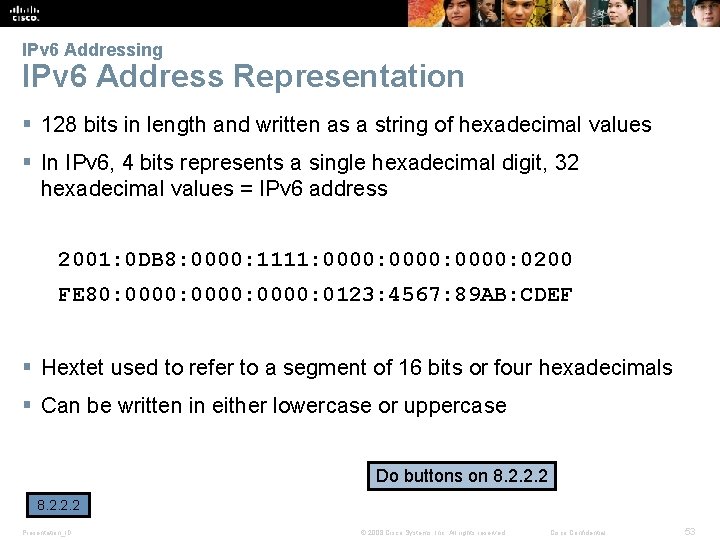
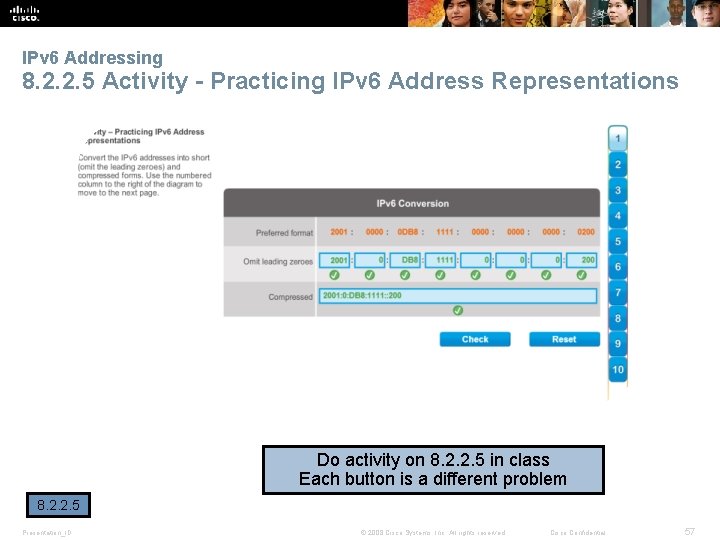
IPv 6 Addressing IPv 6 Address Representation § 128 bits in length and written as a string of hexadecimal values § In IPv 6, 4 bits represents a single hexadecimal digit, 32 hexadecimal values = IPv 6 address 2001: 0 DB 8: 0000: 1111: 0000: 0200 FE 80: 0000: 0123: 4567: 89 AB: CDEF § Hextet used to refer to a segment of 16 bits or four hexadecimals § Can be written in either lowercase or uppercase Do buttons on 8. 2. 2. 2 Presentation_ID © 2008 Cisco Systems, Inc. All rights reserved. Cisco Confidential 53
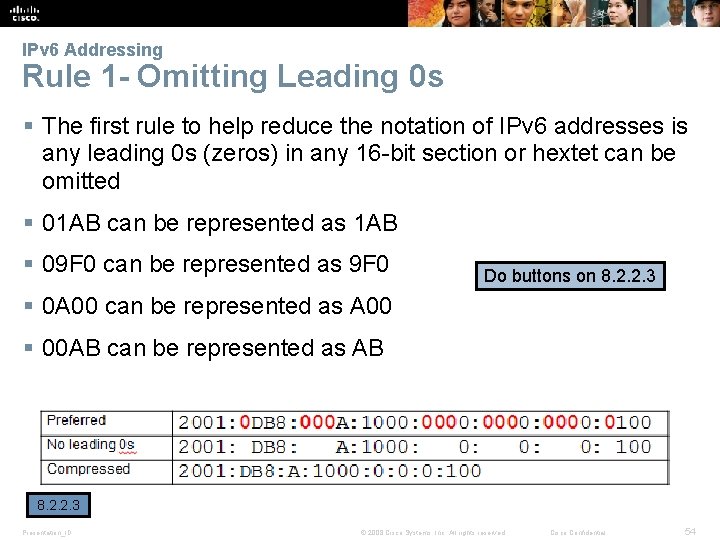
IPv 6 Addressing Rule 1 - Omitting Leading 0 s § The first rule to help reduce the notation of IPv 6 addresses is any leading 0 s (zeros) in any 16 -bit section or hextet can be omitted § 01 AB can be represented as 1 AB § 09 F 0 can be represented as 9 F 0 Do buttons on 8. 2. 2. 3 § 0 A 00 can be represented as A 00 § 00 AB can be represented as AB 8. 2. 2. 3 Presentation_ID © 2008 Cisco Systems, Inc. All rights reserved. Cisco Confidential 54
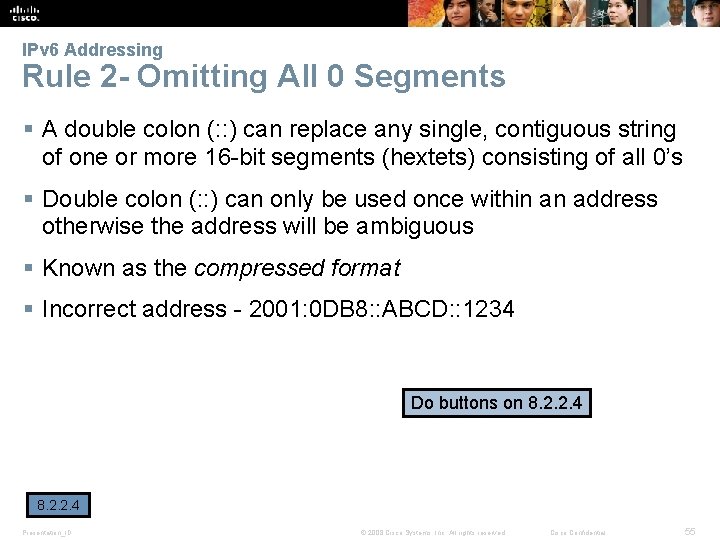
IPv 6 Addressing Rule 2 - Omitting All 0 Segments § A double colon (: : ) can replace any single, contiguous string of one or more 16 -bit segments (hextets) consisting of all 0’s § Double colon (: : ) can only be used once within an address otherwise the address will be ambiguous § Known as the compressed format § Incorrect address - 2001: 0 DB 8: : ABCD: : 1234 Do buttons on 8. 2. 2. 4 Presentation_ID © 2008 Cisco Systems, Inc. All rights reserved. Cisco Confidential 55
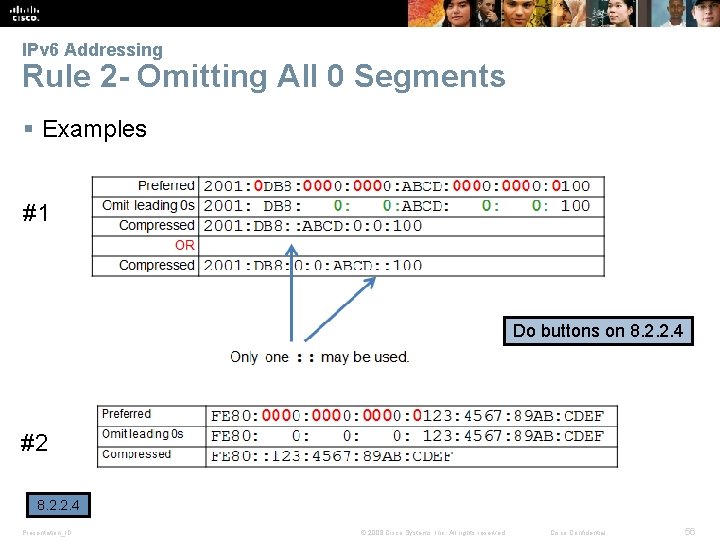
IPv 6 Addressing Rule 2 - Omitting All 0 Segments § Examples #1 Do buttons on 8. 2. 2. 4 #2 8. 2. 2. 4 Presentation_ID © 2008 Cisco Systems, Inc. All rights reserved. Cisco Confidential 56
IPv 6 Addressing 8. 2. 2. 5 Activity - Practicing IPv 6 Address Representations Do activity on 8. 2. 2. 5 in class Each button is a different problem 8. 2. 2. 5 Presentation_ID © 2008 Cisco Systems, Inc. All rights reserved. Cisco Confidential 57
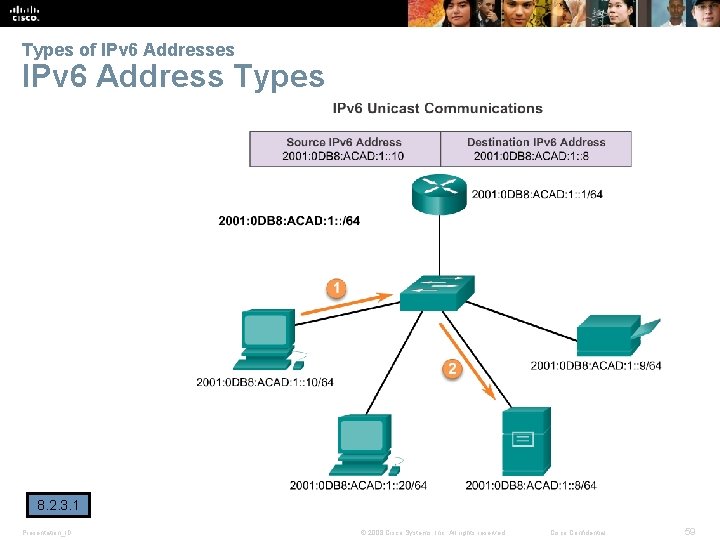
Types of IPv 6 Addresses IPv 6 Address Types There are three types of IPv 6 addresses: • Unicast • Multicast • Anycast. Note: IPv 6 does not have broadcast addresses. 8. 2. 3. 1 Presentation_ID © 2008 Cisco Systems, Inc. All rights reserved. Cisco Confidential 58
Types of IPv 6 Addresses IPv 6 Address Types 8. 2. 3. 1 Presentation_ID © 2008 Cisco Systems, Inc. All rights reserved. Cisco Confidential 59
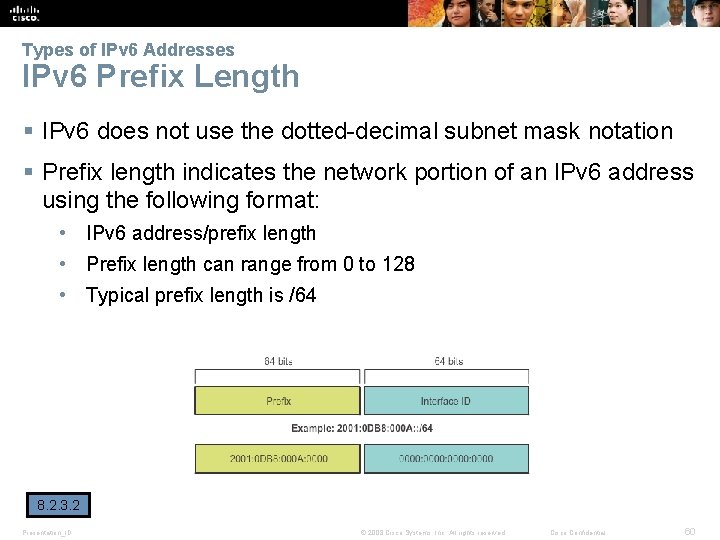
Types of IPv 6 Addresses IPv 6 Prefix Length § IPv 6 does not use the dotted-decimal subnet mask notation § Prefix length indicates the network portion of an IPv 6 address using the following format: • IPv 6 address/prefix length • Prefix length can range from 0 to 128 • Typical prefix length is /64 8. 2. 3. 2 Presentation_ID © 2008 Cisco Systems, Inc. All rights reserved. Cisco Confidential 60
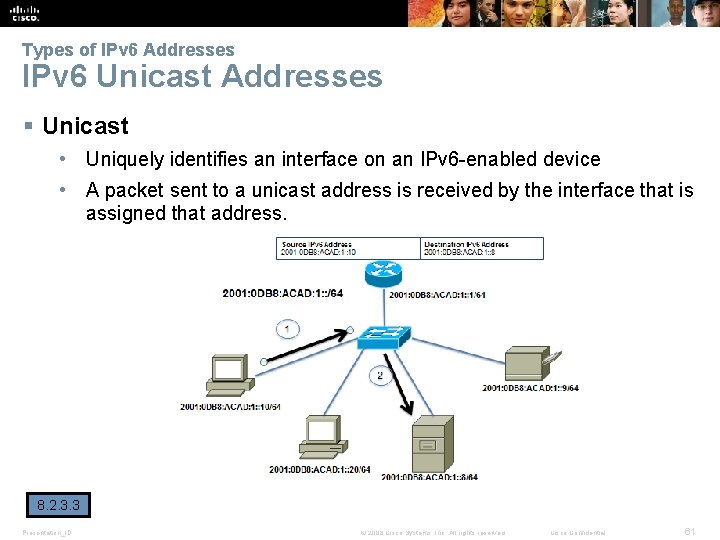
Types of IPv 6 Addresses IPv 6 Unicast Addresses § Unicast • Uniquely identifies an interface on an IPv 6 -enabled device • A packet sent to a unicast address is received by the interface that is assigned that address. 8. 2. 3. 3 Presentation_ID © 2008 Cisco Systems, Inc. All rights reserved. Cisco Confidential 61
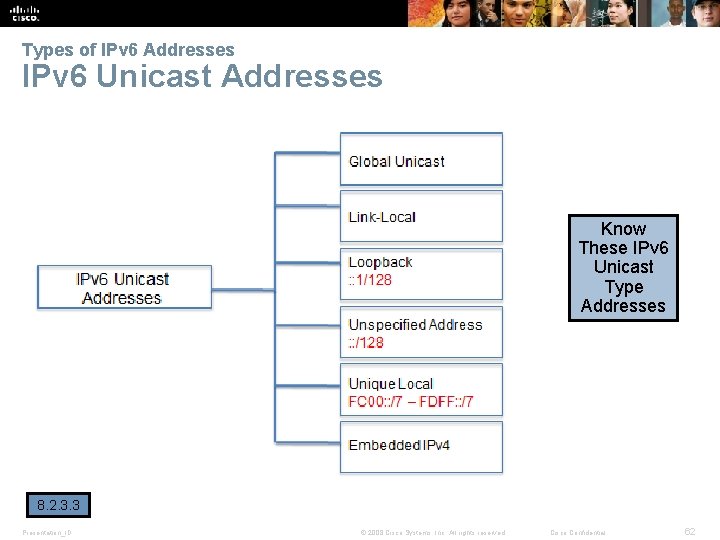
Types of IPv 6 Addresses IPv 6 Unicast Addresses Know These IPv 6 Unicast Type Addresses 8. 2. 3. 3 Presentation_ID © 2008 Cisco Systems, Inc. All rights reserved. Cisco Confidential 62
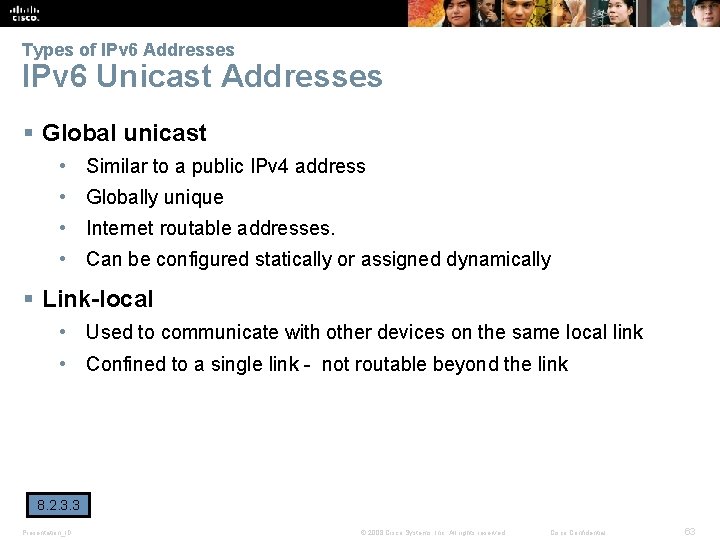
Types of IPv 6 Addresses IPv 6 Unicast Addresses § Global unicast • Similar to a public IPv 4 address • Globally unique • Internet routable addresses. • Can be configured statically or assigned dynamically § Link-local • Used to communicate with other devices on the same local link • Confined to a single link - not routable beyond the link 8. 2. 3. 3 Presentation_ID © 2008 Cisco Systems, Inc. All rights reserved. Cisco Confidential 63
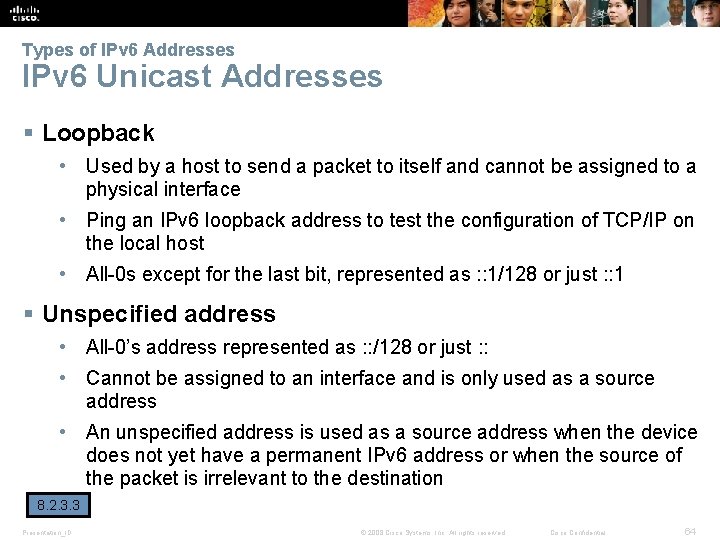
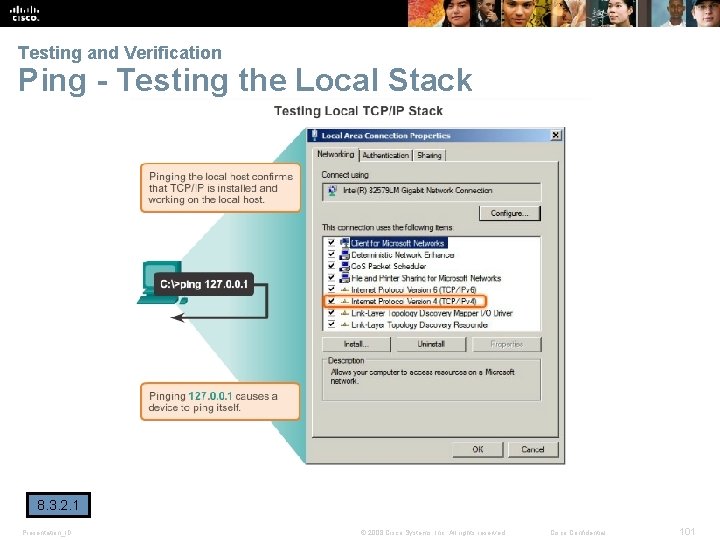
Types of IPv 6 Addresses IPv 6 Unicast Addresses § Loopback • Used by a host to send a packet to itself and cannot be assigned to a physical interface • Ping an IPv 6 loopback address to test the configuration of TCP/IP on the local host • All-0 s except for the last bit, represented as : : 1/128 or just : : 1 § Unspecified address • All-0’s address represented as : : /128 or just : : • Cannot be assigned to an interface and is only used as a source address • An unspecified address is used as a source address when the device does not yet have a permanent IPv 6 address or when the source of the packet is irrelevant to the destination 8. 2. 3. 3 Presentation_ID © 2008 Cisco Systems, Inc. All rights reserved. Cisco Confidential 64
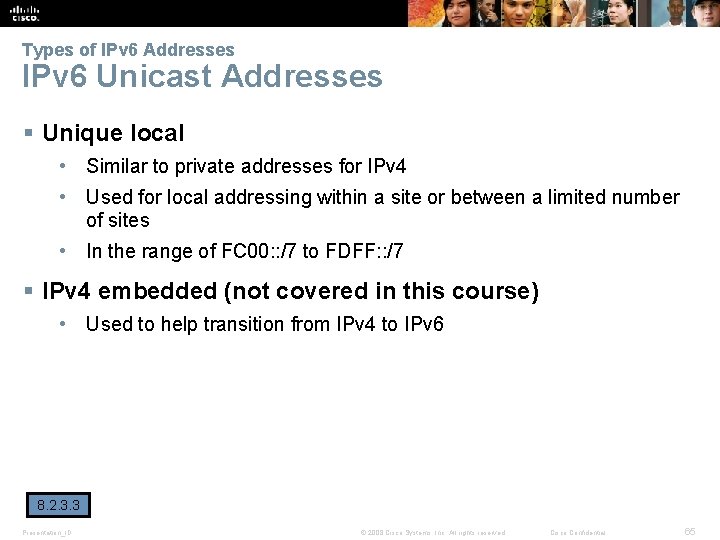
Types of IPv 6 Addresses IPv 6 Unicast Addresses § Unique local • Similar to private addresses for IPv 4 • Used for local addressing within a site or between a limited number of sites • In the range of FC 00: : /7 to FDFF: : /7 § IPv 4 embedded (not covered in this course) • Used to help transition from IPv 4 to IPv 6 8. 2. 3. 3 Presentation_ID © 2008 Cisco Systems, Inc. All rights reserved. Cisco Confidential 65
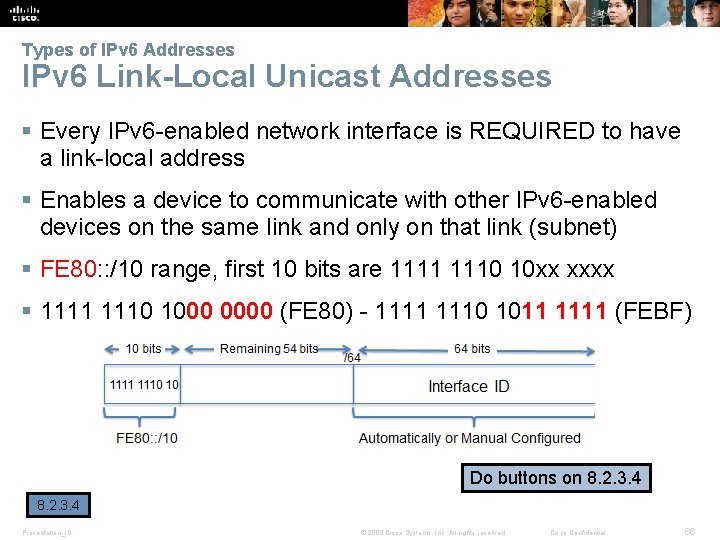
Types of IPv 6 Addresses IPv 6 Link-Local Unicast Addresses § Every IPv 6 -enabled network interface is REQUIRED to have a link-local address § Enables a device to communicate with other IPv 6 -enabled devices on the same link and only on that link (subnet) § FE 80: : /10 range, first 10 bits are 1111 1110 10 xx xxxx § 1111 1110 1000 0000 (FE 80) - 1111 1110 1011 1111 (FEBF) Do buttons on 8. 2. 3. 4 Presentation_ID © 2008 Cisco Systems, Inc. All rights reserved. Cisco Confidential 66
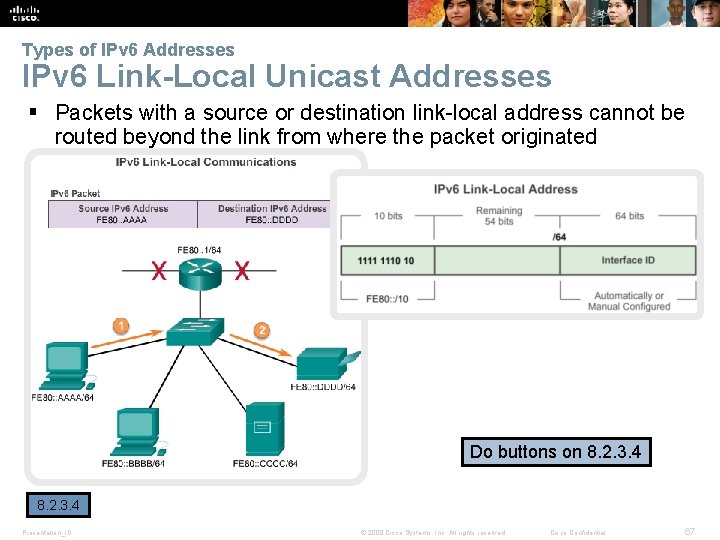
Types of IPv 6 Addresses IPv 6 Link-Local Unicast Addresses § Packets with a source or destination link-local address cannot be routed beyond the link from where the packet originated Do buttons on 8. 2. 3. 4 Presentation_ID © 2008 Cisco Systems, Inc. All rights reserved. Cisco Confidential 67
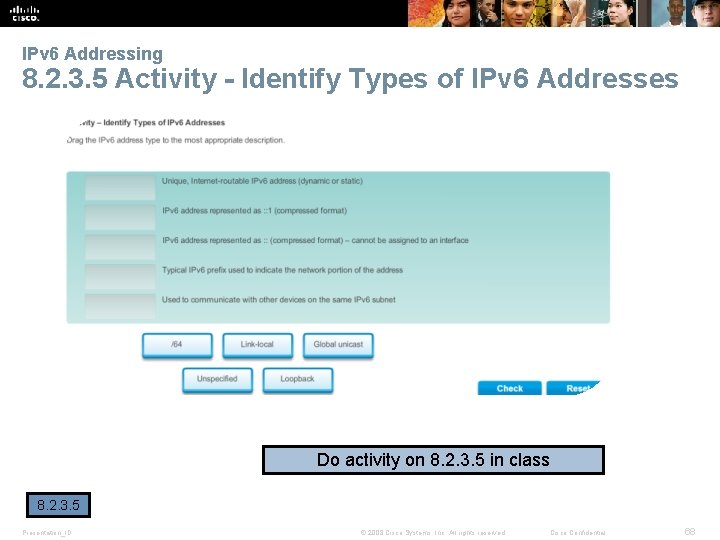
IPv 6 Addressing 8. 2. 3. 5 Activity - Identify Types of IPv 6 Addresses Do activity on 8. 2. 3. 5 in class 8. 2. 3. 5 Presentation_ID © 2008 Cisco Systems, Inc. All rights reserved. Cisco Confidential 68
IPv 6 Unicast Addresses Structure of an IPv 6 Global Unicast Address § IPv 6 global unicast addresses are globally unique and routable on the IPv 6 Internet § Equivalent to public IPv 4 addresses § ICANN allocates IPv 6 address blocks to the five RIRs § Currently, only global unicast addresses with the first three bits of 001 or 2000: : /3 are being assigned Do buttons on 8. 2. 4. 1 Presentation_ID © 2008 Cisco Systems, Inc. All rights reserved. Cisco Confidential 69
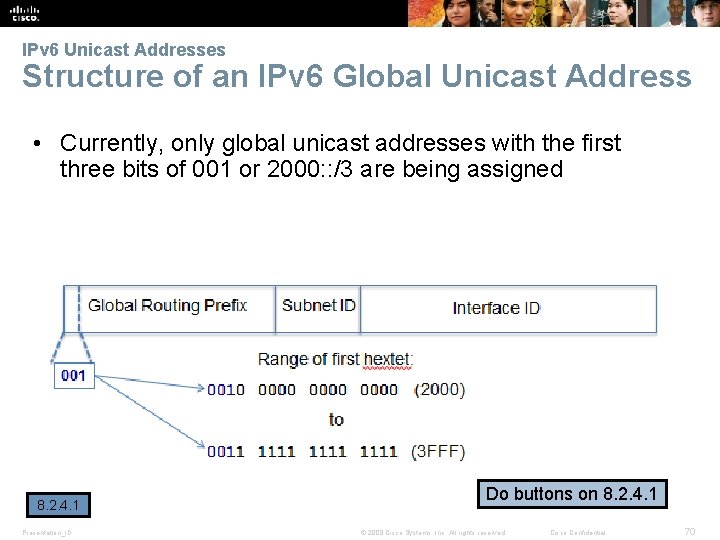
IPv 6 Unicast Addresses Structure of an IPv 6 Global Unicast Address • Currently, only global unicast addresses with the first three bits of 001 or 2000: : /3 are being assigned 8. 2. 4. 1 Presentation_ID Do buttons on 8. 2. 4. 1 © 2008 Cisco Systems, Inc. All rights reserved. Cisco Confidential 70
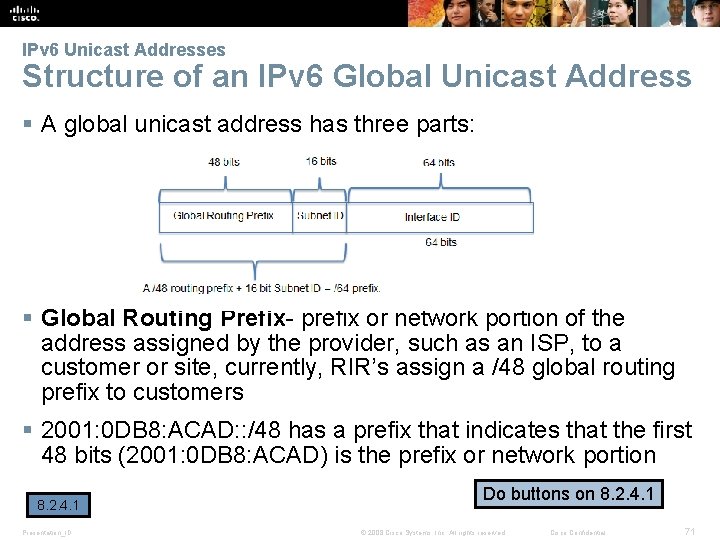
IPv 6 Unicast Addresses Structure of an IPv 6 Global Unicast Address § A global unicast address has three parts: § Global Routing Prefix- prefix or network portion of the address assigned by the provider, such as an ISP, to a customer or site, currently, RIR’s assign a /48 global routing prefix to customers § 2001: 0 DB 8: ACAD: : /48 has a prefix that indicates that the first 48 bits (2001: 0 DB 8: ACAD) is the prefix or network portion 8. 2. 4. 1 Presentation_ID Do buttons on 8. 2. 4. 1 © 2008 Cisco Systems, Inc. All rights reserved. Cisco Confidential 71
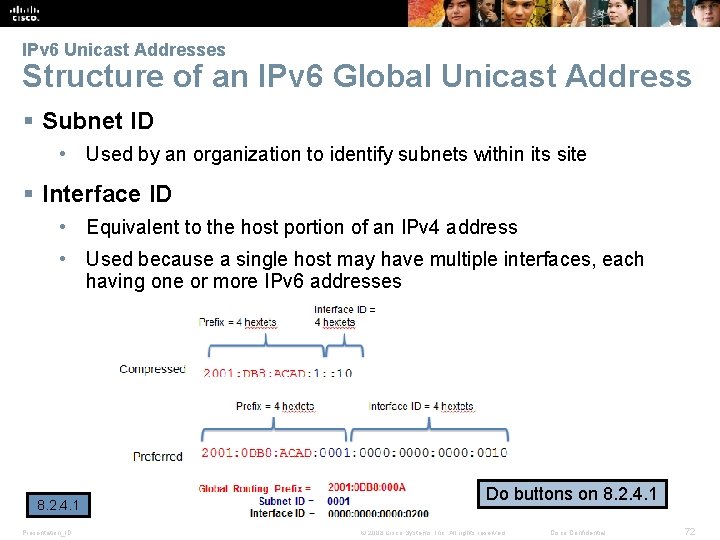
IPv 6 Unicast Addresses Structure of an IPv 6 Global Unicast Address § Subnet ID • Used by an organization to identify subnets within its site § Interface ID • Equivalent to the host portion of an IPv 4 address • Used because a single host may have multiple interfaces, each having one or more IPv 6 addresses 8. 2. 4. 1 Presentation_ID Do buttons on 8. 2. 4. 1 © 2008 Cisco Systems, Inc. All rights reserved. Cisco Confidential 72
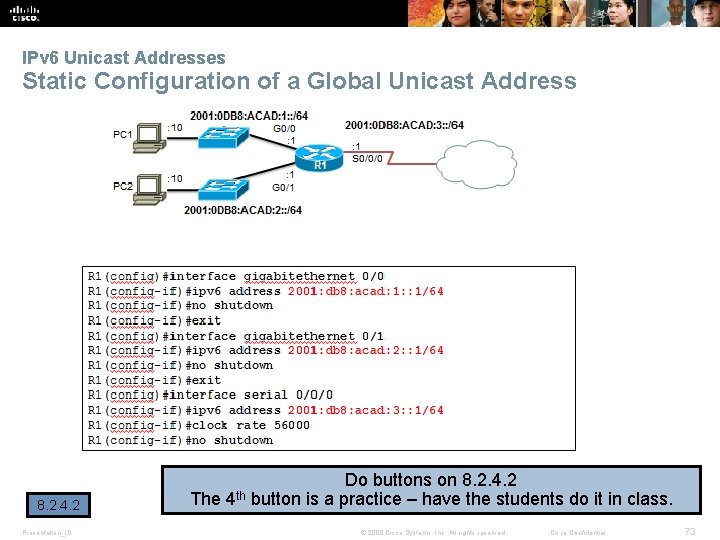
IPv 6 Unicast Addresses Static Configuration of a Global Unicast Address 8. 2. 4. 2 Presentation_ID The 4 th Do buttons on 8. 2. 4. 2 button is a practice – have the students do it in class. © 2008 Cisco Systems, Inc. All rights reserved. Cisco Confidential 73
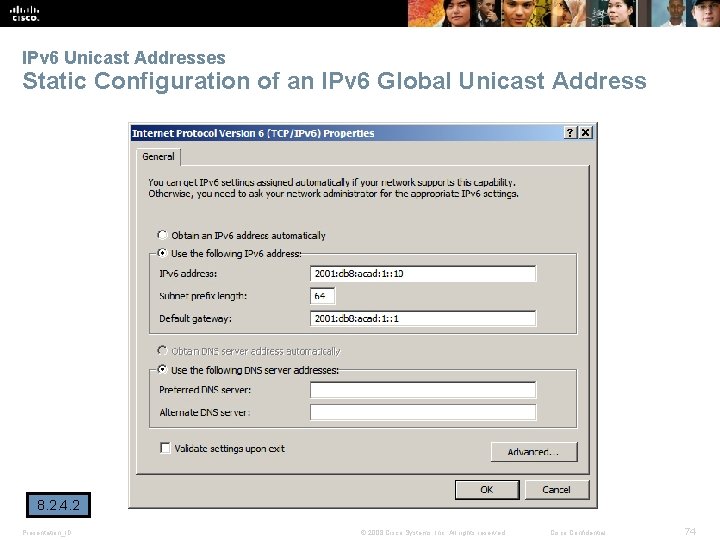
IPv 6 Unicast Addresses Static Configuration of an IPv 6 Global Unicast Address 8. 2. 4. 2 Presentation_ID © 2008 Cisco Systems, Inc. All rights reserved. Cisco Confidential 74
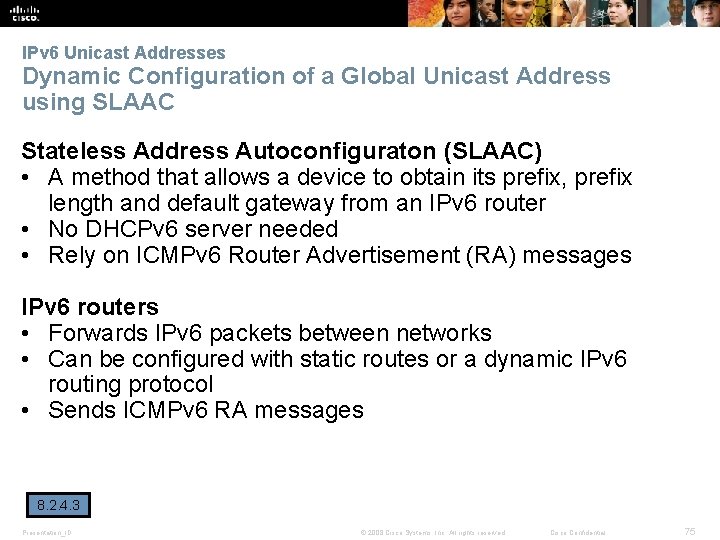
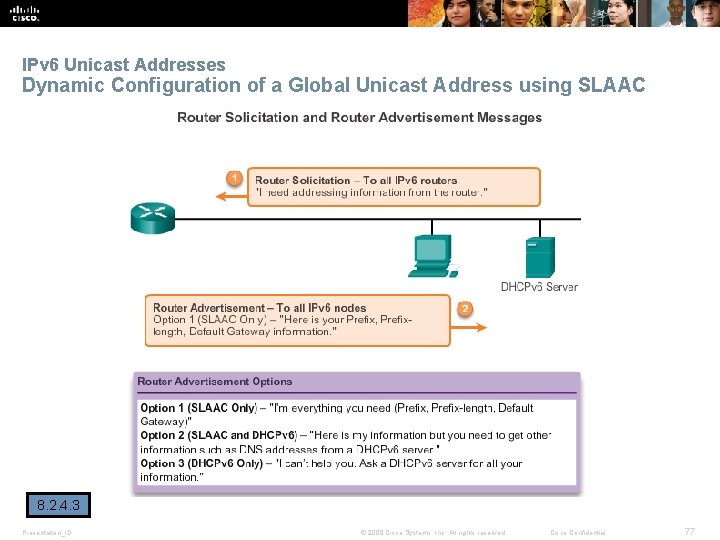
IPv 6 Unicast Addresses Dynamic Configuration of a Global Unicast Address using SLAAC Stateless Address Autoconfiguraton (SLAAC) • A method that allows a device to obtain its prefix, prefix length and default gateway from an IPv 6 router • No DHCPv 6 server needed • Rely on ICMPv 6 Router Advertisement (RA) messages IPv 6 routers • Forwards IPv 6 packets between networks • Can be configured with static routes or a dynamic IPv 6 routing protocol • Sends ICMPv 6 RA messages 8. 2. 4. 3 Presentation_ID © 2008 Cisco Systems, Inc. All rights reserved. Cisco Confidential 75
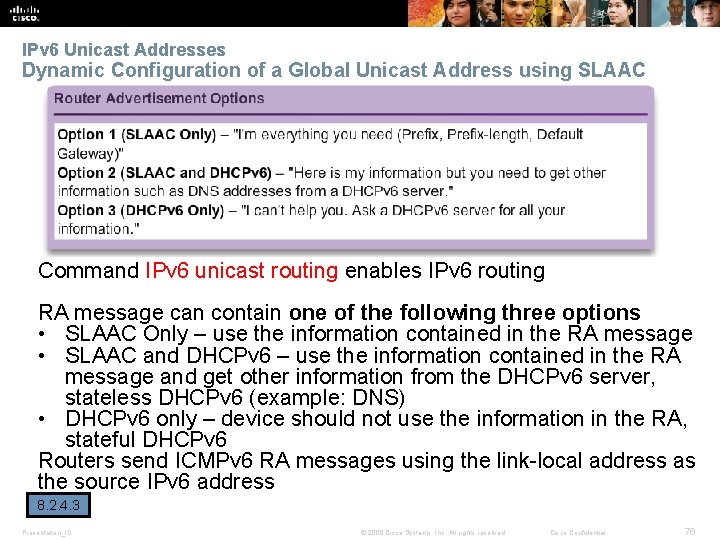
IPv 6 Unicast Addresses Dynamic Configuration of a Global Unicast Address using SLAAC Command IPv 6 unicast routing enables IPv 6 routing RA message can contain one of the following three options • SLAAC Only – use the information contained in the RA message • SLAAC and DHCPv 6 – use the information contained in the RA message and get other information from the DHCPv 6 server, stateless DHCPv 6 (example: DNS) • DHCPv 6 only – device should not use the information in the RA, stateful DHCPv 6 Routers send ICMPv 6 RA messages using the link-local address as the source IPv 6 address 8. 2. 4. 3 Presentation_ID © 2008 Cisco Systems, Inc. All rights reserved. Cisco Confidential 76
IPv 6 Unicast Addresses Dynamic Configuration of a Global Unicast Address using SLAAC 8. 2. 4. 3 Presentation_ID © 2008 Cisco Systems, Inc. All rights reserved. Cisco Confidential 77
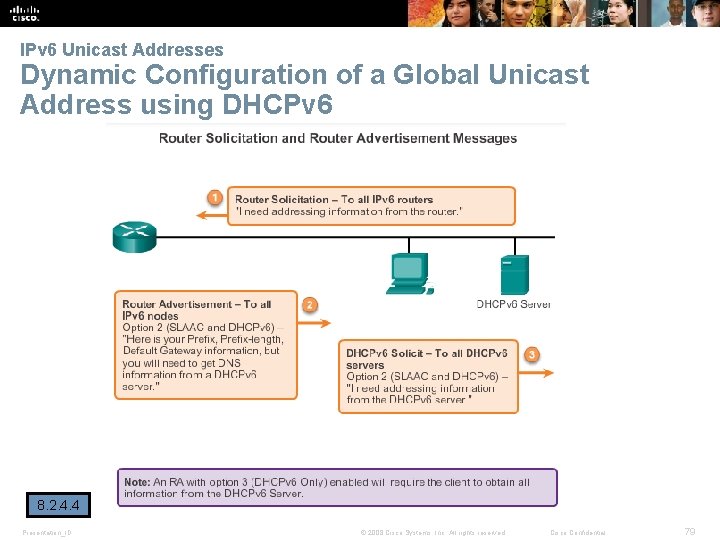
IPv 6 Unicast Addresses Dynamic Configuration of a Global Unicast Address using DHCPv 6 Dynamic Host Configuration Protocol for IPv 6 (DHCPv 6) § Similar to IPv 4 § Automatically receive addressing information including a global unicast address, prefix length, default gateway address and the addresses of DNS servers using the services of a DHCPv 6 server § Device may receive all or some of its IPv 6 addressing information from a DHCPv 6 server depending upon whether option 2 (SLAAC and DHCPv 6) or option 3 (DHCPv 6 only) is specified in the ICMPv 6 RA message § Host may choose to ignore whatever is in the router’s RA message and obtain its IPv 6 address and other information directly from a DHCPv 6 server. 8. 2. 4. 4 Presentation_ID © 2008 Cisco Systems, Inc. All rights reserved. Cisco Confidential 78
IPv 6 Unicast Addresses Dynamic Configuration of a Global Unicast Address using DHCPv 6 8. 2. 4. 4 Presentation_ID © 2008 Cisco Systems, Inc. All rights reserved. Cisco Confidential 79
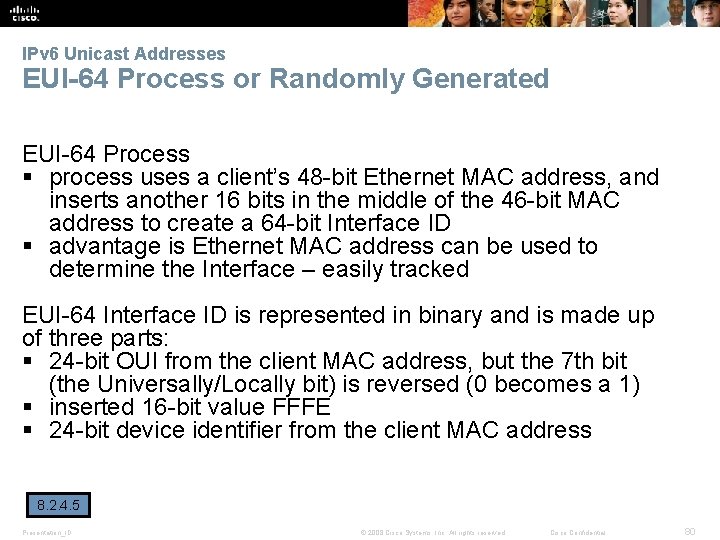
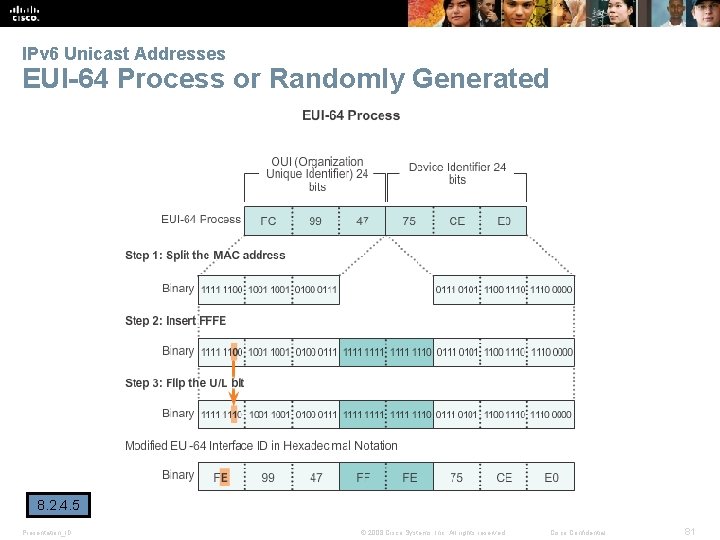
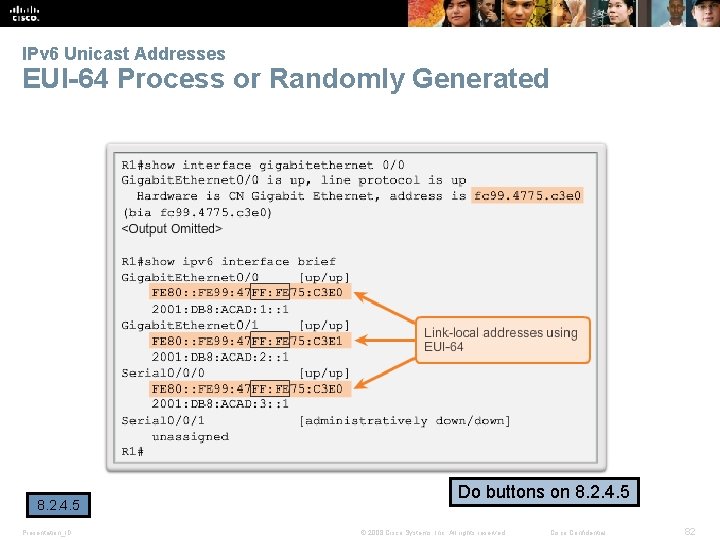
IPv 6 Unicast Addresses EUI-64 Process or Randomly Generated EUI-64 Process § process uses a client’s 48 -bit Ethernet MAC address, and inserts another 16 bits in the middle of the 46 -bit MAC address to create a 64 -bit Interface ID § advantage is Ethernet MAC address can be used to determine the Interface – easily tracked EUI-64 Interface ID is represented in binary and is made up of three parts: § 24 -bit OUI from the client MAC address, but the 7 th bit (the Universally/Locally bit) is reversed (0 becomes a 1) § inserted 16 -bit value FFFE § 24 -bit device identifier from the client MAC address 8. 2. 4. 5 Presentation_ID © 2008 Cisco Systems, Inc. All rights reserved. Cisco Confidential 80
IPv 6 Unicast Addresses EUI-64 Process or Randomly Generated 8. 2. 4. 5 Presentation_ID © 2008 Cisco Systems, Inc. All rights reserved. Cisco Confidential 81
IPv 6 Unicast Addresses EUI-64 Process or Randomly Generated 8. 2. 4. 5 Presentation_ID Do buttons on 8. 2. 4. 5 © 2008 Cisco Systems, Inc. All rights reserved. Cisco Confidential 82
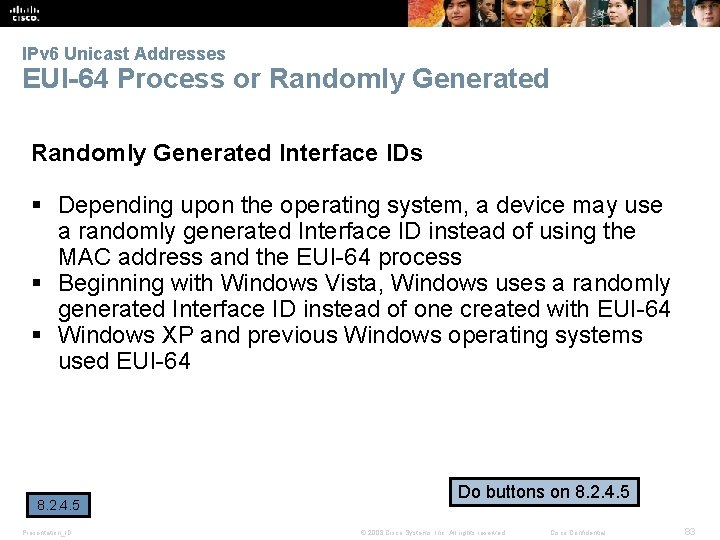
IPv 6 Unicast Addresses EUI-64 Process or Randomly Generated Interface IDs § Depending upon the operating system, a device may use a randomly generated Interface ID instead of using the MAC address and the EUI-64 process § Beginning with Windows Vista, Windows uses a randomly generated Interface ID instead of one created with EUI-64 § Windows XP and previous Windows operating systems used EUI-64 8. 2. 4. 5 Presentation_ID Do buttons on 8. 2. 4. 5 © 2008 Cisco Systems, Inc. All rights reserved. Cisco Confidential 83
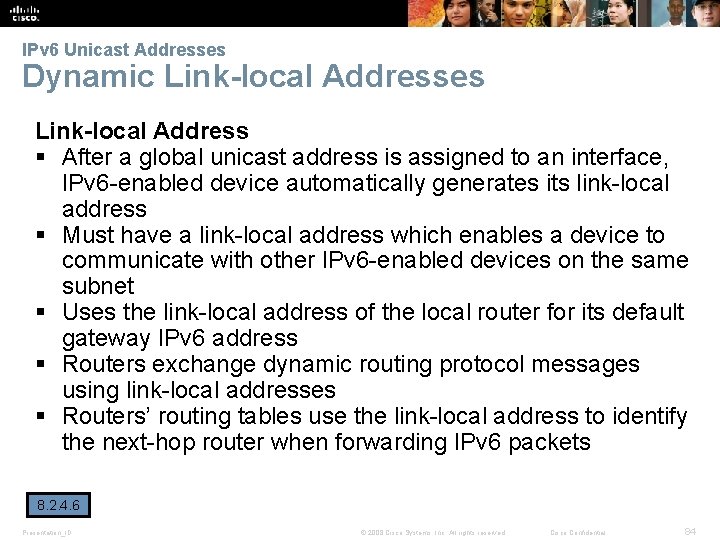
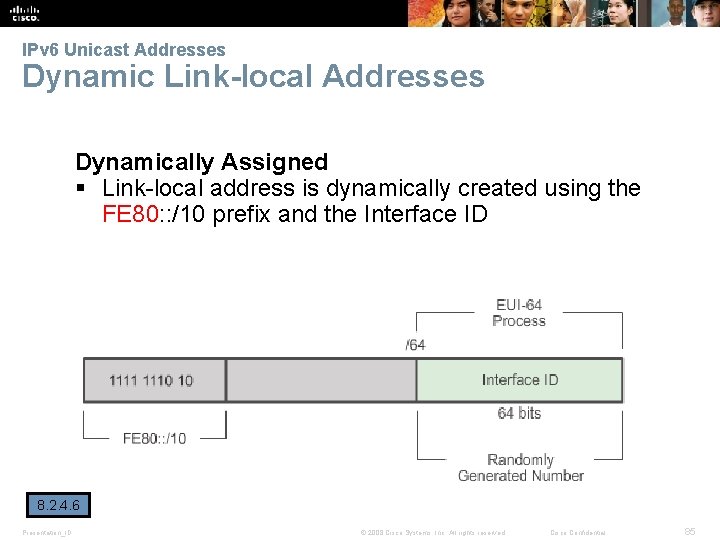
IPv 6 Unicast Addresses Dynamic Link-local Addresses Link-local Address § After a global unicast address is assigned to an interface, IPv 6 -enabled device automatically generates its link-local address § Must have a link-local address which enables a device to communicate with other IPv 6 -enabled devices on the same subnet § Uses the link-local address of the local router for its default gateway IPv 6 address § Routers exchange dynamic routing protocol messages using link-local addresses § Routers’ routing tables use the link-local address to identify the next-hop router when forwarding IPv 6 packets 8. 2. 4. 6 Presentation_ID © 2008 Cisco Systems, Inc. All rights reserved. Cisco Confidential 84
IPv 6 Unicast Addresses Dynamic Link-local Addresses Dynamically Assigned § Link-local address is dynamically created using the FE 80: : /10 prefix and the Interface ID 8. 2. 4. 6 Presentation_ID © 2008 Cisco Systems, Inc. All rights reserved. Cisco Confidential 85
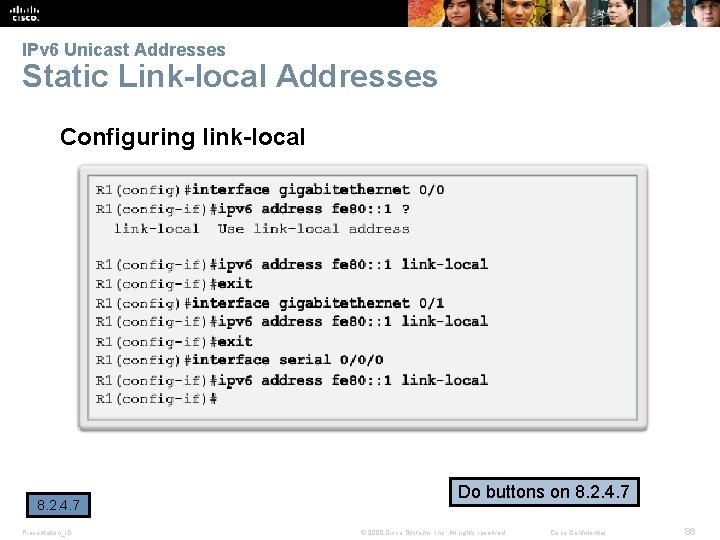
IPv 6 Unicast Addresses Static Link-local Addresses Configuring link-local 8. 2. 4. 7 Presentation_ID Do buttons on 8. 2. 4. 7 © 2008 Cisco Systems, Inc. All rights reserved. Cisco Confidential 86
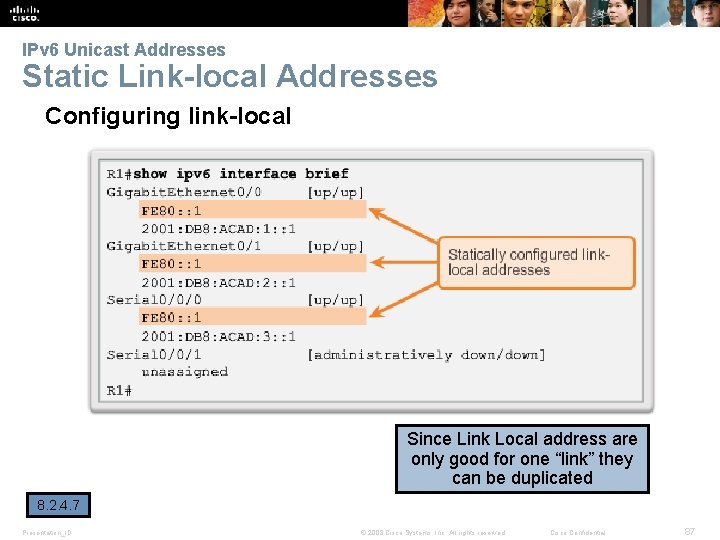
IPv 6 Unicast Addresses Static Link-local Addresses Configuring link-local Since Link Local address are only good for one “link” they can be duplicated 8. 2. 4. 7 Presentation_ID © 2008 Cisco Systems, Inc. All rights reserved. Cisco Confidential 87
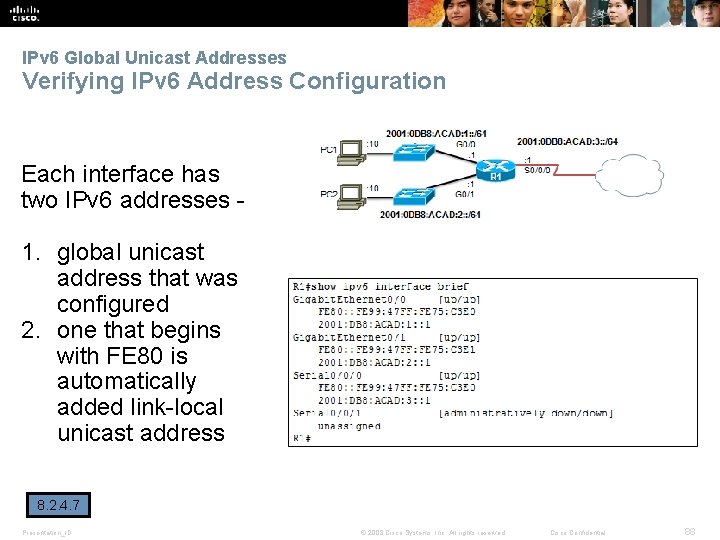
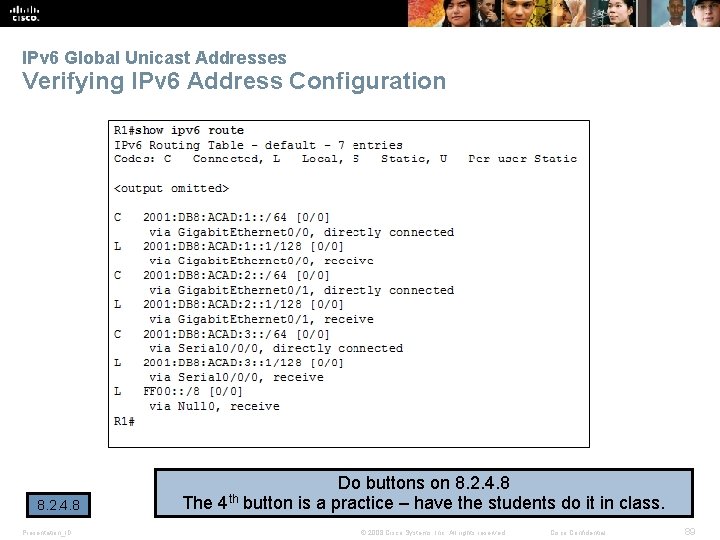
IPv 6 Global Unicast Addresses Verifying IPv 6 Address Configuration Each interface has two IPv 6 addresses - 1. global unicast address that was configured 2. one that begins with FE 80 is automatically added link-local unicast address 8. 2. 4. 7 Presentation_ID © 2008 Cisco Systems, Inc. All rights reserved. Cisco Confidential 88
IPv 6 Global Unicast Addresses Verifying IPv 6 Address Configuration 8. 2. 4. 8 Presentation_ID The 4 th Do buttons on 8. 2. 4. 8 button is a practice – have the students do it in class. © 2008 Cisco Systems, Inc. All rights reserved. Cisco Confidential 89
IPv 6 Multicast Addresses Assigned IPv 6 Multicast Addresses § IPv 6 multicast addresses have the prefix FFxx: : /8 § There are two types of IPv 6 multicast addresses: • Assigned multicast • Solicited node multicast 8. 2. 5. 1 Presentation_ID © 2008 Cisco Systems, Inc. All rights reserved. Cisco Confidential 90
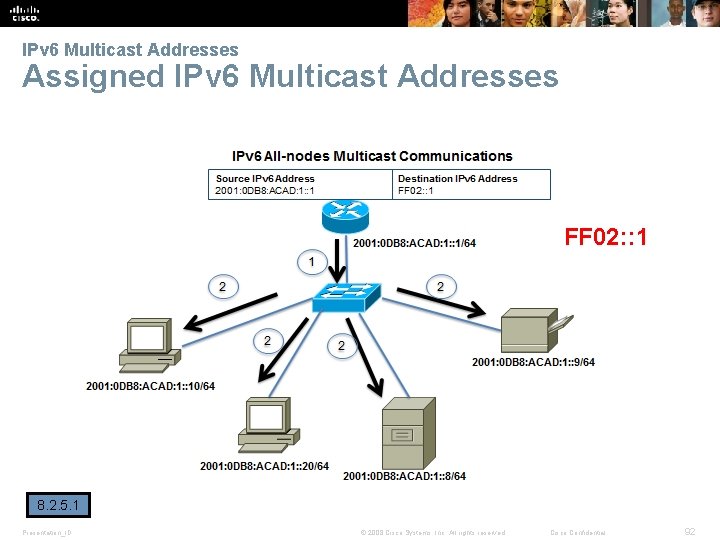
IPv 6 Multicast Addresses Assigned IPv 6 Multicast Addresses Two common IPv 6 assigned multicast groups include: § FF 02: : 1 All-nodes multicast group – • all IPv 6 -enabled devices join • same effect as an IPv 4 broadcast address § FF 02: : 2 All-routers multicast group – • all IPv 6 routers join • a router becomes a member of this group when it is enabled as an IPv 6 router with the ipv 6 unicast-routing global configuration command • a packet sent to this group is received and processed by all IPv 6 routers on the link or network. 8. 2. 5. 1 Presentation_ID © 2008 Cisco Systems, Inc. All rights reserved. Cisco Confidential 91
IPv 6 Multicast Addresses Assigned IPv 6 Multicast Addresses FF 02: : 1 8. 2. 5. 1 Presentation_ID © 2008 Cisco Systems, Inc. All rights reserved. Cisco Confidential 92
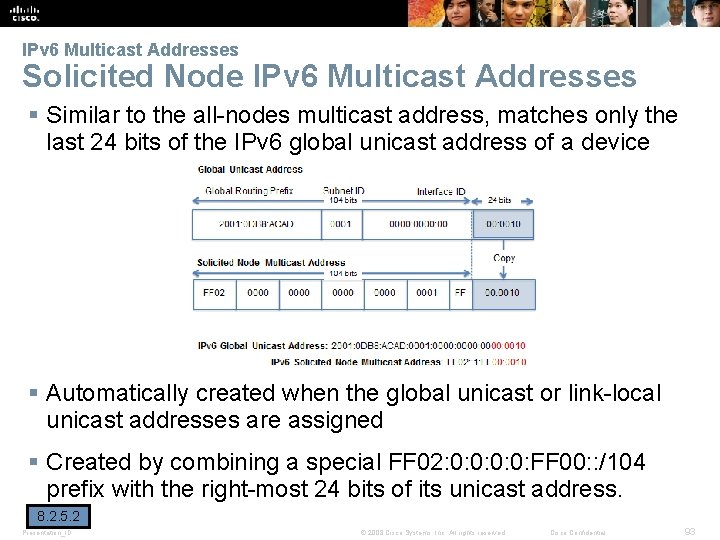
IPv 6 Multicast Addresses Solicited Node IPv 6 Multicast Addresses § Similar to the all-nodes multicast address, matches only the last 24 bits of the IPv 6 global unicast address of a device § Automatically created when the global unicast or link-local unicast addresses are assigned § Created by combining a special FF 02: 0: 0: FF 00: : /104 prefix with the right-most 24 bits of its unicast address. 8. 2. 5. 2 Presentation_ID © 2008 Cisco Systems, Inc. All rights reserved. Cisco Confidential 93
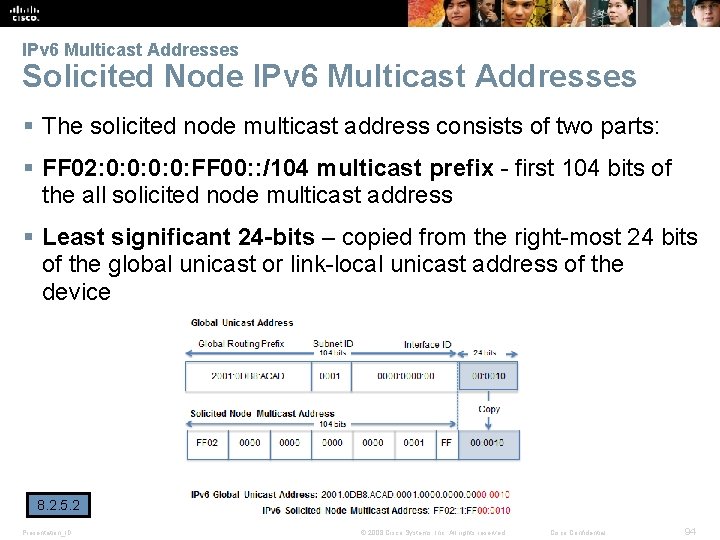
IPv 6 Multicast Addresses Solicited Node IPv 6 Multicast Addresses § The solicited node multicast address consists of two parts: § FF 02: 0: 0: FF 00: : /104 multicast prefix - first 104 bits of the all solicited node multicast address § Least significant 24 -bits – copied from the right-most 24 bits of the global unicast or link-local unicast address of the device 8. 2. 5. 2 Presentation_ID © 2008 Cisco Systems, Inc. All rights reserved. Cisco Confidential 94
8. 3 Connectivity Verification 8. 3 Presentation_ID © 2008 Cisco Systems, Inc. All rights reserved. Cisco Confidential 95
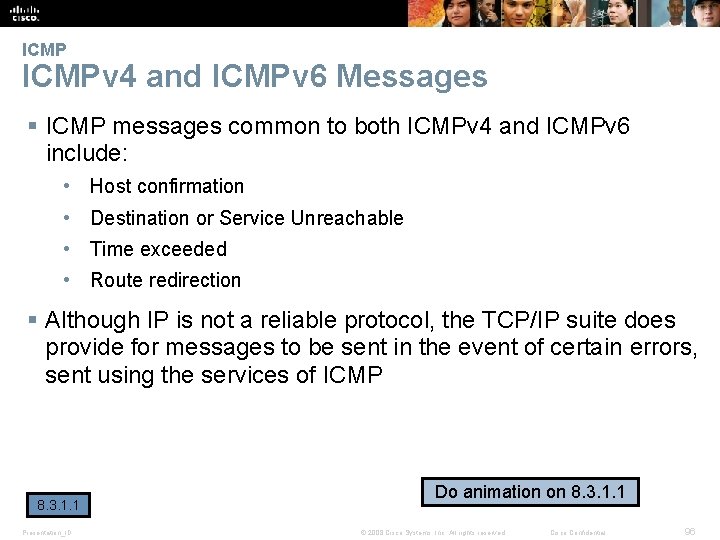
ICMPv 4 and ICMPv 6 Messages § ICMP messages common to both ICMPv 4 and ICMPv 6 include: • Host confirmation • Destination or Service Unreachable • Time exceeded • Route redirection § Although IP is not a reliable protocol, the TCP/IP suite does provide for messages to be sent in the event of certain errors, sent using the services of ICMP 8. 3. 1. 1 Presentation_ID Do animation on 8. 3. 1. 1 © 2008 Cisco Systems, Inc. All rights reserved. Cisco Confidential 96
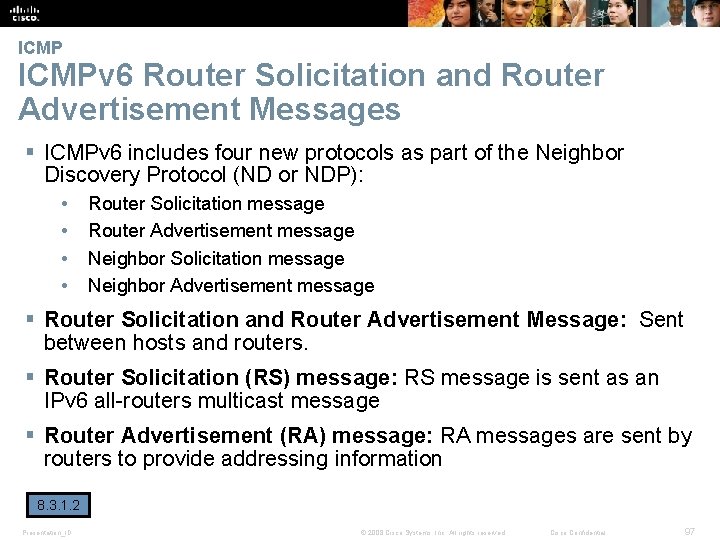
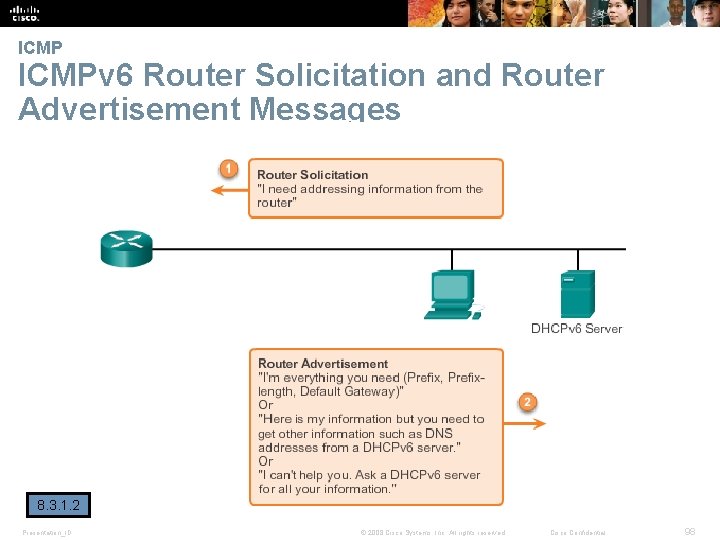
ICMPv 6 Router Solicitation and Router Advertisement Messages § ICMPv 6 includes four new protocols as part of the Neighbor Discovery Protocol (ND or NDP): • • Router Solicitation message Router Advertisement message Neighbor Solicitation message Neighbor Advertisement message § Router Solicitation and Router Advertisement Message: Sent between hosts and routers. § Router Solicitation (RS) message: RS message is sent as an IPv 6 all-routers multicast message § Router Advertisement (RA) message: RA messages are sent by routers to provide addressing information 8. 3. 1. 2 Presentation_ID © 2008 Cisco Systems, Inc. All rights reserved. Cisco Confidential 97
ICMPv 6 Router Solicitation and Router Advertisement Messages 8. 3. 1. 2 Presentation_ID © 2008 Cisco Systems, Inc. All rights reserved. Cisco Confidential 98
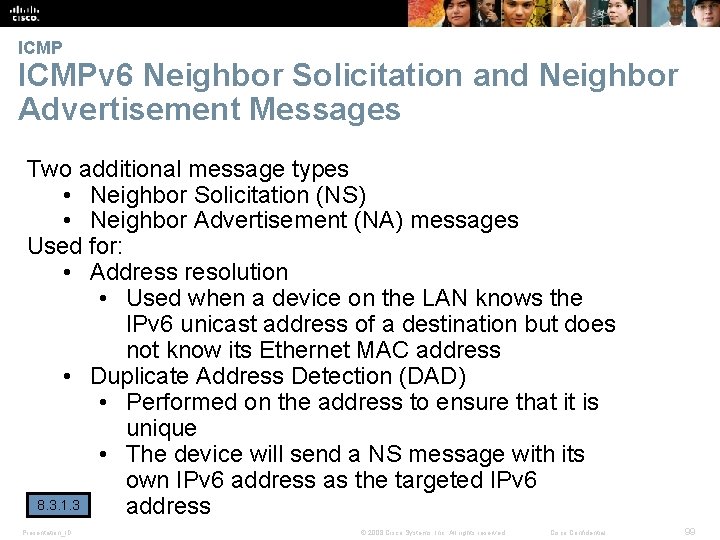
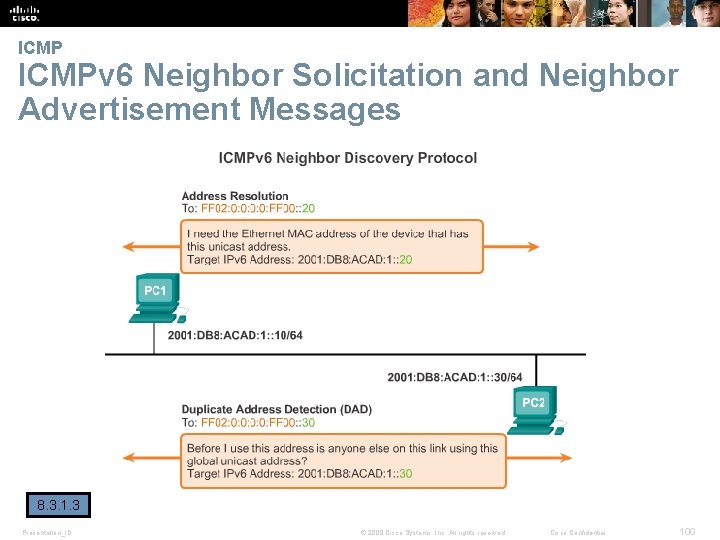
ICMPv 6 Neighbor Solicitation and Neighbor Advertisement Messages Two additional message types • Neighbor Solicitation (NS) • Neighbor Advertisement (NA) messages Used for: • Address resolution • Used when a device on the LAN knows the IPv 6 unicast address of a destination but does not know its Ethernet MAC address • Duplicate Address Detection (DAD) • Performed on the address to ensure that it is unique • The device will send a NS message with its own IPv 6 address as the targeted IPv 6 8. 3. 1. 3 address Presentation_ID © 2008 Cisco Systems, Inc. All rights reserved. Cisco Confidential 99
ICMPv 6 Neighbor Solicitation and Neighbor Advertisement Messages 8. 3. 1. 3 Presentation_ID © 2008 Cisco Systems, Inc. All rights reserved. Cisco Confidential 100
Testing and Verification Ping - Testing the Local Stack 8. 3. 2. 1 Presentation_ID © 2008 Cisco Systems, Inc. All rights reserved. Cisco Confidential 101
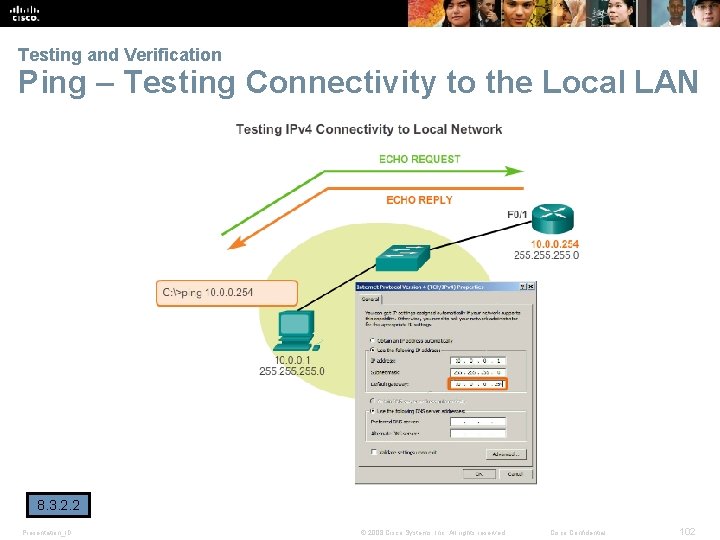
Testing and Verification Ping – Testing Connectivity to the Local LAN 8. 3. 2. 2 Presentation_ID © 2008 Cisco Systems, Inc. All rights reserved. Cisco Confidential 102
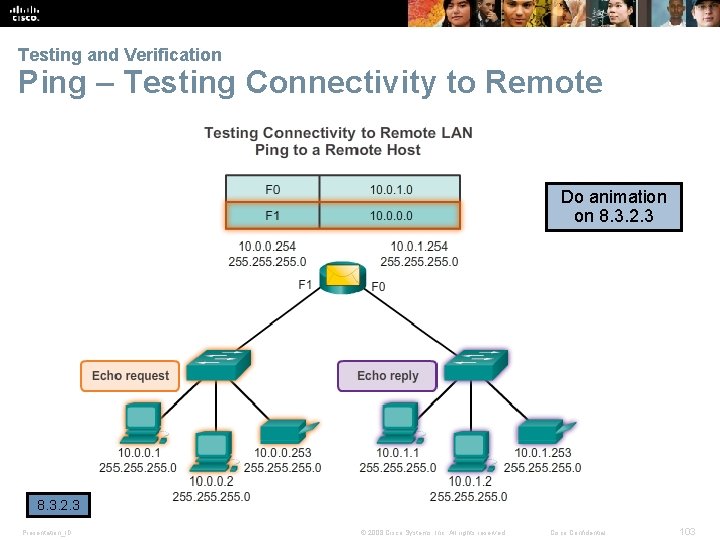
Testing and Verification Ping – Testing Connectivity to Remote Do animation on 8. 3. 2. 3 Presentation_ID © 2008 Cisco Systems, Inc. All rights reserved. Cisco Confidential 103
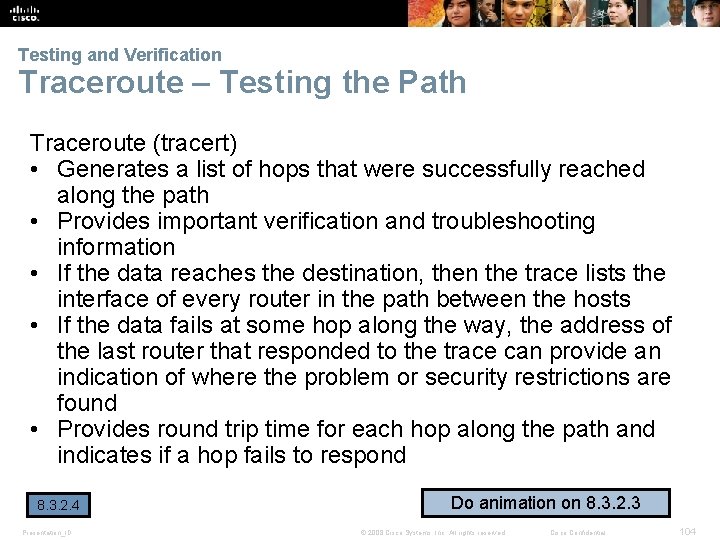
Testing and Verification Traceroute – Testing the Path Traceroute (tracert) • Generates a list of hops that were successfully reached along the path • Provides important verification and troubleshooting information • If the data reaches the destination, then the trace lists the interface of every router in the path between the hosts • If the data fails at some hop along the way, the address of the last router that responded to the trace can provide an indication of where the problem or security restrictions are found • Provides round trip time for each hop along the path and indicates if a hop fails to respond 8. 3. 2. 4 Presentation_ID Do animation on 8. 3. 2. 3 © 2008 Cisco Systems, Inc. All rights reserved. Cisco Confidential 104
IP Addressing Summary § IP addresses are hierarchical with network, subnetwork, and host portions. An IP address can represent a complete network, a specific host, or the broadcast address of the network. § The subnet mask or prefix is used to determine the network portion of an IP address. Once implemented, an IP network needs to be tested to verify its connectivity and operational performance. § DHCP enables the automatic assignment of addressing information such as IP address, subnet mask, default gateway, and other configuration information. 8. 4. 1. 1 – 8. 4. 1. 3 Presentation_ID © 2008 Cisco Systems, Inc. All rights reserved. Cisco Confidential 105
IP Addressing Summary § IPv 4 hosts can communicate one of three different ways: unicast, broadcast, and multicast. § The private IPv 4 address blocks are: 10. 0/8, 172. 16. 0. 0/12, and 192. 168. 0. 0/16. § The depletion of IPv 4 address space is the motivating factor for moving to IPv 6. Each IPv 6 address has 128 bits verses the 32 bits in an IPv 4 address. The prefix length is used to indicate the network portion of an IPv 6 address using the following format: IPv 6 address/prefix length. 8. 4. 1. 1 – 8. 4. 1. 3 Presentation_ID © 2008 Cisco Systems, Inc. All rights reserved. Cisco Confidential 106
IP Addressing Summary § There are three types of IPv 6 addresses: unicast, multicast, and anycast. § An IPv 6 link-local address enables a device to communicate with other IPv 6 -enabled devices on the same link and only on that link (subnet). Packets with a source or destination linklocal address cannot be routed beyond the link from where the packet originated. IPv 6 link-local addresses are in the FE 80: : /10 range. § ICMP is available for both IPv 4 and IPv 6. 8. 4. 1. 1 – 8. 4. 1. 3 Presentation_ID © 2008 Cisco Systems, Inc. All rights reserved. Cisco Confidential 107
8. 3. 2. 4 Presentation_ID © 2008 Cisco Systems, Inc. All rights reserved. Cisco Confidential 108