
Chapter 8 Ionic Compounds 8 1 Forming Chemical

- Slides: 19
Chapter 8: Ionic Compounds
8. 1: Forming Chemical Bonds • Chemical bond- the force that holds two atoms together • Ionic bonds- exist between oppositely charged ions • Cation- positively charged ion • Anion- negatively charged ion
Mini-review • Electron configuration reveals Principle Energy Level where valence electrons are found • Valence electrons are the electrons involved in bonding • Represent valence electrons via electron dot structures
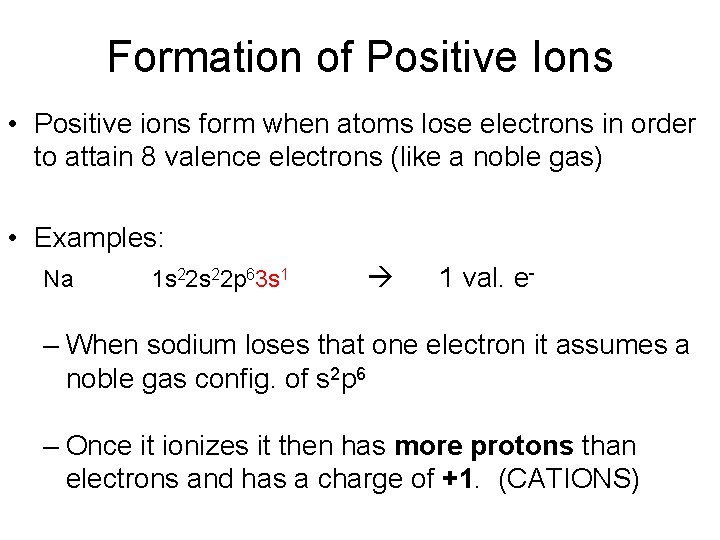
Formation of Positive Ions • Positive ions form when atoms lose electrons in order to attain 8 valence electrons (like a noble gas) • Examples: Na 1 s 22 p 63 s 1 1 val. e- – When sodium loses that one electron it assumes a noble gas config. of s 2 p 6 – Once it ionizes it then has more protons than electrons and has a charge of +1. (CATIONS)
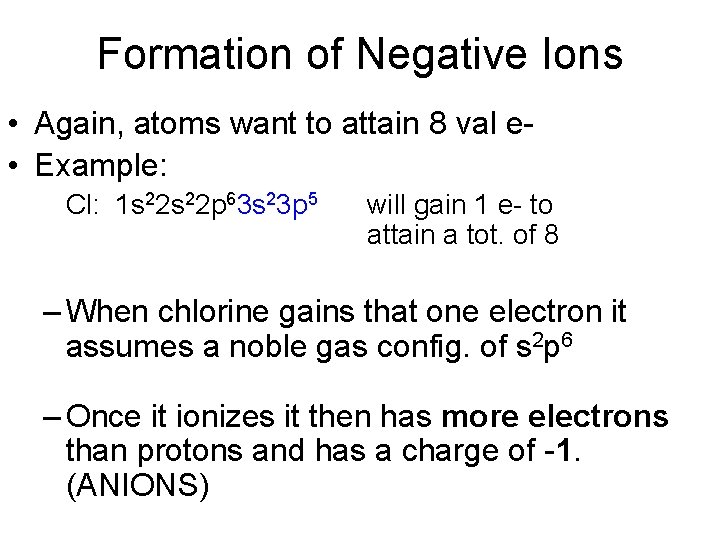
Formation of Negative Ions • Again, atoms want to attain 8 val e • Example: Cl: 1 s 22 p 63 s 23 p 5 will gain 1 e- to attain a tot. of 8 – When chlorine gains that one electron it assumes a noble gas config. of s 2 p 6 – Once it ionizes it then has more electrons than protons and has a charge of -1. (ANIONS)
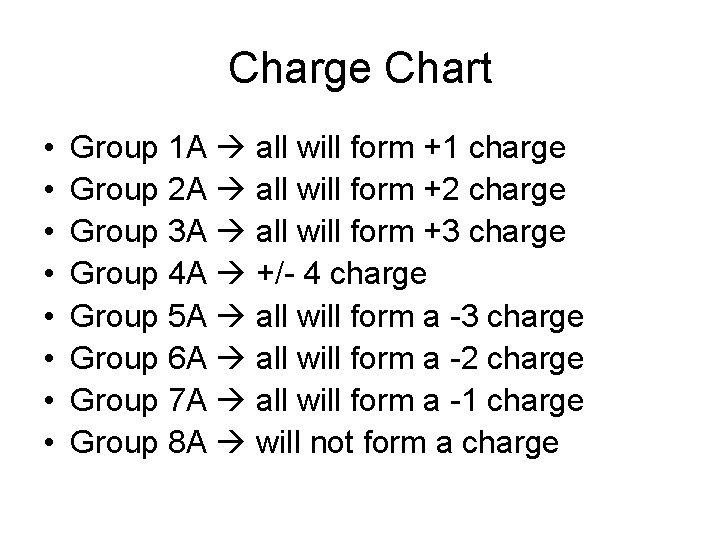
Charge Chart • • Group 1 A all will form +1 charge Group 2 A all will form +2 charge Group 3 A all will form +3 charge Group 4 A +/- 4 charge Group 5 A all will form a -3 charge Group 6 A all will form a -2 charge Group 7 A all will form a -1 charge Group 8 A will not form a charge
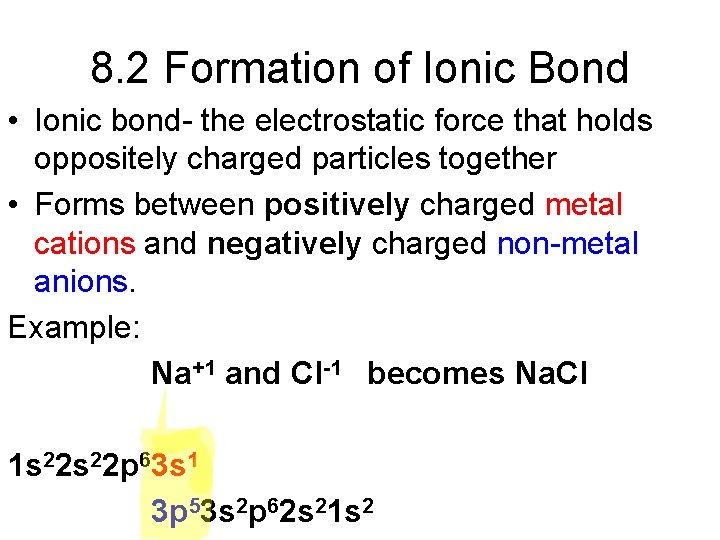
8. 2 Formation of Ionic Bond • Ionic bond- the electrostatic force that holds oppositely charged particles together • Forms between positively charged metal cations and negatively charged non-metal anions. Example: Na+1 and Cl-1 becomes Na. Cl 1 s 22 p 63 s 1 3 p 53 s 2 p 62 s 21 s 2
Also explained via Electron Dot Models
Ionic Vocab. • If a metal combines with a non-metal it forms an ionic compound called a salt. • Exception: A metal bonding with oxygen is called an oxide. • Many ionic compounds are binary which mean they consist of two elements.
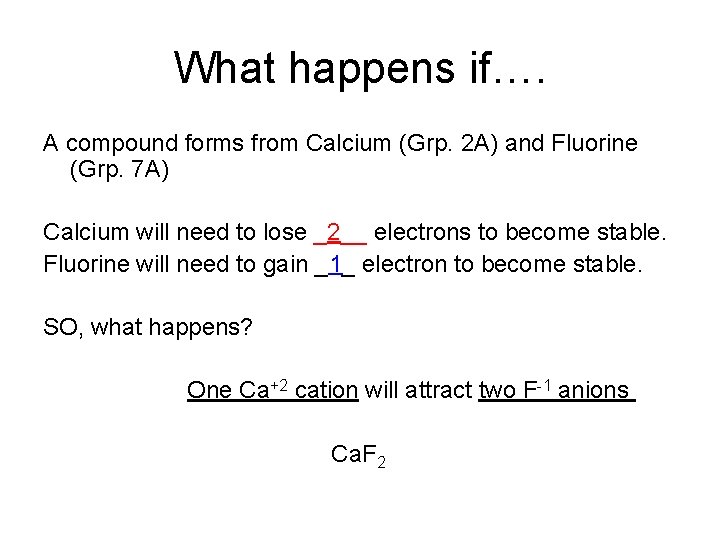
What happens if…. A compound forms from Calcium (Grp. 2 A) and Fluorine (Grp. 7 A) Calcium will need to lose _2__ electrons to become stable. Fluorine will need to gain _1_ electron to become stable. SO, what happens? One Ca+2 cation will attract two F-1 anions Ca. F 2
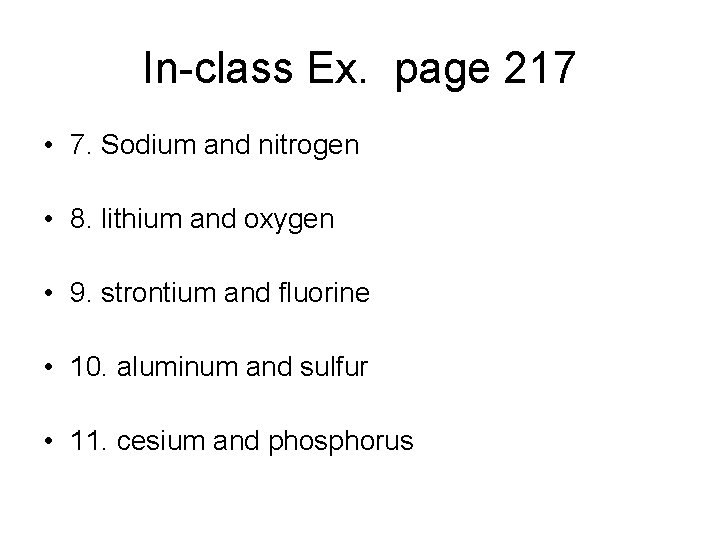
In-class Ex. page 217 • 7. Sodium and nitrogen • 8. lithium and oxygen • 9. strontium and fluorine • 10. aluminum and sulfur • 11. cesium and phosphorus
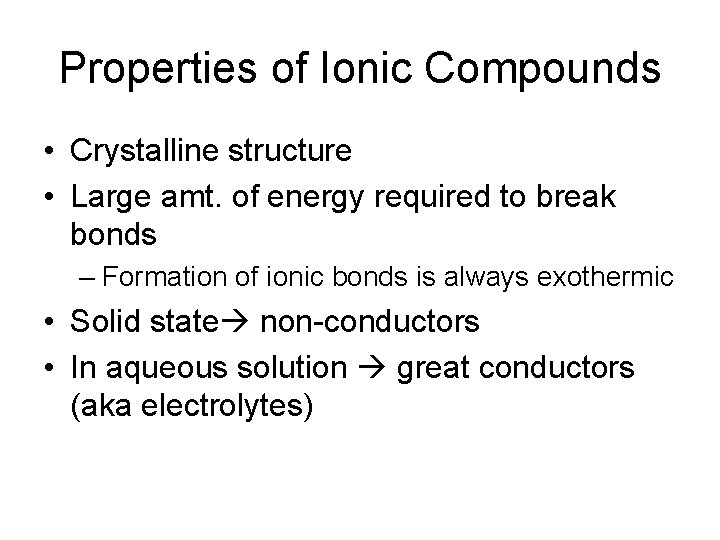
Properties of Ionic Compounds • Crystalline structure • Large amt. of energy required to break bonds – Formation of ionic bonds is always exothermic • Solid state non-conductors • In aqueous solution great conductors (aka electrolytes)
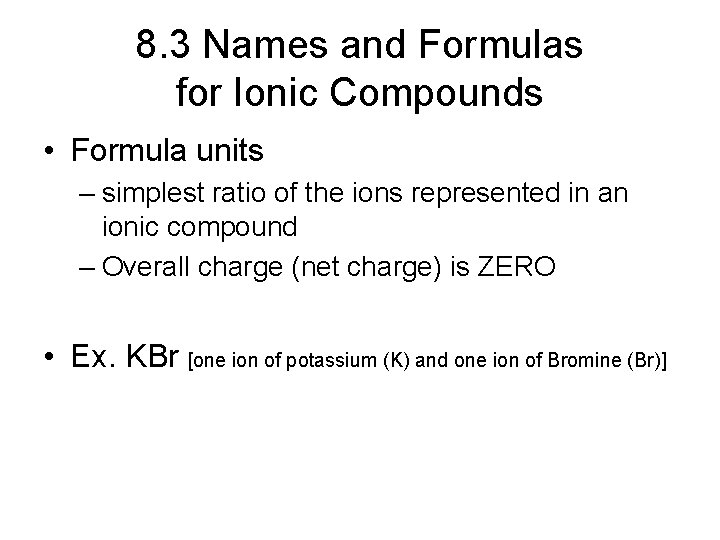
8. 3 Names and Formulas for Ionic Compounds • Formula units – simplest ratio of the ions represented in an ionic compound – Overall charge (net charge) is ZERO • Ex. KBr [one ion of potassium (K) and one ion of Bromine (Br)]
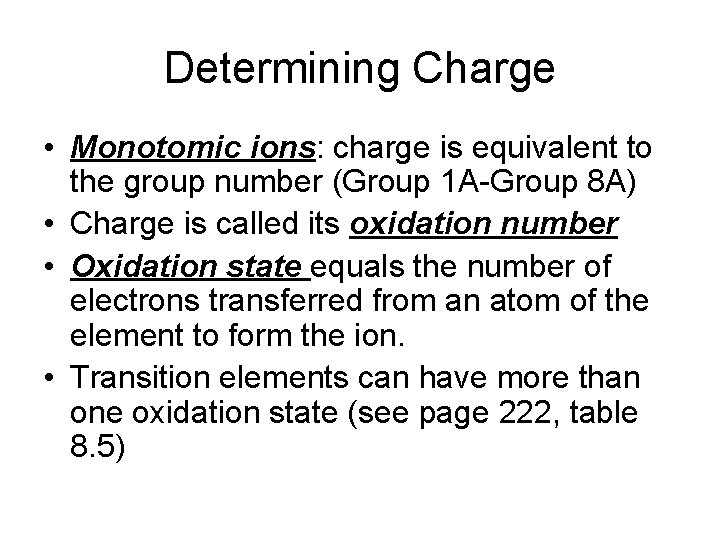
Determining Charge • Monotomic ions: charge is equivalent to the group number (Group 1 A-Group 8 A) • Charge is called its oxidation number • Oxidation state equals the number of electrons transferred from an atom of the element to form the ion. • Transition elements can have more than one oxidation state (see page 222, table 8. 5)
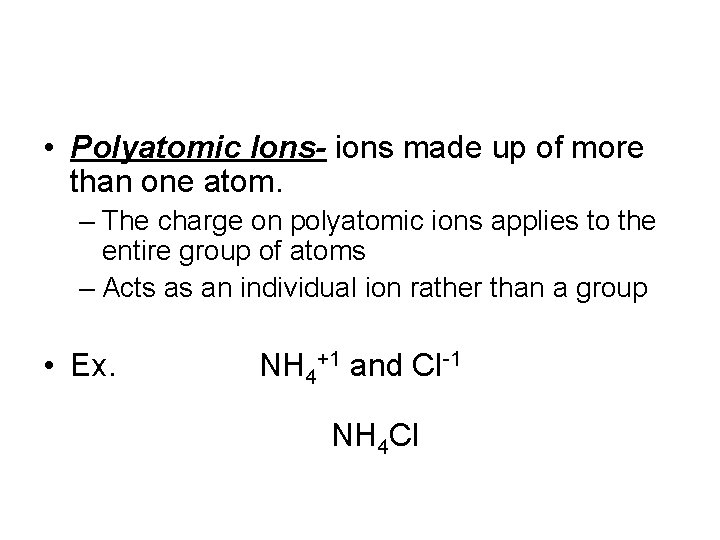
• Polyatomic Ions- ions made up of more than one atom. – The charge on polyatomic ions applies to the entire group of atoms – Acts as an individual ion rather than a group • Ex. NH 4+1 and Cl-1 NH 4 Cl
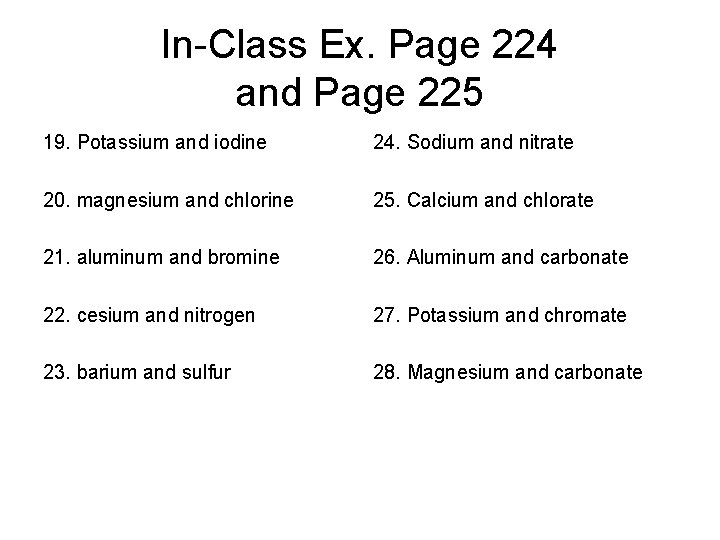
In-Class Ex. Page 224 and Page 225 19. Potassium and iodine 24. Sodium and nitrate 20. magnesium and chlorine 25. Calcium and chlorate 21. aluminum and bromine 26. Aluminum and carbonate 22. cesium and nitrogen 27. Potassium and chromate 23. barium and sulfur 28. Magnesium and carbonate
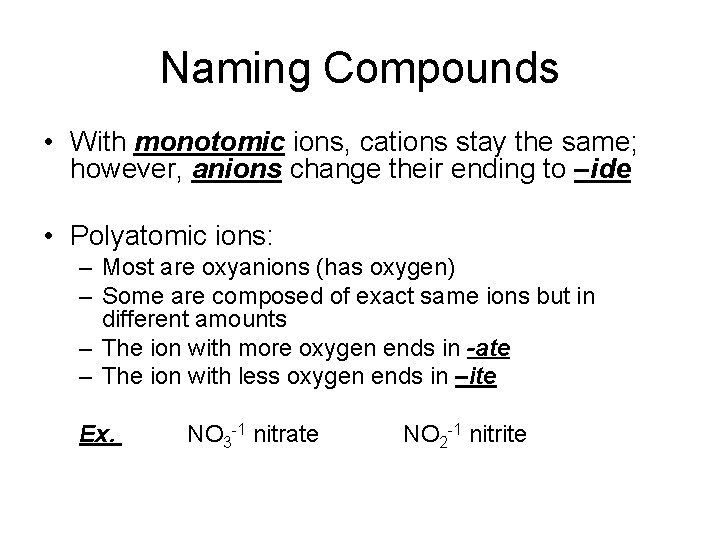
Naming Compounds • With monotomic ions, cations stay the same; however, anions change their ending to –ide • Polyatomic ions: – Most are oxyanions (has oxygen) – Some are composed of exact same ions but in different amounts – The ion with more oxygen ends in -ate – The ion with less oxygen ends in –ite Ex. NO 3 -1 nitrate NO 2 -1 nitrite
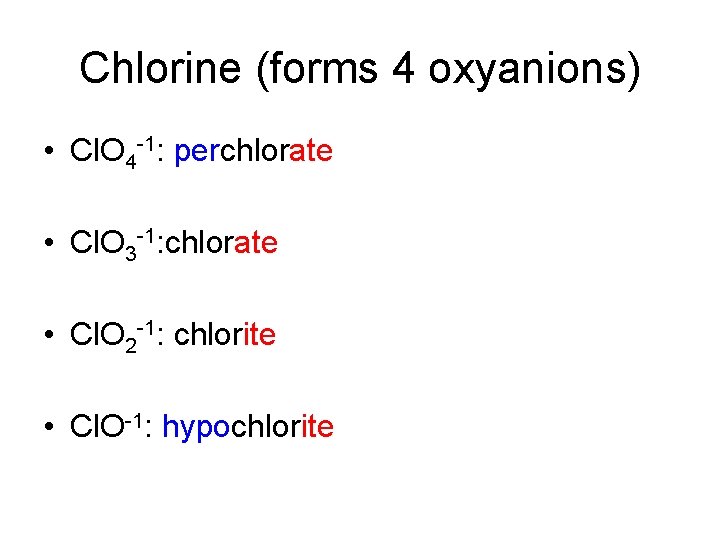
Chlorine (forms 4 oxyanions) • Cl. O 4 -1: perchlorate • Cl. O 3 -1: chlorate • Cl. O 2 -1: chlorite • Cl. O-1: hypochlorite
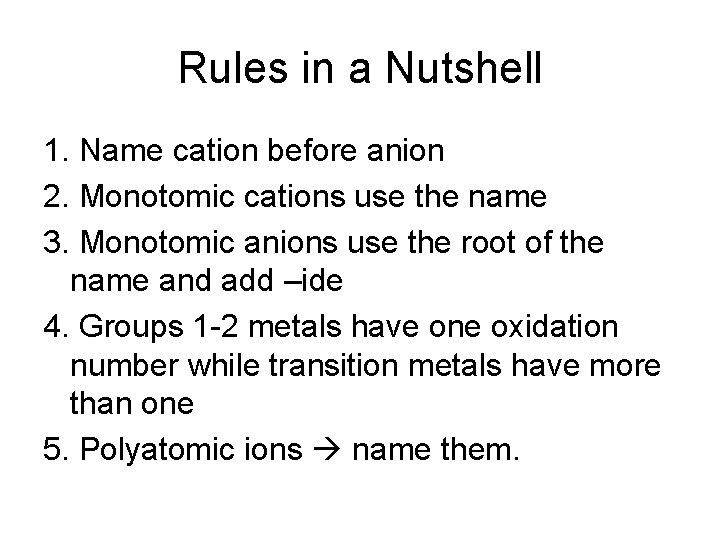
Rules in a Nutshell 1. Name cation before anion 2. Monotomic cations use the name 3. Monotomic anions use the root of the name and add –ide 4. Groups 1 -2 metals have one oxidation number while transition metals have more than one 5. Polyatomic ions name them.