
Chapter 8 Intrusion Detection Classes of Intruders Cyber

Chapter 8 Intrusion Detection
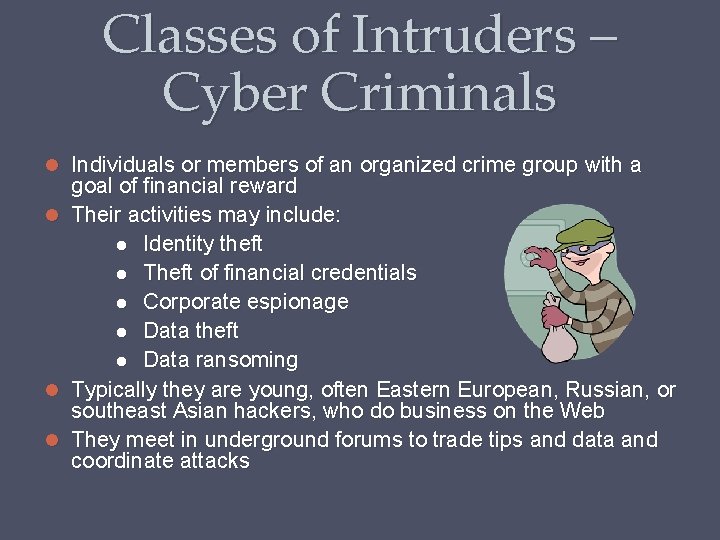
Classes of Intruders – Cyber Criminals Individuals or members of an organized crime group with a goal of financial reward Their activities may include: Identity theft Theft of financial credentials Corporate espionage Data theft Data ransoming Typically they are young, often Eastern European, Russian, or southeast Asian hackers, who do business on the Web They meet in underground forums to trade tips and data and coordinate attacks
Classes of Intruders – Activists Are either individuals, usually working as insiders, or members of a larger group of outsider attackers, who are motivated by social or political causes Also know as hacktivists Skill level is often quite low Aim of their attacks is often to promote and publicize their cause typically through: Website defacement Denial of service attacks Theft and distribution of data that results in negative publicity or compromise of their targets
Classes of Intruders – State-Sponsored Organizations Groups of hackers sponsored by governments to conduct espionage or sabotage activities Also known as Advanced Persistent Threats (APTs) due to the covert nature and persistence over extended periods involved with any attacks in this class Widespread nature and scope of these wide range of countries USA, UK, and their activities by a from China to the intelligence allies
Classes of Intruders – Others Hackers with motivations other than those previously listed Include classic hackers or crackers who are motivated by technical challenge or by peer-group esteem and reputation Many of those responsible for discovering new categories of buffer overflow vulnerabilities could be regarded as members of this class Given the wide availability of attack toolkits, there is a pool of “hobby hackers” using them to explore system and network security
Examples of Intrusion • • • Remote root compromise Web server defacement Guessing/cracking passwords Copying databases containing credit card numbers Viewing sensitive data without authorization Running a packet sniffer Distributing pirated software Using an unsecured modem to access internal network Impersonating an executive to get information Using an unattended workstation
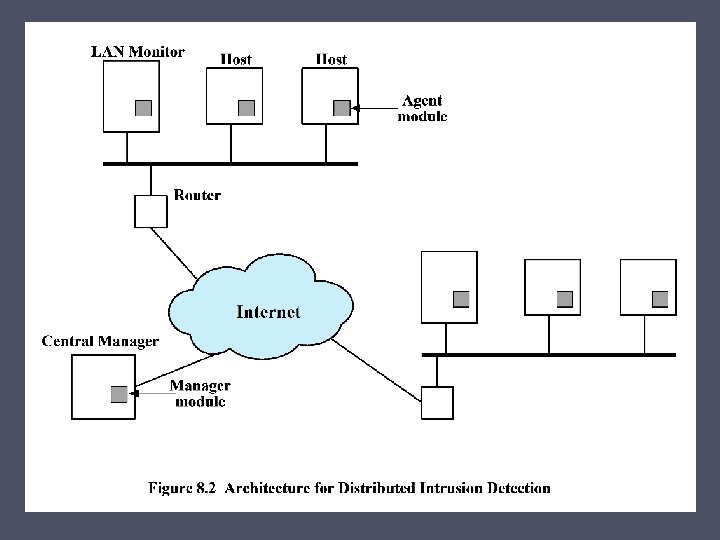
Intrusion Detection System (IDS) Host-based IDS (HIDS) Monitors the characteristics of a single host for suspicious activity Network-based IDS (NIDS) Monitors network traffic and analyzes network, transport, and application protocols to identify suspicious activity Distributed or hybrid IDS Combines information from a number of sensors, often both host and network based, in a central analyzer that is able to better identify and respond to intrusion activity Comprises three logical components: • Sensors - collect data • Analyzers - determine if intrusion has occurred • User interface - view output or control system behavior
Analysis Approaches Signature/Heuristic detection Anomaly detection • Involves the collection of data relating to the behavior of legitimate users over a period of time • Current observed behavior is analyzed to determine whether this behavior is that of a legitimate user or that of an intruder • Uses a set of known malicious data patterns or attack rules that are compared with current behavior • Also known as misuse detection • Can only identify known attacks for which it has patterns or rules
Anomaly Detection A variety of classification approaches are used: Statistical Knowledge based • Analysis of the observed behavior using univariate, multivariate, or time-series models of observed metrics • Approaches use an expert system that classifies observed behavior according to a set of rules that model legitimate behavior Machine-learning • Approaches automatically determine a suitable classification model from the training data using data mining techniques
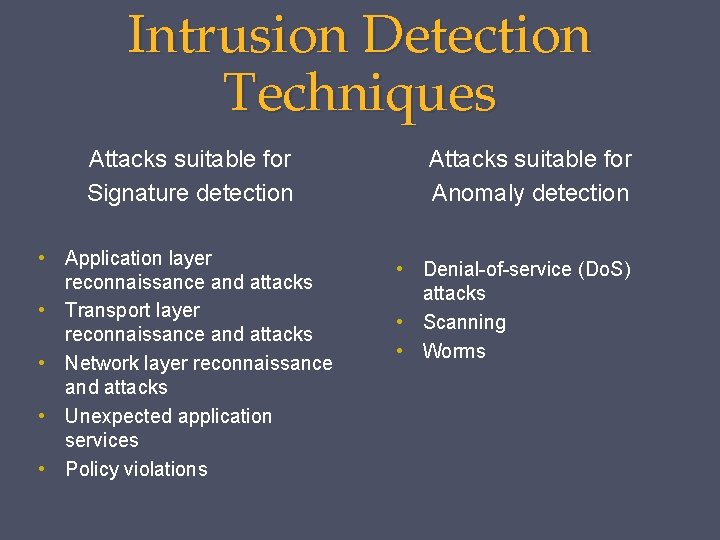
Intrusion Detection Techniques Attacks suitable for Signature detection • Application layer reconnaissance and attacks • Transport layer reconnaissance and attacks • Network layer reconnaissance and attacks • Unexpected application services • Policy violations Attacks suitable for Anomaly detection • Denial-of-service (Do. S) attacks • Scanning • Worms
- Slides: 11