
Chapter 8 Introduction to Number Theory Prime Numbers
Chapter 8 – Introduction to Number Theory
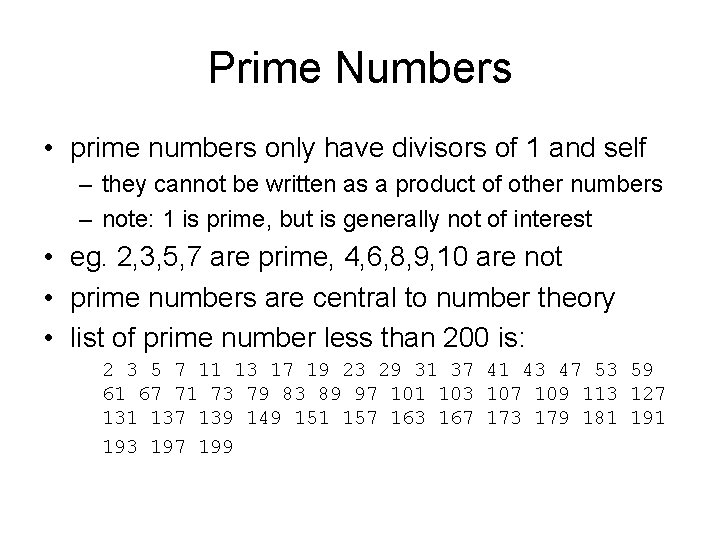
Prime Numbers • prime numbers only have divisors of 1 and self – they cannot be written as a product of other numbers – note: 1 is prime, but is generally not of interest • eg. 2, 3, 5, 7 are prime, 4, 6, 8, 9, 10 are not • prime numbers are central to number theory • list of prime number less than 200 is: 2 3 5 7 11 13 17 19 23 29 31 37 41 43 47 53 59 61 67 71 73 79 83 89 97 101 103 107 109 113 127 131 137 139 149 151 157 163 167 173 179 181 193 197 199
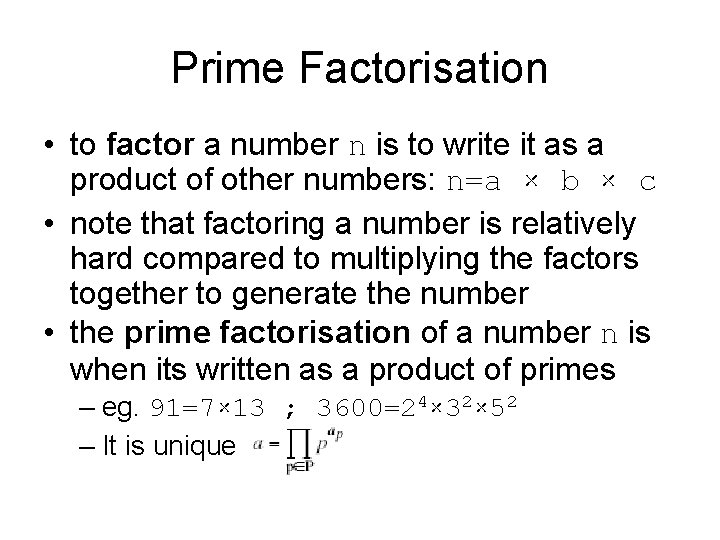
Prime Factorisation • to factor a number n is to write it as a product of other numbers: n=a × b × c • note that factoring a number is relatively hard compared to multiplying the factors together to generate the number • the prime factorisation of a number n is when its written as a product of primes – eg. 91=7× 13 ; 3600=24× 32× 52 – It is unique

Relatively Prime Numbers & GCD • two numbers a, b are relatively prime if have no common divisors apart from 1 – eg. 8 & 15 are relatively prime since factors of 8 are 1, 2, 4, 8 and of 15 are 1, 3, 5, 15 and 1 is the only common factor • conversely can determine the greatest common divisor by comparing their prime factorizations and using least powers – eg. 300=21× 31× 52 18=21× 32 hence GCD(18, 300)=21× 31× 50=6

Fermat's Little Theorem • ap-1 mod p = 1 where p is prime and a is a positive integer not divisible by p
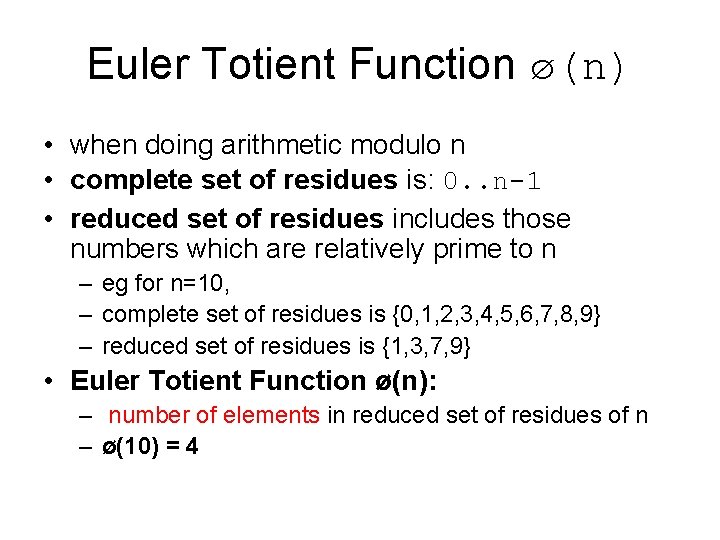
Euler Totient Function ø(n) • when doing arithmetic modulo n • complete set of residues is: 0. . n-1 • reduced set of residues includes those numbers which are relatively prime to n – eg for n=10, – complete set of residues is {0, 1, 2, 3, 4, 5, 6, 7, 8, 9} – reduced set of residues is {1, 3, 7, 9} • Euler Totient Function ø(n): – number of elements in reduced set of residues of n – ø(10) = 4
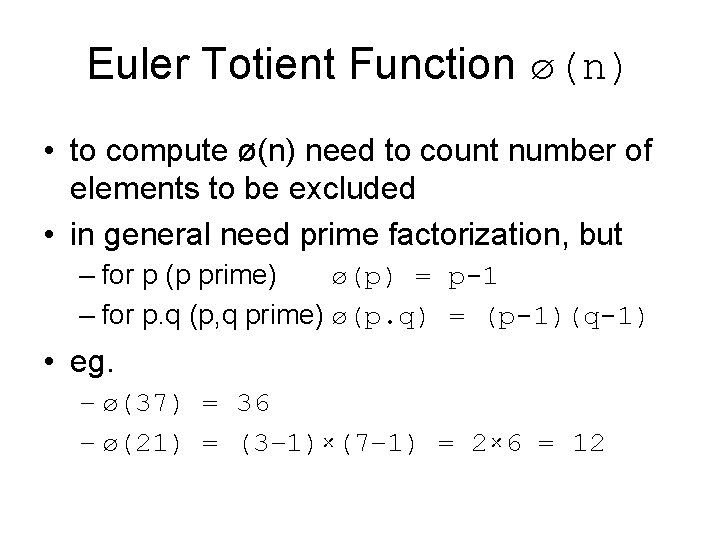
Euler Totient Function ø(n) • to compute ø(n) need to count number of elements to be excluded • in general need prime factorization, but – for p (p prime) ø(p) = p-1 – for p. q (p, q prime) ø(p. q) = (p-1)(q-1) • eg. – ø(37) = 36 – ø(21) = (3– 1)×(7– 1) = 2× 6 = 12

Euler's Theorem • a generalisation of Fermat's Theorem • aø(n)mod n = 1 – where gcd(a, n)=1 • eg. – a=3; n=10; ø(10)=4; – hence 34 = 81 = 1 mod 10 – a=2; n=11; ø(11)=10; – hence 210 = 1024 = 1 mod 11
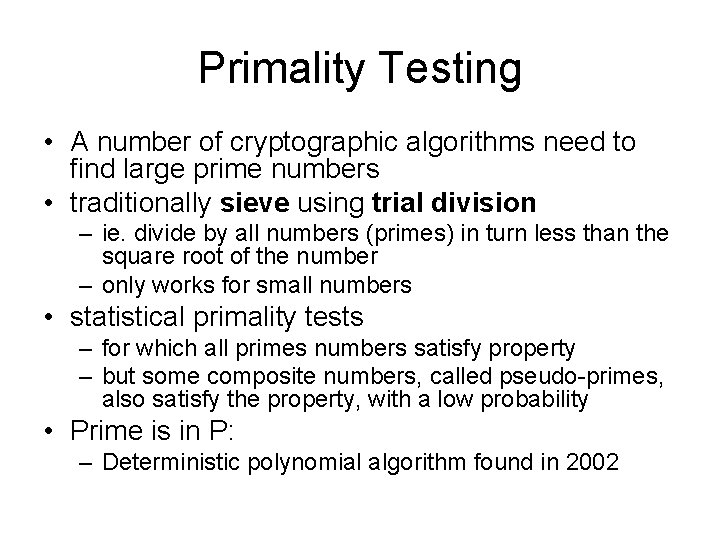
Primality Testing • A number of cryptographic algorithms need to find large prime numbers • traditionally sieve using trial division – ie. divide by all numbers (primes) in turn less than the square root of the number – only works for small numbers • statistical primality tests – for which all primes numbers satisfy property – but some composite numbers, called pseudo-primes, also satisfy the property, with a low probability • Prime is in P: – Deterministic polynomial algorithm found in 2002
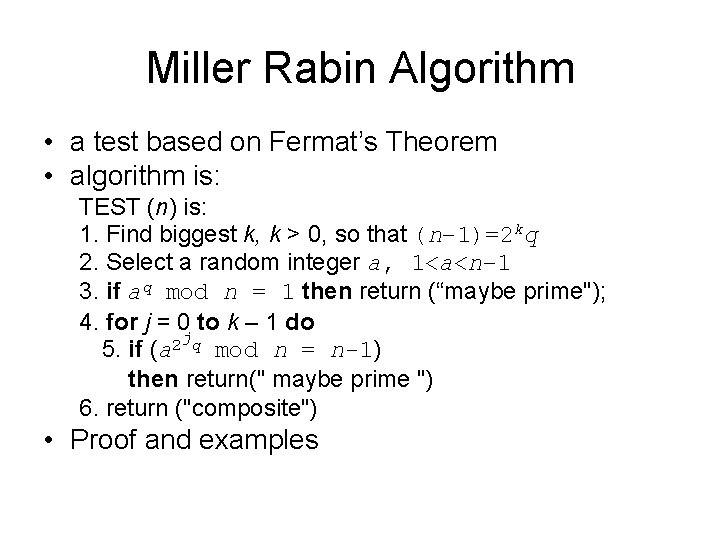
Miller Rabin Algorithm • a test based on Fermat’s Theorem • algorithm is: TEST (n) is: 1. Find biggest k, k > 0, so that (n– 1)=2 kq 2. Select a random integer a, 1<a<n– 1 3. if aq mod n = 1 then return (“maybe prime"); 4. for j = 0 to k – 1 do jq 2 5. if (a mod n = n-1) then return(" maybe prime ") 6. return ("composite") • Proof and examples

Probabilistic Considerations • if Miller-Rabin returns “composite” the number is definitely not prime • otherwise is a prime or a pseudo-prime • chance it detects a pseudo-prime is < ¼ • hence if repeat test with different random a then chance n is prime after t tests is: – Pr(n prime after t tests) = 1 -4 -t – eg. for t=10 this probability is > 0. 99999
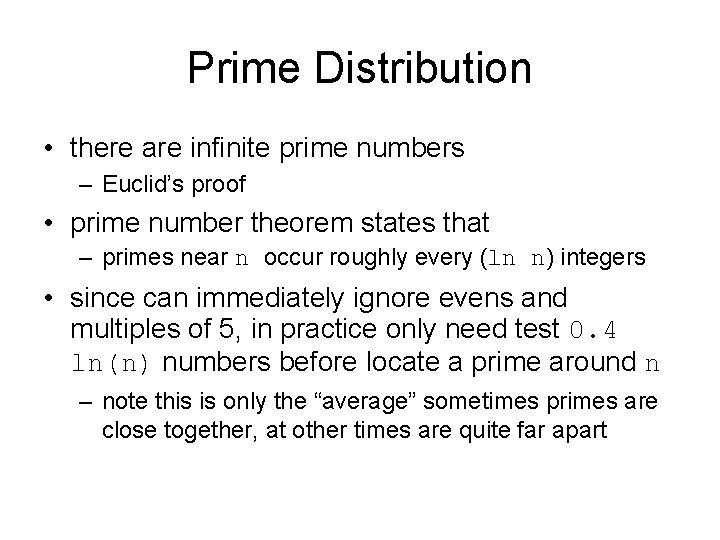
Prime Distribution • there are infinite prime numbers – Euclid’s proof • prime number theorem states that – primes near n occur roughly every (ln n) integers • since can immediately ignore evens and multiples of 5, in practice only need test 0. 4 ln(n) numbers before locate a prime around n – note this is only the “average” sometimes primes are close together, at other times are quite far apart

Chinese Remainder Theorem • Used to speed up modulo computations • Used to modulo a product of numbers – eg. mod M = m 1 m 2. . mk , where gcd(mi, mj)=1 • Chinese Remainder theorem lets us work in each moduli mi separately • since computational cost is proportional to size, this is faster than working in the full modulus M
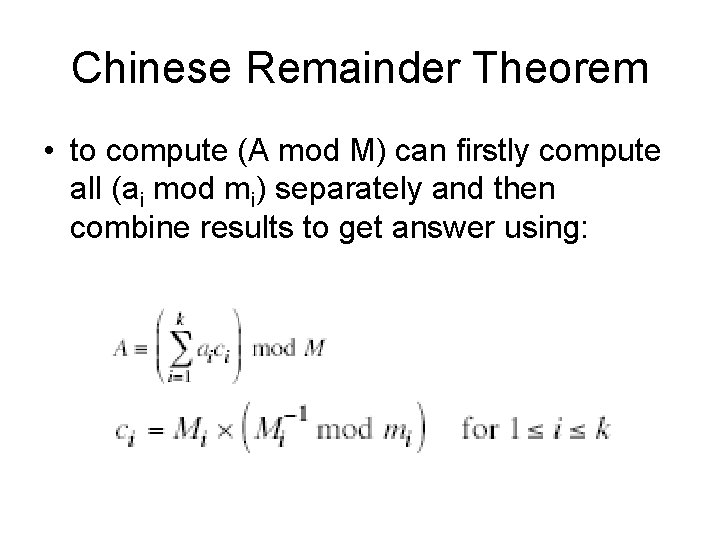
Chinese Remainder Theorem • to compute (A mod M) can firstly compute all (ai mod mi) separately and then combine results to get answer using:
Exponentiation mod p • Ax = b (mod p) • from Euler’s theorem have aø(n) mod n=1 • consider am mod n=1, GCD(a, n)=1 – must exist for m= ø(n) but may be smaller – once powers reach m, cycle will repeat • if smallest is m= ø(n) then a is called a primitive root
Discrete Logarithms or Indices • the inverse problem to exponentiation is to find the discrete logarithm of a number modulo p • Given a, b, p, find x where ax = b mod p • written as x=loga b mod p or x=inda, p(b) • Logirthm may not always exist – x = log 3 4 mod 13 (x st 3 x = 4 mod 13) has no answer – x = log 2 3 mod 13 = 4 by trying successive powers • whilst exponentiation is relatively easy, finding discrete logarithms is generally a hard problem – Oneway-ness: desirable in modern cryptography
Summary • have considered: – prime numbers – Fermat’s and Euler’s Theorems – Primality Testing – Chinese Remainder Theorem – Discrete Logarithms
- Slides: 17