
Chapter 8 Interactive Figure Clickers The Cosmic Perspective



- Slides: 31
Chapter 8 Interactive Figure Clickers The Cosmic Perspective Seventh Edition Formation of the Solar System © 2014 Pearson Education, Inc.
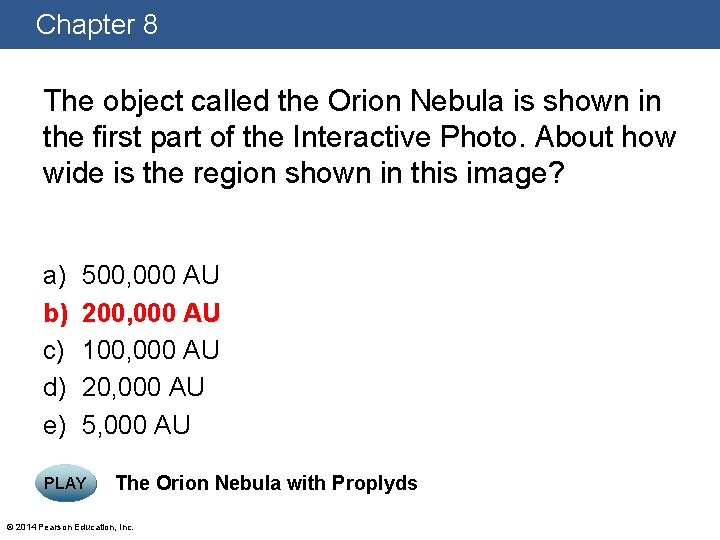
Chapter 8 The object called the Orion Nebula is shown in the first part of the Interactive Photo. About how wide is the region shown in this image? a) b) c) d) e) 500, 000 AU 200, 000 AU 100, 000 AU 20, 000 AU 5, 000 AU PLAY The Orion Nebula with Proplyds © 2014 Pearson Education, Inc.
Chapter 8 The object called the Orion Nebula is shown in the first part of the Interactive Photo. About how wide is the region shown in this image? a) b) c) d) e) 500, 000 AU 200, 000 AU 100, 000 AU 20, 000 AU 5, 000 AU PLAY The Orion Nebula with Proplyds © 2014 Pearson Education, Inc.
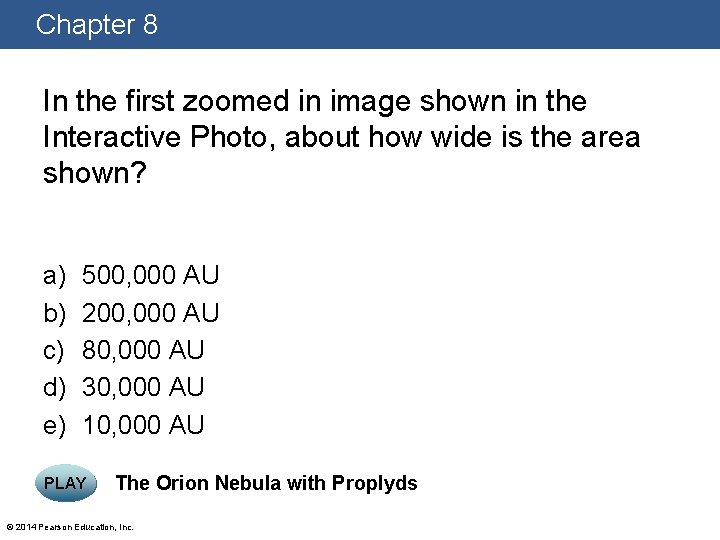
Chapter 8 In the first zoomed in image shown in the Interactive Photo, about how wide is the area shown? a) b) c) d) e) 500, 000 AU 200, 000 AU 80, 000 AU 30, 000 AU 10, 000 AU PLAY The Orion Nebula with Proplyds © 2014 Pearson Education, Inc.
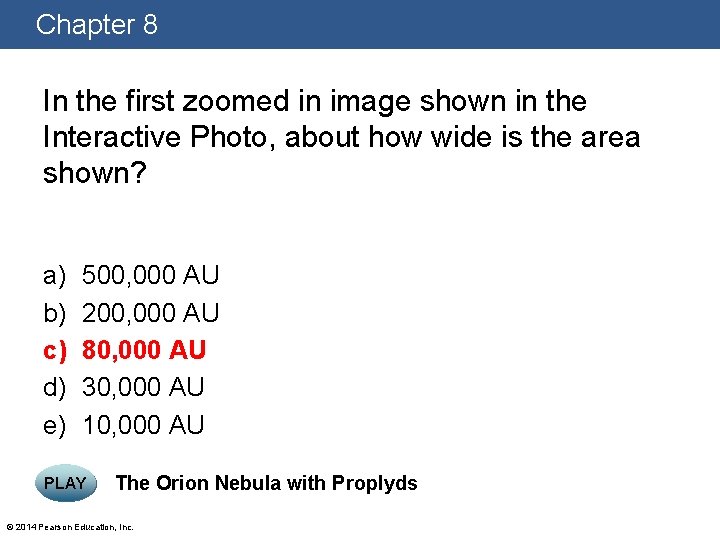
Chapter 8 In the first zoomed in image shown in the Interactive Photo, about how wide is the area shown? a) b) c) d) e) 500, 000 AU 200, 000 AU 80, 000 AU 30, 000 AU 10, 000 AU PLAY The Orion Nebula with Proplyds © 2014 Pearson Education, Inc.
Chapter 8 In the Hubble Wide Field Camera image of the Orion Nebula about how wide is the region shown? a) b) c) d) e) 500, 000 AU 100, 000 AU 50, 000 AU 10, 000 AU 5, 000 AU PLAY The Orion Nebula with Proplyds © 2014 Pearson Education, Inc.
Chapter 8 In the Hubble Wide Field Camera image of the Orion Nebula about how wide is the region shown? a) b) c) d) e) 500, 000 AU 100, 000 AU 50, 000 AU 10, 000 AU 5, 000 AU PLAY The Orion Nebula with Proplyds © 2014 Pearson Education, Inc.
Chapter 8 About how wide is Proplyd 4? a) b) c) d) e) 50, 000 AU 10, 000 AU 5, 000 AU 1, 000 AU 500 AU PLAY The Orion Nebula with Proplyds © 2014 Pearson Education, Inc.
Chapter 8 About how wide is Proplyd 4? a) b) c) d) e) 50, 000 AU 10, 000 AU 5, 000 AU 1, 000 AU 500 AU PLAY The Orion Nebula with Proplyds © 2014 Pearson Education, Inc.
Chapter 8 What is the approximate diameter of the solar system today? a) b) c) d) e) 1 AU 5 AU 10 AU 50 AU 100 AU PLAY The Orion Nebula with Proplyds © 2014 Pearson Education, Inc.
Chapter 8 What is the approximate diameter of the solar system today? a) b) c) d) e) 1 AU 5 AU 10 AU 50 AU 100 AU PLAY The Orion Nebula with Proplyds © 2014 Pearson Education, Inc.
Chapter 8 If Proplyd 4 is about 800 AU in diameter, about how many times larger than the solar system is it? a) b) c) d) e) 1 2 4 8 10 PLAY The Orion Nebula with Proplyds © 2014 Pearson Education, Inc.
Chapter 8 If Proplyd 4 is about 800 AU in diameter, about how many times larger than the solar system is it? a) b) c) d) e) 1 2 4 8 10 PLAY The Orion Nebula with Proplyds © 2014 Pearson Education, Inc.
Chapter 8 In the Collapse of the Solar Nebula simulation, heating is represented by a lightening of color. What part of the cloud appears to heat up the most? a) b) c) d) e) the outer part the right side the left side the center The whole cloud heats up at once. PLAY Collapse of the Solar Nebula © 2014 Pearson Education, Inc.
Chapter 8 In the Collapse of the Solar Nebula simulation, heating is represented by a lightening of color. What part of the cloud appears to heat up the most? a) b) c) d) e) the outer part the right side the left side the center The whole cloud heats up at once. PLAY Collapse of the Solar Nebula © 2014 Pearson Education, Inc.
Chapter 8 In the Collapse of the Solar Nebula simulation the motion of the cloud changes over time. How does it change? a) b) c) d) e) The cloud moves downward. The cloud moves to the right. The cloud moves to the left. The cloud rotates more slowly. The cloud rotates more quickly. PLAY Collapse of the Solar Nebula © 2014 Pearson Education, Inc.
Chapter 8 In the Collapse of the Solar Nebula simulation the motion of the cloud changes over time. How does it change? a) b) c) d) e) The cloud moves downward. The cloud moves to the right. The cloud moves to the left. The cloud rotates more slowly. The cloud rotates more quickly. PLAY Collapse of the Solar Nebula © 2014 Pearson Education, Inc.
Chapter 8 What other key change in the nebula's appearance occurs during the Collapse of the Solar Nebula simulation? a) b) c) d) e) The nebula forms planets. The nebula gets thicker. The nebula becomes more diffuse. The nebula flattens. The nebula becomes cigar-shaped. PLAY Collapse of the Solar Nebula © 2014 Pearson Education, Inc.
Chapter 8 What other key change in the nebula's appearance occurs during the Collapse of the Solar Nebula simulation? a) b) c) d) e) The nebula forms planets. The nebula gets thicker. The nebula becomes more diffuse. The nebula flattens. The nebula becomes cigar-shaped. PLAY Collapse of the Solar Nebula © 2014 Pearson Education, Inc.
Chapter 8 What happens to the ice skater when she pulls her arms in? a) She spins slower. b) She spins faster. c) Her speed does not change. PLAY Collapse of the Solar Nebula © 2014 Pearson Education, Inc.
Chapter 8 What happens to the ice skater when she pulls her arms in? a) She spins slower. b) She spins faster. c) Her speed does not change. PLAY Collapse of the Solar Nebula © 2014 Pearson Education, Inc.
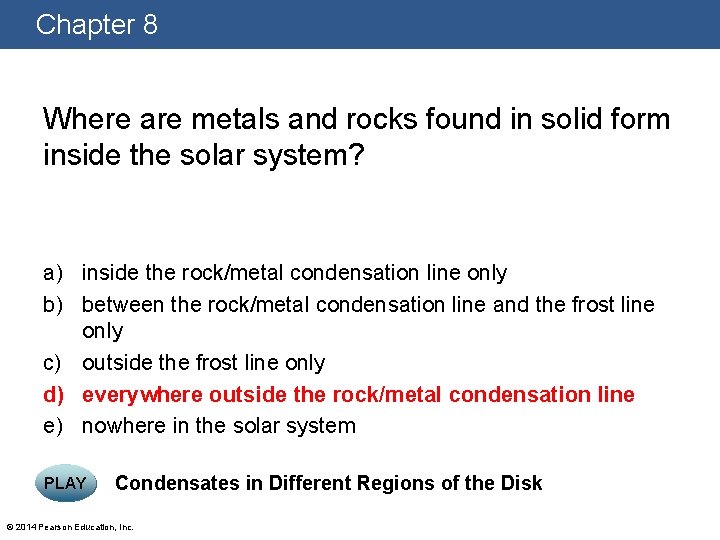
Chapter 8 Where are metals and rocks found in solid form inside the solar system? a) inside the rock/metal condensation line only b) between the rock/metal condensation line and the frost line only c) outside the frost line only d) everywhere outside the rock/metal condensation line e) nowhere in the solar system PLAY Condensates in Different Regions of the Disk © 2014 Pearson Education, Inc.
Chapter 8 Where are metals and rocks found in solid form inside the solar system? a) inside the rock/metal condensation line only b) between the rock/metal condensation line and the frost line only c) outside the frost line only d) everywhere outside the rock/metal condensation line e) nowhere in the solar system PLAY Condensates in Different Regions of the Disk © 2014 Pearson Education, Inc.
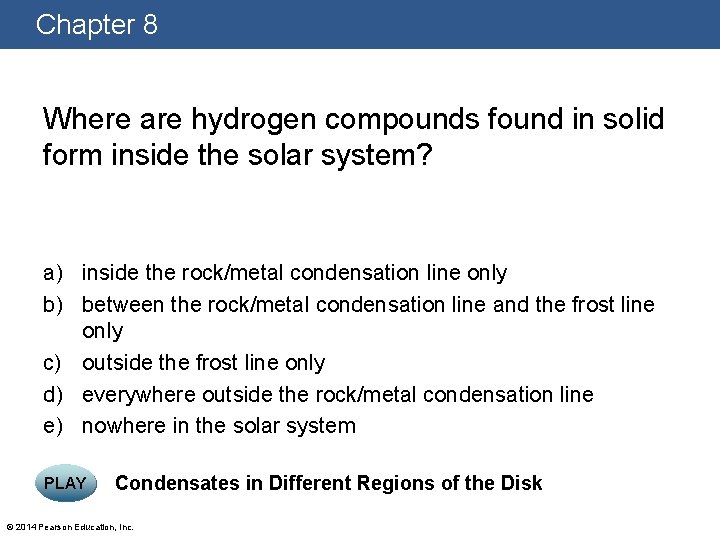
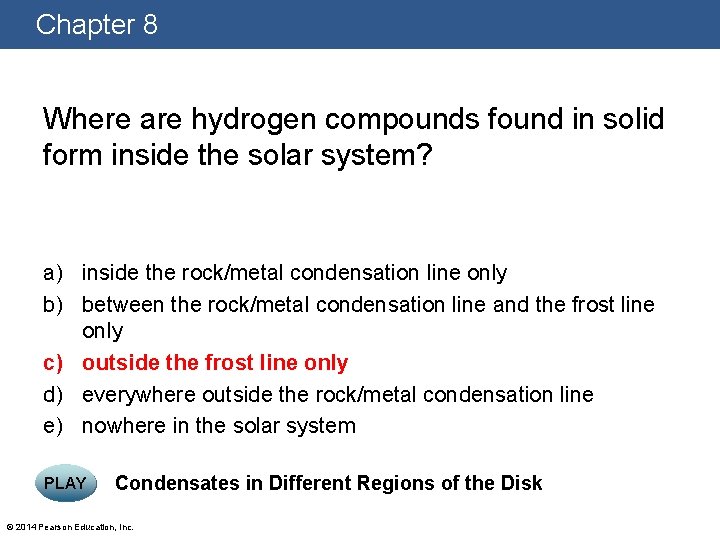
Chapter 8 Where are hydrogen compounds found in solid form inside the solar system? a) inside the rock/metal condensation line only b) between the rock/metal condensation line and the frost line only c) outside the frost line only d) everywhere outside the rock/metal condensation line e) nowhere in the solar system PLAY Condensates in Different Regions of the Disk © 2014 Pearson Education, Inc.
Chapter 8 Where are hydrogen compounds found in solid form inside the solar system? a) inside the rock/metal condensation line only b) between the rock/metal condensation line and the frost line only c) outside the frost line only d) everywhere outside the rock/metal condensation line e) nowhere in the solar system PLAY Condensates in Different Regions of the Disk © 2014 Pearson Education, Inc.
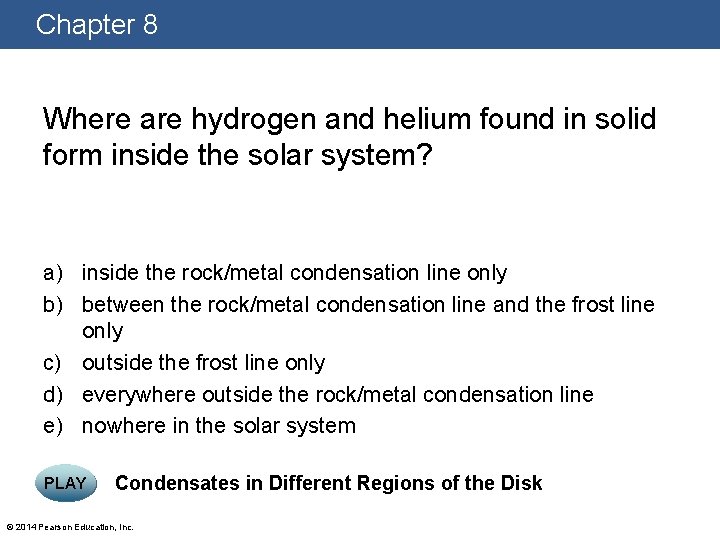
Chapter 8 Where are hydrogen and helium found in solid form inside the solar system? a) inside the rock/metal condensation line only b) between the rock/metal condensation line and the frost line only c) outside the frost line only d) everywhere outside the rock/metal condensation line e) nowhere in the solar system PLAY Condensates in Different Regions of the Disk © 2014 Pearson Education, Inc.
Chapter 8 Where are hydrogen and helium found in solid form inside the solar system? a) inside the rock/metal condensation line only b) between the rock/metal condensation line and the frost line only c) outside the frost line only d) everywhere outside the rock/metal condensation line e) nowhere in the solar system PLAY Condensates in Different Regions of the Disk © 2014 Pearson Education, Inc.
Chapter 8 What happens to the number of particles as time goes on? a) They increase. b) They decrease. c) They stay the same. PLAY Accretion and the Formation of Planets © 2014 Pearson Education, Inc.
Chapter 8 What happens to the number of particles as time goes on? a) They increase. b) They decrease. c) They stay the same. PLAY Accretion and the Formation of Planets © 2014 Pearson Education, Inc.
Chapter 8 What happens to the size of the particles as time goes on? a) They increase. b) They decrease. c) They stay the same. PLAY Accretion and the Formation of Planets © 2014 Pearson Education, Inc.
Chapter 8 What happens to the size of the particles as time goes on? a) They increase. b) They decrease. c) They stay the same. PLAY Accretion and the Formation of Planets © 2014 Pearson Education, Inc.