
Chapter 8 Integration How Can I do it
- Slides: 12
Chapter 8: Integration: How Can I do it ALL? Central concepts: § The standards for all lessons should not be treated simply as a “to do” list. § Integration of the disciplines can be effective when done thoughtfully. § Approaches to integration include looking across the standards and the use of a driving question. T 8. 0
What is Integration? Integration § The ability to apply the standards from a variety of disciplines into one lesson. § Key to successful integration is not to force it. § Successful integration provides an opportunity to revisit content from a different context. T 8. 1
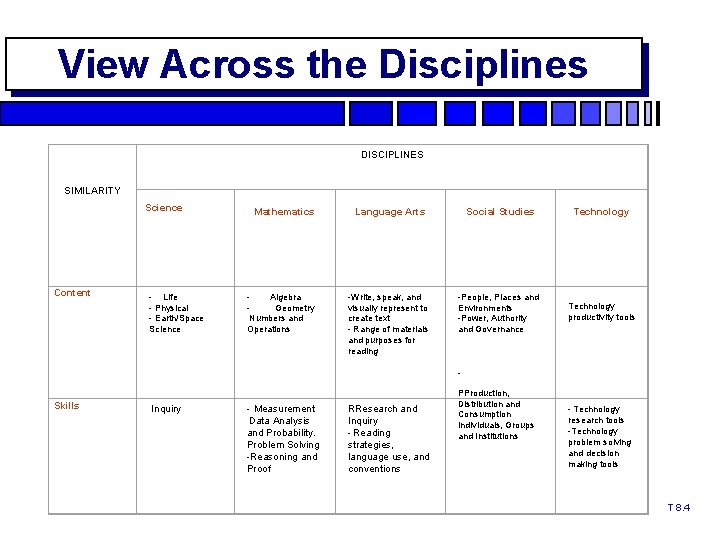
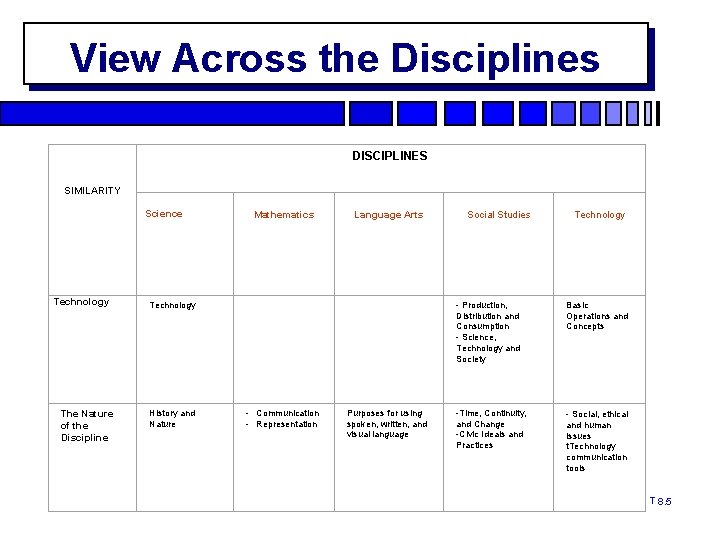
Approaches to Integration Across the Standards § A standards similarities analysis identifies the content knowledge unique to each discipline and shows where similarities exist among the skills for each discipline. § A thorough review of the standards for science, mathematics, language arts, social studies, and technology reveals that each have a standard which reflects the nature of the discipline. This should be developed in the integrated lesson plan. T 8. 2
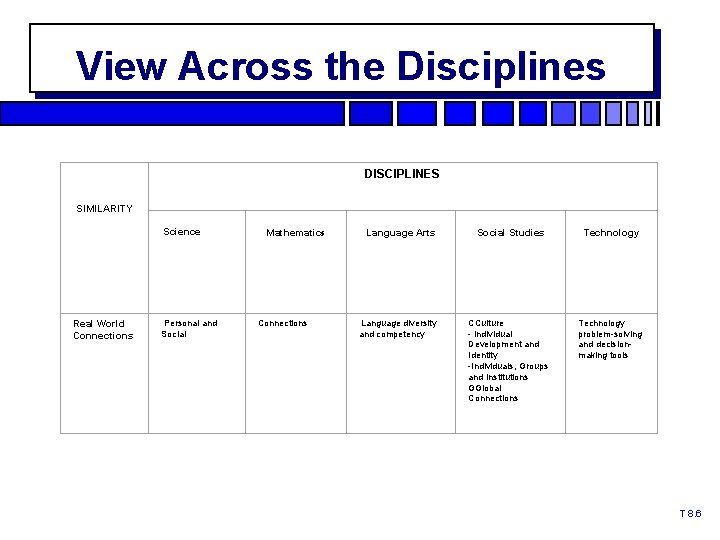
Approaches to Integration Across the Standards A standards similarities analysis… reveals that real world connections are stressed within each discipline. T 8. 3
View Across the Disciplines DISCIPLINES SIMILARITY Science Content - Life - Physical - Earth/Space Science Mathematics - Algebra Geometry Numbers and Operations Language Arts Social Studies -Write, speak, and -People, Places and visually represent to create text - Range of materials and purposes for reading Environments -Power, Authority and Governance Technology productivity tools Skills Inquiry - Measurement Data Analysis and Probability. Problem Solving -Reasoning and Proof RResearch and Inquiry - Reading strategies, language use, and conventions PProduction, Distribution and Consumption Individuals, Groups and Institutions - Technology research tools -Technology problem solving and decision making tools T 8. 4
View Across the Disciplines DISCIPLINES SIMILARITY Science Technology The Nature of the Discipline Mathematics Language Arts Technology History and Nature - Communication - Representation Purposes for using spoken, written, and visual language Social Studies Technology - Production, Distribution and Consumption - Science, Technology and Society Basic Operations and Concepts -Time, Continuity, and Change -Civic Ideals and Practices - Social, ethical and human issues t. Technology communication tools T 8. 5
View Across the Disciplines DISCIPLINES SIMILARITY Science Real World Connections Personal and Social Mathematics Connections Language Arts Language diversity and competency Social Studies Technology CCulture - Individual Development and Identity -Individuals, Groups and Institutions GGlobal Connections Technology problem-solving and decisionmaking tools T 8. 6
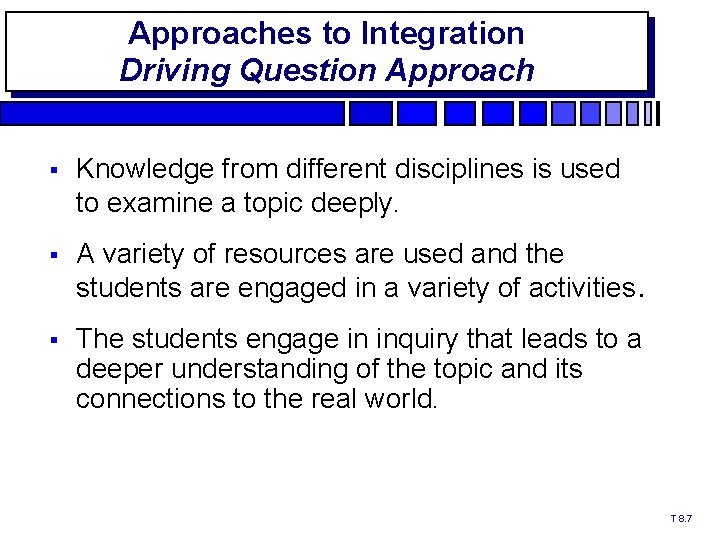
Approaches to Integration Driving Question Approach § Knowledge from different disciplines is used to examine a topic deeply. § A variety of resources are used and the students are engaged in a variety of activities. § The students engage in inquiry that leads to a deeper understanding of the topic and its connections to the real world. T 8. 7
Approaches to Integration Driving Question Approach § Content integration provides a framework by which students can make the needed connections to the new information with the previously learned information. § Striving to answer a driving question encourages us to extend our knowledge and share similar goals for inquiry, observation, problem-solving, experimentation, and communication across content areas. T 8. 8
Approaches to Integration Driving Question Approach § Planning integrated learning experiences using a problem-based learning model helps students develop scientific thinking for problem solving in real life. T 8. 9
Challenges to Integration Planning and implementing an integrated curriculum takes time. § Common planning time is needed by teacher teams to explore theme, locate resources, identify student needs, and to coordinate daily schedules throughout the implementation process. T 8. 10
Challenges to Integration § Locating an effective and coherent theme can be challenging. § It can be difficult to identify content knowledge, skills, standards and themes with appropriate connections to the content areas. T 8. 11