
Chapter 8 Information Processing Theory Overview The Information
- Slides: 17
Chapter 8 Information Processing Theory
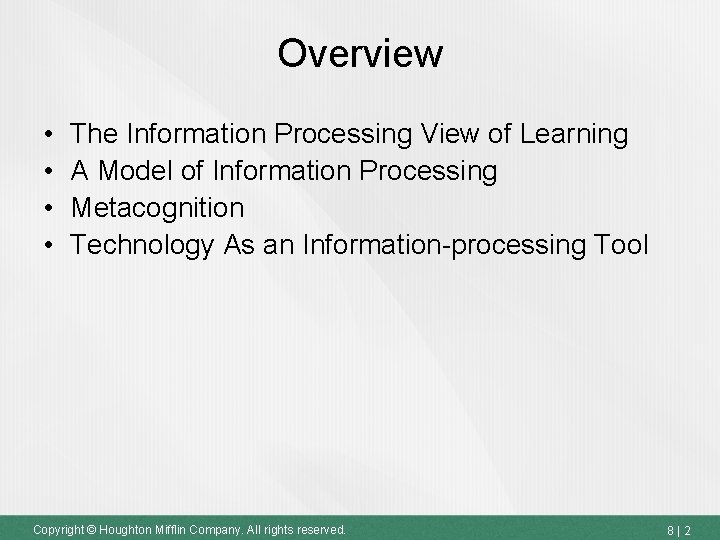
Overview • • The Information Processing View of Learning A Model of Information Processing Metacognition Technology As an Information-processing Tool Copyright © Houghton Mifflin Company. All rights reserved. 8|2
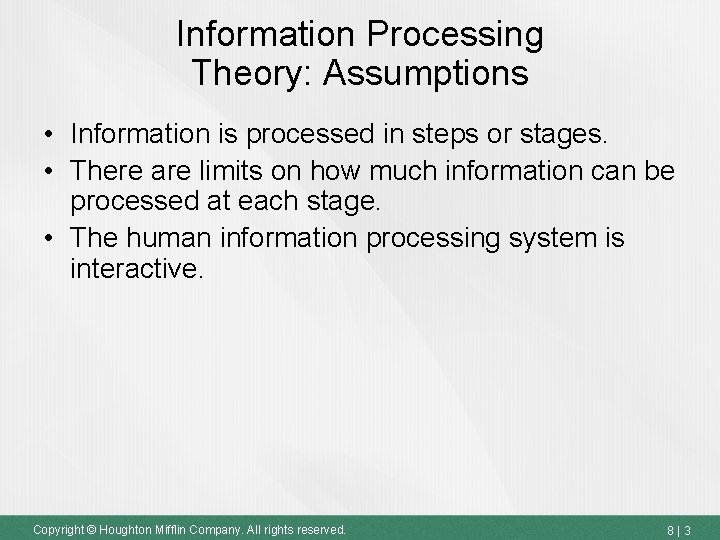
Information Processing Theory: Assumptions • Information is processed in steps or stages. • There are limits on how much information can be processed at each stage. • The human information processing system is interactive. Copyright © Houghton Mifflin Company. All rights reserved. 8|3
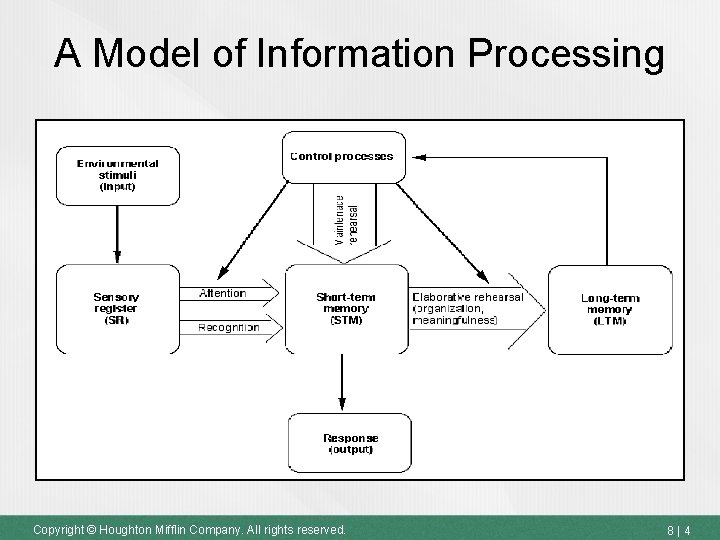
A Model of Information Processing Copyright © Houghton Mifflin Company. All rights reserved. 8|4
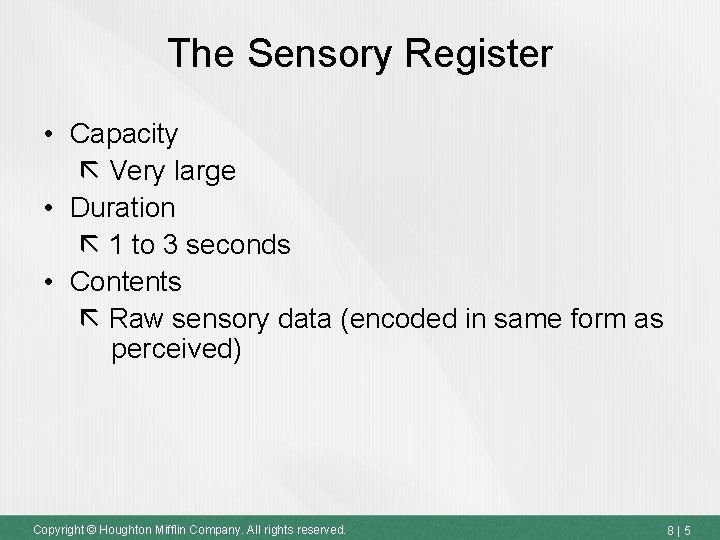
The Sensory Register • Capacity Very large • Duration 1 to 3 seconds • Contents Raw sensory data (encoded in same form as perceived) Copyright © Houghton Mifflin Company. All rights reserved. 8|5
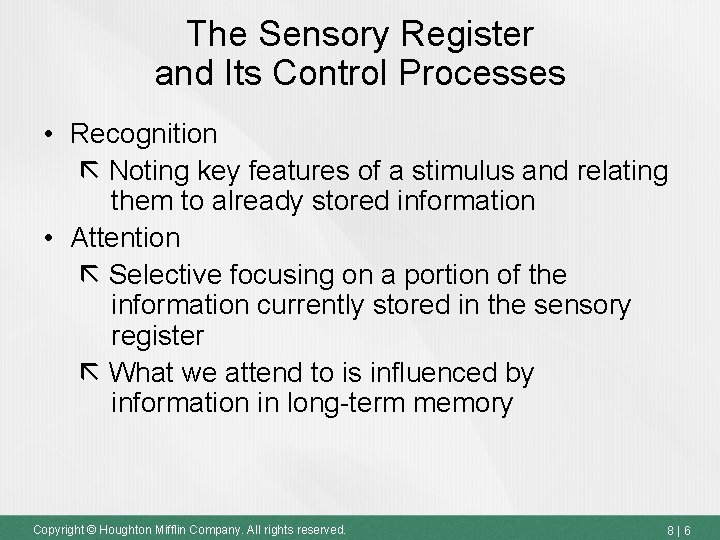
The Sensory Register and Its Control Processes • Recognition Noting key features of a stimulus and relating them to already stored information • Attention Selective focusing on a portion of the information currently stored in the sensory register What we attend to is influenced by information in long-term memory Copyright © Houghton Mifflin Company. All rights reserved. 8|6
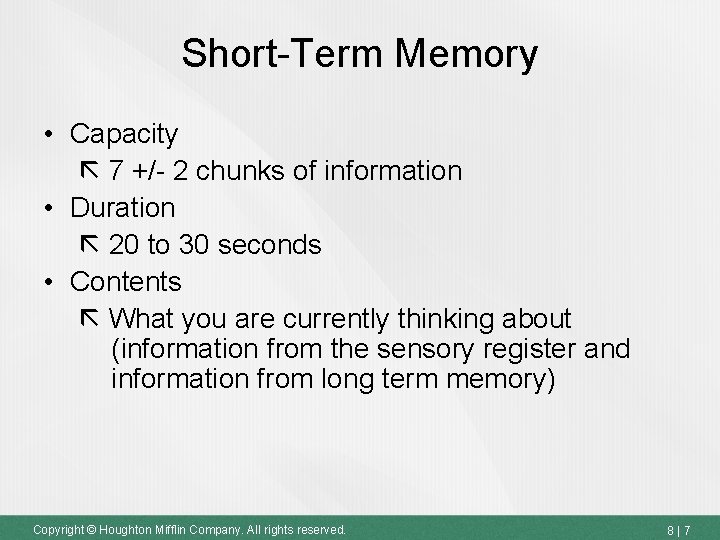
Short-Term Memory • Capacity 7 +/- 2 chunks of information • Duration 20 to 30 seconds • Contents What you are currently thinking about (information from the sensory register and information from long term memory) Copyright © Houghton Mifflin Company. All rights reserved. 8|7
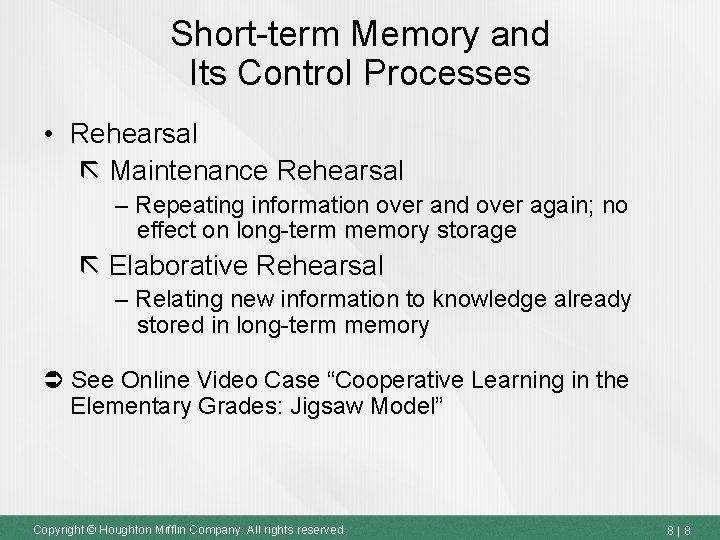
Short-term Memory and Its Control Processes • Rehearsal Maintenance Rehearsal – Repeating information over and over again; no effect on long-term memory storage Elaborative Rehearsal – Relating new information to knowledge already stored in long-term memory See Online Video Case “Cooperative Learning in the Elementary Grades: Jigsaw Model” Copyright © Houghton Mifflin Company. All rights reserved. 8|8
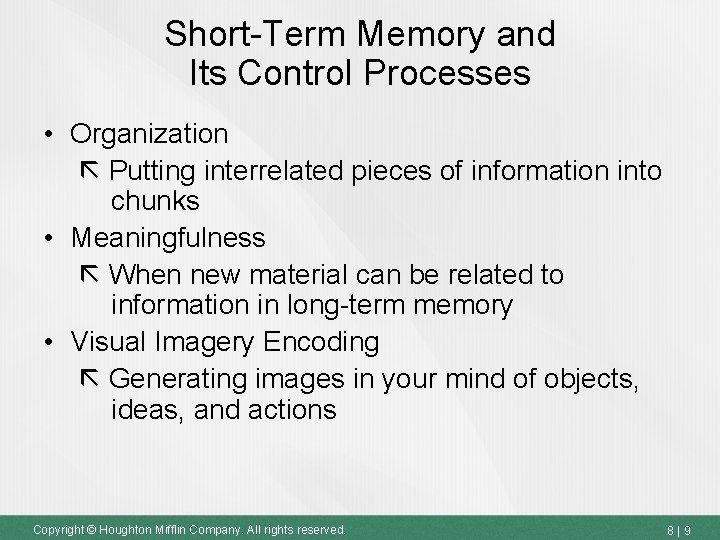
Short-Term Memory and Its Control Processes • Organization Putting interrelated pieces of information into chunks • Meaningfulness When new material can be related to information in long-term memory • Visual Imagery Encoding Generating images in your mind of objects, ideas, and actions Copyright © Houghton Mifflin Company. All rights reserved. 8|9
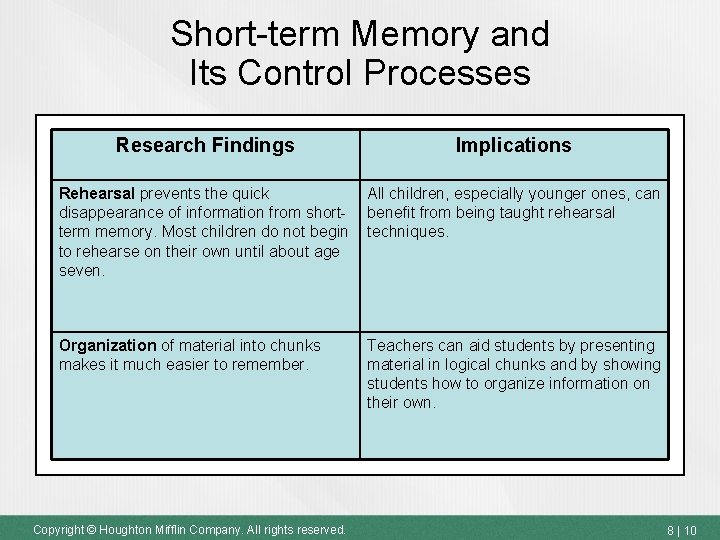
Short-term Memory and Its Control Processes Research Findings Implications Rehearsal prevents the quick disappearance of information from shortterm memory. Most children do not begin to rehearse on their own until about age seven. All children, especially younger ones, can benefit from being taught rehearsal techniques. Organization of material into chunks makes it much easier to remember. Teachers can aid students by presenting material in logical chunks and by showing students how to organize information on their own. Copyright © Houghton Mifflin Company. All rights reserved. 8 | 10
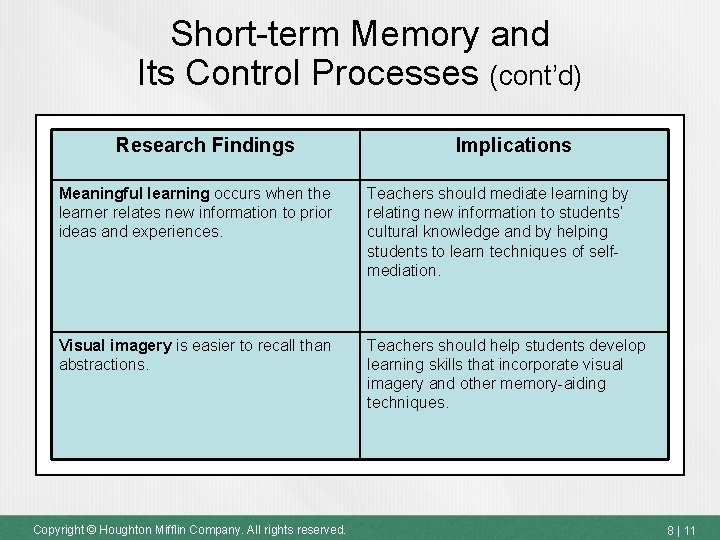
Short-term Memory and Its Control Processes (cont’d) Research Findings Implications Meaningful learning occurs when the learner relates new information to prior ideas and experiences. Teachers should mediate learning by relating new information to students’ cultural knowledge and by helping students to learn techniques of selfmediation. Visual imagery is easier to recall than abstractions. Teachers should help students develop learning skills that incorporate visual imagery and other memory-aiding techniques. Copyright © Houghton Mifflin Company. All rights reserved. 8 | 11
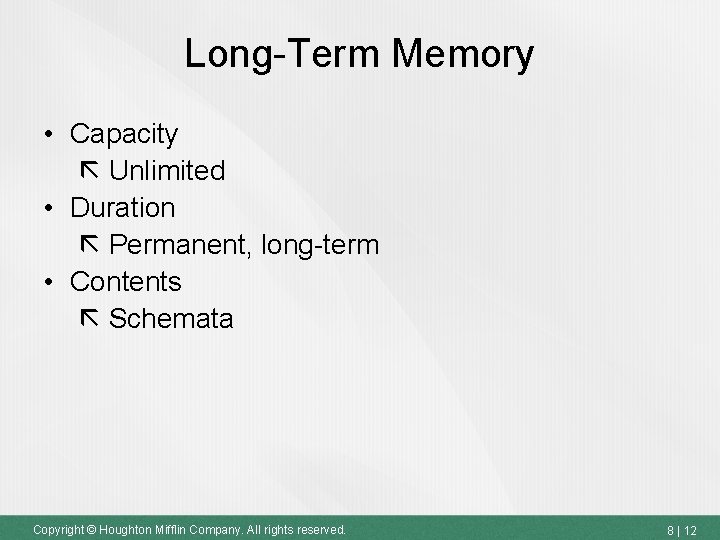
Long-Term Memory • Capacity Unlimited • Duration Permanent, long-term • Contents Schemata Copyright © Houghton Mifflin Company. All rights reserved. 8 | 12
How Well Do We Remember What We Learn in School? • More than 7 out of 10 studies reported less than a 20% loss of what was learned. • Subject matter that had a higher than average level of unfamiliar facts and for which students would have little relevant prior knowledge was associated with increased levels of forgetting. • Most of the forgetting of information occurred within 4 weeks after the end of a unit of instruction. Copyright © Houghton Mifflin Company. All rights reserved. 8 | 13
How Well Do We Remember What We Learn in School? (cont’d) • Less forgetting occurred among students who learned the material to a high level either by being required to achieve a high score, teach it to less knowledgeable students, or take advanced courses. • Less forgetting occurred in classes where students were more actively involved in learning. See Online Video Case “Using Information-Processing Strategies: A Middle School Science Lesson” Copyright © Houghton Mifflin Company. All rights reserved. 8 | 14
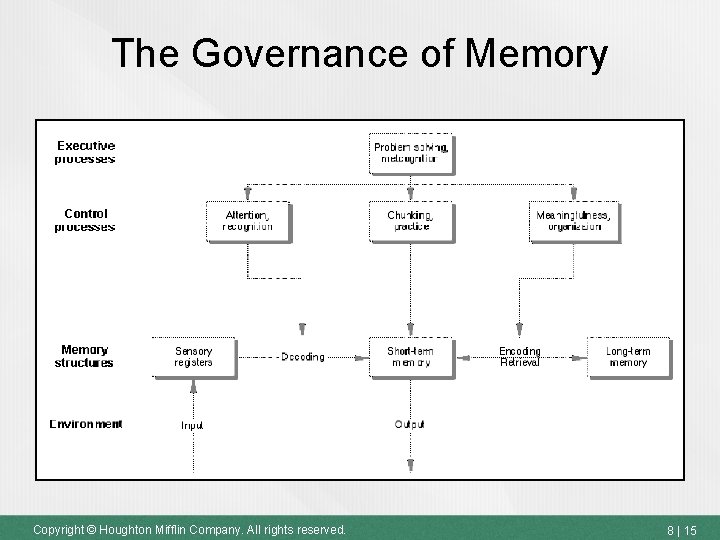
The Governance of Memory Copyright © Houghton Mifflin Company. All rights reserved. 8 | 15
What is Metacognition? • Metacognition is… Our knowledge about attention, recognition, encoding, storage, and retrieval and how those operations might best be used to achieve a learning goal. Copyright © Houghton Mifflin Company. All rights reserved. 8 | 16
Technology as an Information-Processing Tool • • • Technology Tools for Writing Technology Tools for Reading Technology Tools for Science and Math Technology Tools for Art and Music Multimedia Tools Hypermedia Tools Copyright © Houghton Mifflin Company. All rights reserved. 8 | 17