
CHAPTER 8 Index Models Investments 8 th edition
- Slides: 21
CHAPTER 8 Index Models Investments, 8 th edition Bodie, Kane and Marcus Slides by Susan Hine Mc. Graw-Hill/Irwin Copyright © 2009 by The Mc. Graw-Hill Companies, Inc. All rights reserved.
Advantages of the Single Index Model • Reduces the number of inputs for diversification • Easier for security analysts to specialize 8 -2
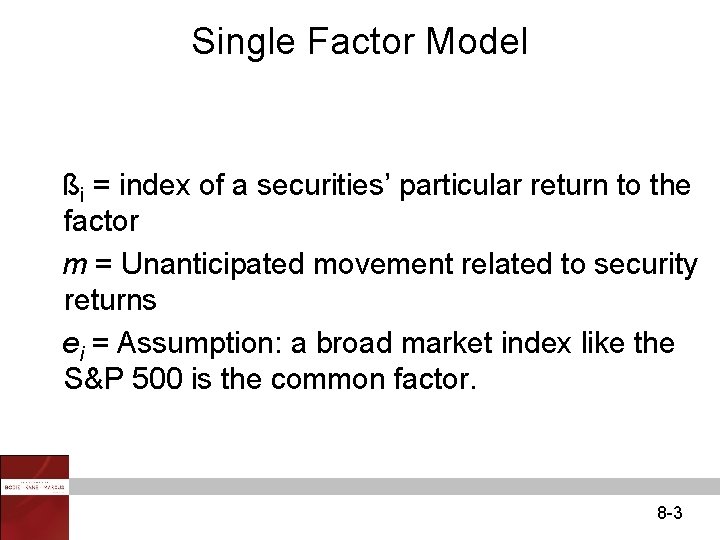
Single Factor Model ßi = index of a securities’ particular return to the factor m = Unanticipated movement related to security returns ei = Assumption: a broad market index like the S&P 500 is the common factor. 8 -3
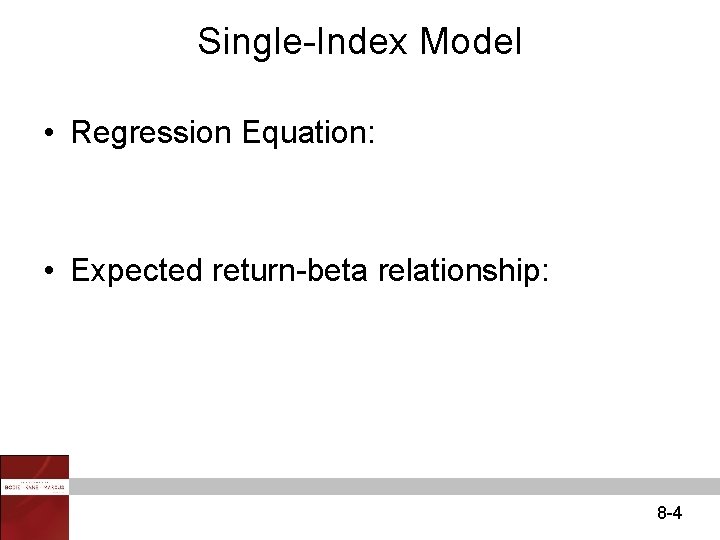
Single-Index Model • Regression Equation: • Expected return-beta relationship: 8 -4
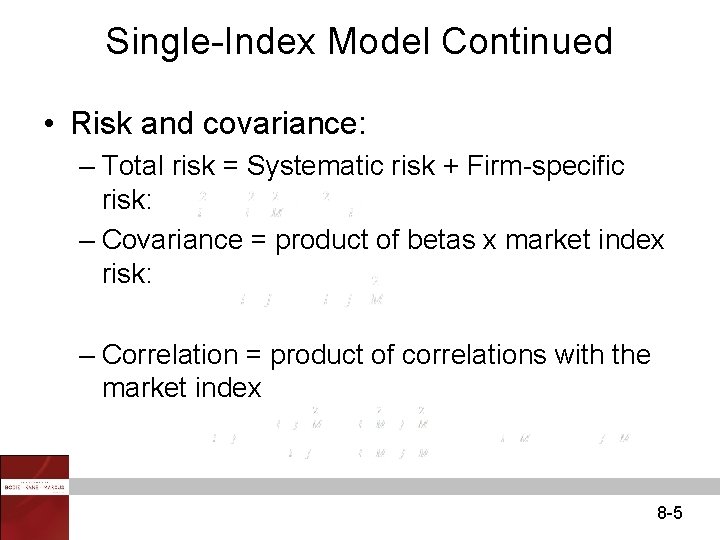
Single-Index Model Continued • Risk and covariance: – Total risk = Systematic risk + Firm-specific risk: – Covariance = product of betas x market index risk: – Correlation = product of correlations with the market index 8 -5
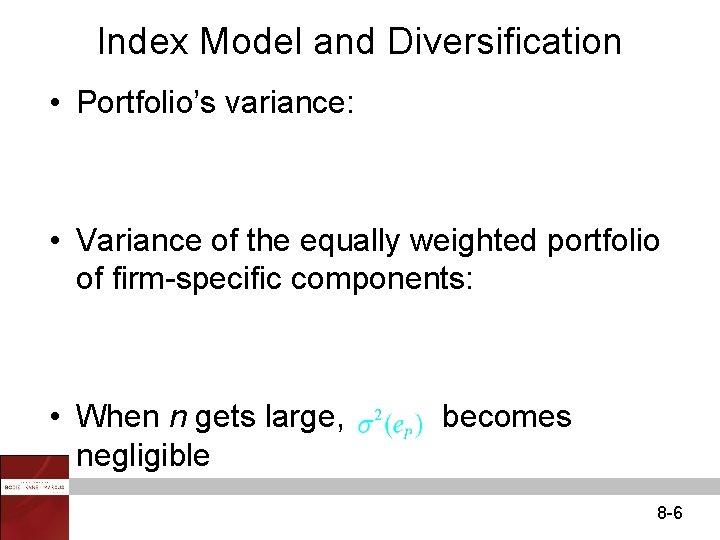
Index Model and Diversification • Portfolio’s variance: • Variance of the equally weighted portfolio of firm-specific components: • When n gets large, negligible becomes 8 -6
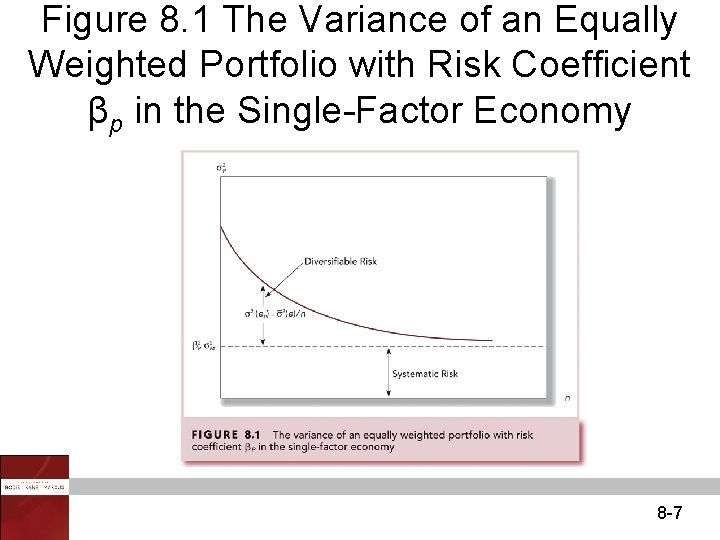
Figure 8. 1 The Variance of an Equally Weighted Portfolio with Risk Coefficient βp in the Single-Factor Economy 8 -7
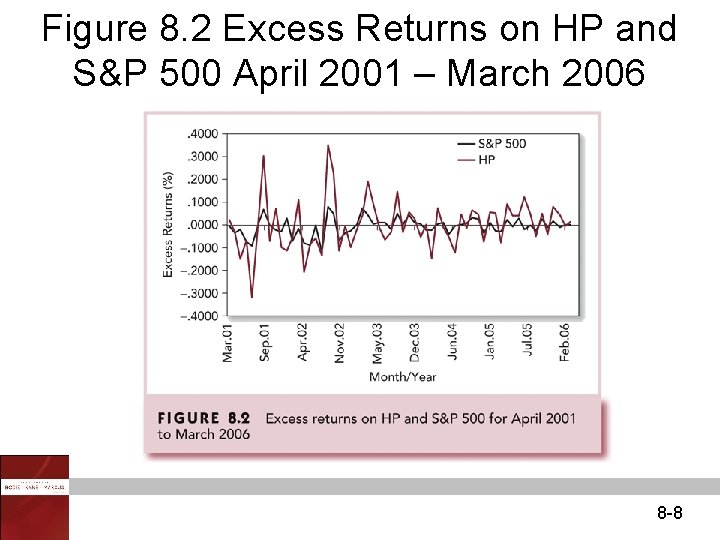
Figure 8. 2 Excess Returns on HP and S&P 500 April 2001 – March 2006 8 -8
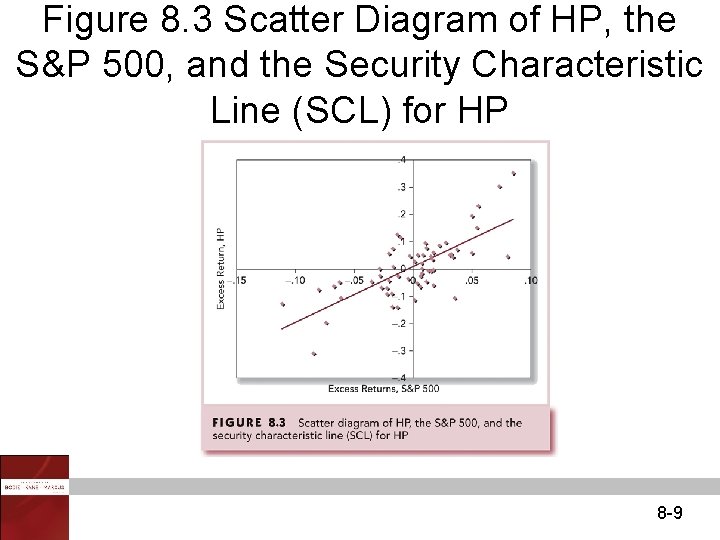
Figure 8. 3 Scatter Diagram of HP, the S&P 500, and the Security Characteristic Line (SCL) for HP 8 -9
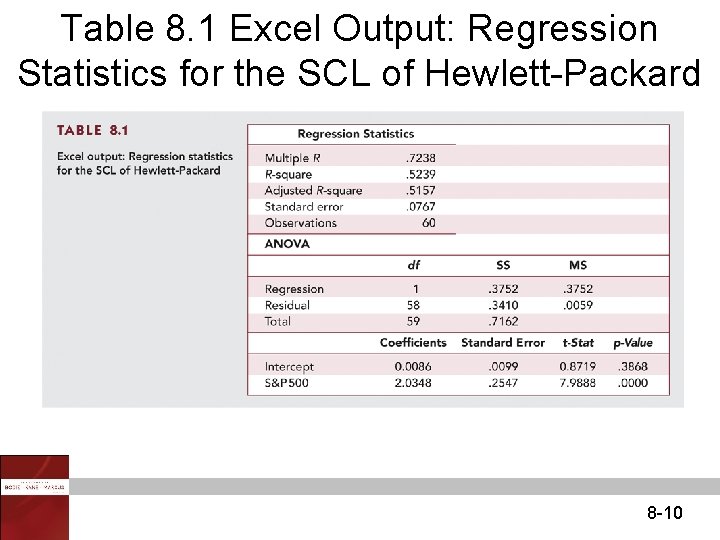
Table 8. 1 Excel Output: Regression Statistics for the SCL of Hewlett-Packard 8 -10
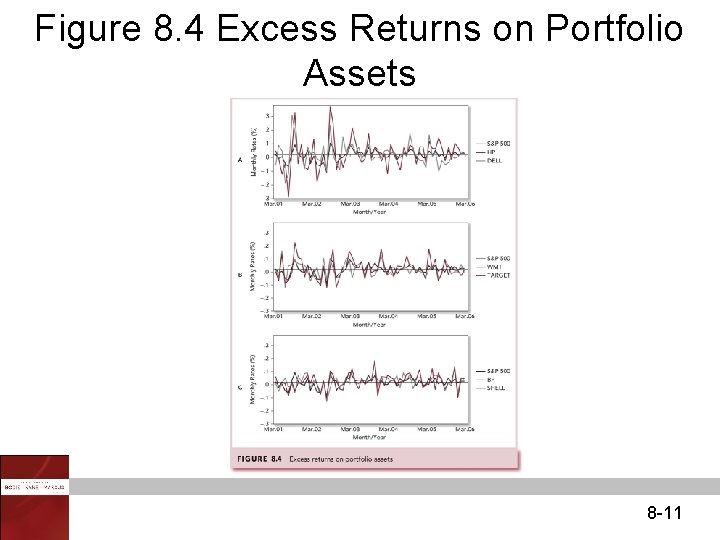
Figure 8. 4 Excess Returns on Portfolio Assets 8 -11
Alpha and Security Analysis • Macroeconomic analysis is used to estimate the risk premium and risk of the market index • Statistical analysis is used to estimate the beta coefficients of all securities and their residual variances, σ2 ( e i ) • Developed from security analysis 8 -12
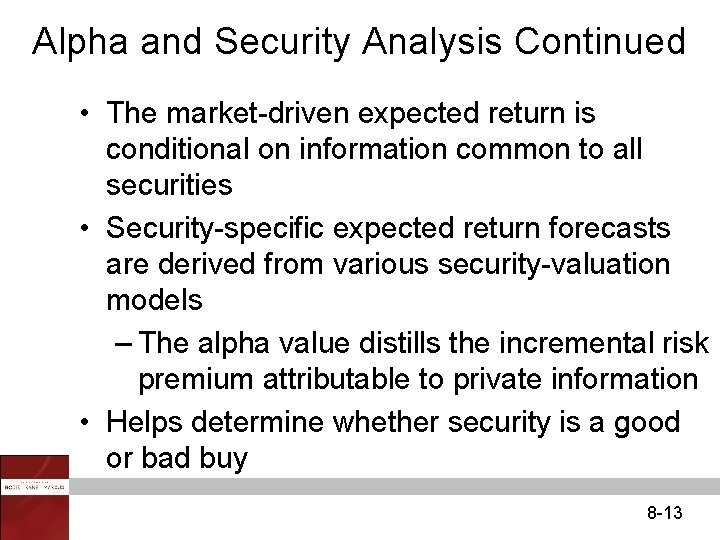
Alpha and Security Analysis Continued • The market-driven expected return is conditional on information common to all securities • Security-specific expected return forecasts are derived from various security-valuation models – The alpha value distills the incremental risk premium attributable to private information • Helps determine whether security is a good or bad buy 8 -13
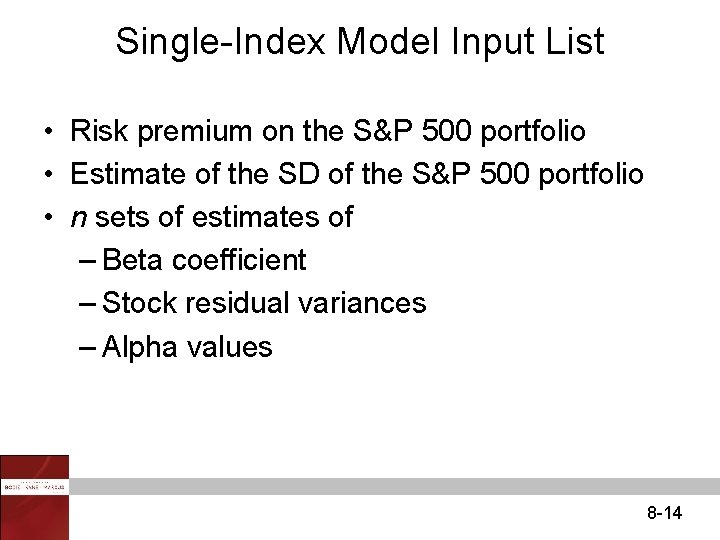
Single-Index Model Input List • Risk premium on the S&P 500 portfolio • Estimate of the SD of the S&P 500 portfolio • n sets of estimates of – Beta coefficient – Stock residual variances – Alpha values 8 -14
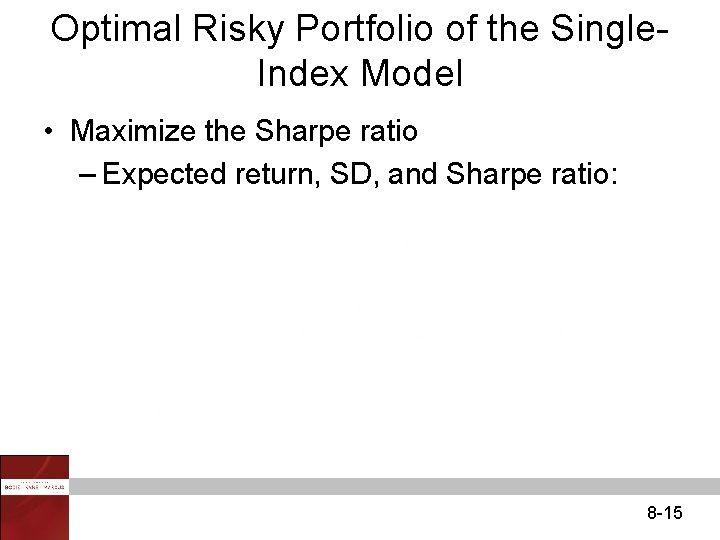
Optimal Risky Portfolio of the Single. Index Model • Maximize the Sharpe ratio – Expected return, SD, and Sharpe ratio: 8 -15
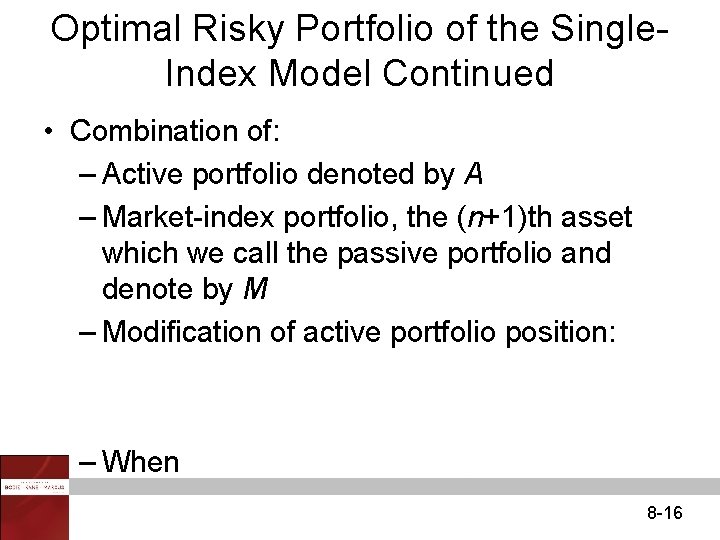
Optimal Risky Portfolio of the Single. Index Model Continued • Combination of: – Active portfolio denoted by A – Market-index portfolio, the (n+1)th asset which we call the passive portfolio and denote by M – Modification of active portfolio position: – When 8 -16
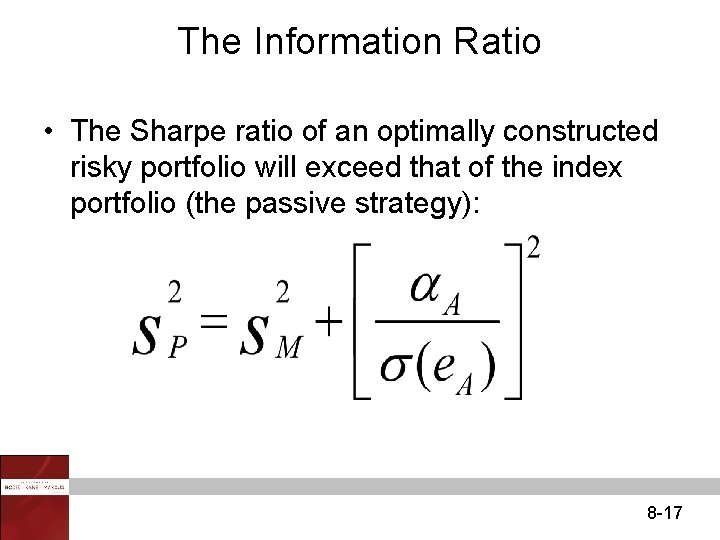
The Information Ratio • The Sharpe ratio of an optimally constructed risky portfolio will exceed that of the index portfolio (the passive strategy): 8 -17
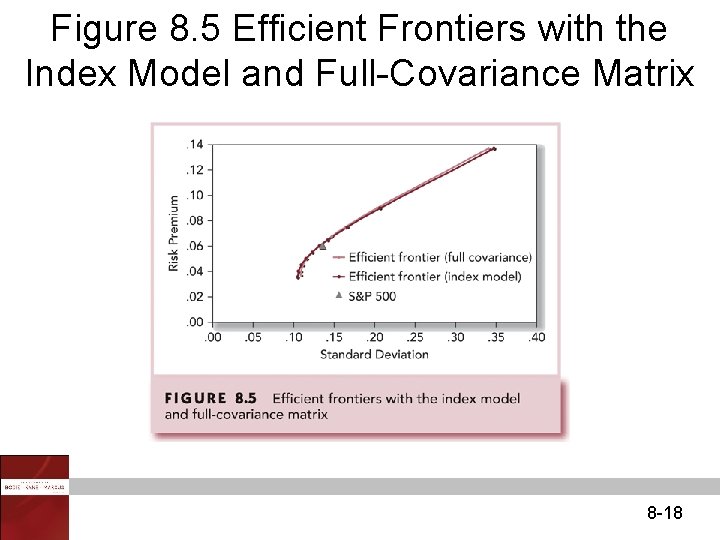
Figure 8. 5 Efficient Frontiers with the Index Model and Full-Covariance Matrix 8 -18
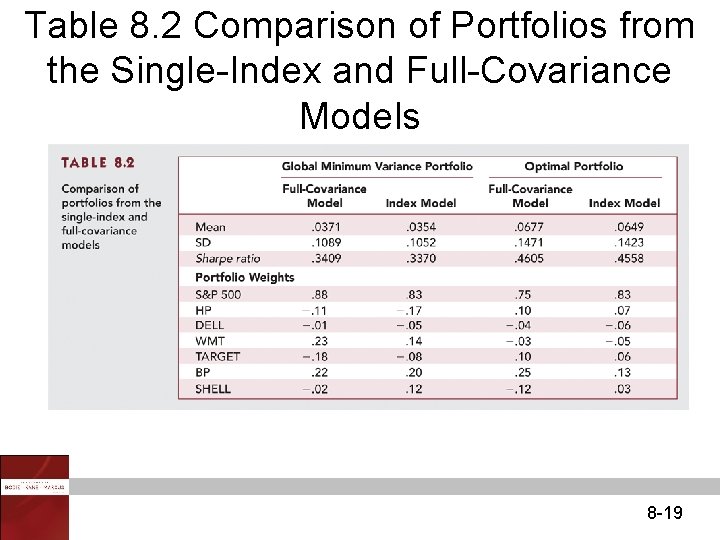
Table 8. 2 Comparison of Portfolios from the Single-Index and Full-Covariance Models 8 -19
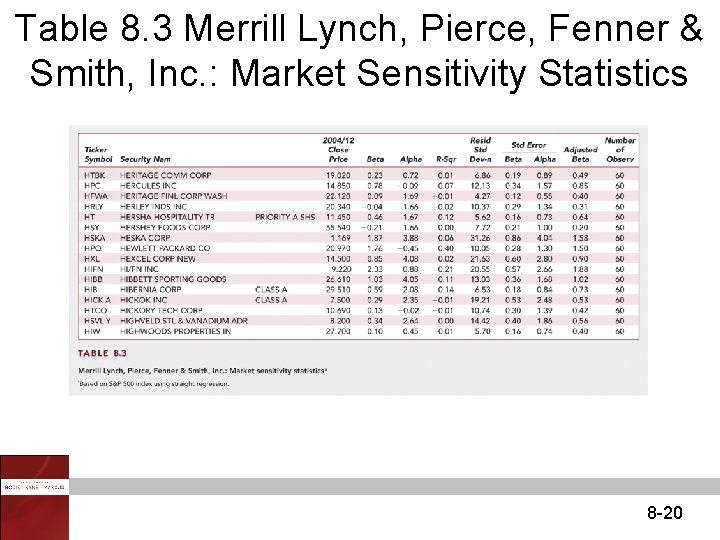
Table 8. 3 Merrill Lynch, Pierce, Fenner & Smith, Inc. : Market Sensitivity Statistics 8 -20
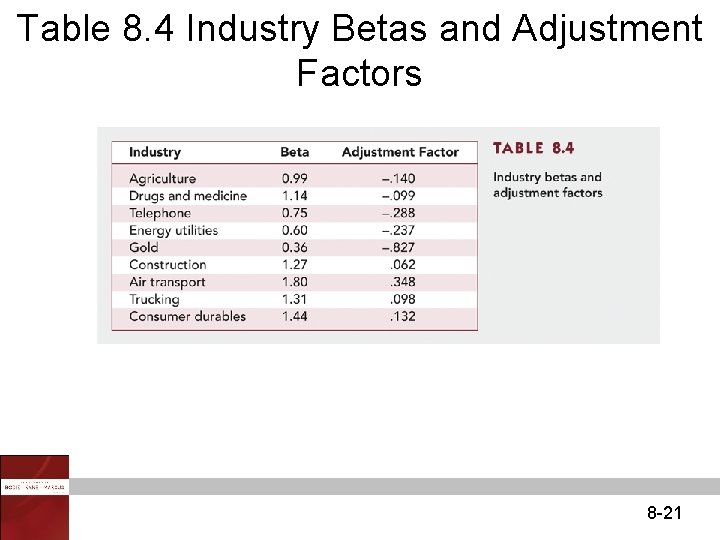
Table 8. 4 Industry Betas and Adjustment Factors 8 -21