
Chapter 8 Incentive Pay Reference Books Strategic Compensation

Chapter # 8 Incentive Pay Reference Books: Ø Strategic Compensation: A Human Resource Management Approach (6 th Edition), Joseph J. , Martocchio Joe, Pearson Education. Ø Strategic Compensation in Canada (4 th Edition), Richard J. Long, Nelson Education Ltd. Ø Internet Resource person: Furqan-ul-haq Siddiqui
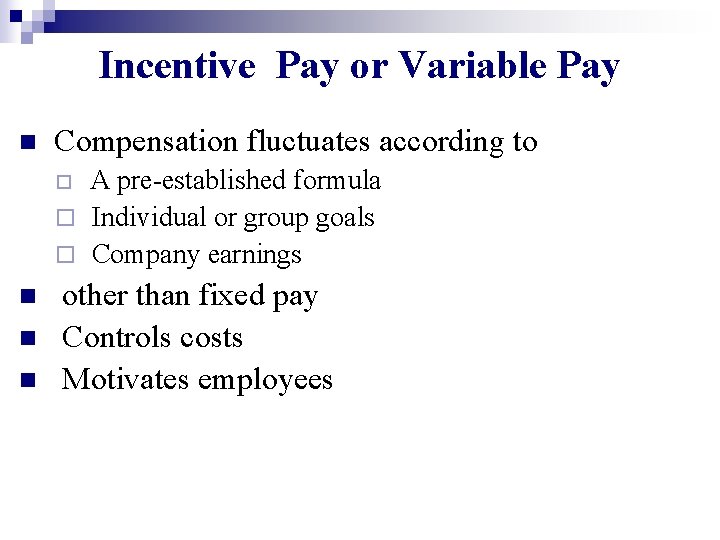
Incentive Pay or Variable Pay n Compensation fluctuates according to ¨ A pre-established formula ¨ Individual or group goals ¨ Company earnings other than fixed pay n Controls costs n Motivates employees n
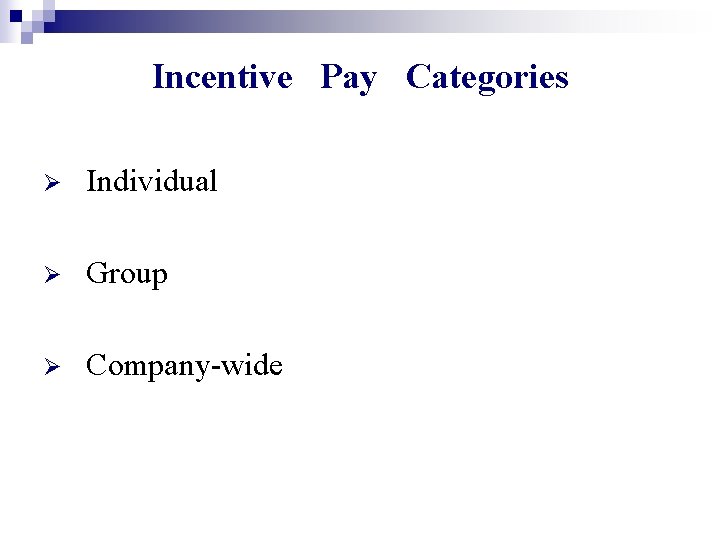
Incentive Pay Categories Ø Individual Ø Group Ø Company-wide
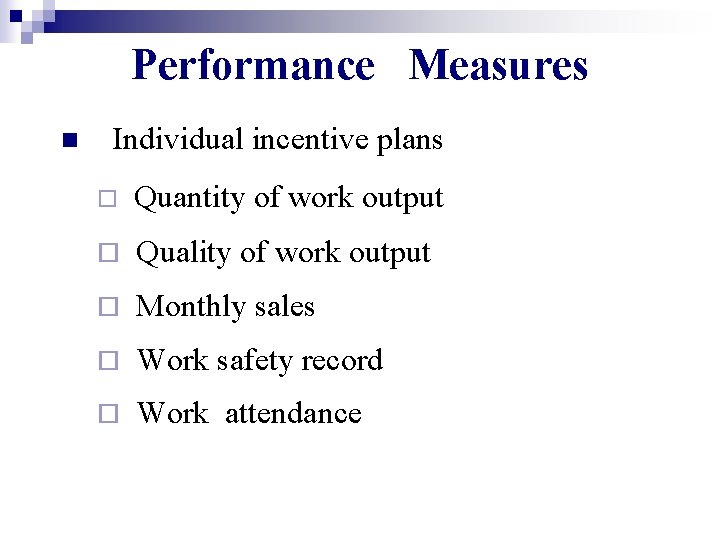
Performance Measures n Individual incentive plans ¨ Quantity of work output ¨ Quality of work output ¨ Monthly sales ¨ Work safety record ¨ Work attendance
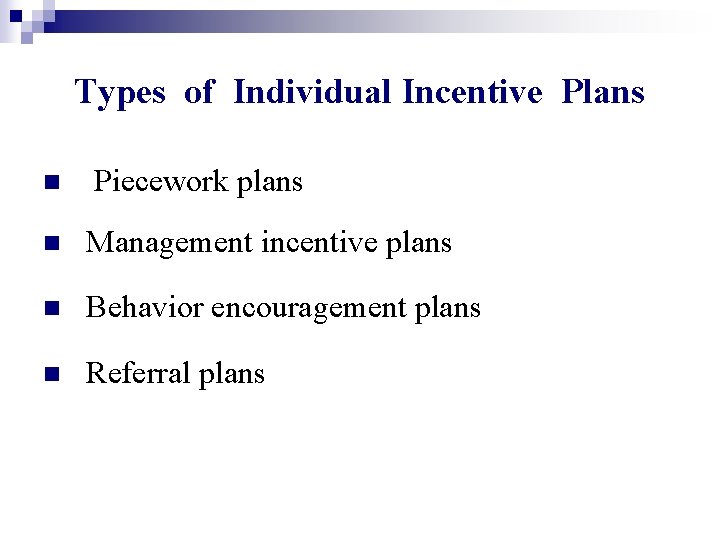
Types of Individual Incentive Plans n Piecework plans n Management incentive plans n Behavior encouragement plans n Referral plans
Piecework Plans Awards based on individual production or objective standards n Awards based on individual performance standards using objective & Subjective criteria n n Quantity and / or quality goals
Individual Incentive Plan Advantages n Helps relate pay to performance Promotes equitable distribution of compensation n n Helps retain best performers Compatible with America’s individualistic culture n
Disadvantages May promote inflexibility n Unrealistic standards may hamper employee motivation n Factors beyond employee’s control may affect outcomes n Factors not rewarded may be overlooked n
Group Incentive Plans Rewards employees for their collective performance n Use has increased in industry n n 2 types ¨ Team - based or small group ¨ Gain sharing
Allocation Methods n Equal incentive payments Differential payments based on contribution to goals n Differential payments according to base pay n
Gain Sharing Gainsharing is a system of management used by a business to increase profitability by motivating employees to improve their performance through involvement and participation. As their performance improves, employees share financially in the gain (improvement). n In gain sharing, gain means savings. An employee or team shares in the amount saved by a business as a result of a suggestion he made or task performed. n
Company - Wide Incentive Plans Rewards employees when company meets performance standards n n 2 Types ¨ Profit sharing plans ¨ Employee stock option plans
Designing Sales Incentive Compensation Plans Sales volume, which indicates the amount of sales that should be achieved for a specified period. Ø New business, which refers to making sales from customers who have not made previous purchases. Ø Retaining sales, which simply targets a level of sales from existing customers. Ø Product mix, which rewards sales professionals for selling a pre-established mix of a company’s product goods or services. Ø Win-back sales, which is designed to motivate sales professionals to regain business from former. n
Designing Sales Incentive Compensation Plans Alternative Sales Compensation Ø Choosing the appropriate plan depends on the company’s competitive strategy Ø Five main alternatives a. Salary-only b. Salary-plus-bonus c. Salary-plus-commission d. Commission-plus-draw e. Commission-only n
Designing Sales Incentive Compensation Plans n Multiple-tiered commissions Ø Award sales professionals with higher percentages of the sales made in a given period, Ø If the sales level exceeds a pre-determined level n Example: Multiple-Tiered Commissions * 8% commissions per unit for sales up to 1000 units * 12% commissions per unit for sales exceeding 1000 units
Executive Compensation n Executive Compensation is a broad term for the financial compensation awarded to a firm's executives. Executive Compensation packages are designed by a company's Board of Directors, typically by the Compensation Committee consisting of independent directors, with the purpose of incentivizing the executive team, who have a significant impact on company strategy, decisionmaking, and value creation (Pay for Performance) as well as enhancing Executive Retention.
Executive Compensation There are following basic features of executive compensation or remuneration: Ø Salary Ø Short-term incentives (STIs), sometimes known as bonuses Ø Long-term incentive plans (LTIPs) Ø Employee benefits and paid expenses (perquisites) Ø Insurance and Golden parachute Plans Ø Stocks n
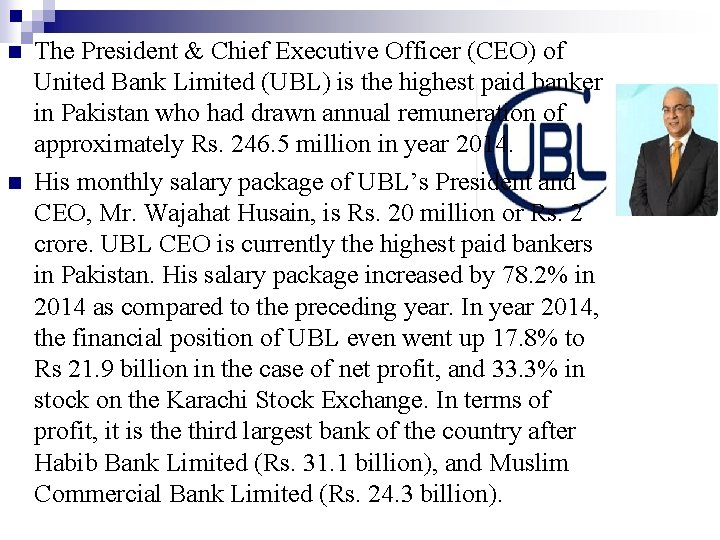
n n The President & Chief Executive Officer (CEO) of United Bank Limited (UBL) is the highest paid banker in Pakistan who had drawn annual remuneration of approximately Rs. 246. 5 million in year 2014. His monthly salary package of UBL’s President and CEO, Mr. Wajahat Husain, is Rs. 20 million or Rs. 2 crore. UBL CEO is currently the highest paid bankers in Pakistan. His salary package increased by 78. 2% in 2014 as compared to the preceding year. In year 2014, the financial position of UBL even went up 17. 8% to Rs 21. 9 billion in the case of net profit, and 33. 3% in stock on the Karachi Stock Exchange. In terms of profit, it is the third largest bank of the country after Habib Bank Limited (Rs. 31. 1 billion), and Muslim Commercial Bank Limited (Rs. 24. 3 billion).
One-dollar Salary n A number of top executives in large businesses and governments work for an annual salary of one dollar. Ø Many executives who take a one-dollar salary also choose not to take any other forms of compensation. In some cases, in lieu of a salary, the executives receive stock options and bonuses. The assumption is that stock prices will reflect the actual value of a company, which reflect the management performance of the company. Ø 19
n n n Facebook founder and CEO Mark Zuckerberg is now the company’s lowest-paid employee, according to its latest proxy filing. Zuckerberg — worth $27. 8 billion mostly in Facebook stock — requested an annual wage of $1 in 2013, joining the ranks of a handful of other very wealthy CEOs who take a symbolically negligible base pay. Zuckerberg, who earned $770, 000 in combined salary and bonus in 2012, is now in good company among giants of the tech sector. Google's GOOG -1. 73% Sergey Brin and Larry Page, worth roughly $30 billion a piece, have been drawing a $1 salary for a decade now. “The dollar salary really for them is meant to signify that they have large stakes in their company. The value they’re going to receive – the compensation they’ll earn – is coming solely from their stock, ” “You’re not going to question whether or not Larry Page is interested in growing a company’s stock as a shareholder. As one of the largest shareholders, he’s all in. ” 20
Related Article Ø Kerr, S. (1995). On the folly of rewarding A, while hoping for B. The Academy of Management Executive (1993 -2005), 7 -14.
- Slides: 21