
CHAPTER 8 IDEAL OPERATIONAL AMPLIFIER AND OPAMP CIRCUITS
- Slides: 20
CHAPTER 8 IDEAL OPERATIONAL AMPLIFIER AND OP-AMP CIRCUITS
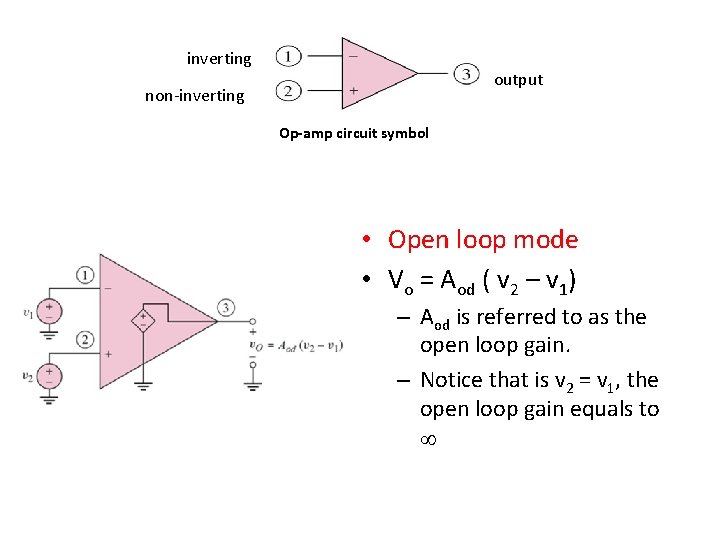
inverting output non-inverting Op-amp circuit symbol • Open loop mode • Vo = Aod ( v 2 – v 1) – Aod is referred to as the open loop gain. – Notice that is v 2 = v 1, the open loop gain equals to
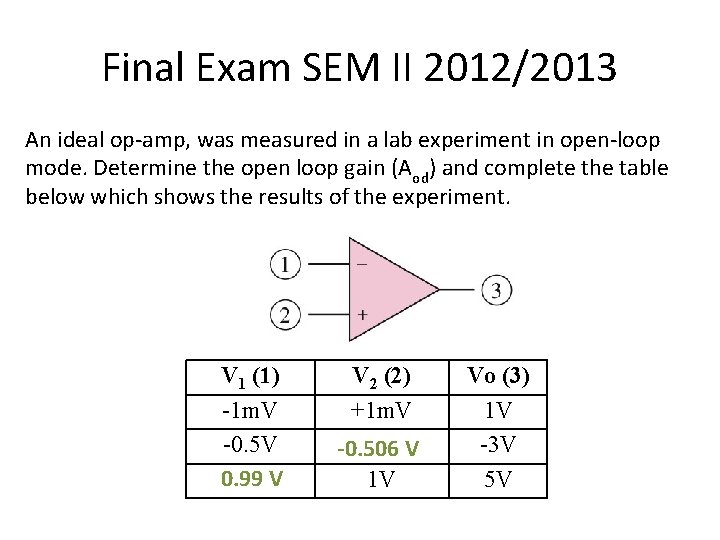
Final Exam SEM II 2012/2013 An ideal op-amp, was measured in a lab experiment in open-loop mode. Determine the open loop gain (Aod) and complete the table below which shows the results of the experiment. V 1 (1) -1 m. V -0. 5 V 0. 99 V V 2 (2) +1 m. V V -0. 506 1 V Vo (3) 1 V -3 V 5 V
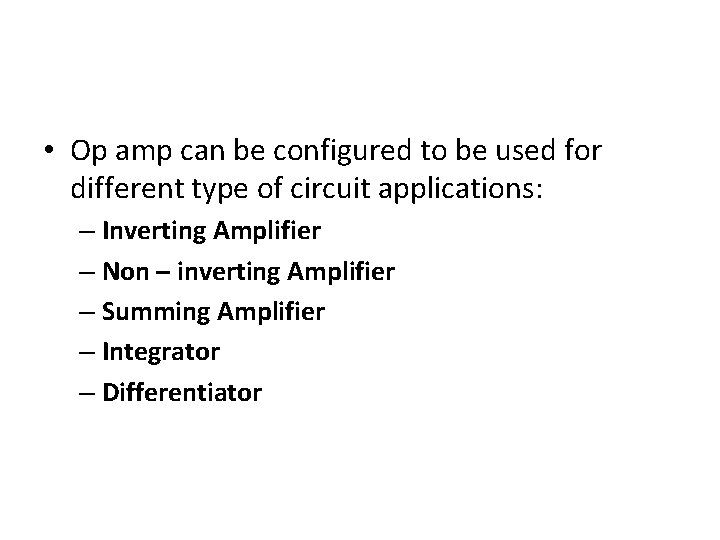
• Op amp can be configured to be used for different type of circuit applications: – Inverting Amplifier – Non – inverting Amplifier – Summing Amplifier – Integrator – Differentiator
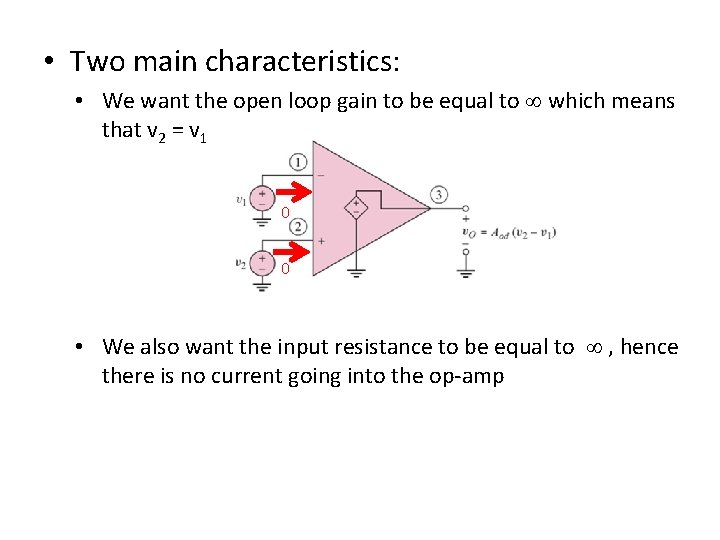
• Two main characteristics: • We want the open loop gain to be equal to which means that v 2 = v 1 0 0 • We also want the input resistance to be equal to , hence there is no current going into the op-amp
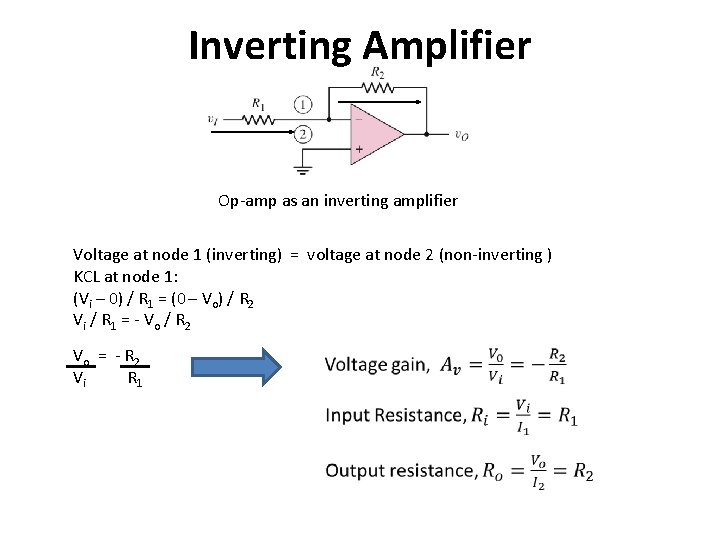
Inverting Amplifier Op-amp as an inverting amplifier Voltage at node 1 (inverting) = voltage at node 2 (non-inverting ) KCL at node 1: (Vi – 0) / R 1 = (0 – Vo) / R 2 Vi / R 1 = - Vo / R 2 Vo = - R 2 Vi R 1
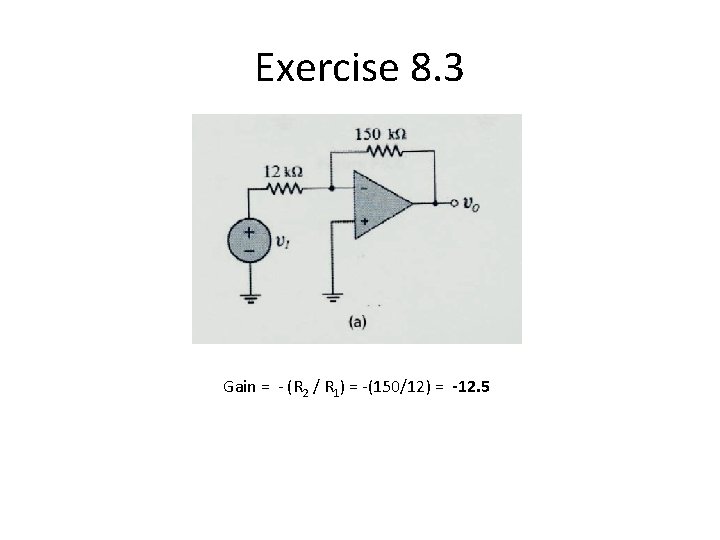
Exercise 8. 3 Gain = - (R 2 / R 1) = -(150/12) = -12. 5
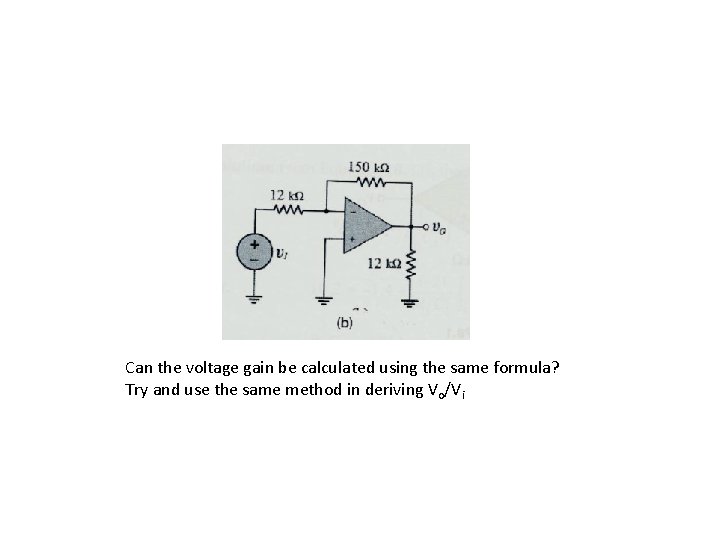
Can the voltage gain be calculated using the same formula? Try and use the same method in deriving Vo/Vi
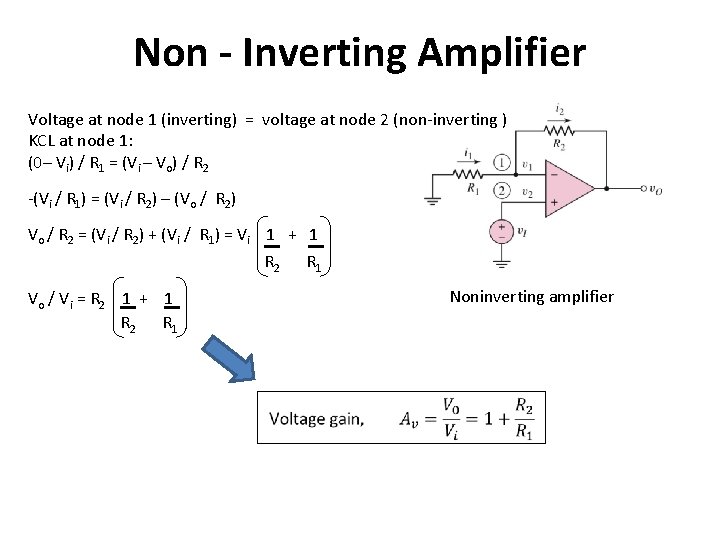
Non - Inverting Amplifier Voltage at node 1 (inverting) = voltage at node 2 (non-inverting ) KCL at node 1: (0– Vi) / R 1 = (Vi – Vo) / R 2 -(Vi / R 1) = (Vi / R 2) – (Vo / R 2) Vo / R 2 = (Vi / R 2) + (Vi / R 1) = Vi 1 + 1 R 2 Vo / Vi = R 2 1 + 1 R 2 R 1 Noninverting amplifier
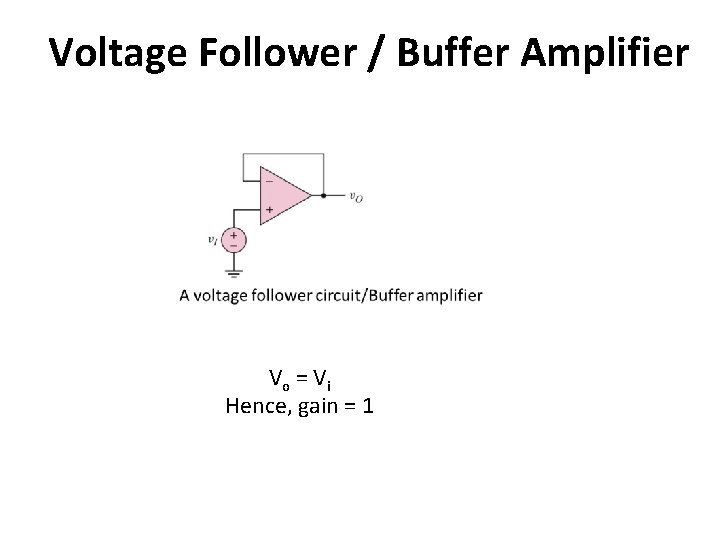
Voltage Follower / Buffer Amplifier Vo = Vi Hence, gain = 1
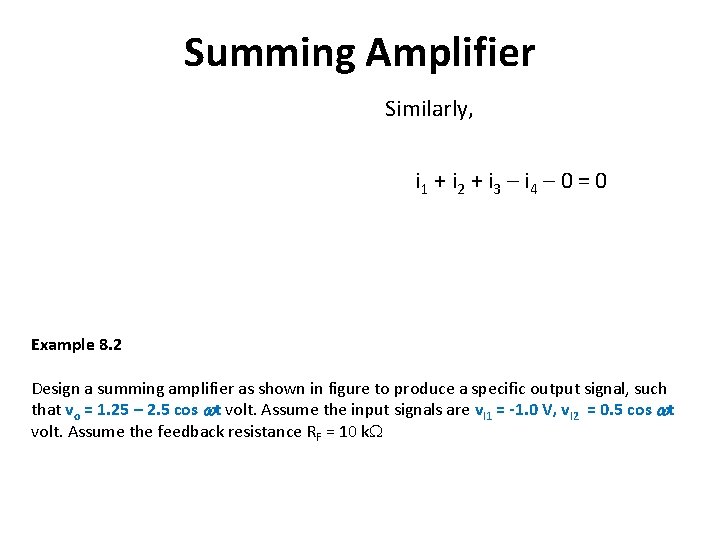
Summing Amplifier Similarly, i 1 + i 2 + i 3 – i 4 – 0 = 0 Example 8. 2 Design a summing amplifier as shown in figure to produce a specific output signal, such that vo = 1. 25 – 2. 5 cos t volt. Assume the input signals are v. I 1 = -1. 0 V, v. I 2 = 0. 5 cos t volt. Assume the feedback resistance RF = 10 k
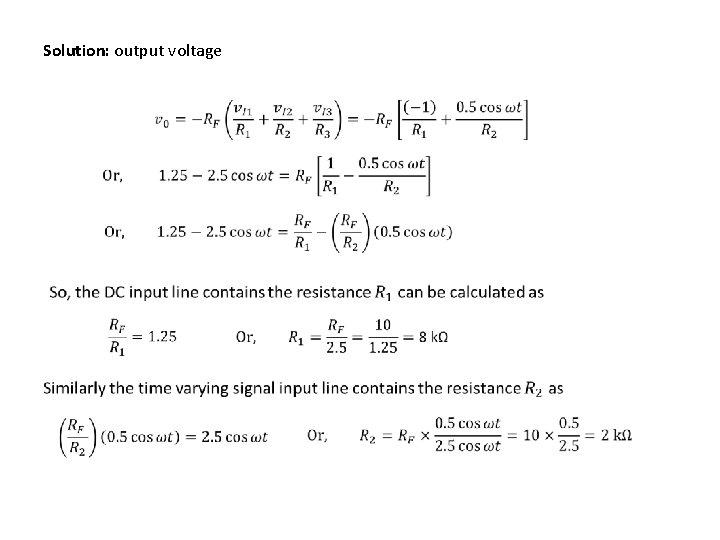
Solution: output voltage
Other Op-Amp Applications
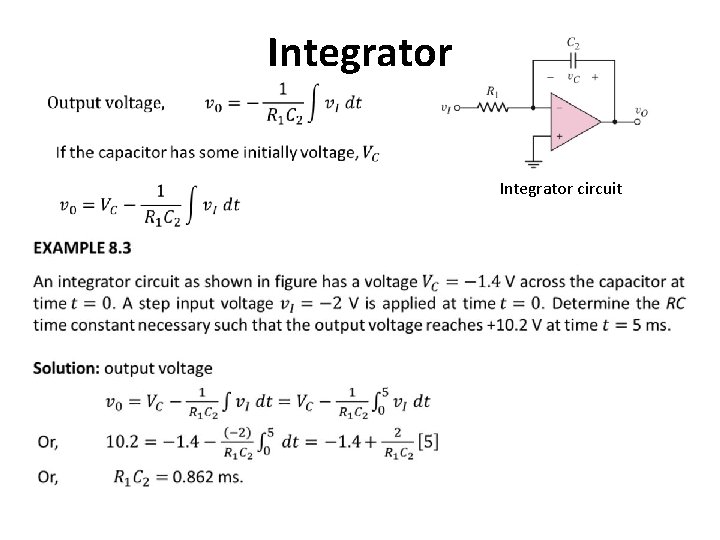
Integrator Integrator circuit
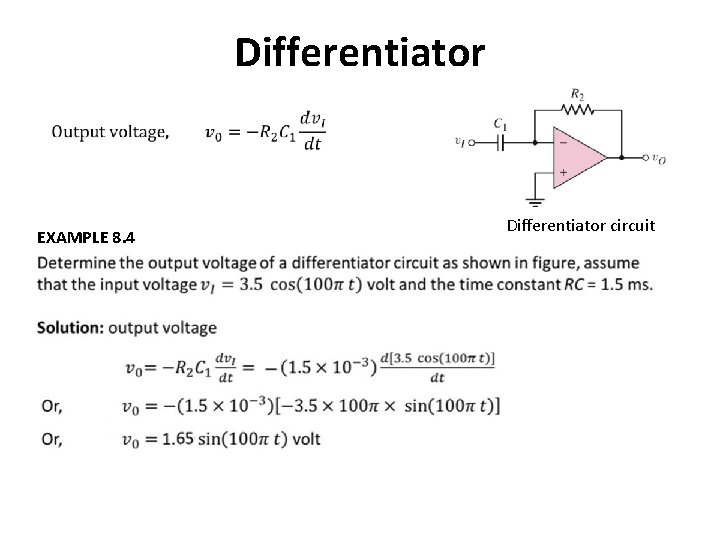
Differentiator EXAMPLE 8. 4 Differentiator circuit
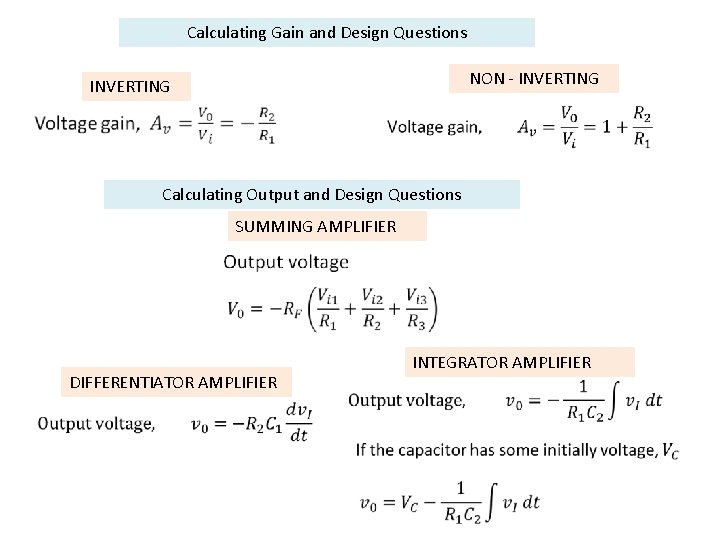
Calculating Gain and Design Questions NON - INVERTING Calculating Output and Design Questions SUMMING AMPLIFIER DIFFERENTIATOR AMPLIFIER INTEGRATOR AMPLIFIER
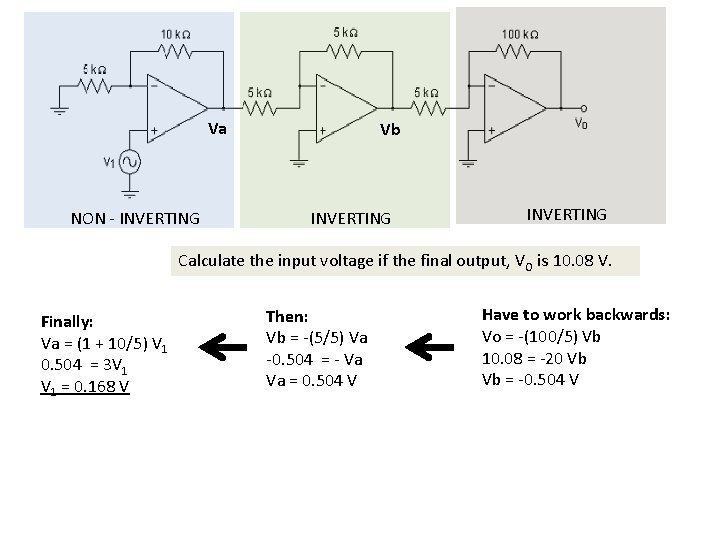
Va NON - INVERTING Vb INVERTING Calculate the input voltage if the final output, VO is 10. 08 V. Finally: Va = (1 + 10/5) V 1 0. 504 = 3 V 1 = 0. 168 V Then: Vb = -(5/5) Va -0. 504 = - Va Va = 0. 504 V Have to work backwards: Vo = -(100/5) Vb 10. 08 = -20 Vb Vb = -0. 504 V
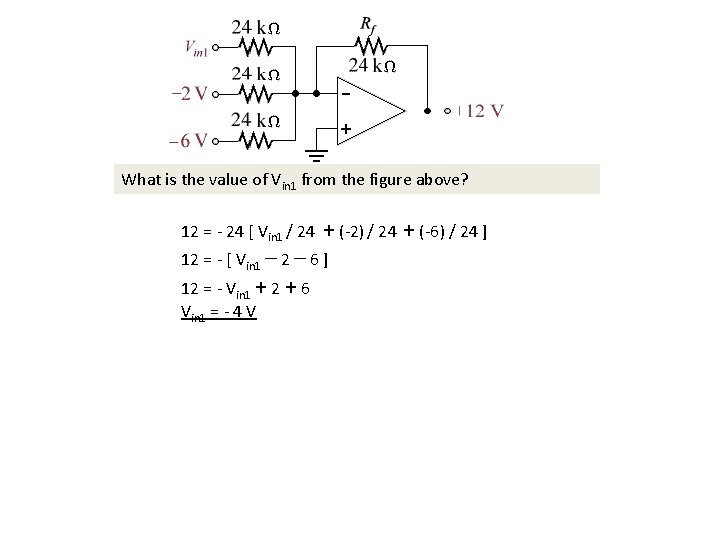
What is the value of Vin 1 from the figure above? 12 = - 24 [ Vin 1 / 24 + (-2) / 24 + (-6) / 24 ] 12 = - [ Vin 1 – 2 – 6 ] 12 = - Vin 1 + 2 + 6 Vin 1 = - 4 V
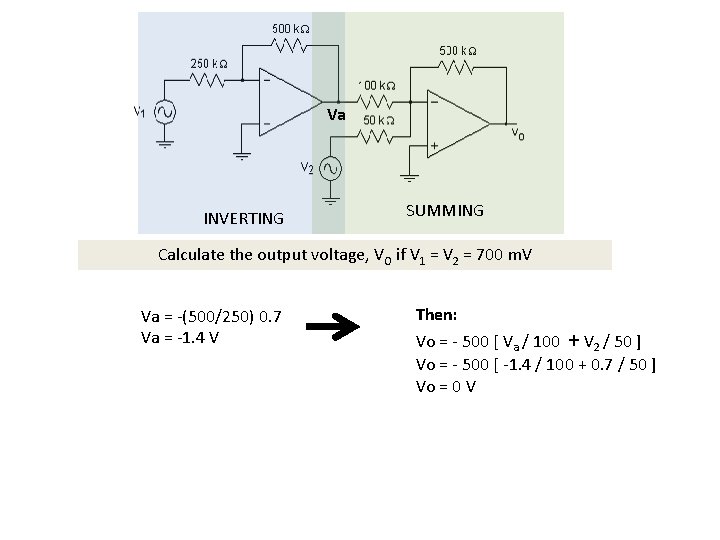
Va INVERTING SUMMING Calculate the output voltage, VO if V 1 = V 2 = 700 m. V Va = -(500/250) 0. 7 Va = -1. 4 V Then: Vo = - 500 [ Va / 100 + V 2 / 50 ] Vo = - 500 [ -1. 4 / 100 + 0. 7 / 50 ] Vo = 0 V
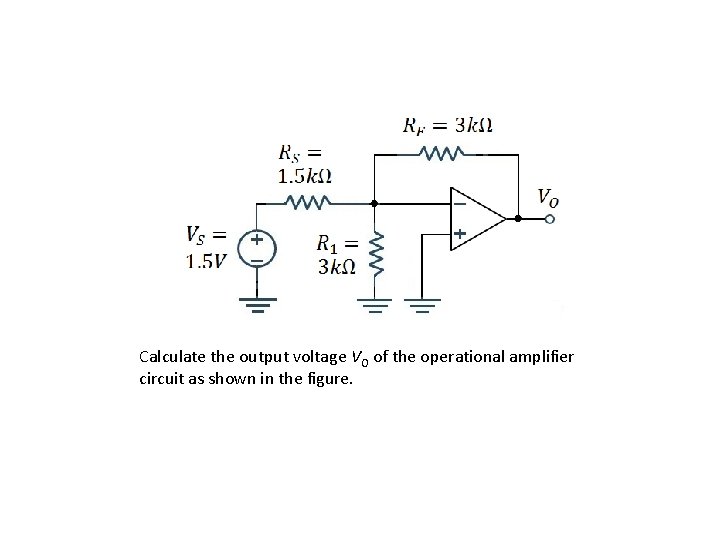
Calculate the output voltage VO of the operational amplifier circuit as shown in the figure.