
CHAPTER 8 How We Change Behavior Change and
CHAPTER 8 How We Change: Behavior Change and Personal Training Copyright © 2010 American College of Sports Medicine
OBJECTIVES • Understand the distinct, predictable stages of behavior change. • Determine the stage your client is in for a particular behavior. • Match training approach to different stages of change. Copyright © 2010 American College of Sports Medicine
INTRODUCTION • While you can’t force a client to show up for an appointment, you can take a step toward improving the current abysmal dropout rate during the first year of personal training by learning to assist clients in making positive changes, not just in their exercise habits, but in other areas of their life as well. • Understanding the process of change is the first step toward improving the noncompliance rate. Copyright © 2010 American College of Sports Medicine
THE CONTEXT FOR LASTING CHANGE • Relationship • Accountability Copyright © 2010 American College of Sports Medicine
RELATIONSHIP • Change occurs best in the context of a supportive and encouraging relationship. • The Personal Trainer–client relationship can provide this context when a client wishes to develop a healthier lifestyle. • A skilled Personal Trainer allows the process of change to unfold with ease by offering a profound level of encouragement and willingness to accept and meet the client “where they are. ” Copyright © 2010 American College of Sports Medicine
ACCOUNTABILITY • The Personal Trainer–client relationship provides a structure of accountability for both parties. • The Personal Trainer must be accountable to his or her client. • Conversely, when a client shares a commitment to achieve goals with a Personal Trainer they respect and who believes in them, they are likely to stay motivated and keep their commitments. Copyright © 2010 American College of Sports Medicine
BEHAVIOR MODIFICATION THEORY • Behaviorism argues that human behavior is dictated by the environment, primarily the antecedents and consequences of the behavior. • In a meta-analysis of over 100 physical activity interventions, behavior modification strategies had greater effects on increasing exercise adherence than all other approaches. Copyright © 2010 American College of Sports Medicine
CLASSICAL AND OPERANT CONDITIONING • Classical conditioning (Pavlov) states that a response (behavior) can be modified by changing the stimulus (antecedent). • Operant conditioning (Skinner) is the philosophy that behavior is shaped by consequences or rewards. Copyright © 2010 American College of Sports Medicine
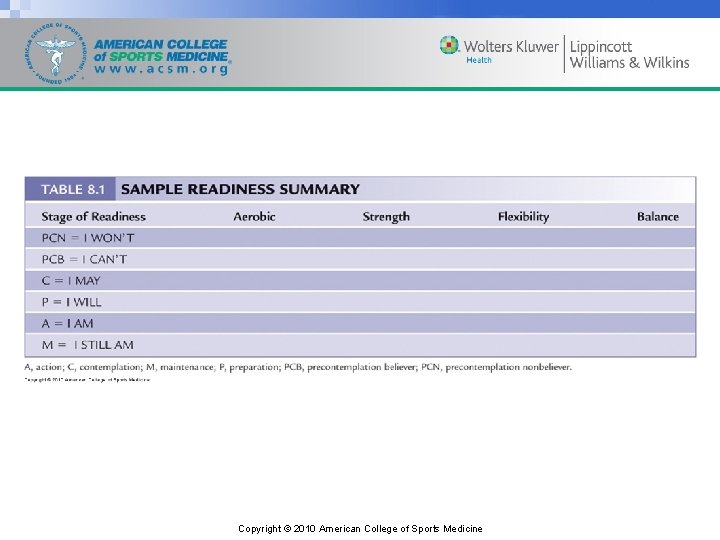
BEHAVIORAL CHANGE AS A STAGED PROCESS • Transtheoretical model to describe behavior change – – – Precontemplation (I won’t, I can’t) Contemplation (I might) Preparation (I will) Action (I am) Maintenance (I still am) Copyright © 2010 American College of Sports Medicine
PRECONTEMPLATION • Individuals who are “precontemplators” are in one of two categories: “I won’t” or “I can’t. ” • Generally speaking, the “I won’ts” are disinterested in change, whereas the “I can’ts” are dispirited and cannot imagine being able to make a change. • The “I won’t” precontemplators have no interest in changing a behavior because they do not believe they have a problem. • The “I can’t” precontemplators do not believe they are capable of changing. Copyright © 2010 American College of Sports Medicine
CONTEMPLATION • During this stage, clients are “thinking about” changing an unhealthy behavior and are considering taking action within the next 6 months. • Individuals are well aware that a particular behavioral change would benefit them, and they are becoming more dissatisfied with the results of not changing. • Yet, they need to resolve their ambivalence before their actions will be successful and sustainable. Copyright © 2010 American College of Sports Medicine
PREPARATION • The “I will” stage is defined as the stage where the client has consciously decided to take action within the next month, and is actively planning to do so. • The motivators are defined and strong, and feelings of ambivalence have largely been handled. • A characteristic behavior at this stage is “experimenting” with the change of concern. Copyright © 2010 American College of Sports Medicine
ACTION (I am) • A client is committed to a new behavior, and he or she is doing it consistently, building up to the target level. • This is the busiest stage because people are concentrating and working very hard practicing a new behavior, refining it, and incorporating it consistently into their lives. • This stage begins when a client is consistently acting on changing a behavior and ends when they have been doing it consistently for 6 months. Copyright © 2010 American College of Sports Medicine
MAINTENANCE • The “maintenance” stage is achieved when someone has adopted a new behavior and done it consistently for 6 months. • It is referred to as “I still am!” This is when the new behavior is a firmly established habit and the client is absolutely confident in their ability to maintain the behavior. Copyright © 2010 American College of Sports Medicine
Strategies For Different Stages Precontemplation • Not yet discovered “pros” to outweigh discomfort and difficulty of change • Need information • Need to understand all the benefits of change • Client must be receptive to info – Need to know right time to provide info – Need to be non-judgmental • Info alone will not change behavior Copyright © 2010 American College of Sports Medicine
Strategies For Different Stages Contemplative • • May last a while Highlight is ambivalance Must listen and be empathetic Must understand the clients need to work through issues on own timetable Copyright © 2010 American College of Sports Medicine
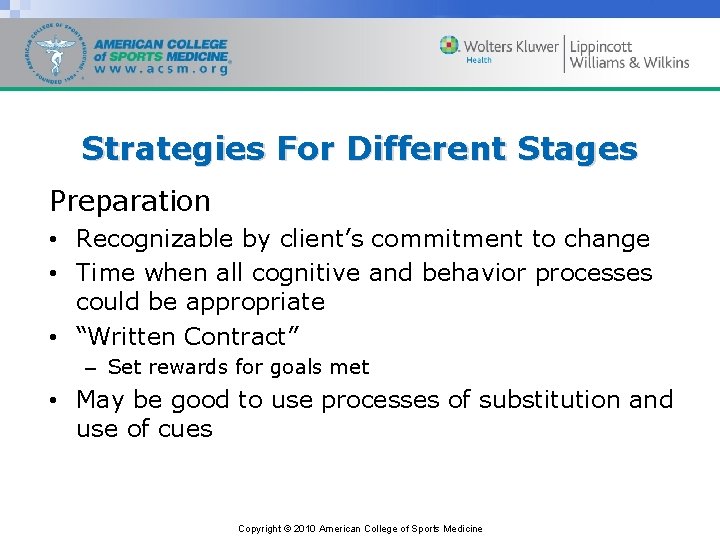
Strategies For Different Stages Preparation • Recognizable by client’s commitment to change • Time when all cognitive and behavior processes could be appropriate • “Written Contract” – Set rewards for goals met • May be good to use processes of substitution and use of cues Copyright © 2010 American College of Sports Medicine
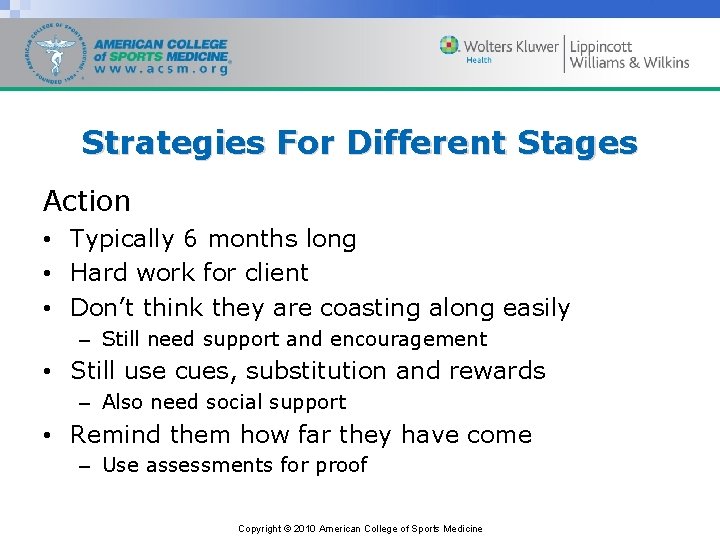
Strategies For Different Stages Action • Typically 6 months long • Hard work for client • Don’t think they are coasting along easily – Still need support and encouragement • Still use cues, substitution and rewards – Also need social support • Remind them how far they have come – Use assessments for proof Copyright © 2010 American College of Sports Medicine
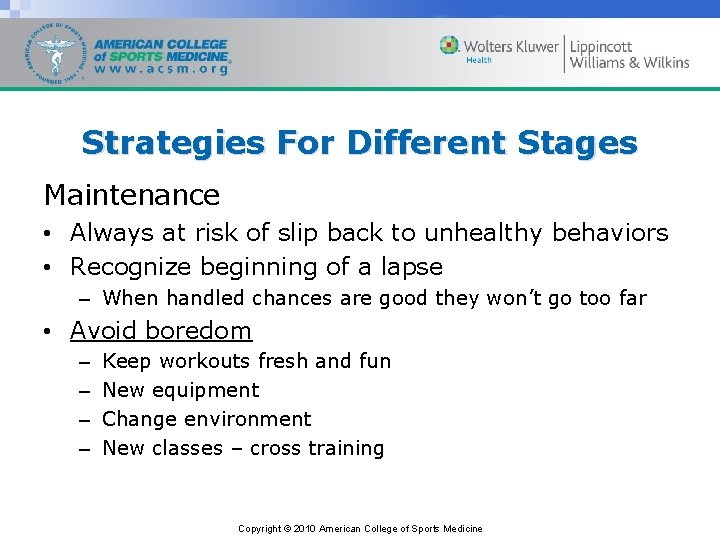
Strategies For Different Stages Maintenance • Always at risk of slip back to unhealthy behaviors • Recognize beginning of a lapse – When handled chances are good they won’t go too far • Avoid boredom – – Keep workouts fresh and fun New equipment Change environment New classes – cross training Copyright © 2010 American College of Sports Medicine
Copyright © 2010 American College of Sports Medicine
COGNITIVE CHANGE PROCESSES Consciousness Raising: Raising Includes information gathering, either by learning new facts about a subject, or discovering previously unknown feelings, values, etc. Health education is an important consciousness raising technique for Personal Trainers to utilize. For example, when doing fitness assessments, a client can discover exactly what their fitness level is in relation to healthy norms. Copyright © 2010 American College of Sports Medicine
Self-image (Self Re-evaluation): Re-evaluation) A positive self-image should be aligned with the new behavior. A client is excited when considering how he or she will look, feel, and act, and how life will be better as the changed self, so the client is drawn to the target behavior. Copyright © 2010 American College of Sports Medicine
Dramatic release: release Dramatic release is similar to consciousness-raising, but works at a deeper, emotional level. For example, when a client’s close friend has a sudden heart attack, this may motivate the client to start running again. Copyright © 2010 American College of Sports Medicine
Social norms: norms Social norms reflect the relationships between individuals and provide support and reinforce new behavior. Groups such as Weight Watchers are very helpful in early stages of change. In these settings, group expectations reinforce the new healthy behavior. There is a palpable collective empathy for the “changer, ” and at the same time, numerous role models are present to provide tips and encouragement. Copyright © 2010 American College of Sports Medicine
Role Modeling: Modeling The process of role modeling involves considering how our behaviors affect those that we love. For example, parents who begin to question what they are teaching their children about health and wellness may take up exercise or quit smoking. This process is helpful in the early stages of change when finding the pros of a behavior change is occurring. Copyright © 2010 American College of Sports Medicine
BEHAVIORAL CHANGE PROCESSES Commitment: Commitment Making a formal commitment connotes a full acceptance of responsibility for changing. An example of this change strategy is called a contingency contract, an agreement between the Personal Trainer and client that details goals, time frames, measures of success, and rewards. The more specific a commitment, the more effective it is. Copyright © 2010 American College of Sports Medicine
Environmental Control: Control In environmental control, the client identifies and eliminates the cues that produce the problem behavior from the environment. They then develop new cues that signal the healthy behavior. For example, they can be reminded to exercise by strategically placed notes to themselves, by getting emails from the Personal Trainer, or by putting exercise clothes in their car to encourage going to the gym after work. Copyright © 2010 American College of Sports Medicine
Substitutions (counter-conditioning): (counter-conditioning) Countering, or substituting healthy behaviors in the place of unhealthy ones, can be called the “instead of” process. When exercising is the target behavior, the Personal Trainer can encourage stairs “instead of” elevators, or biking to work “instead of” driving, or substituting a short walk for zoning out in front of the television. Copyright © 2010 American College of Sports Medicine
Social support (helping relationships): relationships) This process is important in all stages of change. The Personal Trainer can provide a very important element of social support for clients as they traverse the stages of change. Other sources of support can come from family close friends and should be encouraged. For example, suggest a client walk with a friend, because it is much more likely that they will keep their promise to walk if they are meeting someone. Copyright © 2010 American College of Sports Medicine
Rewards (reinforcement): (reinforcement) In this process, the target behavior is rewarded to help increase its frequency. The reinforcement could come from the Personal Trainer, by rewarding a client for completed exercise sessions and/or for accomplishing specific goals. The client can come up with their own reward system, and make it part of their formal commitment. Copyright © 2010 American College of Sports Medicine
- Slides: 30