
Chapter 8 Health Promotion Programs for the Workplace
- Slides: 19
Chapter 8 Health Promotion Programs for the Workplace
Epidemic of Chronic Diseases in the Workplace • According to Jack et al. (2006), as the ever increasing burden of chronic diseases in the United States continues, greater efforts will be made to identify and implement interventions that successfully reduce disease risk, especially in the workplace. • Although chronic diseases are among the most common and costly of health problems, they are also among the most preventable.
Major Diseases That Develop in the Workplace • Research clearly implicates tobacco use, obesity, physical inactivity and diet as the major causes of many of the most deadly and expensive chronic diseases. • These diseases are developing during the working years and produce enormous economic costs for the worker and the employer later in life.
Employers Concern About Health Care Costs • Escalation in health insurance premiums • Reduction in worker productivity • Increase in worker morbidity and mortality
Reasons for Expansion of Workplace Wellness Programs • In response to the rising costs of health insurance, many employers are now beginning to offer employees worksite wellness programs. • The worksite offers an excellent opportunity for the development of a new health promotion program. • These programs have been shown to increase worker morale and loyalty.
Planning a Workplace Wellness program • The first step in the establishment of a workplace wellness program is the establishment of a planning committee for the project. • This planning committee should include management, workers, union representatives, and someone from the human resource management department.
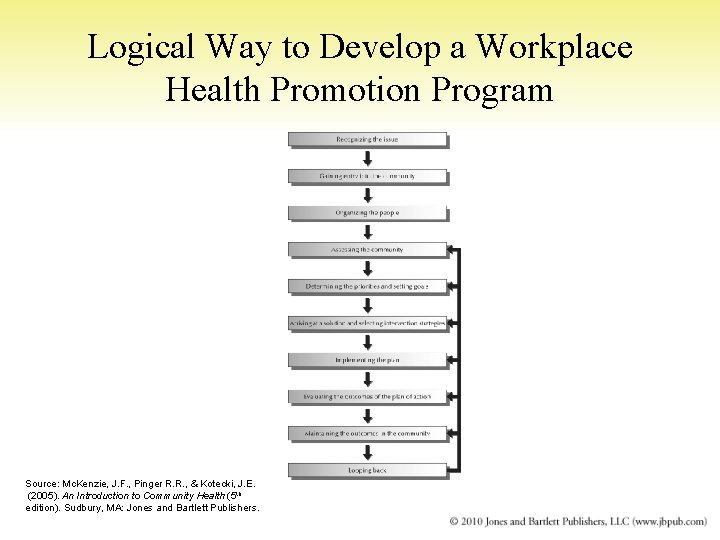
Logical Way to Develop a Workplace Health Promotion Program Source: Mc. Kenzie, J. F. , Pinger R. R. , & Kotecki, J. E. (2005). An Introduction to Community Health (5 th edition). Sudbury, MA: Jones and Bartlett Publishers.
Physical Inactivity • The prevalence of a sedentary life style makes physical inactivity a force to be dealt with by employers. • The barriers to physical activity have been found to be time, motivation, and social support and knowledge. • All of these barriers can potentially be reduced or eliminated in the workplace.
Tobacco Use, Second Hand Smoke, and the Workplace • The Centers for Disease Control and Prevention argue that the use of tobacco is the leading cause of the development of many chronic diseases in this country. • Smoking harms nearly every organ in the body, causing many diseases, and reduces life expectancy and quality of life for many Americans.
Tobacco Use, Second Hand Smoke, and the Workplace, Continued • Research is uncovering more and more dangers from “passive smoke. ” • There is no risk-free level of exposure to secondhand smoke. • The workplace has been identified as a major source of secondhand smoke exposure for adults in this country. • All workplaces need smoke-free policies.
Overweight, Obesity, and the Workplace • The growing obesity problem in the United States can cut the average life expectancy of Americans by as much as five years. • This weight gain by Americans affects the employer by increased worker illness and disability and a reduction in productivity. • Employer sponsored weight management programs could yield significant cost savings for the workplace.
Nutrition in the Workplace • Dietary factors are responsible for 40 percent of the leading causes of mortality in this country. • According to the Prevention Institute (2006), eating is a behavior that is greatly influenced by the workplace. • At least one meal per day is consumed at work, and snacks are often a means to relieve pressure and take breaks throughout the workday.
Primary Health Care in the Workplace • Prevention programs occur before a problem occurs. • There is absolutely no reason for American businesses not to be interested in keeping their employees healthy. • American businesses are starting to see workplace wellness programs as one health care reform that works.
Health Risk Appraisals • An excellent starting point in the development of a worksite wellness program is found in the use of a Health Risk appraisal (HRA). • The HRA can be a great tool to increase employee awareness of high-risk health behaviors, which will predispose them to the development of chronic diseases. • The results of the HRA’s should be presented to all employees by a medical consultant.
Health Risk Appraisal, Continued • The Centers for Medicare and Medicaid (CMS) describes HRA as “a systematic approach to collecting information from individuals that identifies risk factors, provides individualized feedback and links the person with at least one intervention to promote health, sustain function and/or prevent disease. ”
Rate of Return on Workplace Wellness Programs • Goetzel (2004) reports that the rate of return on investment for workplace wellness programs ranges from $1. 40 to $13. 00 in benefits per dollar spent on the program, depending on what type of program is offered to employees.
Workplace Wellness Success Stories • Coca Cola reports saving $500 every year per employee after implementing a fitness program, with only 60 percent of their employees participating. • Pacific Bell reported that overall absenteeism decreased after implementing a wellness program.
Workplace Wellness Success Stories, Continued • Coors Brewing Co. reported that for each dollar spent on their Corporate Wellness Program they saw a $5. 50 return, and the employees who participated reduced their absentee rate by 18 percent. • Prudential Insurance Company reported that the benefits costs for employees participating in their program were $312, as opposed to $574 for non-participants.
Discussion Questions • How do workplace wellness programs help to improve health and reduce health insurance premiums? • Why has it taken so long for workplace wellness programs to be accepted by employers as a way to deal with the health insurance crisis in this country? • What is the value of conducting a needs assessment before beginning a workplace wellness program?