
CHAPTER 8 Group Treatment Substance Abuse Counseling Theory
CHAPTER 8: Group Treatment Substance Abuse Counseling: Theory and Practice Fifth Edition Patricia Stevens Robert L. Smith Prepared by: Dr. Susan Rose, University of the Cumberlands
Overview of Chapter ● Introduction ● Evolution of Group Treatment ● Group Dynamics, Process and Structure ● Group Treatment in the Continuum of Care ● Pragmatics of Group Treatment ● Group Treatment Efficacy Stevens/Smith. Substance Abuse Counseling: Theory and Practice, 5 e © 2013, 2009, 2005, 2001, 1998 by Pearson Education, Inc. All Rights Reserved 8 -2

Introduction ● Group treatment is the most common modality for the delivery of services to individuals and families recovering from substance use disorders. ● Psychoeducational groups can provide means for learning information about addiction as well as social and coping skills needed to reduce risk of relapse. ● Self-help groups cultivate hope. ● Best outcomes involve matching clients with stages of change, intervention, or counselor characteristics. ● Early identification and intervention with at-risk adolescents can disrupt the progression of problems with addictive disorders. Stevens/Smith. Substance Abuse Counseling: Theory and Practice, 5 e © 2013, 2009, 2005, 2001, 1998 by Pearson Education, Inc. All Rights Reserved 8 -3
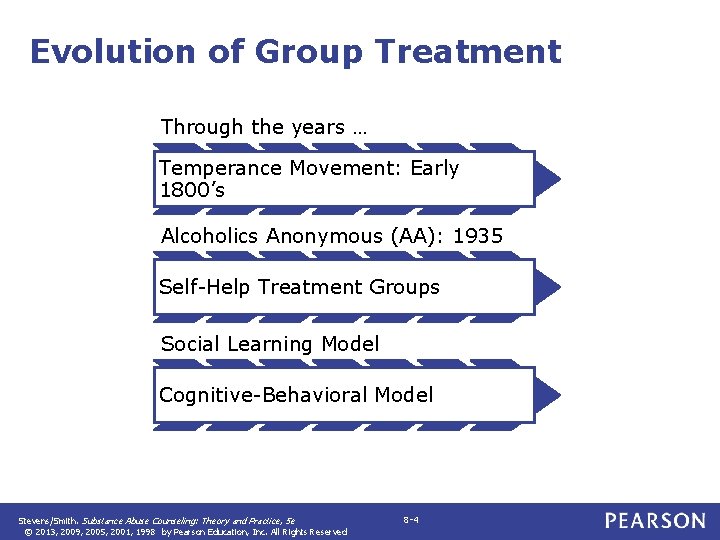
Evolution of Group Treatment Through the years … Temperance Movement: Early 1800’s Alcoholics Anonymous (AA): 1935 Self-Help Treatment Groups Social Learning Model Cognitive-Behavioral Model Stevens/Smith. Substance Abuse Counseling: Theory and Practice, 5 e © 2013, 2009, 2005, 2001, 1998 by Pearson Education, Inc. All Rights Reserved 8 -4
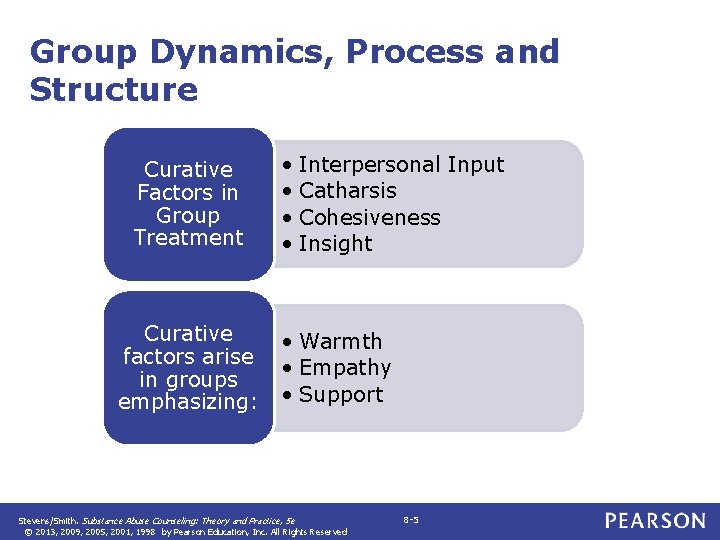
Group Dynamics, Process and Structure Curative Factors in Group Treatment Curative factors arise in groups emphasizing: • Interpersonal Input • Catharsis • Cohesiveness • Insight • Warmth • Empathy • Support Stevens/Smith. Substance Abuse Counseling: Theory and Practice, 5 e © 2013, 2009, 2005, 2001, 1998 by Pearson Education, Inc. All Rights Reserved 8 -5
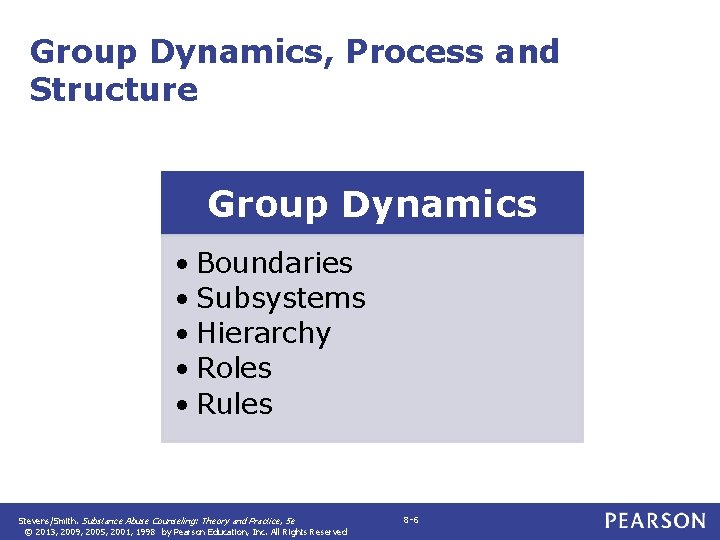
Group Dynamics, Process and Structure Group Dynamics • Boundaries • Subsystems • Hierarchy • Roles • Rules Stevens/Smith. Substance Abuse Counseling: Theory and Practice, 5 e © 2013, 2009, 2005, 2001, 1998 by Pearson Education, Inc. All Rights Reserved 8 -6

Group Dynamics, Process and Structure: Stages of Group Development Yalom’s Formative Development Stages • Initial Stage • Storming Stage • Final Stage Stevens/Smith. Substance Abuse Counseling: Theory and Practice, 5 e © 2013, 2009, 2005, 2001, 1998 by Pearson Education, Inc. All Rights Reserved Corey’s Development Stages • Formation • Initial Orientation and Exploration • Transition or Dealing with Resistance • Working or Cohesion and Productivity • Consolidation and Termination • Evaluation and Follow-Up 8 -7
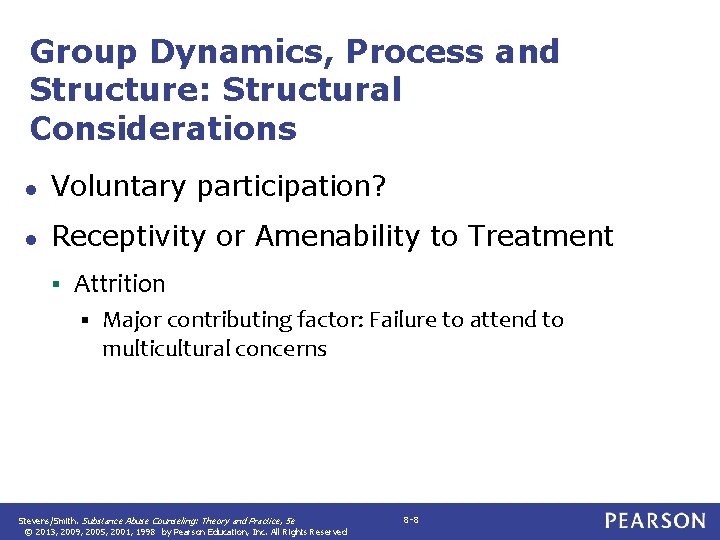
Group Dynamics, Process and Structure: Structural Considerations ● Voluntary participation? ● Receptivity or Amenability to Treatment § Attrition § Major contributing factor: Failure to attend to multicultural concerns Stevens/Smith. Substance Abuse Counseling: Theory and Practice, 5 e © 2013, 2009, 2005, 2001, 1998 by Pearson Education, Inc. All Rights Reserved 8 -8
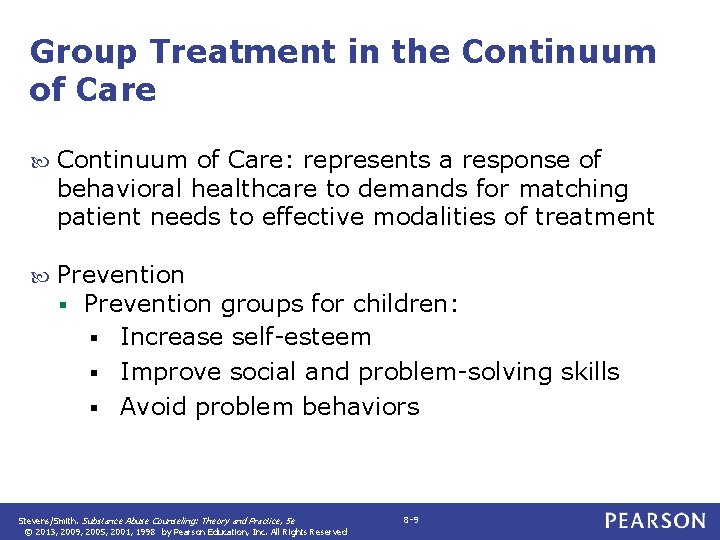
Group Treatment in the Continuum of Care: represents a response of behavioral healthcare to demands for matching patient needs to effective modalities of treatment Prevention § Prevention groups for children: § Increase self-esteem § Improve social and problem-solving skills § Avoid problem behaviors Stevens/Smith. Substance Abuse Counseling: Theory and Practice, 5 e © 2013, 2009, 2005, 2001, 1998 by Pearson Education, Inc. All Rights Reserved 8 -9
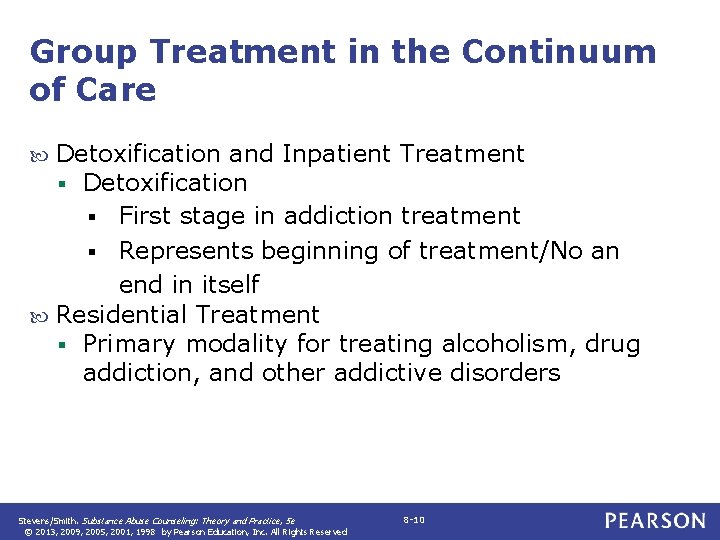
Group Treatment in the Continuum of Care Detoxification and Inpatient Treatment § Detoxification § First stage in addiction treatment § Represents beginning of treatment/No an end in itself Residential Treatment § Primary modality for treating alcoholism, drug addiction, and other addictive disorders Stevens/Smith. Substance Abuse Counseling: Theory and Practice, 5 e © 2013, 2009, 2005, 2001, 1998 by Pearson Education, Inc. All Rights Reserved 8 -10
Group Treatment in the Continuum of Care Partial Hospitalization and Day Treatment § Day treatment represents a modality especially indicated fro dual-diagnosis patients Aftercare and Sober Living Outpatient Groups and Community Care § Provides support to reduce risk of relapse Stevens/Smith. Substance Abuse Counseling: Theory and Practice, 5 e © 2013, 2009, 2005, 2001, 1998 by Pearson Education, Inc. All Rights Reserved 8 -11
Pragmatics of Group Treatment Therapeutic Community § Self-Help Groups § The Group Method of Therapeutic Community is based on: § Shared governance § Accountability to others § Expression of healthy values Based on the 12 Steps and Traditions of Alcoholics Anonymous Psychoeducational Groups Apply principles of teaching to convey important information about addiction and recovery § Cannabis Youth Treatment Series § Stevens/Smith. Substance Abuse Counseling: Theory and Practice, 5 e © 2013, 2009, 2005, 2001, 1998 by Pearson Education, Inc. All Rights Reserved 8 -12
Pragmatics of Group Treatment Cognitive and Behavioral Interventions Combine the didactic method of psychoeducational groups with systematic training in coping, social, and problem-solving skills § Co-occuring disorders: contemporary term for comorbid disorders or dual diagnosis § Forms of Cognitive and Behavioral Interventions § § § Seeking Safety Motivational Interviewing Stevens/Smith. Substance Abuse Counseling: Theory and Practice, 5 e © 2013, 2009, 2005, 2001, 1998 by Pearson Education, Inc. All Rights Reserved 8 -13
Pragmatics of Group Treatment Group § Differs from other forms of group treatment: § § § Psychotherapy Highly skilled leader is required Group itself is viewed as the means for therapeutic change Uses cohesiveness to create a safe, holding environment in which members may explore their feelings and their relationships with one another Stevens/Smith. Substance Abuse Counseling: Theory and Practice, 5 e © 2013, 2009, 2005, 2001, 1998 by Pearson Education, Inc. All Rights Reserved 8 -14
Pragmatics of Group Treatment Relational Therapy and Family Groups Involves individuals and intimate others in a group process to examine bonding and boundaries § Most common form of relational therapy in substance treatment is multifamily groups. § Some groups seem to fit a particular level in the continuum of care: § § Psychoeducational groups in the school setting to prevent substance abuse Stevens/Smith. Substance Abuse Counseling: Theory and Practice, 5 e © 2013, 2009, 2005, 2001, 1998 by Pearson Education, Inc. All Rights Reserved 8 -15

Group Treatment Efficacy Group Treatment presents obvious benefits in terms of: Efficiency, Relatively low costs in comparison to individual treatment, § Compatibility with the needs and preferences of recovering people. § § Stevens/Smith. Substance Abuse Counseling: Theory and Practice, 5 e © 2013, 2009, 2005, 2001, 1998 by Pearson Education, Inc. All Rights Reserved 8 -16
- Slides: 16