
Chapter 8 Gas Tungsten Arc Welding Objectives Contrast


Chapter 8 Gas Tungsten Arc Welding
Objectives • Contrast the effects of DCEN, DCEP, and ac on surface cleaning efficiency, electrode life, and weld characteristics. • Select the proper welding power source, polarity, shielding gas, flow rate, tungsten electrode type and diameter, nozzle size, and filler metal required to produce an acceptable weld using the GTAW process. • Properly assemble the parts of a GTAW welding station and GTAW torch. • Correctly prepare a tungsten electrode for welding with an ac or dc power source. © Goodheart-Willcox Co. , Inc. Permission granted to reproduce for educational use only.
Objectives • Correctly prepare metals for welding and create acceptable welds on all types of joints in all positions. • Correctly set and adjust the welding current and shielding gas flow rate. • Weld different base metals using GTAW process. • Identify the potential safety hazards of using the GTAW process in a working environment and describe ways of safely dealing with these hazards. • Pass a safety test on the proper and safe use of the GTAW process. © Goodheart-Willcox Co. , Inc. Permission granted to reproduce for educational use only.
Gas Tungsten Arc Welding • Gas tungsten arc welding (GTAW) is a process used to produce high-quality welds on virtually all weldable metals • GTAW is done with a tungsten electrode • The tungsten electrode is not consumed • GTAW can be done in any position • Filler metal may or may not be required with GTAW © Goodheart-Willcox Co. , Inc. Permission granted to reproduce for educational use only.

Gas Tungsten Arc Welding Principles • Either direct current electrode negative (DCEN) or direct current electrode positive (DCEP) can be used • Filler metal is added to the weld pool either manually or automatically • Manual welding with an automatic wire feeder is called semiautomatic welding © Goodheart-Willcox Co. , Inc. Permission granted to reproduce for educational use only.
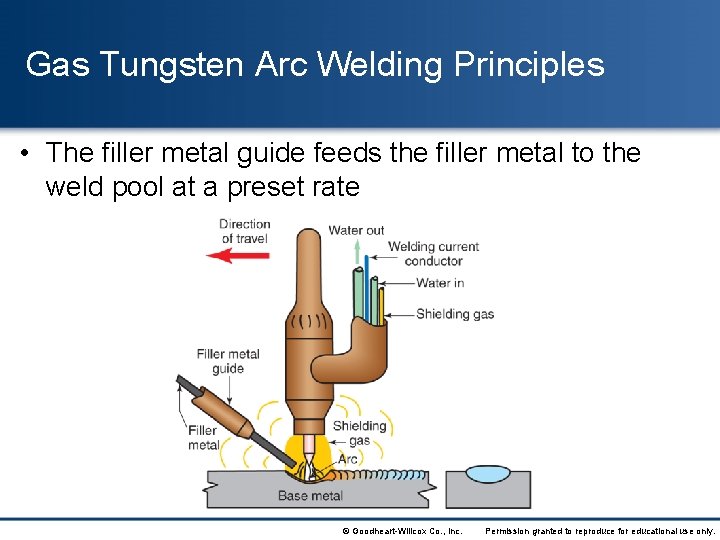
Gas Tungsten Arc Welding Principles • The filler metal guide feeds the filler metal to the weld pool at a preset rate © Goodheart-Willcox Co. , Inc. Permission granted to reproduce for educational use only.
Gas Tungsten Arc Welding Principles • Alternating current or DCEP is used when surface oxides must be removed • Metal oxides, known as refractory oxides, melt at a higher temperature than the base metal • Ac gives better penetration than DCEP • Welding with DCEP current requires an electrode larger than one used for ac welding © Goodheart-Willcox Co. , Inc. Permission granted to reproduce for educational use only.
Pulsed DC GTAW Welding • When dc current is used, it can be electronically controlled to create a pulsed arc • A pulsed arc provides a period of high welding current and a period of lower current • The high current is called peak current • The low current is called background current • Not all gas tungsten arc welding machines can provide a pulsed current © Goodheart-Willcox Co. , Inc. Permission granted to reproduce for educational use only.

AC GTAW Welding • The graph of a normal ac current flow is called a sine wave • Ac current can be controlled to provide a desired amperage or polarity • More electrode negative time or more current will provide for better penetration • By adjusting the wave pattern, a welder can create a welding current to suit the job © Goodheart-Willcox Co. , Inc. Permission granted to reproduce for educational use only.
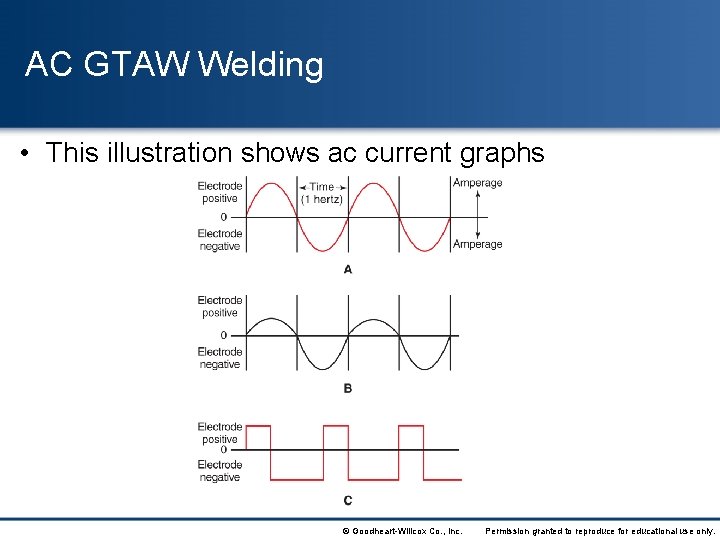
AC GTAW Welding • This illustration shows ac current graphs © Goodheart-Willcox Co. , Inc. Permission granted to reproduce for educational use only.
Additional GTAW Features • Upslope current is used at the beginning of a weld to gradually increase the current from zero to the welding current • Downslope current is a gradual decrease in current at the end of the weld • Pulsed current is used with good results when the workpieces do not fit together well © Goodheart-Willcox Co. , Inc. Permission granted to reproduce for educational use only.

Additional GTAW Features • When performing automatic gas tungsten arc welding, the operator must set the power source to control arc voltage and welding current © Goodheart-Willcox Co. , Inc. Permission granted to reproduce for educational use only.

GTAW Power Sources • Welding power sources for GTAW must provide a constant welding current • Most GTAW machines provide both ac and dc current • Shielding gas made to flow before the arc is struck is called preflow • Shielding gas that continues to flow after the arc is stopped is called postflow © Goodheart-Willcox Co. , Inc. Permission granted to reproduce for educational use only.
Setting Up a GTAW Station • The arc welding power source should be given a brief safety inspection prior to use • The ground leap clamp should be checked for a good connection • Check to make sure the shielding gas cylinder is properly secured • Connect the fittings from the torch to the proper locations on the welding machine © Goodheart-Willcox Co. , Inc. Permission granted to reproduce for educational use only.
Safety • A chain or other safety device should be used to prevent a gas cylinder from being knocked over © Goodheart-Willcox Co. , Inc. Permission granted to reproduce for educational use only.
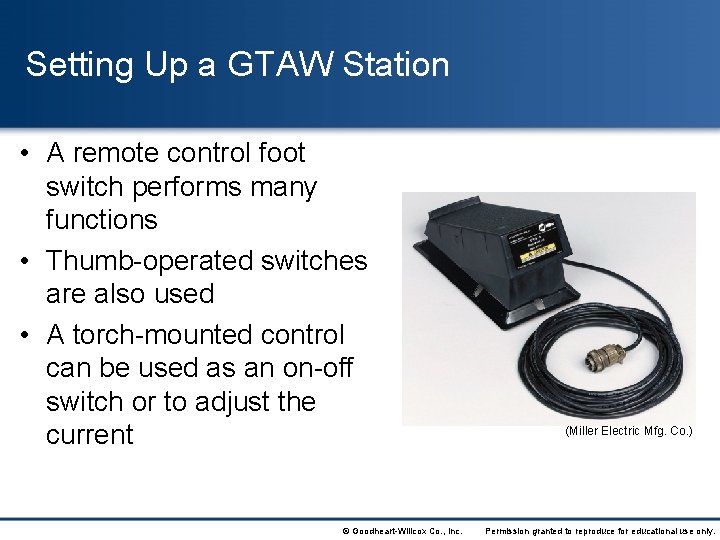
Setting Up a GTAW Station • A remote control foot switch performs many functions • Thumb-operated switches are also used • A torch-mounted control can be used as an on-off switch or to adjust the current © Goodheart-Willcox Co. , Inc. (Miller Electric Mfg. Co. ) Permission granted to reproduce for educational use only.

Setting Up the GTAW Power Source • Once the welding station has been checked, the welding power source, or machine, must be properly set up • Not all welding machines have the same controls (The Lincoln Electric Co. ) © Goodheart-Willcox Co. , Inc. Permission granted to reproduce for educational use only.
Selecting the Proper Current for GTAW • When selecting the type of current to use for a welding job, usually the most important factor is the type of base metal to be welded • Alternating current combines the penetration and cleaning qualities of DCEN and DCEP • After the type of current is selected, the amount of current must be set © Goodheart-Willcox Co. , Inc. Permission granted to reproduce for educational use only.
Proper Shielding Gas for GTAW • Argon is the most common shielding gas used for ac and dc GTAW • Using argon provides a smoother arc • Helium provides a higher available heat at the workpiece • Argon and helium mixtures are used in some applications • Gas mixtures can be obtained in cylinders from distributors • Gas mixtures can also be created using a gas mixer © Goodheart-Willcox Co. , Inc. Permission granted to reproduce for educational use only.
Selecting the Correct Gas Flow Rate • The flow rate is the volume of gas flowing • This flow rate varies with – The base metal being welded – The thickness of the base metal – The position of the welded joint • After the correct gas and flow rate are determined, the rate must be set on the flowmeter © Goodheart-Willcox Co. , Inc. Permission granted to reproduce for educational use only.

Selecting the Correct Gas Flow Rate • This illustration shows a schematic of a gas flowmeter © Goodheart-Willcox Co. , Inc. Permission granted to reproduce for educational use only.
Tungsten Electrodes for GTAW • The selection of the correct tungsten electrode is very important • Determine the type and thickness of metal to be welded • Select the correct electrode by type and diameter • For ac welding, pure tungsten or zirconiated electrodes are preferred © Goodheart-Willcox Co. , Inc. Permission granted to reproduce for educational use only.
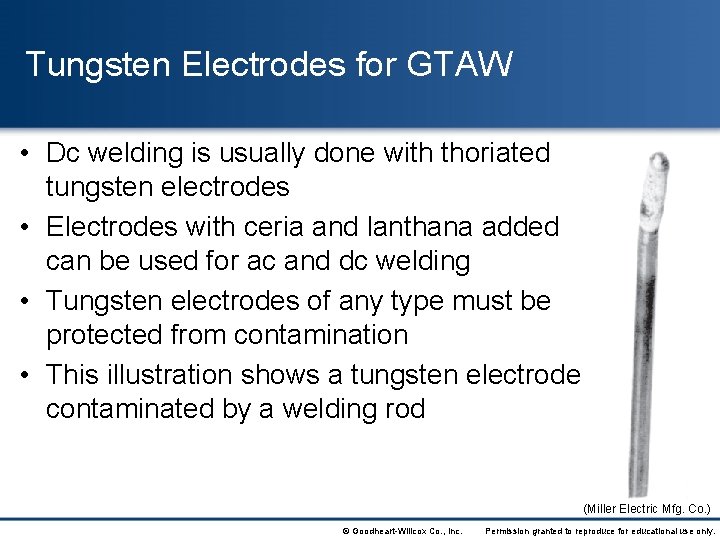
Tungsten Electrodes for GTAW • Dc welding is usually done with thoriated tungsten electrodes • Electrodes with ceria and lanthana added can be used for ac and dc welding • Tungsten electrodes of any type must be protected from contamination • This illustration shows a tungsten electrode contaminated by a welding rod (Miller Electric Mfg. Co. ) © Goodheart-Willcox Co. , Inc. Permission granted to reproduce for educational use only.

Tungsten Electrodes for GTAW • Contamination may be from oxygen and nitrogen in the air and from airborne dirt • Tungsten electrodes come in sizes from 0. 010″ to 1/4″ • Special grinding wheels should be used for pointing tungsten electrodes • Grinding wheels made of borazon or diamond are preferred © Goodheart-Willcox Co. , Inc. Permission granted to reproduce for educational use only.

Safety • Tungsten dust should not be inhaled • Thoriated tungsten contains thorium, a low level radioactive material • A dust extractor should be installed on the grinding wheel to control dust • A dust mask can be worn • Always wear safety glasses or goggles when grinding © Goodheart-Willcox Co. , Inc. Permission granted to reproduce for educational use only.
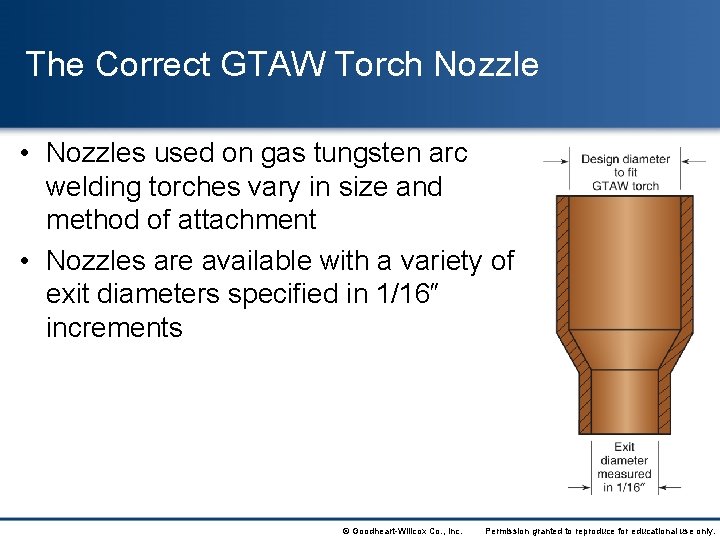
The Correct GTAW Torch Nozzle • Nozzles used on gas tungsten arc welding torches vary in size and method of attachment • Nozzles are available with a variety of exit diameters specified in 1/16″ increments © Goodheart-Willcox Co. , Inc. Permission granted to reproduce for educational use only.
The Correct Filler Metal for GTAW • Filler metal used for GTAW is generally bare, uncoated, wire • The filler metal is purchased in large coils or in precut lengths • Filler metal alloy must be selected for the specific job • Common diameters of filler wires vary from 1/16″ to 1/4″ © Goodheart-Willcox Co. , Inc. Permission granted to reproduce for educational use only.
Preparing Metal for Welding • Before welding, the surface of the base metal must be thoroughly cleaned • The joint designs used for GTAW are the same as those used for SMAW • If parts must be beveled or shaped, they may be cut by thermal or mechanical means • Metal parts of a weldment must be held in alignment for welding © Goodheart-Willcox Co. , Inc. Permission granted to reproduce for educational use only.
Preparing Metal for Welding • A backing ring or strip can be used when welding metals exhibit hot shortness • Shielding gas applied to the root side of a weld is often called backing gas • To prevent contamination, parts can be welded in a chamber • The chamber may contain shielding gas, or it may be a vacuum © Goodheart-Willcox Co. , Inc. Permission granted to reproduce for educational use only.
Safety • Always wear goggles to protect your eyes when using chemical solutions or wire brushes • Never enter an area filled with a shielding gas unless you are wearing an air-supplied respirator • In a space filled with shielding gas, a person can lose consciousness or die • Using an air-purifying respirator in a room with no oxygen will result in death © Goodheart-Willcox Co. , Inc. Permission granted to reproduce for educational use only.
Methods for Starting the Arc • A gas tungsten arc can be started in one of three ways – When touch starting is used, the electrode is touched to the base metal and then withdrawn – With superimposed high frequency, the nozzle is placed on the metal and the contactor switch is turned on – High-voltage starting is done with a high-voltage surge © Goodheart-Willcox Co. , Inc. Permission granted to reproduce for educational use only.
Gas Tungsten Arc Welding Techniques • Position the torch at or near the start of the weld and strike the arc • Move to the location where the base metal must be melted • When the weld pool reaches the desired size, add welding rod if needed • Start moving the weld pool along the joint © Goodheart-Willcox Co. , Inc. Permission granted to reproduce for educational use only.
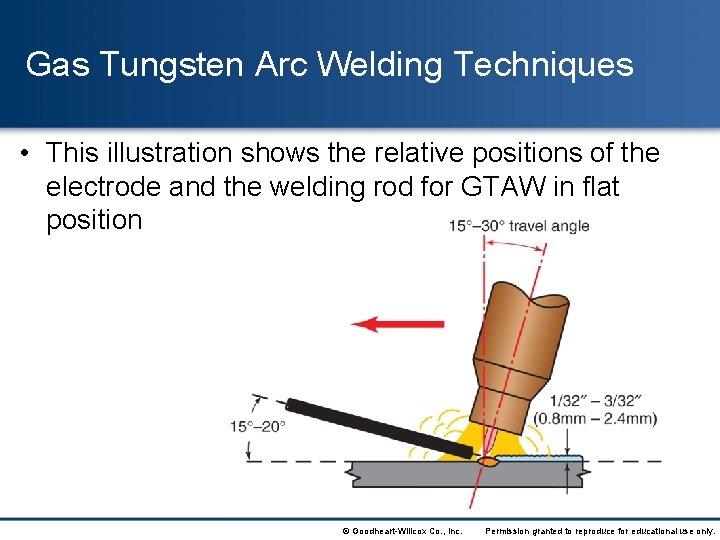
Gas Tungsten Arc Welding Techniques • This illustration shows the relative positions of the electrode and the welding rod for GTAW in flat position © Goodheart-Willcox Co. , Inc. Permission granted to reproduce for educational use only.
Gas Tungsten Arc Welding Techniques • While welding, control the location of the arc and the arc length • Add filler metal at the proper times • The welding current may be changed while welding • GTAW requires practice to master © Goodheart-Willcox Co. , Inc. Permission granted to reproduce for educational use only.
Shutting Down the GTAW Station • When welding is stopped for long periods, the station should be shut down – – – After the gas postflow period, hang up the torch Shut off the shielding gas cylinder Drain the shielding gas system of gas Turn off the regulator and flowmeter Turn off the arc welding power source switch © Goodheart-Willcox Co. , Inc. Permission granted to reproduce for educational use only.
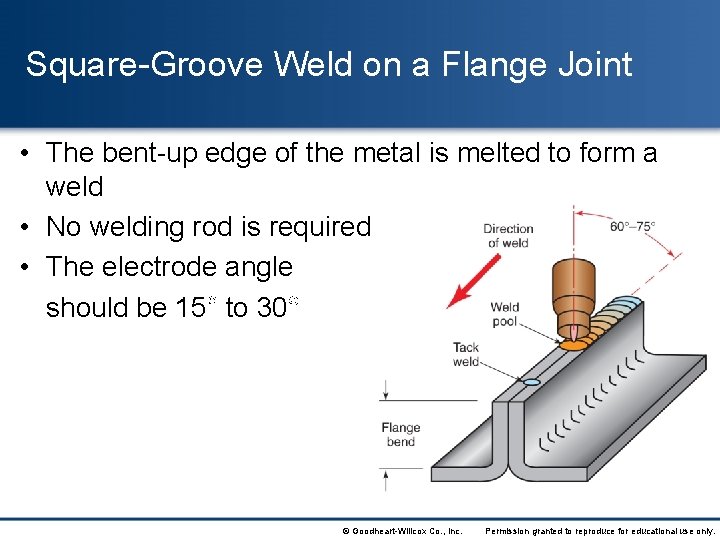
Square-Groove Weld on a Flange Joint • The bent-up edge of the metal is melted to form a weld • No welding rod is required • The electrode angle should be 15° to 30° © Goodheart-Willcox Co. , Inc. Permission granted to reproduce for educational use only.
Square-Groove Weld on a Flange Joint • When the end of the weld joint is reached – The electrode should be moved backward slightly – The welding current should be decreased using the contactor switch • Hold the electrode near the end of the weld until the shielding gas stops flowing • A general rule for postflow is to allow one second for every 10 A of current © Goodheart-Willcox Co. , Inc. Permission granted to reproduce for educational use only.
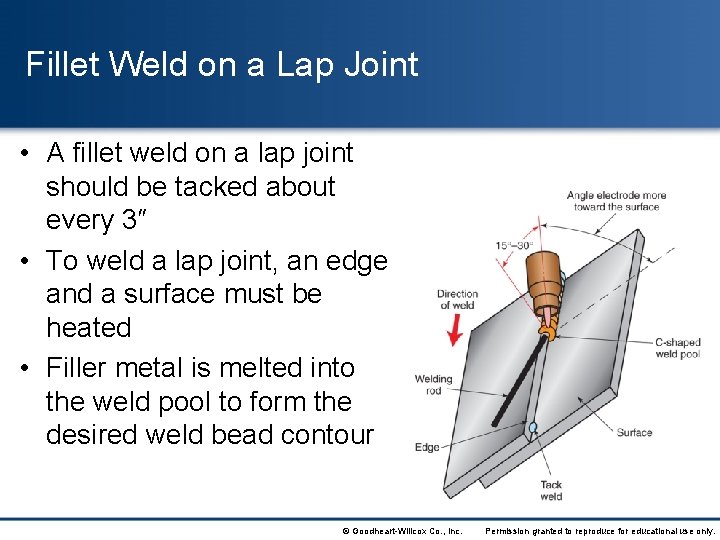
Fillet Weld on a Lap Joint • A fillet weld on a lap joint should be tacked about every 3″ • To weld a lap joint, an edge and a surface must be heated • Filler metal is melted into the weld pool to form the desired weld bead contour © Goodheart-Willcox Co. , Inc. Permission granted to reproduce for educational use only.
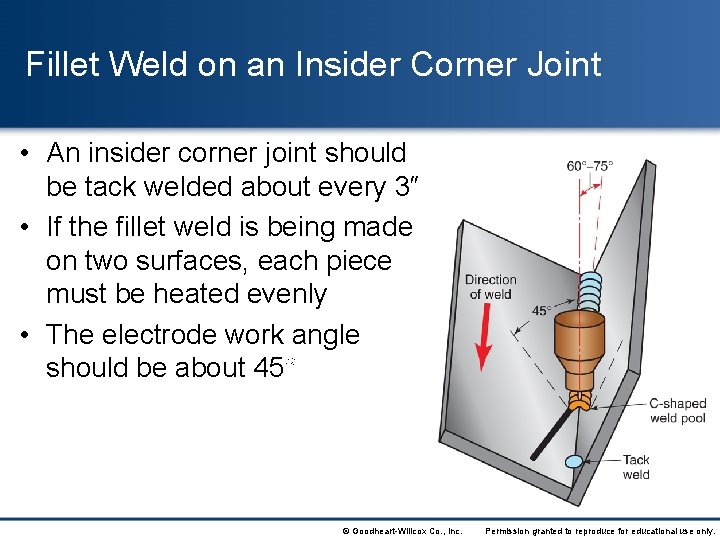
Fillet Weld on an Insider Corner Joint • An insider corner joint should be tack welded about every 3″ • If the fillet weld is being made on two surfaces, each piece must be heated evenly • The electrode work angle should be about 45° © Goodheart-Willcox Co. , Inc. Permission granted to reproduce for educational use only.
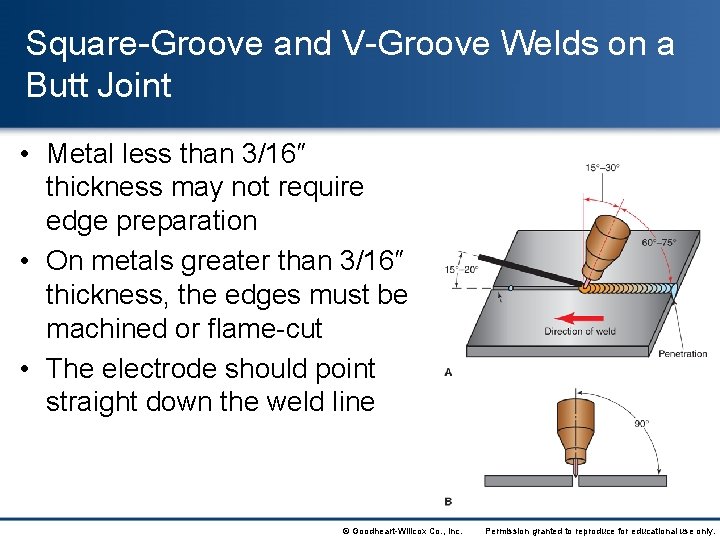
Square-Groove and V-Groove Welds on a Butt Joint • Metal less than 3/16″ thickness may not require edge preparation • On metals greater than 3/16″ thickness, the edges must be machined or flame-cut • The electrode should point straight down the weld line © Goodheart-Willcox Co. , Inc. Permission granted to reproduce for educational use only.
Square-Groove and V-Groove Welds on a Butt Joint • The design shapes may be square-, U-, J-, V-, or bevel-groove • To obtain complete penetration, the keyhole method of welding is used • To complete a V-groove or other wide-mouthed joint, a weaving bead might be used © Goodheart-Willcox Co. , Inc. Permission granted to reproduce for educational use only.
Welding Joints in Horizontal Position • When horizontal welding is done, the weld line is horizontal and the face of the bead is in a nearvertical position • To prevent the downward flow of weld metal – Keep the weld pool small – Add the welding rod to the upper edge of the pool – Point the electrode slightly upward © Goodheart-Willcox Co. , Inc. Permission granted to reproduce for educational use only.
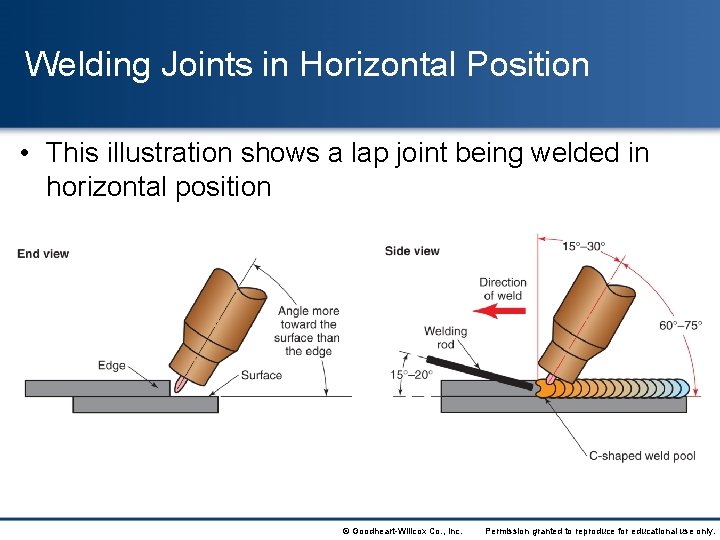
Welding Joints in Horizontal Position • This illustration shows a lap joint being welded in horizontal position © Goodheart-Willcox Co. , Inc. Permission granted to reproduce for educational use only.
Welding Joints in Vertical Position • When welding vertically, it is important to use the lowest current possible for a good weld • A pulsed arc may be used to provide a good cooling period that helps control the molten pool • Vertical welds may be made uphill or downhill © Goodheart-Willcox Co. , Inc. Permission granted to reproduce for educational use only.
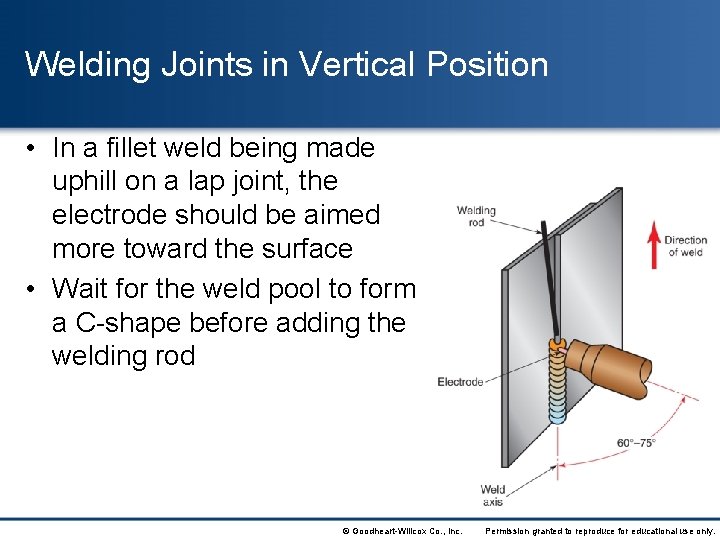
Welding Joints in Vertical Position • In a fillet weld being made uphill on a lap joint, the electrode should be aimed more toward the surface • Wait for the weld pool to form a C-shape before adding the welding rod © Goodheart-Willcox Co. , Inc. Permission granted to reproduce for educational use only.
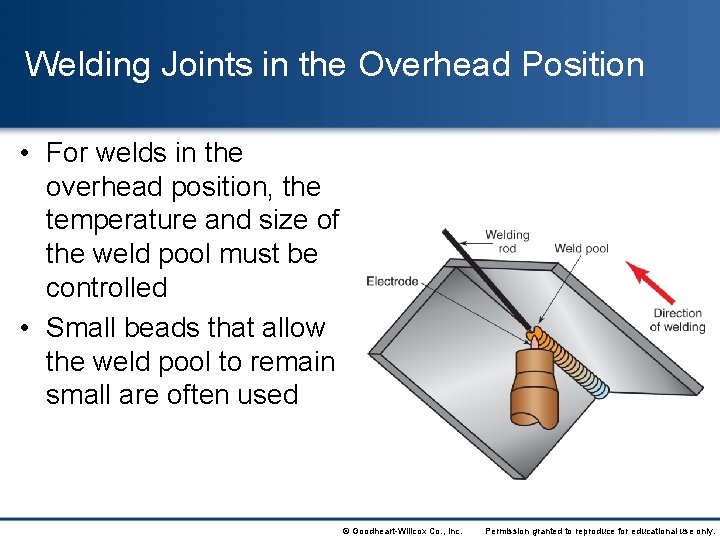
Welding Joints in the Overhead Position • For welds in the overhead position, the temperature and size of the weld pool must be controlled • Small beads that allow the weld pool to remain small are often used Insert figure 8 -62 © Goodheart-Willcox Co. , Inc. Permission granted to reproduce for educational use only.
Semiautomatic Welding • Semiautomatic GTAW is very similar to manual GTAW • The wire feed mechanism must have – A wire drive device – A speed control – An attachment to the torch that guides the wire into the weld pool • The welder must control the arc length and travel speed © Goodheart-Willcox Co. , Inc. Permission granted to reproduce for educational use only.
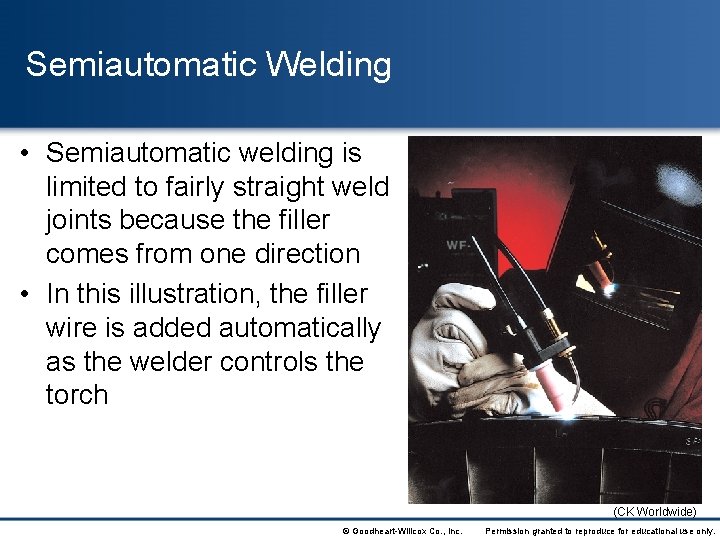
Semiautomatic Welding • Semiautomatic welding is limited to fairly straight weld joints because the filler comes from one direction • In this illustration, the filler wire is added automatically as the welder controls the torch (CK Worldwide) © Goodheart-Willcox Co. , Inc. Permission granted to reproduce for educational use only.
Automated and Mechanized GTAW • Gas tungsten arc welding can be mechanized or fully automated • An automatic GTAW system uses feedback signals to adjust the process to maintain a high-quality weld • Mechanized GTAW does not have feedback systems © Goodheart-Willcox Co. , Inc. Permission granted to reproduce for educational use only.
Automated and Mechanized GTAW • One method used is to mount the torch to a track or a beam and move it along the weld joint • Another option is to keep the torch in place and move the part • A robot can be programmed to use the GTAW process to weld a complete, complex assembly © Goodheart-Willcox Co. , Inc. Permission granted to reproduce for educational use only.
Automated and Mechanized GTAW • Automatic and mechanized GTAW produce welds with excellent quality • Automatic GTAW may be done in all positions using pulsed arc • To increase the rate of welding, a hot filler wire process is sometimes used • Heating the welding wire saves much of the heat of the arc for melting the base metal © Goodheart-Willcox Co. , Inc. Permission granted to reproduce for educational use only.
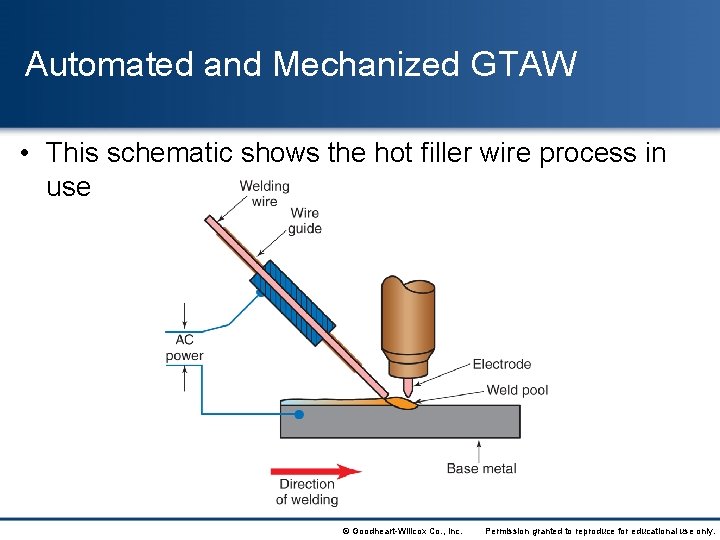
Automated and Mechanized GTAW • This schematic shows the hot filler wire process in use © Goodheart-Willcox Co. , Inc. Permission granted to reproduce for educational use only.
GTAW Spot Welding • Gas tungsten arc welding can be used to produce spot welds • The process consists of striking an arc and holding it in one place • The top sheet of metal melts and fuses with a molten portion of the material below • When spot welding is done with GTAW, the welding process is automatically controlled © Goodheart-Willcox Co. , Inc. Permission granted to reproduce for educational use only.
GTAW Troubleshooting Guide • Problems can affect the quality of a completed weld – – An unstable arc Rapid electrode consumption Tungsten in the weld Porous welds • Welders should watch for these problems and take steps to correct them © Goodheart-Willcox Co. , Inc. Permission granted to reproduce for educational use only.
GTAW Safety • All safety precautions required for other arc welding processes apply to GTAW • Welders should wear protective clothing • GTAW creates ultraviolet and infrared radiation that can cause burns • Gloves are required to protect the hands • Filter shades are recommended for GTAW • Adequate ventilation must be provided © Goodheart-Willcox Co. , Inc. Permission granted to reproduce for educational use only.
Safety • Inert gases, CO, and CO 2 displace oxygen in confined spaces • Wear an air-supplied respirator when entering a space filled with an inert gas, CO, or CO 2 © Goodheart-Willcox Co. , Inc. Permission granted to reproduce for educational use only.
- Slides: 57