
Chapter 8 Gas Power cycle Part 3 Diesel

- Slides: 13
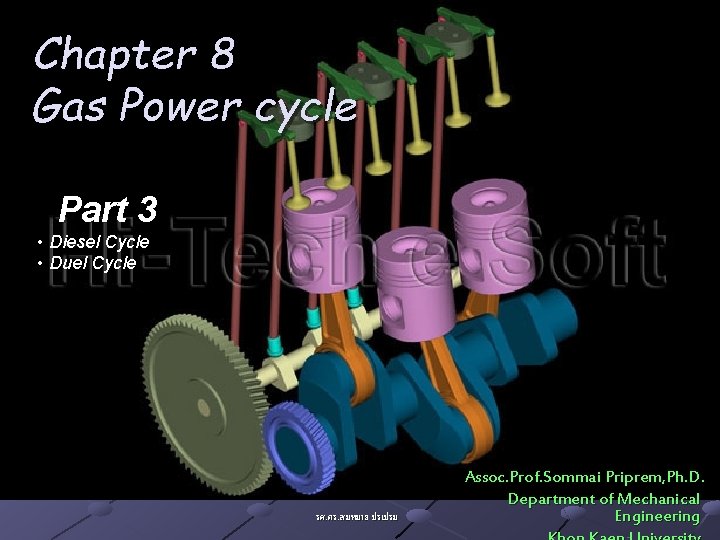
Chapter 8 Gas Power cycle Part 3 • Diesel Cycle • Duel Cycle รศ. ดร. สมหมาย ปรเปรม Assoc. Prof. Sommai Priprem, Ph. D. Department of Mechanical Engineering
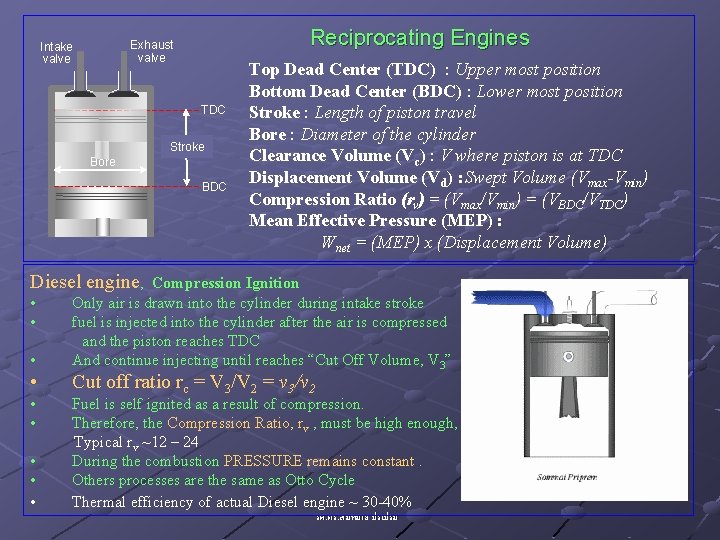
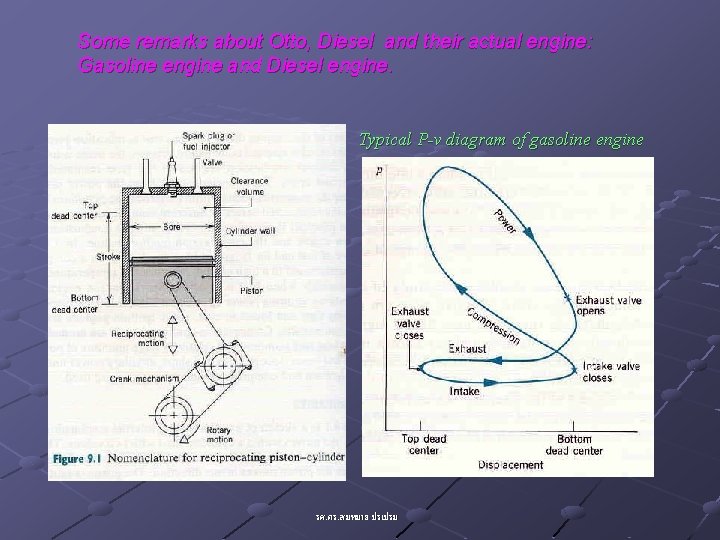
Reciprocating Engines Exhaust valve Intake valve TDC Stroke Bore BDC Top Dead Center (TDC) : Upper most position Bottom Dead Center (BDC) : Lower most position Stroke : Length of piston travel Bore : Diameter of the cylinder Clearance Volume (Vc) : V where piston is at TDC Displacement Volume (Vd) : Swept Volume (Vmax-Vmin) Compression Ratio (rv) = (Vmax/Vmin) = (VBDC/VTDC) Mean Effective Pressure (MEP) : Wnet = (MEP) x (Displacement Volume) Diesel engine, • • • Compression Ignition Only air is drawn into the cylinder during intake stroke fuel is injected into the cylinder after the air is compressed and the piston reaches TDC And continue injecting until reaches “Cut Off Volume, V 3” Cut off ratio rc = V 3/V 2 = v 3/v 2 Fuel is self ignited as a result of compression. Therefore, the Compression Ratio, rv , must be high enough, Typical rv ~12 – 24 During the combustion PRESSURE remains constant. Others processes are the same as Otto Cycle Thermal efficiency of actual Diesel engine ~ 30 -40% รศ. ดร. สมหมาย ปรเปรม
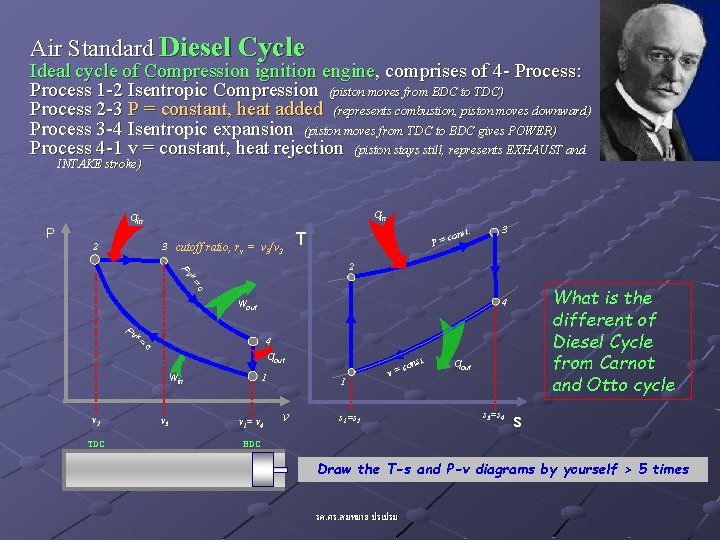
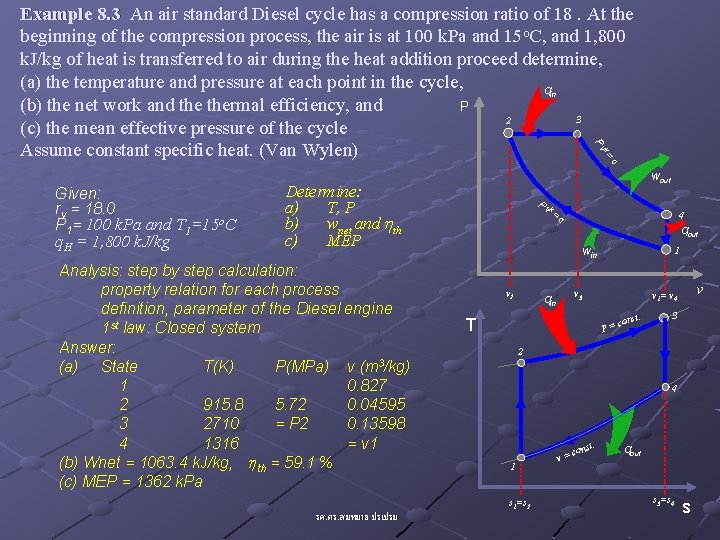
Air Standard Diesel Cycle Ideal cycle of Compression ignition engine, comprises of 4 - Process: Process 1 -2 Isentropic Compression (piston moves from BDC to TDC) Process 2 -3 P = constant, heat added (represents combustion, piston moves downward) Process 3 -4 Isentropic expansion (piston moves from TDC to BDC gives POWER) Process 4 -1 v = constant, heat rejection (piston stays still, represents EXHAUST and INTAKE stroke) qin P 3 2 T cutoff ratio, rv = v 3/v 2 P= t. cons 3 k Pv 2 = What is the different of Diesel Cycle from Carnot and Otto cycle c wout Pv k = 4 c qout win v 2 TDC 4 v 3 1 v 1= v 4 t. 1 v s con v= s 1=s 2 qout s 3=s 4 s BDC Draw the T-s and P-v diagrams by yourself > 5 times รศ. ดร. สมหมาย ปรเปรม
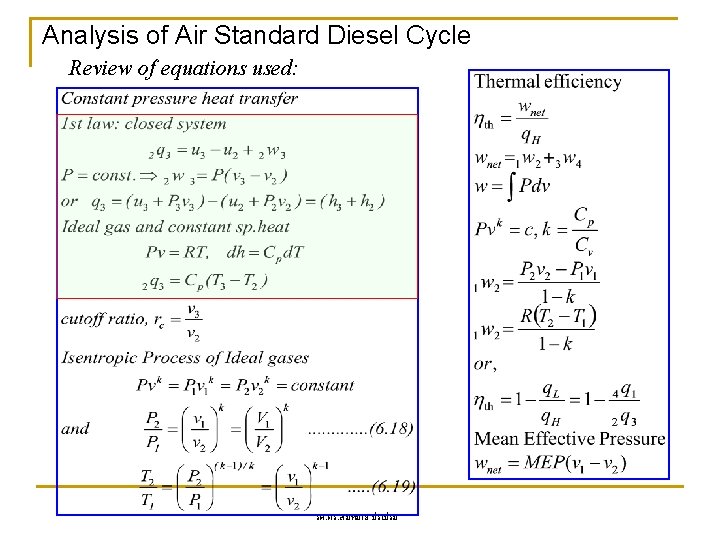
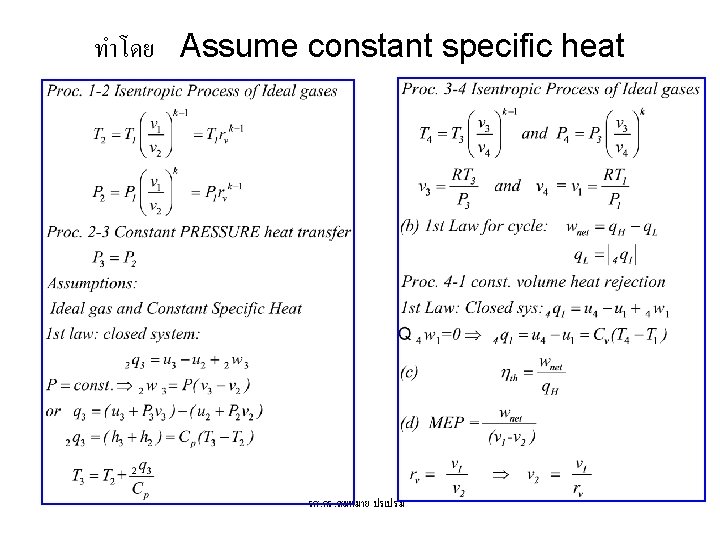
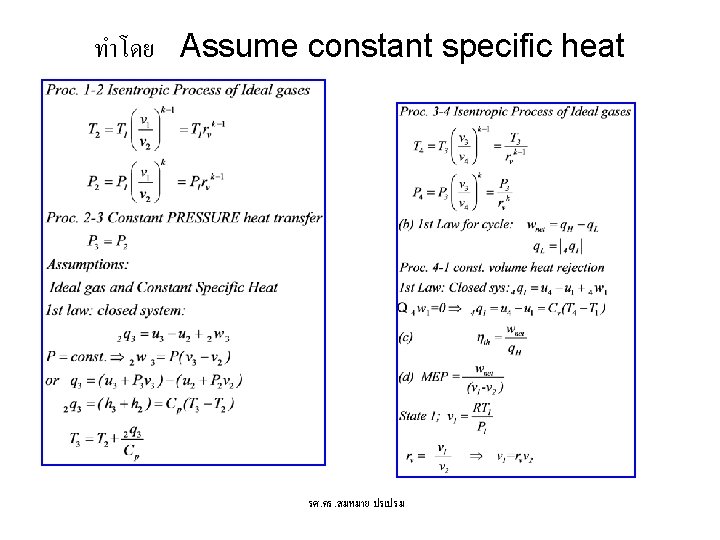
Analysis of Air Standard Diesel Cycle Review of equations used: รศ. ดร. สมหมาย ปรเปรม
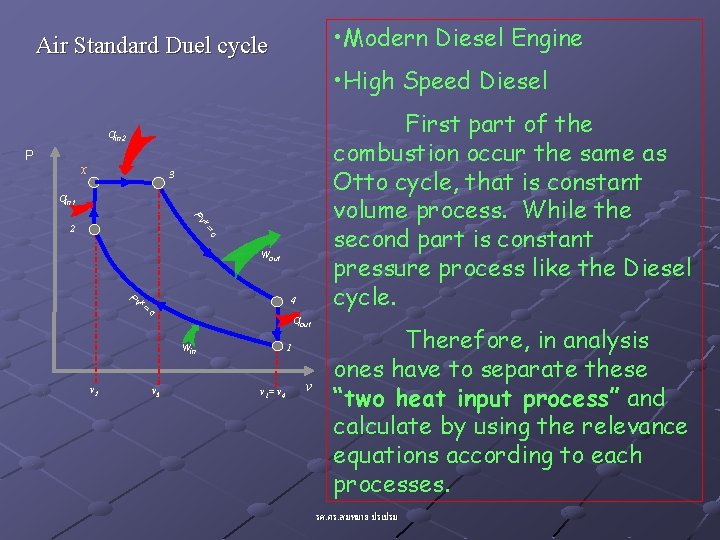
• Modern Diesel Engine Air Standard Duel cycle • High Speed Diesel First part of the combustion occur the same as Otto cycle, that is constant volume process. While the second part is constant pressure process like the Diesel cycle. qin 2 P x 3 qin 1 k Pv = 2 c wout Pv k = 4 c qout win v 2 v 3 1 v 1= v 4 v Therefore, in analysis ones have to separate these “two heat input process” and calculate by using the relevance equations according to each processes. รศ. ดร. สมหมาย ปรเปรม
k Pv Example 8. 3 An air standard Diesel cycle has a compression ratio of 18. At the beginning of the compression process, the air is at 100 k. Pa and 15 o. C, and 1, 800 k. J/kg of heat is transferred to air during the heat addition proceed determine, (a) the temperature and pressure at each point in the cycle, qin (b) the net work and thermal efficiency, and P 3 2 (c) the mean effective pressure of the cycle Assume constant specific heat. (Van Wylen) = c Given: rv = 18. 0 P 1= 100 k. Pa and T 1=15 o. C q. H = 1, 800 k. J/kg wout Determine: a) T, P b) wnet and th c) MEP Analysis: step by step calculation: property relation for each process definition, parameter of the Diesel engine 1 st law: Closed system Answer: (a) State T(K) P(MPa) v (m 3/kg) 1 0. 827 2 915. 8 5. 72 0. 04595 3 2710 = P 2 0. 13598 4 1316 = v 1 (b) Wnet = 1063. 4 k. J/kg, th = 59. 1 % (c) MEP = 1362 k. Pa รศ. ดร. สมหมาย ปรเปรม Pv k = 4 c qout win v 2 1 v 3 qin v v 1= v 4 nst. T co P= 3 2 4 1 s 1=s 2 v= st. con qout s 3=s 4 s
Some remarks about Otto, Diesel and their actual engine: Gasoline engine and Diesel engine. Typical P-v diagram of gasoline engine รศ. ดร. สมหมาย ปรเปรม
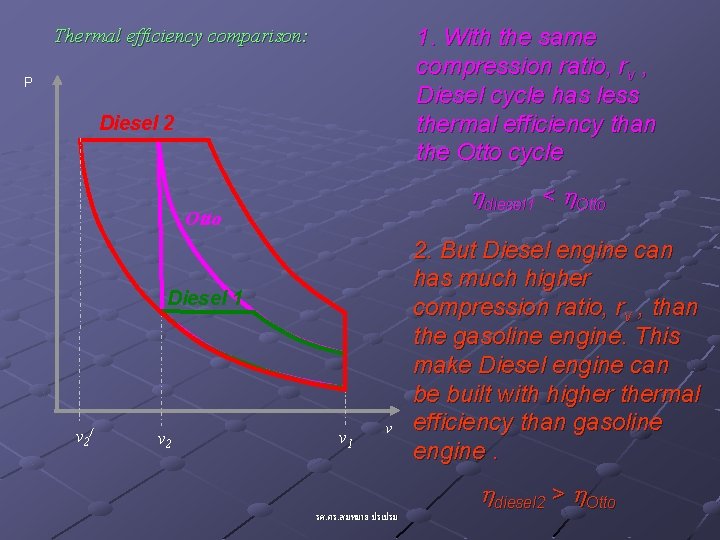
1. With the same compression ratio, rv , Diesel cycle has less thermal efficiency than the Otto cycle Thermal efficiency comparison: P Diesel 2 diesel 1 < Otto Diesel 1 v 2 / v 2 v 1 v รศ. ดร. สมหมาย ปรเปรม 2. But Diesel engine can has much higher compression ratio, rv , than the gasoline engine. This make Diesel engine can be built with higher thermal efficiency than gasoline engine. diesel 2 > Otto
Selected Problems u u u u 7 -39 C How does a diesel engine differ from a gasoline engine? 7 -40 C How does the ideal Diesel cycle differ from the ideal auo cycle? 741 C For a specified compression ratio, is a diesel or gasoline engine more efficient? 7 -42 C Do diesel or gasoline engines operate at higher compression ratios? Why? 7 -43 C What is the cutoff ratio? How does it affect thermal efficiency of a Diesel cycle? 7 -44 An air-standard Diesel cycle has a compression ratio of 16 and a cutoff ratio of 2. At the beginning of the compression process, air is at 95 k. Pa and 27°C. Using constant specific heats at room temperature, determine (a) the temperature after the heat addition process, (b) thermal efficiency, and (c) the mean effective pressure. Answers: (a) 1819 K, (b) 61. 4 percent, (c) 660. 5 k. Pa 7 -45 An air-standard Diesel cycle has a compression ratio of 18. 2. Air is at 27°C and 0. 1 MPa at the beginning of the compression process and at 2000 K at the end of the heat addition process. Using constant specific heats at room temperature, determine (a) the cutoff ratio, (b) the heat rejection per unit mass, and (c) thermal efficiency. รศ. ดร. สมหมาย ปรเปรม
u u u 7 -46 An ideal diesel engine has a compression ratio of 20 and uses air as 'the working fluid. The state of air at the beginning of the compression process is 95 k. Pa and 20°C. If the maximum temperature in the cycle is not to exceed 2200 K, determine (a) thermal efficiency and (b) the mean effective pressure. Assume constant specific heats for air at room temperature. Answers: (a) 63. 5 percent, (b) 933 k. Pa 7 -47 Repeat Prob. 7 -46, but replace the is en tropic expansion process by [polytropic expansion process with the polytropic exponent n = 1. 35. 7 -48 A four-cylinder 4. 5 -L diesel engine that operates on an ideal Diesel Cycle has a compression ratio of 17 and a cutoff ratio of 2. 2. Air is at 27°C and 97 k. Pa at the beginning of the compression process. Using the cold-air-standard assumptions, determine how much power the engine will deliver at 1500 rpm. 7 -49 Repeat Prob. 7 -48 using nitrogen as the working fluid. 7 -50 The compression ratio of an ideal dual cycle is 14. Air is at 100 k. Pa and 300 K at the beginning of the compression process and at 2200 K at the end of the heat addition process. Heat transfer to air takes place partly at constant volume and partly at constant pressure, and it amounts to 1520. 4 k. J/kg. Assuming variable specific heats for air, determine (a) the fraction of heat transferred at constant volume and (b) thermal efficiency of the cycle. รศ. ดร. สมหมาย ปรเปรม
End of Part 3 อยากรจกเครองยนตใหมากขนมย . . ไปดท Web Links: . 1 http: //en. wikipedia. org/wiki/Four-stroke_cycle. 2 http: //library. thinkquest. org/C 006011/english/sites/index. php 3? v=2 . 3 http: //auto. howstuffworks. com/diesel 1. htm รศ. ดร. สมหมาย ปรเปรม