
Chapter 8 Fundamental Networks IT Essentials PC Hardware
- Slides: 70
Chapter 8: Fundamental Networks IT Essentials: PC Hardware and Software v 4. 1 ITE PC v 4. 1 Chapter 8 © 2007 -2010 Cisco Systems, Inc. All rights reserved. Cisco Public 1
Chapter 8 Objectives § 8. 1 Explain the principles of networking § 8. 2 Describe types of networks § 8. 3 Describe basic networking concepts and technologies § 8. 4 Describe the physical components of a network § 8. 5 Describe LAN topologies and architectures § 8. 6 Identify standards organizations § 8. 7 Identify Ethernet standards § 8. 8 Explain OSI and TCP/IP data models § 8. 9 Describe how to configure a NIC and a modem § 8. 10 Identify names, purposes, and characteristics of other technologies used to establish connectivity § 8. 11 Identify and apply common preventive maintenance techniques used for networks § 8. 12 Troubleshoot a network ITE PC v 4. 1 Chapter 8 © 2007 -2010 Cisco Systems, Inc. All rights reserved. Cisco Public 2
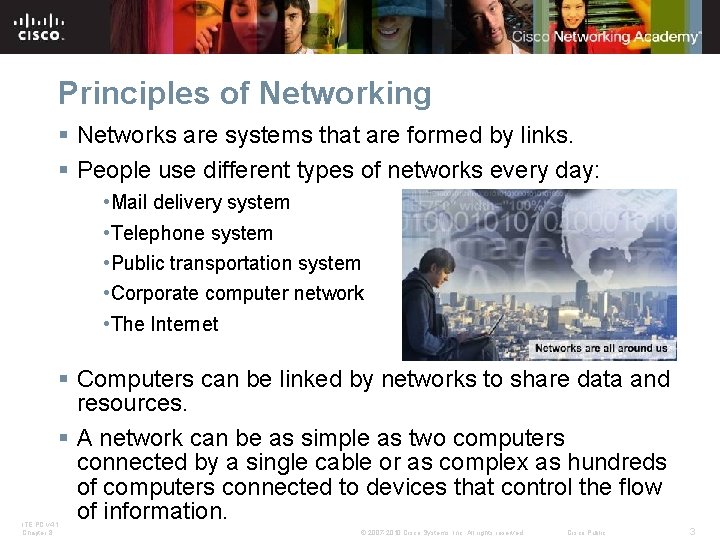
Principles of Networking § Networks are systems that are formed by links. § People use different types of networks every day: • Mail delivery system • Telephone system • Public transportation system • Corporate computer network • The Internet § Computers can be linked by networks to share data and resources. § A network can be as simple as two computers connected by a single cable or as complex as hundreds of computers connected to devices that control the flow of information. ITE PC v 4. 1 Chapter 8 © 2007 -2010 Cisco Systems, Inc. All rights reserved. Cisco Public 3
Computer Networks § A computer data network is a collection of hosts connected by networking devices such as computers, printers, scanners, smartphones and file and print servers. § Resources shared across networks include different types of services, storage devices and applications. § Network devices link together using a variety of connections: • Copper cabling • Fiber-optic cabling • Wireless connection § Some benefits from networking includes: • Fewer peripherals needed • Increased communication capabilities • Avoid file duplication and corruption • Lower cost licensing • Centralized administration • Conserve resources ITE PC v 4. 1 Chapter 8 © 2007 -2010 Cisco Systems, Inc. All rights reserved. Cisco Public 4
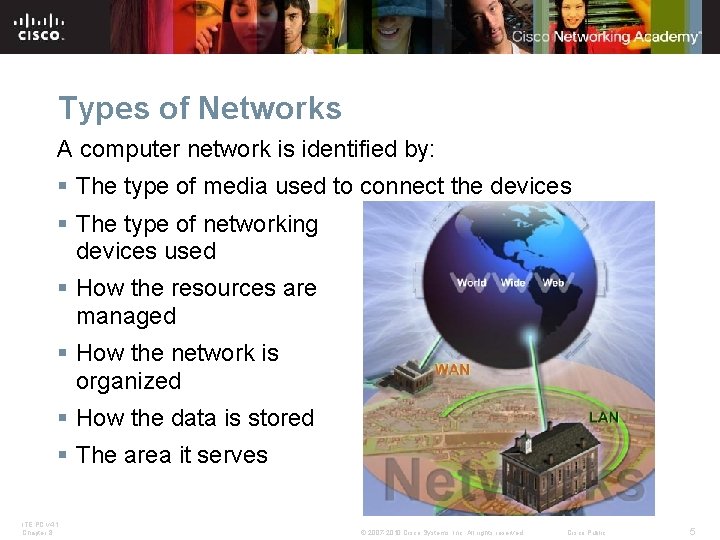
Types of Networks A computer network is identified by: § The type of media used to connect the devices § The type of networking devices used § How the resources are managed § How the network is organized § How the data is stored § The area it serves ITE PC v 4. 1 Chapter 8 © 2007 -2010 Cisco Systems, Inc. All rights reserved. Cisco Public 5
Types of Networks § LAN: A group of interconnected computers under one administrative control group that governs the security and access control policies that are in force on the network. § WAN: A networks that connects LANs in geographically separated locations. § WLAN: Group of wireless devices that connect to access points within a specified area. Access points are typically connected to the network using copper cabling. ITE PC v 4. 1 Chapter 8 © 2007 -2010 Cisco Systems, Inc. All rights reserved. Cisco Public 6
Types of Networks (Continued) § Peer-to-peer networks: Devices which are connected directly to each other without any additional networking devices between them. Each device has equivalent capabilities and responsibilities. § Client/server networks: In a client/server model, the client requests information or services from the server. The server provides the requested information or service to the client. ITE PC v 4. 1 Chapter 8 © 2007 -2010 Cisco Systems, Inc. All rights reserved. Cisco Public 7
Bandwidth and Latency § Bandwidth is the amount of data that can be transmitted within a fixed time period. § Bandwidth is measured in bits per second and is usually denoted by the following: • bps - bits per second • Kbps - kilobits per second • Mbps - megabits per second § Latency is the amount of time it takes data to travel from source to destination. § Data is transmitted in one of three modes: • Simplex (Unidirectional transmission) is a single, one-way transmission. • Half-duplex allows data to flow in one direction at a time. • Full-duplex allows data to flow in both directions at the same time. ITE PC v 4. 1 Chapter 8 © 2007 -2010 Cisco Systems, Inc. All rights reserved. Cisco Public 8
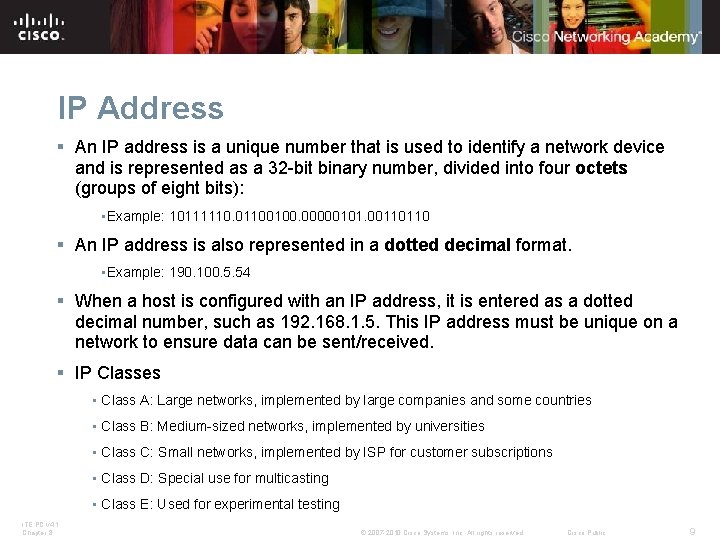
IP Address § An IP address is a unique number that is used to identify a network device and is represented as a 32 -bit binary number, divided into four octets (groups of eight bits): • Example: 10111110. 01100100. 00000101. 00110110 § An IP address is also represented in a dotted decimal format. • Example: 190. 100. 5. 54 § When a host is configured with an IP address, it is entered as a dotted decimal number, such as 192. 168. 1. 5. This IP address must be unique on a network to ensure data can be sent/received. § IP Classes • Class A: Large networks, implemented by large companies and some countries • Class B: Medium-sized networks, implemented by universities • Class C: Small networks, implemented by ISP for customer subscriptions • Class D: Special use for multicasting • Class E: Used for experimental testing ITE PC v 4. 1 Chapter 8 © 2007 -2010 Cisco Systems, Inc. All rights reserved. Cisco Public 9
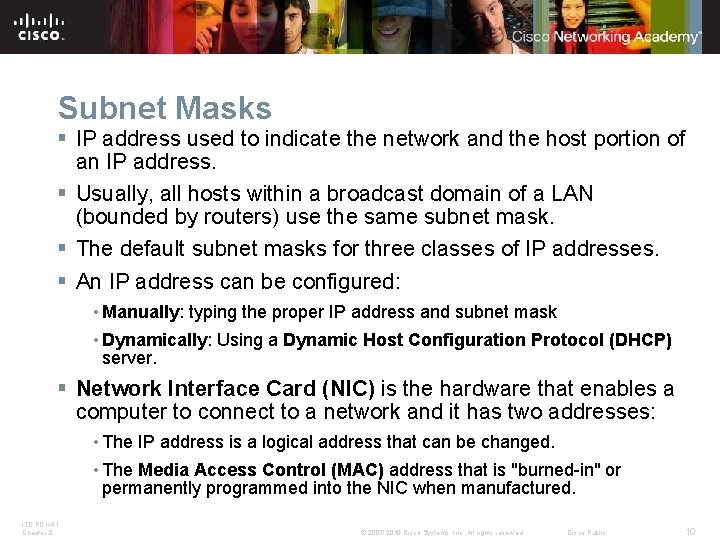
Subnet Masks § IP address used to indicate the network and the host portion of an IP address. § Usually, all hosts within a broadcast domain of a LAN (bounded by routers) use the same subnet mask. § The default subnet masks for three classes of IP addresses. § An IP address can be configured: • Manually: typing the proper IP address and subnet mask • Dynamically: Using a Dynamic Host Configuration Protocol (DHCP) server. § Network Interface Card (NIC) is the hardware that enables a computer to connect to a network and it has two addresses: • The IP address is a logical address that can be changed. • The Media Access Control (MAC) address that is "burned-in" or permanently programmed into the NIC when manufactured. ITE PC v 4. 1 Chapter 8 © 2007 -2010 Cisco Systems, Inc. All rights reserved. Cisco Public 10
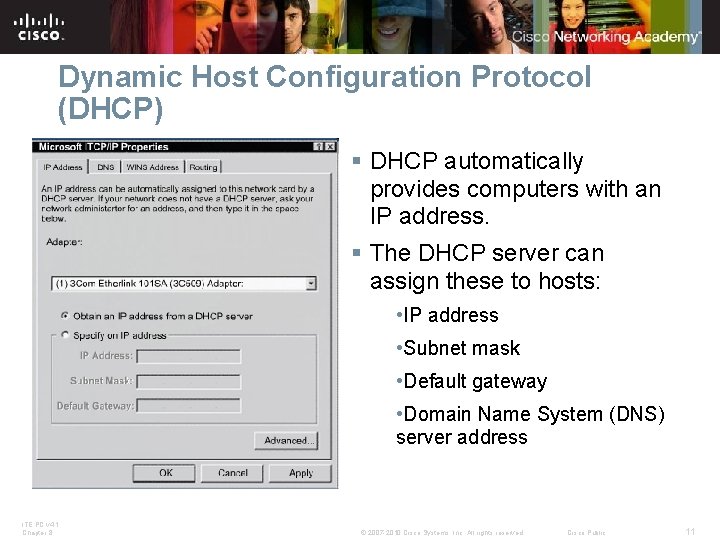
Dynamic Host Configuration Protocol (DHCP) § DHCP automatically provides computers with an IP address. § The DHCP server can assign these to hosts: • IP address • Subnet mask • Default gateway • Domain Name System (DNS) server address ITE PC v 4. 1 Chapter 8 © 2007 -2010 Cisco Systems, Inc. All rights reserved. Cisco Public 11
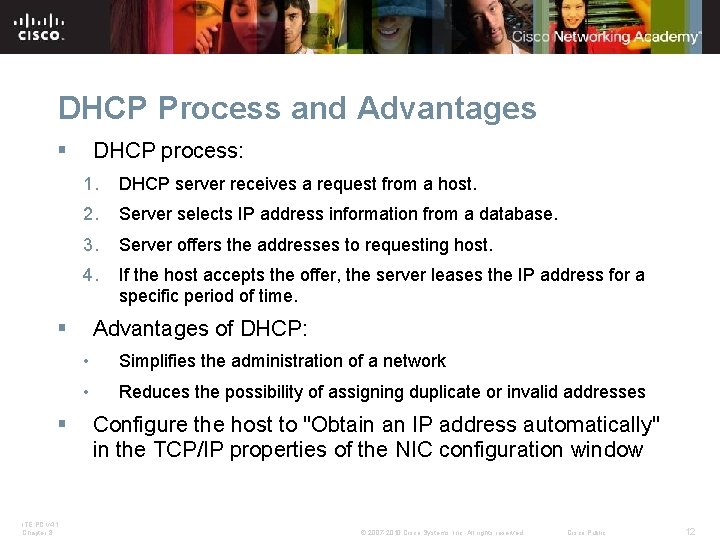
DHCP Process and Advantages § DHCP process: 1. DHCP server receives a request from a host. 2. Server selects IP address information from a database. 3. Server offers the addresses to requesting host. 4. If the host accepts the offer, the server leases the IP address for a specific period of time. § § ITE PC v 4. 1 Chapter 8 Advantages of DHCP: • Simplifies the administration of a network • Reduces the possibility of assigning duplicate or invalid addresses Configure the host to "Obtain an IP address automatically" in the TCP/IP properties of the NIC configuration window © 2007 -2010 Cisco Systems, Inc. All rights reserved. Cisco Public 12
Internet Protocols § A protocol is a set of rules. Internet protocols govern communication within and between computers on a network. § Many protocols consist of a suite (or group) of protocols stacked in layers. These layers depend on the operation of the other layers in the suite to function properly. § The main functions of protocols: • Identifying errors • Compressing the data • Deciding how data is to be sent • Addressing data • Deciding how to announce sent and received data § Protocols used for browsing the web, sending and receiving e-mail, and transferring data files. • TCP/IP • NETBEUI and NETBIOS • IPX and SPX ITE PC v 4. 1 Chapter 8 • • FTP SSH Telnet POP • IMAP • SMTP • HTTP and HTTPS © 2007 -2010 Cisco Systems, Inc. All rights reserved. Cisco Public 13
Internet Control Message Protocol (ICMP) § Internet Control Message Protocol (ICMP) is used by devices on a network to send control and error messages to computers and servers. § PING (Packet Internet Groper) is a simple command line utility used to test connections between computers. • Used to determine whether a specific IP address is accessible. • Used with either the hostname or the IP address. • Works by sending an ICMP echo request to a destination computer. • Receiving device sends back an ICMP echo reply message. § Four ICMP echo requests (pings) are sent to the destination computer to determine the reliability and reachability of the destination computer. ITE PC v 4. 1 Chapter 8 © 2007 -2010 Cisco Systems, Inc. All rights reserved. Cisco Public 14
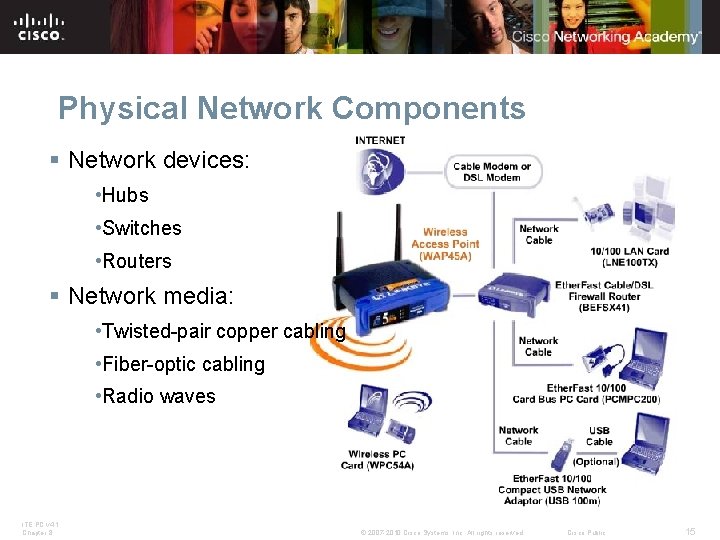
Physical Network Components § Network devices: • Hubs • Switches • Routers § Network media: • Twisted-pair copper cabling • Fiber-optic cabling • Radio waves ITE PC v 4. 1 Chapter 8 © 2007 -2010 Cisco Systems, Inc. All rights reserved. Cisco Public 15
Network Devices § Hub • Extend the range of a signal by receiving then regenerating it and sending it out all other ports. • Allow a lot of collisions on the network segment and are often not a good solution. • Also called concentrators because they serve as a central connection point for a LAN. § Bridges and Switches • A packet, along with its MAC address information, is called a frame. • LANs are often divided into sections called segments bounded by bridges. • A bridge has the intelligence to determine if an incoming frame is to be sent to a different segment, or dropped. A bridge has two ports. • A switch (multiport bridge) has several ports and refers to a table of MAC addresses to determine which port to use to forward the frame. ITE PC v 4. 1 Chapter 8 © 2007 -2010 Cisco Systems, Inc. All rights reserved. Cisco Public 16
Network Devices (Continued) § Routers • Devices that connect entire networks to each other. They use IP addresses to forward packets to other networks. • A router can be a computer with special network software installed or can be a device built by network equipment manufacturers. • Routers contain tables of IP addresses along with optimal routes to other networks. § Wireless Access Points • Provide network access to wireless devices such as laptops and PDAs. • Use radio waves to communicate with radios in computers, PDAs, and other wireless access points. • Have limited range of coverage. ITE PC v 4. 1 Chapter 8 © 2007 -2010 Cisco Systems, Inc. All rights reserved. Cisco Public 17
Network Devices (Continued) § Multipurpose Devices • Perform more than one function. • More convenient to purchase and configure just one device. • Combines the functions of a switch, a router and a wireless access point into one device. • The Linksys 300 N is an example of a multipurpose device. ITE PC v 4. 1 Chapter 8 © 2007 -2010 Cisco Systems, Inc. All rights reserved. Cisco Public 18
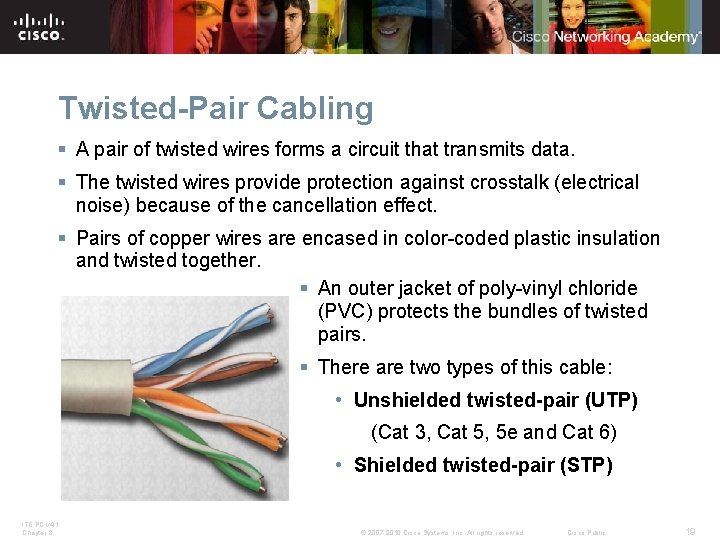
Twisted-Pair Cabling § A pair of twisted wires forms a circuit that transmits data. § The twisted wires provide protection against crosstalk (electrical noise) because of the cancellation effect. § Pairs of copper wires are encased in color-coded plastic insulation and twisted together. § An outer jacket of poly-vinyl chloride (PVC) protects the bundles of twisted pairs. § There are two types of this cable: • Unshielded twisted-pair (UTP) (Cat 3, Cat 5, 5 e and Cat 6) • Shielded twisted-pair (STP) ITE PC v 4. 1 Chapter 8 © 2007 -2010 Cisco Systems, Inc. All rights reserved. Cisco Public 19
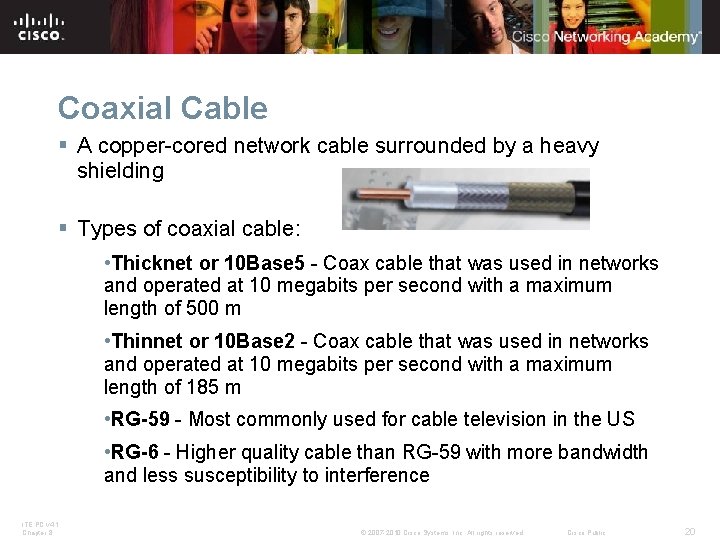
Coaxial Cable § A copper-cored network cable surrounded by a heavy shielding § Types of coaxial cable: • Thicknet or 10 Base 5 - Coax cable that was used in networks and operated at 10 megabits per second with a maximum length of 500 m • Thinnet or 10 Base 2 - Coax cable that was used in networks and operated at 10 megabits per second with a maximum length of 185 m • RG-59 - Most commonly used for cable television in the US • RG-6 - Higher quality cable than RG-59 with more bandwidth and less susceptibility to interference ITE PC v 4. 1 Chapter 8 © 2007 -2010 Cisco Systems, Inc. All rights reserved. Cisco Public 20
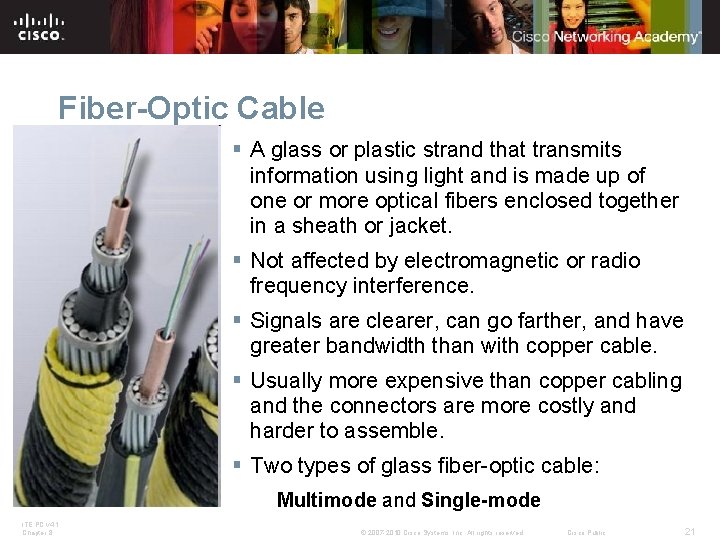
Fiber-Optic Cable § A glass or plastic strand that transmits information using light and is made up of one or more optical fibers enclosed together in a sheath or jacket. § Not affected by electromagnetic or radio frequency interference. § Signals are clearer, can go farther, and have greater bandwidth than with copper cable. § Usually more expensive than copper cabling and the connectors are more costly and harder to assemble. § Two types of glass fiber-optic cable: Multimode and Single-mode ITE PC v 4. 1 Chapter 8 © 2007 -2010 Cisco Systems, Inc. All rights reserved. Cisco Public 21
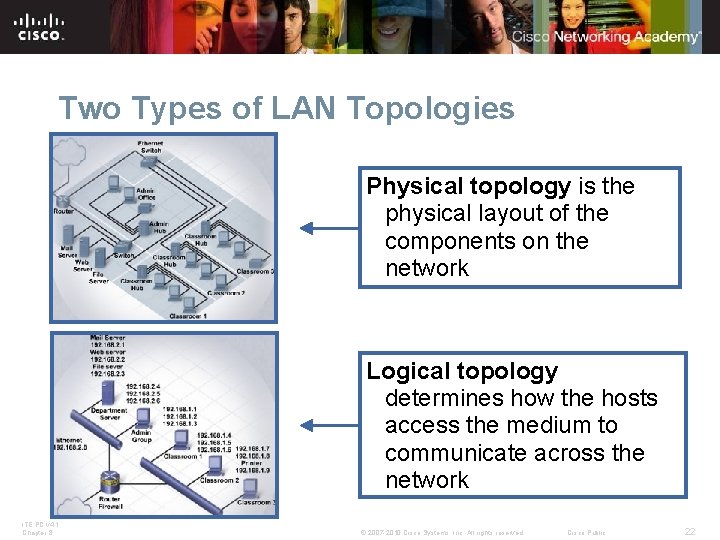
Two Types of LAN Topologies Physical topology is the physical layout of the components on the network Logical topology determines how the hosts access the medium to communicate across the network ITE PC v 4. 1 Chapter 8 © 2007 -2010 Cisco Systems, Inc. All rights reserved. Cisco Public 22
LAN Physical Topologies § A physical topology defines the way in which computers, printers, and other devices are connected to a network. § Bus • Each computer connects to a common cable The ends of the cable have a terminator installed to prevent signal reflections and network errors. • Only one computer can transmit data at a time or frames will collide and be destroyed. § Ring • Hosts are connected in a physical ring or circle. • A special frame, a token, travels around the ring, stopping at each host to allow data transmission. • There are two types of ring topologies: • Single-ring and Dual-ring ITE PC v 4. 1 Chapter 8 © 2007 -2010 Cisco Systems, Inc. All rights reserved. Cisco Public 23
LAN Physical Topologies (Continued) § Star • Has a central connection point : a hub, switch, or router. • Easy to troubleshoot, since each host is connected to the central device with its own wire. § Hierarchical or Extended Star Topology • A star network with an additional networking device connected to the main networking device to increase the size of the network. • Used for larger networks. § Mesh Topology • Connects all devices to each other. • Used in WANs that interconnect LANs. The Internet is an example of a mesh topology. ITE PC v 4. 1 Chapter 8 © 2007 -2010 Cisco Systems, Inc. All rights reserved. Cisco Public 24
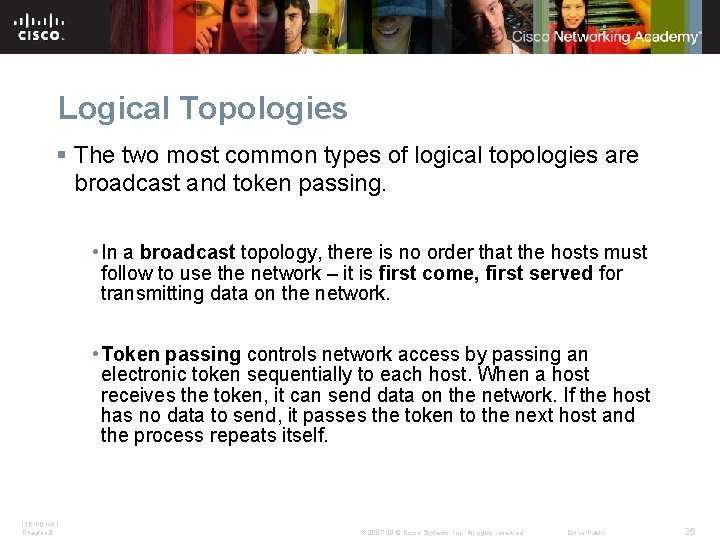
Logical Topologies § The two most common types of logical topologies are broadcast and token passing. • In a broadcast topology, there is no order that the hosts must follow to use the network – it is first come, first served for transmitting data on the network. • Token passing controls network access by passing an electronic token sequentially to each host. When a host receives the token, it can send data on the network. If the host has no data to send, it passes the token to the next host and the process repeats itself. ITE PC v 4. 1 Chapter 8 © 2007 -2010 Cisco Systems, Inc. All rights reserved. Cisco Public 25
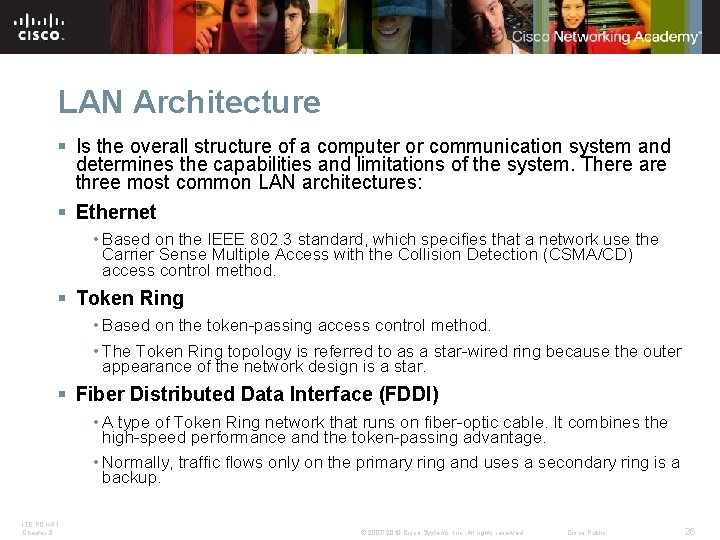
LAN Architecture § Is the overall structure of a computer or communication system and determines the capabilities and limitations of the system. There are three most common LAN architectures: § Ethernet • Based on the IEEE 802. 3 standard, which specifies that a network use the Carrier Sense Multiple Access with the Collision Detection (CSMA/CD) access control method. § Token Ring • Based on the token-passing access control method. • The Token Ring topology is referred to as a star-wired ring because the outer appearance of the network design is a star. § Fiber Distributed Data Interface (FDDI) • A type of Token Ring network that runs on fiber-optic cable. It combines the high-speed performance and the token-passing advantage. • Normally, traffic flows only on the primary ring and uses a secondary ring is a backup. ITE PC v 4. 1 Chapter 8 © 2007 -2010 Cisco Systems, Inc. All rights reserved. Cisco Public 26
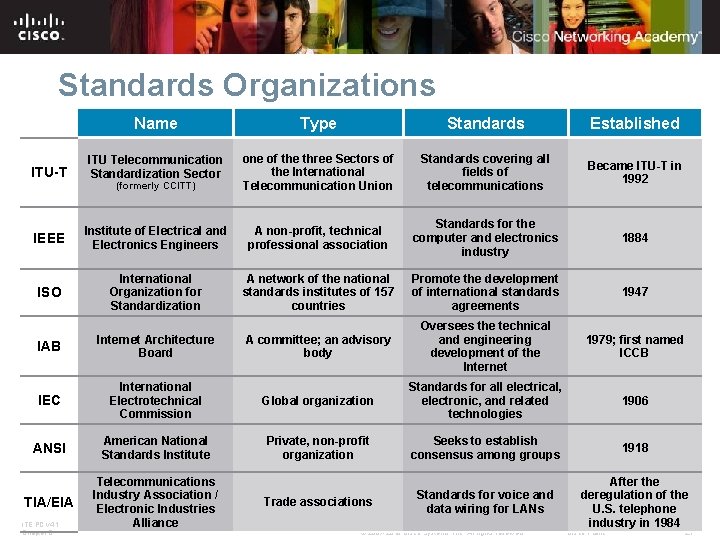
Standards Organizations Name Type Standards Established ITU Telecommunication Standardization Sector (formerly CCITT) one of the three Sectors of the International Telecommunication Union Standards covering all fields of telecommunications Became ITU-T in 1992 IEEE Institute of Electrical and Electronics Engineers A non-profit, technical professional association Standards for the computer and electronics industry 1884 ISO International Organization for Standardization A network of the national standards institutes of 157 countries Promote the development of international standards agreements 1947 IAB Internet Architecture Board A committee; an advisory body Oversees the technical and engineering development of the Internet 1979; first named ICCB IEC International Electrotechnical Commission Global organization Standards for all electrical, electronic, and related technologies 1906 ANSI American National Standards Institute Private, non-profit organization Seeks to establish consensus among groups 1918 TIA/EIA Telecommunications Industry Association / Electronic Industries Alliance Trade associations Standards for voice and data wiring for LANs After the deregulation of the U. S. telephone industry in 1984 ITU-T ITE PC v 4. 1 Chapter 8 © 2007 -2010 Cisco Systems, Inc. All rights reserved. Cisco Public 27
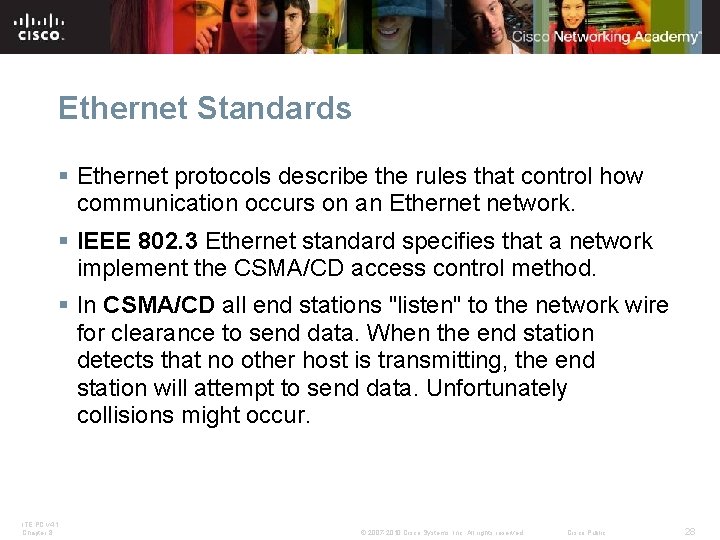
Ethernet Standards § Ethernet protocols describe the rules that control how communication occurs on an Ethernet network. § IEEE 802. 3 Ethernet standard specifies that a network implement the CSMA/CD access control method. § In CSMA/CD all end stations "listen" to the network wire for clearance to send data. When the end station detects that no other host is transmitting, the end station will attempt to send data. Unfortunately collisions might occur. ITE PC v 4. 1 Chapter 8 © 2007 -2010 Cisco Systems, Inc. All rights reserved. Cisco Public 28
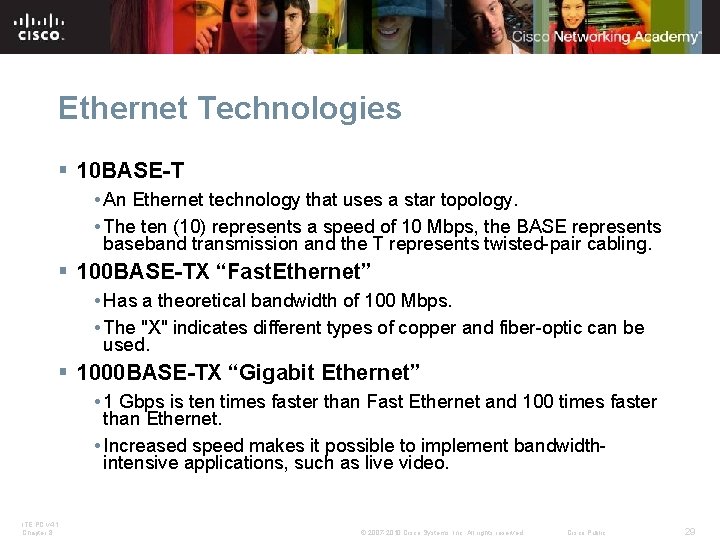
Ethernet Technologies § 10 BASE-T • An Ethernet technology that uses a star topology. • The ten (10) represents a speed of 10 Mbps, the BASE represents baseband transmission and the T represents twisted-pair cabling. § 100 BASE-TX “Fast. Ethernet” • Has a theoretical bandwidth of 100 Mbps. • The "X" indicates different types of copper and fiber-optic can be used. § 1000 BASE-TX “Gigabit Ethernet” • 1 Gbps is ten times faster than Fast Ethernet and 100 times faster than Ethernet. • Increased speed makes it possible to implement bandwidthintensive applications, such as live video. ITE PC v 4. 1 Chapter 8 © 2007 -2010 Cisco Systems, Inc. All rights reserved. Cisco Public 29
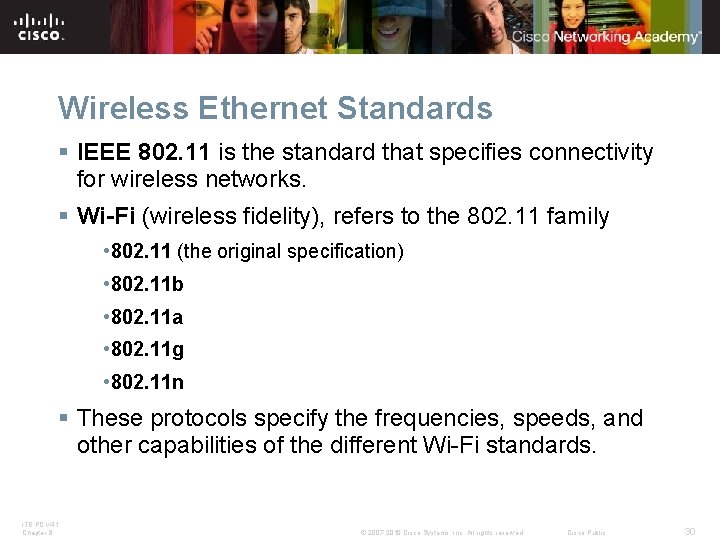
Wireless Ethernet Standards § IEEE 802. 11 is the standard that specifies connectivity for wireless networks. § Wi-Fi (wireless fidelity), refers to the 802. 11 family • 802. 11 (the original specification) • 802. 11 b • 802. 11 a • 802. 11 g • 802. 11 n § These protocols specify the frequencies, speeds, and other capabilities of the different Wi-Fi standards. ITE PC v 4. 1 Chapter 8 © 2007 -2010 Cisco Systems, Inc. All rights reserved. Cisco Public 30
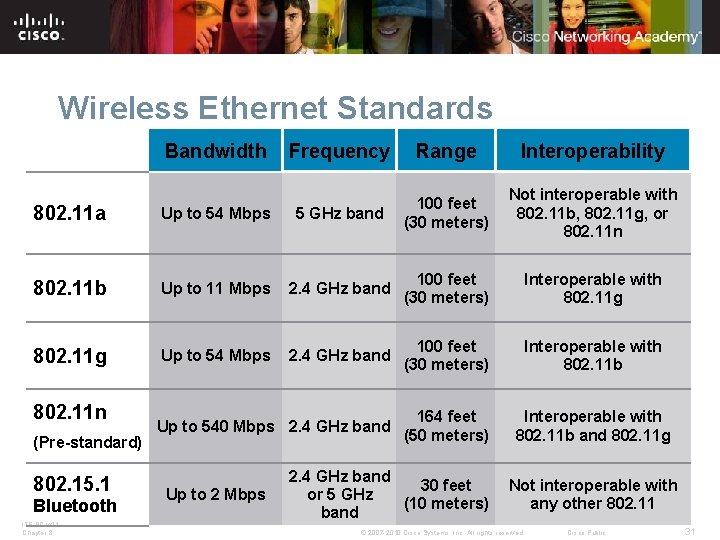
Wireless Ethernet Standards Bandwidth Frequency Range Interoperability Not interoperable with 802. 11 b, 802. 11 g, or 802. 11 n 802. 11 a Up to 54 Mbps 5 GHz band 100 feet (30 meters) 802. 11 b Up to 11 Mbps 2. 4 GHz band 100 feet (30 meters) Interoperable with 802. 11 g Up to 54 Mbps 2. 4 GHz band 100 feet (30 meters) Interoperable with 802. 11 b Up to 540 Mbps 2. 4 GHz band 164 feet (50 meters) Interoperable with 802. 11 b and 802. 11 g 802. 11 n (Pre-standard) 802. 15. 1 Bluetooth ITE PC v 4. 1 Chapter 8 Up to 2 Mbps 2. 4 GHz band 30 feet or 5 GHz (10 meters) band Not interoperable with any other 802. 11 © 2007 -2010 Cisco Systems, Inc. All rights reserved. Cisco Public 31
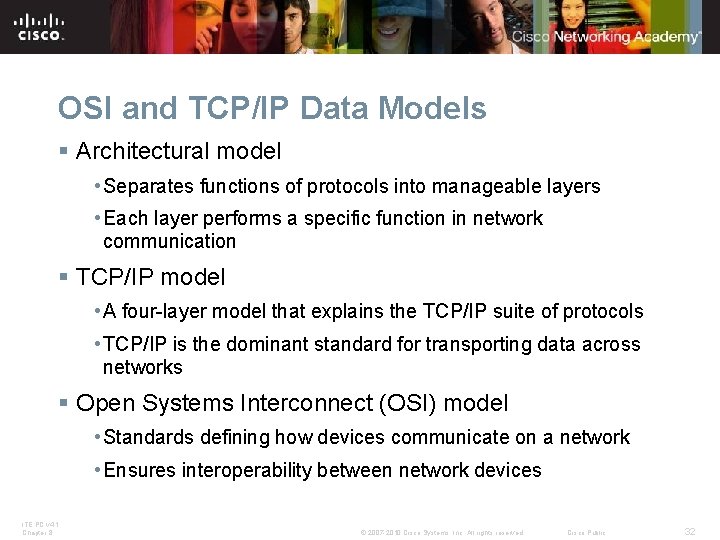
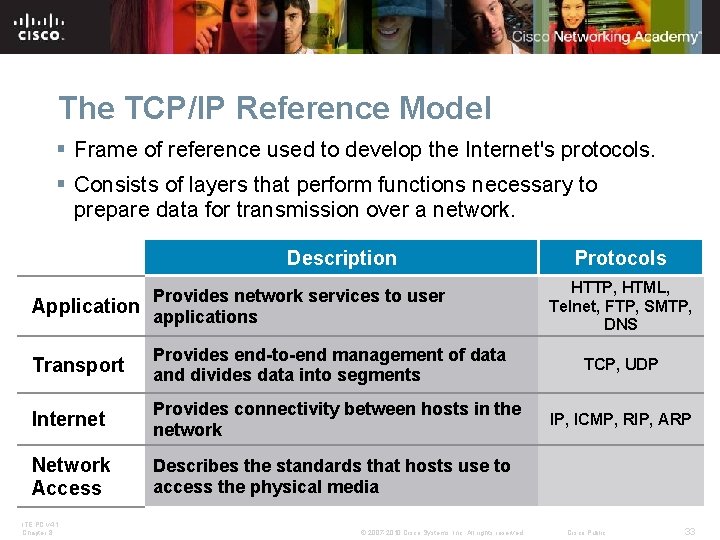
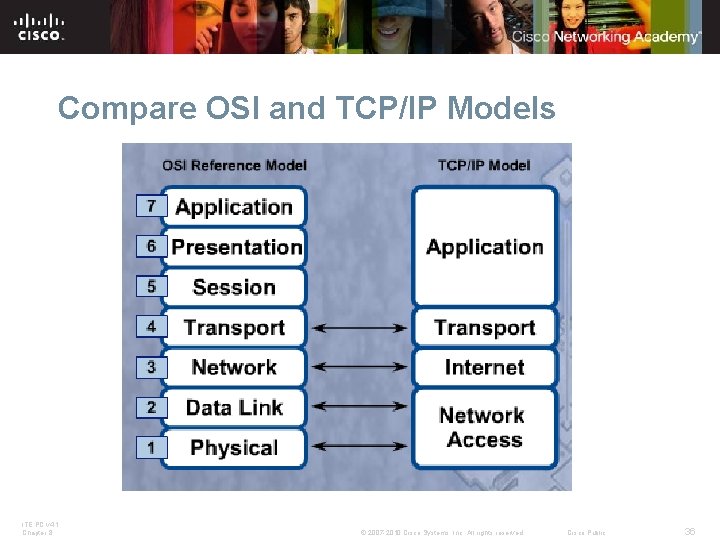
OSI and TCP/IP Data Models § Architectural model • Separates functions of protocols into manageable layers • Each layer performs a specific function in network communication § TCP/IP model • A four-layer model that explains the TCP/IP suite of protocols • TCP/IP is the dominant standard for transporting data across networks § Open Systems Interconnect (OSI) model • Standards defining how devices communicate on a network • Ensures interoperability between network devices ITE PC v 4. 1 Chapter 8 © 2007 -2010 Cisco Systems, Inc. All rights reserved. Cisco Public 32
The TCP/IP Reference Model § Frame of reference used to develop the Internet's protocols. § Consists of layers that perform functions necessary to prepare data for transmission over a network. Description Provides network services to user Application applications Transport Provides end-to-end management of data and divides data into segments Internet Provides connectivity between hosts in the network Network Access Describes the standards that hosts use to access the physical media ITE PC v 4. 1 Chapter 8 © 2007 -2010 Cisco Systems, Inc. All rights reserved. Protocols HTTP, HTML, Telnet, FTP, SMTP, DNS TCP, UDP IP, ICMP, RIP, ARP Cisco Public 33
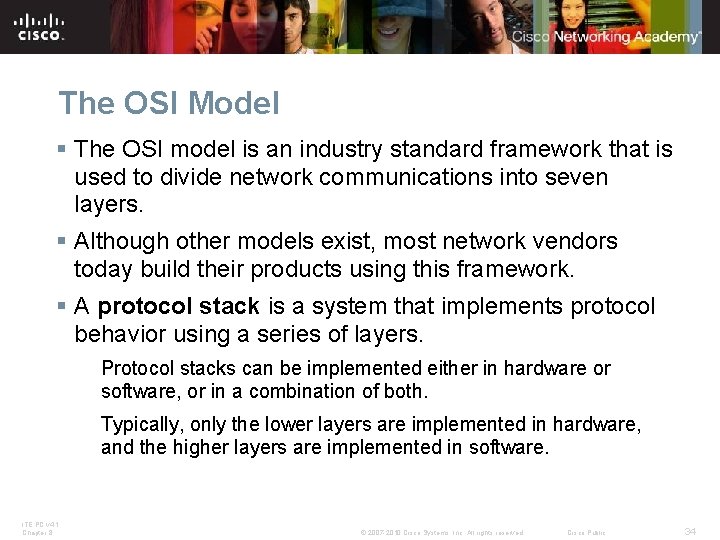
The OSI Model § The OSI model is an industry standard framework that is used to divide network communications into seven layers. § Although other models exist, most network vendors today build their products using this framework. § A protocol stack is a system that implements protocol behavior using a series of layers. Protocol stacks can be implemented either in hardware or software, or in a combination of both. Typically, only the lower layers are implemented in hardware, and the higher layers are implemented in software. ITE PC v 4. 1 Chapter 8 © 2007 -2010 Cisco Systems, Inc. All rights reserved. Cisco Public 34
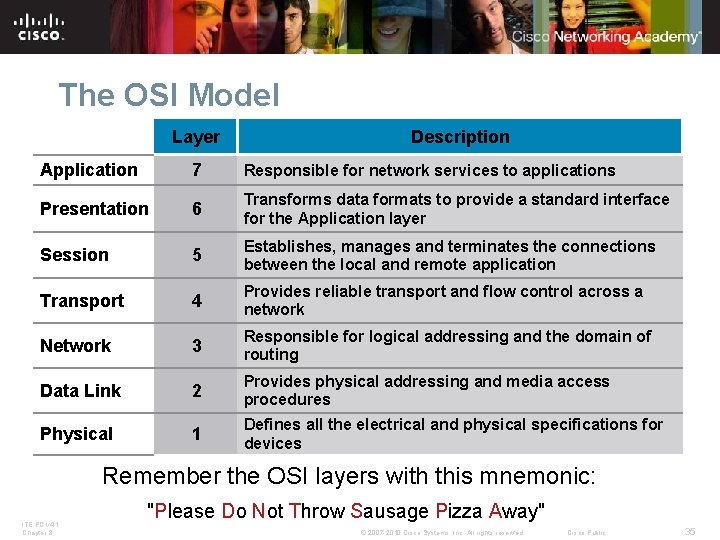
The OSI Model Layer Description Application 7 Responsible for network services to applications Presentation 6 Transforms data formats to provide a standard interface for the Application layer Session 5 Establishes, manages and terminates the connections between the local and remote application Transport 4 Provides reliable transport and flow control across a network Network 3 Responsible for logical addressing and the domain of routing Data Link 2 Provides physical addressing and media access procedures Physical 1 Defines all the electrical and physical specifications for devices Remember the OSI layers with this mnemonic: ITE PC v 4. 1 Chapter 8 "Please Do Not Throw Sausage Pizza Away" © 2007 -2010 Cisco Systems, Inc. All rights reserved. Cisco Public 35
Compare OSI and TCP/IP Models ITE PC v 4. 1 Chapter 8 © 2007 -2010 Cisco Systems, Inc. All rights reserved. Cisco Public 36
Install or Update a NIC Driver § Manufacturers publish new driver software for NICs. • May enhance the functionality of the NIC • May be needed for operating system compatibility § When installing a new driver manually, there a couple of things to keep in mind. For instance you will need to disable the virus protection and close all applications. § Alternatively, you can click the Update Driver button in the toolbar of the Device Manager. § If a new NIC driver does not perform as expected after it has been installed, the driver can be uninstalled, or rolled back, to the previous driver. ITE PC v 4. 1 Chapter 8 © 2007 -2010 Cisco Systems, Inc. All rights reserved. Cisco Public 37
Attach Computer to Existing Network § After connecting the network cable, activity should be verified by looking at the LEDs. § Every NIC must be configured with the following information: • Protocols • IP address • MAC address § Networks connection should be tested. Commands are available to run this type of tests and to obtain information: • ping • ipconfig • telnet ITE PC v 4. 1 Chapter 8 © 2007 -2010 Cisco Systems, Inc. All rights reserved. Cisco Public 38
Modem Installation § A modem is an electronic device that transfers data between one computer and another using analog signals over a telephone line. • A transmitting modem converts digital data to analog signals, called modulation. • The receiving modem reconverts the analog signals back to digital data, called demodulation. § An internal modem plugs into an expansion slot on the motherboard and a software driver is installed. § External modems connect to a computer through the serial and USB ports and also require a software driver. ITE PC v 4. 1 Chapter 8 © 2007 -2010 Cisco Systems, Inc. All rights reserved. Cisco Public 39
Dial-up Networking (DUN) § When computers use the public telephone system to communicate, it is called dial-up networking (DUN). § Modems communicate with each other using audio tone signals. DUN creates a Point-to-Point Protocol (PPP) connection between two computers over a phone line. § After the line connection has been established, a "handshaking sequence" takes place between the two modems and the computers. § The digital signals from the computers must be converted to an analog signal to travel across telephone lines. They are converted back to the digital form, 1 s and 0 s, by the receiving modem so that the receiving computer can process the data. ITE PC v 4. 1 Chapter 8 © 2007 -2010 Cisco Systems, Inc. All rights reserved. Cisco Public 40
Other types of Connectivity § Phone, cable, satellite, and private telecommunications companies provide Internet connections. § In the 1990 s, low-speed modems used the plain old telephone system (POTS) to send and receive data. § Today, many businesses and home users have switched to high-speed Internet connections, which allows for transmission of data, voice and video. ITE PC v 4. 1 Chapter 8 © 2007 -2010 Cisco Systems, Inc. All rights reserved. Cisco Public 41
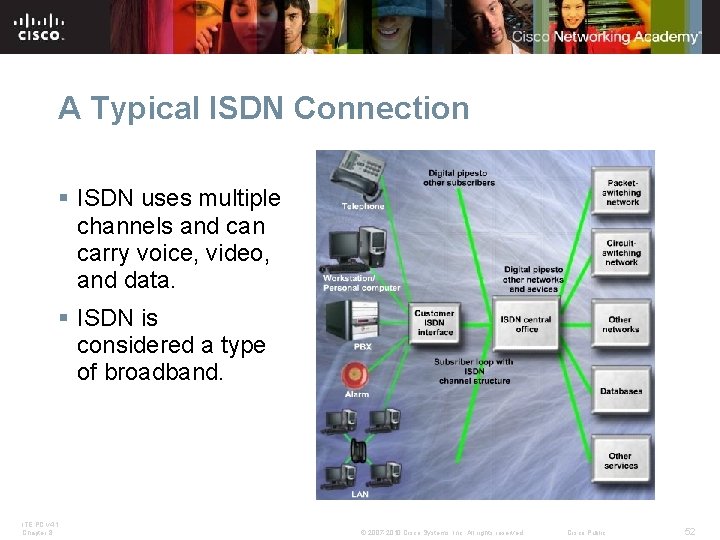
Integrated Services Digital Network (ISDN) § A standard for sending voice, video, and data over telephone wires. § Provides higher-quality voice and higher-speed data transfer than traditional analog telephone service. § Three services offered by ISDN digital connections: Basic Rate Interface (BRI), Primary Rate Interface (PRI), and Broadband ISDN (BISDN). § ISDN uses two different types of communications channels: "B" channel is used to carry the information - data, voice, or video. "D" channel is usually used for controlling and signaling, but can be used for data. ITE PC v 4. 1 Chapter 8 © 2007 -2010 Cisco Systems, Inc. All rights reserved. Cisco Public 42
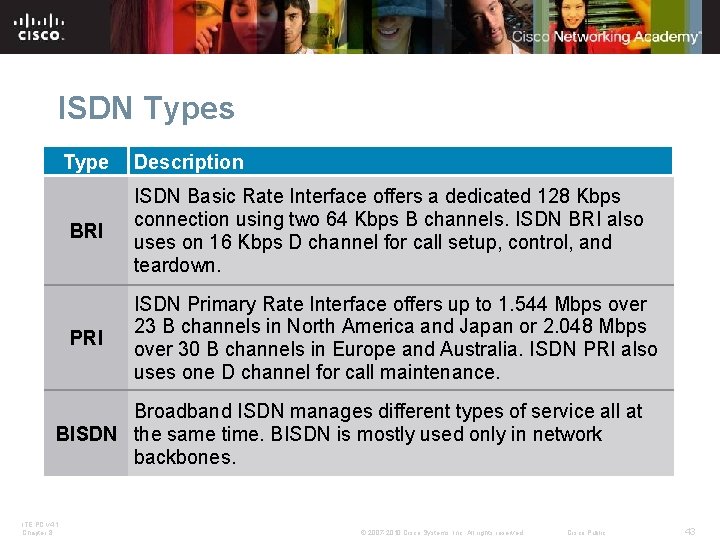
ISDN Types Type Description BRI ISDN Basic Rate Interface offers a dedicated 128 Kbps connection using two 64 Kbps B channels. ISDN BRI also uses on 16 Kbps D channel for call setup, control, and teardown. PRI ISDN Primary Rate Interface offers up to 1. 544 Mbps over 23 B channels in North America and Japan or 2. 048 Mbps over 30 B channels in Europe and Australia. ISDN PRI also uses one D channel for call maintenance. Broadband ISDN manages different types of service all at BISDN the same time. BISDN is mostly used only in network backbones. ITE PC v 4. 1 Chapter 8 © 2007 -2010 Cisco Systems, Inc. All rights reserved. Cisco Public 43
Digital Subscriber Line (DSL) § An "always-on" technology; there is no need to dial up each time to connect to the Internet. § Uses the existing copper telephone lines to provide high-speed data communication between end users and telephone companies. § Asymmetric DSL (ADSL) is currently the most commonly used DSL technology. Has a fast downstream speed, typically 1. 5 Mbps. Upload rate of ADSL is slower. Not the best solution for hosting a web server or FTP server. ITE PC v 4. 1 Chapter 8 © 2007 -2010 Cisco Systems, Inc. All rights reserved. Cisco Public 44
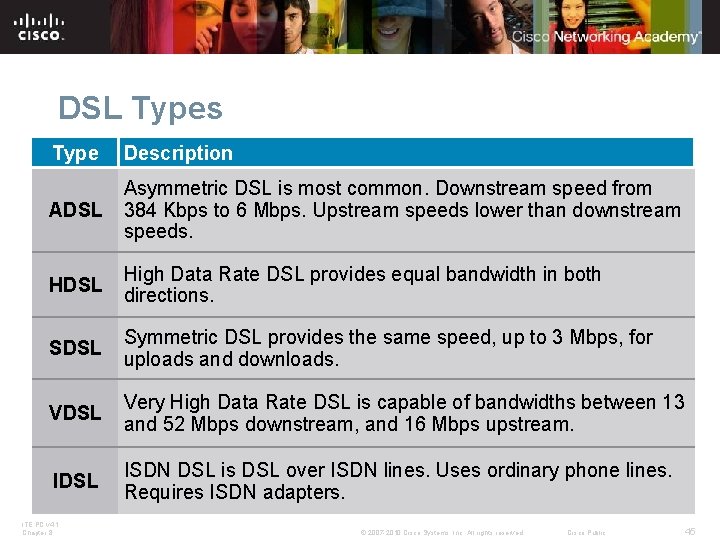
DSL Types Type Description ADSL Asymmetric DSL is most common. Downstream speed from 384 Kbps to 6 Mbps. Upstream speeds lower than downstream speeds. HDSL High Data Rate DSL provides equal bandwidth in both directions. SDSL Symmetric DSL provides the same speed, up to 3 Mbps, for uploads and downloads. VDSL Very High Data Rate DSL is capable of bandwidths between 13 and 52 Mbps downstream, and 16 Mbps upstream. IDSL ISDN DSL is DSL over ISDN lines. Uses ordinary phone lines. Requires ISDN adapters. ITE PC v 4. 1 Chapter 8 © 2007 -2010 Cisco Systems, Inc. All rights reserved. Cisco Public 45
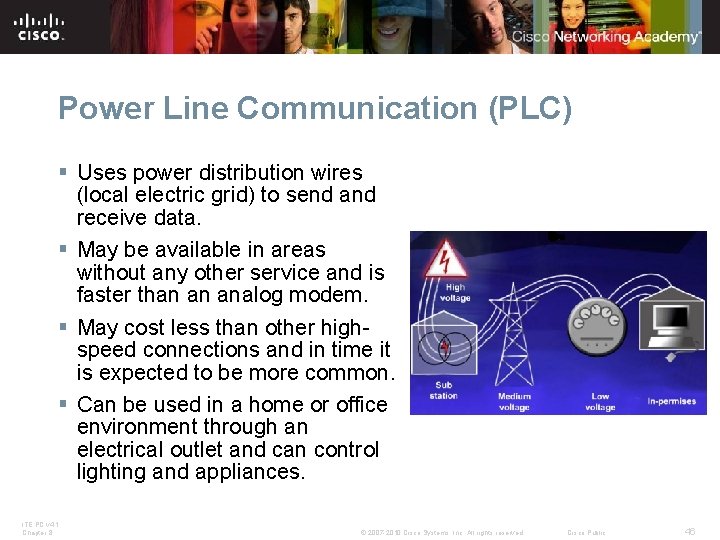
Power Line Communication (PLC) § Uses power distribution wires (local electric grid) to send and receive data. § May be available in areas without any other service and is faster than an analog modem. § May cost less than other highspeed connections and in time it is expected to be more common. § Can be used in a home or office environment through an electrical outlet and can control lighting and appliances. ITE PC v 4. 1 Chapter 8 © 2007 -2010 Cisco Systems, Inc. All rights reserved. Cisco Public 46
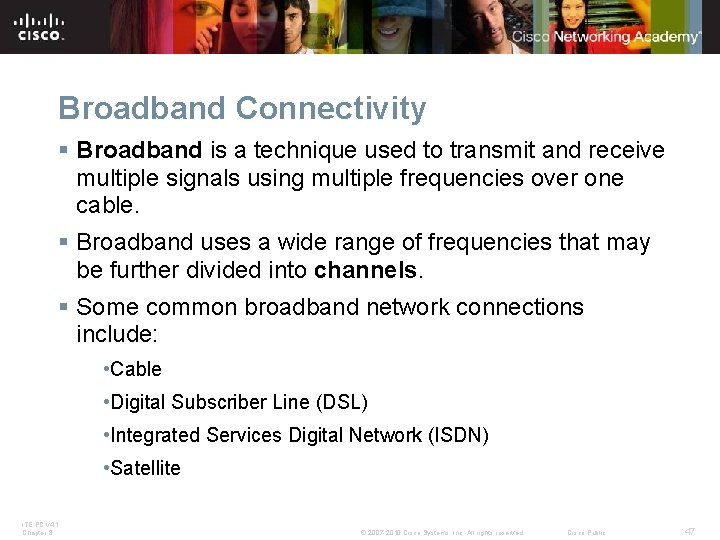
Broadband Connectivity § Broadband is a technique used to transmit and receive multiple signals using multiple frequencies over one cable. § Broadband uses a wide range of frequencies that may be further divided into channels. § Some common broadband network connections include: • Cable • Digital Subscriber Line (DSL) • Integrated Services Digital Network (ISDN) • Satellite ITE PC v 4. 1 Chapter 8 © 2007 -2010 Cisco Systems, Inc. All rights reserved. Cisco Public 47
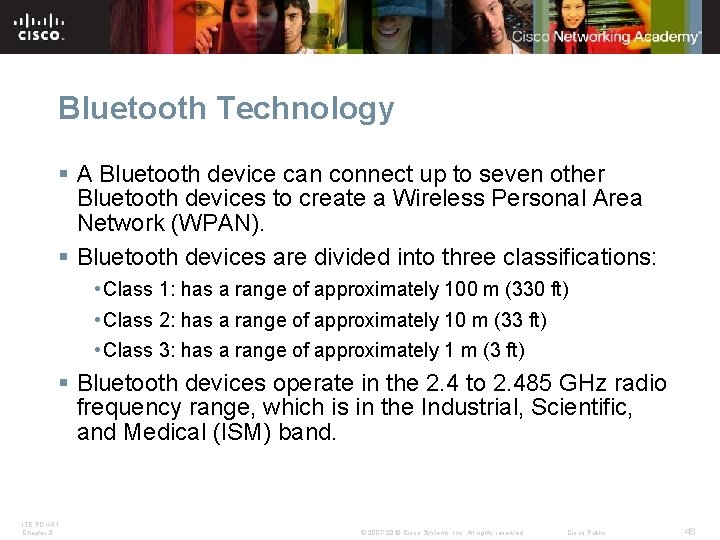
Bluetooth Technology § A Bluetooth device can connect up to seven other Bluetooth devices to create a Wireless Personal Area Network (WPAN). § Bluetooth devices are divided into three classifications: • Class 1: has a range of approximately 100 m (330 ft) • Class 2: has a range of approximately 10 m (33 ft) • Class 3: has a range of approximately 1 m (3 ft) § Bluetooth devices operate in the 2. 4 to 2. 485 GHz radio frequency range, which is in the Industrial, Scientific, and Medical (ISM) band. ITE PC v 4. 1 Chapter 8 © 2007 -2010 Cisco Systems, Inc. All rights reserved. Cisco Public 48
Cellular Technology § Cellular technology enables the transfer of voice, video, and data. With a cellular WAN adapter installed, a laptop user can access the Internet over the cellular network. § Although slower than DSL and cable connections, cellular WANs are still fast enough to be classified as a high-speed connection. § Different Generations has been released: • G 1 • G 2. 5 • G 3. 5 ITE PC v 4. 1 Chapter 8 © 2007 -2010 Cisco Systems, Inc. All rights reserved. Cisco Public 49
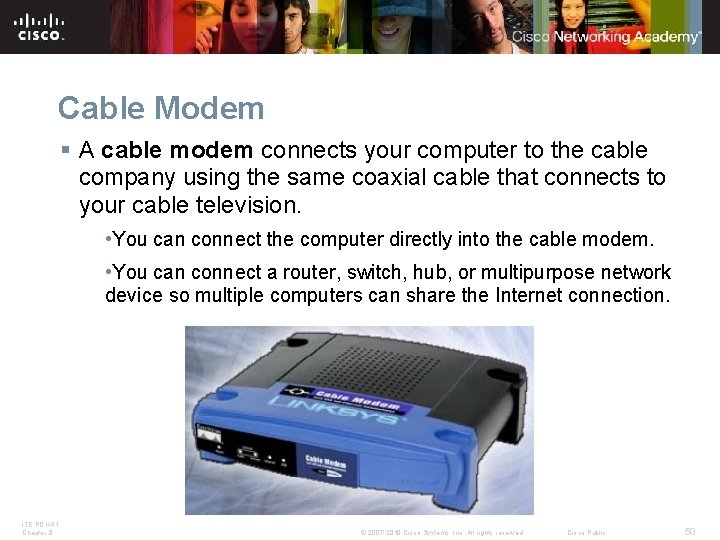
Cable Modem § A cable modem connects your computer to the cable company using the same coaxial cable that connects to your cable television. • You can connect the computer directly into the cable modem. • You can connect a router, switch, hub, or multipurpose network device so multiple computers can share the Internet connection. ITE PC v 4. 1 Chapter 8 © 2007 -2010 Cisco Systems, Inc. All rights reserved. Cisco Public 50
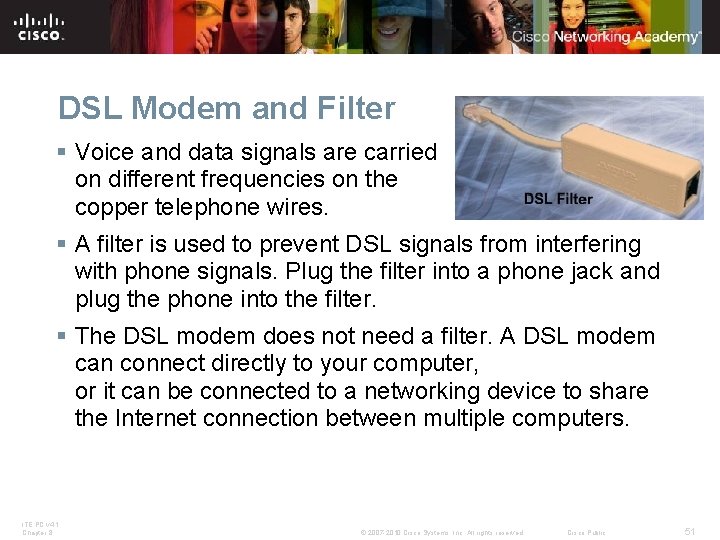
DSL Modem and Filter § Voice and data signals are carried on different frequencies on the copper telephone wires. § A filter is used to prevent DSL signals from interfering with phone signals. Plug the filter into a phone jack and plug the phone into the filter. § The DSL modem does not need a filter. A DSL modem can connect directly to your computer, or it can be connected to a networking device to share the Internet connection between multiple computers. ITE PC v 4. 1 Chapter 8 © 2007 -2010 Cisco Systems, Inc. All rights reserved. Cisco Public 51
A Typical ISDN Connection § ISDN uses multiple channels and can carry voice, video, and data. § ISDN is considered a type of broadband. ITE PC v 4. 1 Chapter 8 © 2007 -2010 Cisco Systems, Inc. All rights reserved. Cisco Public 52
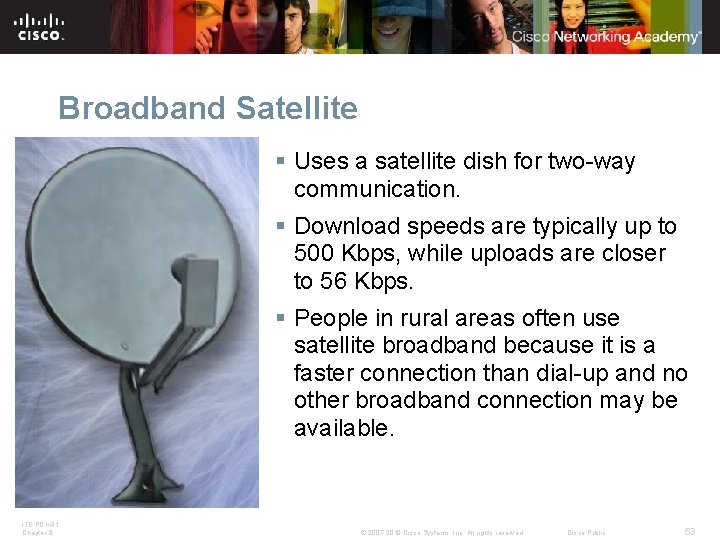
Broadband Satellite § Uses a satellite dish for two-way communication. § Download speeds are typically up to 500 Kbps, while uploads are closer to 56 Kbps. § People in rural areas often use satellite broadband because it is a faster connection than dial-up and no other broadband connection may be available. ITE PC v 4. 1 Chapter 8 © 2007 -2010 Cisco Systems, Inc. All rights reserved. Cisco Public 53
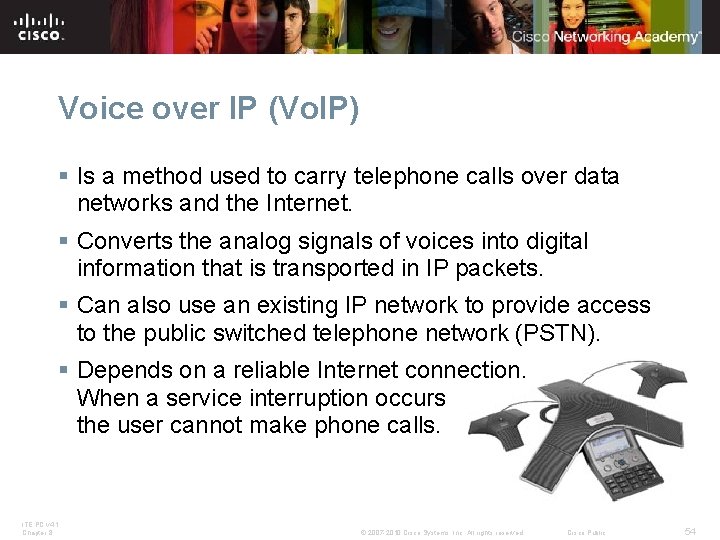
Voice over IP (Vo. IP) § Is a method used to carry telephone calls over data networks and the Internet. § Converts the analog signals of voices into digital information that is transported in IP packets. § Can also use an existing IP network to provide access to the public switched telephone network (PSTN). § Depends on a reliable Internet connection. When a service interruption occurs the user cannot make phone calls. ITE PC v 4. 1 Chapter 8 © 2007 -2010 Cisco Systems, Inc. All rights reserved. Cisco Public 54
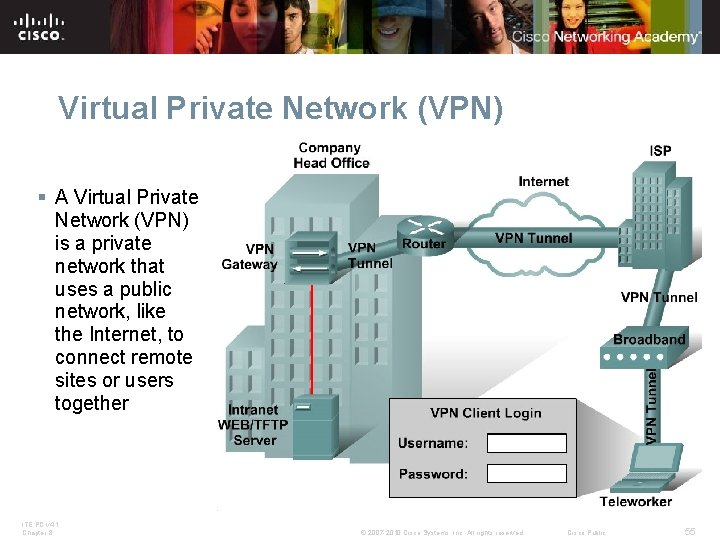
Virtual Private Network (VPN) § A Virtual Private Network (VPN) is a private network that uses a public network, like the Internet, to connect remote sites or users together ITE PC v 4. 1 Chapter 8 © 2007 -2010 Cisco Systems, Inc. All rights reserved. Cisco Public 55
Preventive Maintenance for Networks § Common preventive maintenance techniques should continually be performed for a network to operate properly. • Keep network rooms clean and change air filters often. • Checking the various components of a network for wear. • Check the condition of network cables because they are often moved, unplugged, and kicked. • Label the cables to save troubleshooting time later. Refer to wiring diagrams and always follow your company's cable labeling guidelines. • AC power adapters should be checked regularly. • The uninterruptible power supply (UPS) should be tested to ensure that you have power in the case of an outage. ITE PC v 4. 1 Chapter 8 © 2007 -2010 Cisco Systems, Inc. All rights reserved. Cisco Public 56
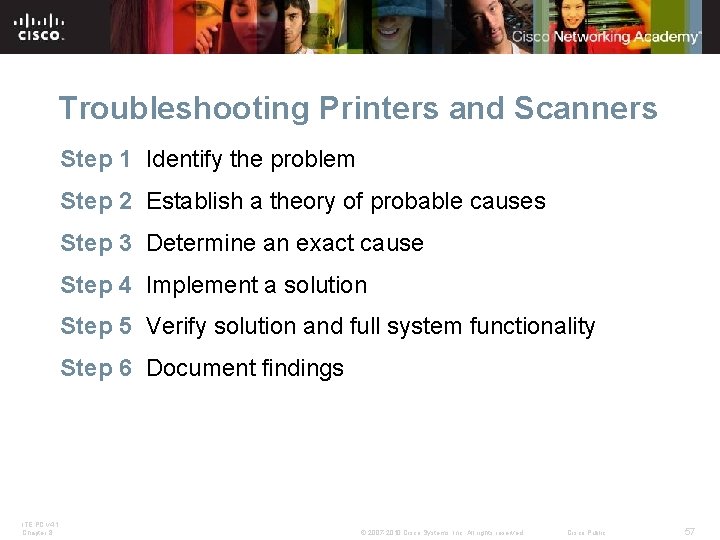
Troubleshooting Printers and Scanners Step 1 Identify the problem Step 2 Establish a theory of probable causes Step 3 Determine an exact cause Step 4 Implement a solution Step 5 Verify solution and full system functionality Step 6 Document findings ITE PC v 4. 1 Chapter 8 © 2007 -2010 Cisco Systems, Inc. All rights reserved. Cisco Public 57
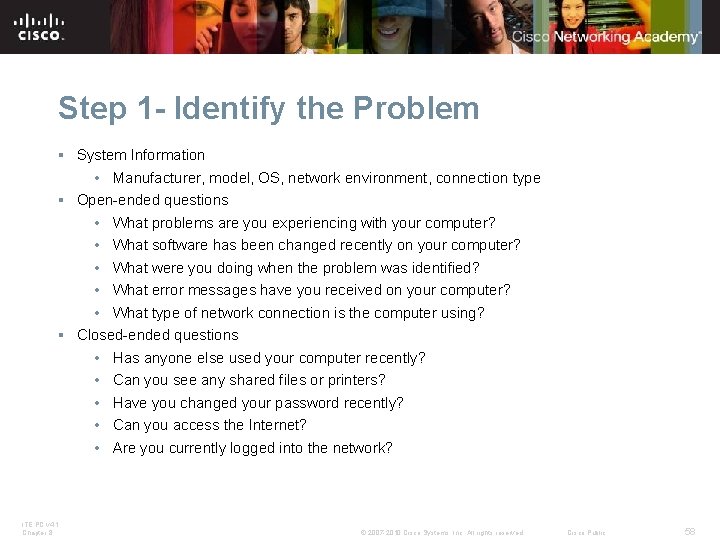
Step 1 - Identify the Problem § System Information • Manufacturer, model, OS, network environment, connection type § Open-ended questions • What problems are you experiencing with your computer? • What software has been changed recently on your computer? • What were you doing when the problem was identified? • What error messages have you received on your computer? • What type of network connection is the computer using? § Closed-ended questions • Has anyone else used your computer recently? • Can you see any shared files or printers? • Have you changed your password recently? • Can you access the Internet? • Are you currently logged into the network? ITE PC v 4. 1 Chapter 8 © 2007 -2010 Cisco Systems, Inc. All rights reserved. Cisco Public 58
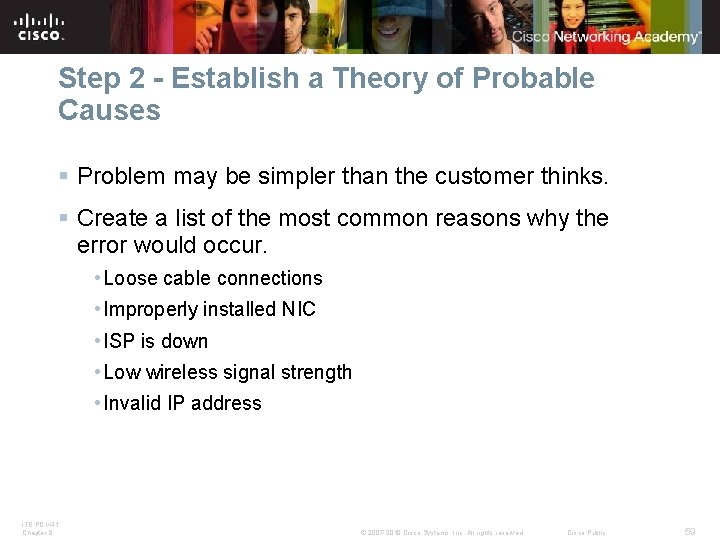
Step 2 - Establish a Theory of Probable Causes § Problem may be simpler than the customer thinks. § Create a list of the most common reasons why the error would occur. • Loose cable connections • Improperly installed NIC • ISP is down • Low wireless signal strength • Invalid IP address ITE PC v 4. 1 Chapter 8 © 2007 -2010 Cisco Systems, Inc. All rights reserved. Cisco Public 59
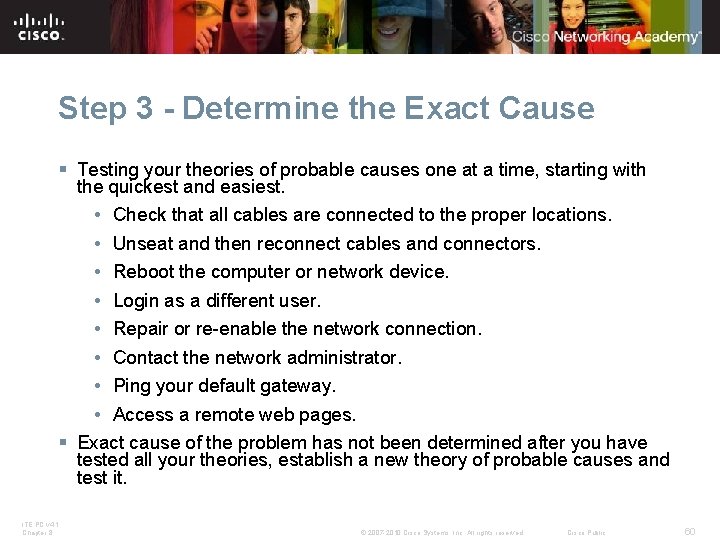
Step 3 - Determine the Exact Cause § Testing your theories of probable causes one at a time, starting with the quickest and easiest. • Check that all cables are connected to the proper locations. • Unseat and then reconnect cables and connectors. • Reboot the computer or network device. • Login as a different user. • Repair or re-enable the network connection. • Contact the network administrator. • Ping your default gateway. • Access a remote web pages. § Exact cause of the problem has not been determined after you have tested all your theories, establish a new theory of probable causes and test it. ITE PC v 4. 1 Chapter 8 © 2007 -2010 Cisco Systems, Inc. All rights reserved. Cisco Public 60
Step 4 - Implement a Solution § Sometimes quick procedures can determine the exact cause of the problem or even correct the problem. § If a quick procedure does not correct the problem, you might need to research the problem further to establish the exact cause. § Divide larger problems into smaller problems that can be analyzed and solved individually. ITE PC v 4. 1 Chapter 8 © 2007 -2010 Cisco Systems, Inc. All rights reserved. Cisco Public 61
Step 5 - Verify Solution and System Functionality § Verifying full system functionality and implementing any preventive measures if needed. § Ping is used to check network connectivity. § Nslookup is used to query Internet domain name server. § Tracert is used to determine the route taken by packets when they travel across the network. § Net View is used to display a list of computers in a workgroup. § Have the customer verify the solution and system functionality. ITE PC v 4. 1 Chapter 8 © 2007 -2010 Cisco Systems, Inc. All rights reserved. Cisco Public 62
6. Document Findings § Discuss the solution with the customer § Have the customer confirm that the problem has been solved § Document the process • Problem description • Solution • Components used • Amount of time spent in solving the problem ITE PC v 4. 1 Chapter 8 © 2007 -2010 Cisco Systems, Inc. All rights reserved. Cisco Public 63
Common Problems and Solutions § Printer and scanner problems can be attributed to hardware, software, networks, or some combination of the three. You will resolve some types of printer and scanner problems more often than others. ITE PC v 4. 1 Chapter 8 © 2007 -2010 Cisco Systems, Inc. All rights reserved. Cisco Public 64
Chapter 8 Summary § A computer network is composed of two or more computers that share data and resources. § A Local Area Network (LAN) refers to a group of interconnected computers that are under the same administrative control. § A Wide Area Network (WAN) is a network that connects LANs in geographically separated locations. § In a peer-to-peer network, devices are connected directly to each other. A peer-to-peer network is easy to install, and no additional equipment or dedicated administrator is required. Users control their own resources, and a networks best with a small number of computers. A client/server network uses a dedicated system that functions as the server. The server responds to requests made by users or clients connected to the network. ITE PC v 4. 1 Chapter 8 © 2007 -2010 Cisco Systems, Inc. All rights reserved. Cisco Public 65
Chapter 8 Summary (Continued) § A LAN uses a direct connection from one computer to another. It is suitable for a small area, such as in a home, building, or school. A WAN uses point-to-point or point-to-multipoint, serial communications lines to communicate over greater distances. A WLAN uses wireless technology to connect devices together. § The network topology defines the way in which computers, printers, and other devices are connected. Physical topology describes the layout of the wire and devices, as well as the paths used by data transmissions. Logical topology is the path that signals travel from one point to another. Topologies include bus, star, ring, and mesh. § Networking devices are used to connect computers and peripheral devices so that they can communicate. These include hubs, bridges, switches, routers, and multipurpose devices. The type of device implemented depends on the type of network. ITE PC v 4. 1 Chapter 8 © 2007 -2010 Cisco Systems, Inc. All rights reserved. Cisco Public 66
Chapter 8 Summary (Continued) § Networking media can be defined as the means by which signals, or data, are sent from one computer to another. Signals can be transmitted either by cable or wireless means. The media types discussed were coaxial, twisted-pair, fiber-optic cabling, and radio frequencies. § Ethernet architecture is now the most popular type of LAN architecture. Architecture refers to the overall structure of a computer or communications system. It determines the capabilities and limitations of the system. The Ethernet architecture is based on the IEEE 802. 3 standard. The IEEE 802. 3 standard specifies that a network implement the CSMA/CD access control method. § The OSI reference model is an industry standard framework that is used to divide the functions of networking into seven distinct layers. These layers include Application, Presentation, Session, Transport, Network, Data Link, and Physical. It is important to understand the purpose of each layer. ITE PC v 4. 1 Chapter 8 © 2007 -2010 Cisco Systems, Inc. All rights reserved. Cisco Public 67
Chapter 8 Summary (Continued) § The TCP/IP suite of protocols has become the dominant standard for the Internet. TCP/IP represents a set of public standards that specify how packets of information are exchanged between computers over one or more networks. § A NIC is a device that plugs into a motherboard and provides ports for the network cable connections. It is the computer interface with the LAN. § A modem is an electronic device that is used for computer communications through telephone lines. It allows data transfer between one computer and another. The modem converts byte-oriented data to serial bit streams. All modems require software to control the communication session. The set of commands that most modem software uses is known as the Hayes-compatible command set. ITE PC v 4. 1 Chapter 8 © 2007 -2010 Cisco Systems, Inc. All rights reserved. Cisco Public 68
Chapter 8 Summary (Continued) § The three transmission methods to sending signals over data channels are simplex, half-duplex, and full-duplex. Full-duplex networking technology increases performance because data can be sent and received at the same time. DSL, two-way cable modem, and other broadband technologies operate in full-duplex mode. § Network devices and media, such as computer components, must be maintained. It is important to clean equipment regularly and use a proactive approach to prevent problems. Repair or replace broken equipment to prevent downtime. § When troubleshooting network problems, listen to what your customer tells you so that you can formulate open-ended and closed-ended questions that will help you determine where to begin fixing the problem. Verify obvious issues and try quick solutions before escalating the troubleshooting process. ITE PC v 4. 1 Chapter 8 © 2007 -2010 Cisco Systems, Inc. All rights reserved. Cisco Public 69
ITE PC v 4. 1 Chapter 8 © 2007 -2010 Cisco Systems, Inc. All rights reserved. Cisco Public 70