
CHAPTER 8 Fuel Supply Air Induction and Emissions
- Slides: 54
CHAPTER 8 Fuel Supply, Air Induction, and Emissions
Learning Objectives • Name various types of fuel that can be used in a small engine and list practical applications for each. • Explain the importance of proper fuel-oil mixture in a two-cycle engine. • Describe the purpose of fuel filters. • Explain fuel pump operation. • Describe the operation of a pressurized fuel system. • Describe the purpose of an air cleaner. • Explain the importance of emission control. © Goodheart-Willcox Co. , Inc. Permission granted to reproduce for educational use only.
Engine Fuels • Gasoline – High power potential – Widely available • • Liquefied petroleum gas Natural gas Kerosene Diesel fuel © Goodheart-Willcox Co. , Inc. Permission granted to reproduce for educational use only.
Gasoline • Most popular fuel for small engines • Refined from petroleum • Desirable characteristics – Ignites readily, burns cleanly, resists detonation – Vaporizes easily – Free of dirt, water, and abrasives © Goodheart-Willcox Co. , Inc. Permission granted to reproduce for educational use only.
Octane Number • Ability to resist detonation • Premium grade burns slower – Used in high-compression engines • Regular grade burns faster – Used in most small engines © Goodheart-Willcox Co. , Inc. Permission granted to reproduce for educational use only.
Unleaded Gasoline • Leaded gasoline phased out in 1980 s – Damaged catalytic converters • Oxygenates added to increase octane – Super unleaded or premium unleaded – Increases moisture absorption – Can cause corrosion and damage plastic © Goodheart-Willcox Co. , Inc. Permission granted to reproduce for educational use only.
Fuel Stabilizers • Added to fuel for storage • Keep fuel fresh • Reduce chemical breakdown – Less gum and varnish • Contain petroleum distillate © Goodheart-Willcox Co. , Inc. Permission granted to reproduce for educational use only.
Two-Cycle Fuel Mixtures • Oil mixed with gas – Ratio varies with engine design • Too little oil – Overheating – Scoring of internal components • Too much oil – Incomplete combustion – Carbon buildup © Goodheart-Willcox Co. , Inc. Permission granted to reproduce for educational use only.
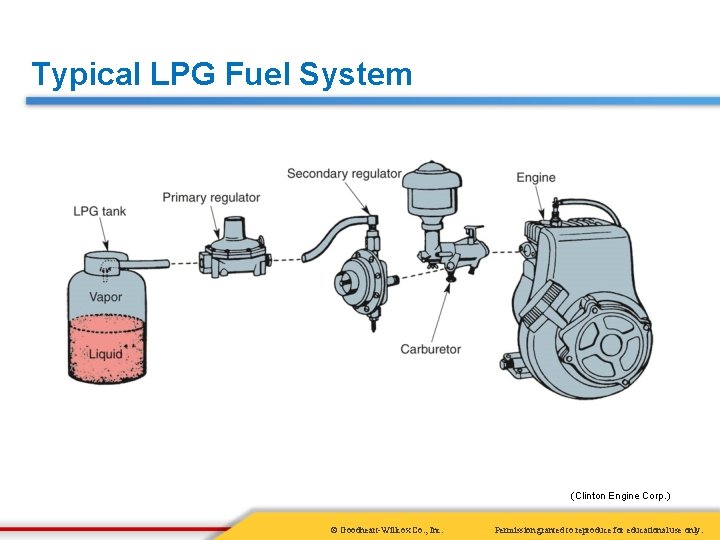
Liquefied Petroleum Gas and Natural Gas • Require special fuel system • Liquefied petroleum gas (LPG) – May consist of propane, butane, or mix – Burns cleanly with high anti-knock rating – No loss of horsepower • Natural gas – 20% loss of horsepower © Goodheart-Willcox Co. , Inc. Permission granted to reproduce for educational use only.
Combustion of LPG • Ignition timing advanced – Burns slower than gasoline – Higher ignition temperature • May require higher voltage at spark plug – Colder plugs are smaller plug gaps © Goodheart-Willcox Co. , Inc. Permission granted to reproduce for educational use only.
LPG vs. Gasoline • Advantages of LPG – Cheaper – Less engine wear and maintenance – Produces smoother power with fewer emissions • Disadvantages of LPG – High initial equipment costs – Less availability – Harder to start in cold weather © Goodheart-Willcox Co. , Inc. Permission granted to reproduce for educational use only.
Typical LPG Fuel System (Clinton Engine Corp. ) © Goodheart-Willcox Co. , Inc. Permission granted to reproduce for educational use only.
Kerosene and Diesel Fuels • Some gas engines can be converted – Low compression head and special carburetor – Started and warmed on gasoline – Switched to fuel oil or kerosene when warm • True diesel engines use diesel fuel – Fuel injected into cylinder – High compression ratio (up to 20: 1) © Goodheart-Willcox Co. , Inc. Permission granted to reproduce for educational use only.
Fuel Systems • All parts that help deliver fuel to cylinder – Fuel tank – Fuel line – Fuel filter – Carburetor – Fuel pump © Goodheart-Willcox Co. , Inc. Permission granted to reproduce for educational use only.
Fuel Tanks • Fuel filler caps – Vented – Prevent debris from entering tank • Strainers – Capture debris during refueling • Tanks may have fuel pick-up line – Weighted to keep pick-up in fuel © Goodheart-Willcox Co. , Inc. Permission granted to reproduce for educational use only.
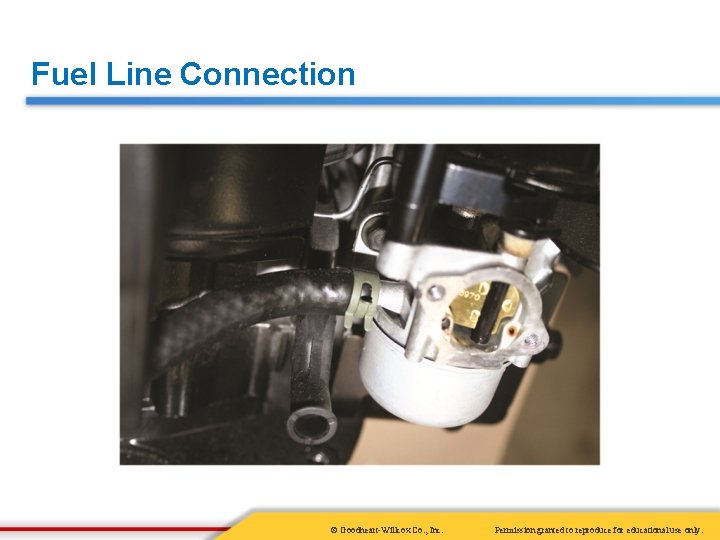
Fuel Lines • Route fuel from tank to carburetor • Typically flexible hoses • Special material and design – Reduce emissions – Withstand constant exposure to fuel • Fastened to fittings with hose clamps © Goodheart-Willcox Co. , Inc. Permission granted to reproduce for educational use only.
Fuel Line Connection © Goodheart-Willcox Co. , Inc. Permission granted to reproduce for educational use only.
Low Permeation Fuel Tanks and Lines • Reduce evaporative emissions • Must be replaced with same type – Compliance with emission standards © Goodheart-Willcox Co. , Inc. Permission granted to reproduce for educational use only.
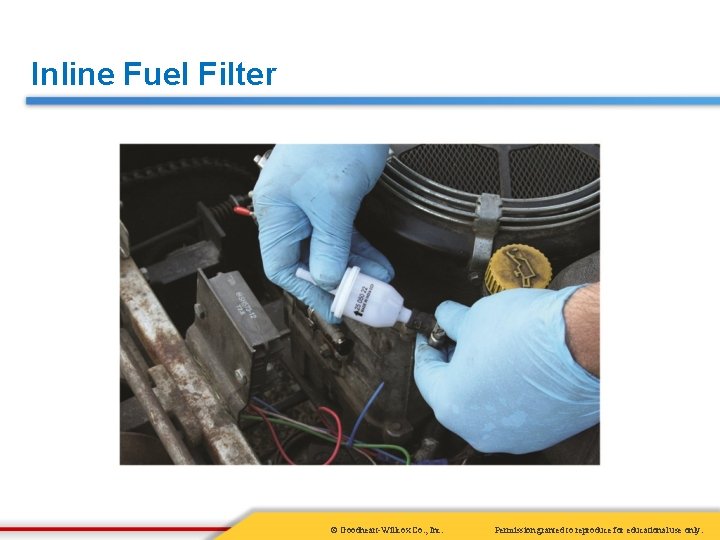
Fuel Filters • Filter screens – Pickup tube – Tank fitting • Replaceable inline filter – Installed between tank and carburetor – Unidirectional © Goodheart-Willcox Co. , Inc. Permission granted to reproduce for educational use only.
Inline Fuel Filter © Goodheart-Willcox Co. , Inc. Permission granted to reproduce for educational use only.
Fuel Pumps • Installed between tank and carburetor • Provide pressurized fuel flow – Tank lower than carburetor – Tank considerable distance from carburetor – Engine is used in different positions • Mechanical and impulse diaphragm types © Goodheart-Willcox Co. , Inc. Permission granted to reproduce for educational use only.
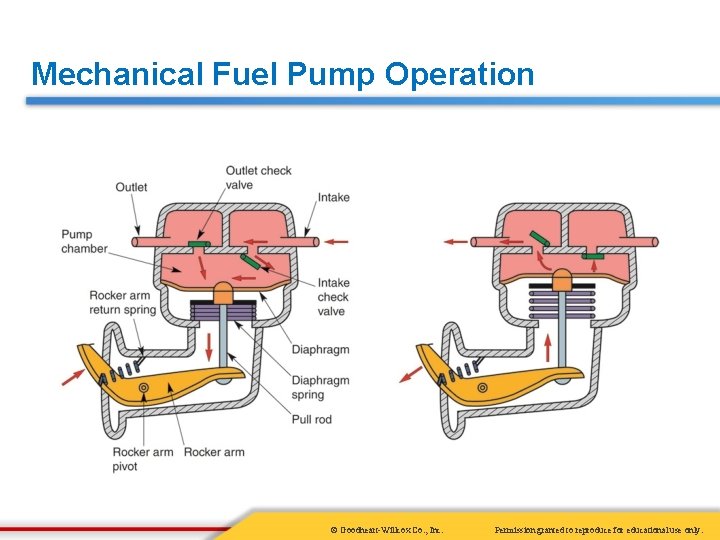
Mechanical Fuel Pumps • Rocker arm follows eccentric – Pull rod compresses spring and pulls down diaphragm – Diaphragm creates vacuum to draw in fuel – Check valves at outlet prevents backflow • Spring pressure returns diaphragm – Forces fuel out of chamber – Check valve at inlet prevents backflow © Goodheart-Willcox Co. , Inc. Permission granted to reproduce for educational use only.
Mechanical Fuel Pump Operation © Goodheart-Willcox Co. , Inc. Permission granted to reproduce for educational use only.
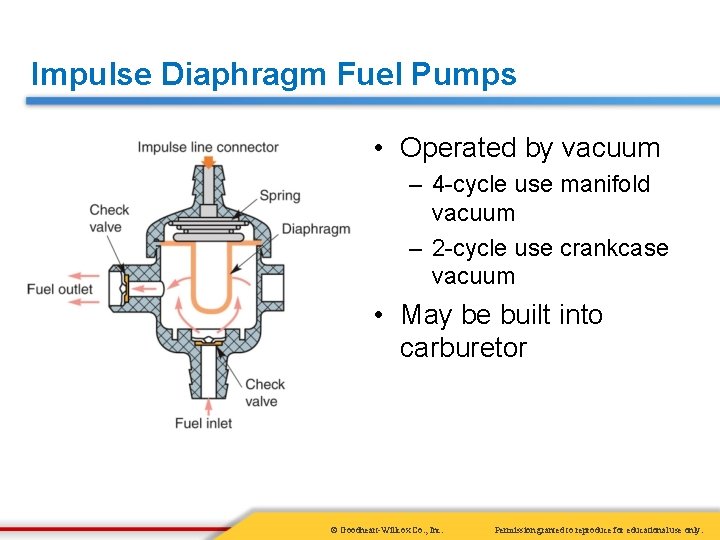
Impulse Diaphragm Fuel Pumps • Operated by vacuum – 4 -cycle use manifold vacuum – 2 -cycle use crankcase vacuum • May be built into carburetor © Goodheart-Willcox Co. , Inc. Permission granted to reproduce for educational use only.
Impulse Diaphragm Fuel Pump Operation • Vacuum pulse moves diaphragm – Draws fuel into chamber – Compresses return spring • Vacuum decreases – Spring pressure returns diaphragm – Pushes fuel out of pump • Check valves prevent backflow © Goodheart-Willcox Co. , Inc. Permission granted to reproduce for educational use only.
Pressurized Fuel System • Used with outboard motors – Tank far below carburetor • Crankcase gases pressurize fuel tank – Initial pressure provided by hand pump – Pressure forces fuel up pick-up tube © Goodheart-Willcox Co. , Inc. Permission granted to reproduce for educational use only.
Vapor Return Fuel Systems • Vapor in carburetor disrupt fuel flow – Engine will not run until vapor condenses • System returns vapor to tank – Prevents vapor lock © Goodheart-Willcox Co. , Inc. Permission granted to reproduce for educational use only.
Air Induction Systems • Delivers air to carburetor • Components – Filter and housing – Intake plenum © Goodheart-Willcox Co. , Inc. Permission granted to reproduce for educational use only.
Air Cleaners and Air Filters • Remove dust from air – Dust causes engine wear • Three common types – Oil-wetted – Dry – Dual-element • Clogged filter causes engine to run rich © Goodheart-Willcox Co. , Inc. Permission granted to reproduce for educational use only.
Oil-Wetted Air Cleaners • Made from polyurethane foam – Pores in foam trap particles • Filter should be cleaned regularly – Every 25 hours of operation (or once a season) – Washed with soap and water – Wetted with oil © Goodheart-Willcox Co. , Inc. Permission granted to reproduce for educational use only.
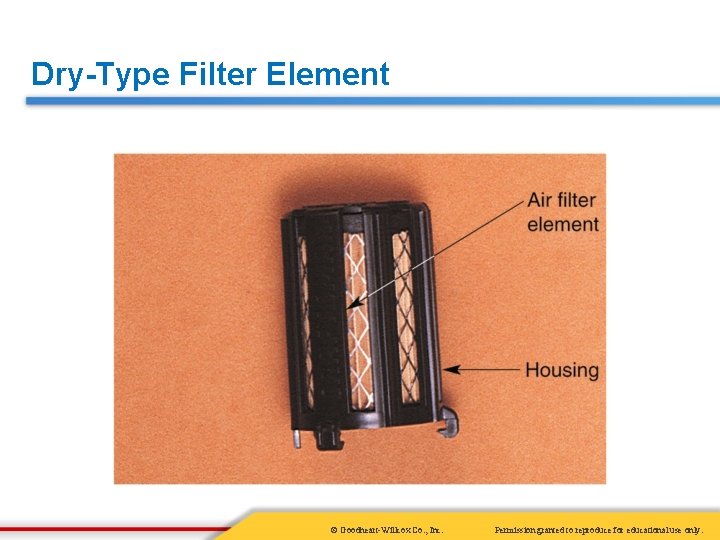
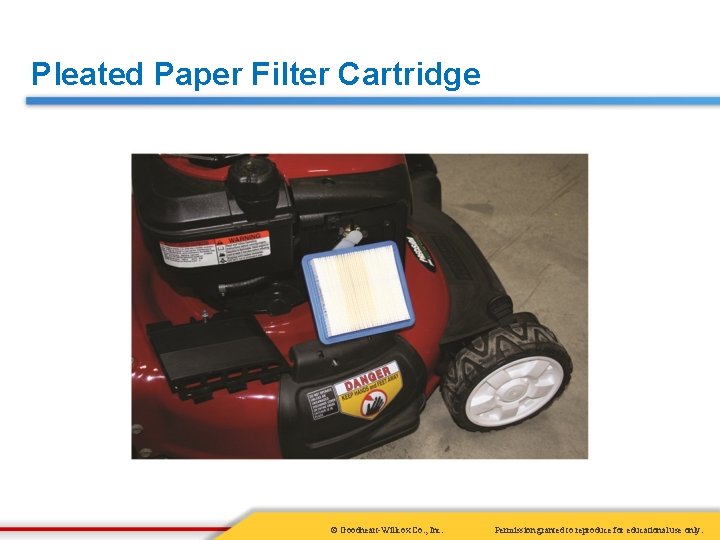
Dry-Type Air Cleaners • Thrown away when dirty – Never clean with compressed air • Pleated paper, felt, fiber, or flocked screen – Cylindrical or rectangular – Pleats in paper increase surface area • Flexible gasket creates seal © Goodheart-Willcox Co. , Inc. Permission granted to reproduce for educational use only.
Dry-Type Filter Element © Goodheart-Willcox Co. , Inc. Permission granted to reproduce for educational use only.
Pleated Paper Filter Cartridge © Goodheart-Willcox Co. , Inc. Permission granted to reproduce for educational use only.
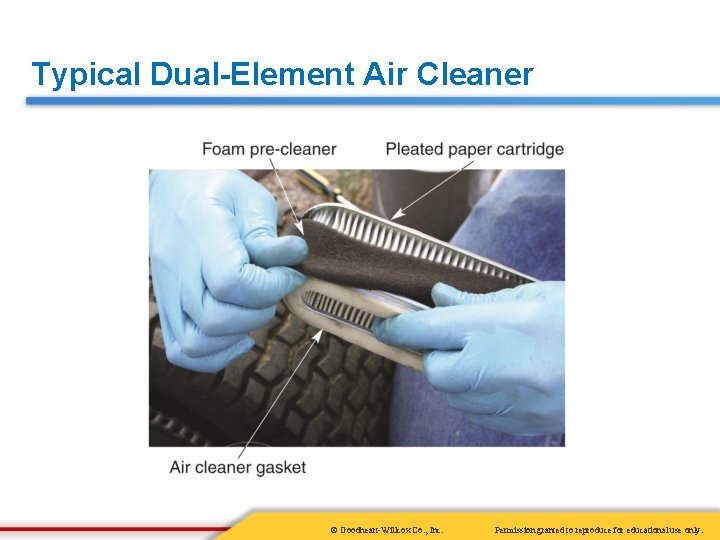
Dual-Element Air Cleaners • Extra protection in dusty conditions • Foam pre-cleaner – Some oiled; some dry – Cleaned like foam air cleaner • Pleated paper cartridge – Replaced when dirty © Goodheart-Willcox Co. , Inc. Permission granted to reproduce for educational use only.
Typical Dual-Element Air Cleaner © Goodheart-Willcox Co. , Inc. Permission granted to reproduce for educational use only.
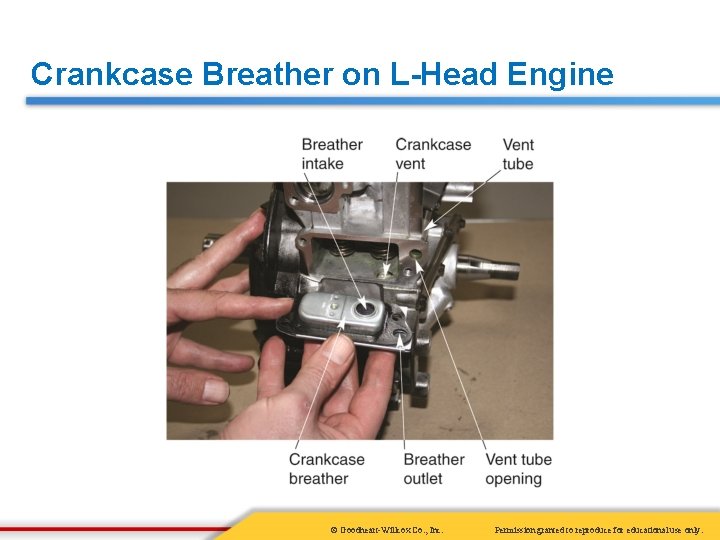
Crankcase Breathers • Prevent pressure buildup in crankcase • Reed valves vent pressure – In old engines, vented to atmosphere – New engines vent to air filter or carburetor • On OHV engines, located in valve cover • On L-Head engines, located in crankcase – Doubles as valve cover © Goodheart-Willcox Co. , Inc. Permission granted to reproduce for educational use only.
Crankcase Breather on L-Head Engine © Goodheart-Willcox Co. , Inc. Permission granted to reproduce for educational use only.
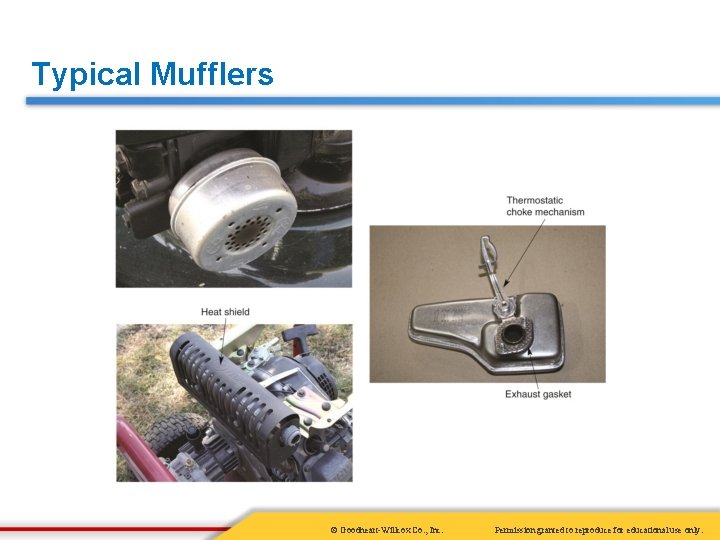
Mufflers • Function: – Reduce exhaust noise – Redirect exhaust gas – Trap sparks – Produce correct back pressure • Spark arrestor • Deflectors and heat shields © Goodheart-Willcox Co. , Inc. Permission granted to reproduce for educational use only.
Typical Mufflers © Goodheart-Willcox Co. , Inc. Permission granted to reproduce for educational use only.
Emissions • Mowing lawn ½ hr = driving 172 miles • Exhaust gasses – CO – NOX – HC • Evaporative emissions © Goodheart-Willcox Co. , Inc. Permission granted to reproduce for educational use only.
Emission Control Regulations • • • Clean Air Act 1990 amendment to CAA California Air Resources Board (CARB) Environment Protection Agency (EPA) Engine must be properly tuned © Goodheart-Willcox Co. , Inc. Permission granted to reproduce for educational use only.
Phase 1 Standards for Small Spark-Ignition Engines • • Established in 1995 by EPA Regulated engines 25 HP and up Goal to reduce HC and NOX emissions 32% 5 displacement classes – 2 handheld (2 -cycle) – 3 non-handheld (4 -cycle) • 2 -cycle mowers excluded © Goodheart-Willcox Co. , Inc. Permission granted to reproduce for educational use only.
Phase 2 Standards for Small Spark-Ignition Engines • Established 2000 by EPA • Goal to reduce NOX and HC emissions 70% • Phased in between 2002 and 2007 – Larger engines switched to OHV design • Added two new handheld classes – 66 cc and under – 66 cc to 100 cc © Goodheart-Willcox Co. , Inc. Permission granted to reproduce for educational use only.
Phase 3 Emission Standards • • • Established 2007 by EPA Goal to reduce HC, NOX, and CO emissions Limits evaporative emissions Phased in by 2012 Compliance may require new designs © Goodheart-Willcox Co. , Inc. Permission granted to reproduce for educational use only.
Impact of Regulations on Technicians and Consumers • Technicians – Must keep up-to-date with regulations – Repairs must keep engine in compliance – Model year determines applicable regulations • Consumers – Should perform regular maintenance – Should avoid fuel spillage © Goodheart-Willcox Co. , Inc. Permission granted to reproduce for educational use only.
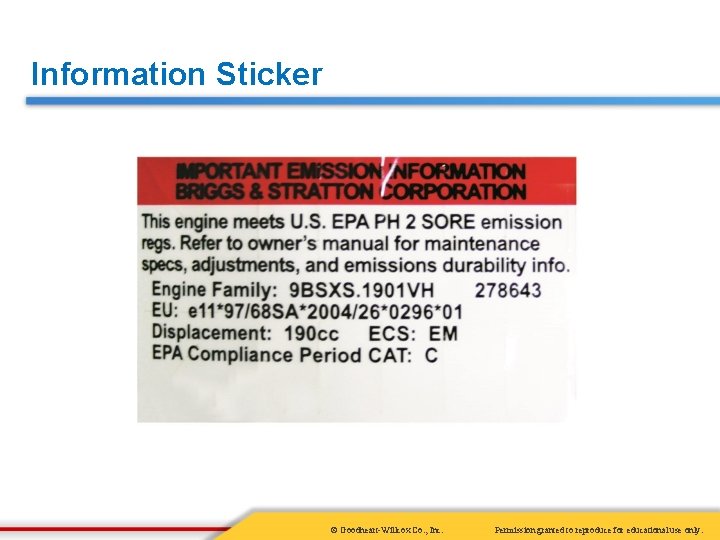
Information Sticker © Goodheart-Willcox Co. , Inc. Permission granted to reproduce for educational use only.
Review What fuels might be used in various small gas engines? Gasoline, liquefied petroleum gas, natural gas, kerosene, fuel oil, and diesel fuel. © Goodheart-Willcox Co. , Inc. Permission granted to reproduce for educational use only.
Review What can happen if an improper fuel/oil mixture is used in a 2 -cycle engine? Too little oil can result in overheating and scoring. Too much oil can result in incomplete combustion and carbon buildup. © Goodheart-Willcox Co. , Inc. Permission granted to reproduce for educational use only.
Review What precaution must be taken when installing an inline fuel filter? The fuel filter must be installed so fuel flows through it in the right direction. © Goodheart-Willcox Co. , Inc. Permission granted to reproduce for educational use only.
Review Describe how the fuel pump diaphragm works to pump fuel. The diaphragm moves to increase volume in the pump, which draws in fuel. Spring pressure returns the diaphragm to its original position, forcing fuel out of the pump. © Goodheart-Willcox Co. , Inc. Permission granted to reproduce for educational use only.
Review In a pressurized fuel system like that used with an outboard engine, what pressurizes the fuel tank? Crankcase pressure © Goodheart-Willcox Co. , Inc. Permission granted to reproduce for educational use only.
Review What is the primary function of an air cleaner? It prevents particles in the air from entering the engine. © Goodheart-Willcox Co. , Inc. Permission granted to reproduce for educational use only.
Review Why is it important for a technician to know when an engine was manufactured? The model year of the engine determines which EPA regulations apply to it. © Goodheart-Willcox Co. , Inc. Permission granted to reproduce for educational use only.