
CHAPTER 8 From DNA to Proteins DNA is


- Slides: 44
CHAPTER 8 : From DNA to Proteins
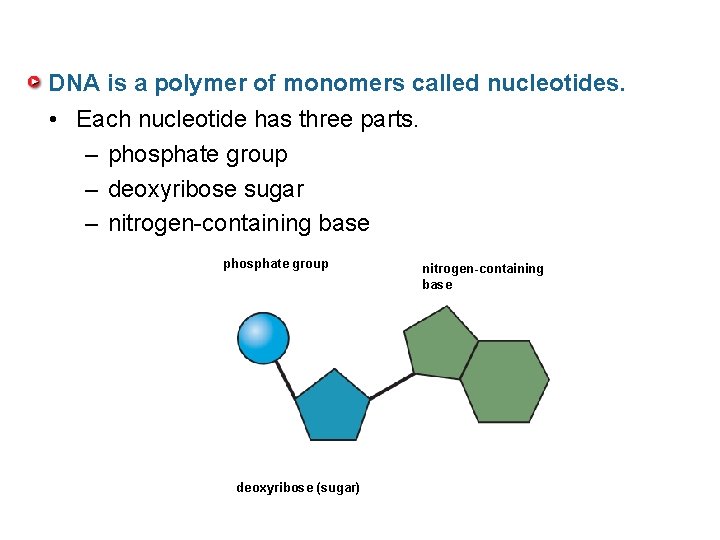
DNA is a polymer of monomers called nucleotides. • Each nucleotide has three parts. – phosphate group – deoxyribose sugar – nitrogen-containing base phosphate group deoxyribose (sugar) nitrogen-containing base
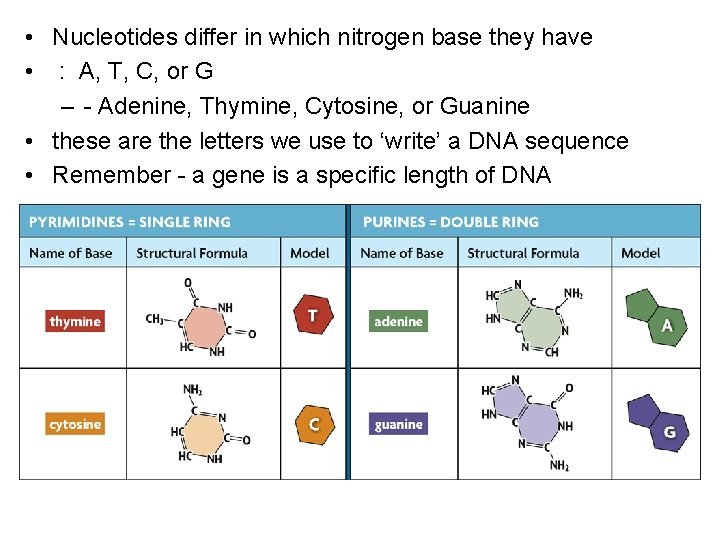
• Nucleotides differ in which nitrogen base they have • : A, T, C, or G – - Adenine, Thymine, Cytosine, or Guanine • these are the letters we use to ‘write’ a DNA sequence • Remember - a gene is a specific length of DNA
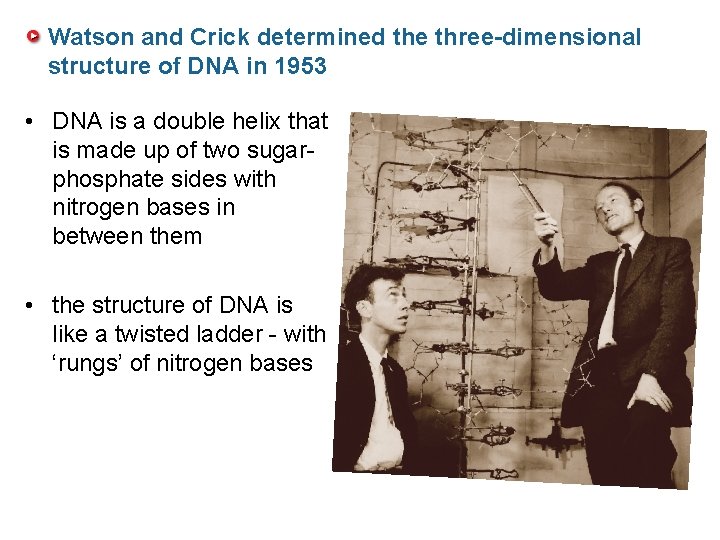
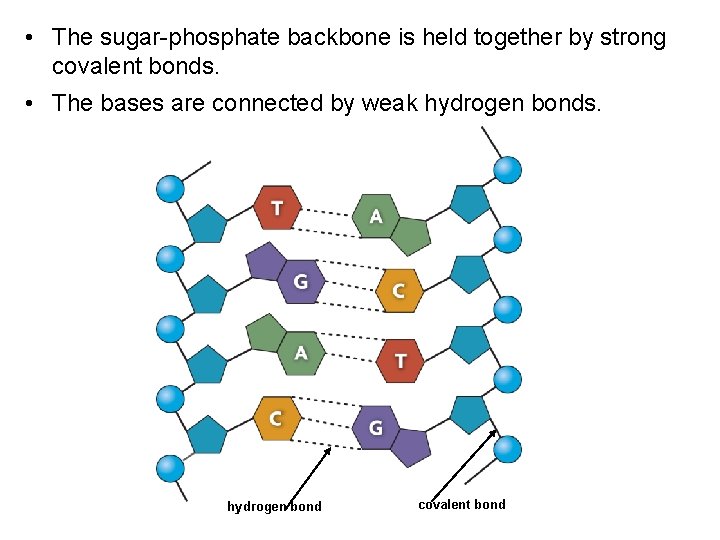
Watson and Crick determined the three-dimensional structure of DNA in 1953 • DNA is a double helix that is made up of two sugarphosphate sides with nitrogen bases in between them • the structure of DNA is like a twisted ladder - with ‘rungs’ of nitrogen bases
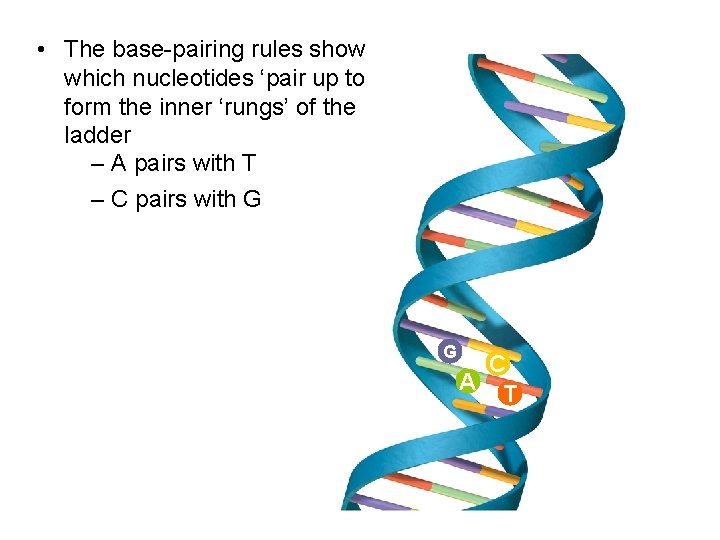
• The base-pairing rules show which nucleotides ‘pair up to form the inner ‘rungs’ of the ladder – A pairs with T – C pairs with G G C A T
• The sugar-phosphate backbone is held together by strong covalent bonds. • The bases are connected by weak hydrogen bonds. hydrogen bond covalent bond
• Practice! • You are given one side of a length of DNA. Write the OTHER side of the DNA molecule below the side given below. • Follow the base pairing rules! • TAC GGC ATG CCC TAG TTA CGA TTA
• Practice! • You are given one side of a length of DNA. Write the OTHER side of the DNA molecule below the side given below. • Follow the base pairing rules! • TAC GGC ATG CCC TAG TTA CGA TTA • ATG CCG TAC GGG ATC AAT GCT AAT
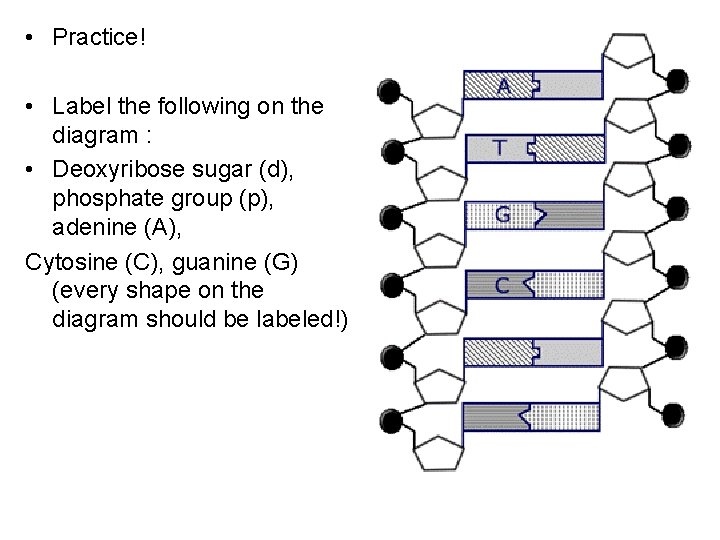
• Practice! • Label the following on the diagram : • Deoxyribose sugar (d), phosphate group (p), adenine (A), Cytosine (C), guanine (G) (every shape on the diagram should be labeled!)
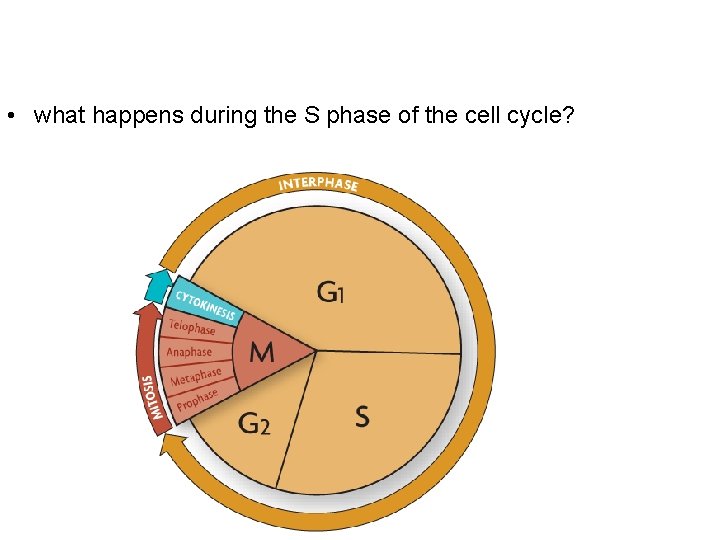
• what happens during the S phase of the cell cycle?
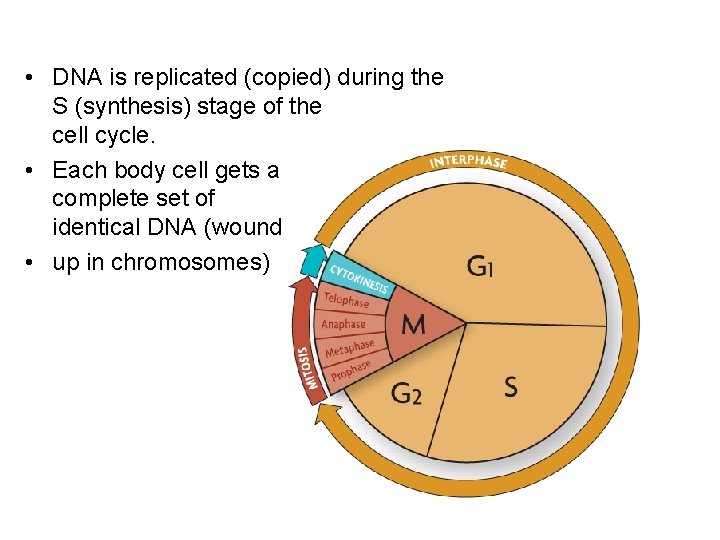
• DNA is replicated (copied) during the S (synthesis) stage of the cell cycle. • Each body cell gets a complete set of identical DNA (wound • up in chromosomes)
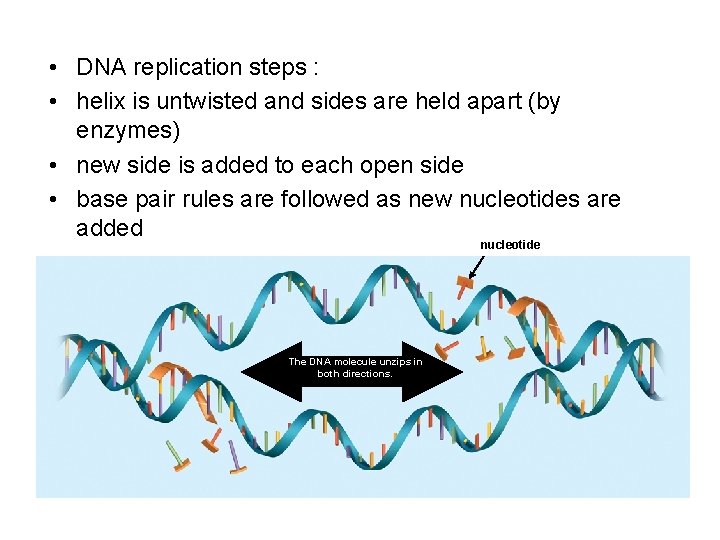
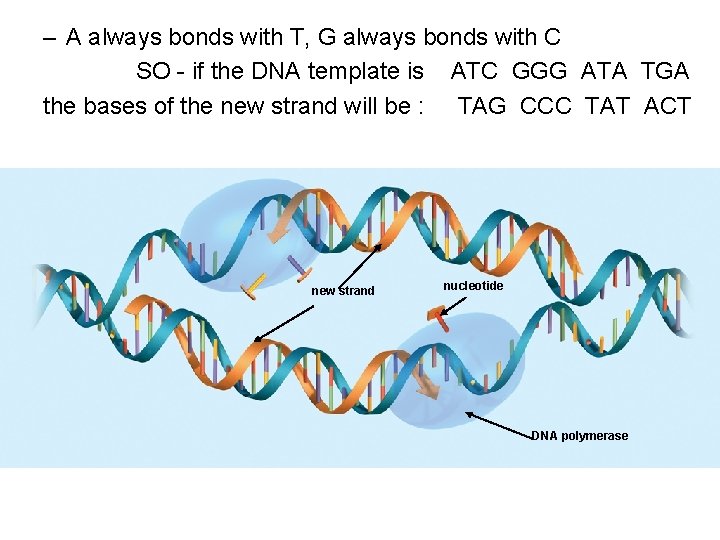
• DNA replication steps : • helix is untwisted and sides are held apart (by enzymes) • new side is added to each open side • base pair rules are followed as new nucleotides are added nucleotide The DNA molecule unzips in both directions.
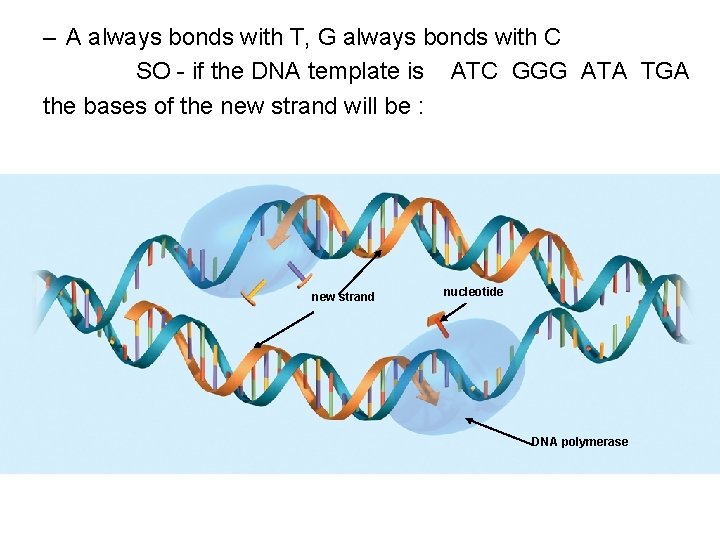
– A always bonds with T, G always bonds with C SO - if the DNA template is ATC GGG ATA TGA the bases of the new strand will be : new strand nucleotide DNA polymerase
– A always bonds with T, G always bonds with C SO - if the DNA template is ATC GGG ATA TGA the bases of the new strand will be : TAG CCC TAT ACT new strand nucleotide DNA polymerase
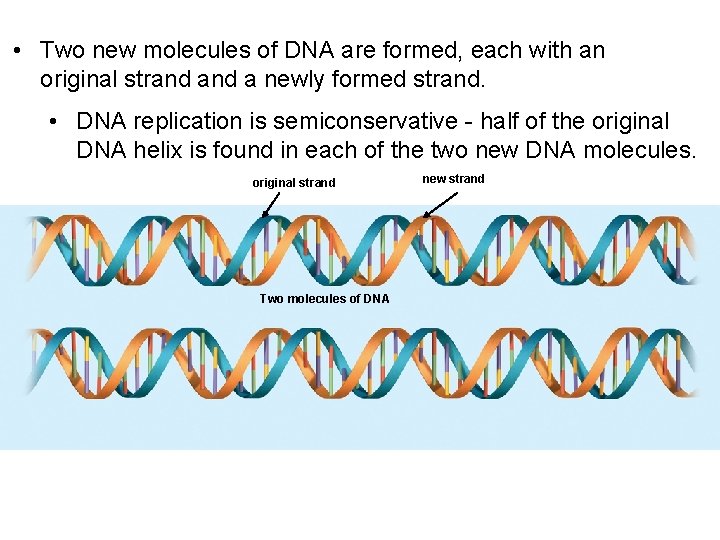
• Two new molecules of DNA are formed, each with an original strand a newly formed strand. • DNA replication is semiconservative - half of the original DNA helix is found in each of the two new DNA molecules. original strand Two molecules of DNA new strand
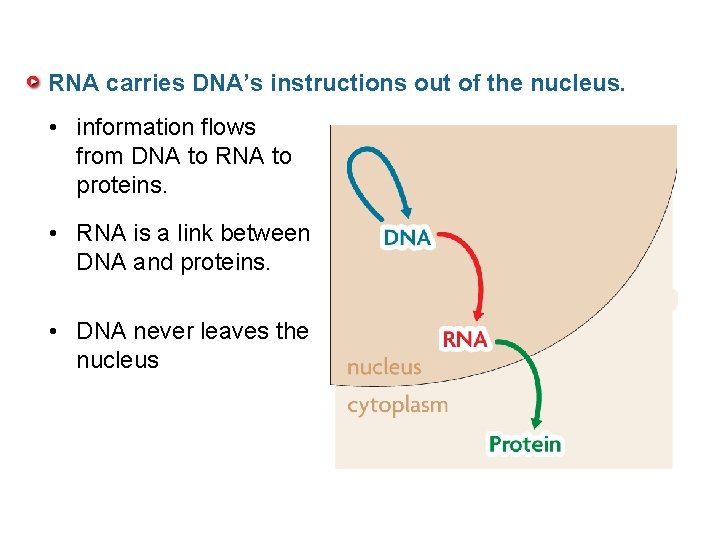
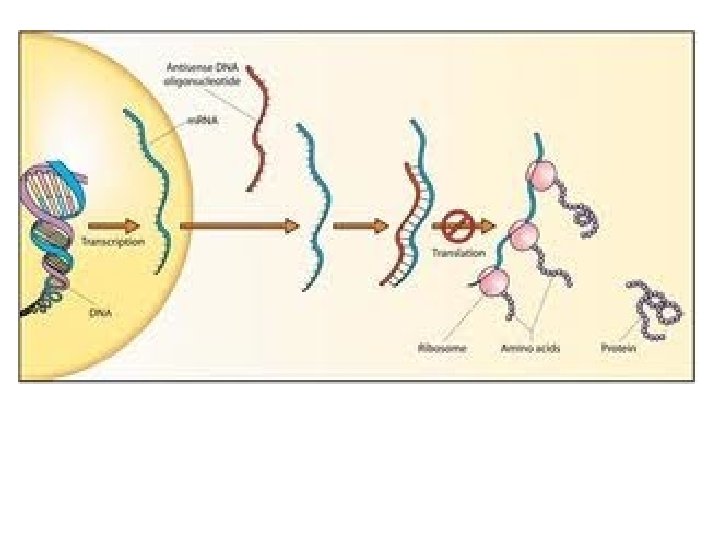
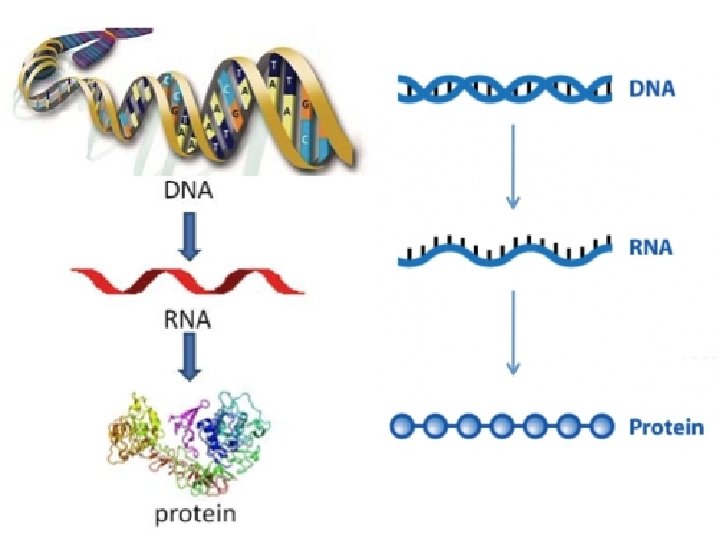
RNA carries DNA’s instructions out of the nucleus. • information flows from DNA to RNA to proteins. • RNA is a link between DNA and proteins. • DNA never leaves the nucleus
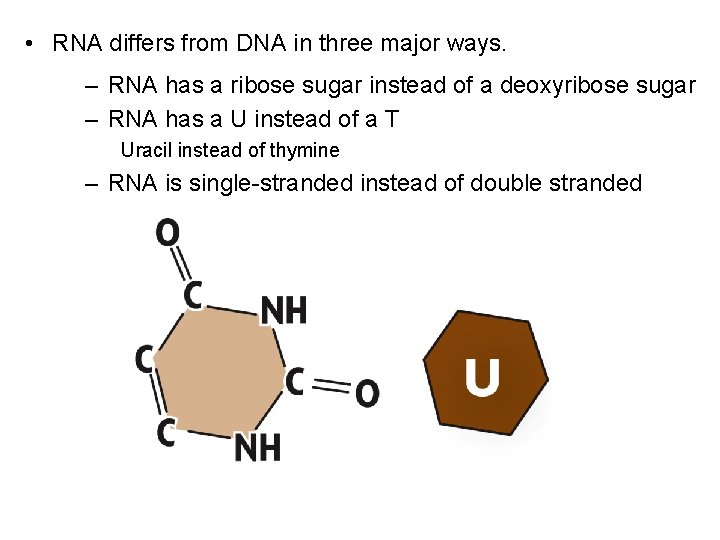
• RNA differs from DNA in three major ways. – RNA has a ribose sugar instead of a deoxyribose sugar – RNA has a U instead of a T Uracil instead of thymine – RNA is single-stranded instead of double stranded
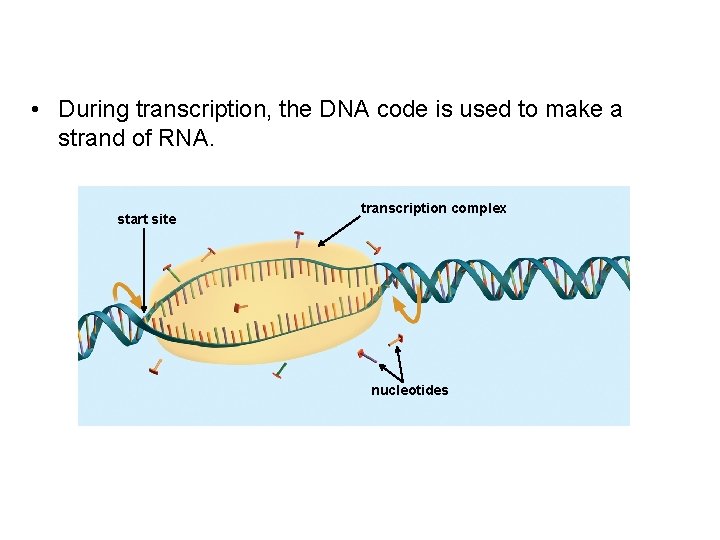
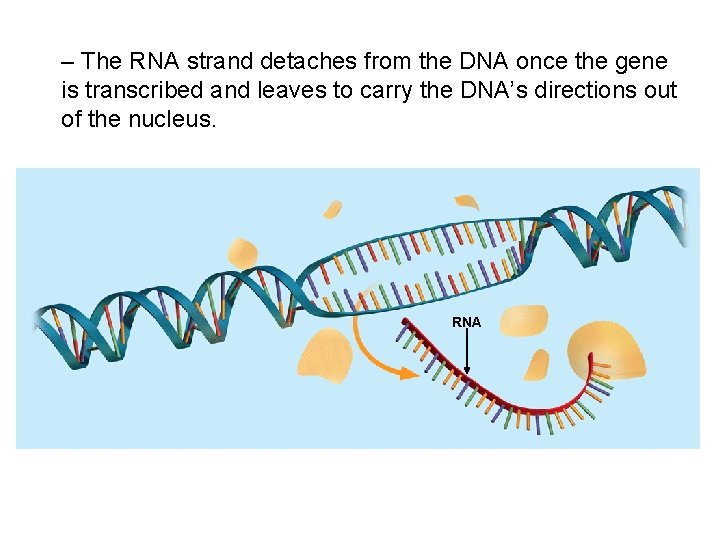
• During transcription, the DNA code is used to make a strand of RNA. start site transcription complex nucleotides
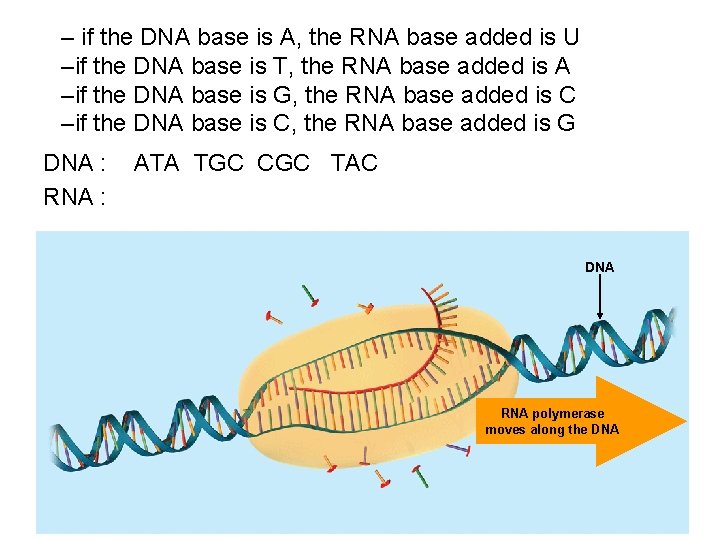
– if the DNA base is A, the RNA base added is U –if the DNA base is T, the RNA base added is A –if the DNA base is G, the RNA base added is C –if the DNA base is C, the RNA base added is G DNA : RNA : ATA TGC CGC TAC DNA RNA polymerase moves along the DNA
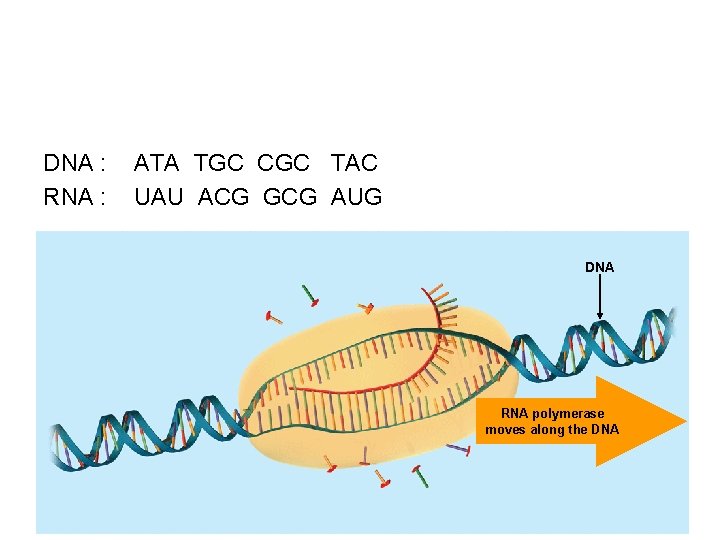
DNA : RNA : ATA TGC CGC TAC UAU ACG GCG AUG DNA RNA polymerase moves along the DNA
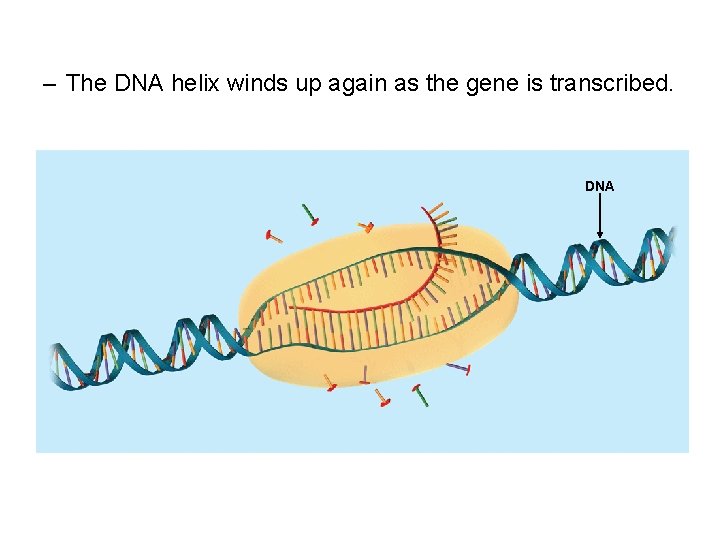
– The DNA helix winds up again as the gene is transcribed. DNA
– The RNA strand detaches from the DNA once the gene is transcribed and leaves to carry the DNA’s directions out of the nucleus. RNA
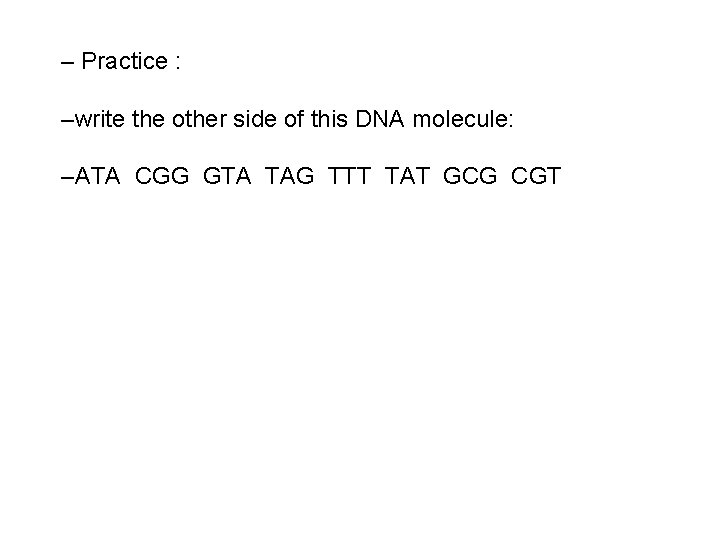
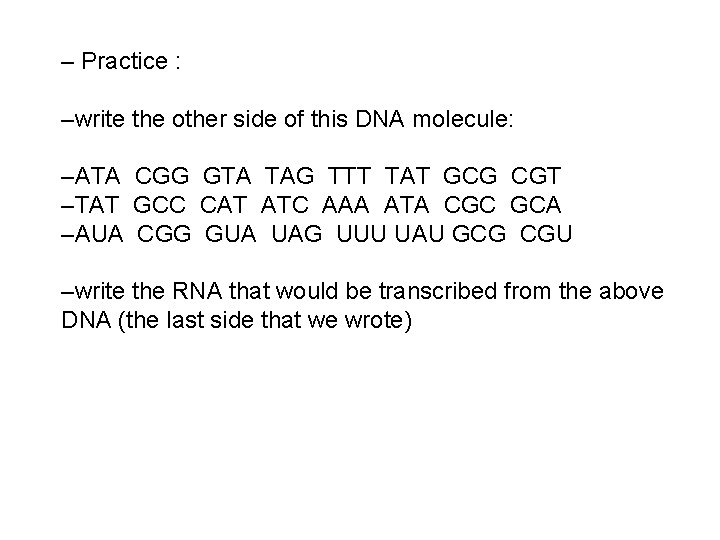
– Practice : –write the other side of this DNA molecule: –ATA CGG GTA TAG TTT TAT GCG CGT
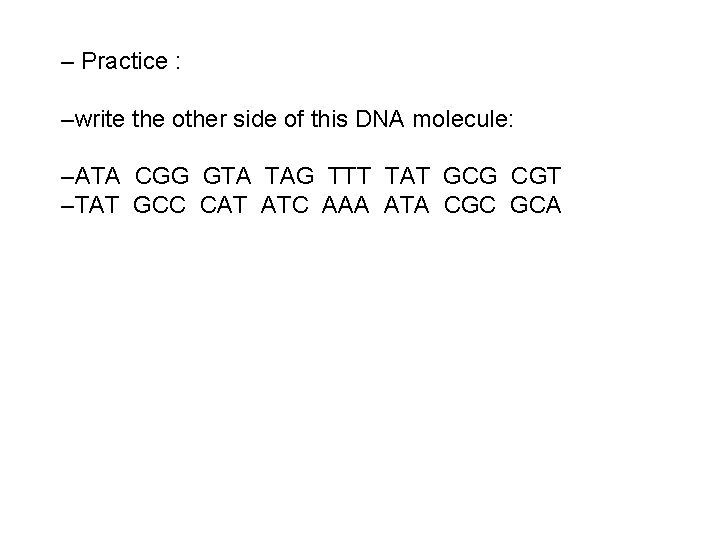
– Practice : –write the other side of this DNA molecule: –ATA CGG GTA TAG TTT TAT GCG CGT –TAT GCC CAT ATC AAA ATA CGC GCA
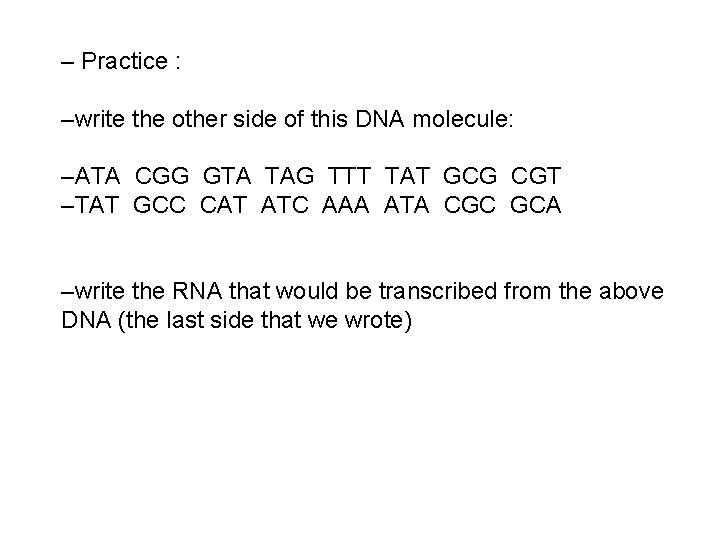
– Practice : –write the other side of this DNA molecule: –ATA CGG GTA TAG TTT TAT GCG CGT –TAT GCC CAT ATC AAA ATA CGC GCA –write the RNA that would be transcribed from the above DNA (the last side that we wrote)
– Practice : –write the other side of this DNA molecule: –ATA CGG GTA TAG TTT TAT GCG CGT –TAT GCC CAT ATC AAA ATA CGC GCA –AUA CGG GUA UAG UUU UAU GCG CGU –write the RNA that would be transcribed from the above DNA (the last side that we wrote)
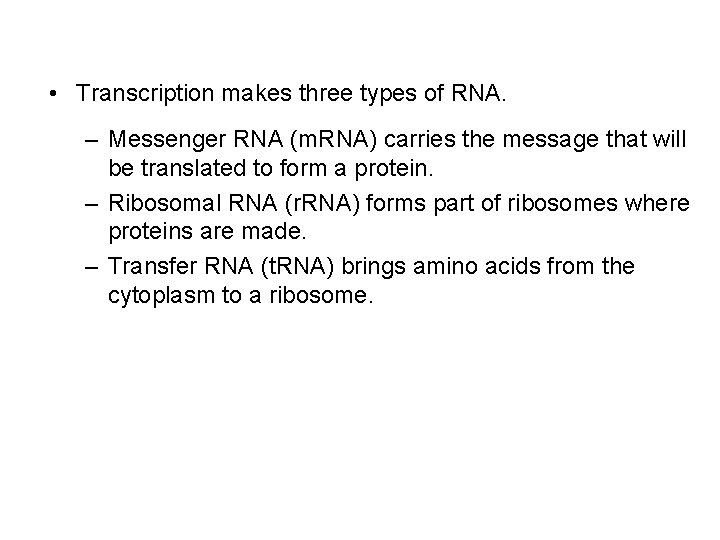
• Transcription makes three types of RNA. – Messenger RNA (m. RNA) carries the message that will be translated to form a protein. – Ribosomal RNA (r. RNA) forms part of ribosomes where proteins are made. – Transfer RNA (t. RNA) brings amino acids from the cytoplasm to a ribosome.
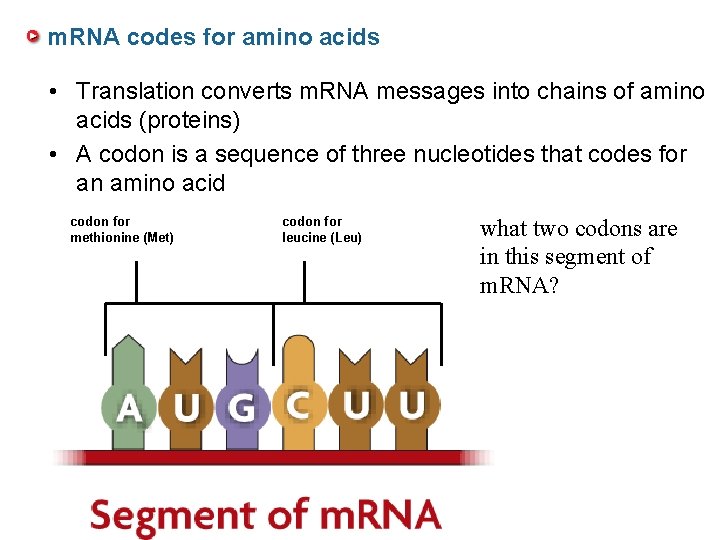
m. RNA codes for amino acids • Translation converts m. RNA messages into chains of amino acids (proteins) • A codon is a sequence of three nucleotides that codes for an amino acid codon for methionine (Met) codon for leucine (Leu) what two codons are in this segment of m. RNA?
m. RNA codes for amino acids • Translation converts m. RNA messages into chains of amino acids (proteins) • A codon is a sequence of three nucleotides that codes for an amino acid codon for methionine (Met) codon for leucine (Leu) what two codons are in this segment of m. RNA? AUG CUU
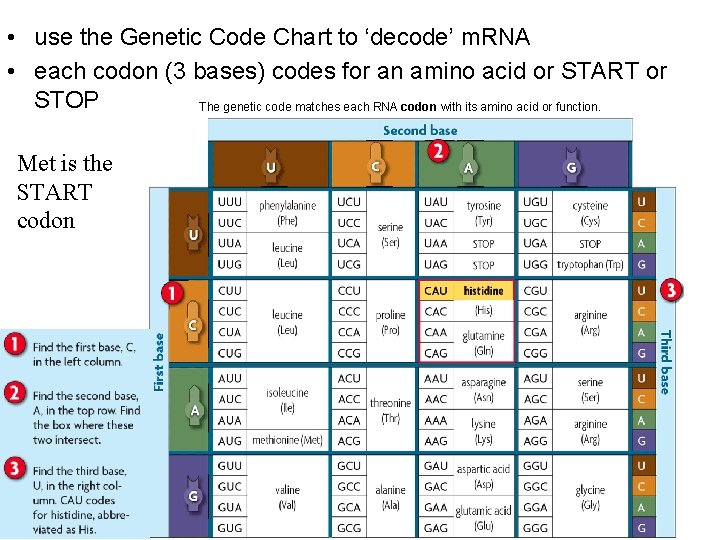
• use the Genetic Code Chart to ‘decode’ m. RNA • each codon (3 bases) codes for an amino acid or START or STOP The genetic code matches each RNA codon with its amino acid or function. Met is the START codon
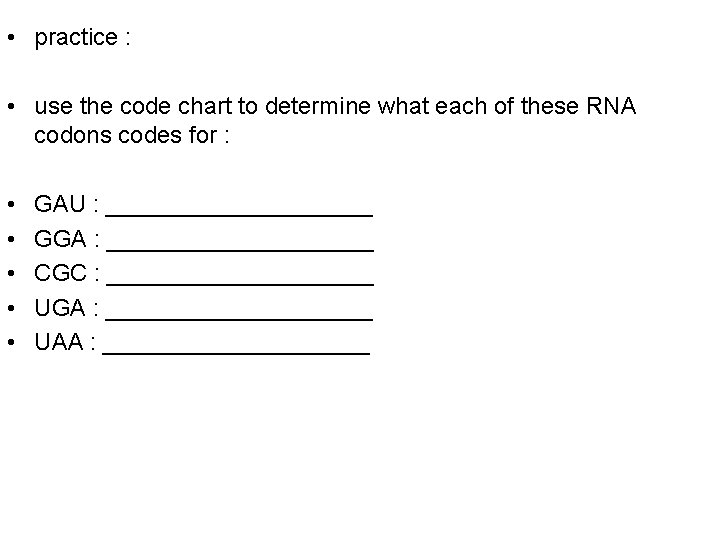
• practice : • use the code chart to determine what each of these RNA codons codes for : • • • GAU : __________ GGA : __________ CGC : __________ UGA : __________ UAA : __________
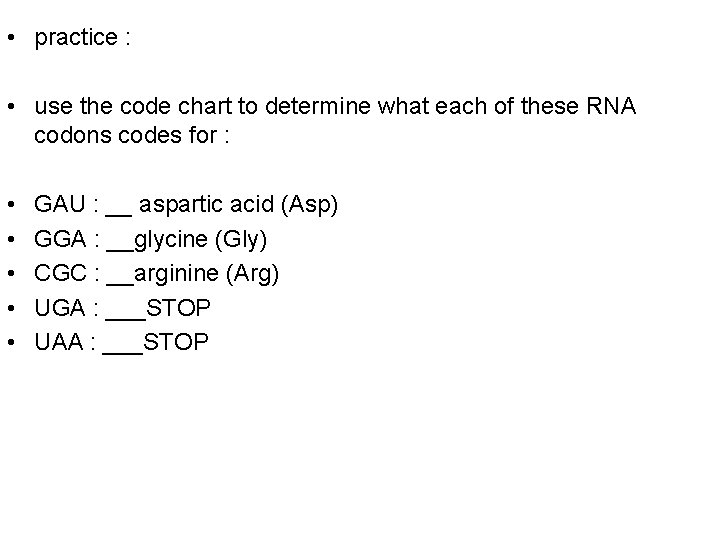
• practice : • use the code chart to determine what each of these RNA codons codes for : • • • GAU : __ aspartic acid (Asp) GGA : __glycine (Gly) CGC : __arginine (Arg) UGA : ___STOP UAA : ___STOP
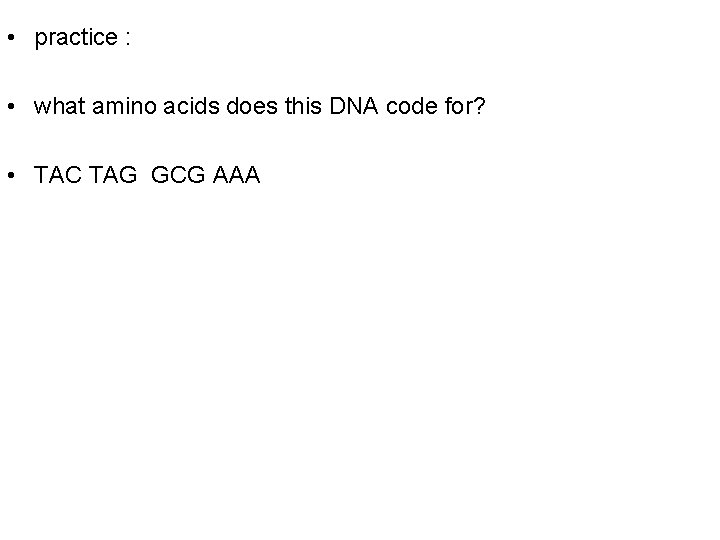
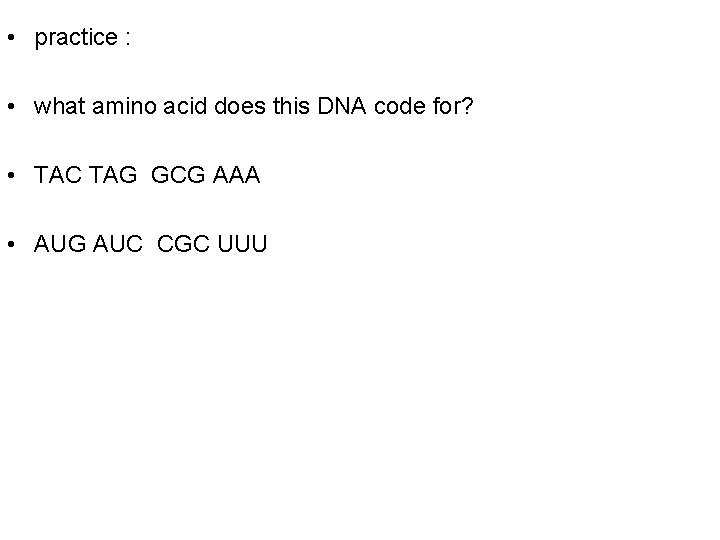
• practice : • what amino acids does this DNA code for? • TAC TAG GCG AAA
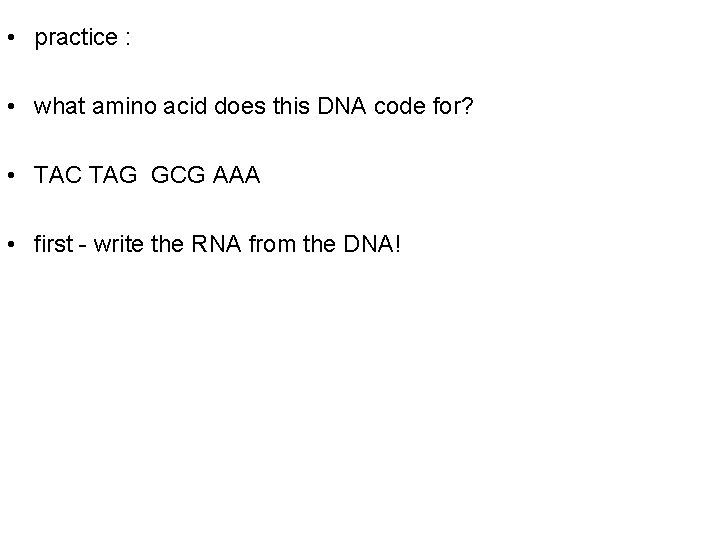
• practice : • what amino acid does this DNA code for? • TAC TAG GCG AAA • first - write the RNA from the DNA!
• practice : • what amino acid does this DNA code for? • TAC TAG GCG AAA • AUG AUC CGC UUU
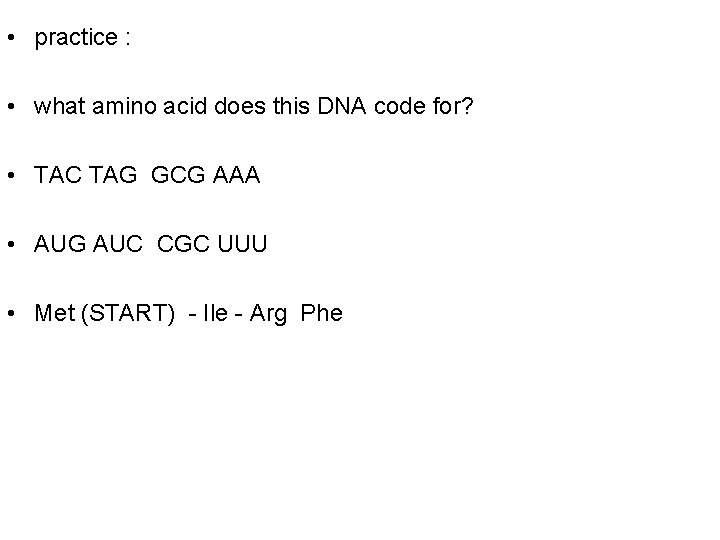
• practice : • what amino acid does this DNA code for? • TAC TAG GCG AAA • AUG AUC CGC UUU • Met (START) - Ile - Arg Phe
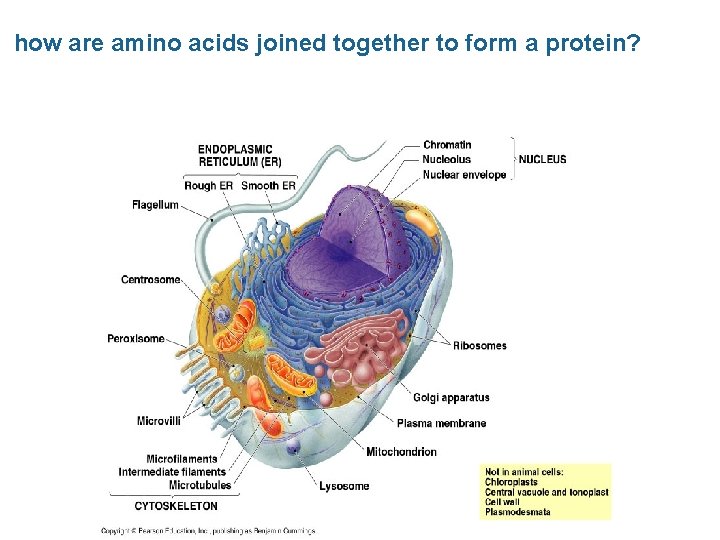
how are amino acids joined together to form a protein?
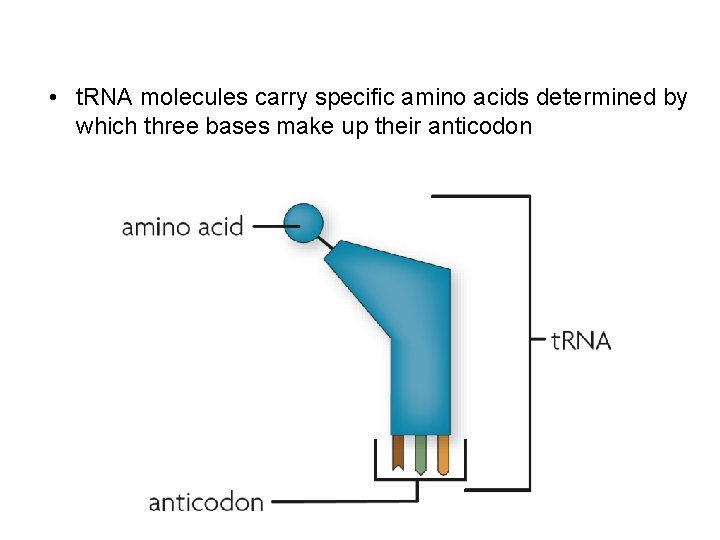
• t. RNA molecules carry specific amino acids determined by which three bases make up their anticodon
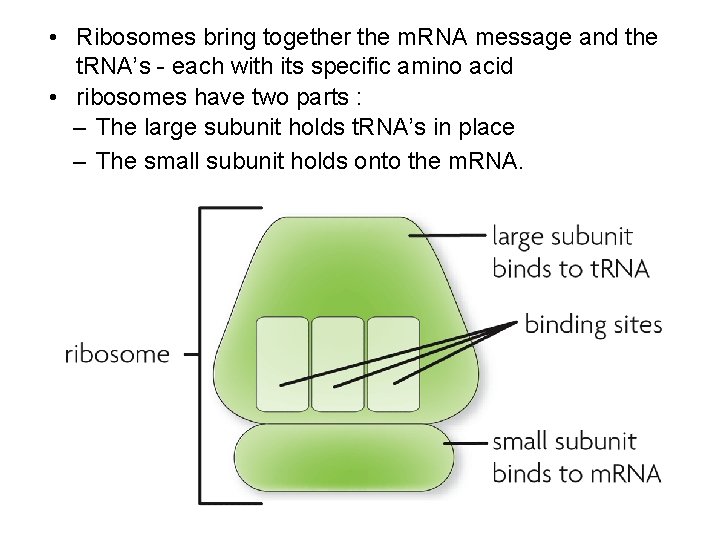
• Ribosomes bring together the m. RNA message and the t. RNA’s - each with its specific amino acid • ribosomes have two parts : – The large subunit holds t. RNA’s in place – The small subunit holds onto the m. RNA.
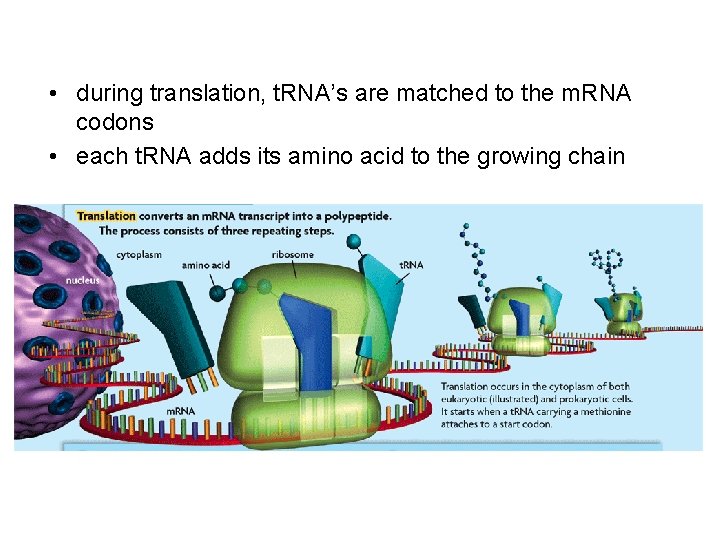
• during translation, t. RNA’s are matched to the m. RNA codons • each t. RNA adds its amino acid to the growing chain
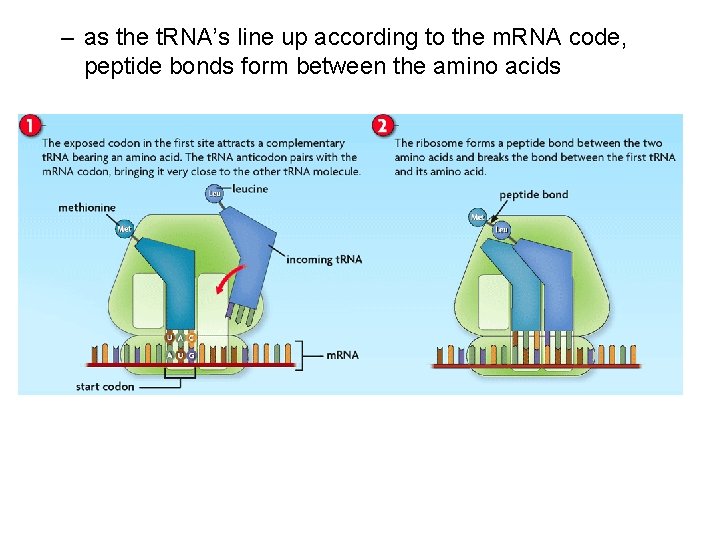
– as the t. RNA’s line up according to the m. RNA code, peptide bonds form between the amino acids
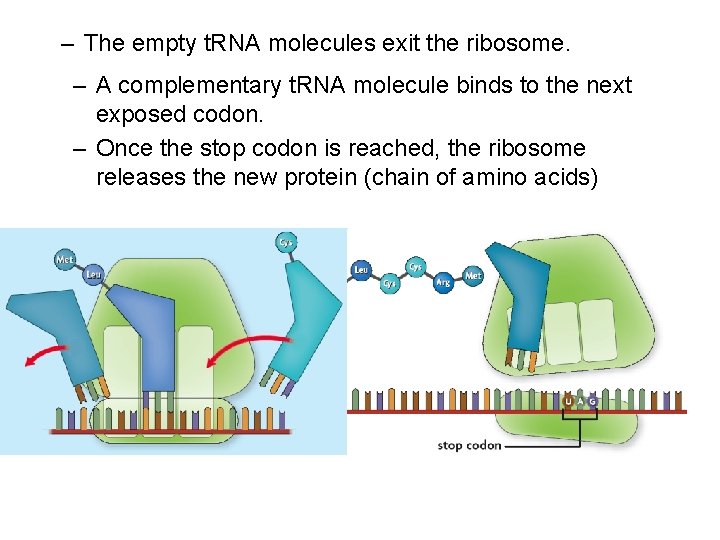
– The empty t. RNA molecules exit the ribosome. – A complementary t. RNA molecule binds to the next exposed codon. – Once the stop codon is reached, the ribosome releases the new protein (chain of amino acids)