
Chapter 8 Frequency and Sound Presentation based on
Chapter 8: Frequency and Sound Presentation based on: "What's a Microcontroller ? " By Andy Lindsay Parallax, Inc Presentation developed by: Martin A. Hebel Southern Illinois University Carbondale College of Applied Sciences and Arts Electronic Systems Technologies 9/10/03 1
Use and Copyright This presentation supplements "What's a Microcontroller" by Andy Lindsay. (Link to text at Parallax) ü This presentation is not a replacement for the text. ü Important concepts of the text are highlighted. ü In some cases, additional material has been added to augment the text. Denoted by titles colored gold ü Full program listings are generally not provided in the presentation. Distribution: This presentation may be freely distributed without modifications. Modifications are permitted by schools and organizations for internal use only. Credits, use and copyright slides must remain. 2
Electric Beeps From your alarm clock to microwave to automobiles and ATM machines your day is full of devices sounding beeps to alert you or indicate actions to be taken. Microcontrollers produce sounds by sending high/low signals very quickly to a speaker. The speed at which the signal repeats is called frequency and is measured in cycles per second or Hertz (Hz) which produce the desired tone or pitch. 3
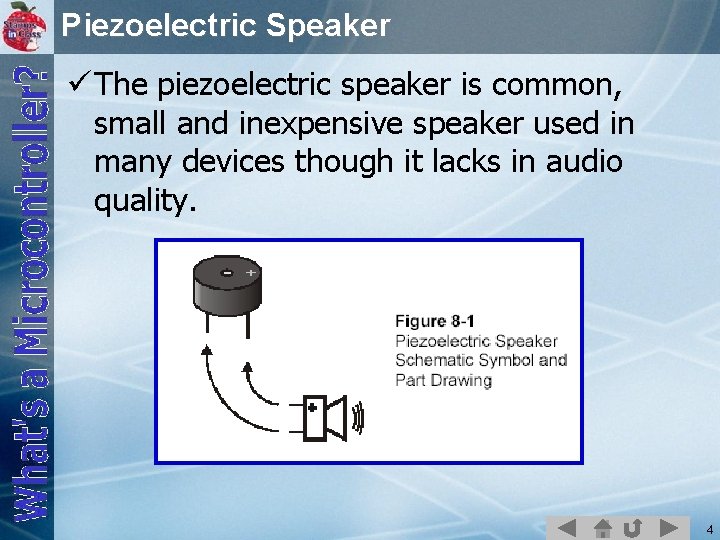
Piezoelectric Speaker ü The piezoelectric speaker is common, small and inexpensive speaker used in many devices though it lacks in audio quality. 4
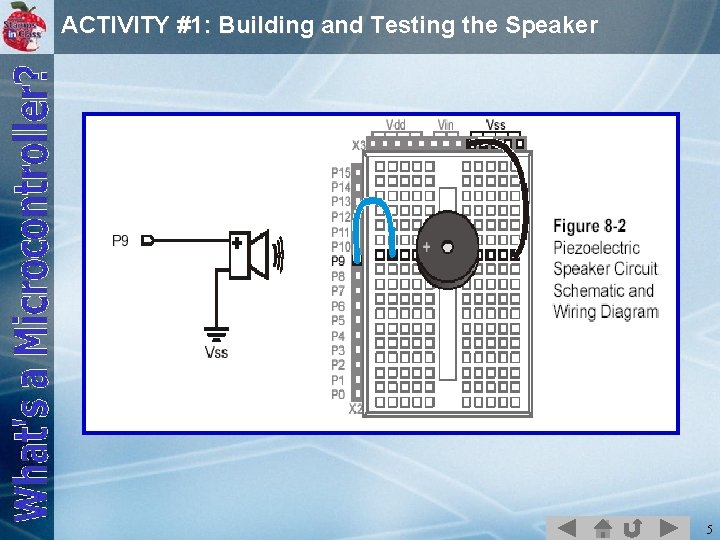
ACTIVITY #1: Building and Testing the Speaker 5
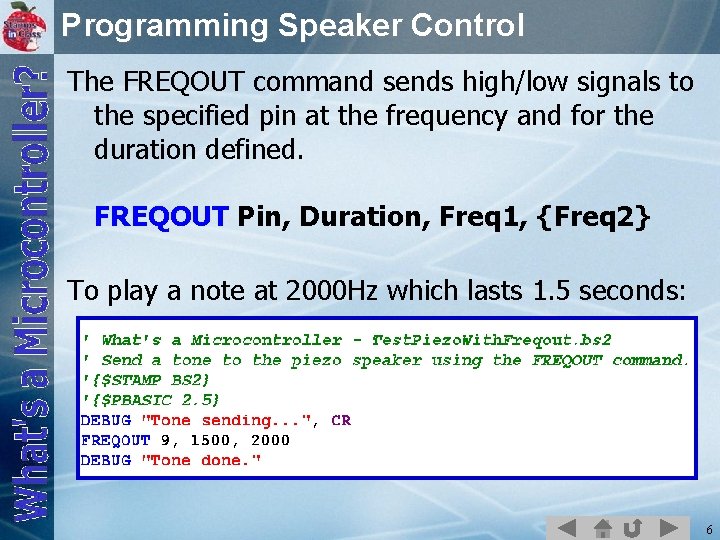
Programming Speaker Control The FREQOUT command sends high/low signals to the specified pin at the frequency and for the duration defined. FREQOUT Pin, Duration, Freq 1, {Freq 2} To play a note at 2000 Hz which lasts 1. 5 seconds: 6
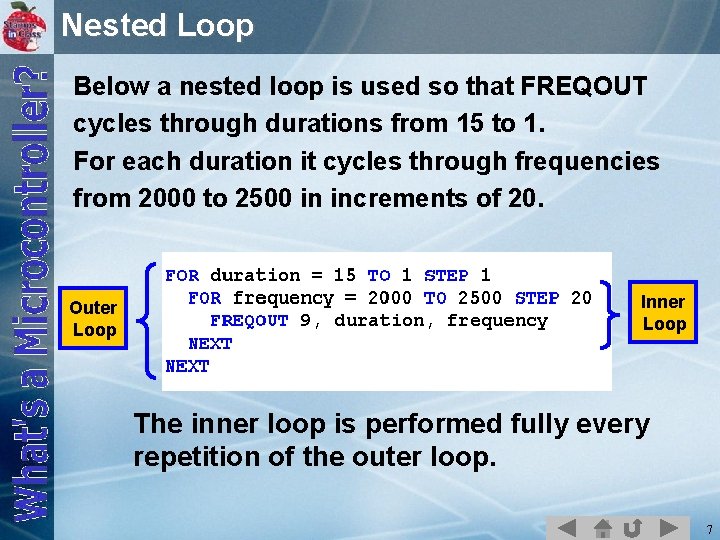
Nested Loop Below a nested loop is used so that FREQOUT cycles through durations from 15 to 1. For each duration it cycles through frequencies from 2000 to 2500 in increments of 20. Outer Loop Inner Loop The inner loop is performed fully every repetition of the outer loop. 7

Example Nested Loop 8
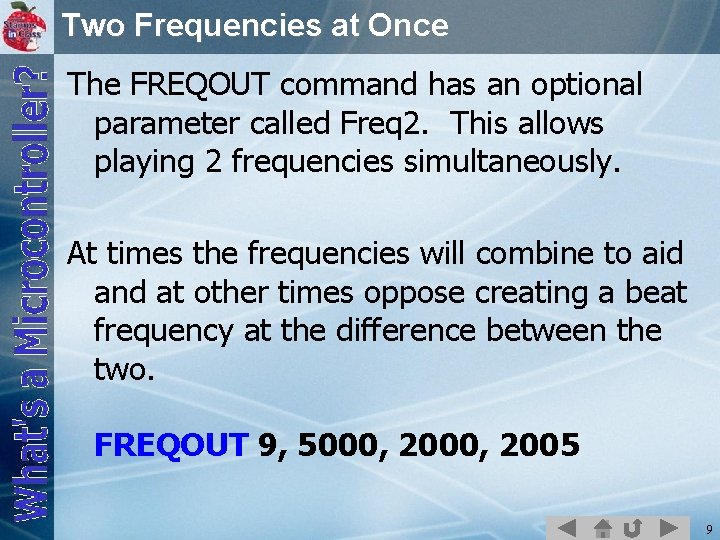
Two Frequencies at Once The FREQOUT command has an optional parameter called Freq 2. This allows playing 2 frequencies simultaneously. At times the frequencies will combine to aid and at other times oppose creating a beat frequency at the difference between the two. FREQOUT 9, 5000, 2005 9
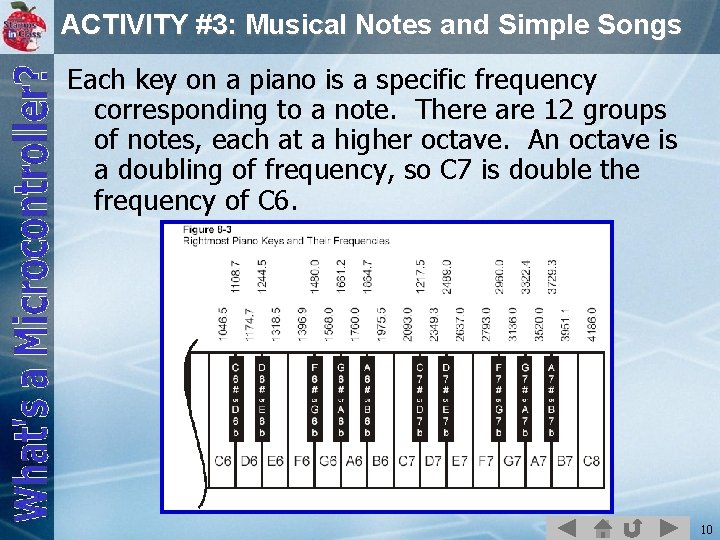
ACTIVITY #3: Musical Notes and Simple Songs Each key on a piano is a specific frequency corresponding to a note. There are 12 groups of notes, each at a higher octave. An octave is a doubling of frequency, so C 7 is double the frequency of C 6. 10
Storing and Retrieving Data The DATA command is similar to WRITE but stores a list of expressions. {Symbol} DATA {Word} Data. Item 1, {Data. Item 2, … } For example: Notes DATA "C", "G", "A", "G" Stores the characters in EEPROM, with the 1 st location called Notes. Each subsequent address is Notes+index value. 11
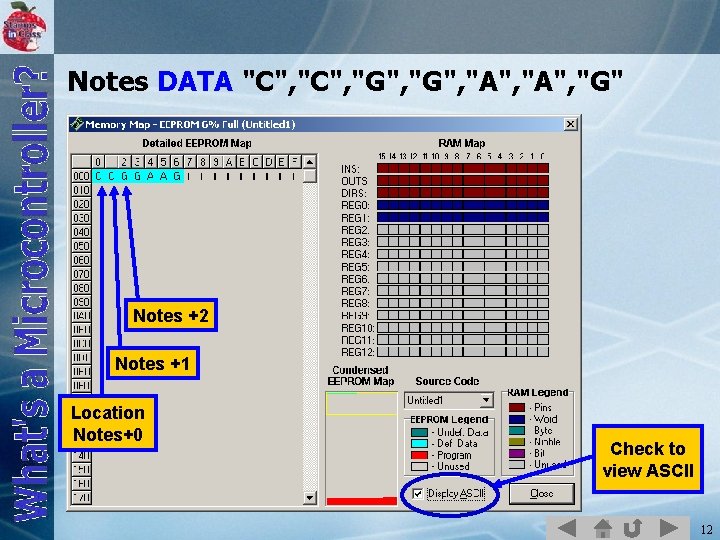
Notes DATA "C", "G", "A", "G" Notes +2 Notes +1 Location Notes+0 Check to view ASCII 12
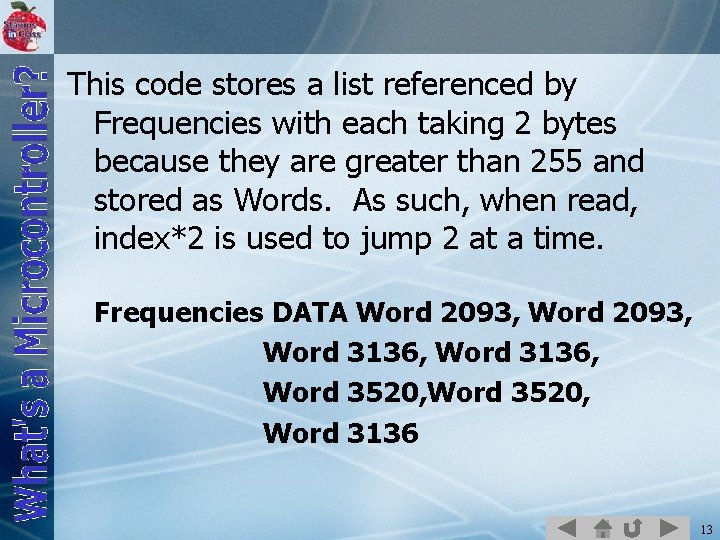
This code stores a list referenced by Frequencies with each taking 2 bytes because they are greater than 255 and stored as Words. As such, when read, index*2 is used to jump 2 at a time. Frequencies DATA Word 2093, Word 3136, Word 3520, Word 3136 13
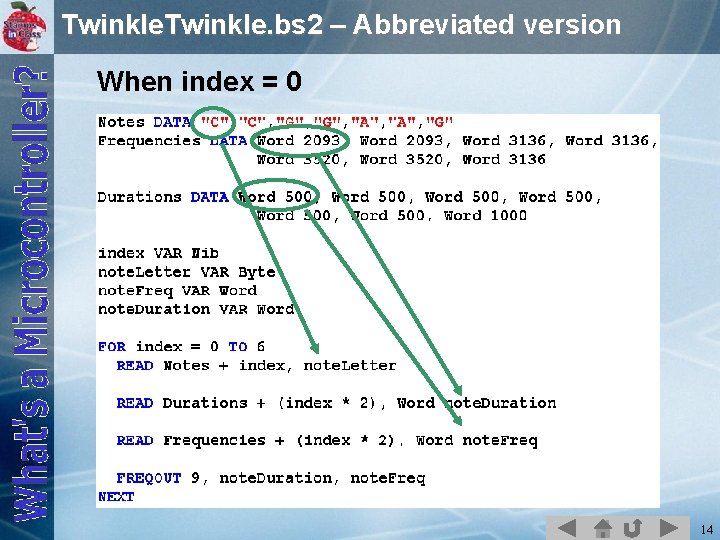
Twinkle. bs 2 – Abbreviated version When index = 0 14
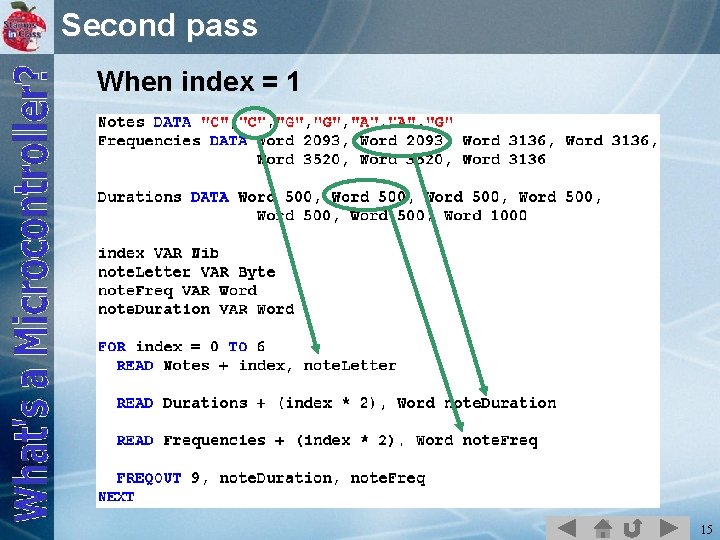
Second pass When index = 1 15
Activity #4: Microcontroller Music Note durations in music are defined as whole, half, quarter, eighth, sixteenth and thirty-second of a whole note. The duration of the whole note depends on the tempo of the music. Some music has a vary fast tempo, others very slow. Rests are durations when no tones are played. 16
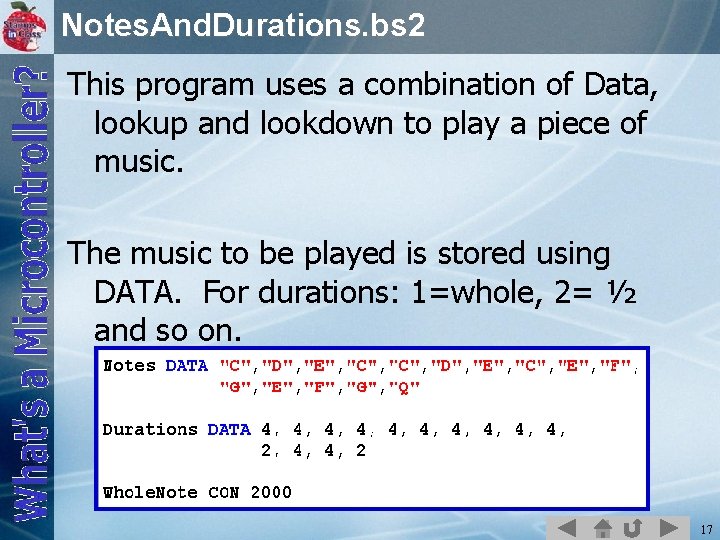
Notes. And. Durations. bs 2 This program uses a combination of Data, lookup and lookdown to play a piece of music. The music to be played is stored using DATA. For durations: 1=whole, 2= ½ and so on. 17
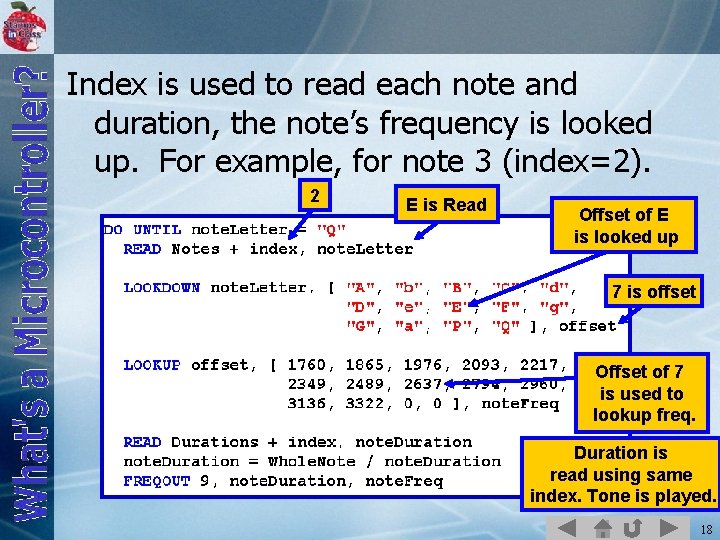
Index is used to read each note and duration, the note’s frequency is looked up. For example, for note 3 (index=2). 2 E is Read Offset of E is looked up 7 is offset Offset of 7 is used to lookup freq. Duration is read using same index. Tone is played. 18
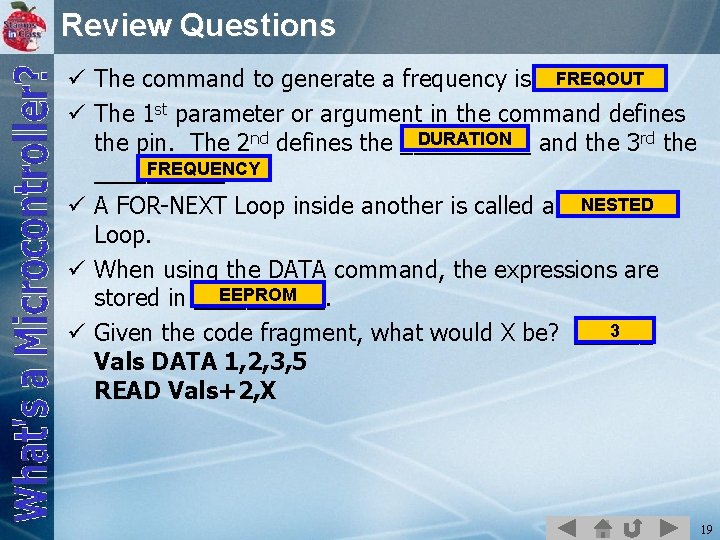
Review Questions FREQOUT ü The command to generate a frequency is _____. ü The 1 st parameter or argument in the command defines DURATION and the 3 rd the pin. The 2 nd defines the _____ FREQUENCY _____. NESTED ü A FOR-NEXT Loop inside another is called a ____ Loop. ü When using the DATA command, the expressions are EEPROM stored in _____. 3 ü Given the code fragment, what would X be? ______ Vals DATA 1, 2, 3, 5 READ Vals+2, X 19
- Slides: 19