
Chapter 8 Existing Wireless Systems 1 G AMPS
- Slides: 28
Chapter 8: Existing Wireless Systems: 1 G, AMPS System Associate Prof. Yuh-Shyan Chen Dept. of Computer Science and Information Engineering National Chung-Cheng University Yschen, CSIE, CCU 1
Introduction ¡A wireless system needs to take many factors into account l. Call rate, call duration, distribution of MSs, and traffic in an adjacent cell. ¡It is important to study various characteristics of existing cellular systems l. How they support seamless mobile communication ¡AMPS (Advanced Mobile Phone System) l. As the first representative of wireless system Yschen, CSIE, CCU 2
Advanced Mobile Phone System (AMPS) ¡AMPS is the first-generation cellular system in USA l. It transmits speed signals employing FM and important control information is transmitted in digital form using FSK (Frequency shift keying) • Is used for modulating a digital signal over a carrier (or two carriers) by using a different frequency for a “ 1” or a “ 0”. l. AMPS is the first cellular phone technology created by AT&T Bell labs. • With the idea of dividing the entire service area into logical division called cells • Each cell is allocated one specific band in the frequency spectrum Yschen, CSIE, CCU 3
Cont. ¡To explore a reuse pattern l. The frequency spectrum is divided among seven cells • Improving the voice quality as each user is given a higher bandwidth l. AMPS uses a cell radius of 1 to 16 miles • Larger cells tend to have more thermal noise and less interference • Smaller cells have more interference and less termal noise l. One important aspect of AMPS is that it allows both cell sectoring and splitting Yschen, CSIE, CCU 4
Cont. l. It is also sufficient to have a lower-power MS (4 Watts or less) and a medium-power BS (about 100 Watts) l. AMPS is capable of supporting about 100, 000 customers per city • The system is aimed to reduce blocking probability to about 2% during busy hours Yschen, CSIE, CCU 5
Characteristics of AMPS ¡AMPS uses frequency band from 824 MHz to 849 MHz for transmissions from MSs to the BS l. Reverse link or uplink ¡Frequency band between 869 MHz to 894 MHz from the BS to MS l. Forward link or downlink l. The 3 -KHz analog voice signal is modulated onto 30 KHz channels l. In transmitting data • The system uses Manchester frequency modulation at the rate of 10 kbps Yschen, CSIE, CCU 6
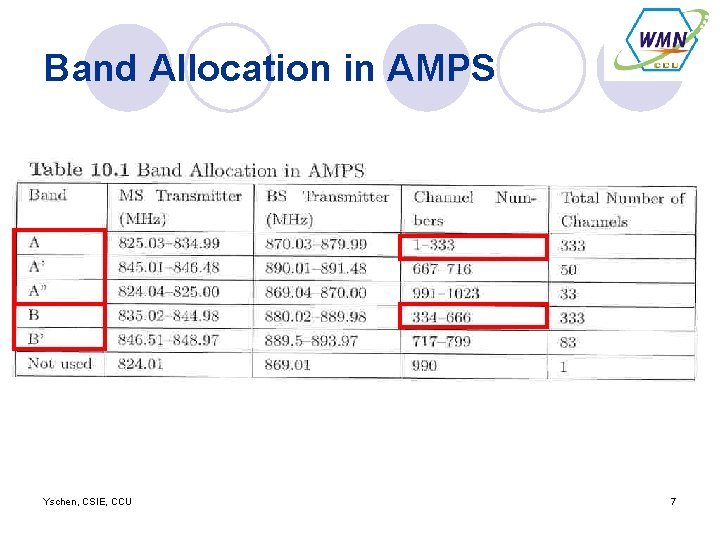
Band Allocation in AMPS Yschen, CSIE, CCU 7
Cont. l Separate channels are used for transmitting control information and data l In AMPS, there are one control transreceiver for every eight voice transreceivers ¡ Frequency allocation in AMPS is done by dividing the entire frequency spectrum into two bands – Band A and B l The non-wireline providers are given Band A l Bell wireline providers are given Band B l A total of 666 channels is divided among these two bands l A cluster of seven cells allows many users to employ the same frequency spectrum simultaneously Yschen, CSIE, CCU 8
Cont. l. AMPS’s use of directional radio propagation enables different frequencies to be transmitted in different directions • Thereby, reducing radio interference considerably. Yschen, CSIE, CCU 9
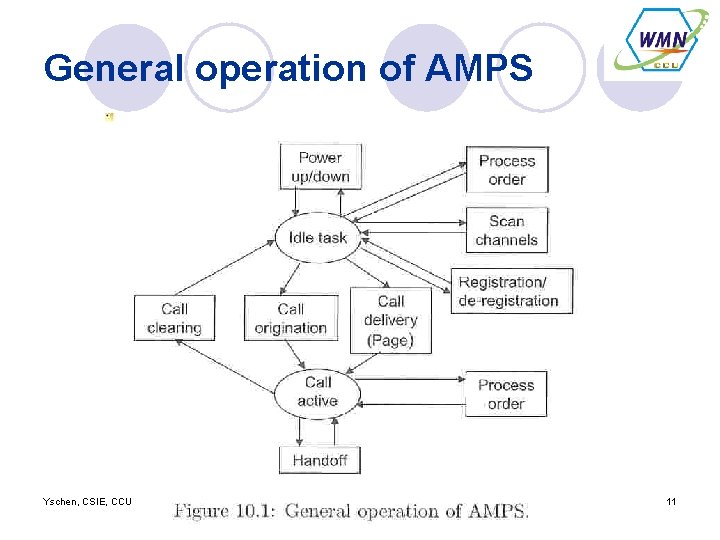
Operations of AMPS l A general state diagram of how an AMPS system handles and various other responsibilities is shown in Fig. 10. 1 l Three identification numbers are included in the AMPS system to perform various functions • Electronic serial number (ESN): A 32 -bit binary number uniquely identifies a cellular unit of an MS and is established by the manufacturer at the factory • System identification number (SID): A unique 15 -bit binary number assigned to a cellular system The SID serves as a check and can be used in determining if a particular MS is registered in the same system or if it is just roaming • Mobile identification number (MIN): A digital representation of MS’s 10 -digit directory telephone number Yschen, CSIE, CCU 10
General operation of AMPS Yschen, CSIE, CCU 11
General working of AMPS phone system l. When a BS powers up (enter idle task), it has to know its surroundings before providing any service to the MSs l. It scans all the control channels and tunes itself to the strongest channel l. It sends its system parameters to all the MSs present in the service area l. Each MS updates its SID and establishes its paging channels only if its SID matches the one transmitted by the BS l. Then, the MS goes into the idle state, responding only to the beacon and page signals Yschen, CSIE, CCU 12
Cont. l. If a call is placed to an MS, the BS locates the MS through the IS-41 message exchange • Then the BS pages the MS with an order l. If the MS is active, it responds to the page with its MIN, ESN, and so on • The BS then sends the control information necessary for the call • For which the MS has to confirm with a supervisory audio tone (SAT), Indicating completion of a call l. If a call is to be placed from an MS, the MS first sends the origination message to the BS on the control channel Yschen, CSIE, CCU 13
Cont. l. The BS passes this to IS-41 and sends the necessary control signal and orders to the MS l. Thereafter, both MS and BS shift to the voice channel l. An FVC and RVC control message exchange follows to confirms the channel allocation l. Thus the actual conversation starts Yschen, CSIE, CCU 14
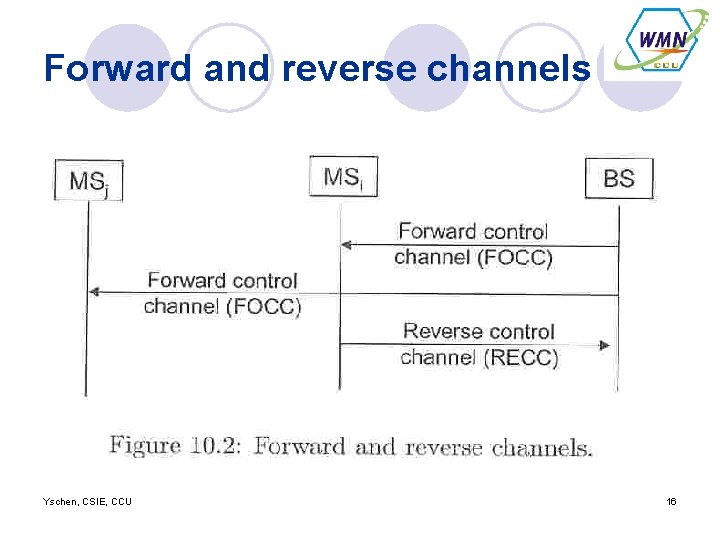
How an MS know when it receives a call ? l. The answer lies in the messages passed on the control channels l. Whenever the MS is not in service, it tunes to the strongest channels to find out useful control information • The same happens at the BS as well l. The various channels used by the AMPS are as follows • • Yschen, CSIE, CCU FOCC RECC FVC RVC 15
Forward and reverse channels Yschen, CSIE, CCU 16
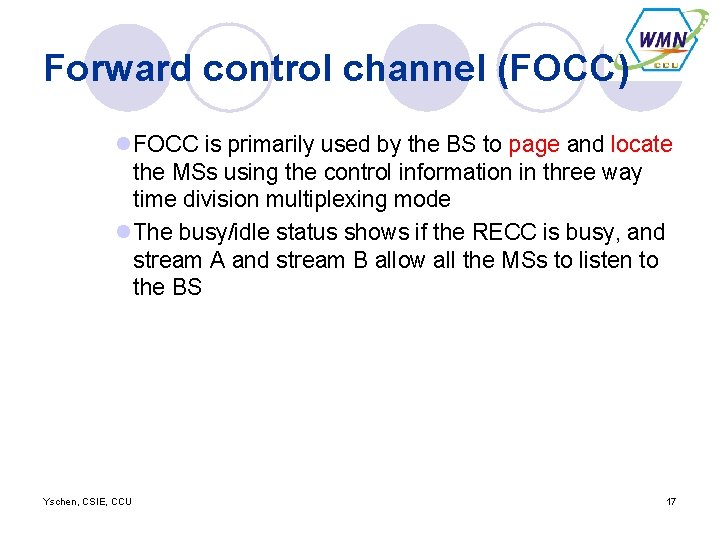
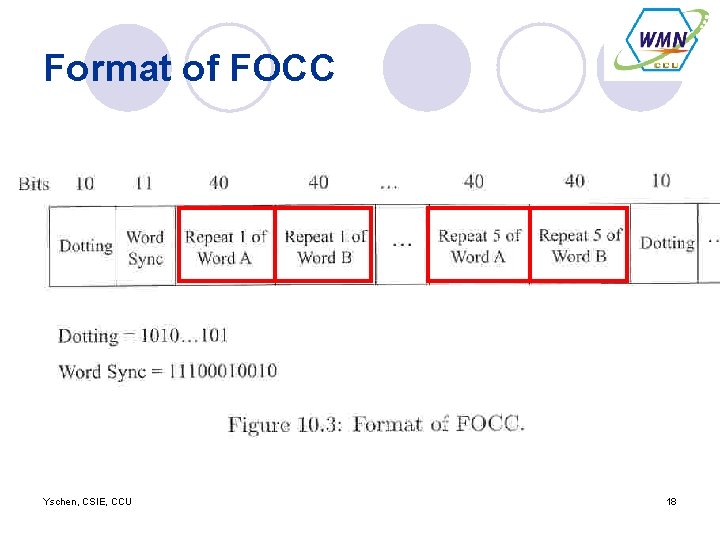
Forward control channel (FOCC) l. FOCC is primarily used by the BS to page and locate the MSs using the control information in three way time division multiplexing mode l. The busy/idle status shows if the RECC is busy, and stream A and stream B allow all the MSs to listen to the BS Yschen, CSIE, CCU 17
Format of FOCC Yschen, CSIE, CCU 18
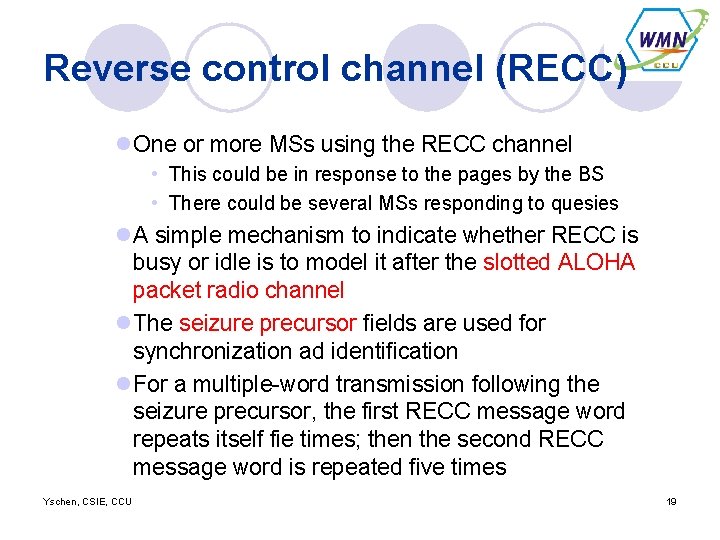
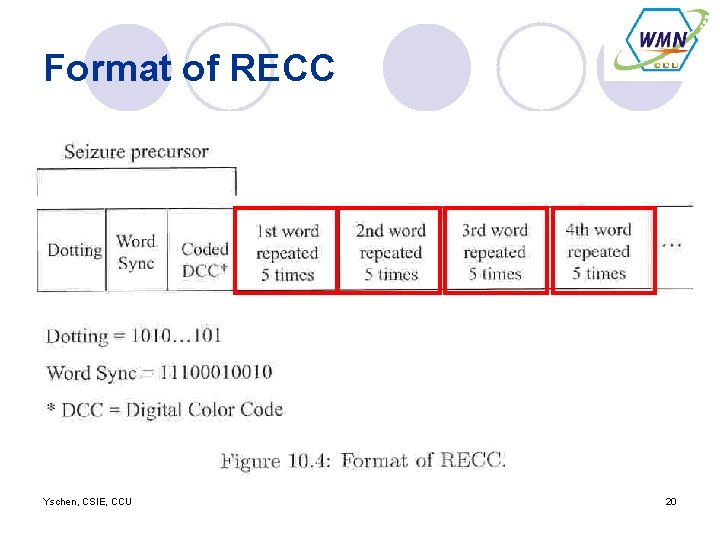
Reverse control channel (RECC) l. One or more MSs using the RECC channel • This could be in response to the pages by the BS • There could be several MSs responding to quesies l. A simple mechanism to indicate whether RECC is busy or idle is to model it after the slotted ALOHA packet radio channel l. The seizure precursor fields are used for synchronization ad identification l. For a multiple-word transmission following the seizure precursor, the first RECC message word repeats itself fie times; then the second RECC message word is repeated five times Yschen, CSIE, CCU 19
Format of RECC Yschen, CSIE, CCU 20
Forward voice channel (FVC) l. FVC is used for one-to-one communication from the BS to each individual MS l. A limited number of messages can be sent on this channel l. A 101 -bit dotting pattern represents the beginning of the frame l. The forward channel supports two different tones Yschen, CSIE, CCU • Continuous supervisory audio The BS transmits beacon signal to check for the live MSs in the service area • The discontinuous data stream BS sends orders or new voice channel assignment to the MS 21
Reverse voice channel (RVC) l. Reverse voice channel is used for one-to-one communication form MS to the BS during calls in progress and is assigned by the BS to an MS for its exclusive use Yschen, CSIE, CCU 22
IS-41 ¡IS-41 is an interim standard that allows handoff between BSs under control of different MSCs and allows roaming of a MS outside its home system ¡In order to facilitate this, the following services need to provided l. Registering for the MS with a visiting MSC l. Allowing for call origination in a foreign MSC l. Allowing the MS to roam from one foreign system to another Yschen, CSIE, CCU 23
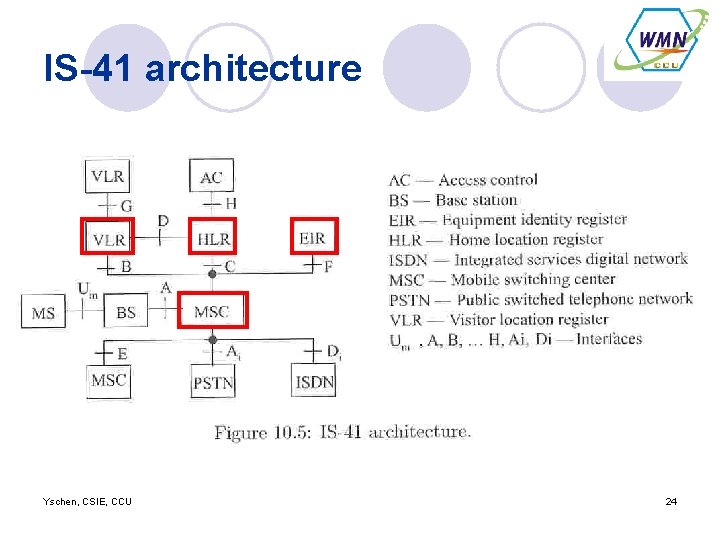
IS-41 architecture Yschen, CSIE, CCU 24
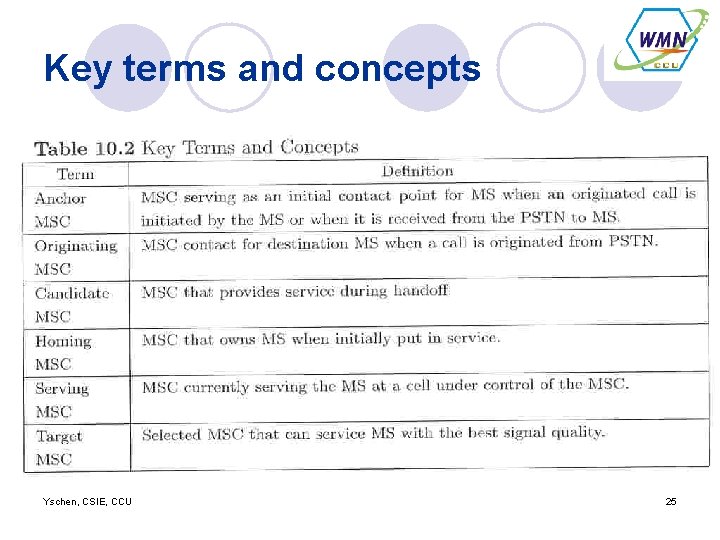
Key terms and concepts Yschen, CSIE, CCU 25
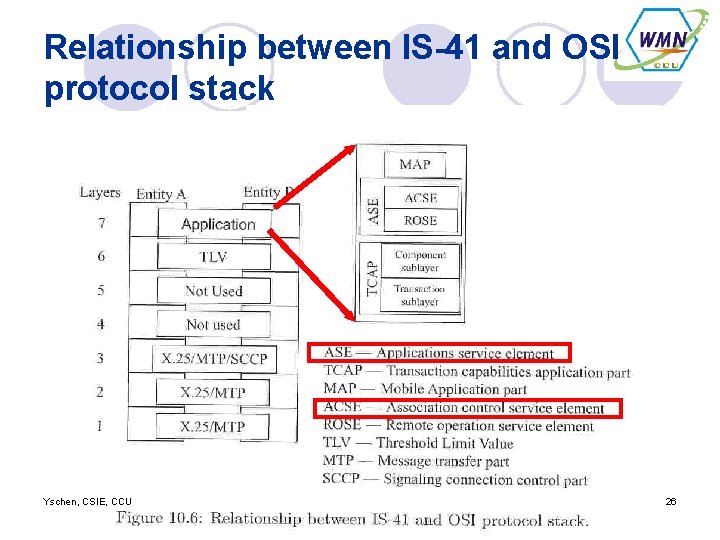
Relationship between IS-41 and OSI protocol stack Yschen, CSIE, CCU 26
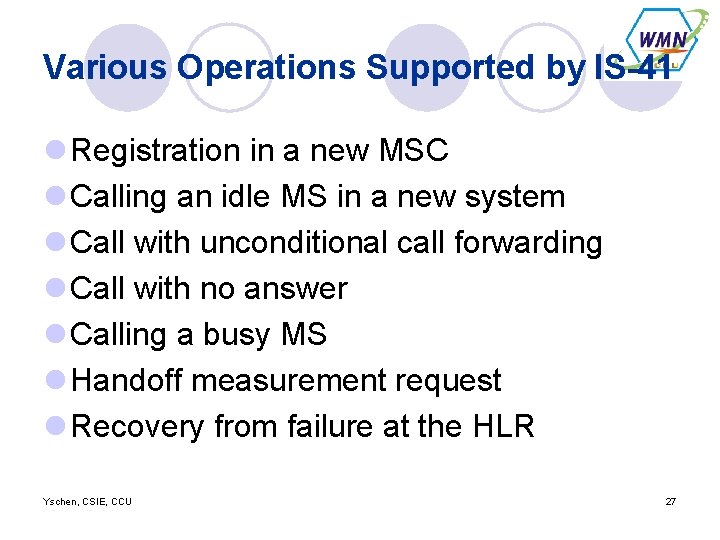
Various Operations Supported by IS-41 l Registration in a new MSC l Calling an idle MS in a new system l Call with unconditional call forwarding l Call with no answer l Calling a busy MS l Handoff measurement request l Recovery from failure at the HLR Yschen, CSIE, CCU 27
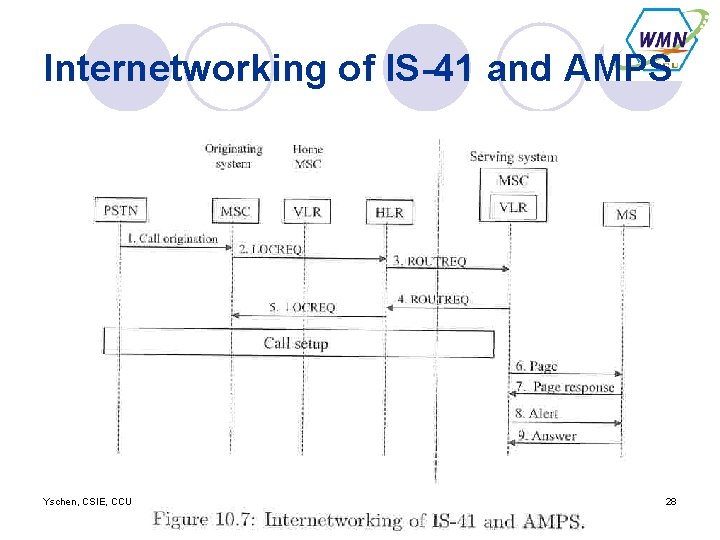
Internetworking of IS-41 and AMPS Yschen, CSIE, CCU 28