
Chapter 8 Evaluation of Feeder Animals What are







- Slides: 40
Chapter 8 Evaluation of Feeder Animals
What are Feeder Animals • Those raised or sold for – the purpose of going into intensive feeding system. • Pigs, lambs, cattle. • Some extent: poultry; commercial fish.
What are Feeder Animals • Feeder cattle are usually – calves • Yearlings grown mainly on – milk and grass. • Feeder lambs sold after weaning, fall. • Term Feeder used to describe – feedlot operator
Feeder Animal Terms • Steer, Barrow, Wether— – Castrated males of the species • Ewe, Heifer, Gilt— – Young females that have not reproduced. • Bull, Ram, Boar— – Reproductive males • Cow, Ewe, Sow— – Reproductive females
Performance • Large range in performance characteristics. – ROG, carcass grade, % lean. • Genetics and environment – plays largest role in the efficiency of livestock. • Producers will select stock based upon – their condition, feed supply, and markets.
Feeder Cattle • Grown throughout the country— • Where the feed supplies are. • Breed differences relate to quality. – Book will disagree, but is true – Maybe not as a feeder calf, but as mature.
Feeder Cattle • Hereford long was predominant breed in the U. S. • Angus thought to be-– too small to cope with rugged environment.
Feeder Cattle • First In US were the— – English or British breeds – Angus, Shorthorn, Hereford • Other breeds, including Shorthorn and European (Continental or Exotic) Limousin and Simmental— – mostly for cross-breeding.
Feeder Cattle • Introduction of Indian Breeds – Brahman, Santa Gertrudis (Gerts), Charbray, and crosses – Crosses with English used in Gulf Coast States. Why? • Insect and temperature resistance • Dairy cattle gain well, higher % lean in carcass, book says grade lower, NOT True.
Feeder Cattle: Age and Weight • Usually depends on breed as well as: – feed, labor and capital available. • Average – 550 -600 pounds. • Yearlings usually weigh – 7 -800 pounds.
Feeder Cattle: Age and Weight • Ideal market weight is – 1100 -1300 pounds – which will produce 700 -850 CWT. • Less profitable to grow to a lighter finished weight. Why? • As grow, weight will be put on as fat. • Cheaper to add fat than muscle.
Age and Weight • Drawback: – Cattle less efficient increase age • Lighter/younger more prone – for disease and stress, need more shelter. • Mid 1900’s, 25% calves weighed 450 -550 and 70% weighed 750 -800 pounds. • Positive correlation between – initial weight and rate of gain. (win-win situation)
Factors contributing rate of gain versus initial weight • 1. Larger animals eat more food. – More functional rumen, eat more. • 2. If assume no Birth Weight or beginning weight difference, – difference due to heredity.
Factors contributing rate of gain versus initial weight • 3. Heavier more resistant – to disease, inclement weather, stress. • 4. Bunk space limited, – heavier have advantage – push others out.
Sex and Condition • Who gains faster? – Steers gain faster than heifers. • Heifers have – shorter feeding period – lower price (usually, not always).
Sex and Condition • Also, if heifers not fed estrus-suppressing hormones, – become restless, do not eat. • Heifers could be pregnant – reduce DP. • Melengestrol acetate (MGA) – used to prevent feedlot heifers from “heat”.
Conformation and Performance • Those “high cutability” show – natural muscle, rib, loin and round. • Bulge of muscles, round in structure. • Market grades for feeder cattle. • Page 151, but handout new grades effective October 1, 2000; don’t ask how I got them. • Talk about conformation, #1 in feeders.
Feeder Calves • Talk about USDA grades • Videos about live evaluation • Let’s do some practice.
Feeder Lambs
Feeder Lambs • Sheep adapted to – cool climate – rough terrain – sparse vegetation – Mountains and arid Plains states.
Feeder Lambs • Larger feedlots have – appeared by packers. • Transportation and handling costs – are less than cattle. • Most usually sold for slaughter at weaning. • Market weight 100 to 150 pounds within – 120 -140 d of feeding.
Breeding and Color Markings • Prefer some type of – meat-type breeding. • Wool breeds (fine) – more narrow, rangier, and hang less desirable carcasses. • Many use a cross breeding system between fine wool and mutton-type lambs. • Hampsire or Suffolks used for crossbreeding
Age and Weight • Weaning at – 5 -8 months – weighing 65 -95 pounds. • Lighter ones are desired. Why? – Consumers demand lighter product. – Get 50% roughage diet.
Age and Weight • Book says lighter ones will – grade USDA Choice. • Not true, 95% of lambs in U. S. grade USDA Choice or higher. • Conformation large role in USDA grades. – Also maturity and fat.
Sex and Condition • Seldom sorted on sex, although – males gain faster than ewes in feedlot. • Starting to raise rams (no castration). • Why? • Next slide
Sex and Condition • • • Gain faster no decrease in performance due to castration no difference in carcass composition. One slight problem book? If grown too long, – develop strong mutton ram off flavor, very unpleasant.
Grades and Conformation • Very little emphasis on grades of feeder lambs due to – lack of variation. • Very seasonal influence – 1 time per year. • Very limited difference in weight due to – feedlot constraints.
Grades and Conformation • Most will grade Choice or better. – Book says Good – very sorry range maggot will grade Select.
Feeder Pigs
Feeder Pigs • Very little movement in swine industry. • Why? – Stress, costs, packers, quality. • Most farrowed/weaned – one place and finished at another. • Raising feeder pigs requires – less labor and capital investment than beef or lamb.
Feeder Pigs • Raising does require – high management level • Biggest Risk: – pigs can carry diseases. • Some will not bring in other animals or let outside people into farms.
Feeder Pigs • Nearly all pigs sold soon after weaning, – at about 40 pounds. • Essentially all are – crossbreds or hybrids.
Health and Preparation • Across state lines – vaccinated w/ papers. • Reputation will proceed producers – with high quality, healthy animals.
Health and Preparation • Sanitation important in: – buildings, scales, pens, trucks, equipment. • Males castrated • Tails docked – 1/4 -1/2 inch.
USDA Grades: Appraisal Systems and Weight • All pigs slaughter about – 6 months age. • Prices for feeder pigs based upon – price of slaughter hogs. • 3 ways on next slide
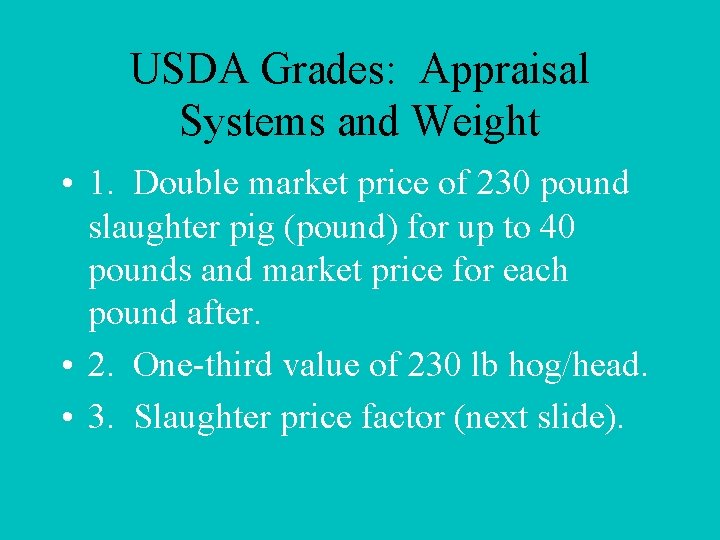
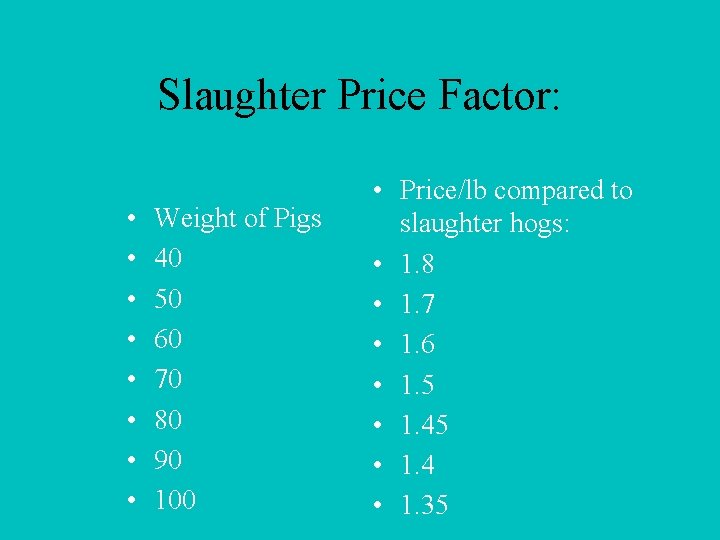
USDA Grades: Appraisal Systems and Weight • 1. Double market price of 230 pound slaughter pig (pound) for up to 40 pounds and market price for each pound after. • 2. One-third value of 230 lb hog/head. • 3. Slaughter price factor (next slide).
Slaughter Price Factor: • • Weight of Pigs 40 50 60 70 80 90 100 • Price/lb compared to slaughter hogs: • 1. 8 • 1. 7 • 1. 6 • 1. 5 • 1. 4 • 1. 35
Last factor • 4. A downpayment at delivery – similar to that in system for 3, plus final payment that depends on market price for slaughter hogs at a predetermined market four months later. • Price of grains also considered.
Sex and Sex Condition • Barrows gain faster than gilts (duh). • Will be slightly fatter – at same finish weight. • Boars gain faster but have – strong off-flavor • Boars usually not fed in commercial feeder operations.
End of Chapter 8