
Chapter 8 Enzymes Basic Concepts and Kinetics 2019
Chapter 8 Enzymes: Basic Concepts and Kinetics © 2019 W. H. Freeman and Company
Ch. 8 Learning Objectives By the end of this chapter, you should be able to: 1. Describe the relations between the enzyme catalysis of a reaction, thermodynamics of the reaction, and the formation of the transition state. 2. Explain the relation between the transition state and the active site of an enzyme, and list the characteristics of active sites. 3. Explain what reaction velocity is. 4. Explain how reaction velocity is determined and how reaction velocities are used to characterize enzyme activity. 5. Explain how different types of reversible inhibitors can be identified.
Ch. 8 Outline • 8. 1 Enzymes Are Powerful and Highly Specific Catalysts • 8. 2 Gibbs Free Energy Is a Useful Thermodynamic Function for Understanding Enzymes • 8. 3 Enzymes Accelerate Reactions by Facilitating the Formation of the Transition State • 8. 4 The Michaelis–Menten Model Accounts for the Kinetic Properties of Many Enzymes • 8. 5 Enzymes Can Be Inhibited by Specific Molecules
Enzymes are Remarkable Catalysts • They are crucial in speeding up important chemical reactions and are also the target of many drugs. – Example: omeprazole is used to inhibit the K+/H+ ATPase, the enzyme that acidifies the stomach. – When this enzyme is too active, painful heartburn results and can increase risk for stomach cancer; so omeprazole is an important inhibitor. • Most biological catalysts are proteins, although some are RNA. • Enzymes function by stabilizing the transition state, the highest-energy species in the reaction pathway.
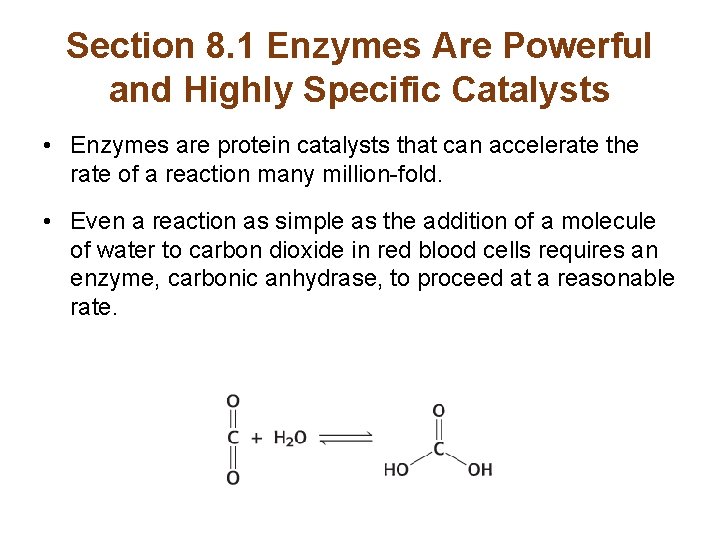
Section 8. 1 Enzymes Are Powerful and Highly Specific Catalysts • Enzymes are protein catalysts that can accelerate the rate of a reaction many million-fold. • Even a reaction as simple as the addition of a molecule of water to carbon dioxide in red blood cells requires an enzyme, carbonic anhydrase, to proceed at a reasonable rate.
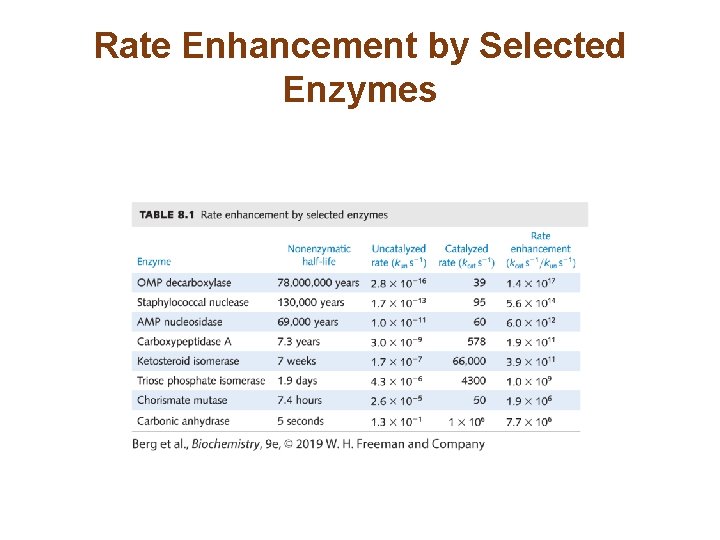
Rate Enhancement by Selected Enzymes
Enzymes Catalyze Highly Specific Reactions • Reactants in enzyme-catalyzed reactions are called substrates. • Enzymes tend to be highly specific. Example: proteolytic enzymes catalyze the hydrolysis of peptide bonds. • However, most proteolytic enzymes also catalyze the hydrolysis of an ester bond, and these reactions can often be easily monitored in lab investigations.
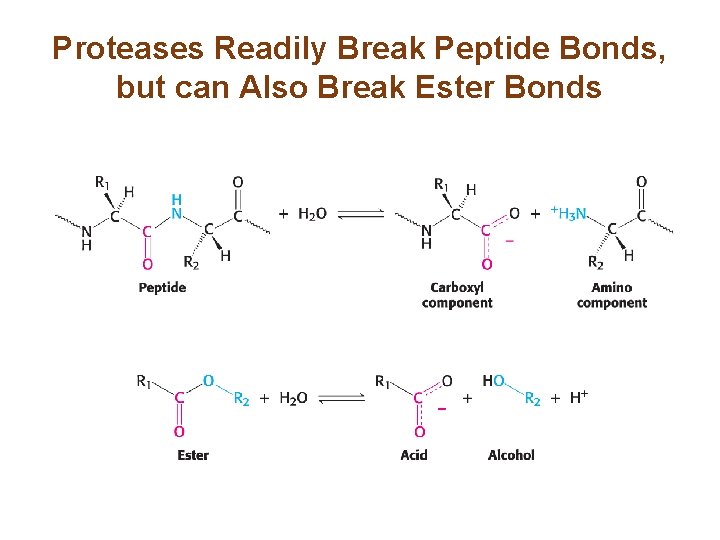
Proteases Readily Break Peptide Bonds, but can Also Break Ester Bonds
Enzyme Specificity (1/2) • Enzymes can display a high degree of specificity, due to the precise interaction of the enzyme and the substrate. • The proteolytic enzymes trypsin and papain have different degrees of specificity.
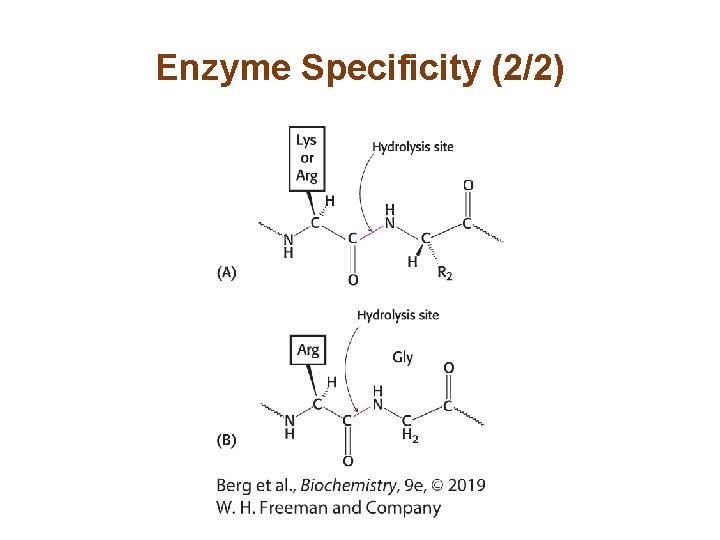
Enzyme Specificity (2/2)
Section 8. 2 Gibbs Free Energy Is a Useful Thermodynamic Function for Understanding Enzymes • The free-energy change provides information about the spontaneity but not the rate of a reaction. 1. A reaction will occur without the input of energy, or spontaneously, only if ΔG is negative. Such reactions are called exergonic reactions. 2. If a reaction is at equilibrium, there is no net change in the amount of reactant or product. At equilibrium, ΔG =0. 3. A reaction will not occur spontaneously if the ΔG is positive. These reactions are called endergonic reactions. 4. The ΔG of a reaction depends only on the free energy difference between reactants and products and is independent of how the reaction occurs. 5. The ΔG of a reaction provides no information about the rate of the reaction.
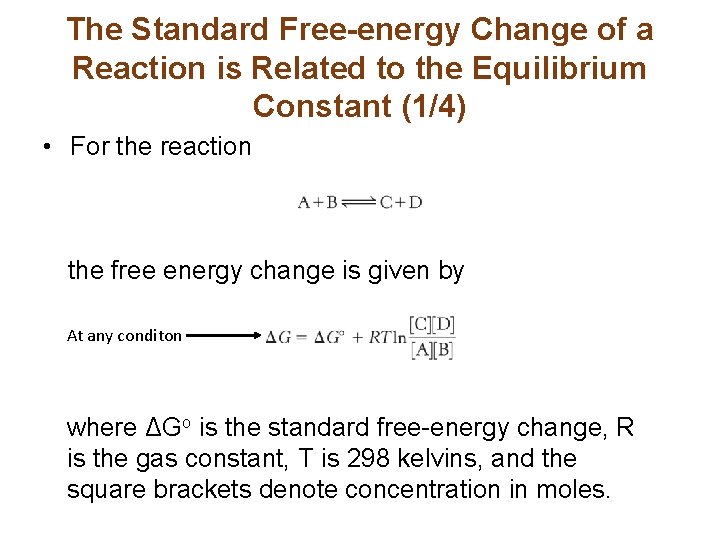
The Standard Free-energy Change of a Reaction is Related to the Equilibrium Constant (1/4) • For the reaction the free energy change is given by At any conditon where ΔGo is the standard free-energy change, R is the gas constant, T is 298 kelvins, and the square brackets denote concentration in moles.
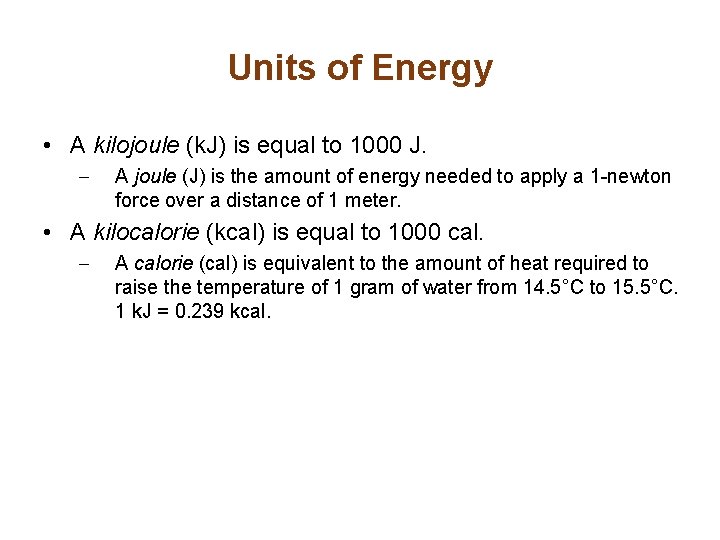
Units of Energy • A kilojoule (k. J) is equal to 1000 J. – A joule (J) is the amount of energy needed to apply a 1 -newton force over a distance of 1 meter. • A kilocalorie (kcal) is equal to 1000 cal. – A calorie (cal) is equivalent to the amount of heat required to raise the temperature of 1 gram of water from 14. 5°C to 15. 5°C. 1 k. J = 0. 239 kcal.
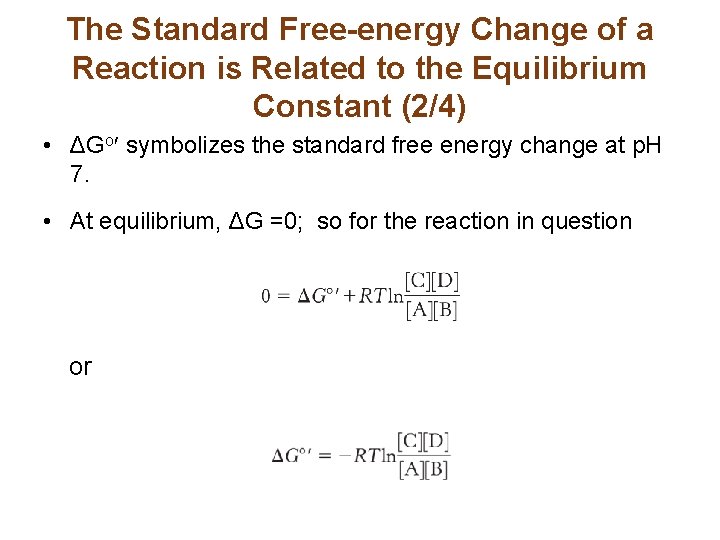
The Standard Free-energy Change of a Reaction is Related to the Equilibrium Constant (2/4) • ΔGo symbolizes the standard free energy change at p. H 7. • At equilibrium, ΔG =0; so for the reaction in question or
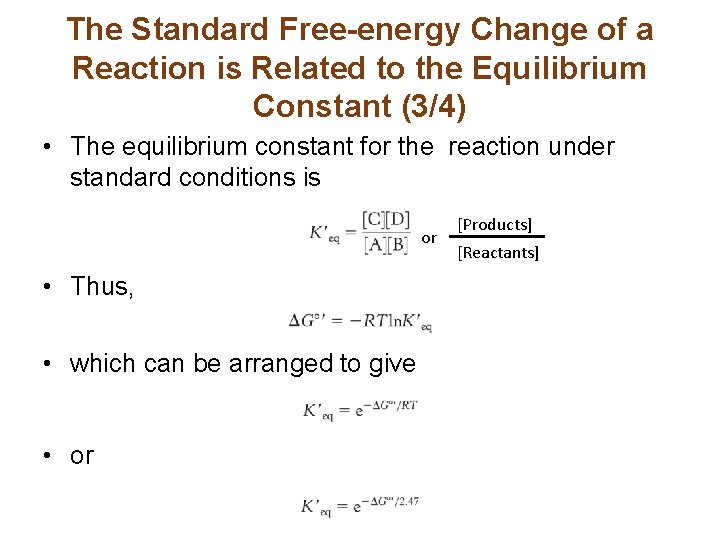
The Standard Free-energy Change of a Reaction is Related to the Equilibrium Constant (3/4) • The equilibrium constant for the reaction under standard conditions is or • Thus, • which can be arranged to give • or [Products] [Reactants]
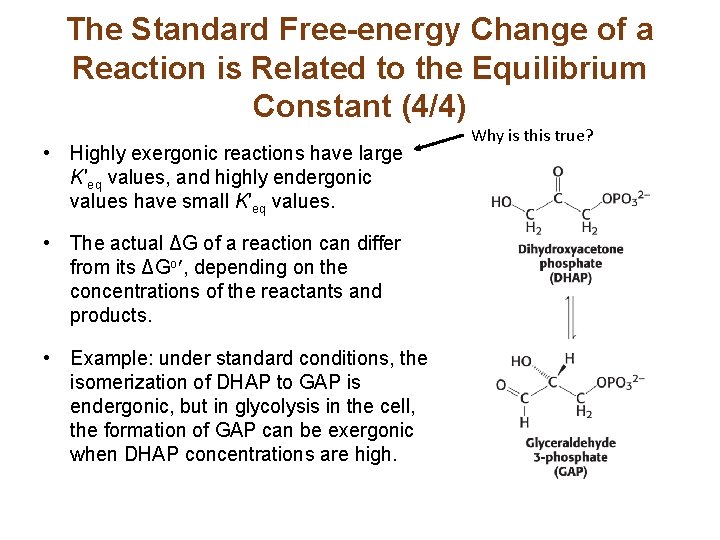
The Standard Free-energy Change of a Reaction is Related to the Equilibrium Constant (4/4) • Highly exergonic reactions have large K′eq values, and highly endergonic values have small K′eq values. • The actual ΔG of a reaction can differ from its ΔGo , depending on the concentrations of the reactants and products. • Example: under standard conditions, the isomerization of DHAP to GAP is endergonic, but in glycolysis in the cell, the formation of GAP can be exergonic when DHAP concentrations are high. Why is this true?
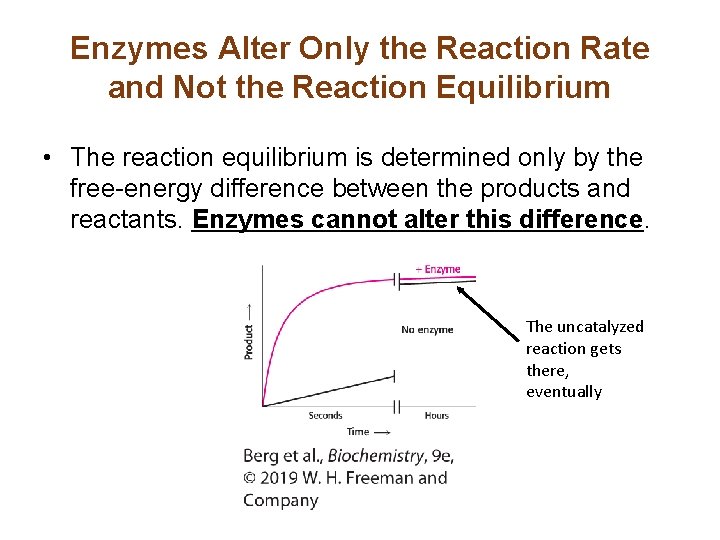
Enzymes Alter Only the Reaction Rate and Not the Reaction Equilibrium • The reaction equilibrium is determined only by the free-energy difference between the products and reactants. Enzymes cannot alter this difference. The uncatalyzed reaction gets there, eventually
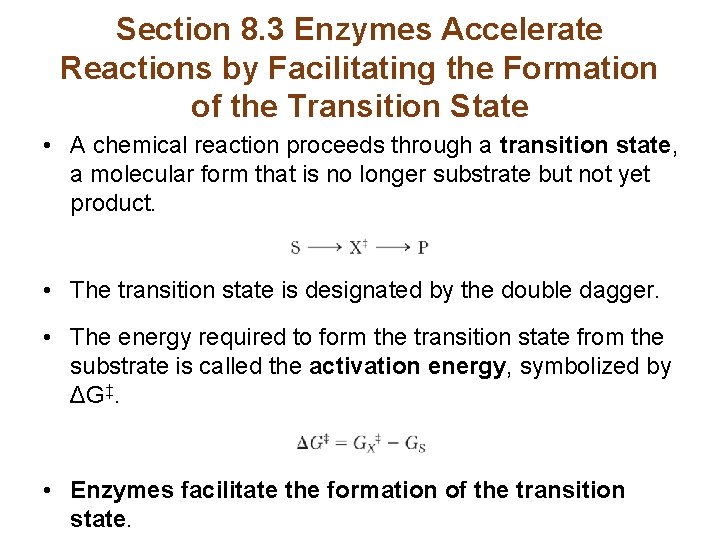
Section 8. 3 Enzymes Accelerate Reactions by Facilitating the Formation of the Transition State • A chemical reaction proceeds through a transition state, a molecular form that is no longer substrate but not yet product. • The transition state is designated by the double dagger. • The energy required to form the transition state from the substrate is called the activation energy, symbolized by ΔG‡. • Enzymes facilitate the formation of the transition state.
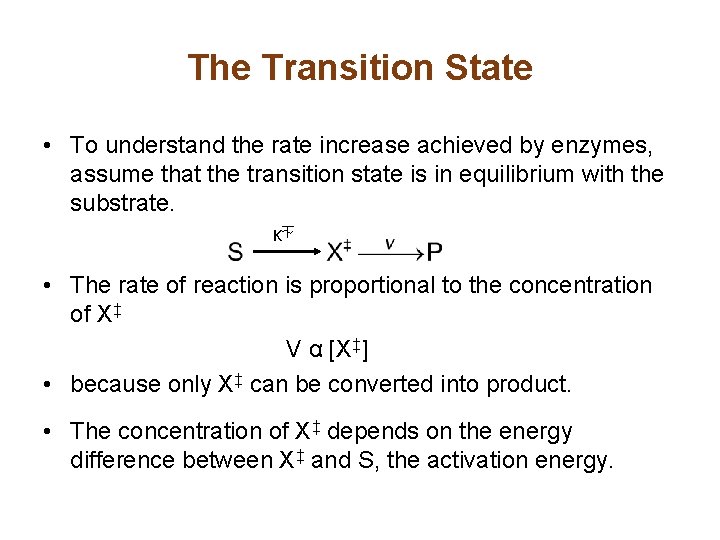
The Transition State • To understand the rate increase achieved by enzymes, assume that the transition state is in equilibrium with the substrate. K⏇ • The rate of reaction is proportional to the concentration of X‡ V α [X‡] • because only X‡ can be converted into product. • The concentration of X‡ depends on the energy difference between X‡ and S, the activation energy.
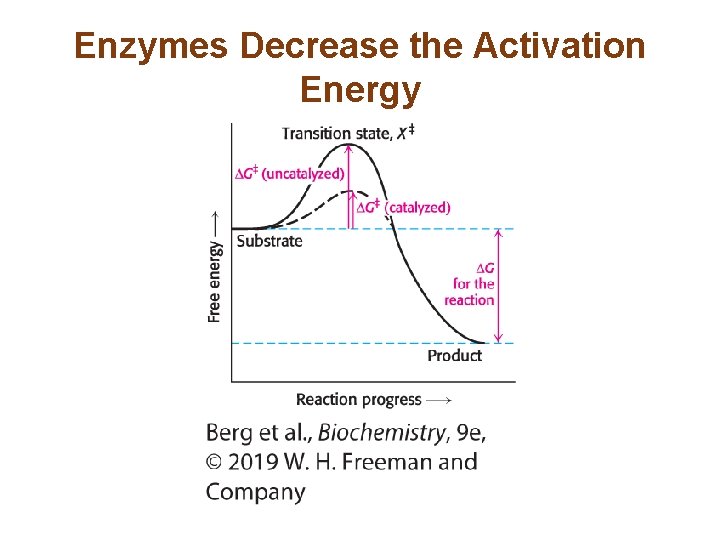
Enzymes Decrease the Activation Energy
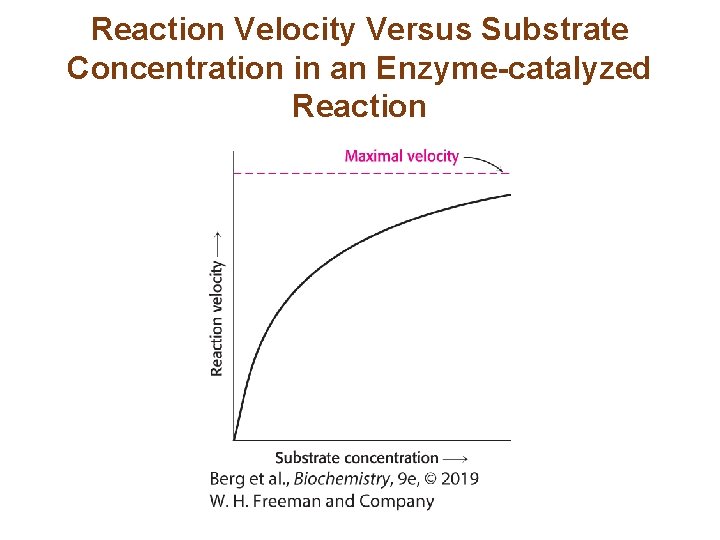
Reaction Velocity Versus Substrate Concentration in an Enzyme-catalyzed Reaction
The Active Sites of Enzymes have Some Common Features 1. The active site is a three-dimensional cleft or crevice created by amino acids from different parts of the primary structure. 2. The active site constitutes a small portion of the enzyme volume. 3. Active sites create unique microenvironments. 4. The interaction of the enzyme and substrate at the active site involves multiple weak interactions. 5. Enzyme specificity depends on the molecular architecture at the active site.
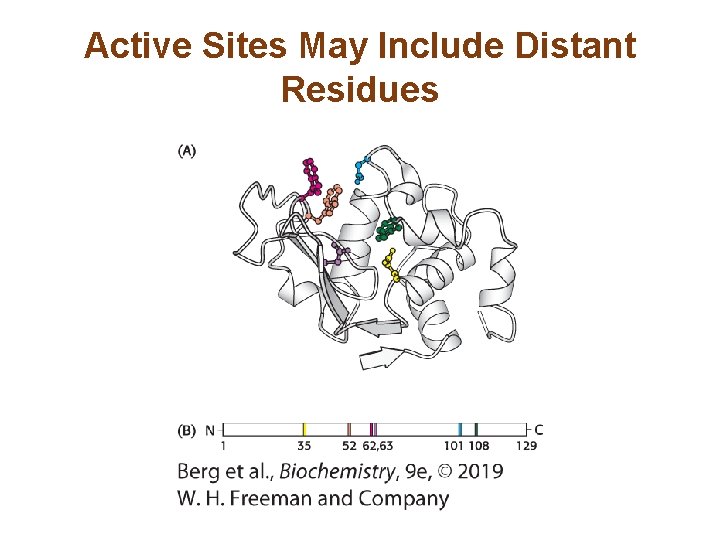
Active Sites May Include Distant Residues
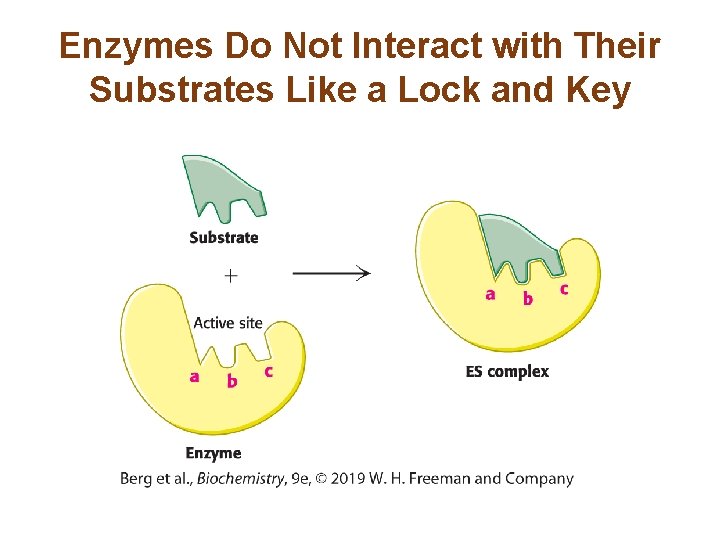
Enzymes Do Not Interact with Their Substrates Like a Lock and Key
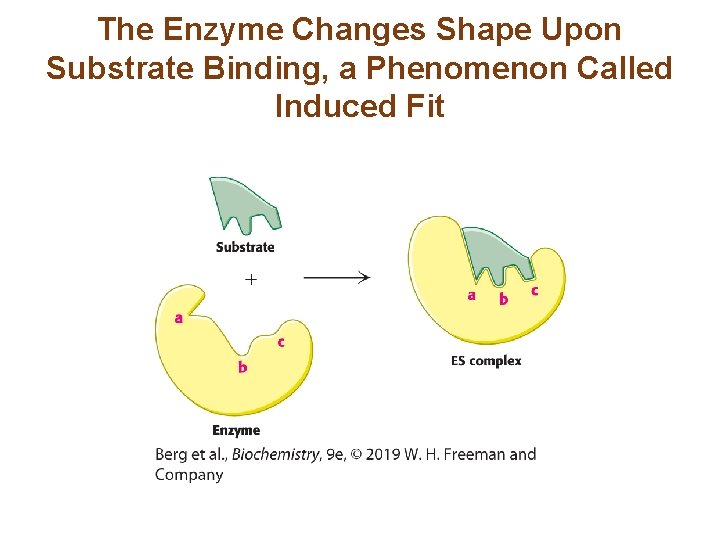
The Enzyme Changes Shape Upon Substrate Binding, a Phenomenon Called Induced Fit
Recognition (Binding) All protein molecules function via binding other molecules • May be other macromolecules or ligands Binding involves the noncovalent interaction of the protein and the target • VDW interactions: Hydrophobic and London Forces (<- Interactions that occur at limit of the Van der Waals radius only) Specificity of Binding relies upon the complementarity of shape and character of the protein/ligand complex
Microenvironments A binding site must provide complementarity for a ligand An active site must contain catalytically important chemical groups in a specific state AS WELL AS a binding site that can accommodate the transition state The microenvironment of each ensures ligand complementarity or chemical readiness
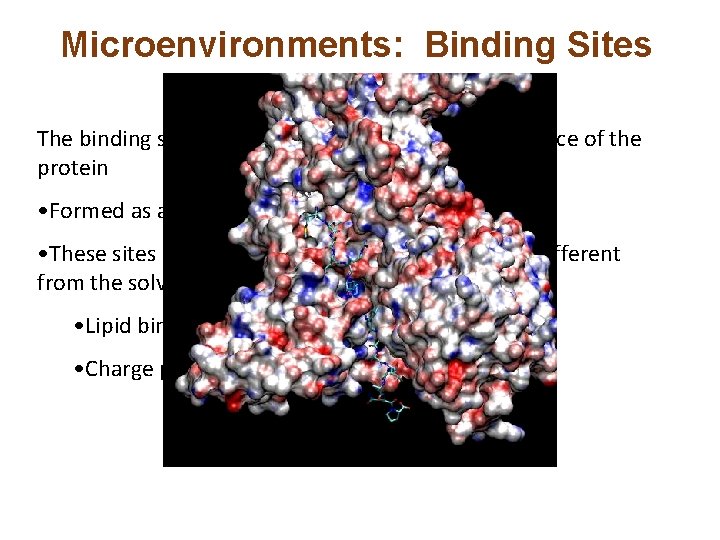
Microenvironments: Binding Sites The binding site may be a cleft or groove on the surface of the protein • Formed as a result of the overall fold • These sites may have an environment that is very different from the solvent • Lipid binding • Charge patches
Microenvironments: Active Sites Most enzymes use general acid/base catalysis • Protons are donated or accepted b/w catalytically important side chains and/or water molecules Example: Asp and Lys in an active site 1. Charge state of each at physiological p. H? • What should form/happen between them? 2. It doesn’t, why? • Microenvironment! • Surrounding residues H-bond or use VDW to pull Lys just far enough away 3. When substrate/cofactors bind, active site geometry rearranges to place groups in position
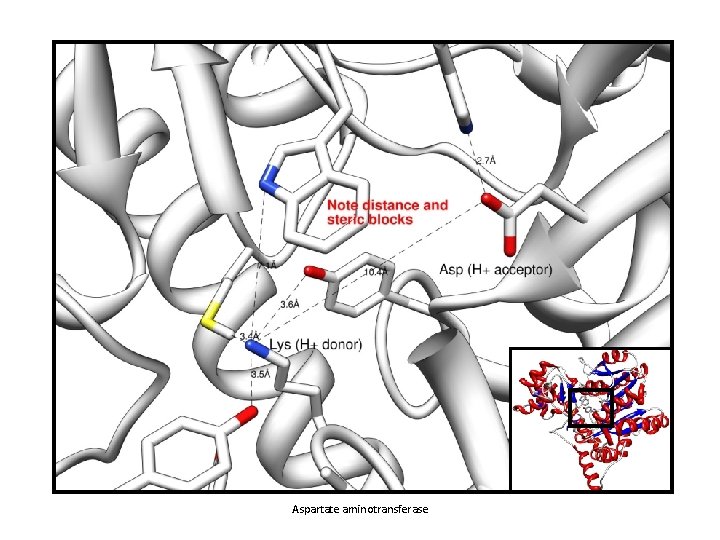
Aspartate aminotransferase
Microenvironments and Thermodynamics Binding sites must have shape complementarity and have a microenvironment that is substantially different from solvent Active sites must manipulate the microenvironment surrounding the chemically relevant moieties • Prevent acid/base interactions and salt bridge formation • Alter proton affinities • Stabilize products / destabilize substrates
Microenvironments and Thermodynamics Two things to consider: 1. The bunching/crowding of similarly charged residues is a repulsive force and is energetically unfavorable 2. Providing an environment that prevents acid/base interactions (pre-binding) or electrostatic interactions introduces strain and is energetically unfavorable
Difference b/w Binding Affinity and Specificity Binding affinity is a measure of the strength of binding • Depends on VDW interactions • Holds ligand for reaction Binding specificity refers to the potential to bind a ligand at all • Depends on anisotropic forces (Differ in strength depending on direction you measure them) • Hydrogen bonding • Serves to guide ligand in binding site with appropriate orientation
Active Site Geometry We can break the active site down into two subsites: 1. Specificity or Binding subsite: VDW and Polar interactions hold the substrate 2. Reaction subsite: Chemistry is carried out Protein engineering relies upon this splitting of duties The specificity can be changed without changing the chemistry
Qualitatively speaking, How? Enzymes speed up reactions through various means 1. Optimal ligand orientation w. r. t. catalytic residues 2. Chemical properties of amino acids • Destabilize substrate • Stabilize transition state or product • Polarize binds • Form covalent intermediates 3. Provide a solvent-shielded scaffold/workbench
Qualitatively speaking, How? Enzymes speed up reactions through various means 1. Optimal ligand orientation w. r. t. catalytic residues 2. Chemical properties of amino acids • Destabilize substrate • Stabilize transition state or product • Polarize binds • Form covalent intermediates 3. Provide a solvent-shielded scaffold/workbench
Qualitatively speaking, How? 1) The rearrangement of covalent bonds in the substrate may result from the formation of transient bonds b/w the enzyme and the substrate 2) The ES complex has a binding energy associated with it. This binding energy is a major source of the free energy needed to lower the activation energy • The DG released by forming several weak binds between the enzyme and substrate drives catalysis • The binding energy contributes to the mandatory specificity as well • Weak interactions are optimized in the transition state • The active site of many enzymes is complementary to the transition state • This pulls the substrate along the reaction coordinate
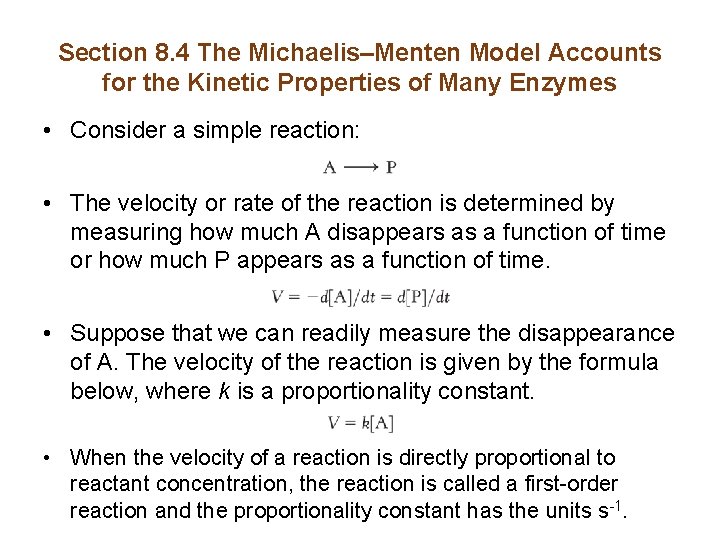
Section 8. 4 The Michaelis–Menten Model Accounts for the Kinetic Properties of Many Enzymes • Consider a simple reaction: • The velocity or rate of the reaction is determined by measuring how much A disappears as a function of time or how much P appears as a function of time. • Suppose that we can readily measure the disappearance of A. The velocity of the reaction is given by the formula below, where k is a proportionality constant. • When the velocity of a reaction is directly proportional to reactant concentration, the reaction is called a first-order reaction and the proportionality constant has the units s-1.
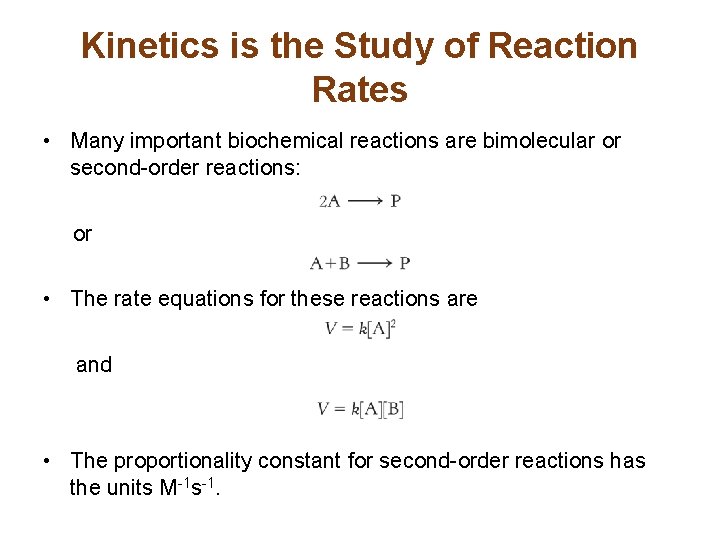
Kinetics is the Study of Reaction Rates • Many important biochemical reactions are bimolecular or second-order reactions: or • The rate equations for these reactions are and • The proportionality constant for second-order reactions has the units M-1 s-1.
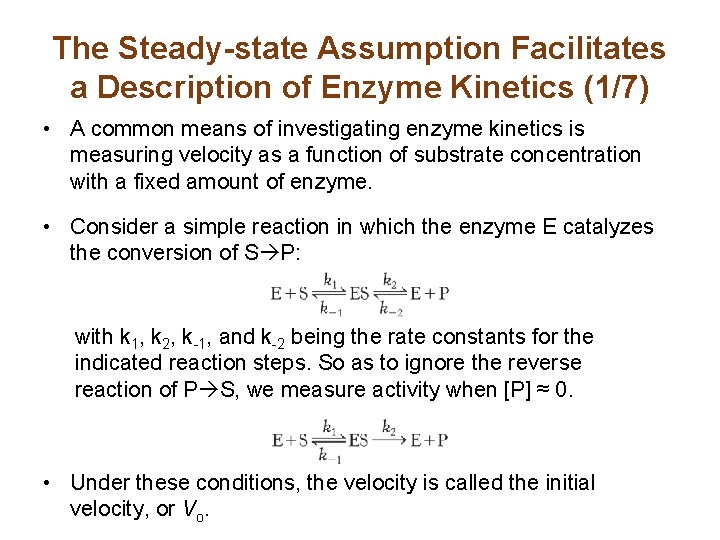
The Steady-state Assumption Facilitates a Description of Enzyme Kinetics (1/7) • A common means of investigating enzyme kinetics is measuring velocity as a function of substrate concentration with a fixed amount of enzyme. • Consider a simple reaction in which the enzyme E catalyzes the conversion of S P: with k 1, k 2, k-1, and k-2 being the rate constants for the indicated reaction steps. So as to ignore the reverse reaction of P S, we measure activity when [P] ≈ 0. • Under these conditions, the velocity is called the initial velocity, or Vo.
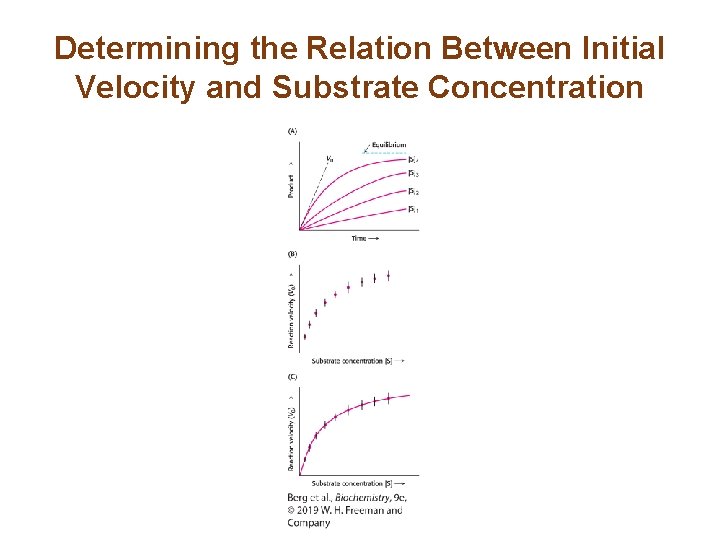
Determining the Relation Between Initial Velocity and Substrate Concentration
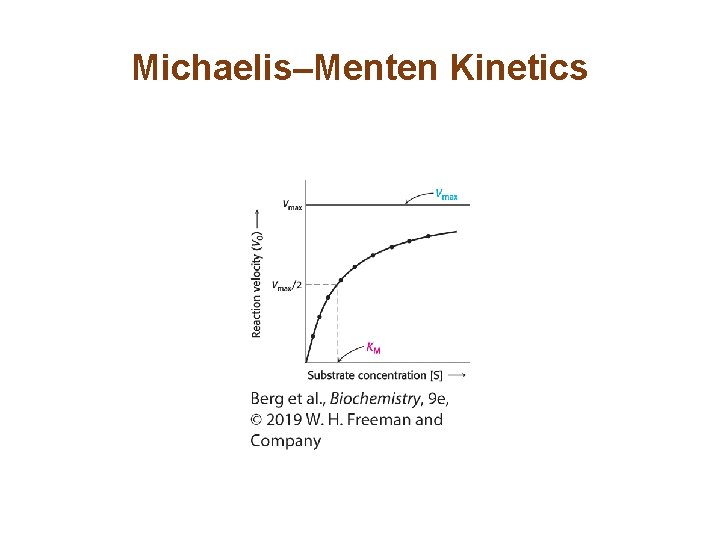
Michaelis–Menten Kinetics
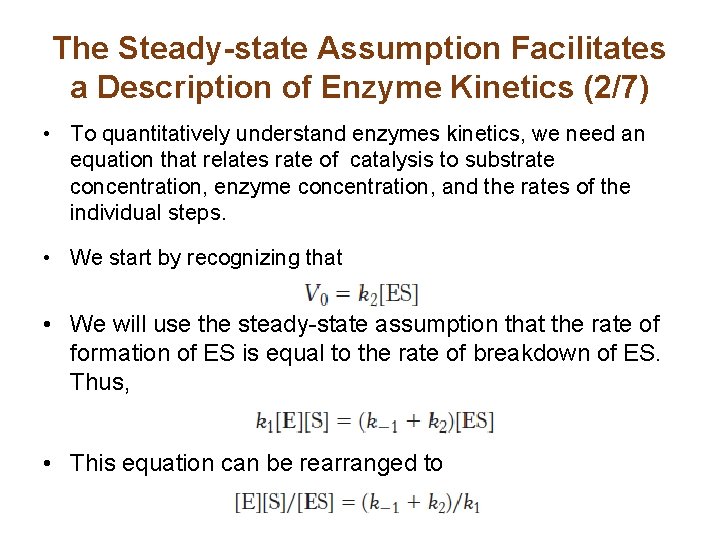
The Steady-state Assumption Facilitates a Description of Enzyme Kinetics (2/7) • To quantitatively understand enzymes kinetics, we need an equation that relates rate of catalysis to substrate concentration, enzyme concentration, and the rates of the individual steps. • We start by recognizing that • We will use the steady-state assumption that the rate of formation of ES is equal to the rate of breakdown of ES. Thus, • This equation can be rearranged to
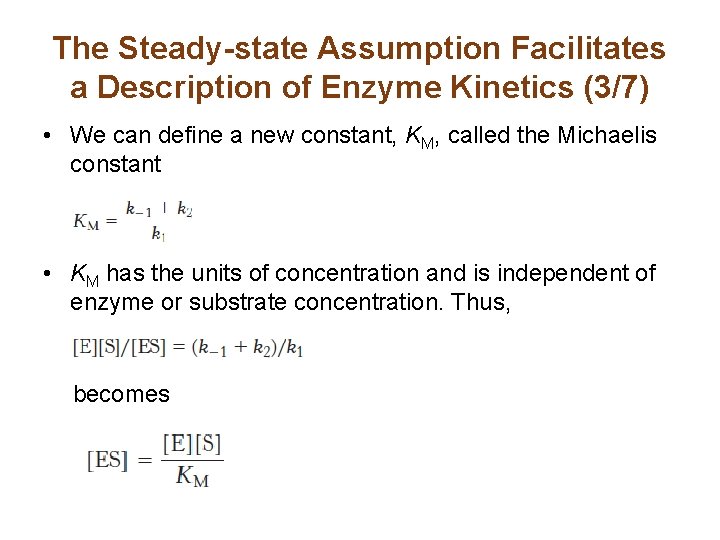
The Steady-state Assumption Facilitates a Description of Enzyme Kinetics (3/7) • We can define a new constant, KM, called the Michaelis constant • KM has the units of concentration and is independent of enzyme or substrate concentration. Thus, becomes
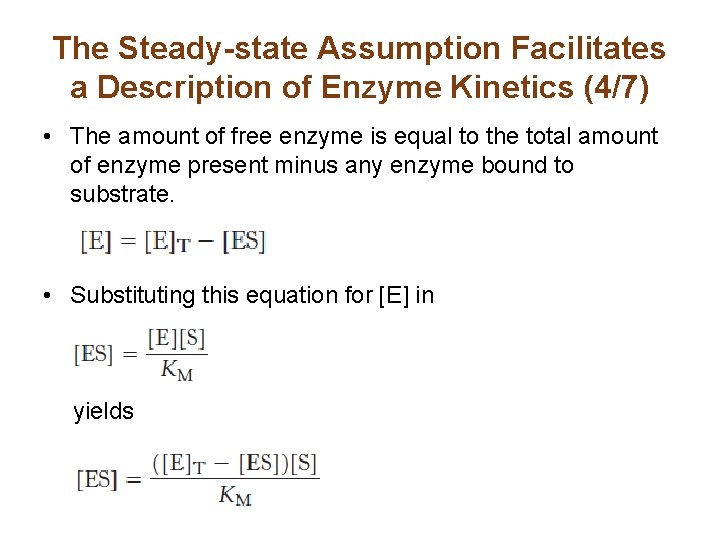
The Steady-state Assumption Facilitates a Description of Enzyme Kinetics (4/7) • The amount of free enzyme is equal to the total amount of enzyme present minus any enzyme bound to substrate. • Substituting this equation for [E] in yields
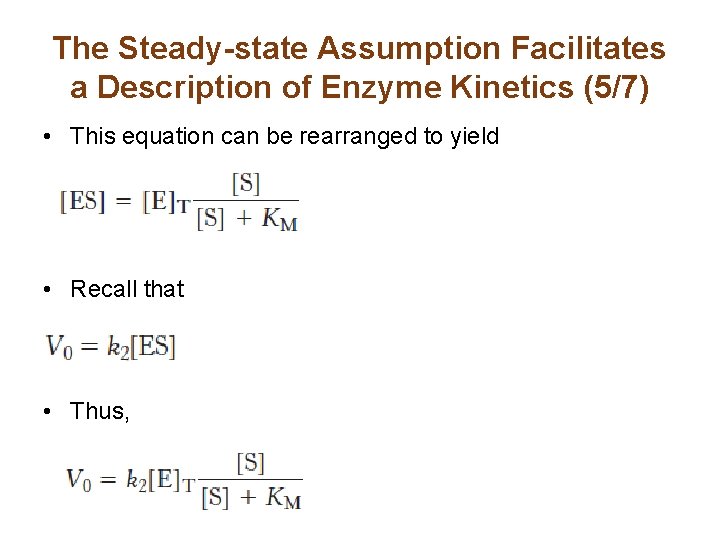
The Steady-state Assumption Facilitates a Description of Enzyme Kinetics (5/7) • This equation can be rearranged to yield • Recall that • Thus,
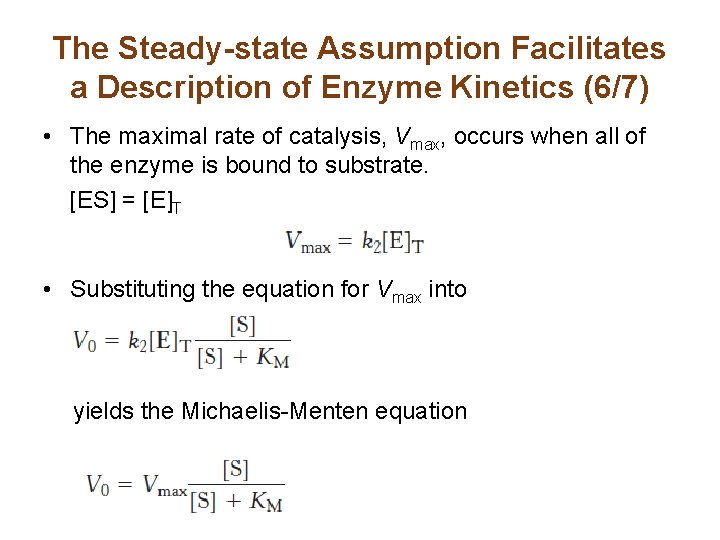
The Steady-state Assumption Facilitates a Description of Enzyme Kinetics (6/7) • The maximal rate of catalysis, Vmax, occurs when all of the enzyme is bound to substrate. [ES] = [E]T • Substituting the equation for Vmax into yields the Michaelis-Menten equation
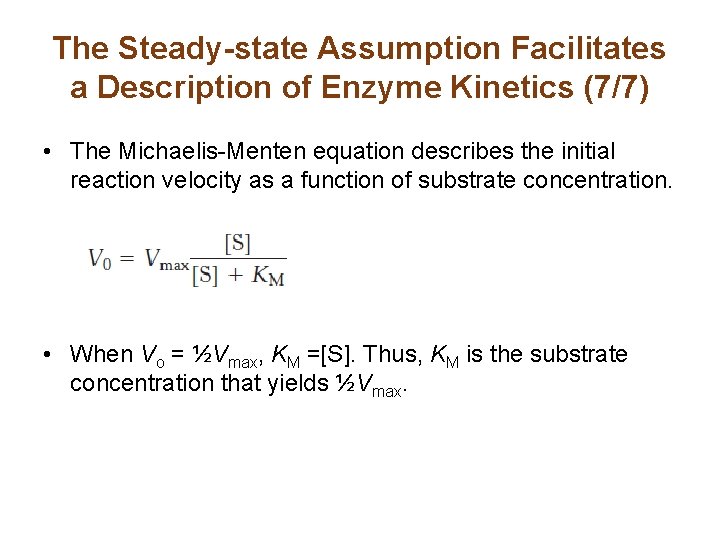
The Steady-state Assumption Facilitates a Description of Enzyme Kinetics (7/7) • The Michaelis-Menten equation describes the initial reaction velocity as a function of substrate concentration. • When Vo = ½Vmax, KM =[S]. Thus, KM is the substrate concentration that yields ½Vmax.
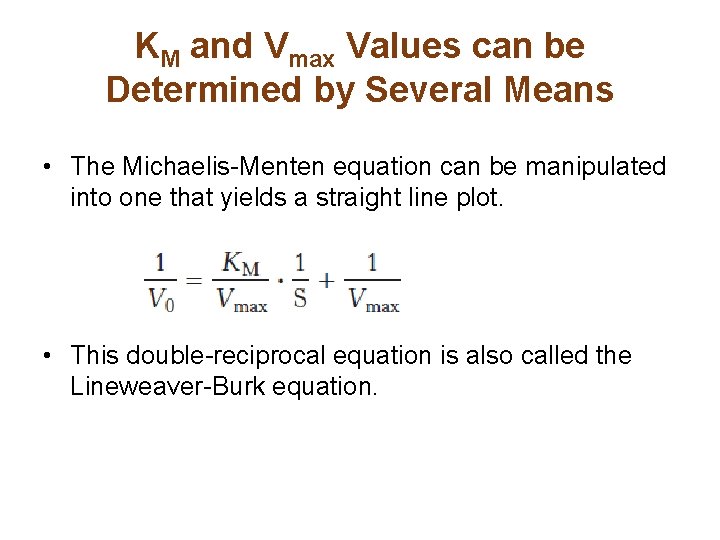
KM and Vmax Values can be Determined by Several Means • The Michaelis-Menten equation can be manipulated into one that yields a straight line plot. • This double-reciprocal equation is also called the Lineweaver-Burk equation.
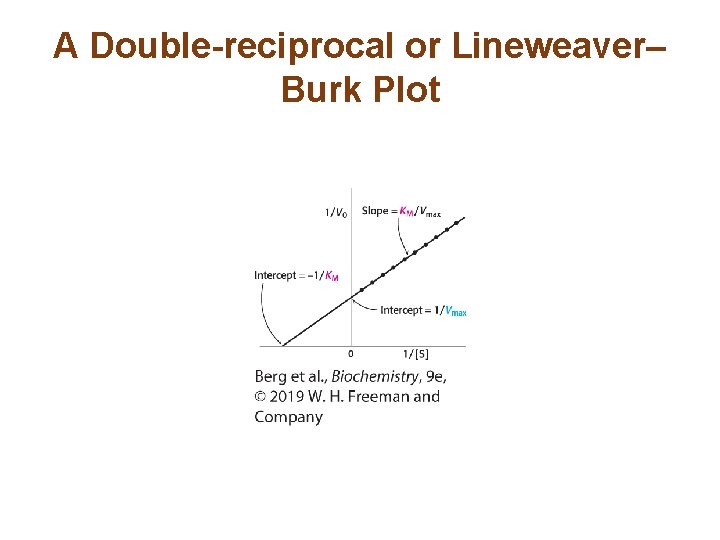
A Double-reciprocal or Lineweaver– Burk Plot
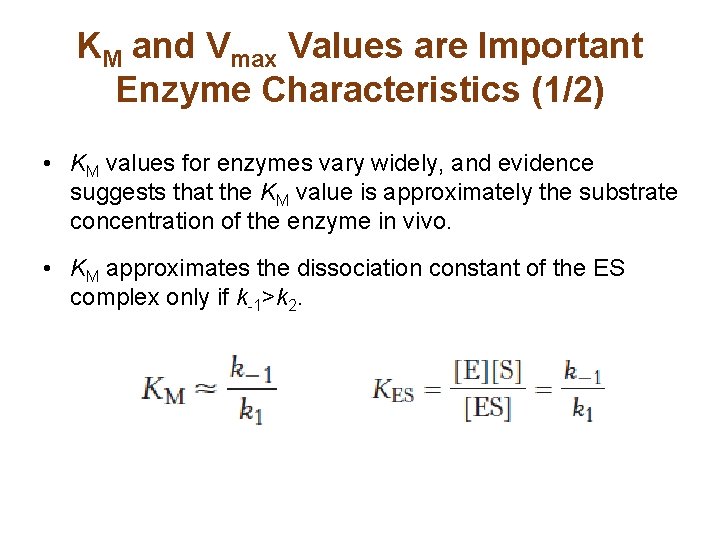
KM and Vmax Values are Important Enzyme Characteristics (1/2) • KM values for enzymes vary widely, and evidence suggests that the KM value is approximately the substrate concentration of the enzyme in vivo. • KM approximates the dissociation constant of the ES complex only if k-1>k 2.
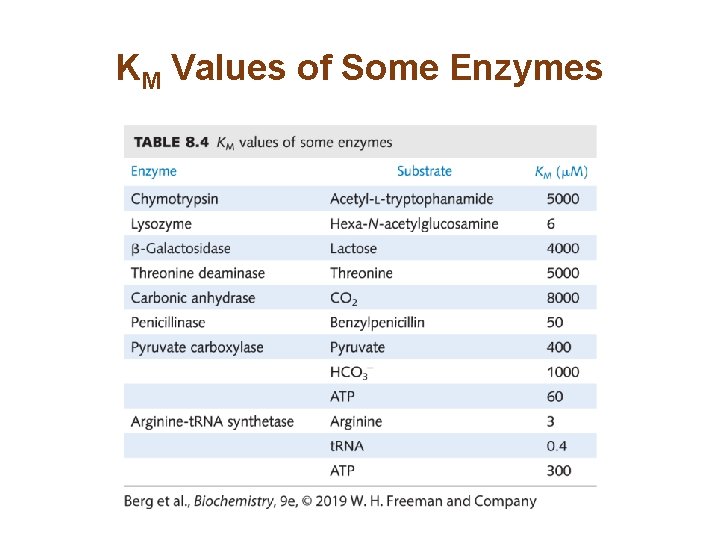
KM Values of Some Enzymes
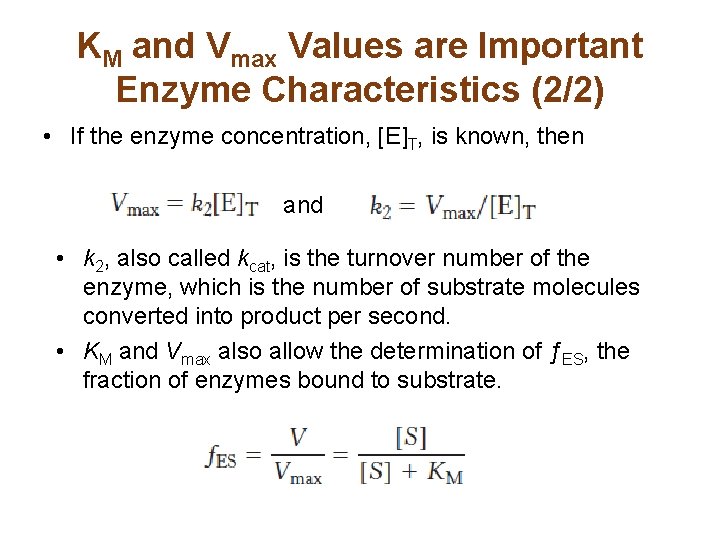
KM and Vmax Values are Important Enzyme Characteristics (2/2) • If the enzyme concentration, [E]T, is known, then and • k 2, also called kcat, is the turnover number of the enzyme, which is the number of substrate molecules converted into product per second. • KM and Vmax also allow the determination of ƒES, the fraction of enzymes bound to substrate.
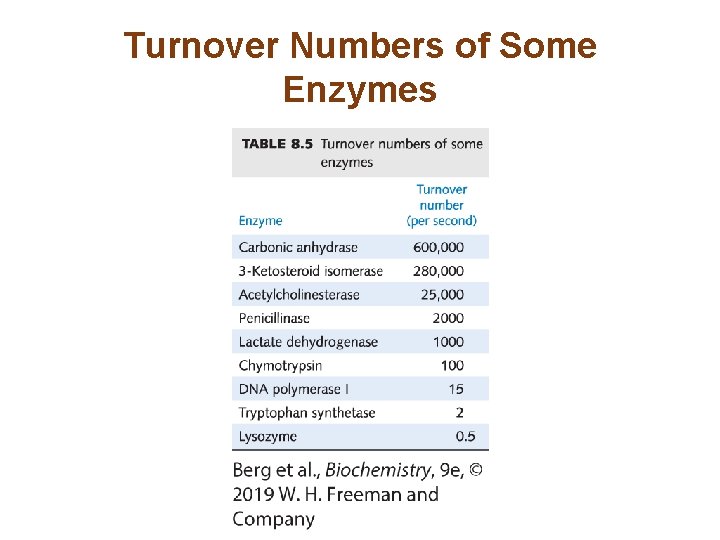
Turnover Numbers of Some Enzymes
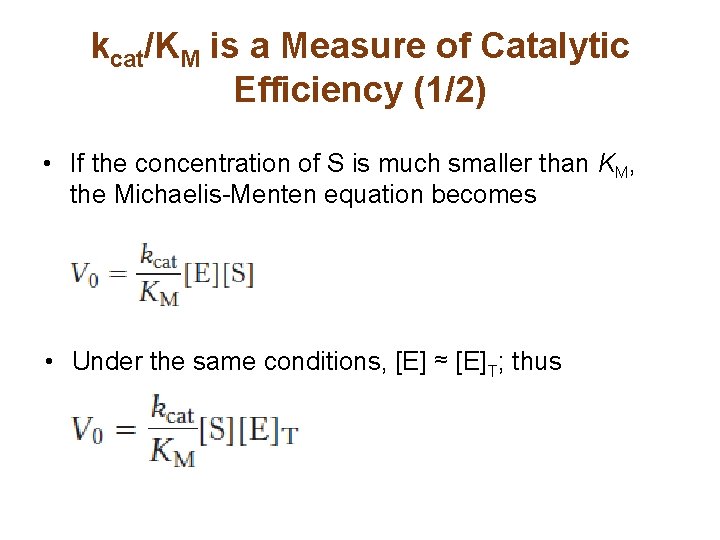
kcat/KM is a Measure of Catalytic Efficiency (1/2) • If the concentration of S is much smaller than KM, the Michaelis-Menten equation becomes • Under the same conditions, [E] ≈ [E]T; thus
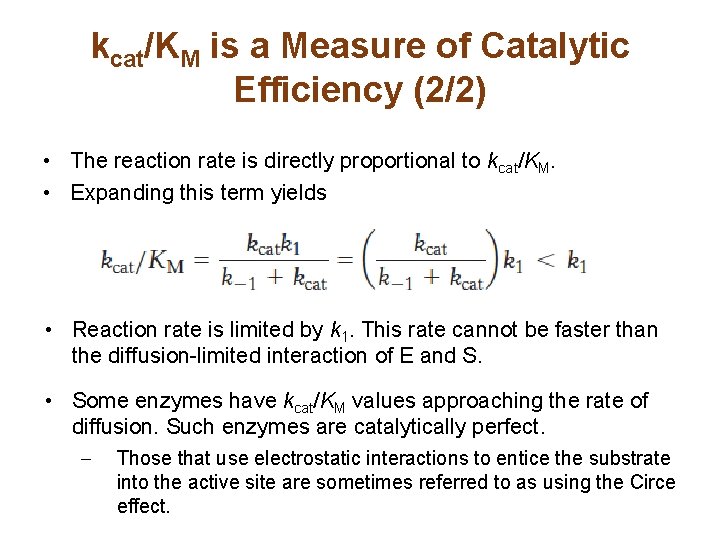
kcat/KM is a Measure of Catalytic Efficiency (2/2) • The reaction rate is directly proportional to kcat/KM. • Expanding this term yields • Reaction rate is limited by k 1. This rate cannot be faster than the diffusion-limited interaction of E and S. • Some enzymes have kcat/KM values approaching the rate of diffusion. Such enzymes are catalytically perfect. – Those that use electrostatic interactions to entice the substrate into the active site are sometimes referred to as using the Circe effect.
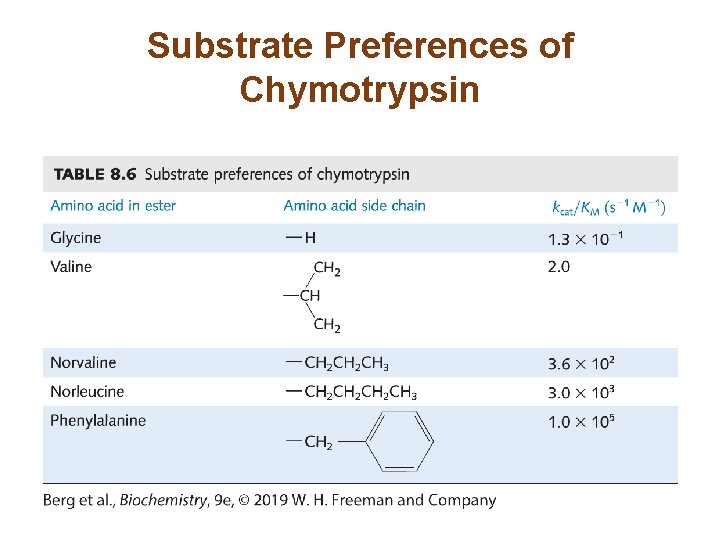
Substrate Preferences of Chymotrypsin
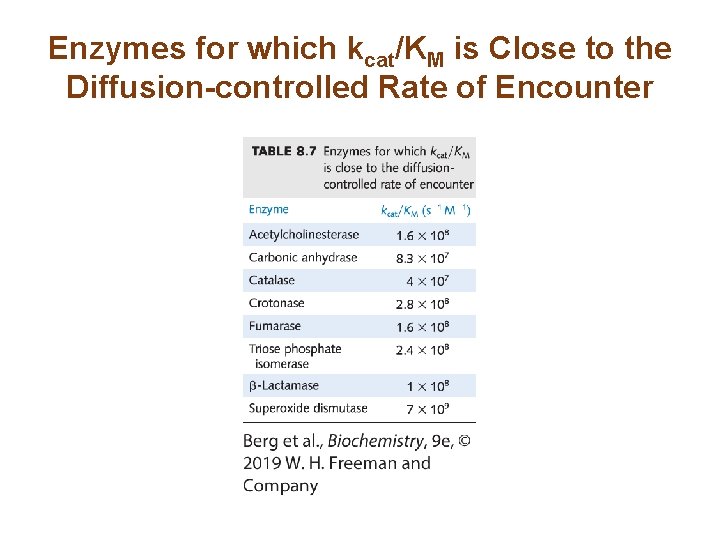
Enzymes for which kcat/KM is Close to the Diffusion-controlled Rate of Encounter
Most Biochemical Reactions Include Multiple Substrates • There are two classes of multiple substrate reactions: sequential and double-displacement reactions. • Sequential reactions, which may be random or ordered, are characterized by the formation of a ternary complex consisting of the enzyme and both substrates. • Double-displacement reactions are characterized by the formation of a substituted enzyme intermediate.
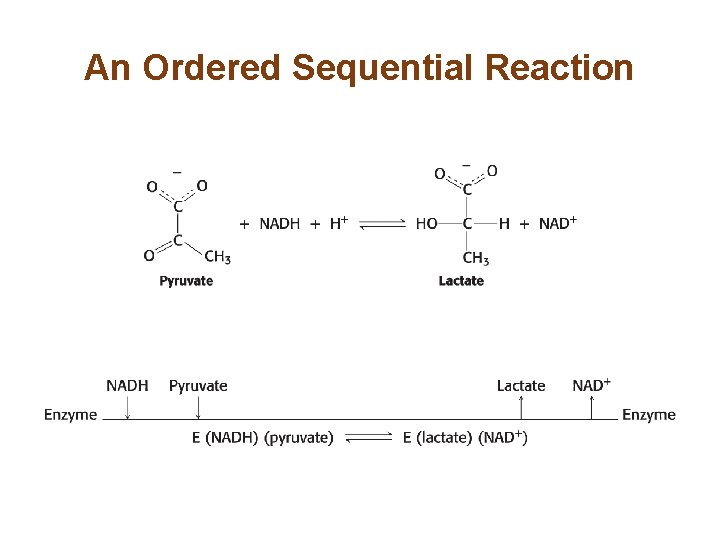
An Ordered Sequential Reaction
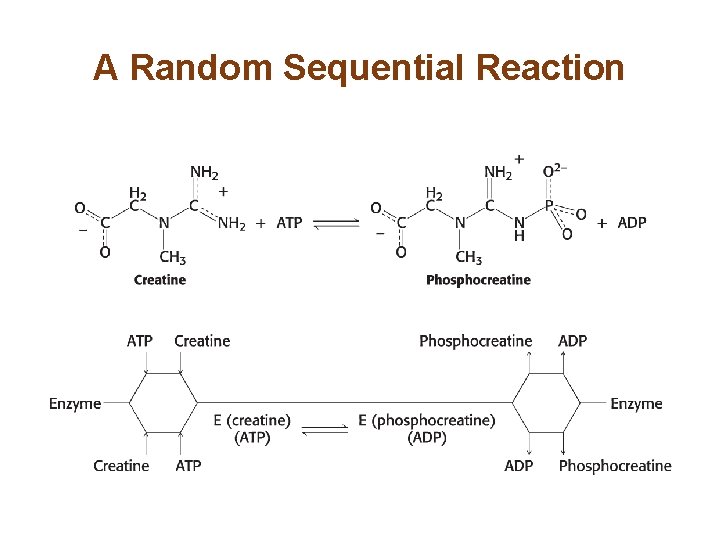
A Random Sequential Reaction
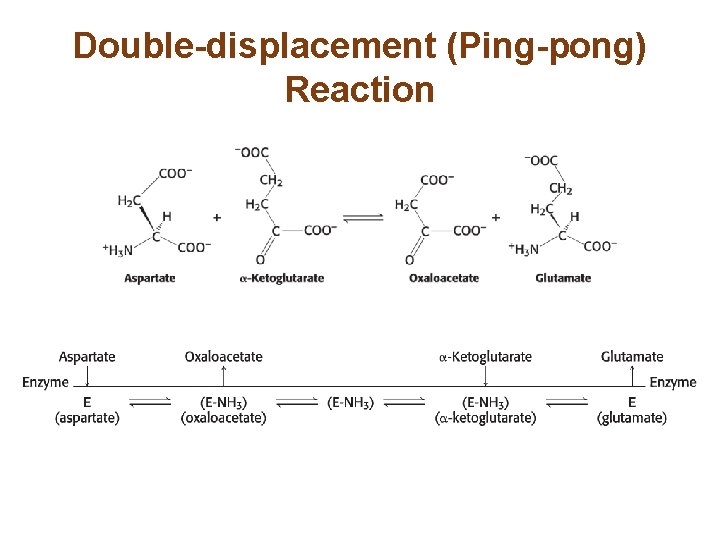
Double-displacement (Ping-pong) Reaction
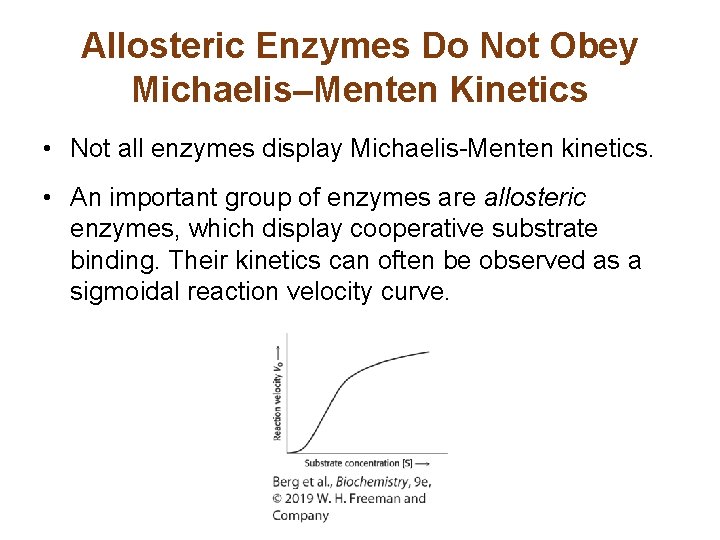
Allosteric Enzymes Do Not Obey Michaelis–Menten Kinetics • Not all enzymes display Michaelis-Menten kinetics. • An important group of enzymes are allosteric enzymes, which display cooperative substrate binding. Their kinetics can often be observed as a sigmoidal reaction velocity curve.
Section 8. 5 Enzymes Can Be Inhibited by Specific Molecules • Irreversible enzyme inhibitors bind covalently or noncovalently to the enzyme, but with a negligible dissociation constant. • Reversible inhibition is characterized by a rapid dissociation of the enzyme-inhibitor complex. • There are three common types of reversible inhibition: 1. Competitive inhibition: The inhibitor is structurally similar to the substrate and can bind to the active site, preventing the actual substrate from binding. 2. Uncompetitive inhibition: The inhibitor binds only to the enzyme -substrate complex in what is essentially substrate-dependent inhibition. 3. Noncompetitive inhibition: The inhibitor binds either the enzyme or enzyme-substrate complex.
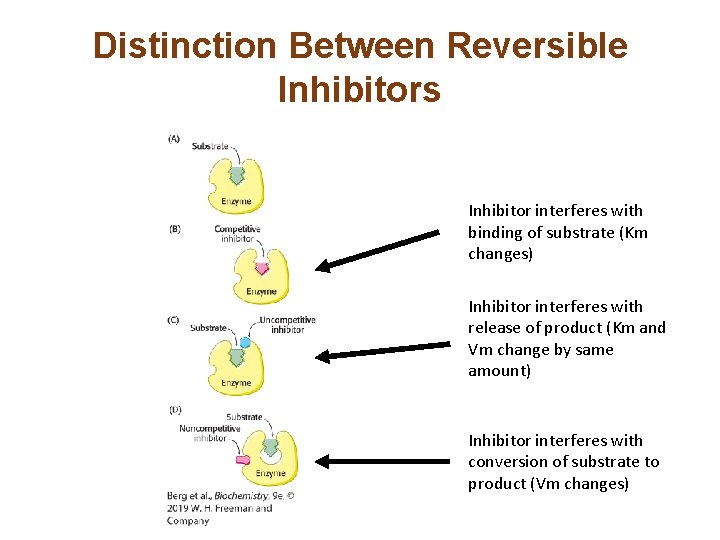
Distinction Between Reversible Inhibitors Inhibitor interferes with binding of substrate (Km changes) Inhibitor interferes with release of product (Km and Vm change by same amount) Inhibitor interferes with conversion of substrate to product (Vm changes)
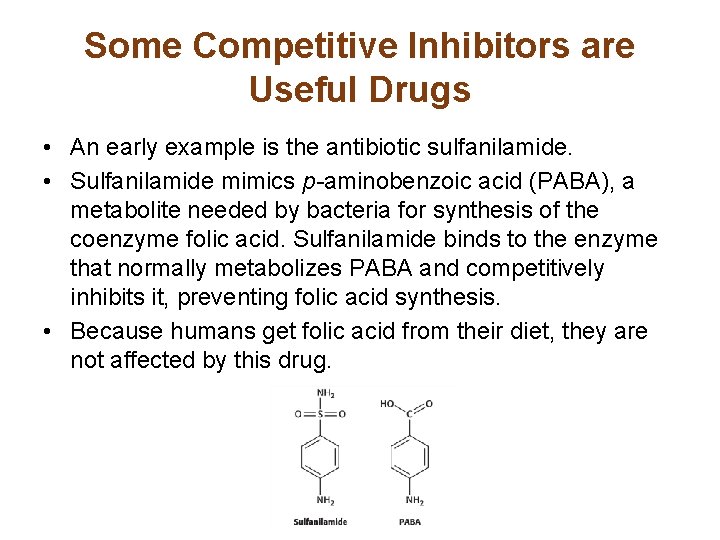
Some Competitive Inhibitors are Useful Drugs • An early example is the antibiotic sulfanilamide. • Sulfanilamide mimics p-aminobenzoic acid (PABA), a metabolite needed by bacteria for synthesis of the coenzyme folic acid. Sulfanilamide binds to the enzyme that normally metabolizes PABA and competitively inhibits it, preventing folic acid synthesis. • Because humans get folic acid from their diet, they are not affected by this drug.
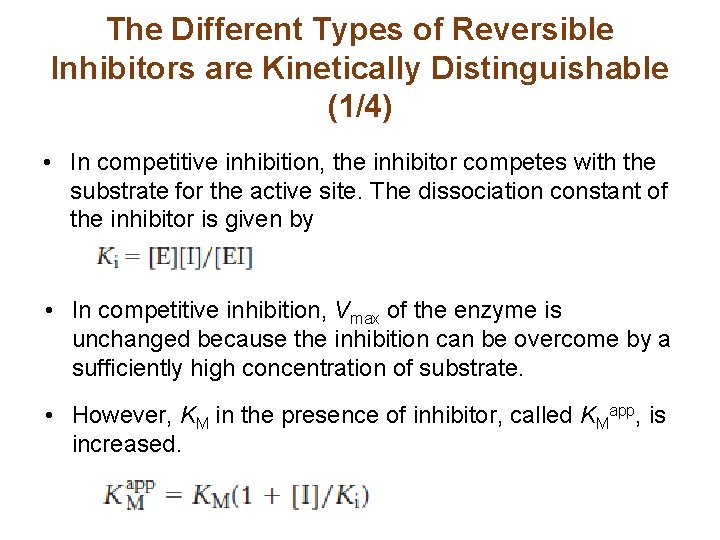
The Different Types of Reversible Inhibitors are Kinetically Distinguishable (1/4) • In competitive inhibition, the inhibitor competes with the substrate for the active site. The dissociation constant of the inhibitor is given by • In competitive inhibition, Vmax of the enzyme is unchanged because the inhibition can be overcome by a sufficiently high concentration of substrate. • However, KM in the presence of inhibitor, called KMapp, is increased.
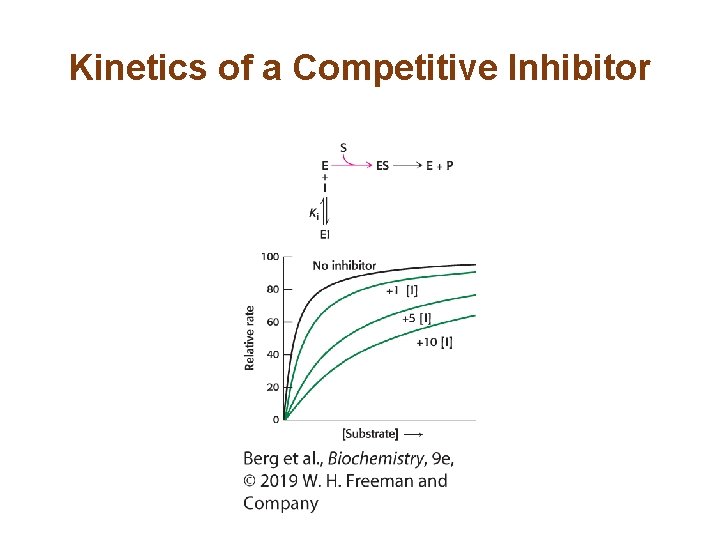
Kinetics of a Competitive Inhibitor
The Different Types of Reversible Inhibitors are Kinetically Distinguishable (2/4) • In uncompetitive inhibition, the enzyme-inhibitorsubstrate complex does not form product. The apparent Vmax, called Vmaxapp , is lower in the presence of inhibitor. • The KM is also lower. • Uncompetitive inhibition cannot be overcome by the addition of excess substrate.
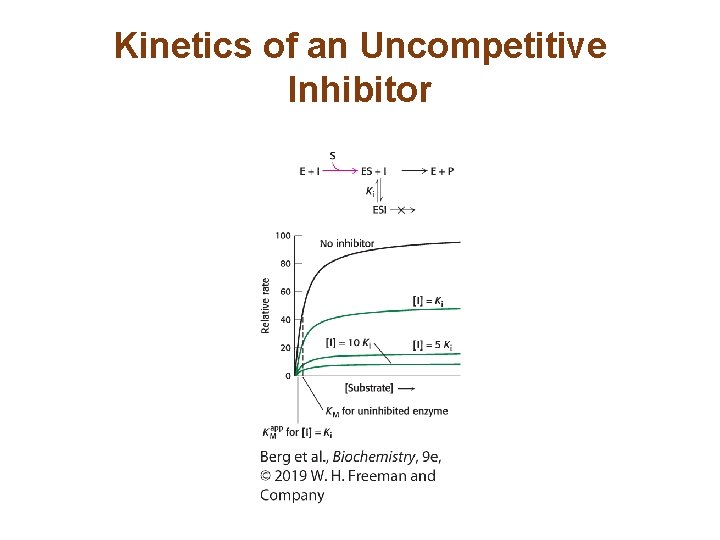
Kinetics of an Uncompetitive Inhibitor
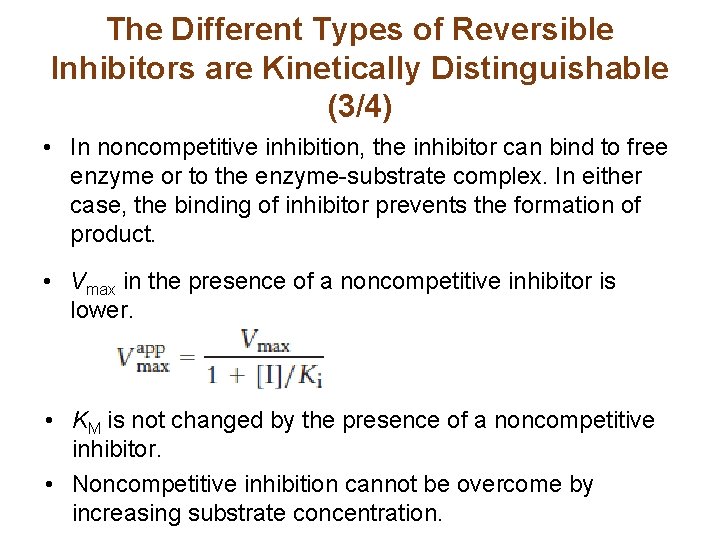
The Different Types of Reversible Inhibitors are Kinetically Distinguishable (3/4) • In noncompetitive inhibition, the inhibitor can bind to free enzyme or to the enzyme-substrate complex. In either case, the binding of inhibitor prevents the formation of product. • Vmax in the presence of a noncompetitive inhibitor is lower. • KM is not changed by the presence of a noncompetitive inhibitor. • Noncompetitive inhibition cannot be overcome by increasing substrate concentration.
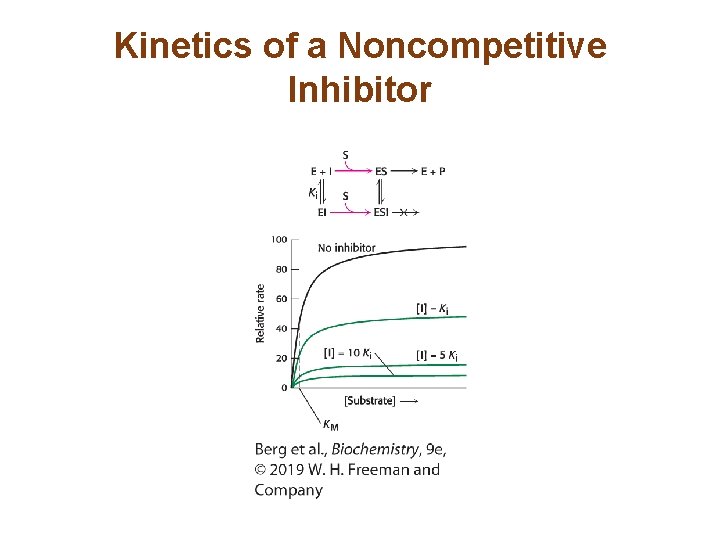
Kinetics of a Noncompetitive Inhibitor
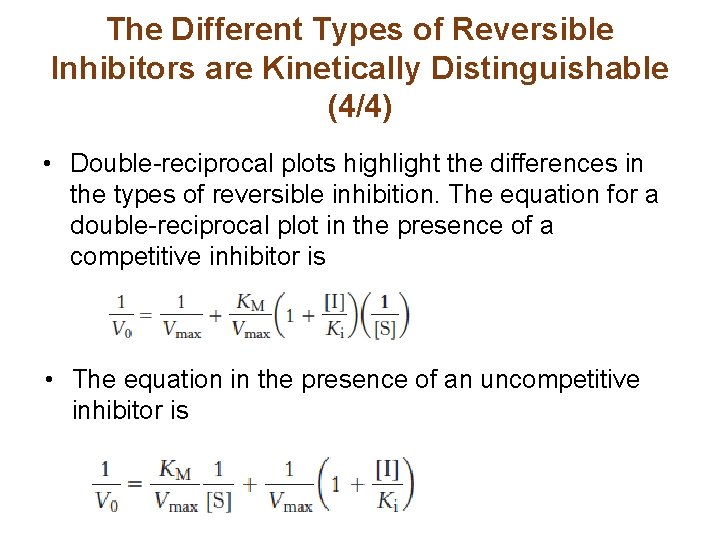
The Different Types of Reversible Inhibitors are Kinetically Distinguishable (4/4) • Double-reciprocal plots highlight the differences in the types of reversible inhibition. The equation for a double-reciprocal plot in the presence of a competitive inhibitor is • The equation in the presence of an uncompetitive inhibitor is
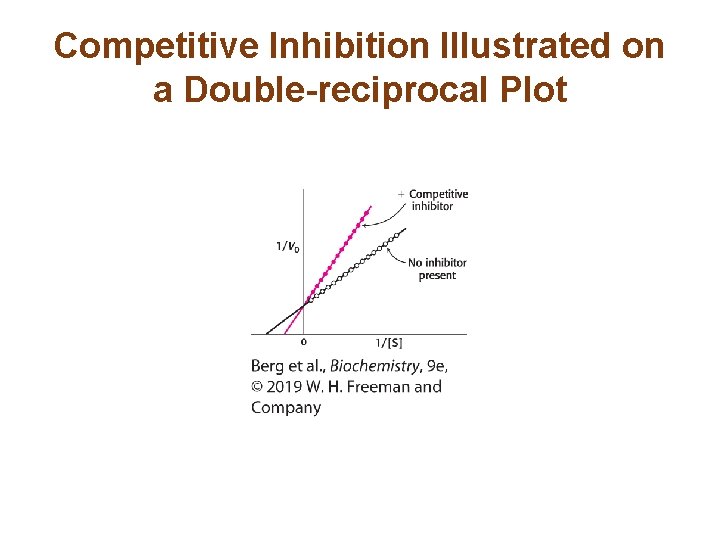
Competitive Inhibition Illustrated on a Double-reciprocal Plot
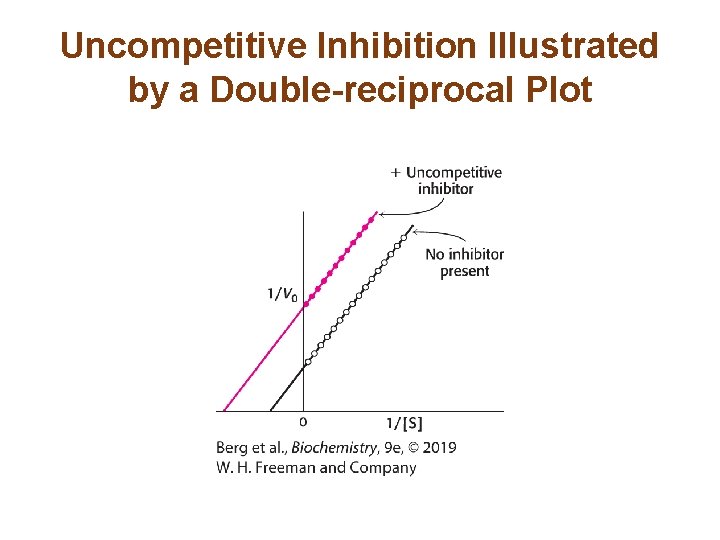
Uncompetitive Inhibition Illustrated by a Double-reciprocal Plot
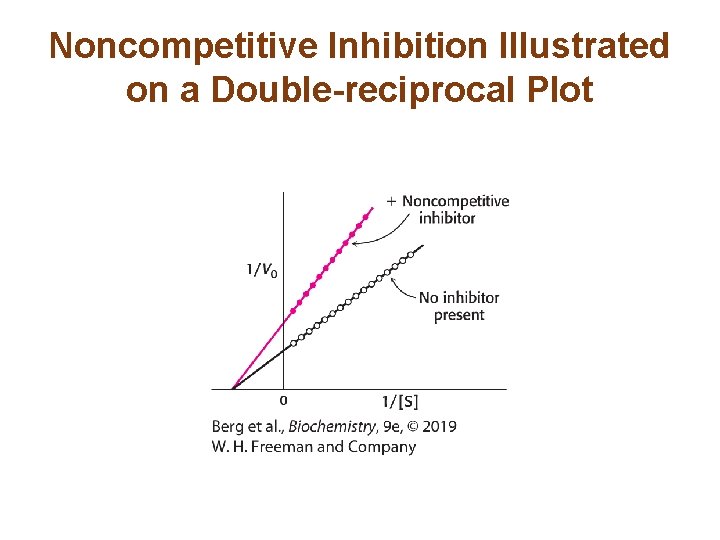
Noncompetitive Inhibition Illustrated on a Double-reciprocal Plot
- Slides: 76