
Chapter 8 Energy Expenditure During Rest and Physical
- Slides: 26
Chapter 8 Energy Expenditure During Rest and Physical Activity Copyright © 2011 Wolters Kluwer Health | Lippincott Williams & Wilkins
Objectives • Define the basal metabolic rate, and indicate factors that affect it. • Explain the effect of body weight on the energy cost of different forms of physical activity. • Identify the factors that contribute to the total daily energy expenditure. • Outline the different classification systems for rating the strenuousness of physical activity. • Describe two means to predict resting daily energy expenditure. • Explain the concepts of exercise efficiency and exercise economy. • List factors that affect the energy cost of walking and running. • Identify the factors that contribute to the lower exercise economy of swimming compared with running. Copyright © 2011 Wolters Kluwer Health | Lippincott Williams & Wilkins
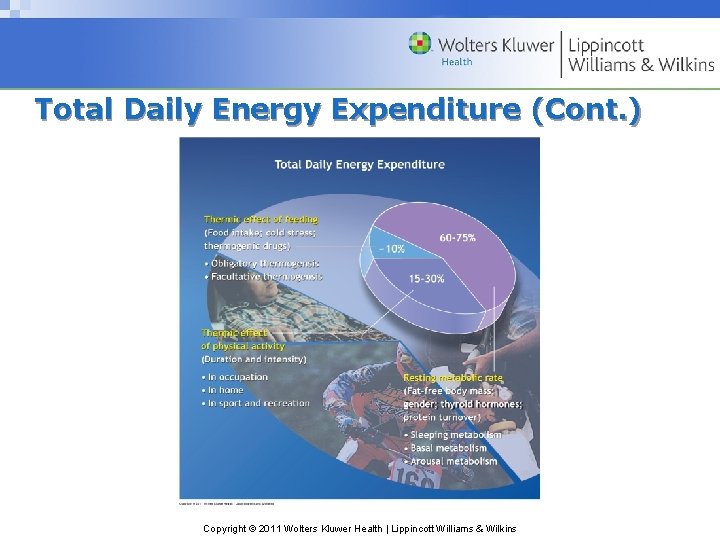
Total Daily Energy Expenditure • Determined by: – Resting metabolic rate – Thermogenic influence of consumed food – Energy expended during physical activity and recovery Copyright © 2011 Wolters Kluwer Health | Lippincott Williams & Wilkins
Total Daily Energy Expenditure (Cont. ) Copyright © 2011 Wolters Kluwer Health | Lippincott Williams & Wilkins
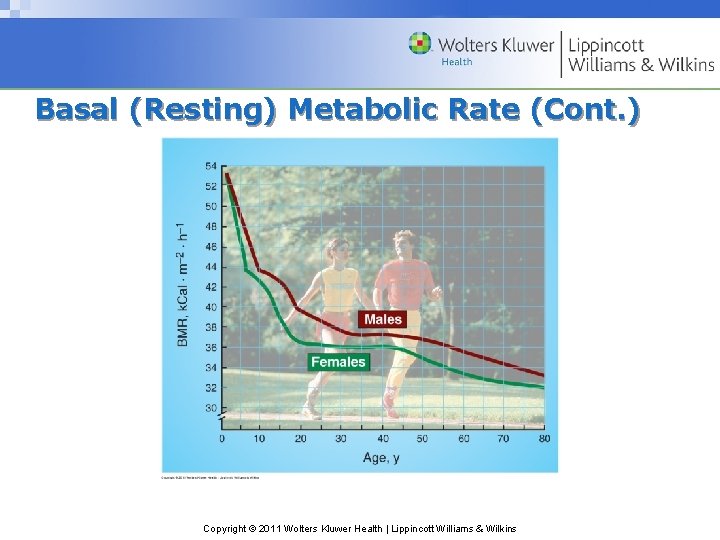
Basal (Resting) Metabolic Rate • For each individual, a minimum energy requirement sustains the body’s functions in the waking state. • Body surface area frequently provides a common denominator for expressing basal metabolism. • BMR averages 5% to 10% lower in females compared with males at all ages. Copyright © 2011 Wolters Kluwer Health | Lippincott Williams & Wilkins
Basal (Resting) Metabolic Rate (Cont. ) Copyright © 2011 Wolters Kluwer Health | Lippincott Williams & Wilkins
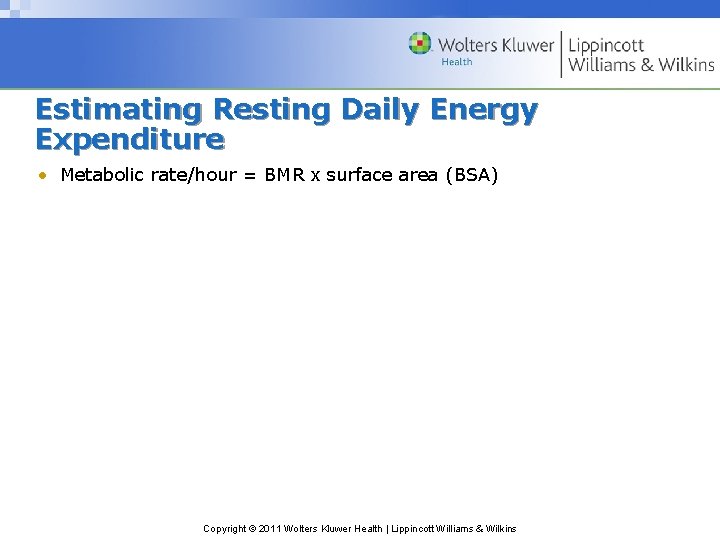
Estimating Resting Daily Energy Expenditure • Metabolic rate/hour = BMR x surface area (BSA) Copyright © 2011 Wolters Kluwer Health | Lippincott Williams & Wilkins
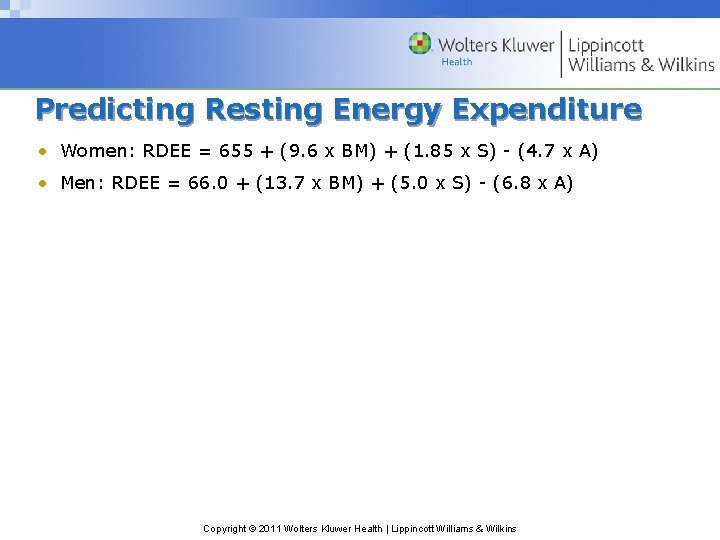
Predicting Resting Energy Expenditure • Women: RDEE = 655 + (9. 6 x BM) + (1. 85 x S) - (4. 7 x A) • Men: RDEE = 66. 0 + (13. 7 x BM) + (5. 0 x S) - (6. 8 x A) Copyright © 2011 Wolters Kluwer Health | Lippincott Williams & Wilkins
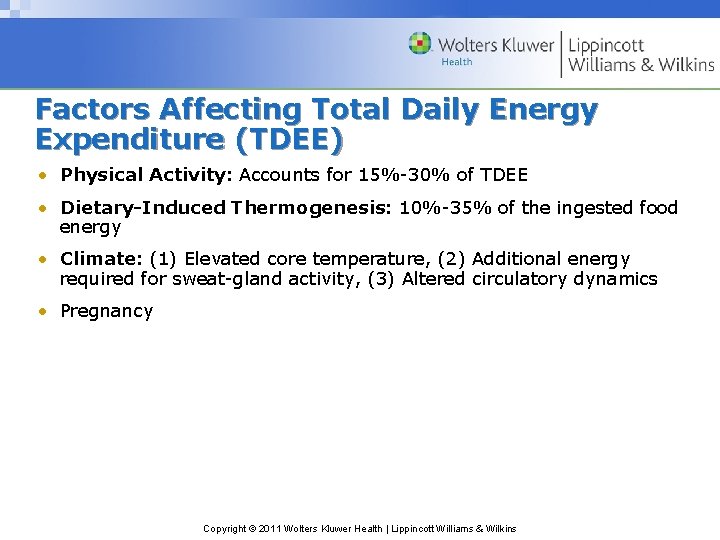
Factors Affecting Total Daily Energy Expenditure (TDEE) • Physical Activity: Accounts for 15%-30% of TDEE • Dietary-Induced Thermogenesis: 10%-35% of the ingested food energy • Climate: (1) Elevated core temperature, (2) Additional energy required for sweat-gland activity, (3) Altered circulatory dynamics • Pregnancy Copyright © 2011 Wolters Kluwer Health | Lippincott Williams & Wilkins
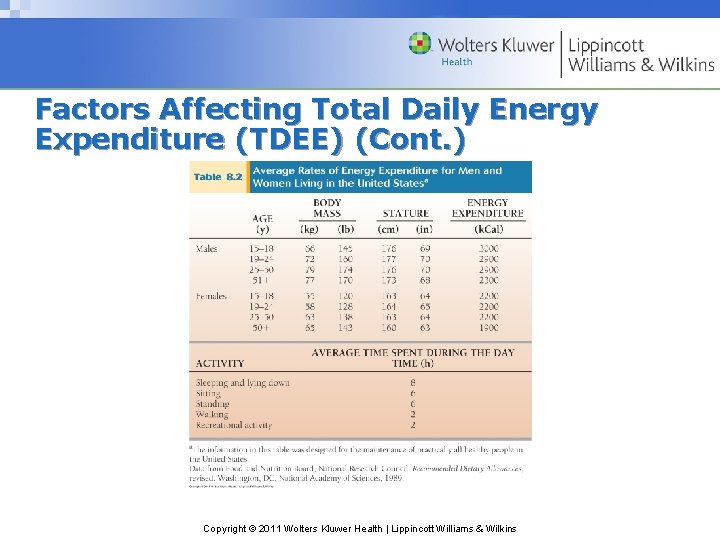
Factors Affecting Total Daily Energy Expenditure (TDEE) (Cont. ) Copyright © 2011 Wolters Kluwer Health | Lippincott Williams & Wilkins
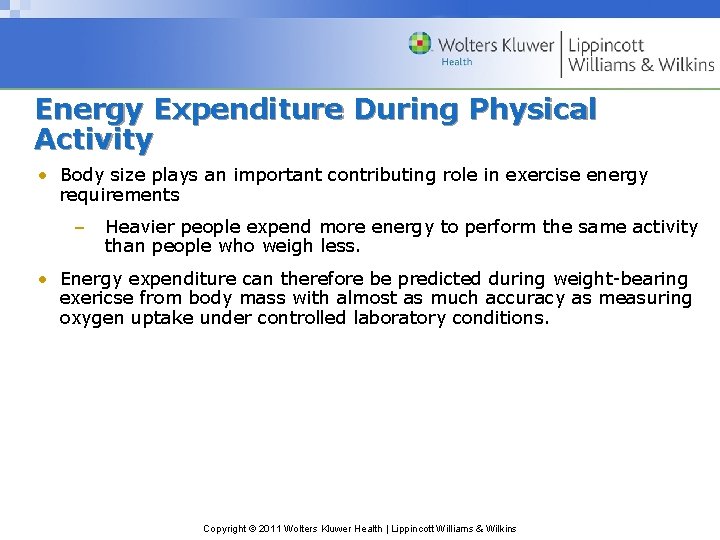
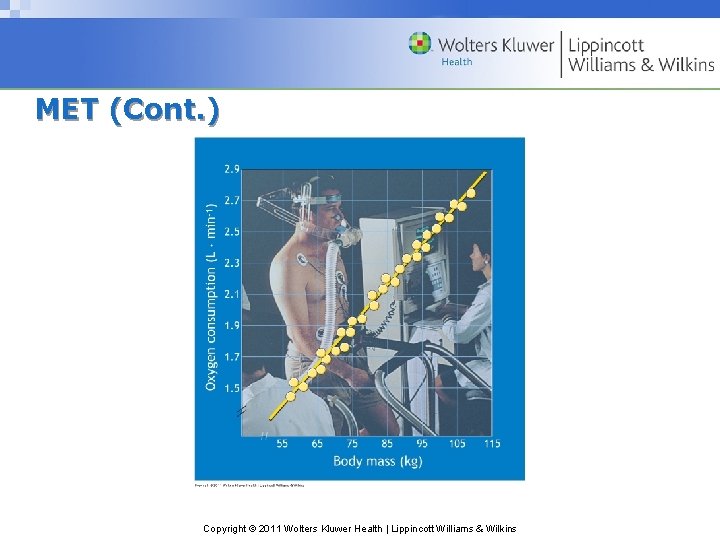
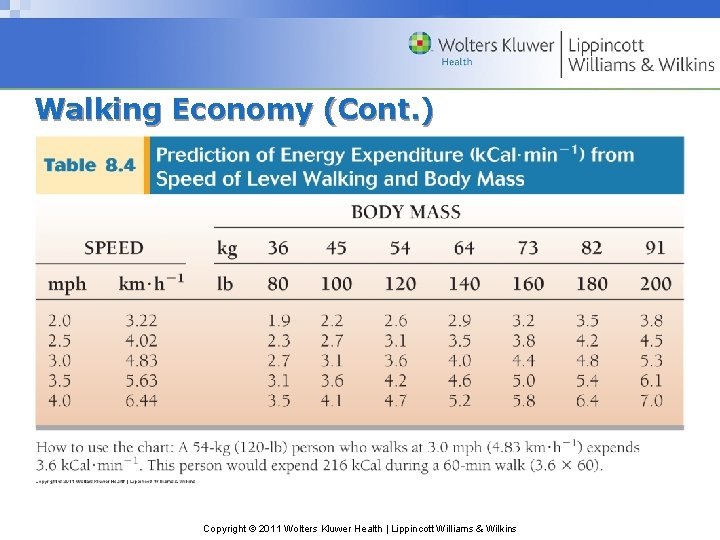
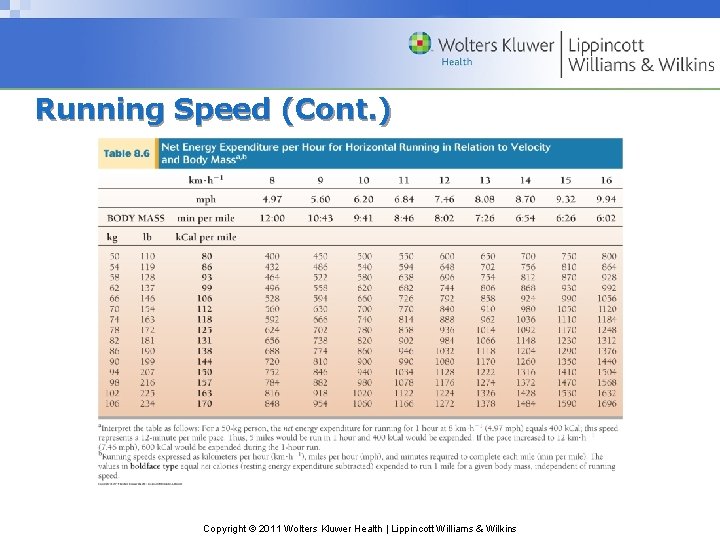
Energy Expenditure During Physical Activity • Body size plays an important contributing role in exercise energy requirements – Heavier people expend more energy to perform the same activity than people who weigh less. • Energy expenditure can therefore be predicted during weight-bearing exericse from body mass with almost as much accuracy as measuring oxygen uptake under controlled laboratory conditions. Copyright © 2011 Wolters Kluwer Health | Lippincott Williams & Wilkins
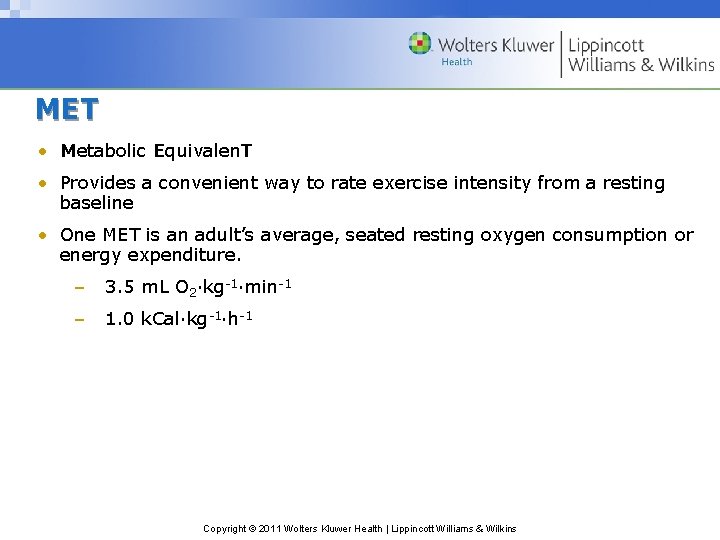
MET • Metabolic Equivalen. T • Provides a convenient way to rate exercise intensity from a resting baseline • One MET is an adult’s average, seated resting oxygen consumption or energy expenditure. – 3. 5 m. L O 2·kg-1·min-1 – 1. 0 k. Cal·kg-1·h-1 Copyright © 2011 Wolters Kluwer Health | Lippincott Williams & Wilkins
MET (Cont. ) Copyright © 2011 Wolters Kluwer Health | Lippincott Williams & Wilkins
Efficiency of Energy Use • Mechanical Efficiency: % of total chemical energy expended that contributes to external work output – Most affected by energy needed to overcome friction • Gross Mechanical Efficiency: The total oxygen uptake during the exercise • Net Mechanical Efficiency: Resting energy expenditure subtracted from total energy expended during exercise • Delta Efficiency: Ratio of the difference between work output at two levels of work output to the difference in energy expenditure determined for the two levels of work output Copyright © 2011 Wolters Kluwer Health | Lippincott Williams & Wilkins
Factors Influencing Exercise Efficiency • Work rate: As work rate increases, efficiency decreases. • Movement speed: Any deviation from the optimal movement speed decreases efficiency. • Extrinsic factors: Improvements in equipment design have increased efficiency in many physical activities. • Muscle fiber composition: Work done by slow-twitch muscle fibers is more efficient than the same work done by fast-twitch fibers. • Fitness level: More fit individuals perform a given task at a higher efficiency. • Body composition: Fatter individuals perform a given exercise task at a lower efficiency. • Technique: Improved technique produces fewer extraneous body movements, resulting in a lower energy expenditure, and hence higher efficiency. Copyright © 2011 Wolters Kluwer Health | Lippincott Williams & Wilkins
Economy of Movement • The quantity of energy to perform a particular task relative to performance quality • Can be assessed by measuring the steady-rate oxygen uptake during a specific exercise at a set power output or speed – At a given submaximum speed of running, cycling, or swimming, an individual with greater movement economy consumes less oxygen • All else being equal, a training adjustment that improves economy of effort directly translates to improved exercise performance Copyright © 2011 Wolters Kluwer Health | Lippincott Williams & Wilkins
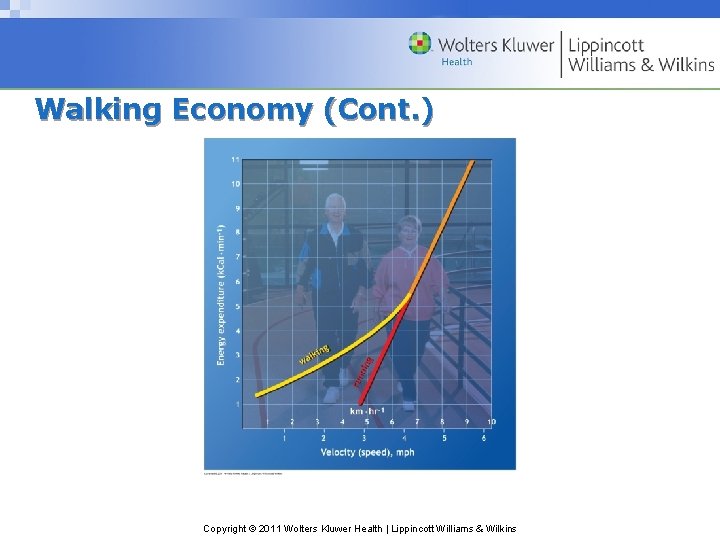
Walking Economy • A curvilinear relationship exists between energy expenditure versus walking at slow and fast speeds. – A linear relationship exists between walking speeds of 3. 0 -5. 0 km·h-1 (1. 9 to 3. 1 mph) and oxygen uptake. – At faster speeds, walking becomes less economical so the relationship curves upward to indicate a disproportionate increase in energy cost related to walking speed. – The crossover velocity is ~6. 5 km·h-1 (4. 0 mph) at which running becomes more economical than walking. Copyright © 2011 Wolters Kluwer Health | Lippincott Williams & Wilkins
Walking Economy (Cont. ) Copyright © 2011 Wolters Kluwer Health | Lippincott Williams & Wilkins
Walking Economy (Cont. ) Copyright © 2011 Wolters Kluwer Health | Lippincott Williams & Wilkins
Walking Surface and Footwear Effects • Walking Surface – Similar economies exist for level walking on a grass track or paved surface. – Energy cost almost doubles walking in sand, and is 3 -fold when walking on soft snow. • Footwear – More energy is needed to carry added weight on the feet or ankles than to carry similar weight attached to the torso. – Ankle weights increase the energy cost of walking to values usually observed for running. Copyright © 2011 Wolters Kluwer Health | Lippincott Williams & Wilkins
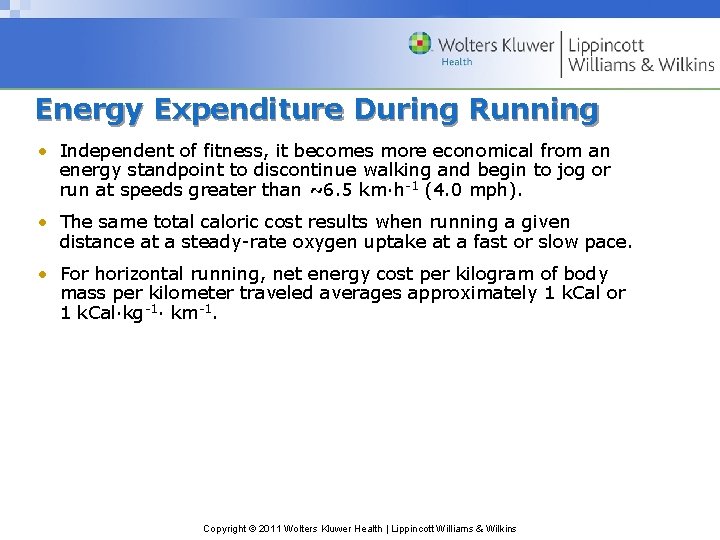
Energy Expenditure During Running • Independent of fitness, it becomes more economical from an energy standpoint to discontinue walking and begin to jog or run at speeds greater than ~6. 5 km·h-1 (4. 0 mph). • The same total caloric cost results when running a given distance at a steady-rate oxygen uptake at a fast or slow pace. • For horizontal running, net energy cost per kilogram of body mass per kilometer traveled averages approximately 1 k. Cal or 1 k. Cal·kg-1· km-1. Copyright © 2011 Wolters Kluwer Health | Lippincott Williams & Wilkins
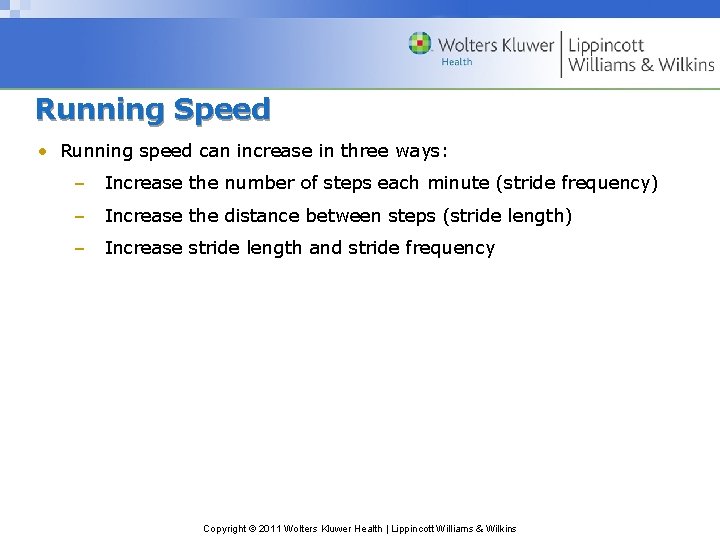
Running Speed • Running speed can increase in three ways: – Increase the number of steps each minute (stride frequency) – Increase the distance between steps (stride length) – Increase stride length and stride frequency Copyright © 2011 Wolters Kluwer Health | Lippincott Williams & Wilkins
Running Speed (Cont. ) Copyright © 2011 Wolters Kluwer Health | Lippincott Williams & Wilkins
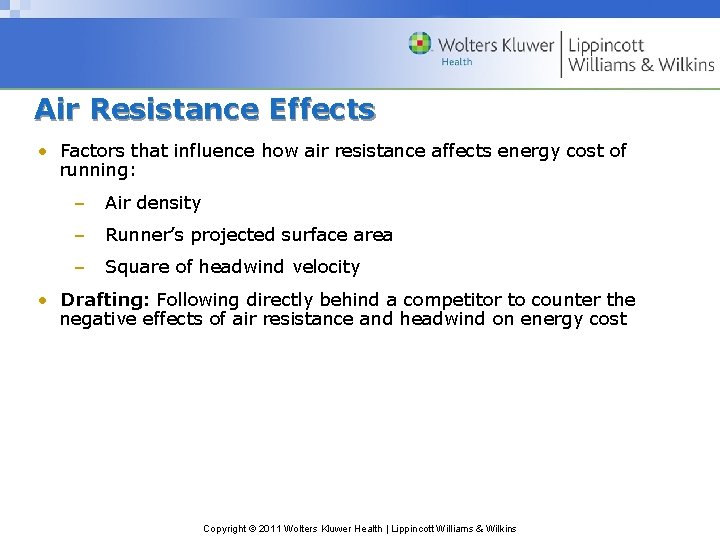
Air Resistance Effects • Factors that influence how air resistance affects energy cost of running: – Air density – Runner’s projected surface area – Square of headwind velocity • Drafting: Following directly behind a competitor to counter the negative effects of air resistance and headwind on energy cost Copyright © 2011 Wolters Kluwer Health | Lippincott Williams & Wilkins
Energy Expenditure During Swimming • Swimmers’ energy expenditure differs from walking and running in the following ways: – Energy to maintain buoyancy while generating horizontal movement at the same time using the arms and legs, either in combination or separately – Energy needed to overcome drag forces that impede the movement of an object through a water medium • These factors all contribute to a considerably lower economy swimming compared with running. – Requires 4 x more energy to swim a given distance than to run the same distance Copyright © 2011 Wolters Kluwer Health | Lippincott Williams & Wilkins
Energy Cost and Drag • Three components comprise the total drag force that impedes a swimmer’s forward movement: – Wave drag – Skin friction drag – Viscous pressure drag Copyright © 2011 Wolters Kluwer Health | Lippincott Williams & Wilkins