
Chapter 8 Electronics Fundamentals Circuits Devices and Applications
- Slides: 72
Chapter 8 Electronics Fundamentals Circuits, Devices and Applications - Floyd © Copyright 2007 Prentice-Hall
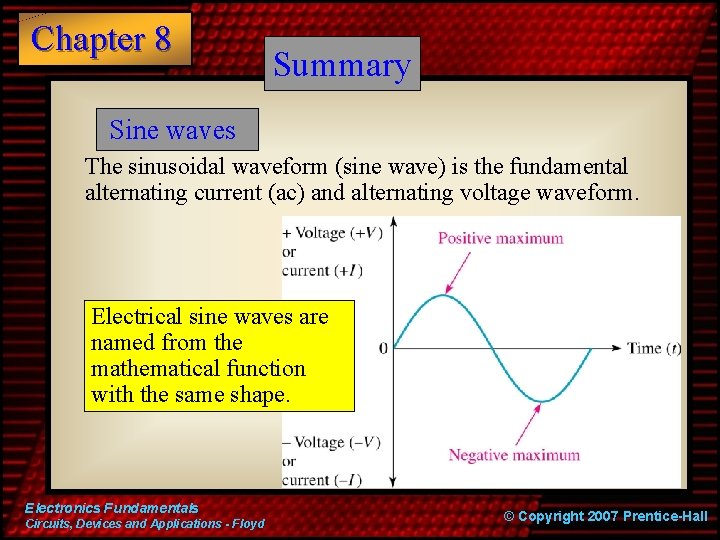
Chapter 8 Summary Sine waves The sinusoidal waveform (sine wave) is the fundamental alternating current (ac) and alternating voltage waveform. Electrical sine waves are named from the mathematical function with the same shape. Electronics Fundamentals Circuits, Devices and Applications - Floyd © Copyright 2007 Prentice-Hall
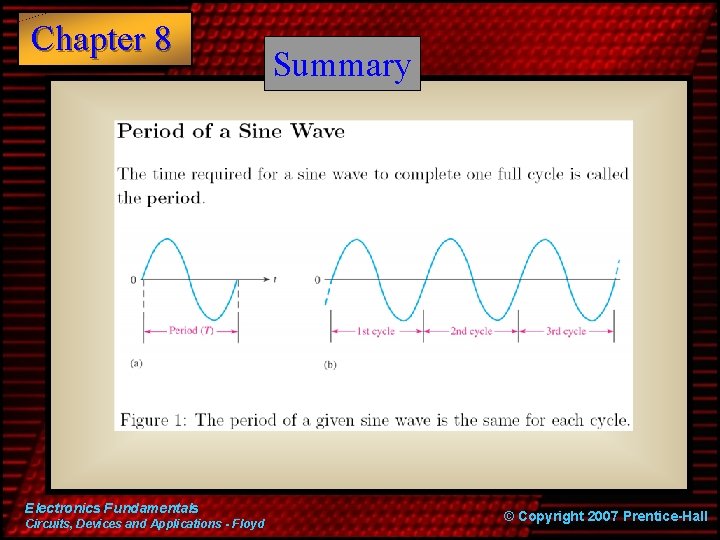
Chapter 8 Electronics Fundamentals Circuits, Devices and Applications - Floyd Summary © Copyright 2007 Prentice-Hall
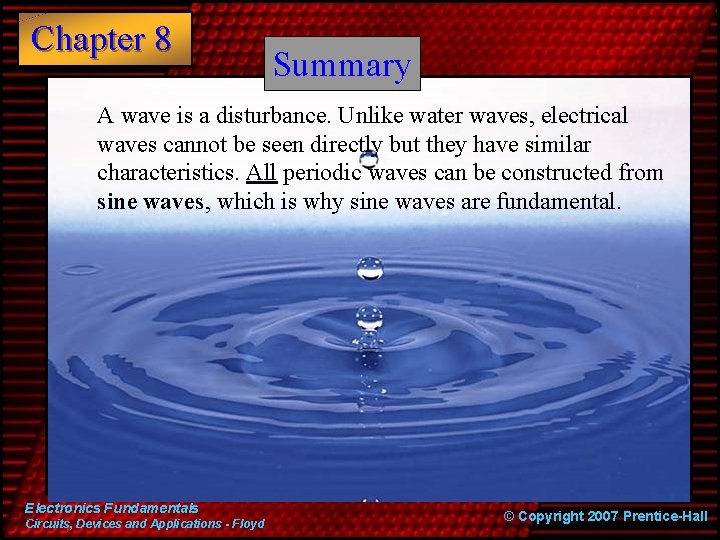
Chapter 8 Summary A wave is a disturbance. Unlike water waves, electrical waves cannot be seen directly but they have similar characteristics. All periodic waves can be constructed from sine waves, which is why sine waves are fundamental. Electronics Fundamentals Circuits, Devices and Applications - Floyd © Copyright 2007 Prentice-Hall
Chapter 8 Electronics Fundamentals Circuits, Devices and Applications - Floyd Summary © Copyright 2007 Prentice-Hall
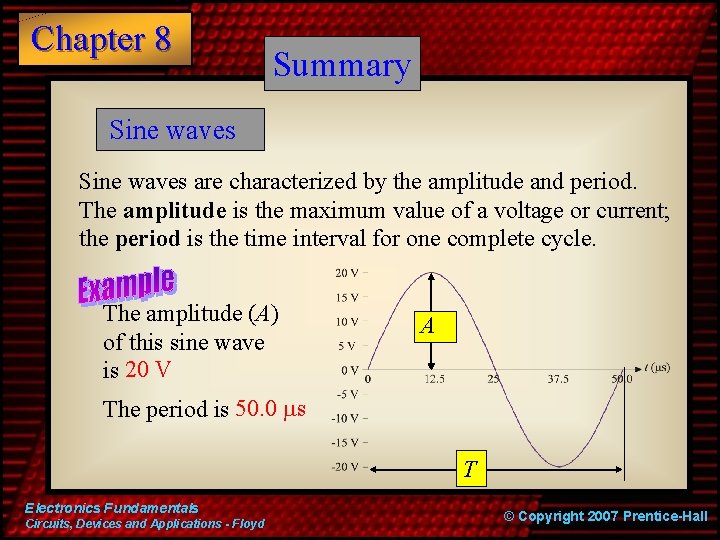
Chapter 8 Summary Sine waves are characterized by the amplitude and period. The amplitude is the maximum value of a voltage or current; the period is the time interval for one complete cycle. The amplitude (A) of this sine wave is 20 V A The period is 50. 0 ms T Electronics Fundamentals Circuits, Devices and Applications - Floyd © Copyright 2007 Prentice-Hall
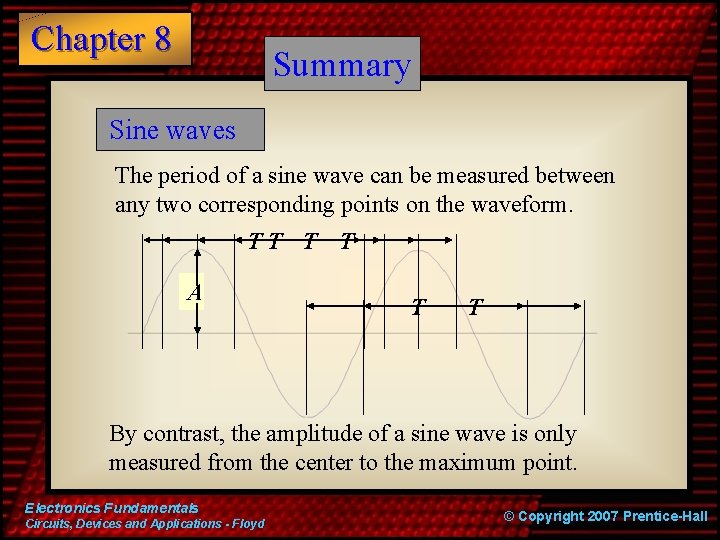
Chapter 8 Summary Sine waves The period of a sine wave can be measured between any two corresponding points on the waveform. TT T T A T T By contrast, the amplitude of a sine wave is only measured from the center to the maximum point. Electronics Fundamentals Circuits, Devices and Applications - Floyd © Copyright 2007 Prentice-Hall
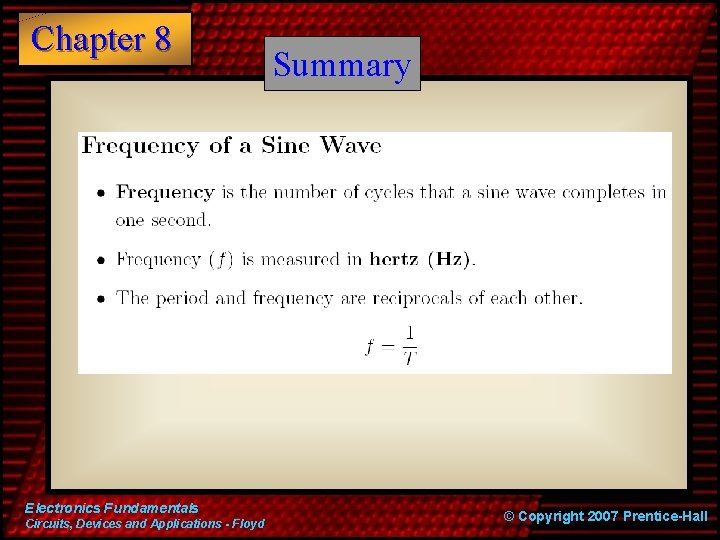
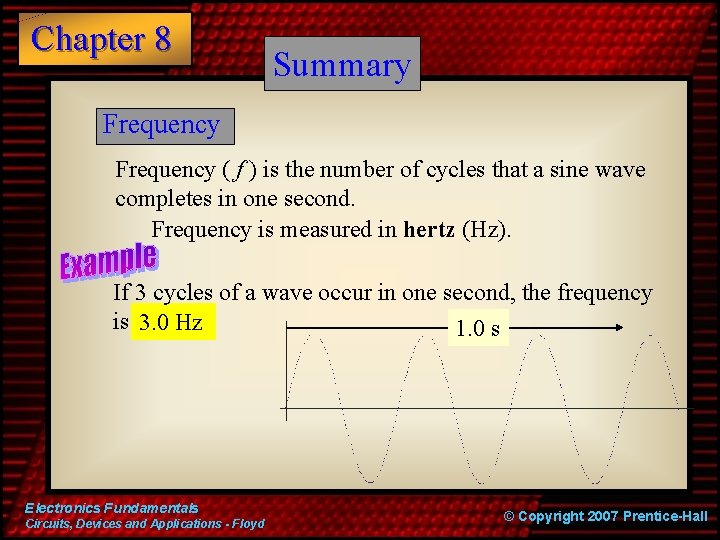
Chapter 8 Summary Frequency ( f ) is the number of cycles that a sine wave completes in one second. Frequency is measured in hertz (Hz). If 3 cycles of a wave occur in one second, the frequency is 3. 0 Hz 1. 0 s Electronics Fundamentals Circuits, Devices and Applications - Floyd © Copyright 2007 Prentice-Hall
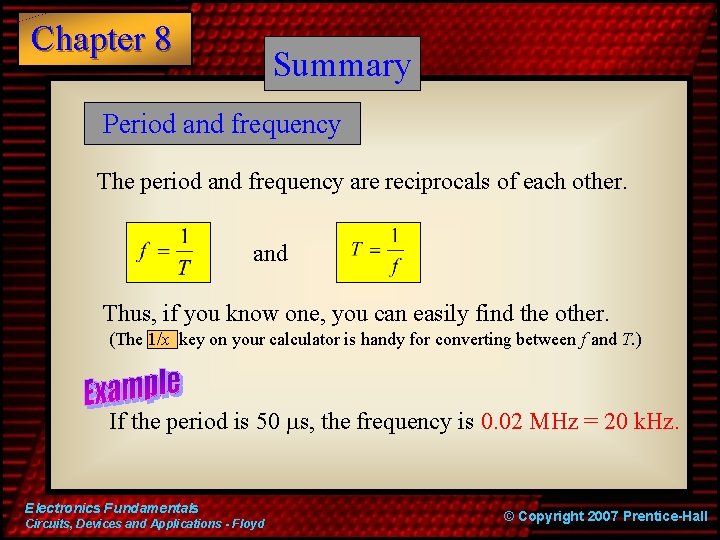
Chapter 8 Summary Period and frequency The period and frequency are reciprocals of each other. and Thus, if you know one, you can easily find the other. (The 1/x key on your calculator is handy for converting between f and T. ) If the period is 50 ms, the frequency is 0. 02 MHz = 20 k. Hz. Electronics Fundamentals Circuits, Devices and Applications - Floyd © Copyright 2007 Prentice-Hall
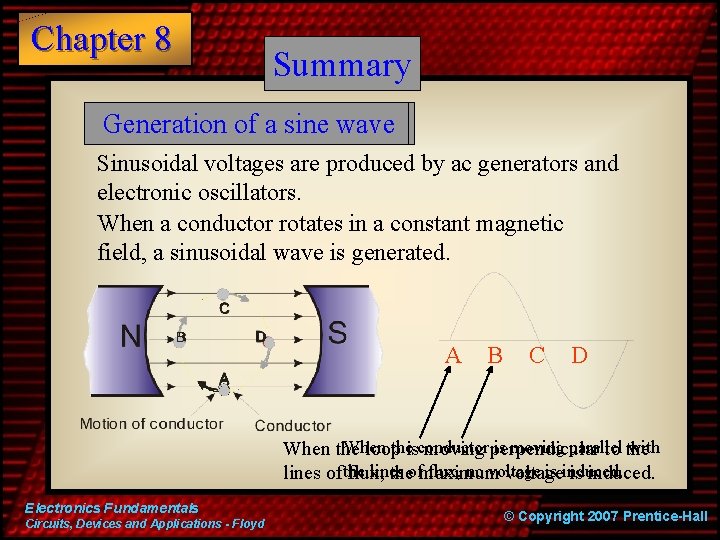
Chapter 8 Summary Sinusoidal voltage Generation of a sinesources wave Sinusoidal voltages are produced by ac generators and electronic oscillators. When a conductor rotates in a constant magnetic field, a sinusoidal wave is generated. A B C D When theisconductor is moving parallel with When the loop moving perpendicular to the lines flux, no voltage is induced. lines of the flux, theofmaximum voltage is induced. Electronics Fundamentals Circuits, Devices and Applications - Floyd © Copyright 2007 Prentice-Hall
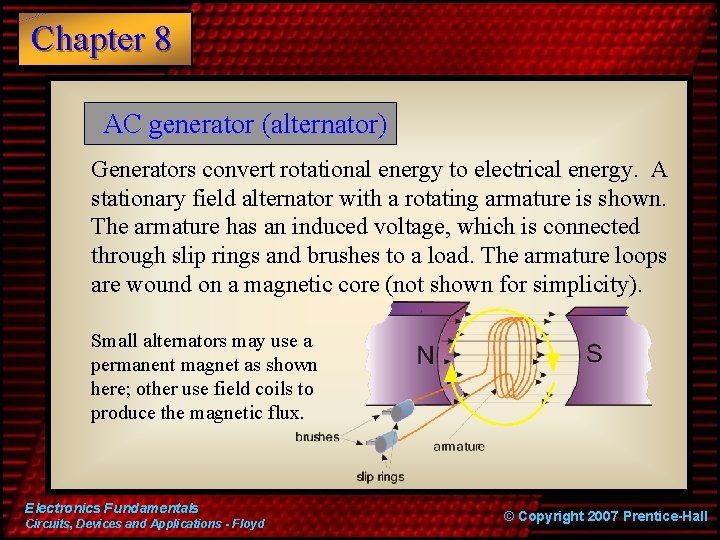
Chapter 8 AC generator (alternator) Generators convert rotational energy to electrical energy. A stationary field alternator with a rotating armature is shown. The armature has an induced voltage, which is connected through slip rings and brushes to a load. The armature loops are wound on a magnetic core (not shown for simplicity). Small alternators may use a permanent magnet as shown here; other use field coils to produce the magnetic flux. Electronics Fundamentals Circuits, Devices and Applications - Floyd © Copyright 2007 Prentice-Hall
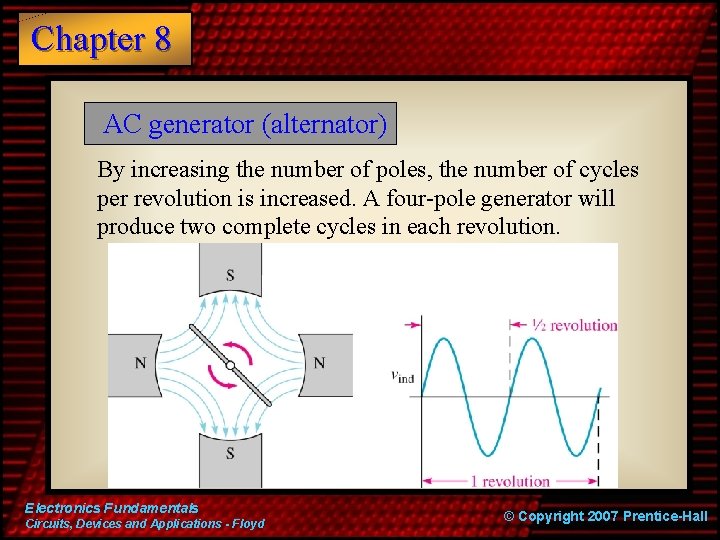
Chapter 8 AC generator (alternator) By increasing the number of poles, the number of cycles per revolution is increased. A four-pole generator will produce two complete cycles in each revolution. Electronics Fundamentals Circuits, Devices and Applications - Floyd © Copyright 2007 Prentice-Hall
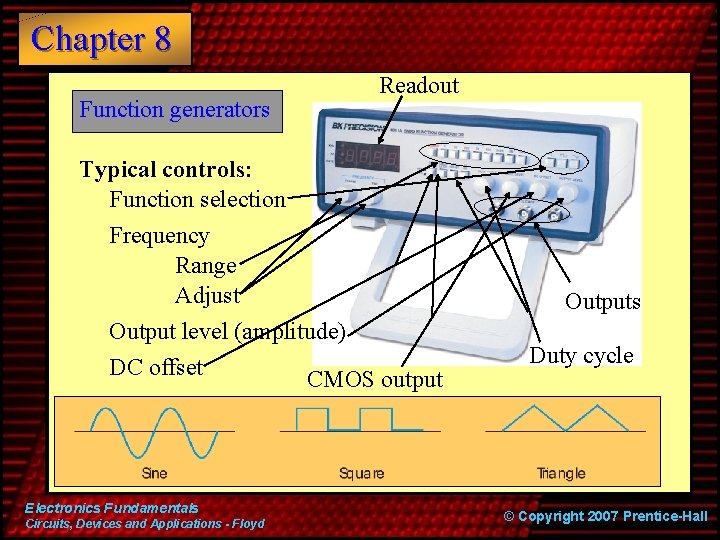
Chapter 8 Function generators Readout Typical controls: Function selection Frequency Range Adjust Output level (amplitude) DC offset CMOS output Electronics Fundamentals Circuits, Devices and Applications - Floyd Outputs Duty cycle © Copyright 2007 Prentice-Hall
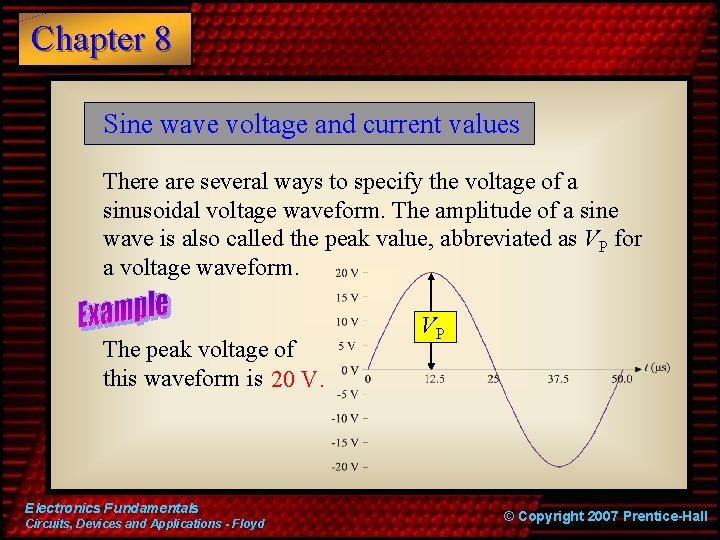
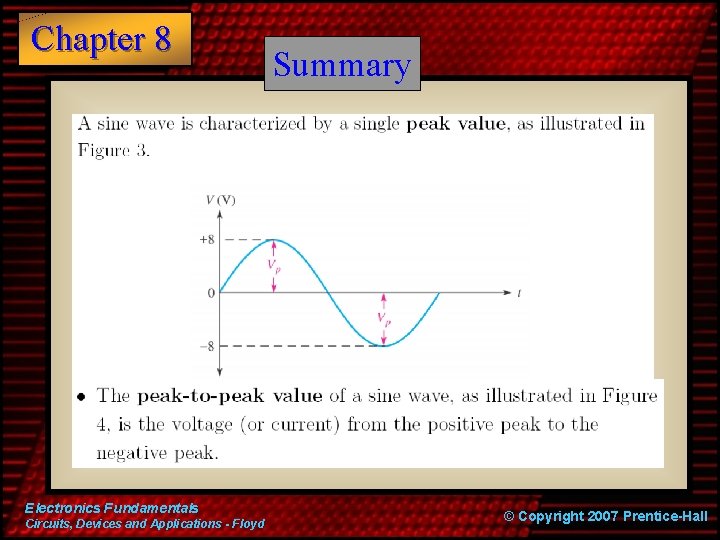
Chapter 8 Sine wave voltage and current values There are several ways to specify the voltage of a sinusoidal voltage waveform. The amplitude of a sine wave is also called the peak value, abbreviated as VP for a voltage waveform. The peak voltage of this waveform is 20 V. Electronics Fundamentals Circuits, Devices and Applications - Floyd VP © Copyright 2007 Prentice-Hall
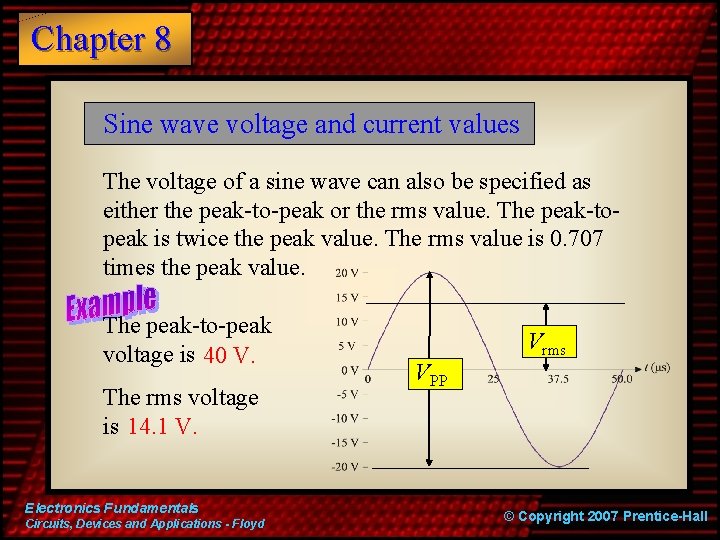
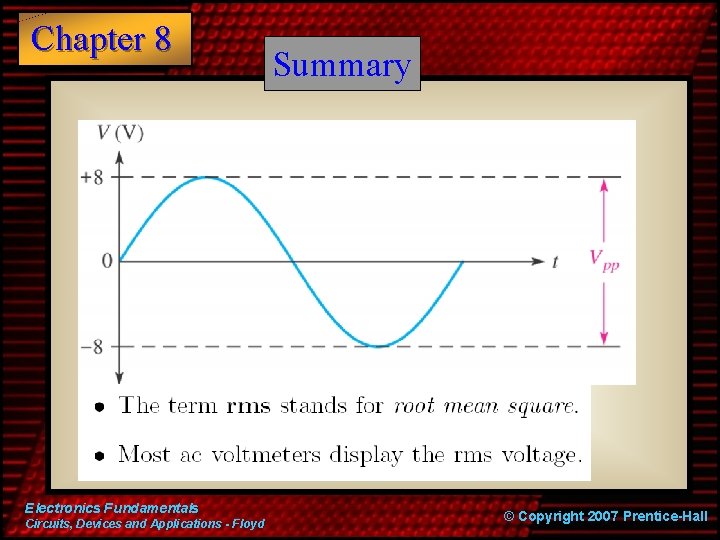
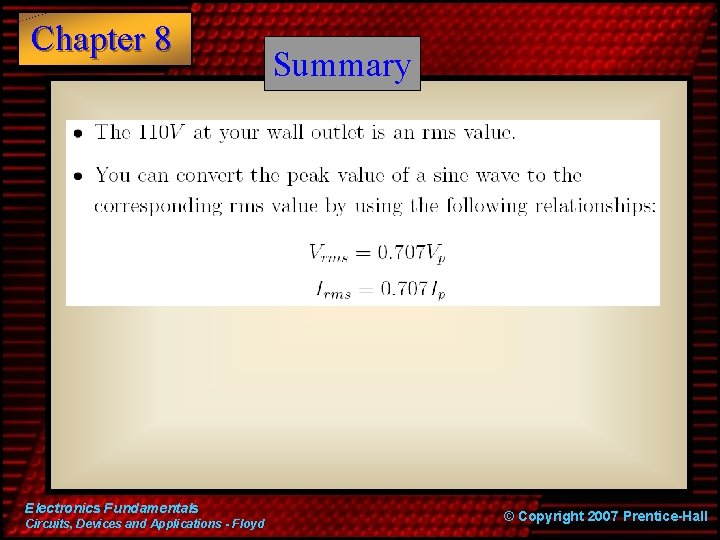
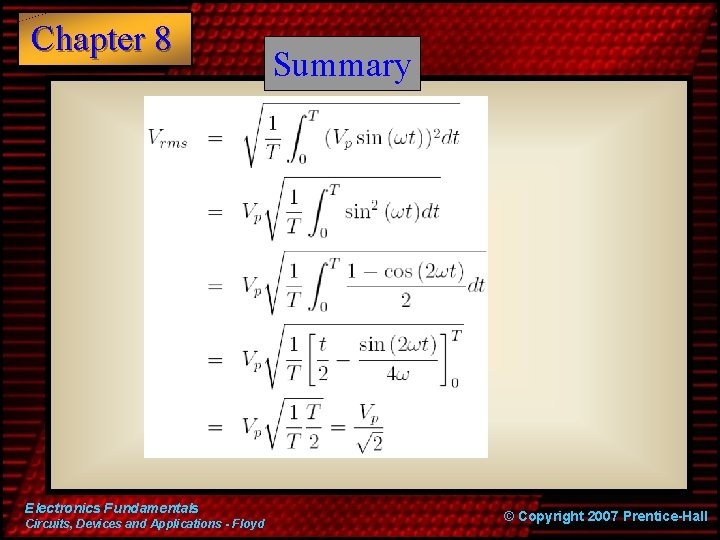
Chapter 8 Sine wave voltage and current values The voltage of a sine wave can also be specified as either the peak-to-peak or the rms value. The peak-topeak is twice the peak value. The rms value is 0. 707 times the peak value. The peak-to-peak voltage is 40 V. The rms voltage is 14. 1 V. Electronics Fundamentals Circuits, Devices and Applications - Floyd Vrms VPP © Copyright 2007 Prentice-Hall
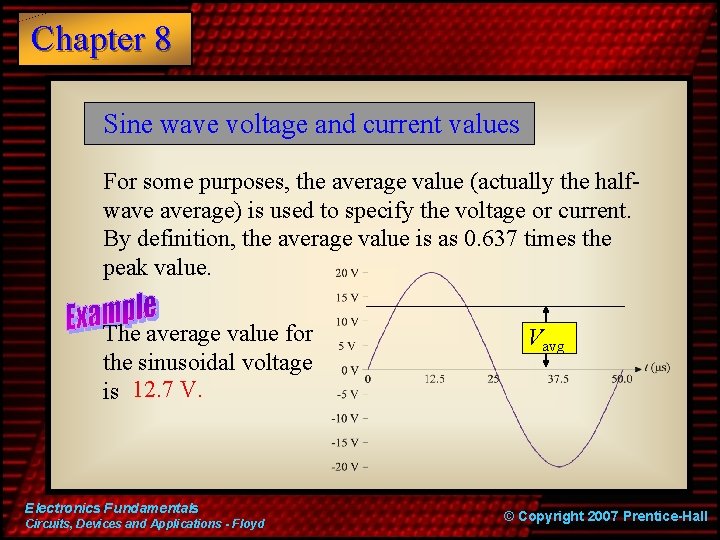
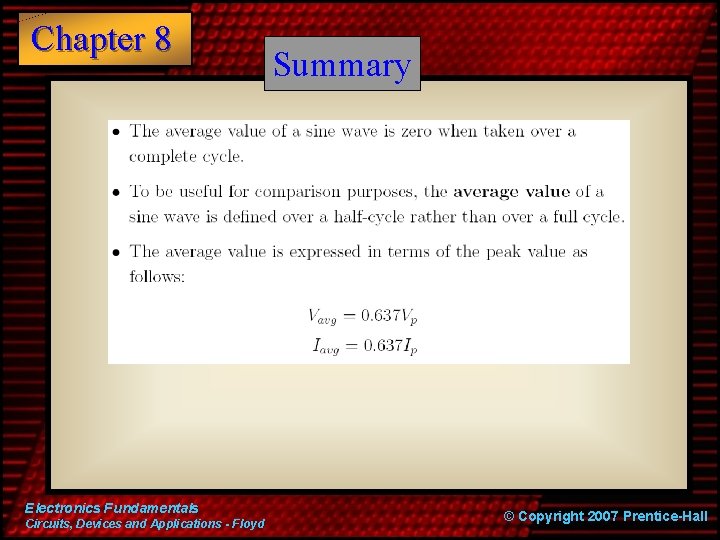
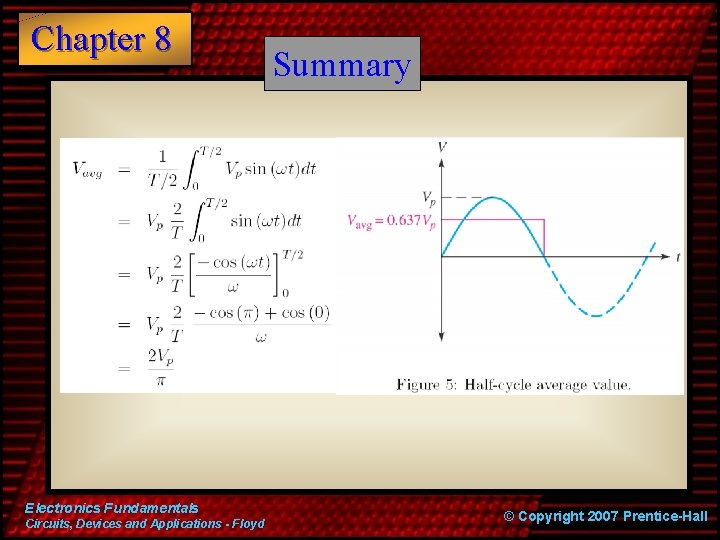
Chapter 8 Sine wave voltage and current values For some purposes, the average value (actually the halfwave average) is used to specify the voltage or current. By definition, the average value is as 0. 637 times the peak value. The average value for the sinusoidal voltage is 12. 7 V. Electronics Fundamentals Circuits, Devices and Applications - Floyd Vavg © Copyright 2007 Prentice-Hall
Chapter 8 Electronics Fundamentals Circuits, Devices and Applications - Floyd Summary © Copyright 2007 Prentice-Hall
Chapter 8 Electronics Fundamentals Circuits, Devices and Applications - Floyd Summary © Copyright 2007 Prentice-Hall
Chapter 8 Electronics Fundamentals Circuits, Devices and Applications - Floyd Summary © Copyright 2007 Prentice-Hall
Chapter 8 Electronics Fundamentals Circuits, Devices and Applications - Floyd Summary © Copyright 2007 Prentice-Hall
Chapter 8 Electronics Fundamentals Circuits, Devices and Applications - Floyd Summary © Copyright 2007 Prentice-Hall
Chapter 8 Electronics Fundamentals Circuits, Devices and Applications - Floyd Summary © Copyright 2007 Prentice-Hall
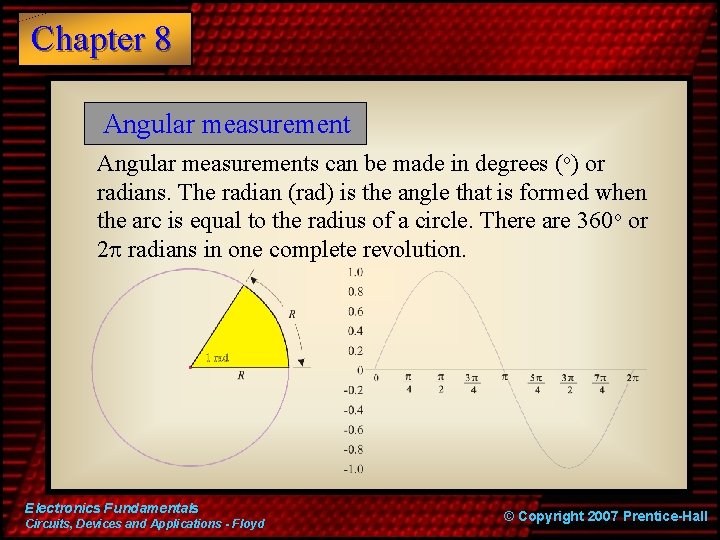
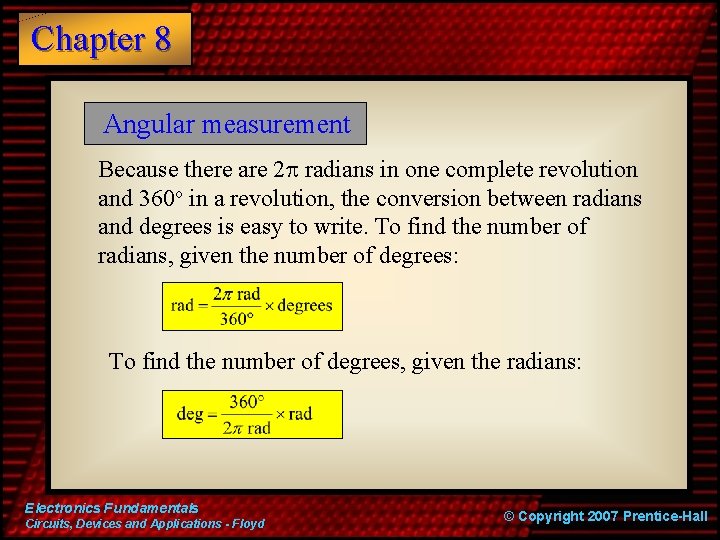
Chapter 8 Angular measurements can be made in degrees (o) or radians. The radian (rad) is the angle that is formed when the arc is equal to the radius of a circle. There are 360 o or 2 p radians in one complete revolution. Electronics Fundamentals Circuits, Devices and Applications - Floyd © Copyright 2007 Prentice-Hall
Chapter 8 Electronics Fundamentals Circuits, Devices and Applications - Floyd Summary © Copyright 2007 Prentice-Hall
Chapter 8 Electronics Fundamentals Circuits, Devices and Applications - Floyd Summary © Copyright 2007 Prentice-Hall
Chapter 8 Angular measurement Because there are 2 p radians in one complete revolution and 360 o in a revolution, the conversion between radians and degrees is easy to write. To find the number of radians, given the number of degrees: To find the number of degrees, given the radians: Electronics Fundamentals Circuits, Devices and Applications - Floyd © Copyright 2007 Prentice-Hall
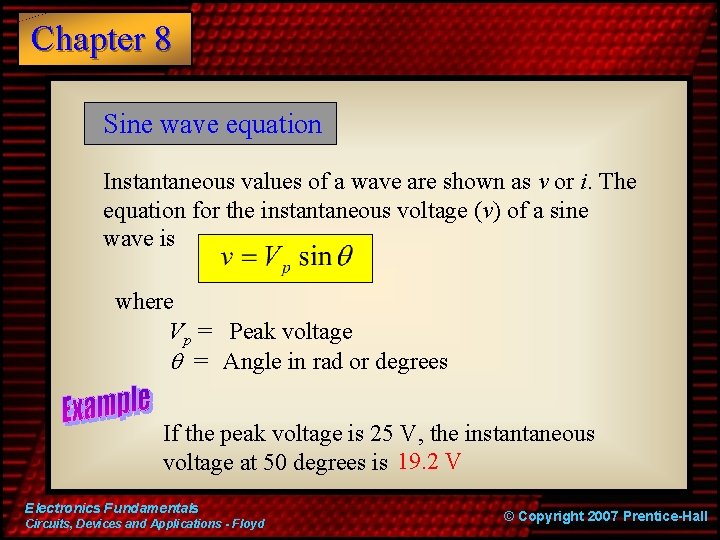
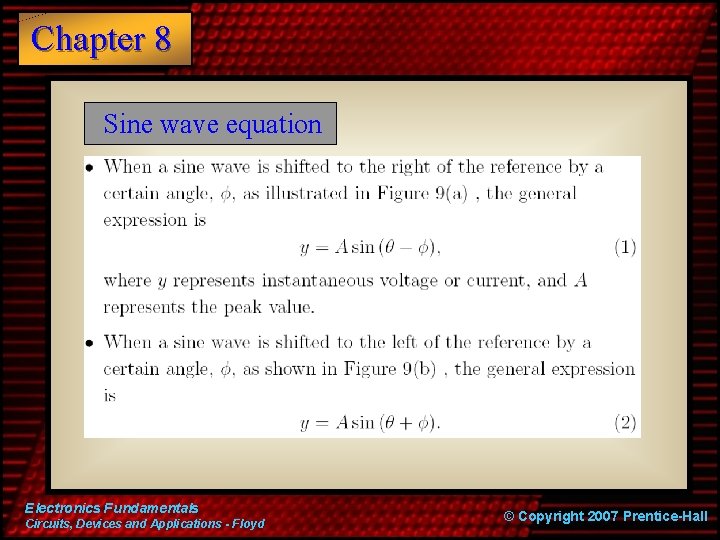
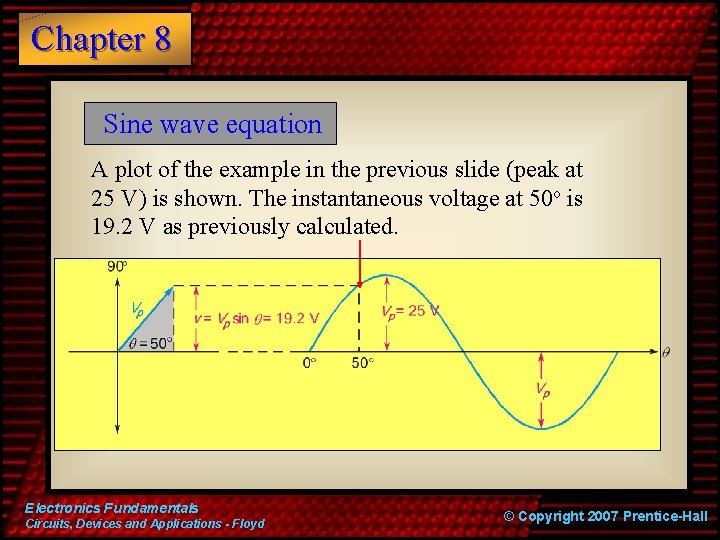
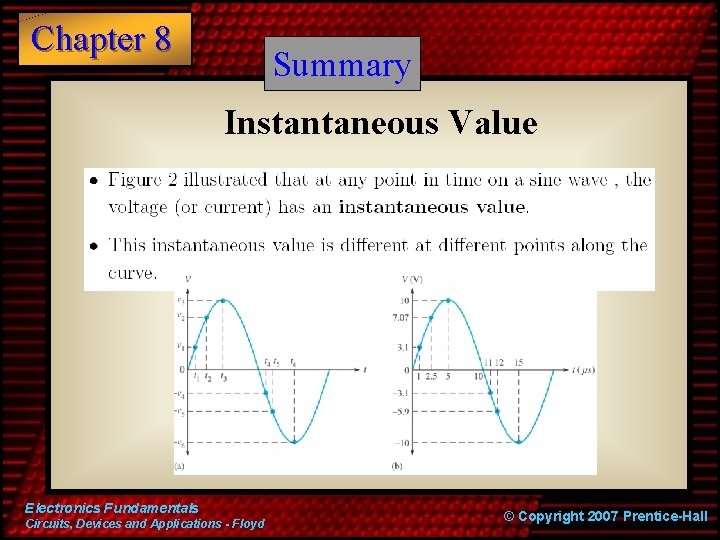
Chapter 8 Sine wave equation Instantaneous values of a wave are shown as v or i. The equation for the instantaneous voltage (v) of a sine wave is where Vp = Peak voltage q = Angle in rad or degrees If the peak voltage is 25 V, the instantaneous voltage at 50 degrees is 19. 2 V Electronics Fundamentals Circuits, Devices and Applications - Floyd © Copyright 2007 Prentice-Hall
Chapter 8 Electronics Fundamentals Circuits, Devices and Applications - Floyd Summary © Copyright 2007 Prentice-Hall
Chapter 8 Electronics Fundamentals Circuits, Devices and Applications - Floyd Summary © Copyright 2007 Prentice-Hall
Chapter 8 Sine wave equation Electronics Fundamentals Circuits, Devices and Applications - Floyd © Copyright 2007 Prentice-Hall
Chapter 8 Electronics Fundamentals Circuits, Devices and Applications - Floyd Summary © Copyright 2007 Prentice-Hall
Chapter 8 Sine wave equation A plot of the example in the previous slide (peak at 25 V) is shown. The instantaneous voltage at 50 o is 19. 2 V as previously calculated. Electronics Fundamentals Circuits, Devices and Applications - Floyd © Copyright 2007 Prentice-Hall
Chapter 8 Electronics Fundamentals Circuits, Devices and Applications - Floyd Summary © Copyright 2007 Prentice-Hall
Chapter 8 Electronics Fundamentals Circuits, Devices and Applications - Floyd Summary © Copyright 2007 Prentice-Hall
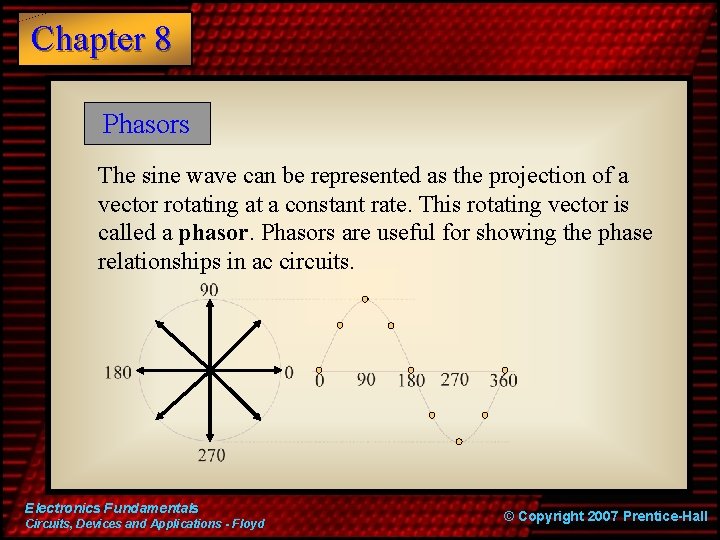
Chapter 8 Phasors The sine wave can be represented as the projection of a vector rotating at a constant rate. This rotating vector is called a phasor. Phasors are useful for showing the phase relationships in ac circuits. Electronics Fundamentals Circuits, Devices and Applications - Floyd © Copyright 2007 Prentice-Hall
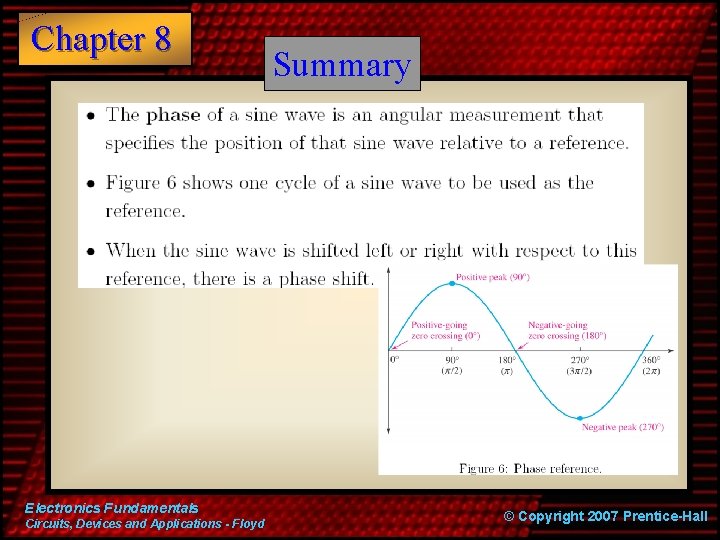
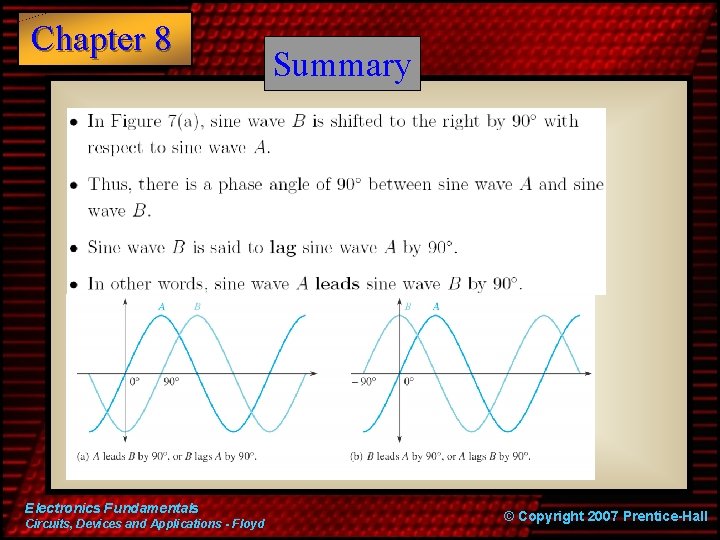
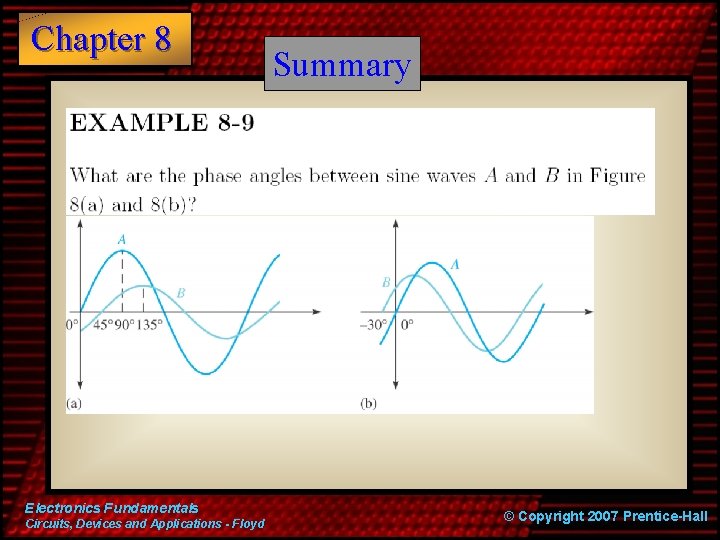
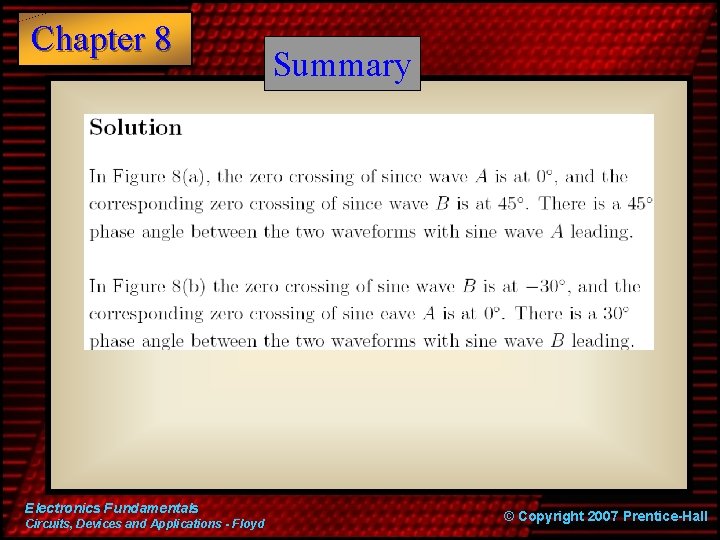
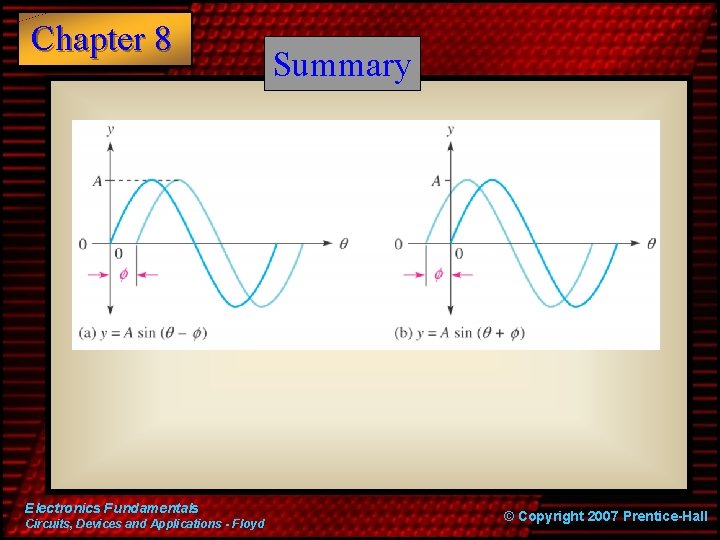
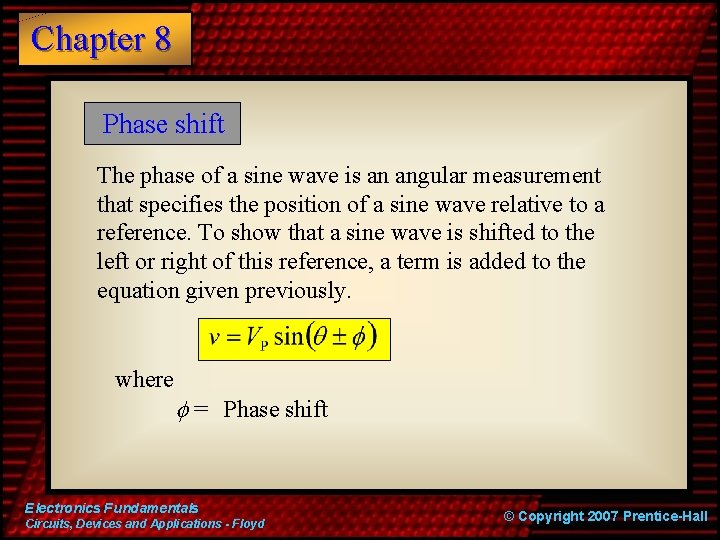
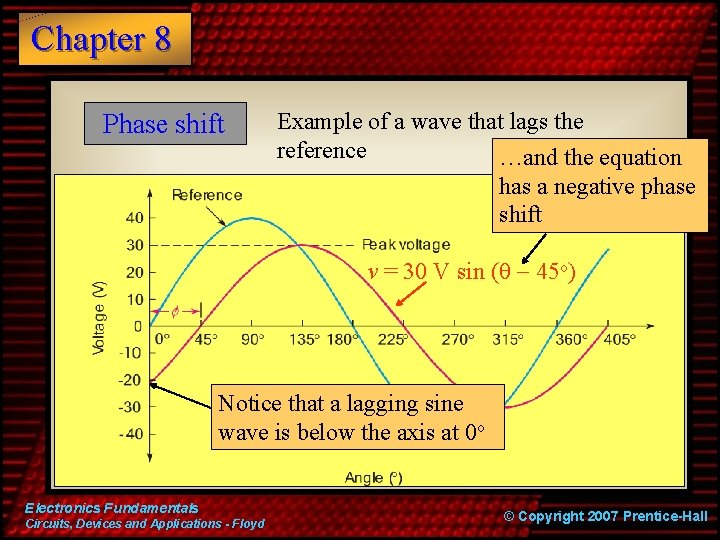
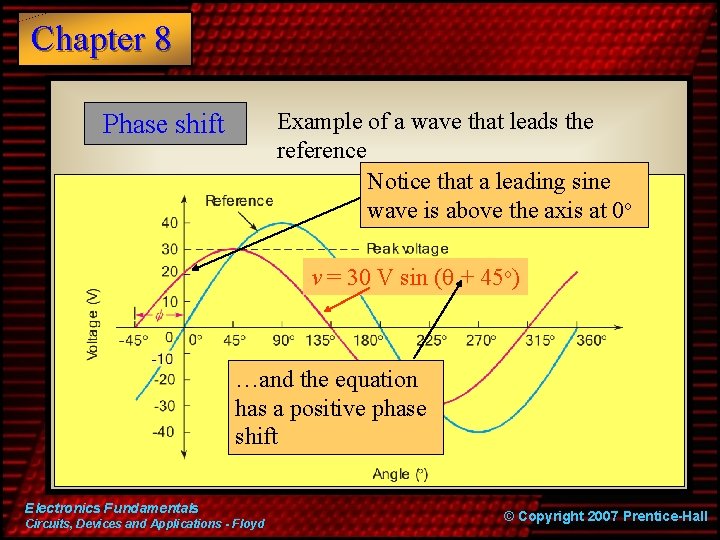
Chapter 8 Phase shift The phase of a sine wave is an angular measurement that specifies the position of a sine wave relative to a reference. To show that a sine wave is shifted to the left or right of this reference, a term is added to the equation given previously. where f = Phase shift Electronics Fundamentals Circuits, Devices and Applications - Floyd © Copyright 2007 Prentice-Hall
Chapter 8 Phase shift Example of a wave that lags the reference …and the equation has a negative phase shift v = 30 V sin (q - 45 o) Notice that a lagging sine wave is below the axis at 0 o Electronics Fundamentals Circuits, Devices and Applications - Floyd © Copyright 2007 Prentice-Hall
Chapter 8 Example of a wave that leads the reference Notice that a leading sine wave is above the axis at 0 o Phase shift v = 30 V sin (q + 45 o) …and the equation has a positive phase shift Electronics Fundamentals Circuits, Devices and Applications - Floyd © Copyright 2007 Prentice-Hall
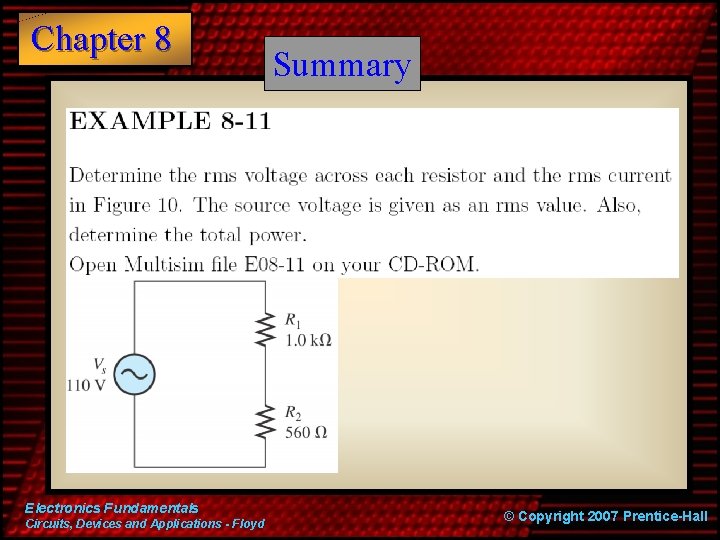
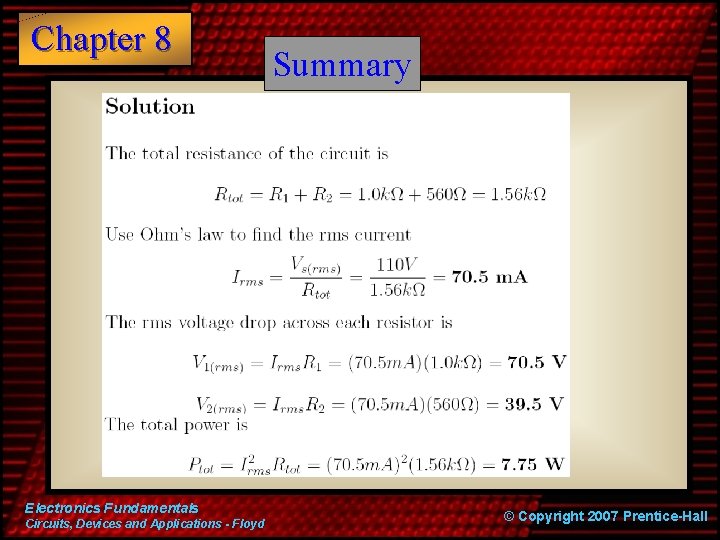
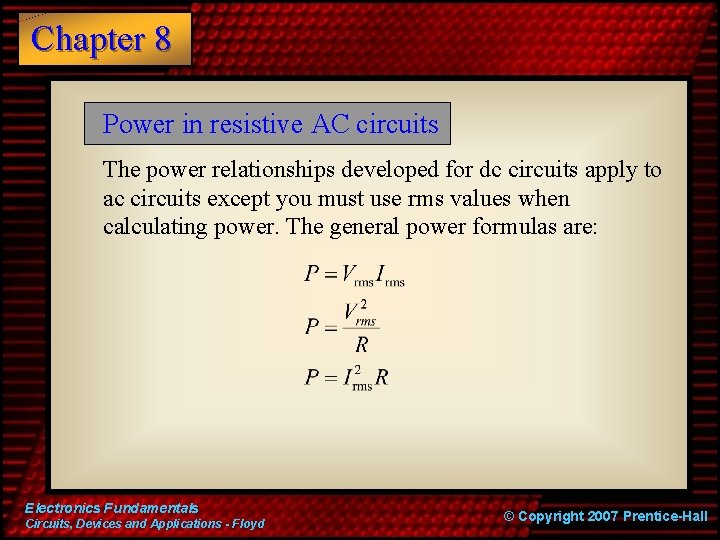
Chapter 8 Power in resistive AC circuits The power relationships developed for dc circuits apply to ac circuits except you must use rms values when calculating power. The general power formulas are: Electronics Fundamentals Circuits, Devices and Applications - Floyd © Copyright 2007 Prentice-Hall
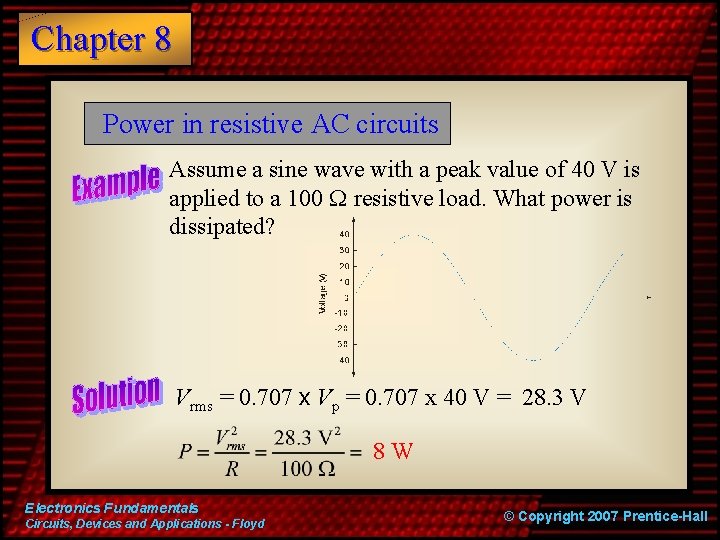
Chapter 8 Power in resistive AC circuits Assume a sine wave with a peak value of 40 V is applied to a 100 W resistive load. What power is dissipated? Vrms = 0. 707 x Vp = 0. 707 x 40 V = 28. 3 V 8 W Electronics Fundamentals Circuits, Devices and Applications - Floyd © Copyright 2007 Prentice-Hall
Chapter 8 Summary Instantaneous Value Electronics Fundamentals Circuits, Devices and Applications - Floyd © Copyright 2007 Prentice-Hall
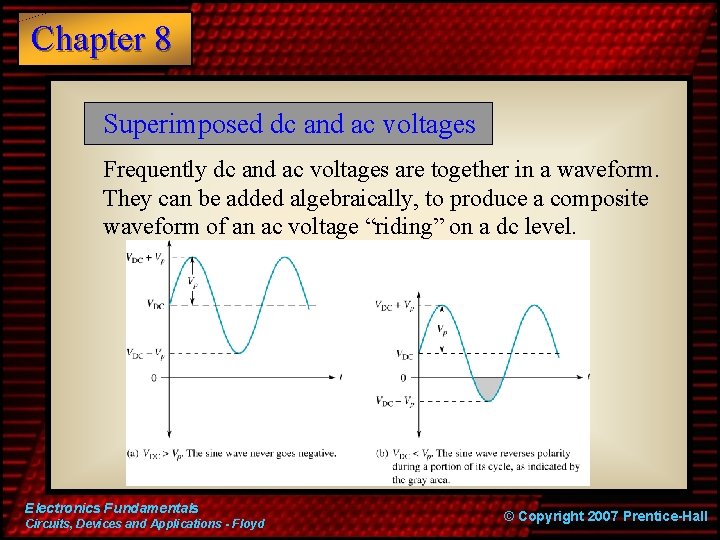
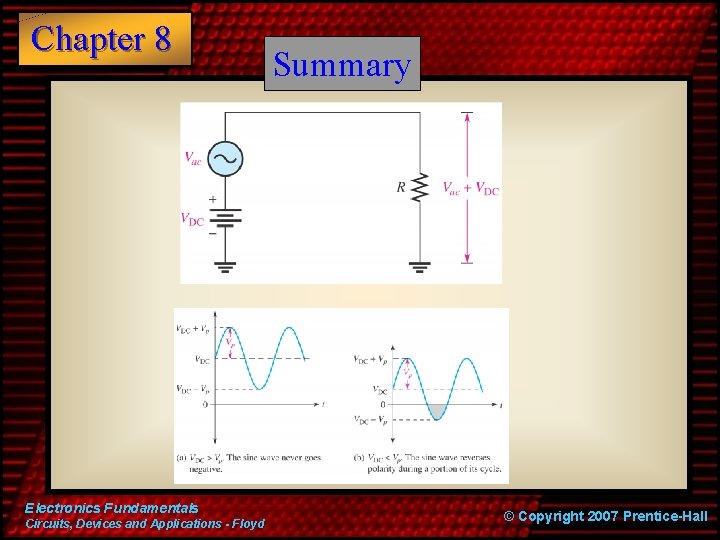
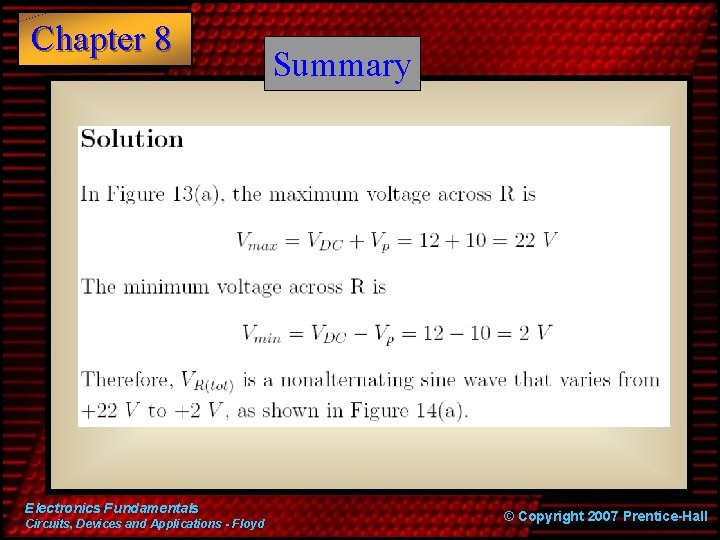
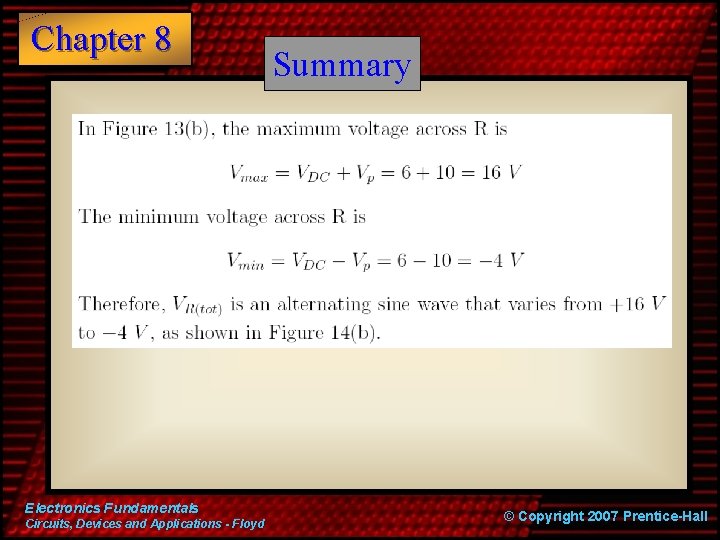
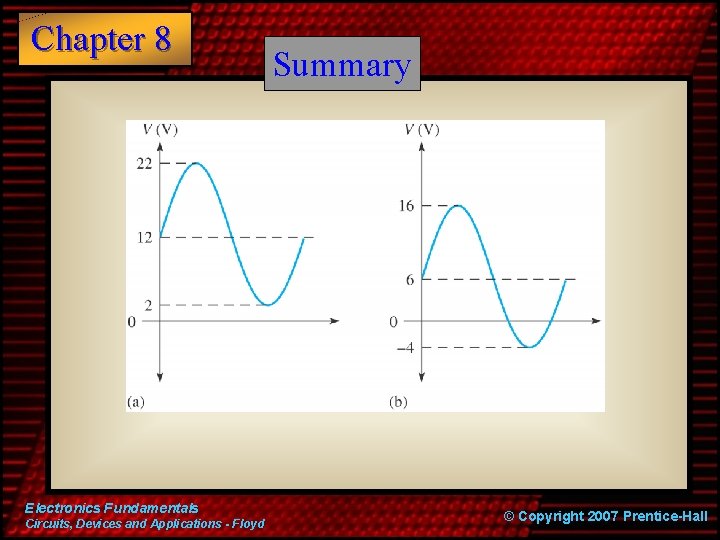
Chapter 8 Superimposed dc and ac voltages Frequently dc and ac voltages are together in a waveform. They can be added algebraically, to produce a composite waveform of an ac voltage “riding” on a dc level. Electronics Fundamentals Circuits, Devices and Applications - Floyd © Copyright 2007 Prentice-Hall
Chapter 8 Electronics Fundamentals Circuits, Devices and Applications - Floyd Summary © Copyright 2007 Prentice-Hall
Chapter 8 Electronics Fundamentals Circuits, Devices and Applications - Floyd Summary © Copyright 2007 Prentice-Hall
Chapter 8 Electronics Fundamentals Circuits, Devices and Applications - Floyd Summary © Copyright 2007 Prentice-Hall
Chapter 8 Electronics Fundamentals Circuits, Devices and Applications - Floyd Summary © Copyright 2007 Prentice-Hall
Chapter 8 Electronics Fundamentals Circuits, Devices and Applications - Floyd Summary © Copyright 2007 Prentice-Hall
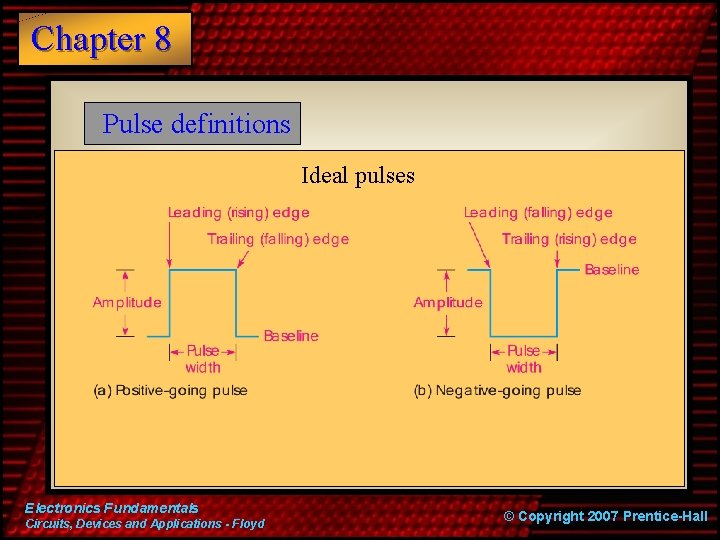
Chapter 8 Pulse definitions Ideal pulses Electronics Fundamentals Circuits, Devices and Applications - Floyd © Copyright 2007 Prentice-Hall
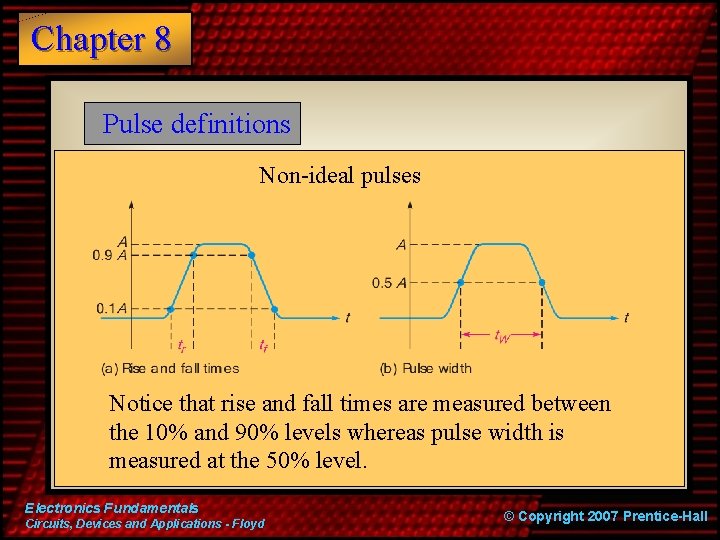
Chapter 8 Pulse definitions Non-ideal pulses Notice that rise and fall times are measured between the 10% and 90% levels whereas pulse width is measured at the 50% level. Electronics Fundamentals Circuits, Devices and Applications - Floyd © Copyright 2007 Prentice-Hall
Chapter 8 Electronics Fundamentals Circuits, Devices and Applications - Floyd Summary © Copyright 2007 Prentice-Hall
Chapter 8 Electronics Fundamentals Circuits, Devices and Applications - Floyd Summary © Copyright 2007 Prentice-Hall
Chapter 8 Electronics Fundamentals Circuits, Devices and Applications - Floyd Summary © Copyright 2007 Prentice-Hall
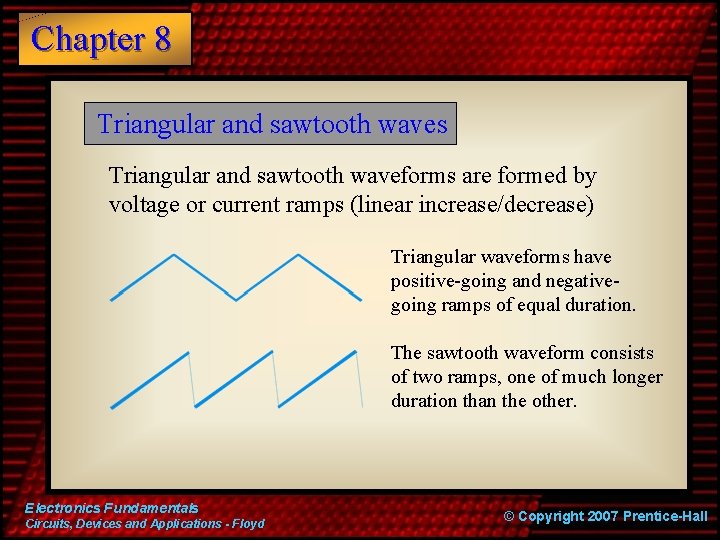
Chapter 8 Triangular and sawtooth waves Triangular and sawtooth waveforms are formed by voltage or current ramps (linear increase/decrease) Triangular waveforms have positive-going and negativegoing ramps of equal duration. The sawtooth waveform consists of two ramps, one of much longer duration than the other. Electronics Fundamentals Circuits, Devices and Applications - Floyd © Copyright 2007 Prentice-Hall
Chapter 8 Harmonics All repetitive non-sinusoidal waveforms are composed of a fundamental frequency (repetition rate of the waveform) and harmonic frequencies. Odd harmonics are frequencies that are odd multiples of the fundamental frequency. Even harmonics are frequencies that are even multiples of the fundamental frequency. Electronics Fundamentals Circuits, Devices and Applications - Floyd © Copyright 2007 Prentice-Hall
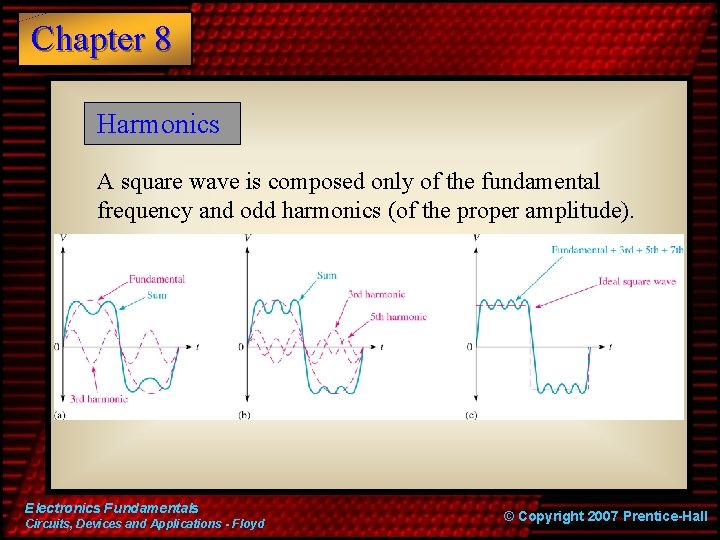
Chapter 8 Harmonics A square wave is composed only of the fundamental frequency and odd harmonics (of the proper amplitude). Electronics Fundamentals Circuits, Devices and Applications - Floyd © Copyright 2007 Prentice-Hall
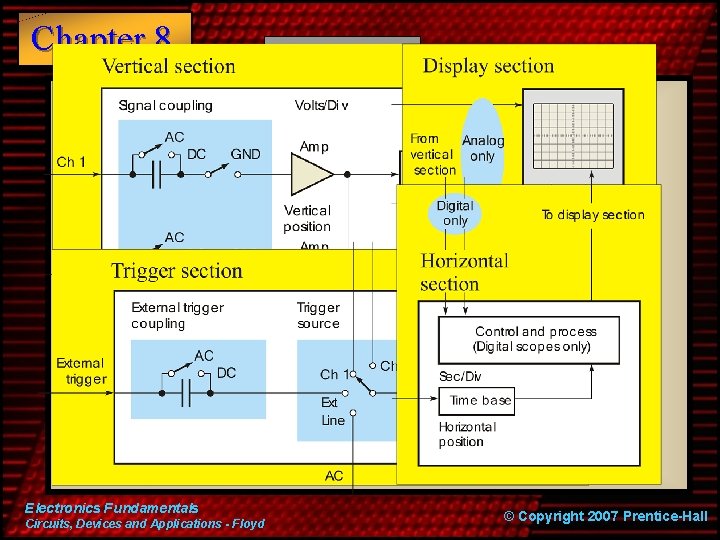
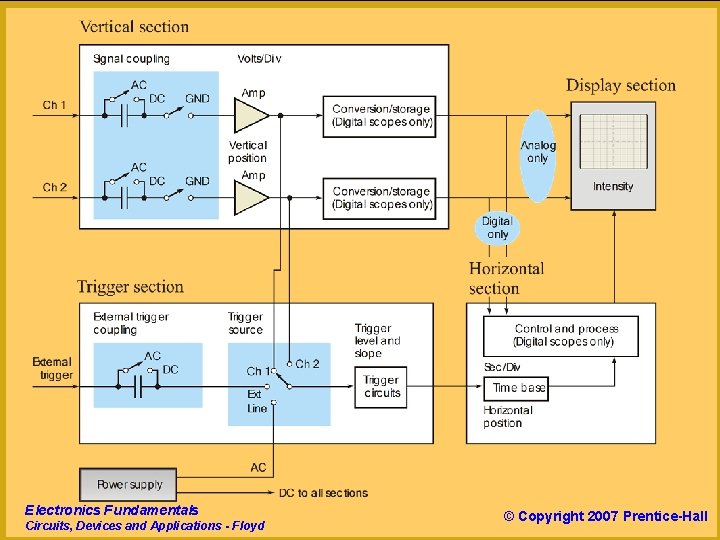
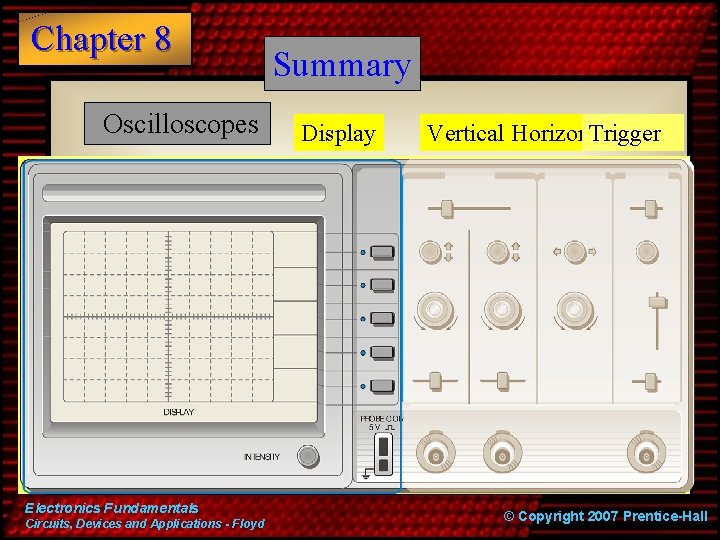
Chapter 8 Oscilloscopes Electronics Fundamentals Circuits, Devices and Applications - Floyd Summary The oscilloscope is divided into four main sections. © Copyright 2007 Prentice-Hall
Chapter 8 Electronics Fundamentals Circuits, Devices and Applications - Floyd © Copyright 2007 Prentice-Hall
Chapter 8 Oscilloscopes Electronics Fundamentals Circuits, Devices and Applications - Floyd Summary Display Vertical Horizontal Trigger © Copyright 2007 Prentice-Hall
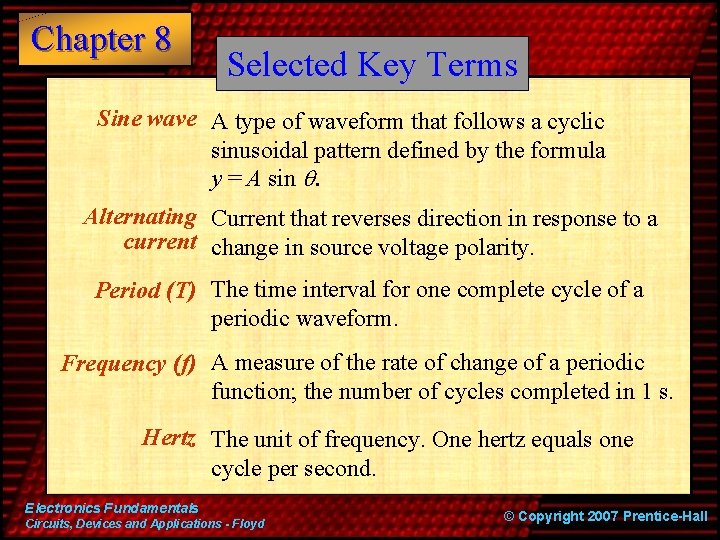
Chapter 8 Selected Key Terms Sine wave A type of waveform that follows a cyclic sinusoidal pattern defined by the formula y = A sin q. Alternating Current that reverses direction in response to a current change in source voltage polarity. Period (T) The time interval for one complete cycle of a periodic waveform. Frequency (f) A measure of the rate of change of a periodic function; the number of cycles completed in 1 s. Hertz The unit of frequency. One hertz equals one cycle per second. Electronics Fundamentals Circuits, Devices and Applications - Floyd © Copyright 2007 Prentice-Hall
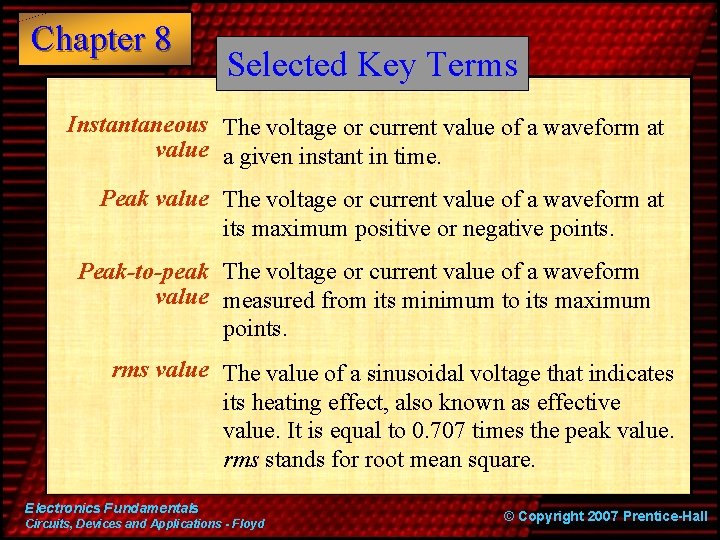
Chapter 8 Selected Key Terms Instantaneous The voltage or current value of a waveform at value a given instant in time. Peak value The voltage or current value of a waveform at its maximum positive or negative points. Peak-to-peak The voltage or current value of a waveform value measured from its minimum to its maximum points. rms value The value of a sinusoidal voltage that indicates its heating effect, also known as effective value. It is equal to 0. 707 times the peak value. rms stands for root mean square. Electronics Fundamentals Circuits, Devices and Applications - Floyd © Copyright 2007 Prentice-Hall
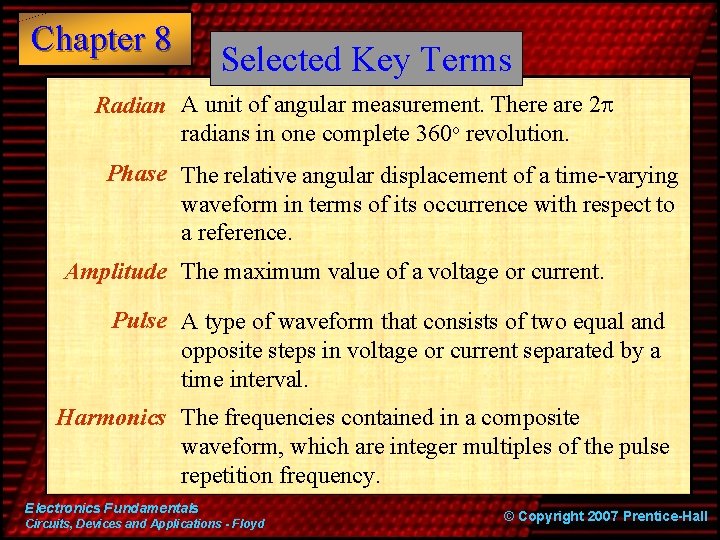
Chapter 8 Selected Key Terms Radian A unit of angular measurement. There are 2 p radians in one complete 360 o revolution. Phase The relative angular displacement of a time-varying waveform in terms of its occurrence with respect to a reference. Amplitude The maximum value of a voltage or current. Pulse A type of waveform that consists of two equal and opposite steps in voltage or current separated by a time interval. Harmonics The frequencies contained in a composite waveform, which are integer multiples of the pulse repetition frequency. Electronics Fundamentals Circuits, Devices and Applications - Floyd © Copyright 2007 Prentice-Hall
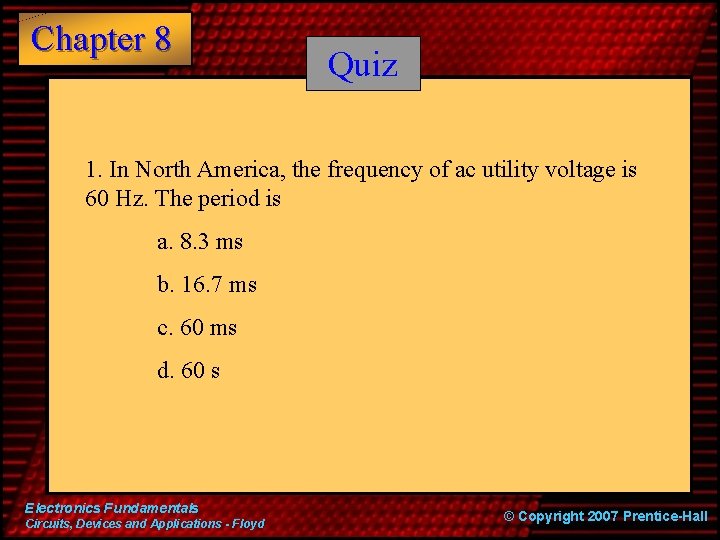
Chapter 8 Quiz 1. In North America, the frequency of ac utility voltage is 60 Hz. The period is a. 8. 3 ms b. 16. 7 ms c. 60 ms d. 60 s Electronics Fundamentals Circuits, Devices and Applications - Floyd © Copyright 2007 Prentice-Hall
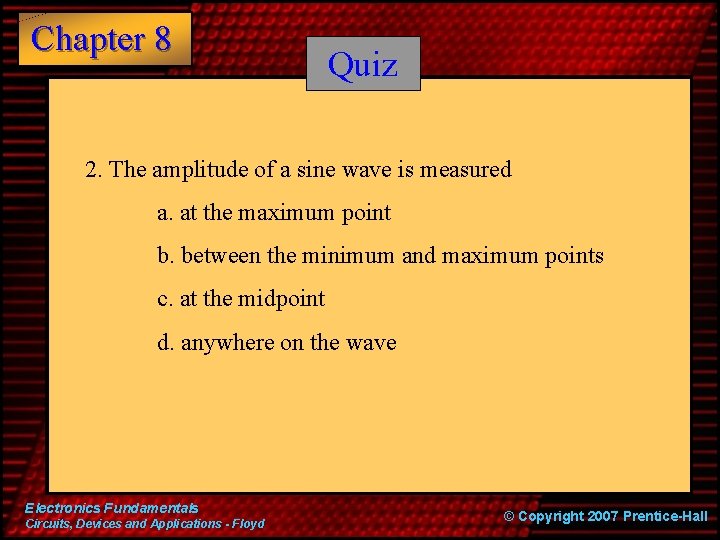
Chapter 8 Quiz 2. The amplitude of a sine wave is measured a. at the maximum point b. between the minimum and maximum points c. at the midpoint d. anywhere on the wave Electronics Fundamentals Circuits, Devices and Applications - Floyd © Copyright 2007 Prentice-Hall
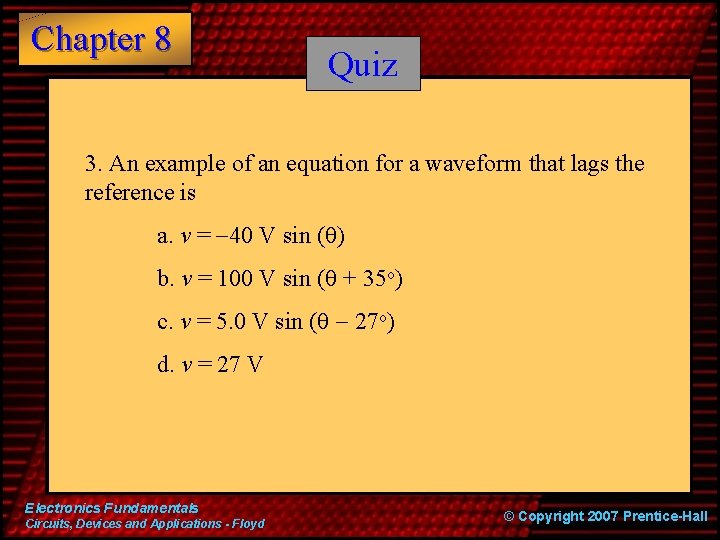
Chapter 8 Quiz 3. An example of an equation for a waveform that lags the reference is a. v = -40 V sin (q) b. v = 100 V sin (q + 35 o) c. v = 5. 0 V sin (q - 27 o) d. v = 27 V Electronics Fundamentals Circuits, Devices and Applications - Floyd © Copyright 2007 Prentice-Hall
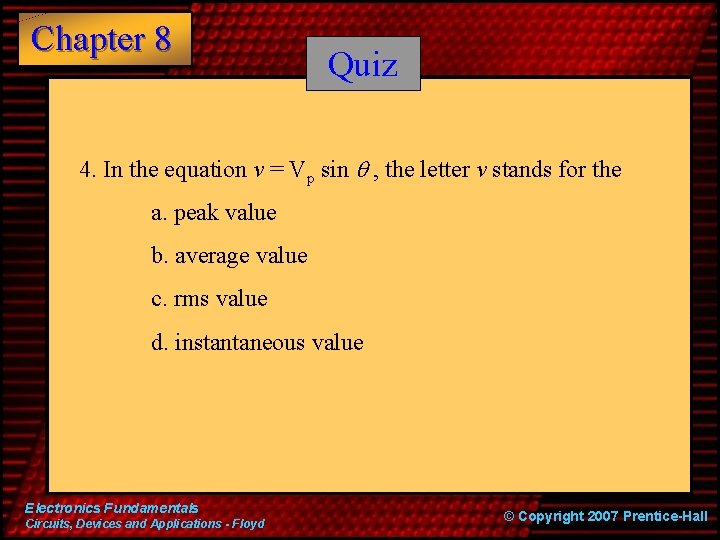
Chapter 8 Quiz 4. In the equation v = Vp sin q , the letter v stands for the a. peak value b. average value c. rms value d. instantaneous value Electronics Fundamentals Circuits, Devices and Applications - Floyd © Copyright 2007 Prentice-Hall
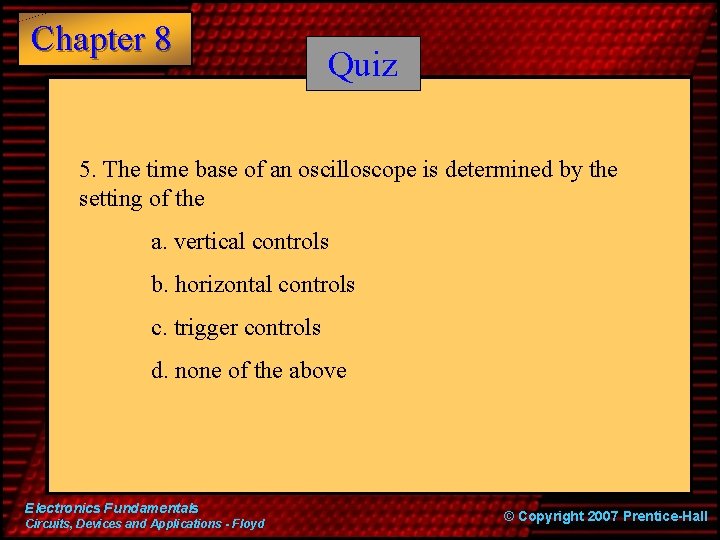
Chapter 8 Quiz 5. The time base of an oscilloscope is determined by the setting of the a. vertical controls b. horizontal controls c. trigger controls d. none of the above Electronics Fundamentals Circuits, Devices and Applications - Floyd © Copyright 2007 Prentice-Hall
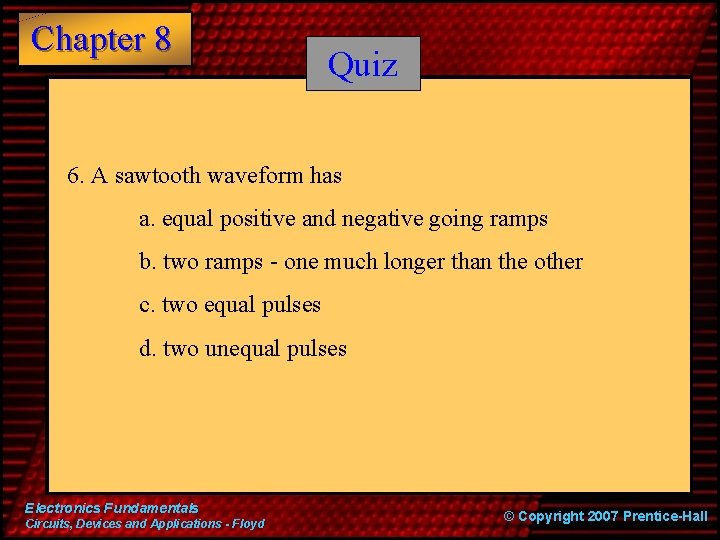
Chapter 8 Quiz 6. A sawtooth waveform has a. equal positive and negative going ramps b. two ramps - one much longer than the other c. two equal pulses d. two unequal pulses Electronics Fundamentals Circuits, Devices and Applications - Floyd © Copyright 2007 Prentice-Hall
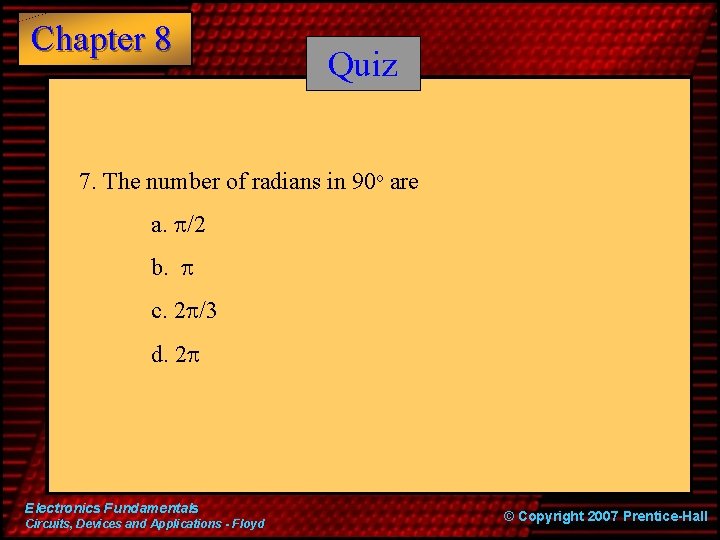
Chapter 8 Quiz 7. The number of radians in 90 o are a. p/2 b. p c. 2 p/3 d. 2 p Electronics Fundamentals Circuits, Devices and Applications - Floyd © Copyright 2007 Prentice-Hall
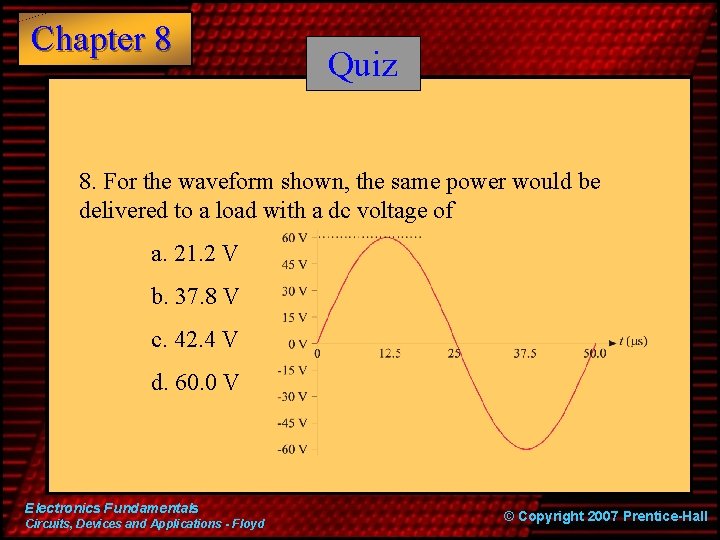
Chapter 8 Quiz 8. For the waveform shown, the same power would be delivered to a load with a dc voltage of a. 21. 2 V b. 37. 8 V c. 42. 4 V d. 60. 0 V Electronics Fundamentals Circuits, Devices and Applications - Floyd © Copyright 2007 Prentice-Hall
Chapter 8 Quiz 9. A square wave consists of a. the fundamental and odd harmonics b. the fundamental and even harmonics c. the fundamental and all harmonics d. only the fundamental Electronics Fundamentals Circuits, Devices and Applications - Floyd © Copyright 2007 Prentice-Hall
Chapter 8 Quiz 10. A control on the oscilloscope that is used to set the desired number of cycles of a wave on the display is a. volts per division control b. time per division control c. trigger level control d. horizontal position control Electronics Fundamentals Circuits, Devices and Applications - Floyd © Copyright 2007 Prentice-Hall
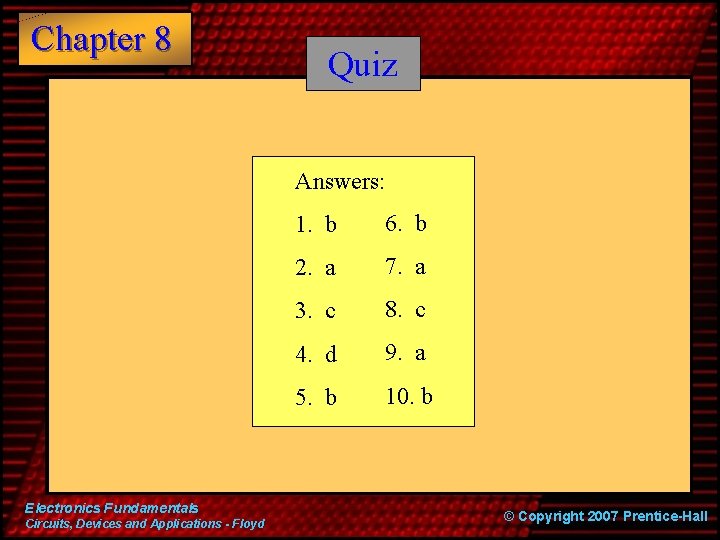
Chapter 8 Quiz Answers: Electronics Fundamentals Circuits, Devices and Applications - Floyd 1. b 6. b 2. a 7. a 3. c 8. c 4. d 9. a 5. b 10. b © Copyright 2007 Prentice-Hall