
Chapter 8 Earth From the Inside Out Yosemites
- Slides: 35
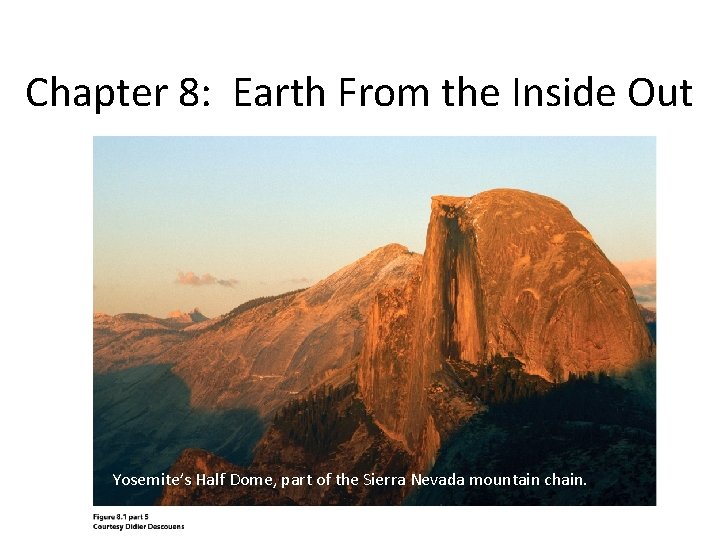
Chapter 8: Earth From the Inside Out Yosemite’s Half Dome, part of the Sierra Nevada mountain chain.
• Geomorphology: study of the shape of the Earth’s features and how they change over time • Uniformitarianism: James Hutton, 1795: the same geologic processes observable today have operated since the beginning of Earth’s history, the present is the key to the past • Catastrophism—previous theory that argued change came through sudden upheavals
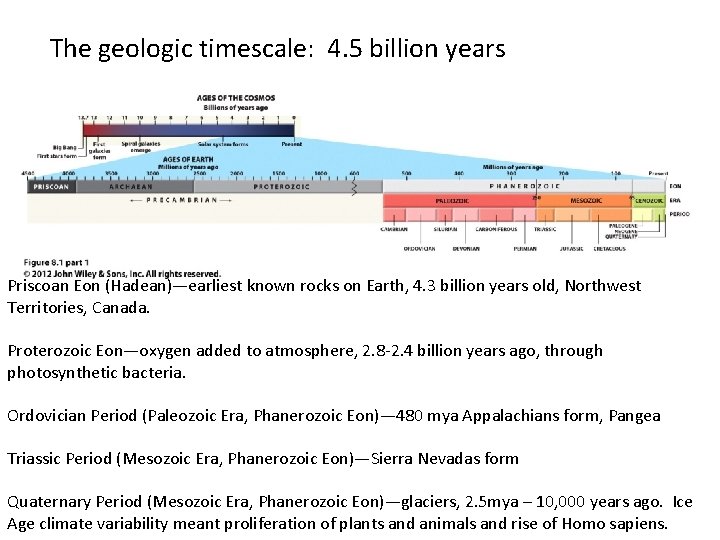
The geologic timescale: 4. 5 billion years Priscoan Eon (Hadean)—earliest known rocks on Earth, 4. 3 billion years old, Northwest Territories, Canada. Proterozoic Eon—oxygen added to atmosphere, 2. 8 -2. 4 billion years ago, through photosynthetic bacteria. Ordovician Period (Paleozoic Era, Phanerozoic Eon)— 480 mya Appalachians form, Pangea Triassic Period (Mesozoic Era, Phanerozoic Eon)—Sierra Nevadas form Quaternary Period (Mesozoic Era, Phanerozoic Eon)—glaciers, 2. 5 mya – 10, 000 years ago. Ice Age climate variability meant proliferation of plants and animals and rise of Homo sapiens.
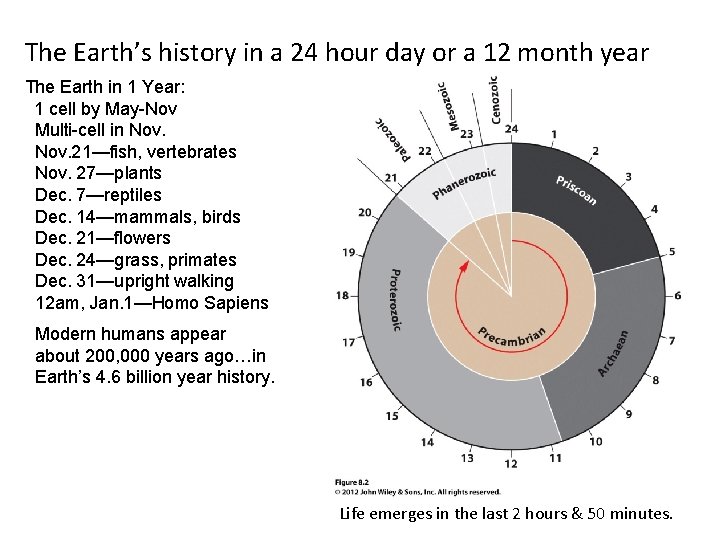
The Earth’s history in a 24 hour day or a 12 month year The Earth in 1 Year: 1 cell by May-Nov Multi-cell in Nov. 21—fish, vertebrates Nov. 27—plants Dec. 7—reptiles Dec. 14—mammals, birds Dec. 21—flowers Dec. 24—grass, primates Dec. 31—upright walking 12 am, Jan. 1—Homo Sapiens Modern humans appear about 200, 000 years ago…in Earth’s 4. 6 billion year history. Life emerges in the last 2 hours & 50 minutes.
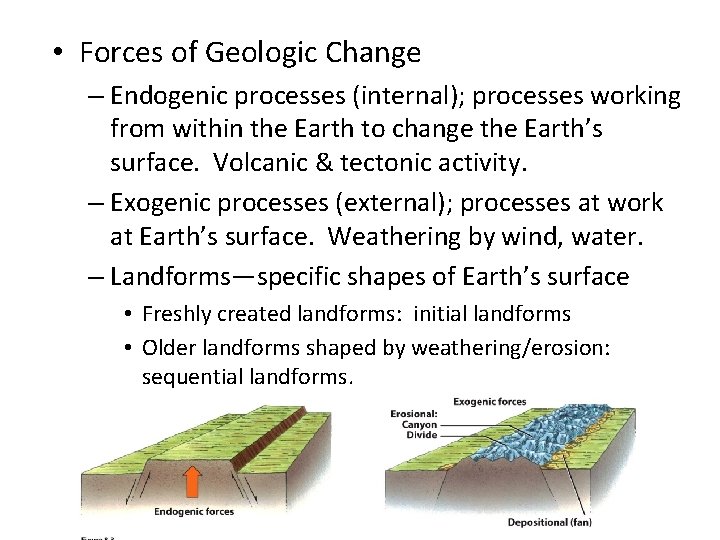
• Forces of Geologic Change – Endogenic processes (internal); processes working from within the Earth to change the Earth’s surface. Volcanic & tectonic activity. – Exogenic processes (external); processes at work at Earth’s surface. Weathering by wind, water. – Landforms—specific shapes of Earth’s surface • Freshly created landforms: initial landforms • Older landforms shaped by weathering/erosion: sequential landforms.
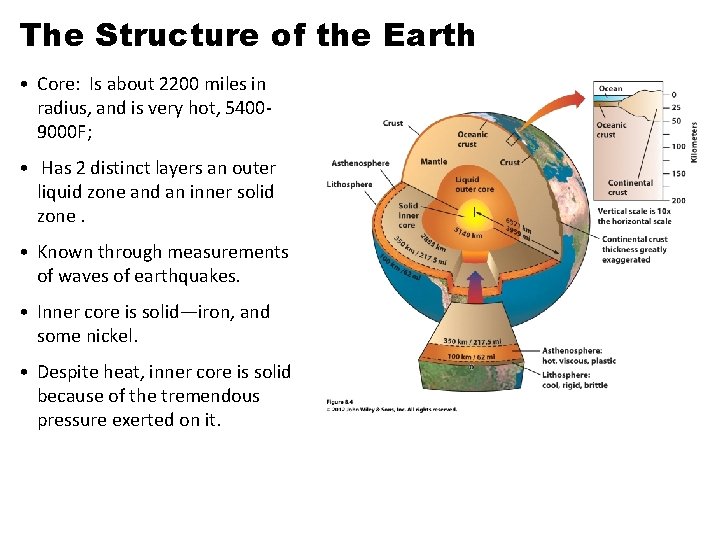
The Structure of the Earth • Core: Is about 2200 miles in radius, and is very hot, 54009000 F; • Has 2 distinct layers an outer liquid zone and an inner solid zone. • Known through measurements of waves of earthquakes. • Inner core is solid—iron, and some nickel. • Despite heat, inner core is solid because of the tremendous pressure exerted on it.
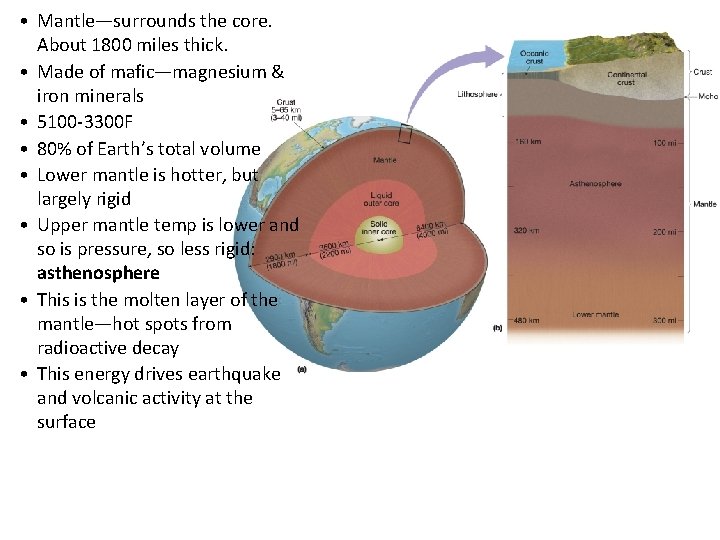
• Mantle—surrounds the core. About 1800 miles thick. • Made of mafic—magnesium & iron minerals • 5100 -3300 F • 80% of Earth’s total volume • Lower mantle is hotter, but largely rigid • Upper mantle temp is lower and so is pressure, so less rigid: asthenosphere • This is the molten layer of the mantle—hot spots from radioactive decay • This energy drives earthquake and volcanic activity at the surface
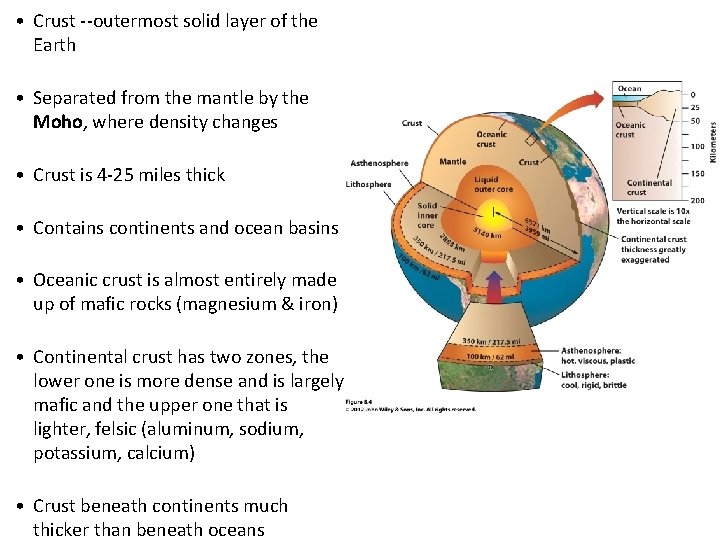
• Crust --outermost solid layer of the Earth • Separated from the mantle by the Moho, where density changes • Crust is 4 -25 miles thick • Contains continents and ocean basins • Oceanic crust is almost entirely made up of mafic rocks (magnesium & iron) • Continental crust has two zones, the lower one is more dense and is largely mafic and the upper one that is lighter, felsic (aluminum, sodium, potassium, calcium) • Crust beneath continents much thicker than beneath oceans
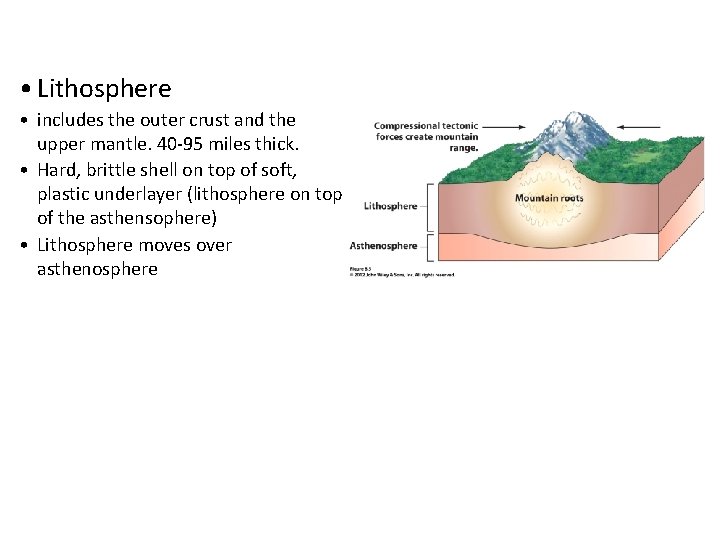
• Lithosphere • includes the outer crust and the upper mantle. 40 -95 miles thick. • Hard, brittle shell on top of soft, plastic underlayer (lithosphere on top of the asthensophere) • Lithosphere moves over asthenosphere
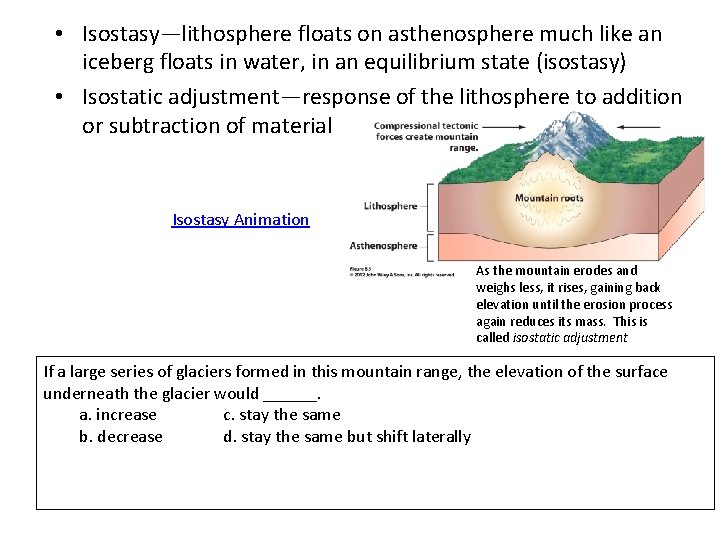
• Isostasy—lithosphere floats on asthenosphere much like an iceberg floats in water, in an equilibrium state (isostasy) • Isostatic adjustment—response of the lithosphere to addition or subtraction of material Isostasy Animation As the mountain erodes and weighs less, it rises, gaining back elevation until the erosion process again reduces its mass. This is called isostatic adjustment If a large series of glaciers formed in this mountain range, the elevation of the surface underneath the glacier would ______. a. increase c. stay the same b. decrease d. stay the same but shift laterally
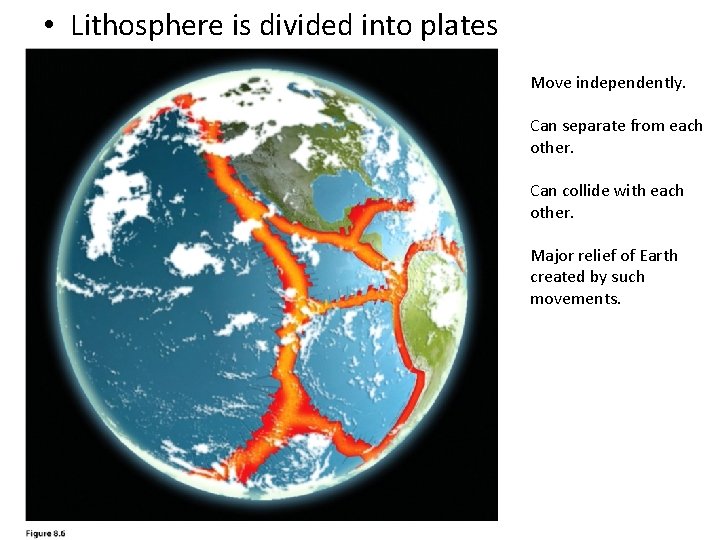
• Lithosphere is divided into plates Move independently. Can separate from each other. Can collide with each other. Major relief of Earth created by such movements.
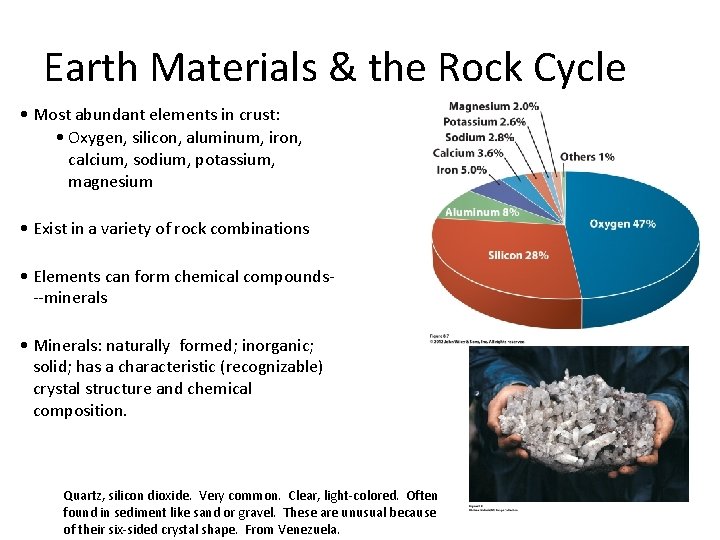
Earth Materials & the Rock Cycle • Most abundant elements in crust: • Oxygen, silicon, aluminum, iron, calcium, sodium, potassium, magnesium • Exist in a variety of rock combinations • Elements can form chemical compounds--minerals • Minerals: naturally formed; inorganic; solid; has a characteristic (recognizable) crystal structure and chemical composition. Quartz, silicon dioxide. Very common. Clear, light-colored. Often found in sediment like sand or gravel. These are unusual because of their six-sided crystal shape. From Venezuela.
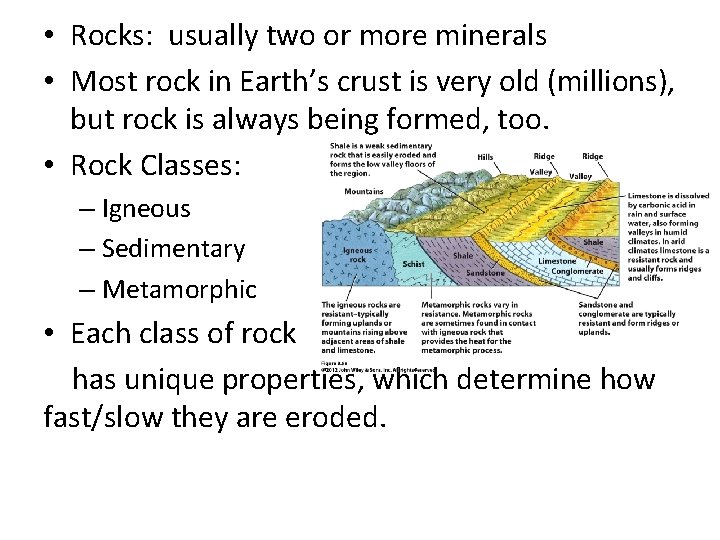
• Rocks: usually two or more minerals • Most rock in Earth’s crust is very old (millions), but rock is always being formed, too. • Rock Classes: – Igneous – Sedimentary – Metamorphic • Each class of rock has unique properties, which determine how fast/slow they are eroded.
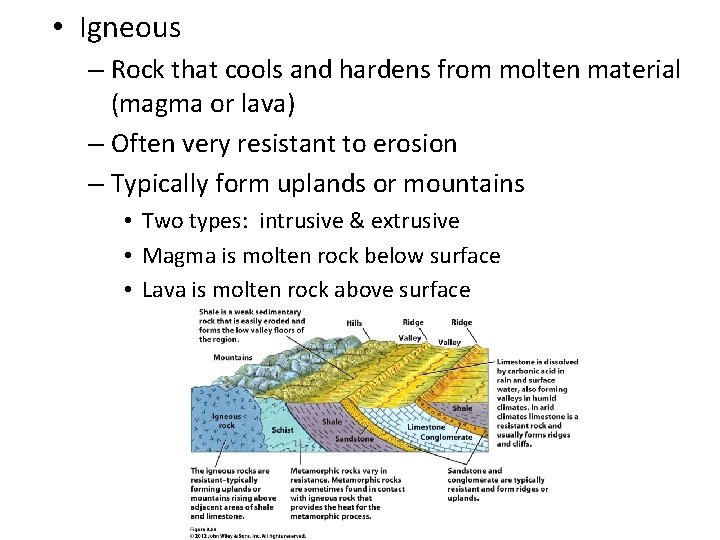
• Igneous – Rock that cools and hardens from molten material (magma or lava) – Often very resistant to erosion – Typically form uplands or mountains • Two types: intrusive & extrusive • Magma is molten rock below surface • Lava is molten rock above surface
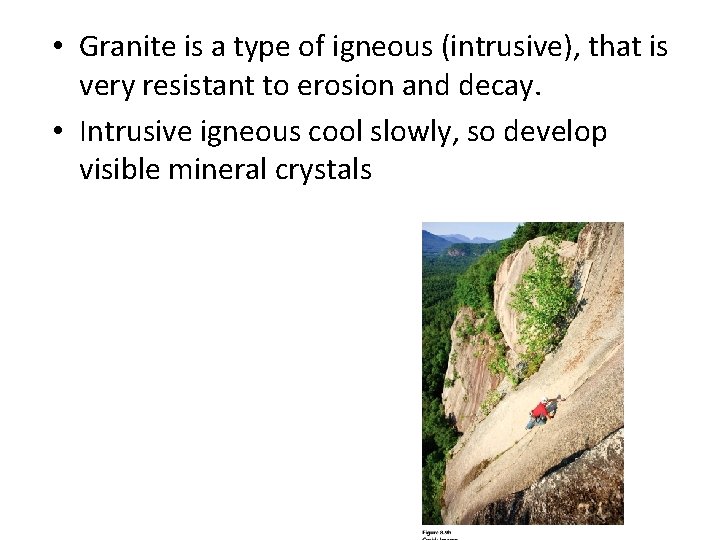
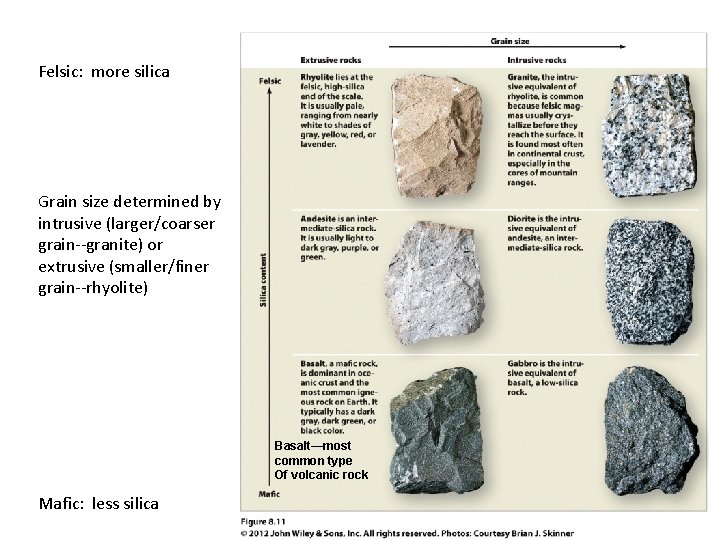
• Granite is a type of igneous (intrusive), that is very resistant to erosion and decay. • Intrusive igneous cool slowly, so develop visible mineral crystals
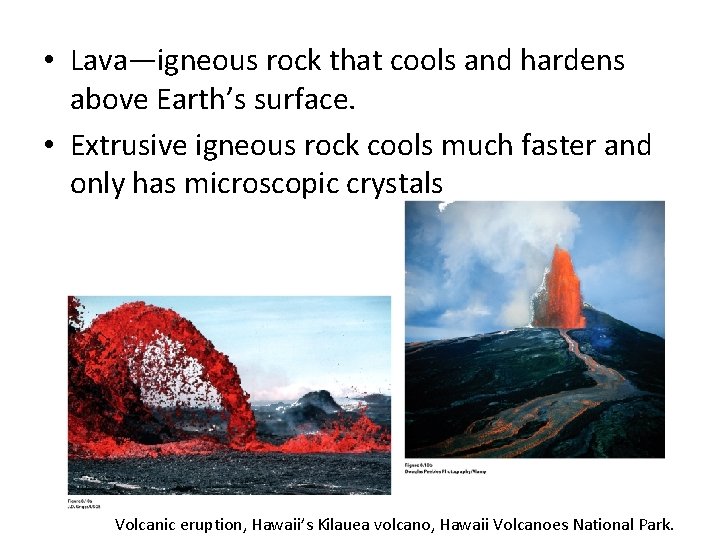
• Lava—igneous rock that cools and hardens above Earth’s surface. • Extrusive igneous rock cools much faster and only has microscopic crystals Volcanic eruption, Hawaii’s Kilauea volcano, Hawaii Volcanoes National Park.
• Most igneous rocks contain silicates—minerals containing silicon and oxygen • Very hard rock • Quartz, silicon dioxide most common • How much silica is present determines its appearance: felsic (more silica, so less dense and lighter in color) or mafic (less silica, so more dense, and darker)
Felsic: more silica Grain size determined by intrusive (larger/coarser grain--granite) or extrusive (smaller/finer grain--rhyolite) Basalt—most common type Of volcanic rock Mafic: less silica
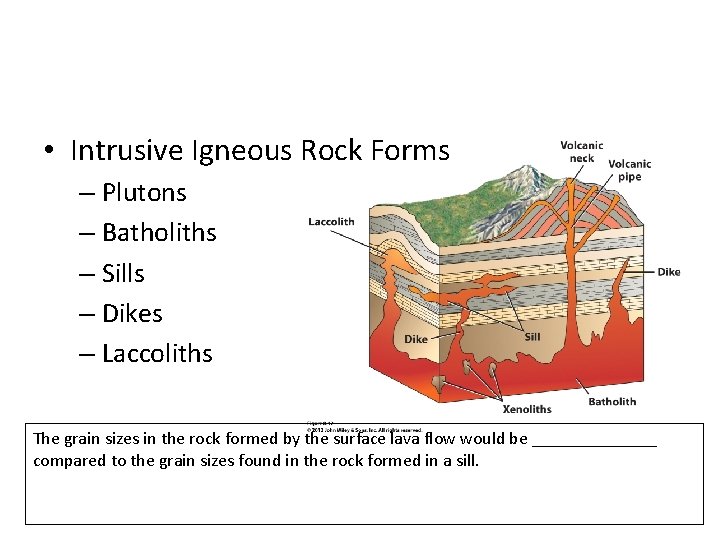
• Intrusive Igneous Rock Forms – Plutons – Batholiths – Sills – Dikes – Laccoliths The grain sizes in the rock formed by the surface lava flow would be _______ compared to the grain sizes found in the rock formed in a sill.
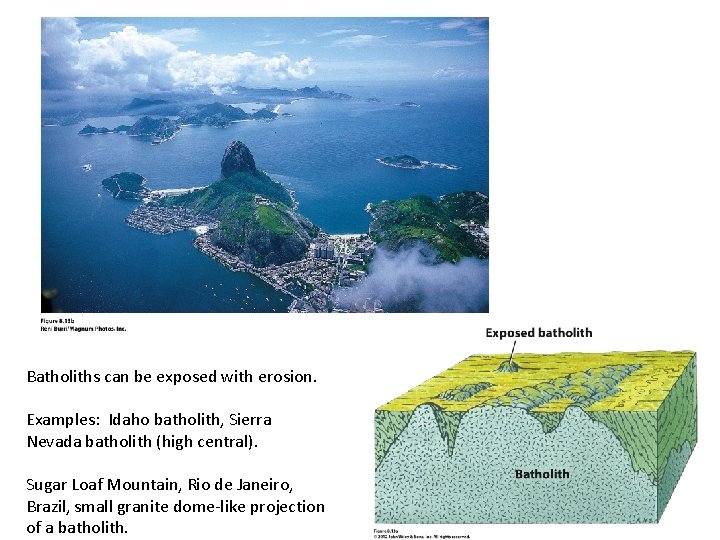
Batholiths can be exposed with erosion. Examples: Idaho batholith, Sierra Nevada batholith (high central). Sugar Loaf Mountain, Rio de Janeiro, Brazil, small granite dome-like projection of a batholith.
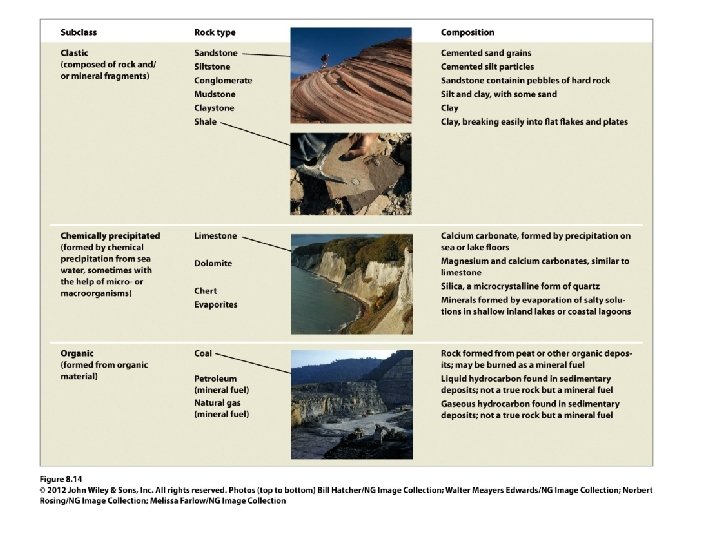
• Sedimentary Rock – Made from layers of mineral particles found in other rocks – Have been carried by weathering – Can include newly formed material, plant and animal material – Physical weathering break down rock at the Earth’s surface – Chemical weathering actually changes the chemical composition of mineral grains (usually through exposure to oxygen and water). – When these particles are transported, they’re called sediment – Have distinctive layers or strata
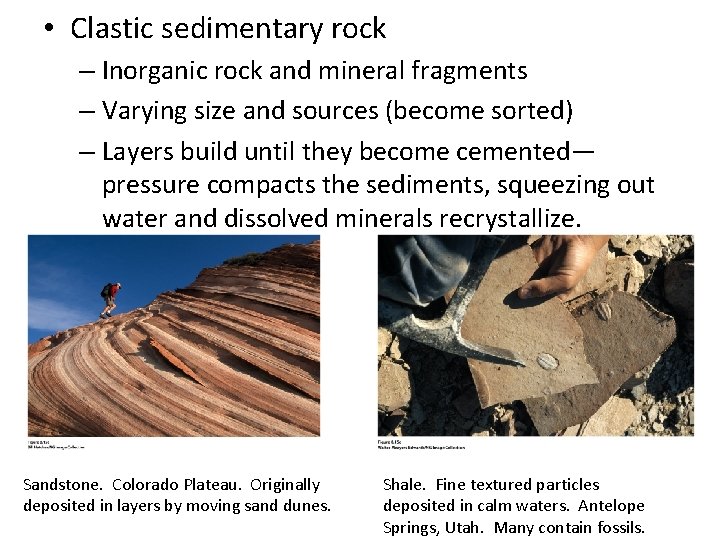
• Clastic sedimentary rock – Inorganic rock and mineral fragments – Varying size and sources (become sorted) – Layers build until they become cemented— pressure compacts the sediments, squeezing out water and dissolved minerals recrystallize. Sandstone. Colorado Plateau. Originally deposited in layers by moving sand dunes. Shale. Fine textured particles deposited in calm waters. Antelope Springs, Utah. Many contain fossils.
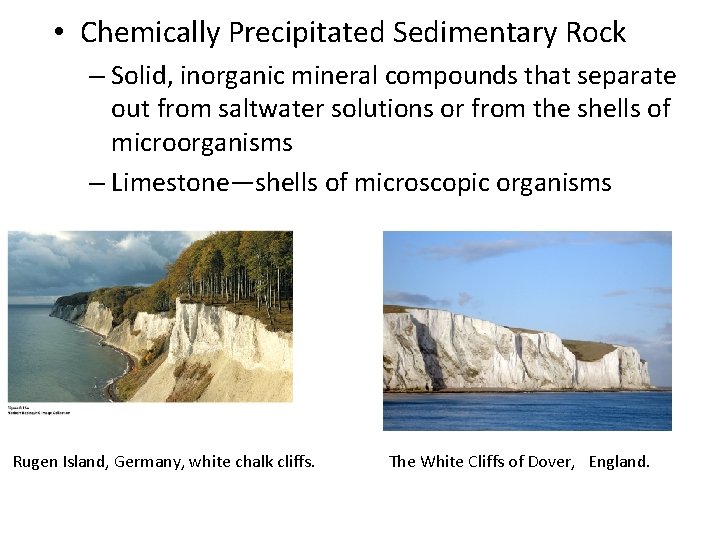
• Chemically Precipitated Sedimentary Rock – Solid, inorganic mineral compounds that separate out from saltwater solutions or from the shells of microorganisms – Limestone—shells of microscopic organisms Rugen Island, Germany, white chalk cliffs. The White Cliffs of Dover, England.
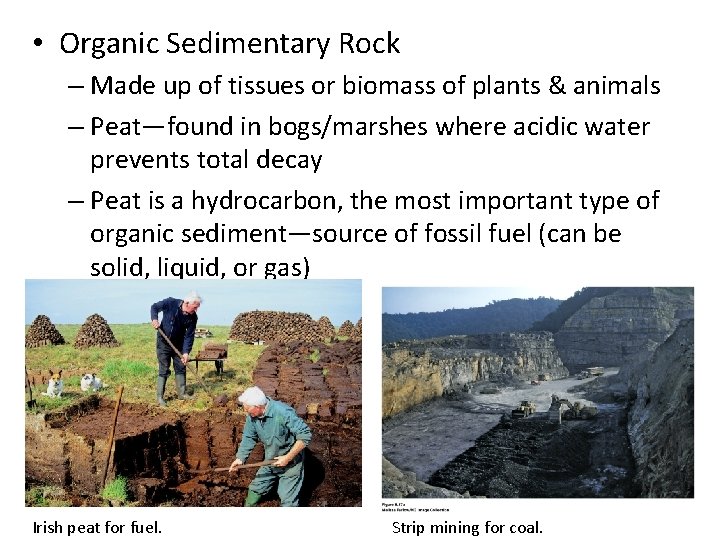
• Organic Sedimentary Rock – Made up of tissues or biomass of plants & animals – Peat—found in bogs/marshes where acidic water prevents total decay – Peat is a hydrocarbon, the most important type of organic sediment—source of fossil fuel (can be solid, liquid, or gas) Irish peat for fuel. Strip mining for coal.
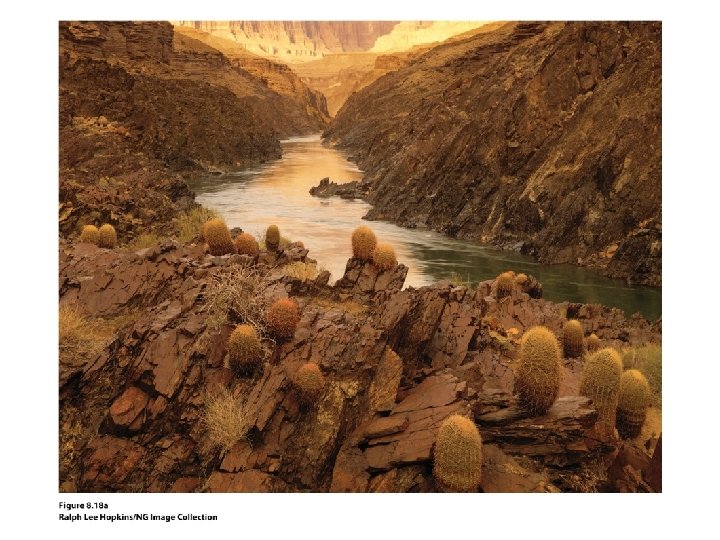
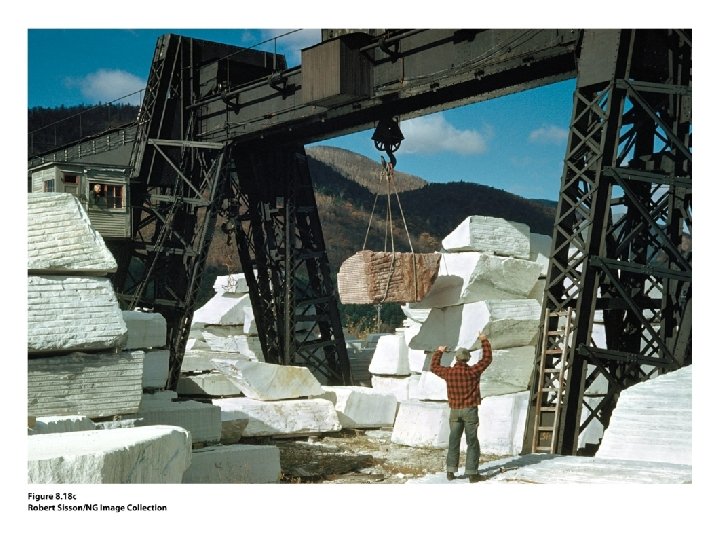
• Metamorphic Rock – Altering of rock due to very high pressure and temperature resulting from mountain-building processes – Rock is changed in texture and structure – More resistant to weathering than their parent rocks: Shale becomes Slate; Sandstone becomes Quartzite; Limestone becomes Marble – Occurs where magma intrudes into crustal rocks, and where tectonic activities are occurring—slate, schist, gneiss.
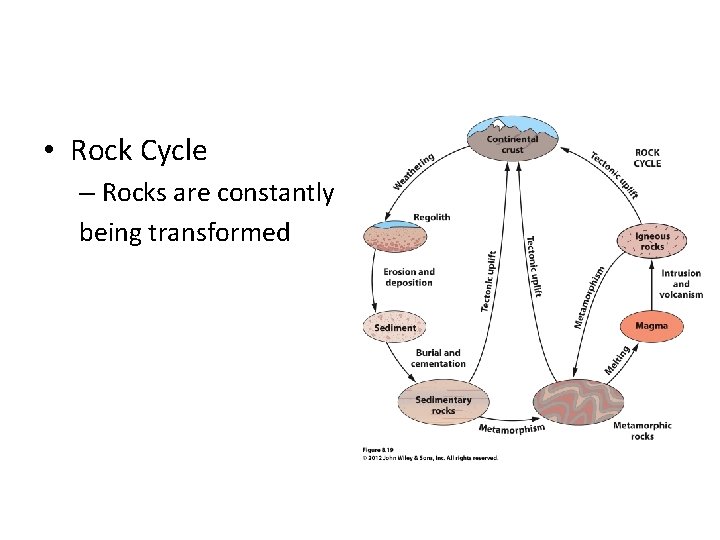
• Rock Cycle – Rocks are constantly being transformed
Earth’s Topography • Topography—major surface features of crust • Relief features—mountain chains, midoceanic ridges, high plateaus, ocean trenches • Continental & Oceanic Features
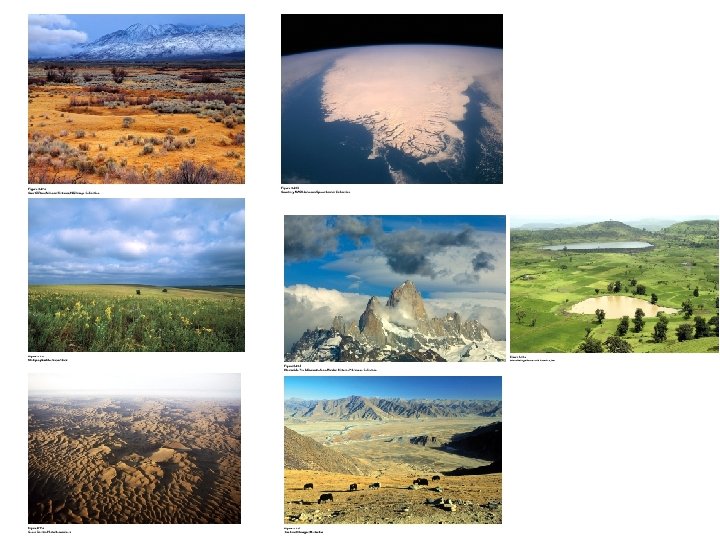
• Continental Features – Alpine Chains • • Active Narrow zones on margins of plates High, rugged Can grow two ways: volcanism, tectonic activity – Continental Shields • Older, inactive • Areas of low-lying igneous and metamorphic rock that haven’t eroded • Continent building material – Continental landforms • Six types:
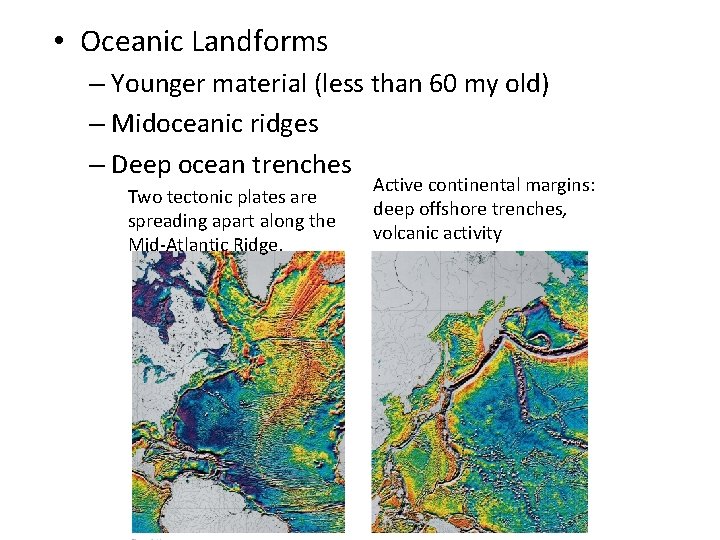
• Oceanic Landforms – Younger material (less than 60 my old) – Midoceanic ridges – Deep ocean trenches Two tectonic plates are spreading apart along the Mid-Atlantic Ridge. Active continental margins: deep offshore trenches, volcanic activity
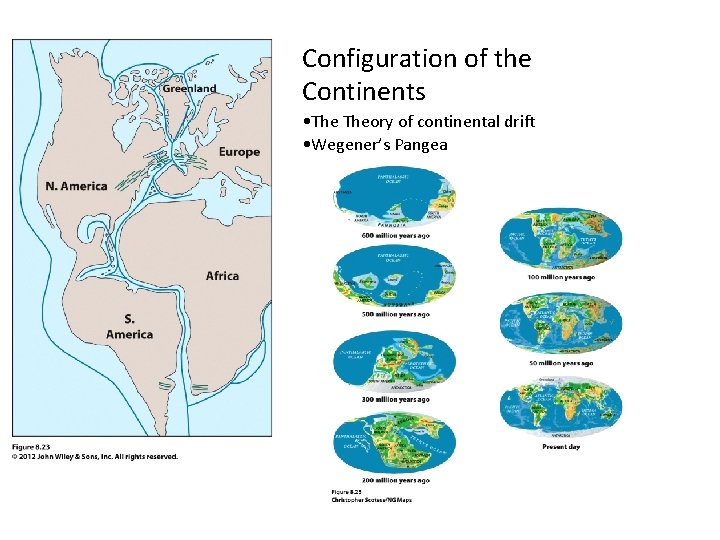
Configuration of the Continents • Theory of continental drift • Wegener’s Pangea
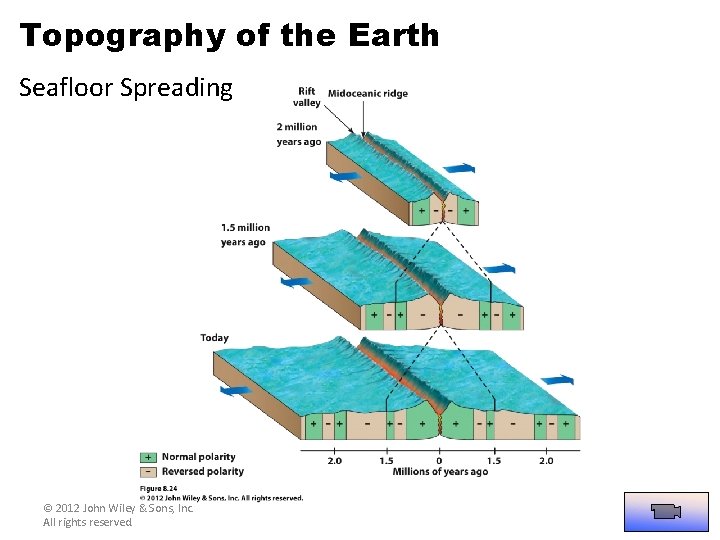
Topography of the Earth Seafloor Spreading © 2012 John Wiley & Sons, Inc. All rights reserved.