
Chapter 8 Dentist Dental Hygienist Dental Assistant U
- Slides: 34
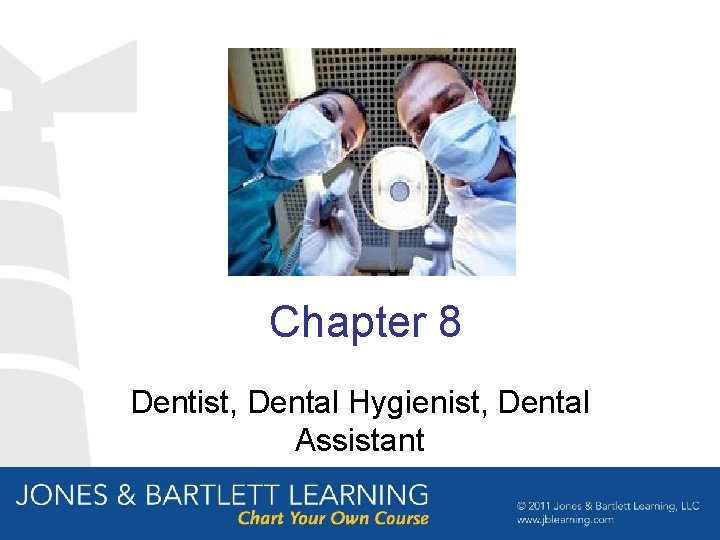
Chapter 8 Dentist, Dental Hygienist, Dental Assistant
U. S. News – Best Jobs 2016 Out of 100 jobs: • Orthodontist #1 • Dentist #2 • Prosthodontist #30 • Dental Hygienist #32
Work Description • Dentists diagnose and treat problems with teeth and tissues in the mouth, along with giving advice and administering care to help prevent future problems. • They provide instruction on diet, brushing, flossing, the use of fluorides, and other aspects of dental care. • They remove tooth decay, fill cavities, examine X-rays, place protective plastic sealants on children’s teeth, straighten teeth, and repair fractured teeth. • They also perform corrective surgery on gums and supporting bones to treat gum diseases. • Dentists extract teeth and make models and measurements for dentures to replace missing teeth. • They also administer anesthetics and write prescriptions for antibiotics and other medications.
Work Environment • Most dentists are solo practitioners, meaning that they own their own businesses and work alone or with a small staff. • Most dentists work 4 - 5 days a week. Some work evenings and weekends to meet their patients’ needs. • Most full-time dentists work between 35 and 40 hours a week. Experienced dentists often work fewer hours. • It is common for dentists to continue in part-time practice well beyond the usual retirement age. • Dentists usually work in the safety of an office environment. However, work-related injuries can occur, such as those resulting from the use of handheld tools when performing dental work on patients.
Employment Opportunities • Dentists held about 141, 900 jobs in 2008. • Most are general practice dentists • Only about 15% of all dentists were specialists – 9 areas: orthodontist, oral surgeons, prosthodontist, endodontists, etc. • Almost all dentists work in private practice.
Educational and Legal Requirements • All 50 states and the District of Columbia require dentists to be licensed. • To qualify for a license in most states, candidates must graduate from an accredited dental school and pass written and practical examinations – 4 yr post bachelor degree dental “medical” school
Education and Training • In 2008, there were 57 dental schools in the United States accredited by the ADA’s Commission on Dental Accreditation. • Most dental students have at least a Bachelor degree before entering dental school. • According to the ADA, 85% of dental students had a Bachelor degree prior to beginning their dental program in the 2006– 2007 academic year.
Licensure • Licensing is required to practice as a dentist. • In most states, licensure requires passing written and practical examinations in addition to having a degree from an accredited dental school.
Other Qualifications • Dentistry requires diagnostic ability and manual skills. • Dentists should have: – – – – Good visual memory Excellent judgment regarding space, shape, and color A high degree of manual dexterity Scientific ability Good business sense Self-discipline Good communication skills
Advancement • Many private practitioners teach part time. • Some dental school graduates work for established dentists as associates for 1 to 2 years to gain experience and save money to equip an office of their own. • Most dental school graduates, however, purchase an established practice or open a new one immediately after graduation.
Employment Opportunities • Employment is projected to grow faster than average. • Job prospects should be good, reflecting the need to replace the large number of dentists expected to retire.
Job Prospects • The employment of dentists is projected to grow by 16% through 2018, which is faster than the average for all occupations. • The demand for dental services is expected to continue to increase. – access to dental insurance – the exploding elderly population
Earnings • Median annual wages of salaried general dentists were $142, 870 in May 2008. • Dentists who are salaried often receive benefits paid by their employer.
DENTAL HYGIENISTS
Work Description • Dental hygienists clean teeth and provide other preventive dental care • They also teach patients how to practice good oral hygiene. • Hygienists examine patients’ teeth and gums, recording the presence of diseases or abnormalities. • They remove calculus, stains, and plaque from teeth; take and develop dental X-rays; • They apply cavity preventive agents such as fluorides and pit and fissure sealants. • In some states, hygienists administer local anesthetics and anesthetic gas; place and carve filling materials, temporary fillings, and periodontal dressings; remove sutures; and smooth and polish metal restorations.
Employment Opportunities • Dental hygienists held about 174, 100 jobs in 2008. • About 51% of dental hygienists worked part time. • Almost all jobs for dental hygienists—about 96%—were in offices of dentists.
Educational and Legal Requirements • Prospective dental hygienists must become licensed in the state in which they wish to practice. • A degree from an accredited dental hygiene school is required along with licensure examinations.
Education and Training • A high school diploma and college entrance test scores are usually required for admission to a dental hygiene program. • High school students interested in becoming a dental hygienist should take courses in biology, chemistry, and mathematics. • Also, some dental hygiene programs require applicants to have completed at least 1 year of college.
Licensure • Dental hygienists must be licensed by the state in which they practice. • Nearly all states require candidates to graduate from an accredited dental hygiene school and pass both a written and clinical examination. • The American Dental Association’s Joint Commission on National Dental Examinations administers the written examination.
Other Qualifications • Dental hygienists should work well with others because they work closely with dentists and dental assistants as well as deal directly with patients. • Hygienists also need good manual dexterity, because they use dental instruments within a patient’s mouth, with little room for error. • Dental hygienists sometimes work with radiation technology
Advancement • Advancement opportunities – working outside a typical dentist’s office - usually requires a Bachelor or Master degree in dental hygiene (Clark College has Bachelors program) • Some dental hygienists may choose to pursue a career teaching in a dental hygiene program, working in public health, or working in a corporate setting.
Employment Trends • Dental hygienist ranks among the fastestgrowing occupations, and job prospects are expected to be favorable in most areas, but competition for jobs is likely in some areas.
Employment Change • Employment of dental hygienists is expected to grow 36% through 2018, which is much faster than the average for all occupations. • This projected growth ranks dental hygienist among the fastest-growing occupations, in response to increasing demand for dental care and the greater use of hygienists.
Earnings • Median annual wages of dental hygienists were $66, 570 in May 2008. • The middle 50% earned between $55, 220 and $78, 990. • The lowest 10% earned less than $44, 180. • The highest 10% earned more than $91, 470.
DENTAL ASSISTANTS
Work Description • Dental assistants perform a variety of patient care, office, and laboratory duties. • They work chairside as Dentists AND Hygienists examine and treat patients. • They make patients comfortable, prepare them for treatment, and obtain dental records. • Assistants hand instruments and materials to dentists, and keep patients’ mouths dry and clear by using suction or other devices. • They also sterilize and disinfect instruments and equipment, prepare tray setups for dental procedures, and instruct patients on postoperative and general oral health care.
Work Environment • Dental assistants work in a well-lighted, clean environment. • Their work area is usually near the dental chair, so they can arrange instruments, materials, and medication and hand them to the dentist when needed. • Dental assistants wear gloves and masks to protect themselves from infectious diseases. • Following safety procedures minimizes the risks of handling radiographic equipment.
Employment Opportunities • About 93% of all jobs for dental assistants were in offices of dentists. • A small number of jobs were in the federal, state, and local governments or in offices of physicians. • Some dental assistants worked part time, sometimes in more than one dental office.
Educational and Legal Requirements • Many assistants learn their skills on the job, although an increasing number are trained in dental-assisting programs – Most programs take 1 year to complete. • Many states require assistants to obtain a license or certification. – especially if working with radiation procedures
Education and Training • In most states, there are no formal education or training requirements to become an entry-level dental assistant. • High school students interested in a career as a dental assistant should take courses in biology, chemistry, health, and office practices.
Licensure and Certification • Most states regulate the duties that dental assistants are allowed to perform. • Licensure may include attending an accredited dental-assisting program and passing a written or practical examination. • Certification is available through the DANB
Advancement • Without further education, advancement opportunities are limited. • Some dental assistants become office managers, dental-assisting instructors, dental product sales representatives, or insurance claims processors for dental insurance companies.
Employment Trends/Prospects • Employment is expected to grow 36% from 2008 to 2018, which is much faster than the average for all occupations. • Dental assistant is expected to be among the fastest growing occupations over the 2008– 2018 projection period. • Job prospects for dental assistants should be excellent, as dentists continue to need the aid of qualified dental assistants.
Earnings • Median annual wages of dental assistants were $32, 380 in May 2008. • The middle 50% earned between $26, 980 and $38, 960. • The lowest 10% earned less than $22, 270, and the highest 10% earned more than $46, 150.