
Chapter 8 Decision Making CONSUMER BEHAVIOR 10 e
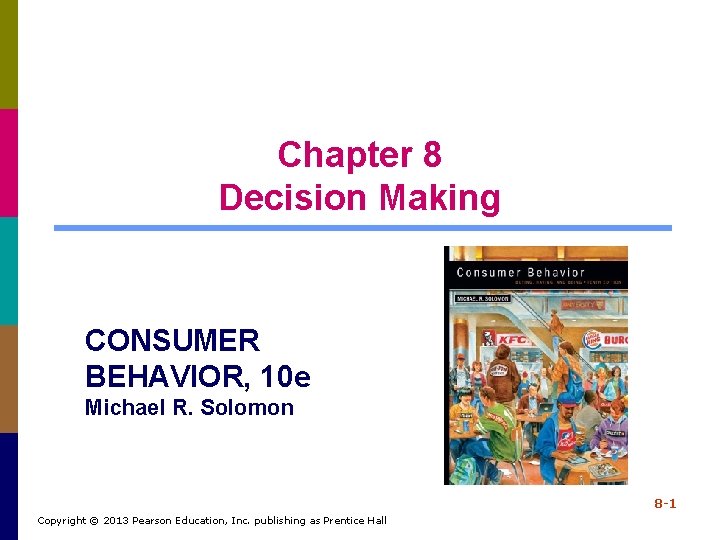
Chapter 8 Decision Making CONSUMER BEHAVIOR, 10 e Michael R. Solomon 8 -1 Copyright © 2013 Pearson Education, Inc. publishing as Prentice Hall
Chapter Objectives When you finish this chapter, you should understand why: 1. Consumer decision making is a central part of consumer behavior, but the way we evaluate and choose products varies widely. 2. A decision is actually composed of a series of stages that results in the selection of one product over competing options. Copyright © 2013 Pearson Education, Inc. publishing as Prentice Hall 8 -2
Chapter Objectives (continued) • Decision making is not always rational. • Our access to online sources is changing the way we decide what to buy. • We often fall back on well-learned “rules-of -thumb” to make decisions. • Consumers rely upon different decision rules when evaluating competing options. Copyright © 2013 Pearson Education, Inc. publishing as Prentice Hall 8 -3
Learning Objective 1 • Consumer decision making is a central part of consumer behavior, but the way we evaluate and choose products varies widely. Copyright © 2013 Pearson Education, Inc. publishing as Prentice Hall 8 -4
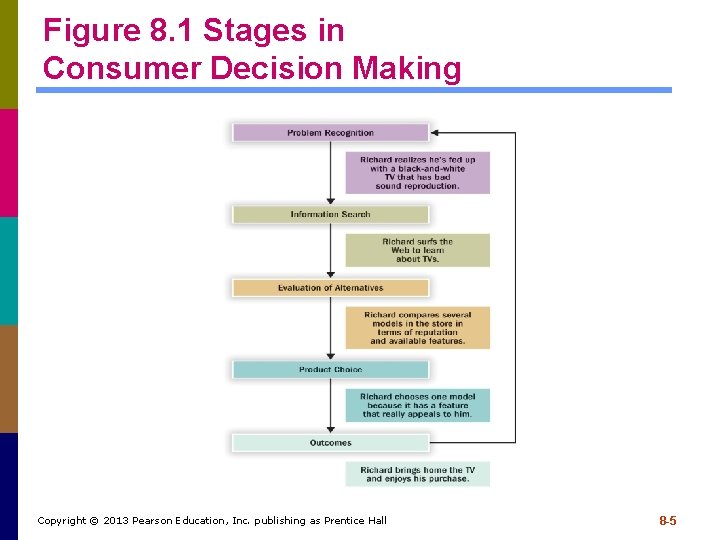
Figure 8. 1 Stages in Consumer Decision Making Copyright © 2013 Pearson Education, Inc. publishing as Prentice Hall 8 -5
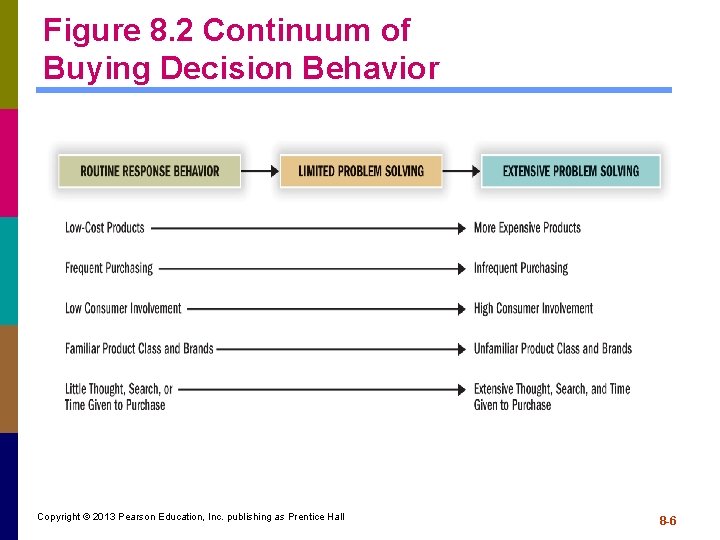
Figure 8. 2 Continuum of Buying Decision Behavior Copyright © 2013 Pearson Education, Inc. publishing as Prentice Hall 8 -6
For Reflection • Is it a problem that consumers have too many choices? Would it be better to have less choices? How does it affect consumer decision-making? Copyright © 2013 Pearson Education, Inc. publishing as Prentice Hall 8 -7
Learning Objective 2 • A decision is actually composed of a series of stages that results in the selection of one product over competing options. Copyright © 2013 Pearson Education, Inc. publishing as Prentice Hall 8 -8
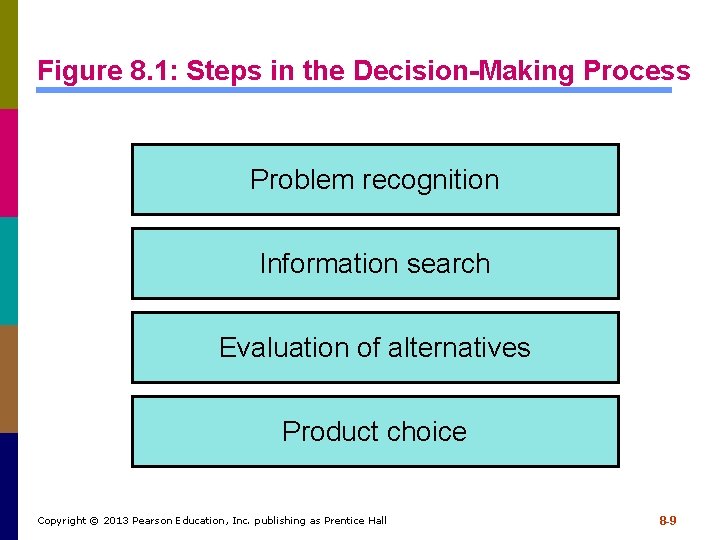
Figure 8. 1: Steps in the Decision-Making Process Problem recognition Information search Evaluation of alternatives Product choice Copyright © 2013 Pearson Education, Inc. publishing as Prentice Hall 8 -9
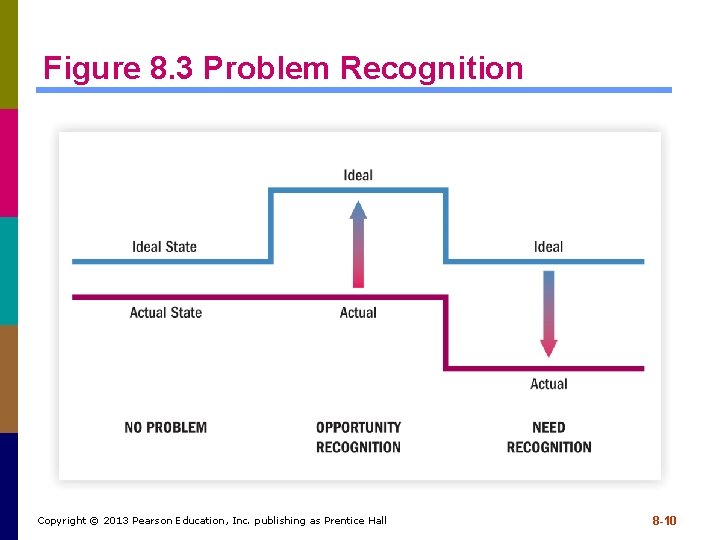
Figure 8. 3 Problem Recognition Copyright © 2013 Pearson Education, Inc. publishing as Prentice Hall 8 -10
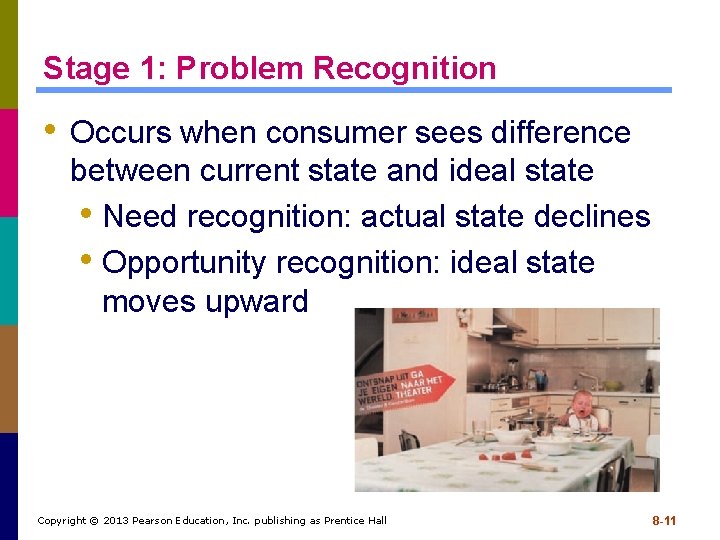
Stage 1: Problem Recognition • Occurs when consumer sees difference between current state and ideal state • Need recognition: actual state declines • Opportunity recognition: ideal state moves upward Copyright © 2013 Pearson Education, Inc. publishing as Prentice Hall 8 -11
Stage 2: Information Search • The process by which we survey the environment for appropriate data to make a reasonable decision • Prepurchase or ongoing search • Internal or external search • Online search Copyright © 2013 Pearson Education, Inc. publishing as Prentice Hall 8 -12
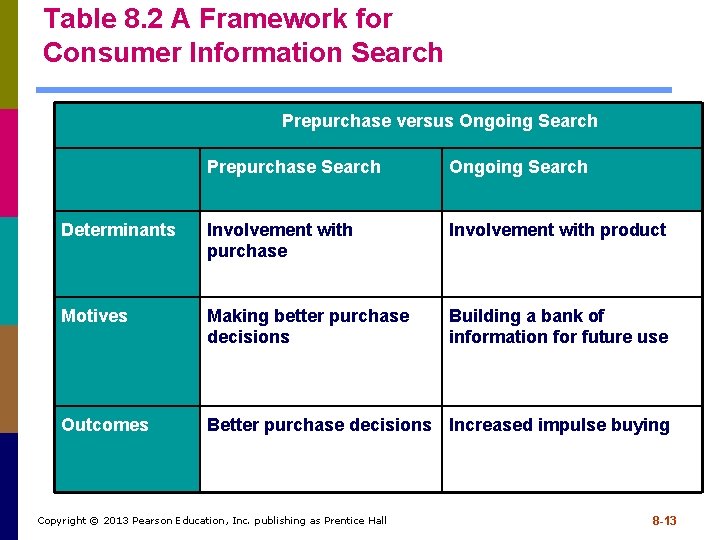
Table 8. 2 A Framework for Consumer Information Search Prepurchase versus Ongoing Search Prepurchase Search Ongoing Search Determinants Involvement with purchase Involvement with product Motives Making better purchase decisions Building a bank of information for future use Outcomes Better purchase decisions Increased impulse buying Copyright © 2013 Pearson Education, Inc. publishing as Prentice Hall 8 -13
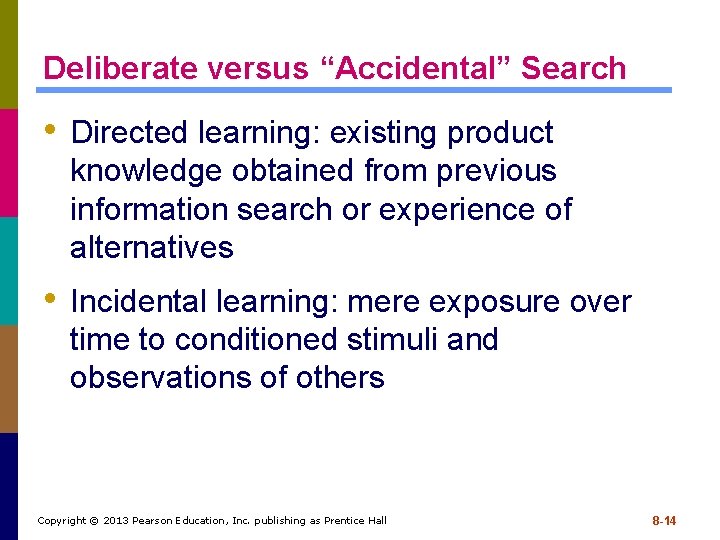
Deliberate versus “Accidental” Search • Directed learning: existing product knowledge obtained from previous information search or experience of alternatives • Incidental learning: mere exposure over time to conditioned stimuli and observations of others Copyright © 2013 Pearson Education, Inc. publishing as Prentice Hall 8 -14
For Reflection • Share a situation in which you searched for information deliberately and one in which you had developed product knowledge incidentally. How would you say the variations in information search affected your decision? Copyright © 2013 Pearson Education, Inc. publishing as Prentice Hall 8 -15
Learning Objective 3 • Decision making is not always rational. Copyright © 2013 Pearson Education, Inc. publishing as Prentice Hall 8 -16
Do Consumers Always Search Rationally? • Some consumers avoid external search, especially with minimal time to do so and with durable goods (e. g. autos) • Symbolic items require more external search • Brand switching: we select familiar brands when decision situation is ambiguous • Variety seeking: desire to choose new alternatives over more familiar ones Copyright © 2013 Pearson Education, Inc. publishing as Prentice Hall 8 -17
Biases in Decision-Making Process • Mental accounting: framing a problem in terms of gains/losses influences our decisions • Sunk-cost fallacy: We are reluctant to waste something we have paid for • Loss aversion: We emphasize losses more than gains • Prospect theory: risk differs when we face gains versus losses Copyright © 2013 Pearson Education, Inc. publishing as Prentice Hall 8 -18
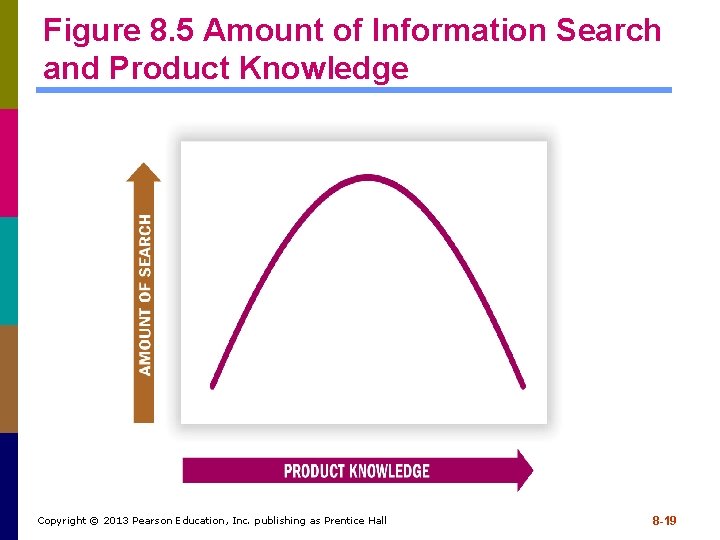
Figure 8. 5 Amount of Information Search and Product Knowledge Copyright © 2013 Pearson Education, Inc. publishing as Prentice Hall 8 -19
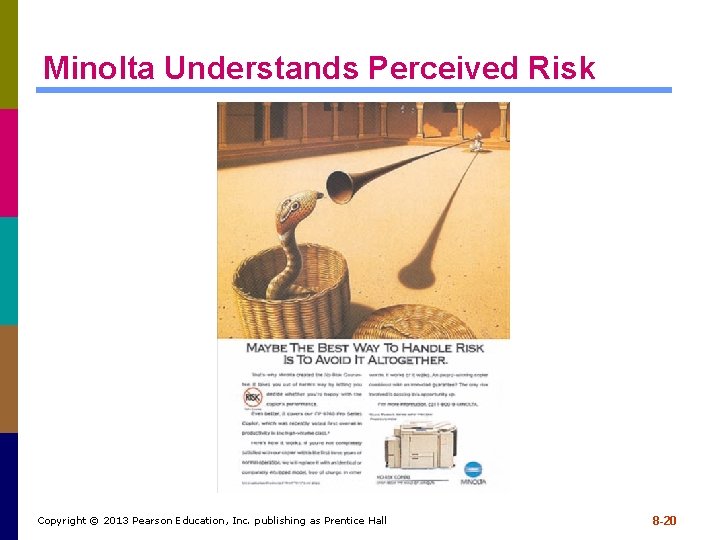
Minolta Understands Perceived Risk Copyright © 2013 Pearson Education, Inc. publishing as Prentice Hall 8 -20
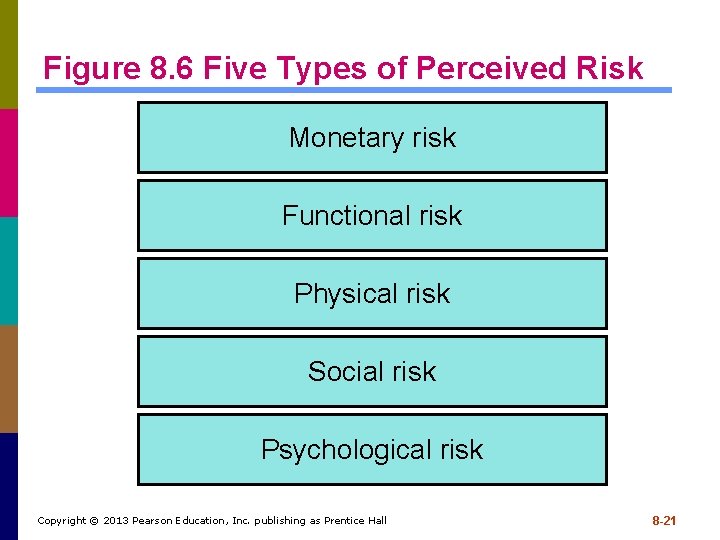
Figure 8. 6 Five Types of Perceived Risk Monetary risk Functional risk Physical risk Social risk Psychological risk Copyright © 2013 Pearson Education, Inc. publishing as Prentice Hall 8 -21
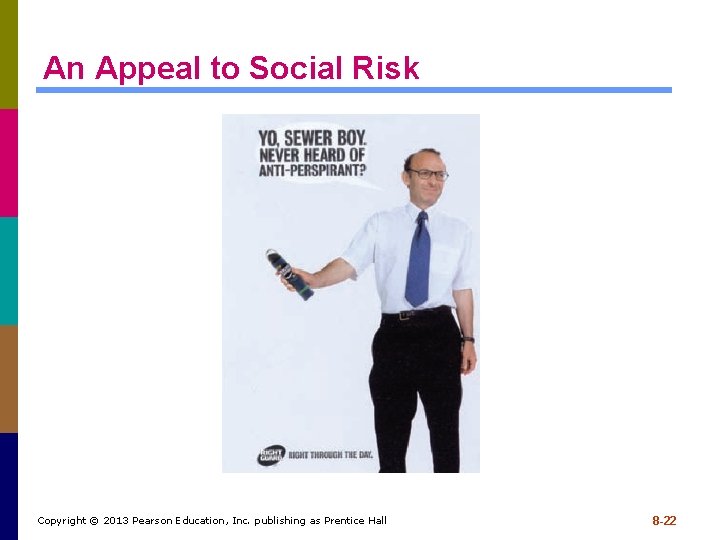
An Appeal to Social Risk Copyright © 2013 Pearson Education, Inc. publishing as Prentice Hall 8 -22
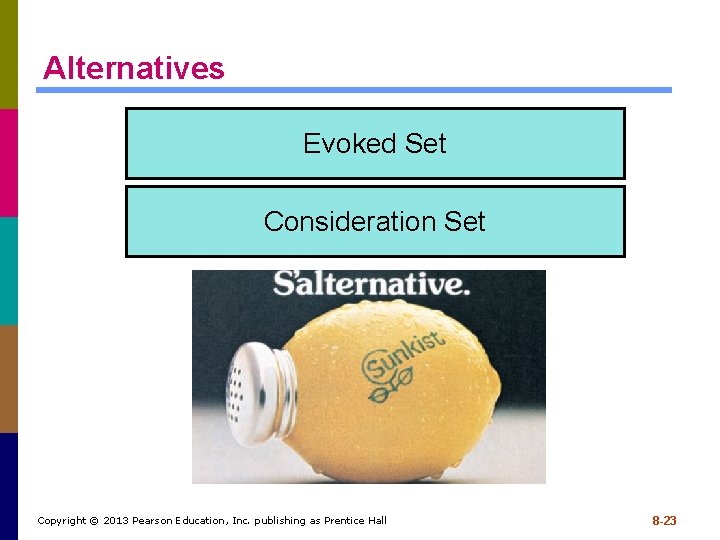
Alternatives Evoked Set Consideration Set Copyright © 2013 Pearson Education, Inc. publishing as Prentice Hall 8 -23
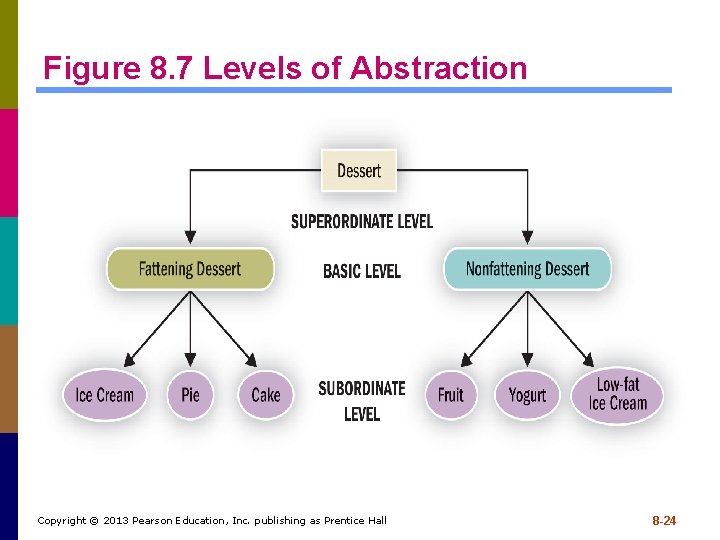
Figure 8. 7 Levels of Abstraction Copyright © 2013 Pearson Education, Inc. publishing as Prentice Hall 8 -24
Strategic Implications of Product Categorization • • Position a product Identify competitors Create an exemplar product Locate products in a store Copyright © 2013 Pearson Education, Inc. publishing as Prentice Hall 8 -25
Product Choice: How Do We Decide? • Once we assemble and evaluate relevant options from a category, we must choose among them • Decision rules for product choice can be very simple or very complicated • Prior experience with (similar) product • Present information at time of purchase • Beliefs about brands (from advertising) Copyright © 2013 Pearson Education, Inc. publishing as Prentice Hall 8 -26
Information Necessary for Recommending a New Decision Criterion • It should point out that there are significant differences among brands on the attribute • It should supply the consumer with a decision-making rule, such as if, then • It should convey a rule that is consistent with how the person made the decision on prior occasions Copyright © 2013 Pearson Education, Inc. publishing as Prentice Hall 8 -27
Neuromarketing • Uses functional magnetic resonance imaging, a brain-scanning device that tracks blood flow as we perform mental tasks • Marketers measure consumers’ reactions to movie trailers, choices about automobiles, the appeal of a pretty face, and loyalty to specific brands Copyright © 2013 Pearson Education, Inc. publishing as Prentice Hall 8 -28
For Reflection • What risky products have you considered recently? • Which forms of risk were involved? Copyright © 2013 Pearson Education, Inc. publishing as Prentice Hall 8 -29
Learning Objective 4 • Our access to online sources changes the way we decide what to buy. Copyright © 2013 Pearson Education, Inc. publishing as Prentice Hall 8 -30
Cybermediaries • The Web delivers enormous amounts of product information in seconds • Cybermediary: helps filter and organize online market information • Examples: Shopping. com, Biz. Rate. com Copyright © 2013 Pearson Education, Inc. publishing as Prentice Hall 8 -31
For Reflection • Which online sources of information are affecting your choices as a consumer? • Online reviews and ratings • Comments on social networks • Other? Copyright © 2013 Pearson Education, Inc. publishing as Prentice Hall 8 -32
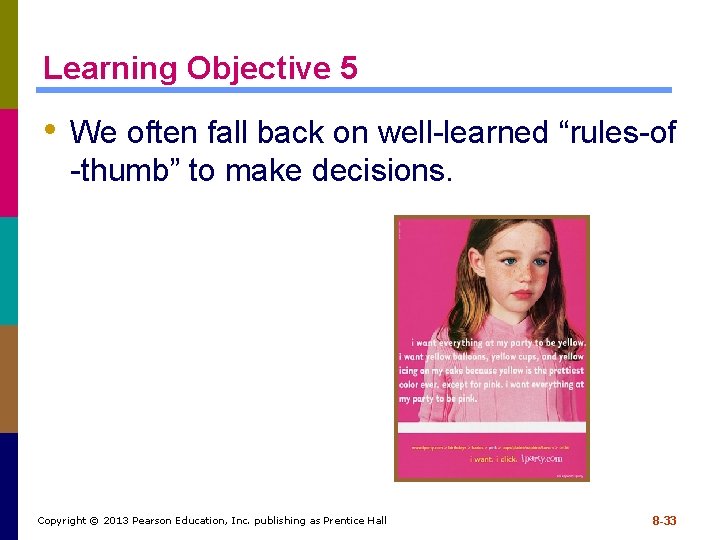
Learning Objective 5 • We often fall back on well-learned “rules-of -thumb” to make decisions. Copyright © 2013 Pearson Education, Inc. publishing as Prentice Hall 8 -33
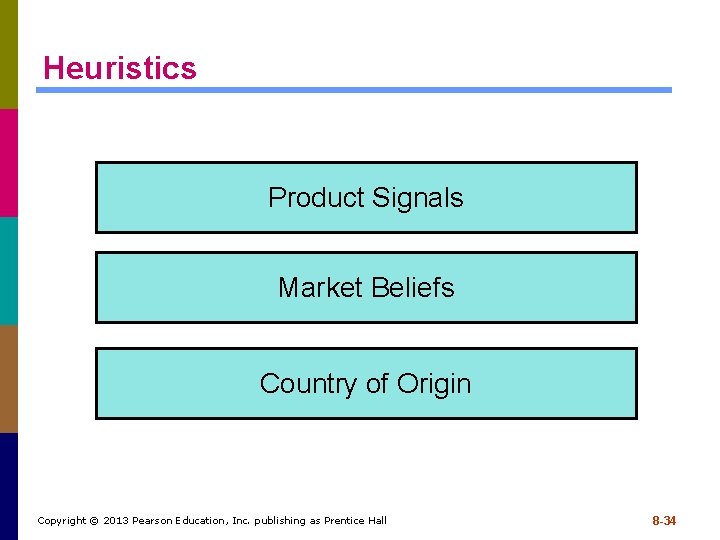
Heuristics Product Signals Market Beliefs Country of Origin Copyright © 2013 Pearson Education, Inc. publishing as Prentice Hall 8 -34
Choosing Familiar Brand Names • Zipf’s Law: our tendency to prefer a number one brand to the competition • Consumer inertia: the tendency to buy a brand out of habit merely because it requires less effort • Brand loyalty: repeat purchasing behavior that reflects a conscious decision to continue buying the same brand Copyright © 2013 Pearson Education, Inc. publishing as Prentice Hall 8 -35
For Reflection • Think of some of the common country of origin effects (e. g. , watches, wine). Which ones affect your consumer choices? What could brands from other countries do to compete such effects? Copyright © 2013 Pearson Education, Inc. publishing as Prentice Hall 8 -36
Learning Objective 6 • Consumers rely on different decision rules when they evaluate competing options. Copyright © 2013 Pearson Education, Inc. publishing as Prentice Hall 8 -37
Noncompensatory Decision Rules • Lexicographic rule: consumers select the brand that is the best on the most important attribute • Elimination-by-aspects rule: the buyer also evaluates brands on the most important attribute • Conjunctive rule: entails processing by brand Copyright © 2013 Pearson Education, Inc. publishing as Prentice Hall 8 -38
Compensatory Decision Rules • Simple additive rule: the consumer merely chooses the alternative that has the largest number of positive attributes • Weighted additive rule: the consumer also takes into account the relative importance of positively rated attributes, essentially multiplying brand ratings by importance weights Copyright © 2013 Pearson Education, Inc. publishing as Prentice Hall 8 -39
For Reflection • Provide an example of a noncompensatory decision and a compensatory decision you made. Why did one rule format work for one situation but not for the other? Copyright © 2013 Pearson Education, Inc. publishing as Prentice Hall 8 -40
Chapter Summary • Decision making is a central part of consumer behavior and decisions are made in stages • Decision making is not always rational • We use rules of thumb and decision rules to make decisions more efficiently Copyright © 2013 Pearson Education, Inc. publishing as Prentice Hall 8 -41
- Slides: 41