
Chapter 8 CPU and Memory Design Implementation and
- Slides: 42
Chapter 8 CPU and Memory: Design, Implementation, and Enhancement The Architecture of Computer Hardware and Systems Software: An Information Technology Approach 3 rd Edition, Irv Englander John Wiley and Sons 2003 Wilson Wong, Bentley College Linda Senne, Bentley College
CPU Architecture Overview § § § CISC – Complex Instruction Set Computer RISC – Reduced Instruction Set Computer CISC vs. RISC Comparisons VLIW – Very Long Instruction Word EPIC – Explicitly Parallel Instruction Computer Chapter 8: CPU and Memory: Design, Implementation, and Enhancement 2
CISC Architecture § Examples § Intel x 86, IBM Z-Series Mainframes, older CPU architectures § Characteristics § Few general purpose registers § Many addressing modes § Large number of specialized, complex instructions § Instructions are of varying sizes Chapter 8: CPU and Memory: Design, Implementation, and Enhancement 3
Limitations of CISC Architecture § Complex instructions are infrequently used by programmers and compilers § Memory references, loads and stores, are slow and account for a significant fraction of all instructions § Procedure and function calls are a major bottleneck § Passing arguments § Storing and retrieving values in registers Chapter 8: CPU and Memory: Design, Implementation, and Enhancement 4
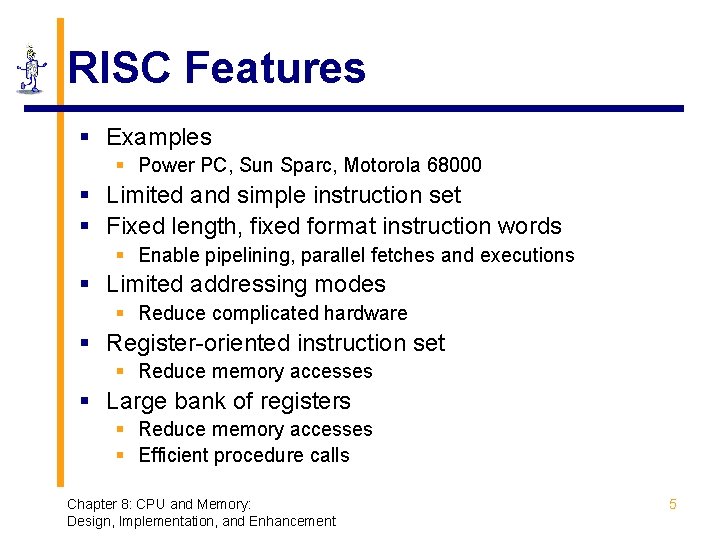
RISC Features § Examples § Power PC, Sun Sparc, Motorola 68000 § Limited and simple instruction set § Fixed length, fixed format instruction words § Enable pipelining, parallel fetches and executions § Limited addressing modes § Reduce complicated hardware § Register-oriented instruction set § Reduce memory accesses § Large bank of registers § Reduce memory accesses § Efficient procedure calls Chapter 8: CPU and Memory: Design, Implementation, and Enhancement 5
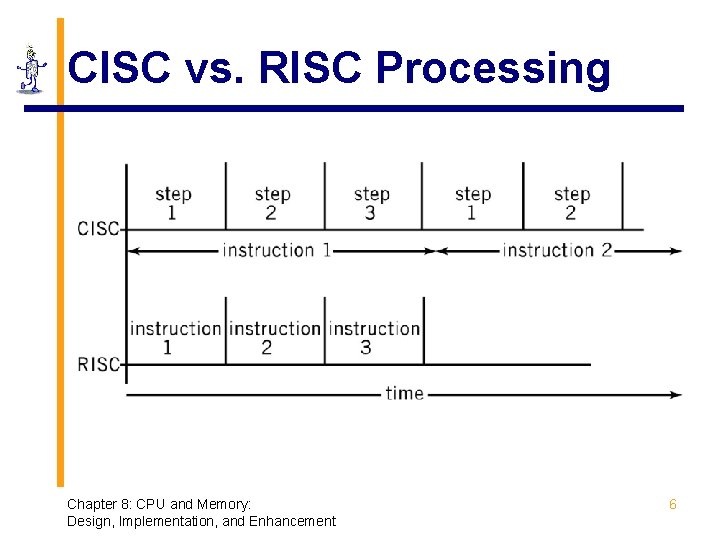
CISC vs. RISC Processing Chapter 8: CPU and Memory: Design, Implementation, and Enhancement 6
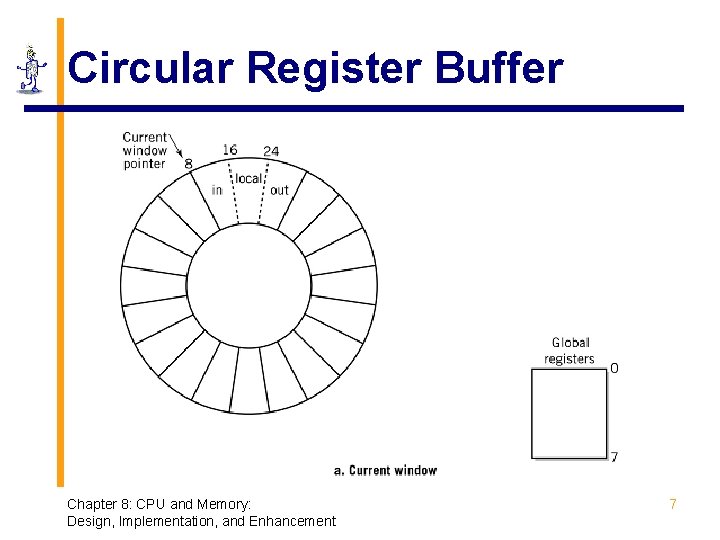
Circular Register Buffer Chapter 8: CPU and Memory: Design, Implementation, and Enhancement 7
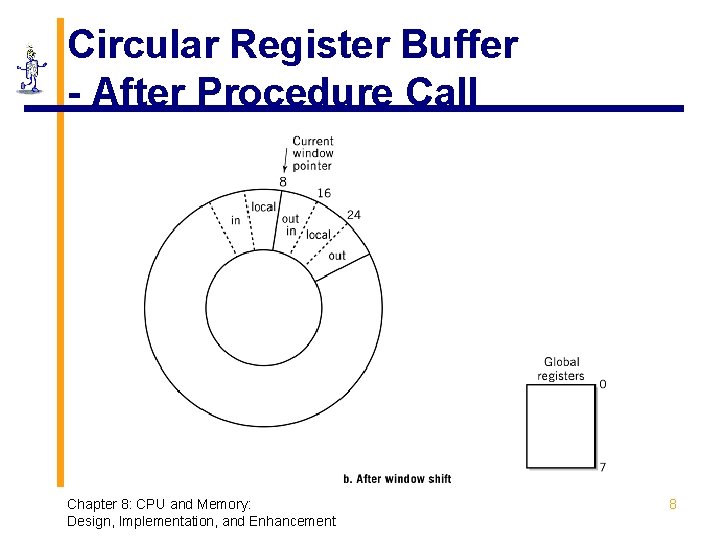
Circular Register Buffer - After Procedure Call Chapter 8: CPU and Memory: Design, Implementation, and Enhancement 8
CISC vs. RISC Performance Comparison § RISC Simpler instructions more memory accesses § RISC more bus traffic and increased cache memory misses § More registers would improve CISC performance but no space available for them § Modern CISC and RISC architectures are becoming similar Chapter 8: CPU and Memory: Design, Implementation, and Enhancement 9
VLIW Architecture § Transmeta Crusoe CPU § 128 -bit instruction bundle = molecule § 4 32 -bit atoms (atom = instruction) § Parallel processing of 4 instructions § 64 general purpose registers § Code morphing layer § Translates instructions written for other CPUs into molecules § Instructions are not written directly for the Crusoe CPU Chapter 8: CPU and Memory: Design, Implementation, and Enhancement 10
EPIC Architecture § Intel Itanium CPU § 128 -bit instruction bundle § 3 41 -bit instructions § 5 bits to identify type of instructions in bundle § § 128 64 -bit general purpose registers 128 82 -bit floating point registers Intel X 86 instruction set included Programmers and compilers follow guidelines to ensure parallel execution of instructions Chapter 8: CPU and Memory: Design, Implementation, and Enhancement 11
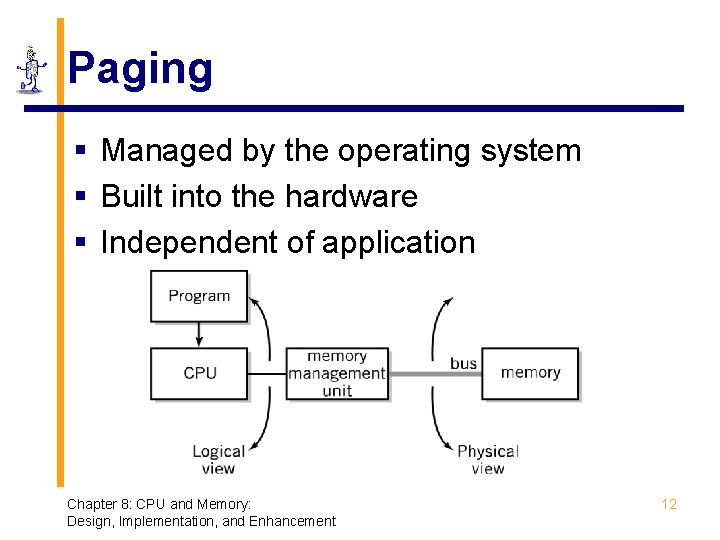
Paging § Managed by the operating system § Built into the hardware § Independent of application Chapter 8: CPU and Memory: Design, Implementation, and Enhancement 12
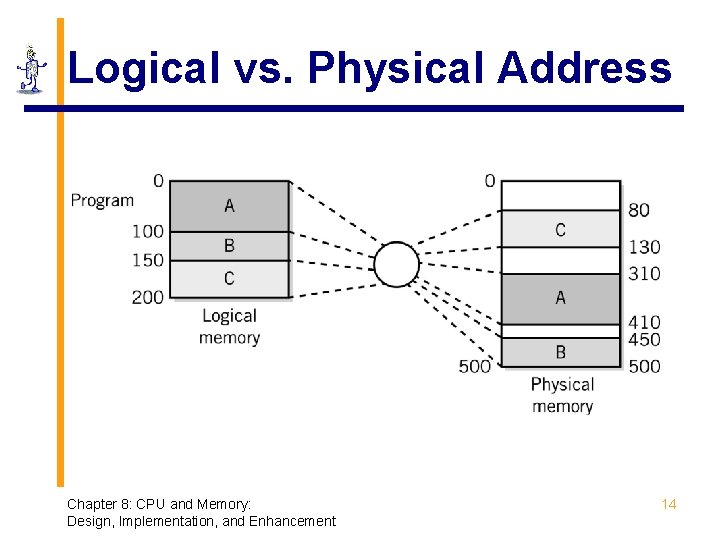
Logical vs. Physical Addresses § Logical addresses are relative locations of data, instructions and branch target and are separate from physical addresses § Logical addresses mapped to physical addresses § Physical addresses do not need to be consecutive Chapter 8: CPU and Memory: Design, Implementation, and Enhancement 13
Logical vs. Physical Address Chapter 8: CPU and Memory: Design, Implementation, and Enhancement 14
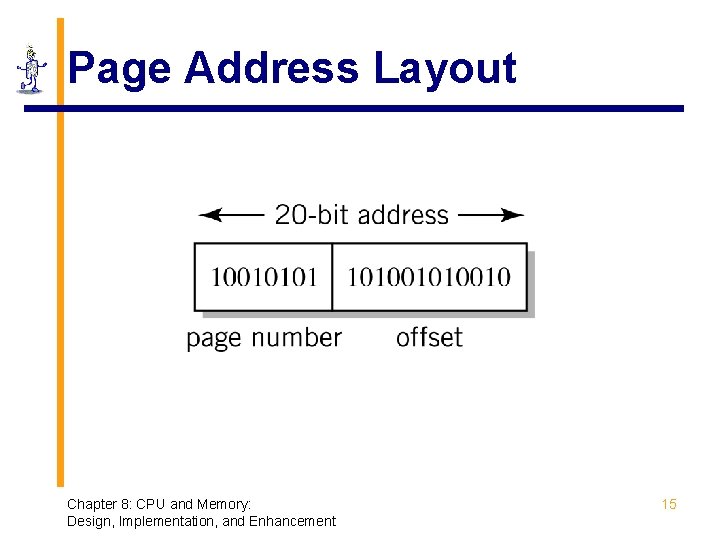
Page Address Layout Chapter 8: CPU and Memory: Design, Implementation, and Enhancement 15
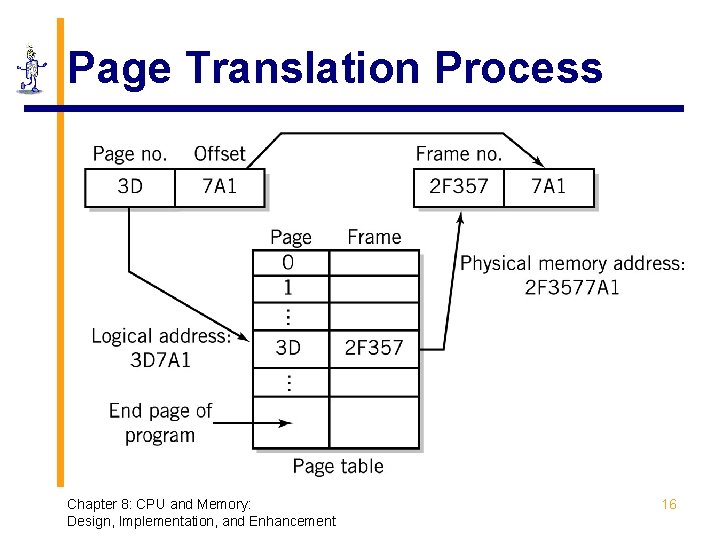
Page Translation Process Chapter 8: CPU and Memory: Design, Implementation, and Enhancement 16
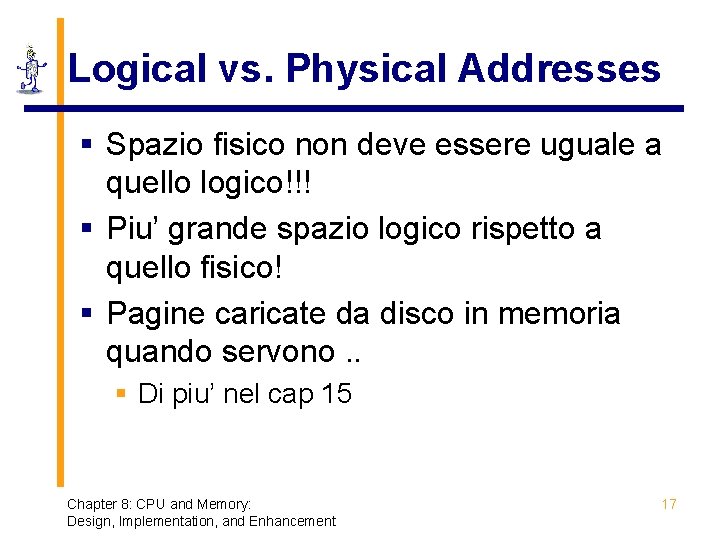
Logical vs. Physical Addresses § Spazio fisico non deve essere uguale a quello logico!!! § Piu’ grande spazio logico rispetto a quello fisico! § Pagine caricate da disco in memoria quando servono. . § Di piu’ nel cap 15 Chapter 8: CPU and Memory: Design, Implementation, and Enhancement 17
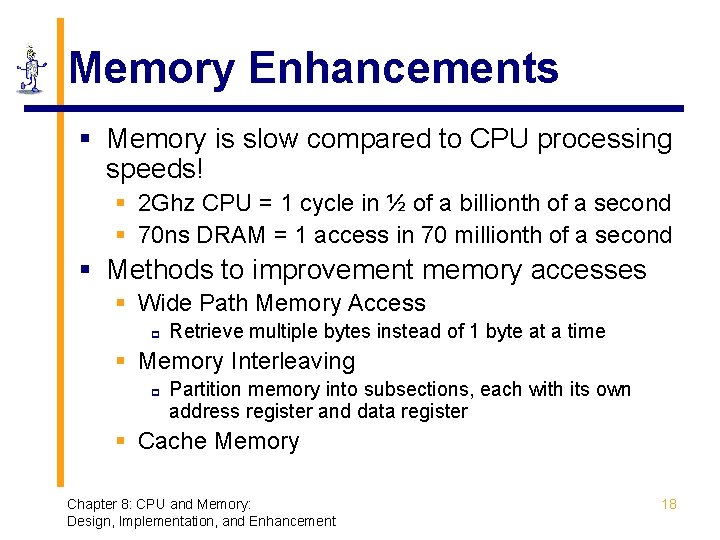
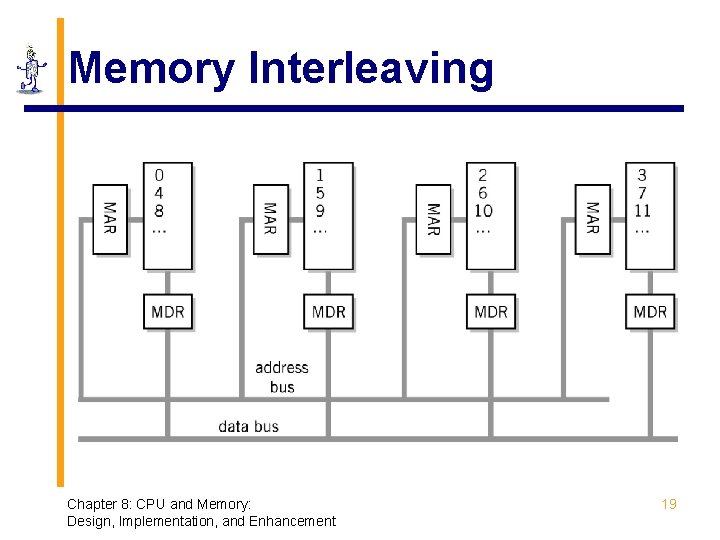
Memory Enhancements § Memory is slow compared to CPU processing speeds! § 2 Ghz CPU = 1 cycle in ½ of a billionth of a second § 70 ns DRAM = 1 access in 70 millionth of a second § Methods to improvement memory accesses § Wide Path Memory Access p Retrieve multiple bytes instead of 1 byte at a time § Memory Interleaving p Partition memory into subsections, each with its own address register and data register § Cache Memory Chapter 8: CPU and Memory: Design, Implementation, and Enhancement 18
Memory Interleaving Chapter 8: CPU and Memory: Design, Implementation, and Enhancement 19
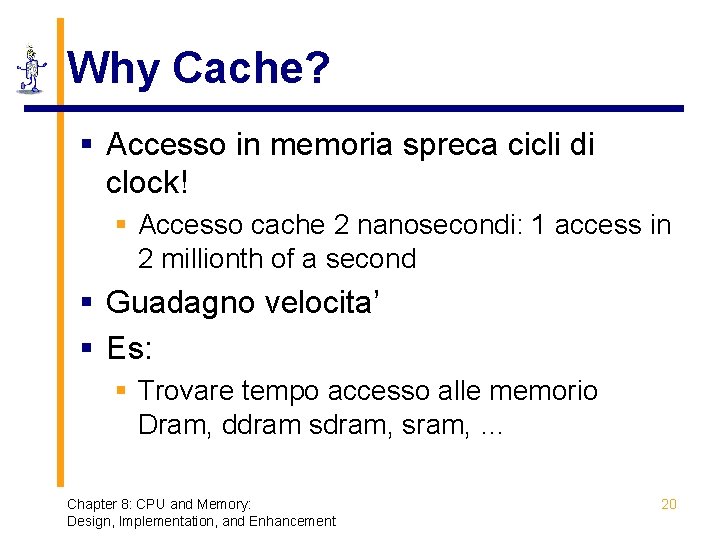
Why Cache? § Accesso in memoria spreca cicli di clock! § Accesso cache 2 nanosecondi: 1 access in 2 millionth of a second § Guadagno velocita’ § Es: § Trovare tempo accesso alle memorio Dram, ddram sdram, sram, … Chapter 8: CPU and Memory: Design, Implementation, and Enhancement 20
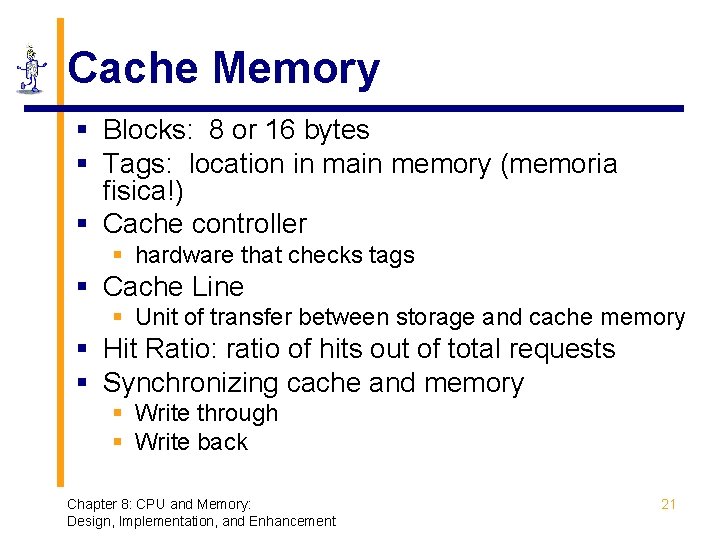
Cache Memory § Blocks: 8 or 16 bytes § Tags: location in main memory (memoria fisica!) § Cache controller § hardware that checks tags § Cache Line § Unit of transfer between storage and cache memory § Hit Ratio: ratio of hits out of total requests § Synchronizing cache and memory § Write through § Write back Chapter 8: CPU and Memory: Design, Implementation, and Enhancement 21
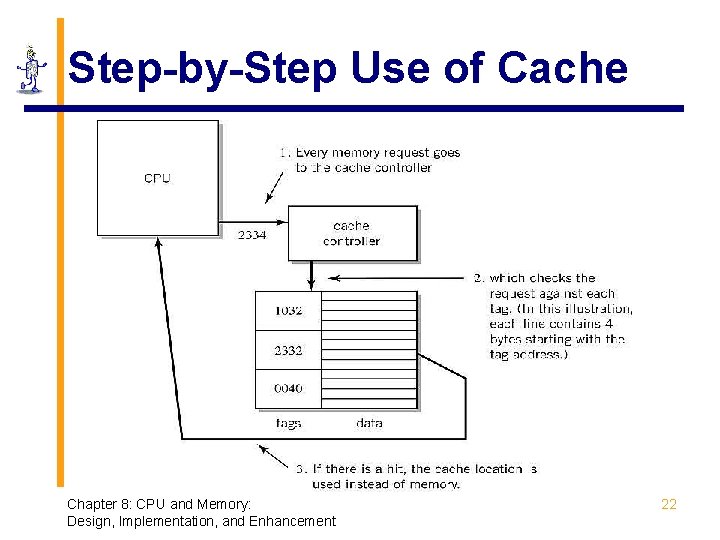
Step-by-Step Use of Cache Chapter 8: CPU and Memory: Design, Implementation, and Enhancement 22
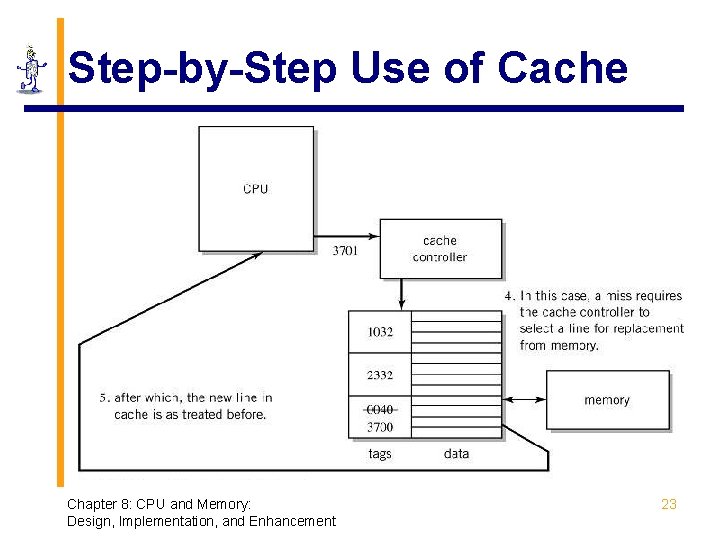
Step-by-Step Use of Cache Chapter 8: CPU and Memory: Design, Implementation, and Enhancement 23
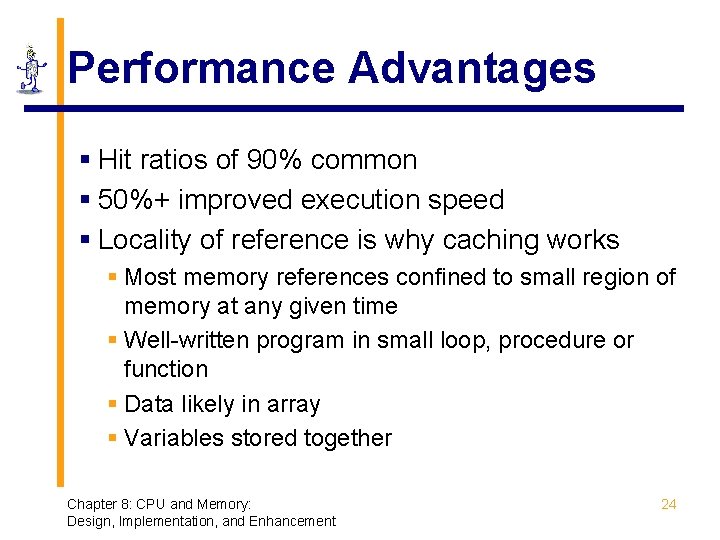
Performance Advantages § Hit ratios of 90% common § 50%+ improved execution speed § Locality of reference is why caching works § Most memory references confined to small region of memory at any given time § Well-written program in small loop, procedure or function § Data likely in array § Variables stored together Chapter 8: CPU and Memory: Design, Implementation, and Enhancement 24
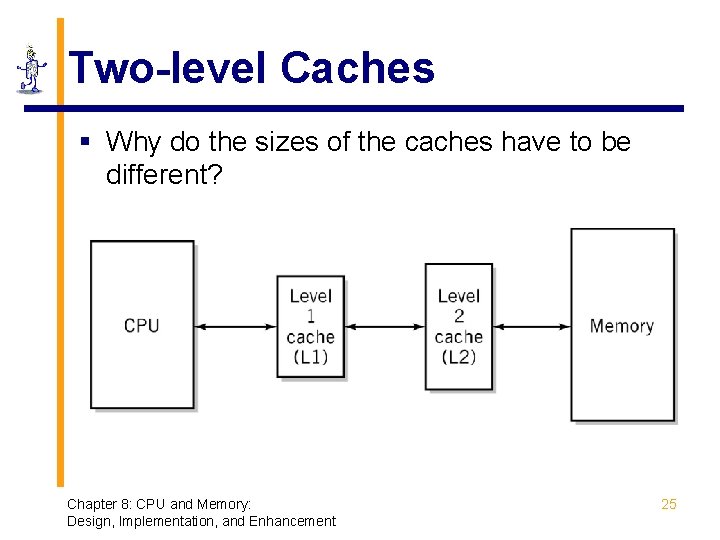
Two-level Caches § Why do the sizes of the caches have to be different? Chapter 8: CPU and Memory: Design, Implementation, and Enhancement 25
Cache sui multiprocessor § Snoopy bus Chapter 8: CPU and Memory: Design, Implementation, and Enhancement 26
E la cache del disco? § Cache per accesso al disco è memoria tra la ram (memoria principale) e il disco gestita dal device. § Controller-cache Chapter 8: CPU and Memory: Design, Implementation, and Enhancement 27
Cache vs. Virtual Memory § Cache speeds up memory access § Virtual memory increases amount of perceived storage § independence from the configuration and capacity of the memory system § low cost per bit Chapter 8: CPU and Memory: Design, Implementation, and Enhancement 28
Modern CPU Processing Methods § § § Timing Issues Separate Fetch/Execute Units Pipelining Scalar Processing Superscalar Processing Chapter 8: CPU and Memory: Design, Implementation, and Enhancement 29
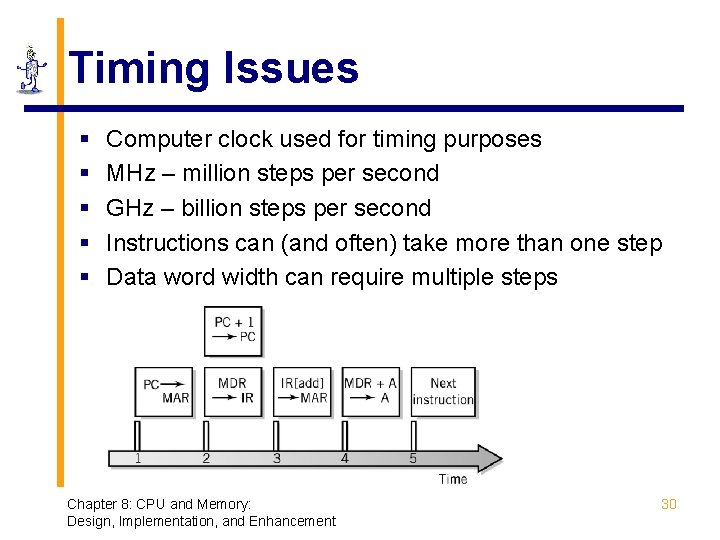
Timing Issues § § § Computer clock used for timing purposes MHz – million steps per second GHz – billion steps per second Instructions can (and often) take more than one step Data word width can require multiple steps Chapter 8: CPU and Memory: Design, Implementation, and Enhancement 30
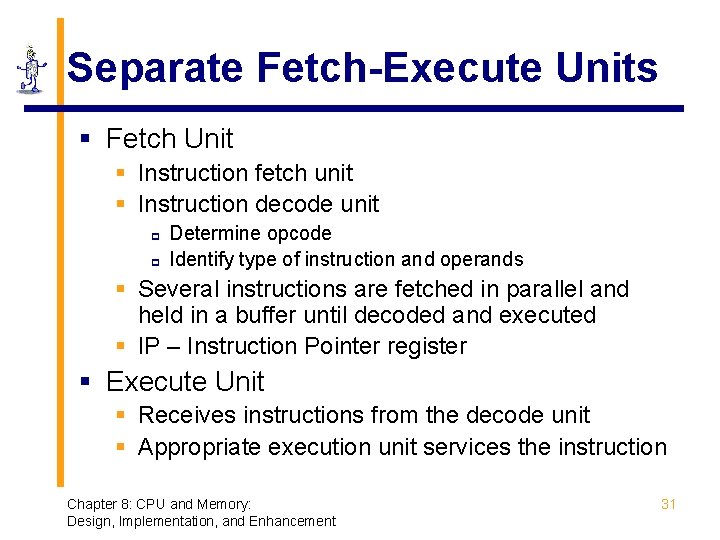
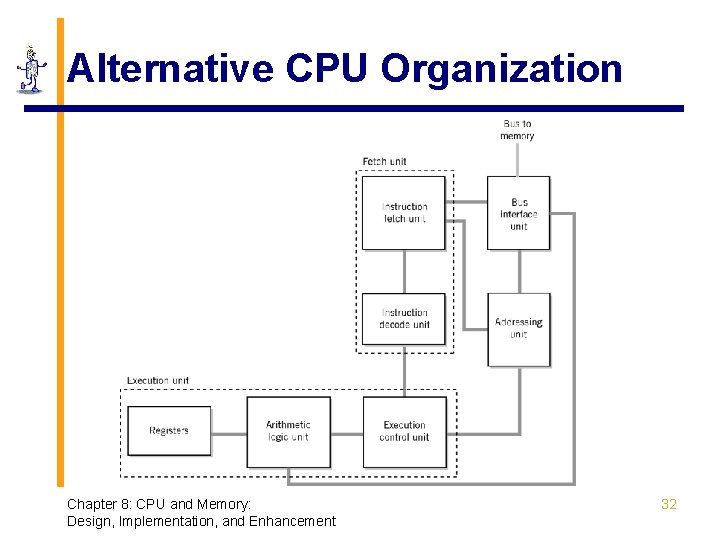
Separate Fetch-Execute Units § Fetch Unit § Instruction fetch unit § Instruction decode unit p p Determine opcode Identify type of instruction and operands § Several instructions are fetched in parallel and held in a buffer until decoded and executed § IP – Instruction Pointer register § Execute Unit § Receives instructions from the decode unit § Appropriate execution unit services the instruction Chapter 8: CPU and Memory: Design, Implementation, and Enhancement 31
Alternative CPU Organization Chapter 8: CPU and Memory: Design, Implementation, and Enhancement 32
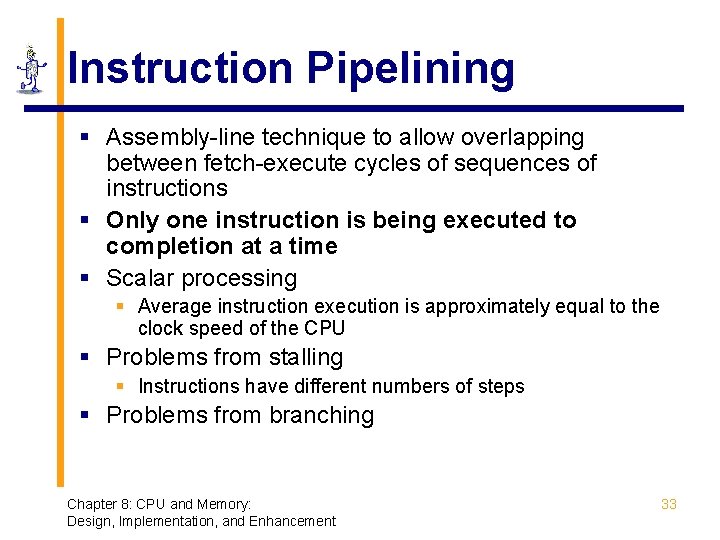
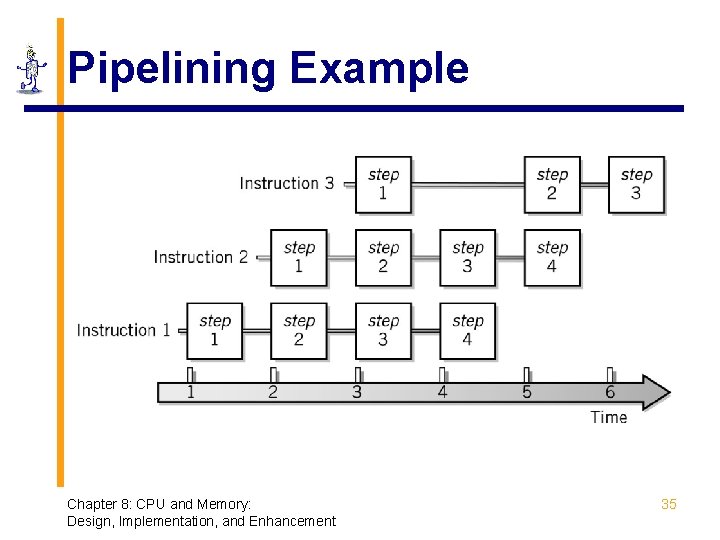
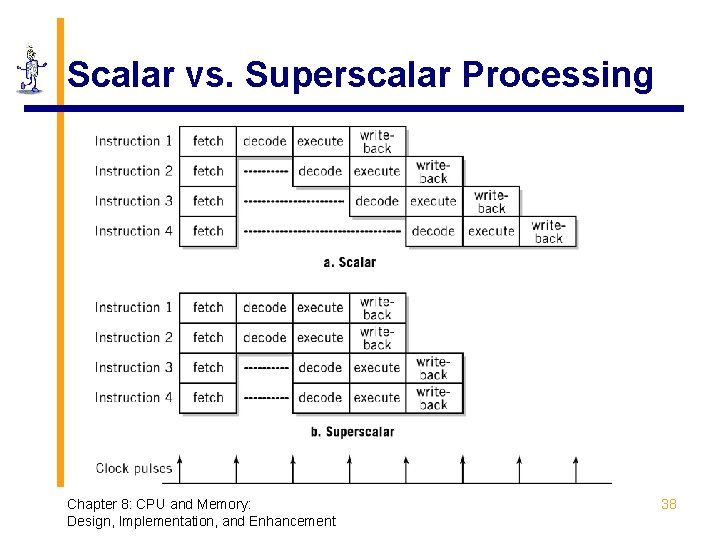
Instruction Pipelining § Assembly-line technique to allow overlapping between fetch-execute cycles of sequences of instructions § Only one instruction is being executed to completion at a time § Scalar processing § Average instruction execution is approximately equal to the clock speed of the CPU § Problems from stalling § Instructions have different numbers of steps § Problems from branching Chapter 8: CPU and Memory: Design, Implementation, and Enhancement 33
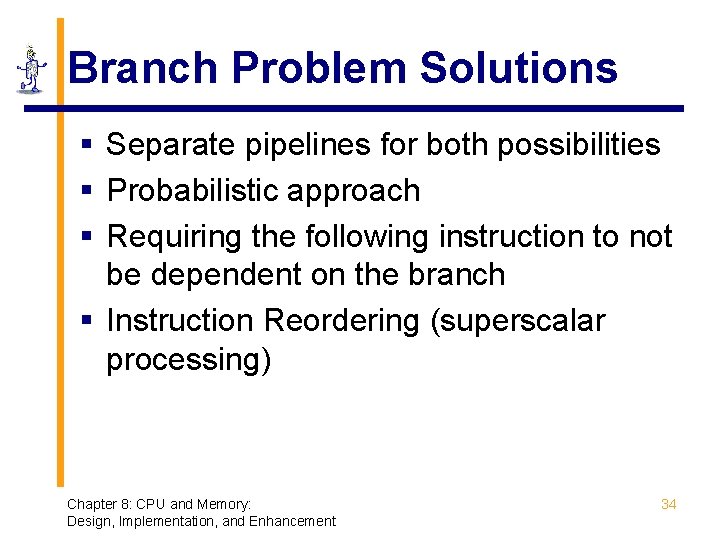
Branch Problem Solutions § Separate pipelines for both possibilities § Probabilistic approach § Requiring the following instruction to not be dependent on the branch § Instruction Reordering (superscalar processing) Chapter 8: CPU and Memory: Design, Implementation, and Enhancement 34
Pipelining Example Chapter 8: CPU and Memory: Design, Implementation, and Enhancement 35
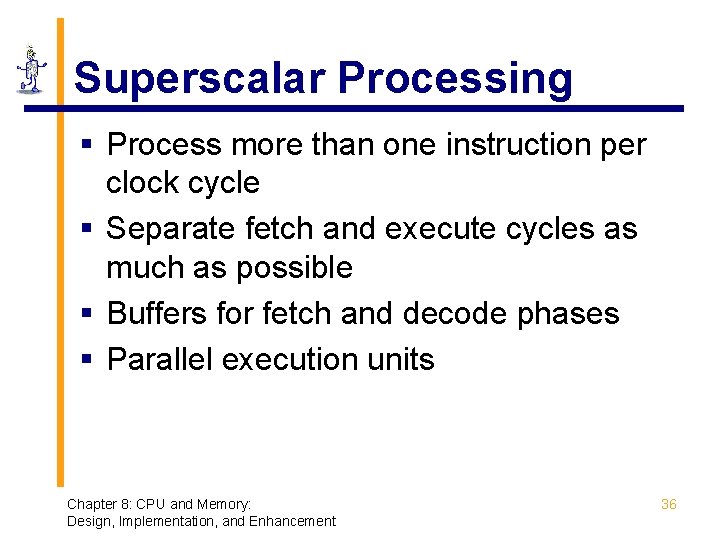
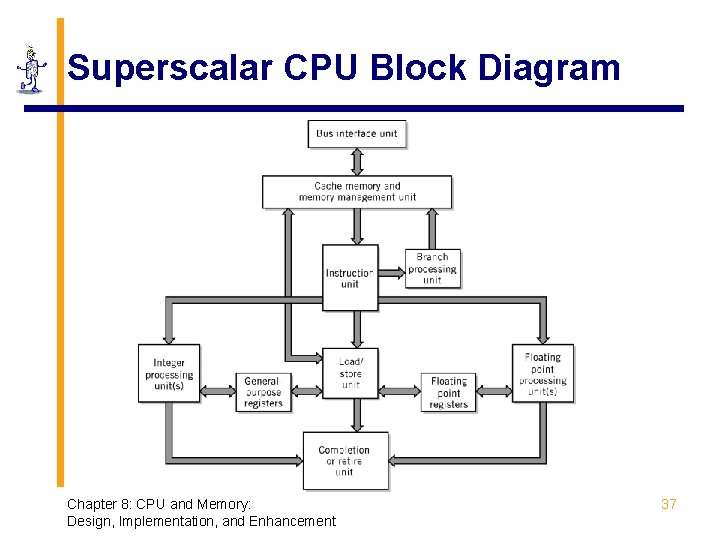
Superscalar Processing § Process more than one instruction per clock cycle § Separate fetch and execute cycles as much as possible § Buffers for fetch and decode phases § Parallel execution units Chapter 8: CPU and Memory: Design, Implementation, and Enhancement 36
Superscalar CPU Block Diagram Chapter 8: CPU and Memory: Design, Implementation, and Enhancement 37
Scalar vs. Superscalar Processing Chapter 8: CPU and Memory: Design, Implementation, and Enhancement 38
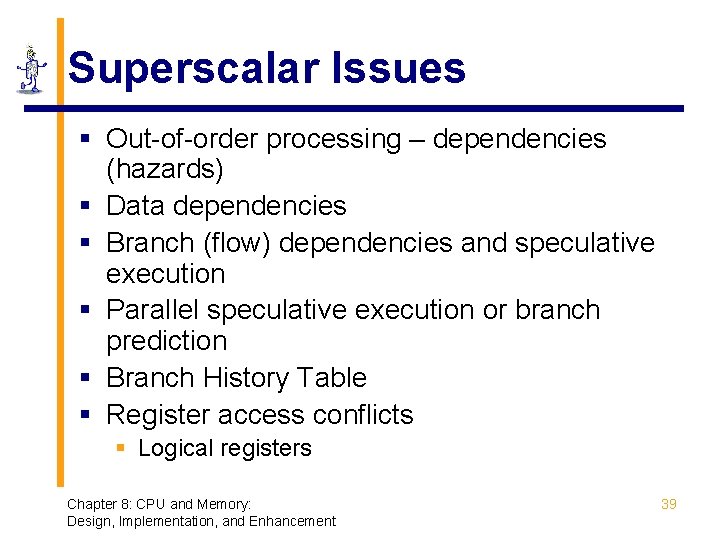
Superscalar Issues § Out-of-order processing – dependencies (hazards) § Data dependencies § Branch (flow) dependencies and speculative execution § Parallel speculative execution or branch prediction § Branch History Table § Register access conflicts § Logical registers Chapter 8: CPU and Memory: Design, Implementation, and Enhancement 39
Hardware Implementation § Hardware – operations are implemented by logic gates § Advantages § Speed § RISC designs are simple and typically implemented in hardware Chapter 8: CPU and Memory: Design, Implementation, and Enhancement 40
Microprogrammed Implementation § Microcode are tiny programs stored in ROM that replace CPU instructions § Advantages § More flexible § Easier to implement complex instructions § Can emulate other CPUs § Disadvantage § Requires more clock cycles Chapter 8: CPU and Memory: Design, Implementation, and Enhancement 41
Copyright 2003 John Wiley & Sons All rights reserved. Reproduction or translation of this work beyond that permitted in Section 117 of the 1976 United States Copyright Act without express permission of the copyright owner is unlawful. Request for further information should be addressed to the permissions Department, John Wiley & Songs, Inc. The purchaser may make back-up copies for his/her own use only and not for distribution or resale. The Publisher assumes no responsibility for errors, omissions, or damages caused by the use of these programs or from the use of the information contained herein. ” Chapter 8: CPU and Memory: Design, Implementation, and Enhancement 42