
Chapter 8 Covalent Bonding Key C H O
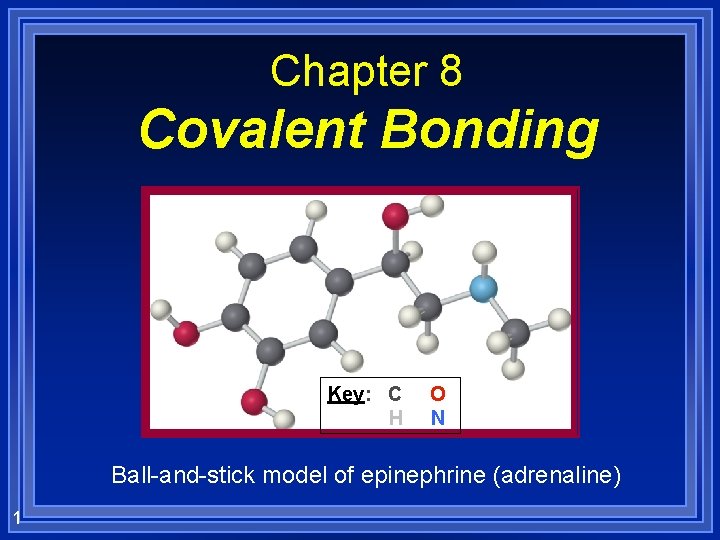
Chapter 8 Covalent Bonding Key: C H O N Ball-and-stick model of epinephrine (adrenaline) 1
8. 1 Molecular Compounds l OBJECTIVES: – Distinguish between the melting points and boiling points of molecular compounds and ionic compounds – Describe the information provided by a molecular formula 2

Bonds are… ü Forces that hold groups of atoms together and make them function as a unit. Two types: 1) 2) 3 Ionic bonds – transfer of electrons results in oppositely charged particles that attract one another. a) Ionic solids are crystals with regular arrangements of +/- ions b) In solutions, cations and anions exist separately – there are NO molecules! Covalent bonds – sharing of electrons. The resulting particle is called a molecule = individual units of a covalent compound
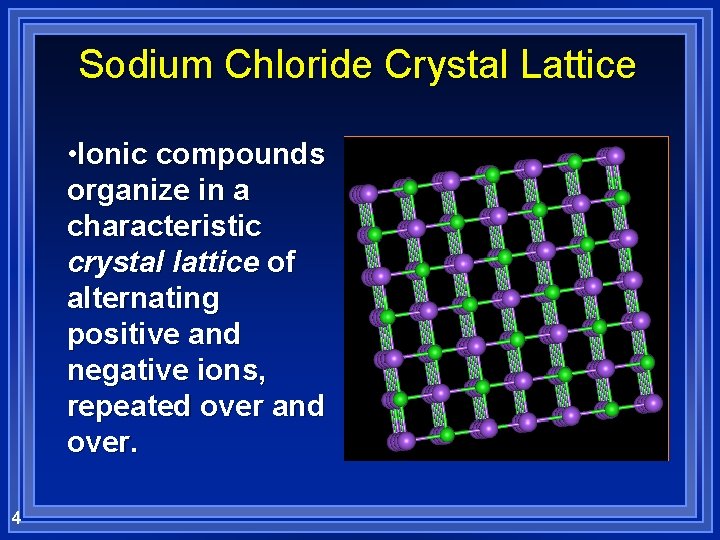
Sodium Chloride Crystal Lattice • Ionic compounds organize in a characteristic crystal lattice of alternating positive and negative ions, repeated over and over. 4
Molecules § Many elements found in nature are in the form of molecules: § a neutral group of atoms joined together by covalent bonds. § For example, air contains oxygen 5 molecules, consisting of two oxygen atoms joined covalently § Called a “diatomic molecule” (O 2)
Formation of a Covalent Bond (Video: Formation of H 2) 6

Covalent Bonds Nonmetals hold on to their valence electrons. l They acquire a stable, noble gas configuration by sharing valence electrons with each other = covalent bonding l By sharing, both atoms “count” the shared electrons toward a noble gas configuration l 7

Covalent Bonding l Fluorine has seven valence electrons – (but would more stable with 8) F 8
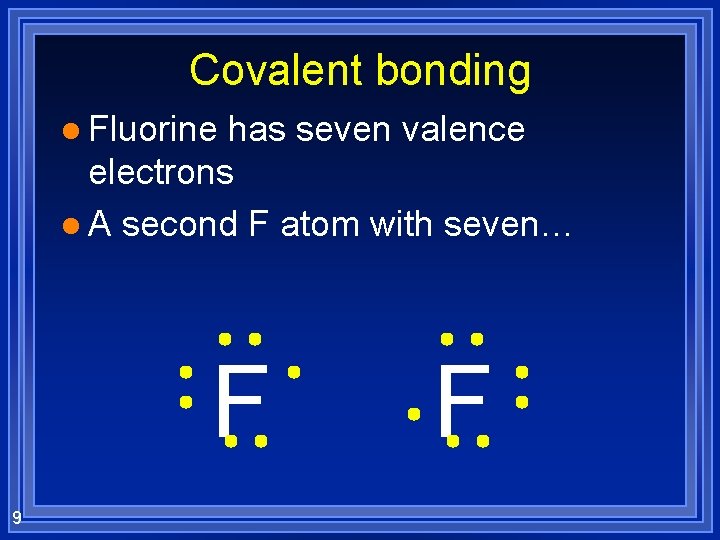
Covalent bonding l Fluorine has seven valence electrons l A second F atom with seven… F 9 F
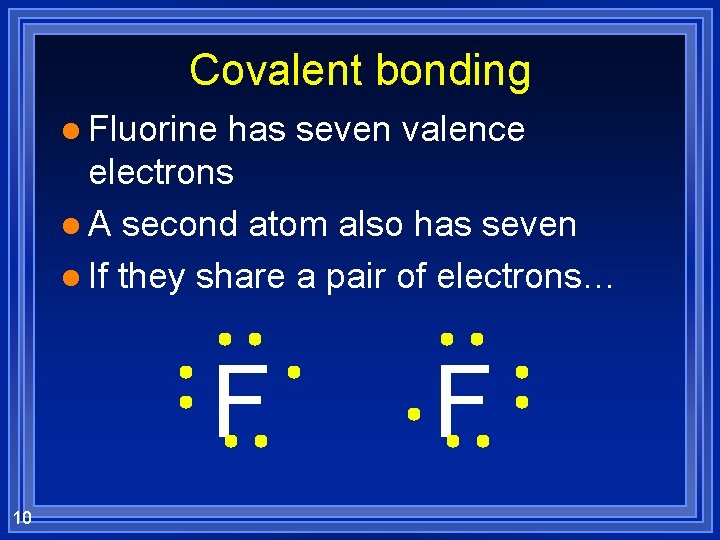
Covalent bonding l Fluorine has seven valence electrons l A second atom also has seven l If they share a pair of electrons… F 10 F
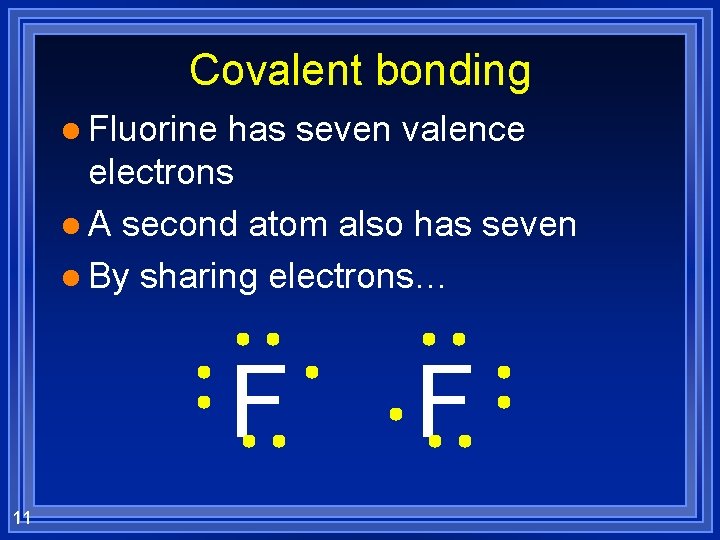
Covalent bonding l Fluorine has seven valence electrons l A second atom also has seven l By sharing electrons… F 11 F
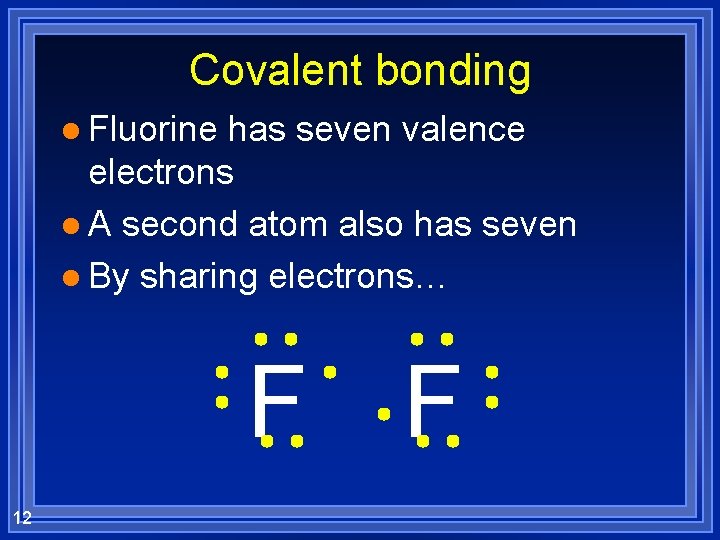
Covalent bonding l Fluorine has seven valence electrons l A second atom also has seven l By sharing electrons… F F 12
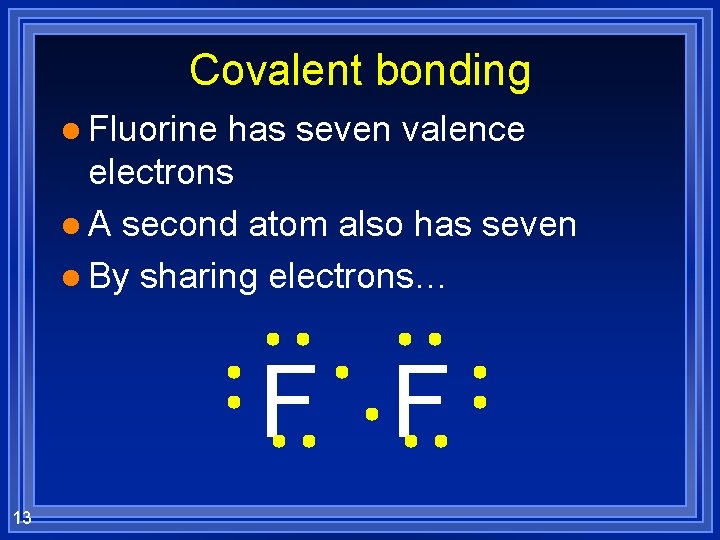
Covalent bonding l Fluorine has seven valence electrons l A second atom also has seven l By sharing electrons… F F 13
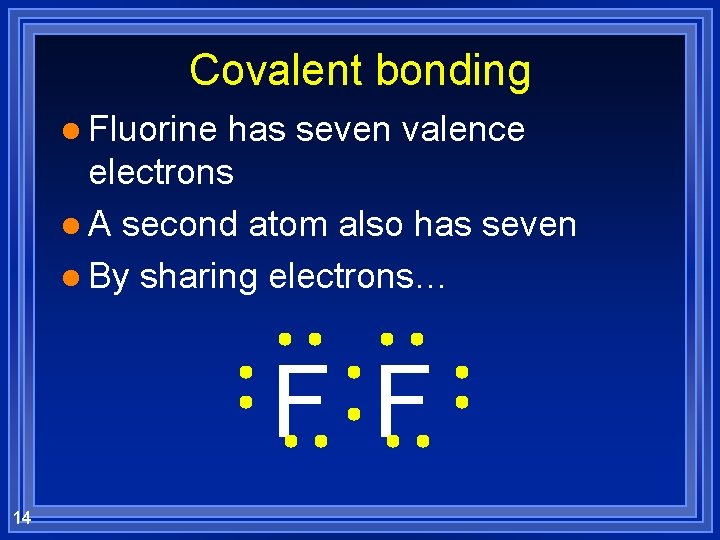
Covalent bonding l Fluorine has seven valence electrons l A second atom also has seven l By sharing electrons… F F 14
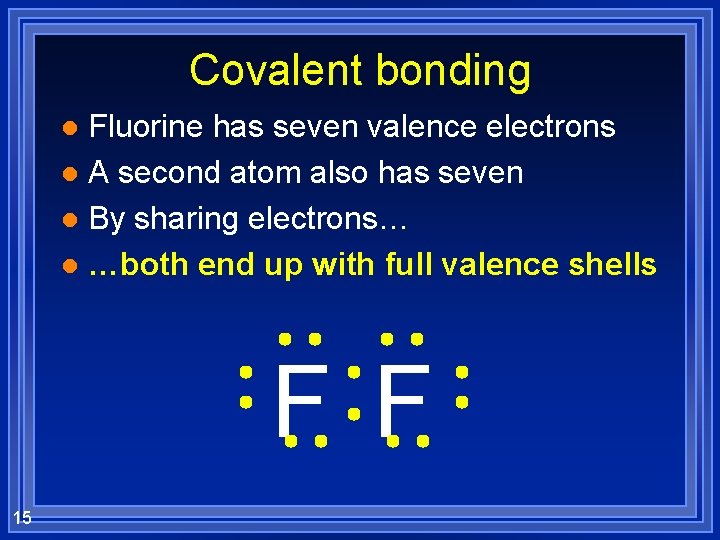
Covalent bonding Fluorine has seven valence electrons l A second atom also has seven l By sharing electrons… l …both end up with full valence shells l F F 15
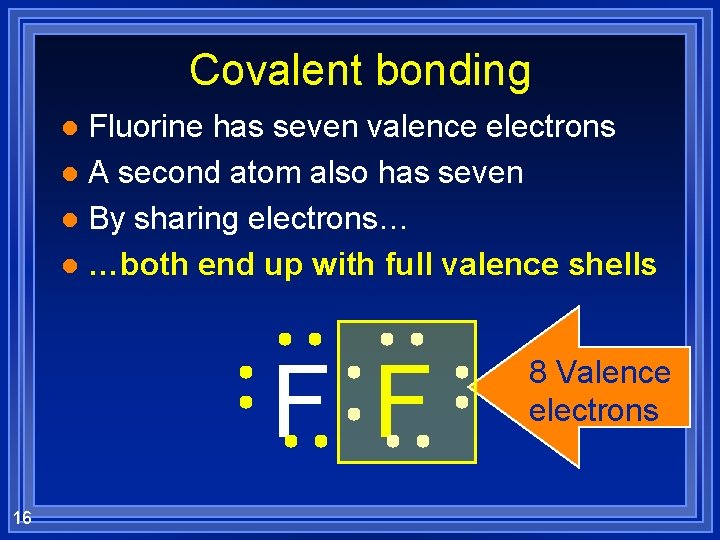
Covalent bonding Fluorine has seven valence electrons l A second atom also has seven l By sharing electrons… l …both end up with full valence shells l F F 16 8 Valence electrons
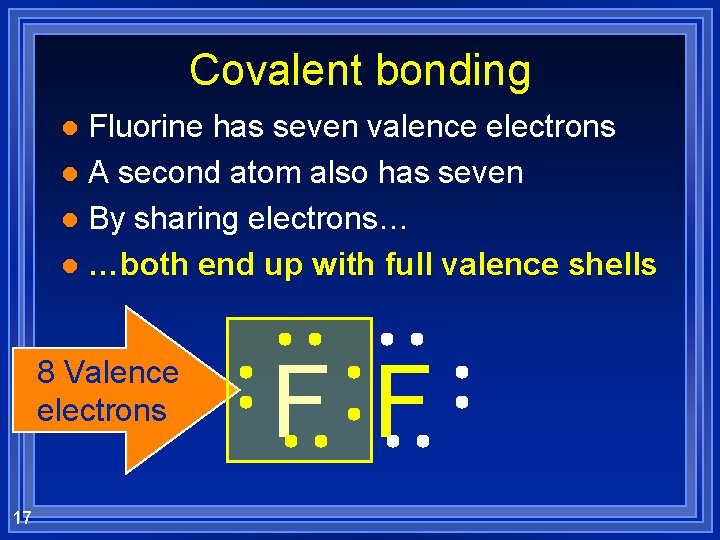
Covalent bonding Fluorine has seven valence electrons l A second atom also has seven l By sharing electrons… l …both end up with full valence shells l 8 Valence electrons 17 F F
Molecular Compounds l l 18 Compounds that are bonded covalently (like H 2 O, CO 2) are called molecular compounds Molecular compounds tend to have relatively lower melting points than ionic compounds Ø Ions are held together in a crystal solid by relatively strong ionic bonds Covalent bonds are very strong but this is an intramolecular force It’s the forces between molecules that holds a solid together (intermolecular forces) Ø and these are often rather weak
Molecular Compounds Thus, molecular compounds are often gases or liquids at room temperature – Ionic compounds are solids l A molecular compound has a molecular formula: – Shows how many atoms of each element a molecule contains l 19
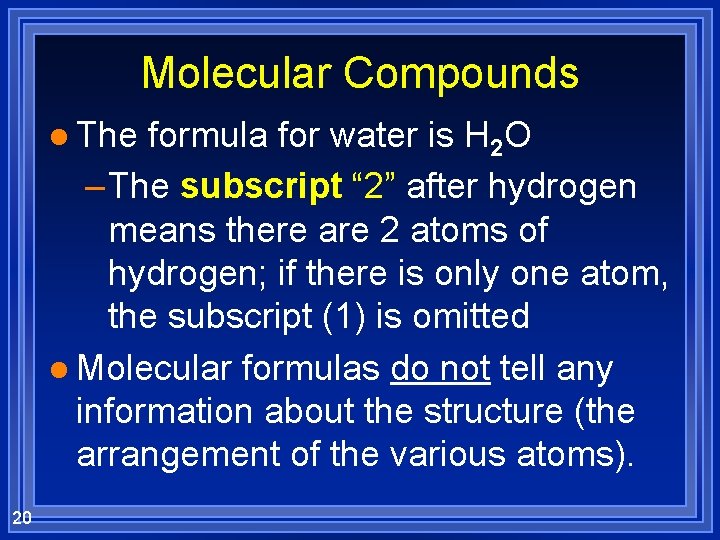
Molecular Compounds l The formula for water is H 2 O – The subscript “ 2” after hydrogen means there are 2 atoms of hydrogen; if there is only one atom, the subscript (1) is omitted l Molecular formulas do not tell any information about the structure (the arrangement of the various atoms). 20
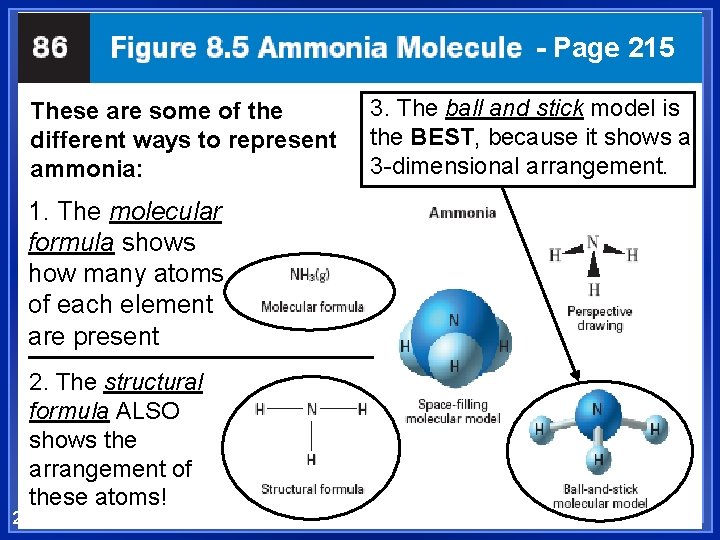
- Page 215 These are some of the different ways to represent ammonia: 1. The molecular formula shows how many atoms of each element are present 2. The structural formula ALSO shows the arrangement of these atoms! 21 3. The ball and stick model is the BEST, because it shows a 3 -dimensional arrangement.
8. 2 Nature of Covalent Bonding l OBJECTIVES – Describe how electrons are shared to form covalent bonds, and identify exceptions to the octet rule – Demonstrate how electron dot structures represent shared electrons – Describe how atoms form double or triple covalent bonds 22
8. 2 Nature of Covalent Bonding l OBJECTIVES: – Distinguish between a covalent bond a coordinate covalent bond, and describe how the strength of a covalent bond is related to its bond dissociation energy – Describe how oxygen atoms are bonded in ozone 23
A Single Covalent Bond is. . . l. A sharing of two valence electrons. l Only nonmetals (including H). l Different from ionic bonds because discrete molecules are formed l Two atoms are joined 24
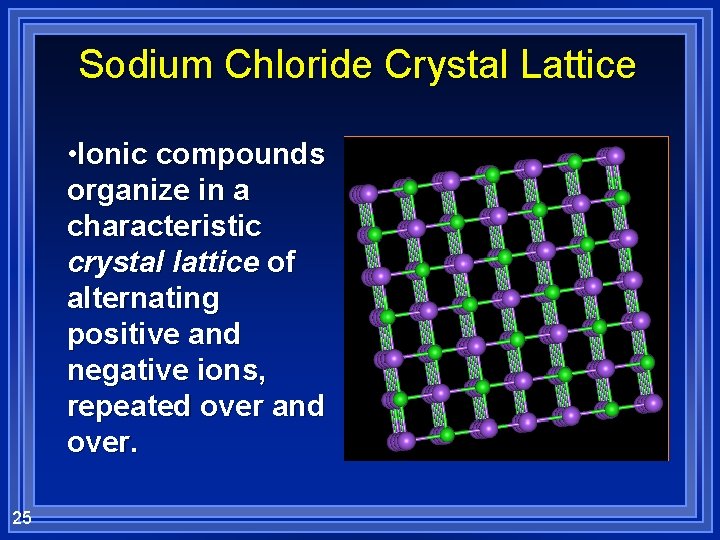
Sodium Chloride Crystal Lattice • Ionic compounds organize in a characteristic crystal lattice of alternating positive and negative ions, repeated over and over. 25
How to show the formation… It’s like a jigsaw puzzle. l You put the pieces together to end up with the right formula. l Carbon is a special example – it can share 4 electrons: 1 s 22 p 2? l Let’s show water is formed with covalent bonds, by using an electron dot diagram… l 26
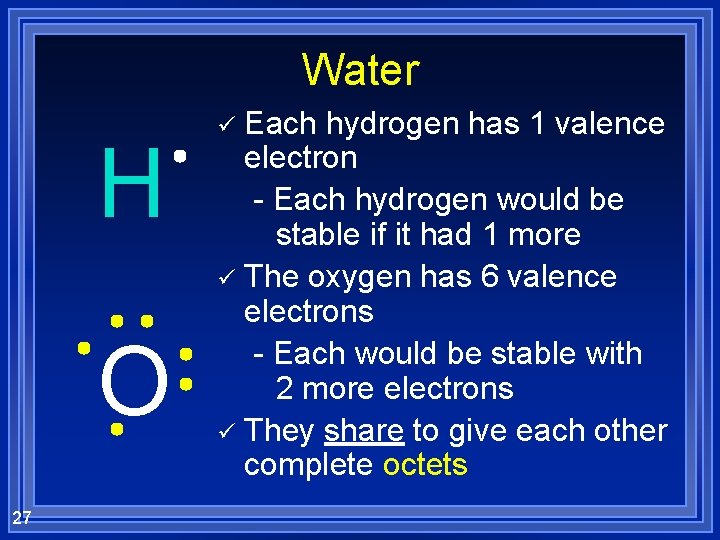
Water H O 27 Each hydrogen has 1 valence electron - Each hydrogen would be stable if it had 1 more ü The oxygen has 6 valence electrons - Each would be stable with 2 more electrons ü They share to give each other complete octets ü
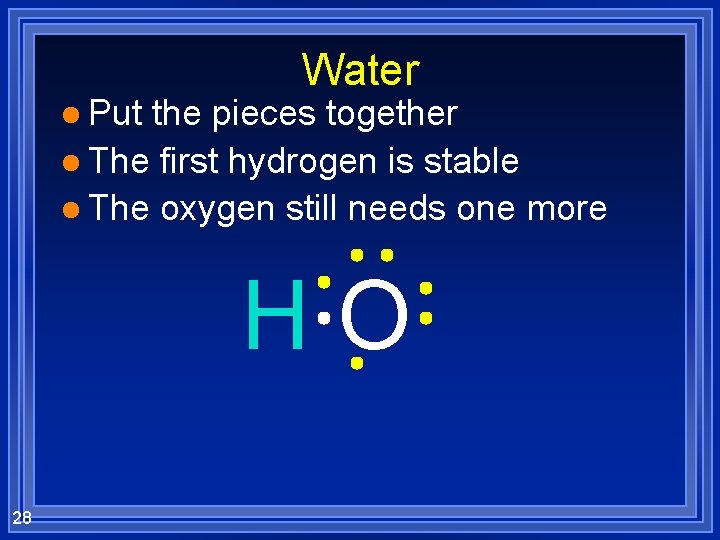
l Put Water the pieces together l The first hydrogen is stable l The oxygen still needs one more HO 28
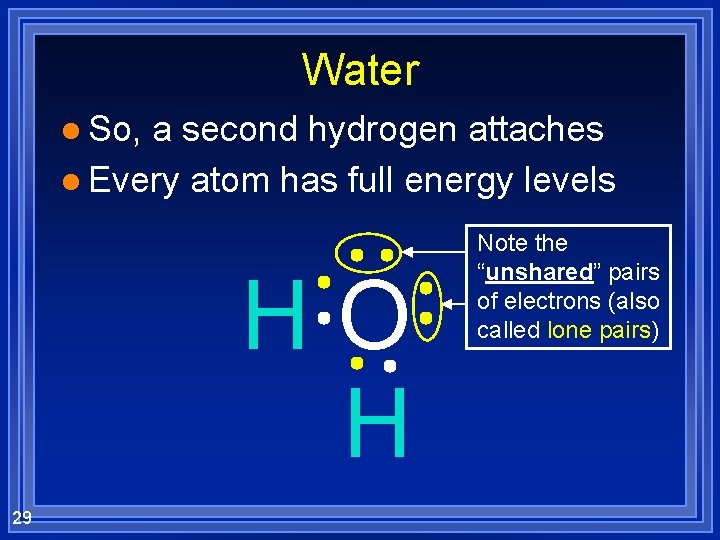
Water l So, a second hydrogen attaches l Every atom has full energy levels HO H 29 Note the “unshared” pairs of electrons (also called lone pairs)
Examples: 1. Conceptual Problem 8. 1 on page 220 2. Do PCl 3 30
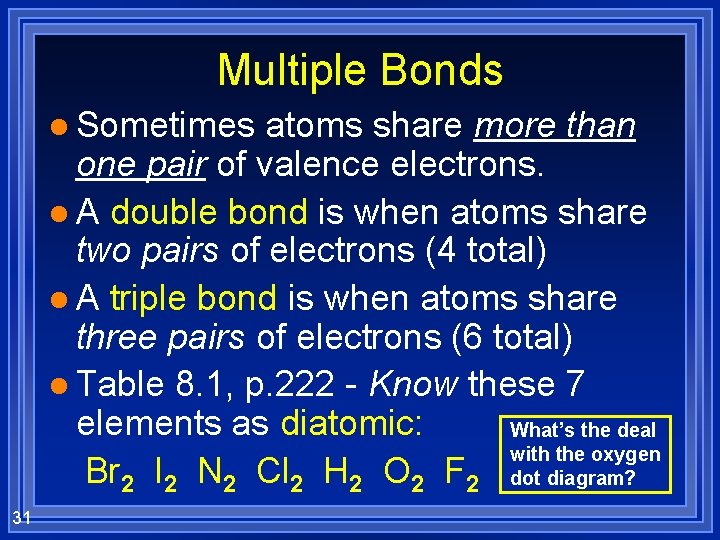
Multiple Bonds l Sometimes atoms share more than one pair of valence electrons. l A double bond is when atoms share two pairs of electrons (4 total) l A triple bond is when atoms share three pairs of electrons (6 total) l Table 8. 1, p. 222 - Know these 7 elements as diatomic: What’s the deal with the oxygen Br 2 I 2 N 2 Cl 2 H 2 O 2 F 2 dot diagram? 31
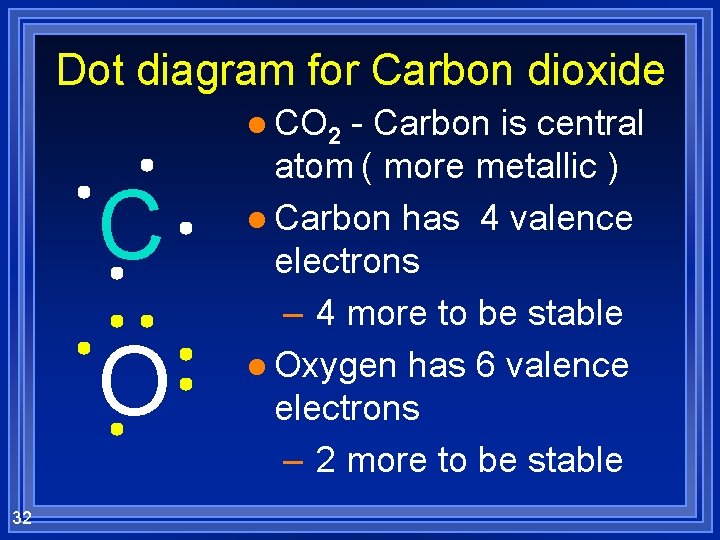
Dot diagram for Carbon dioxide l CO 2 C O 32 - Carbon is central atom ( more metallic ) l Carbon has 4 valence electrons – 4 more to be stable l Oxygen has 6 valence electrons – 2 more to be stable
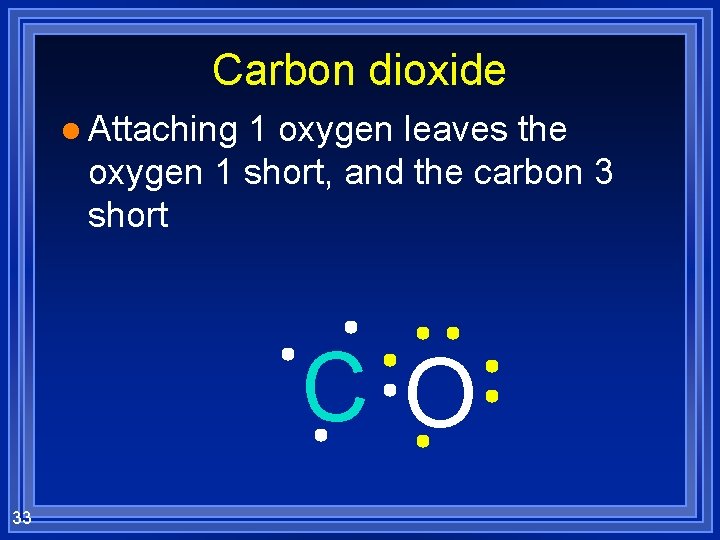
Carbon dioxide l Attaching 1 oxygen leaves the oxygen 1 short, and the carbon 3 short CO 33
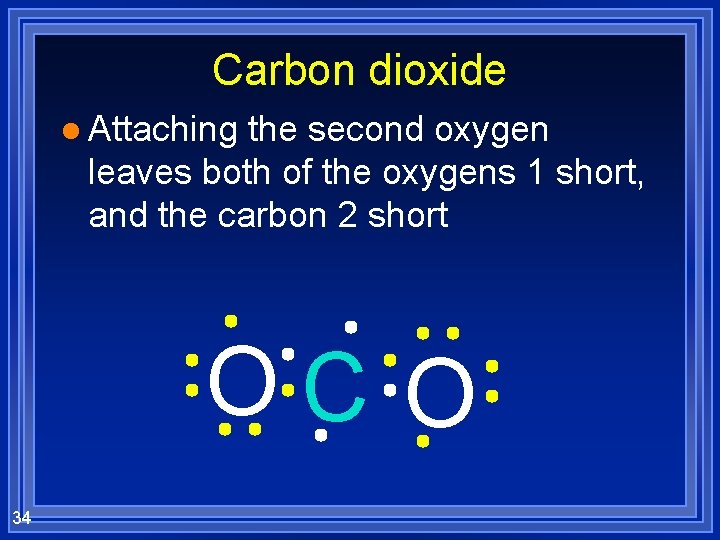
Carbon dioxide l Attaching the second oxygen leaves both of the oxygens 1 short, and the carbon 2 short OC O 34
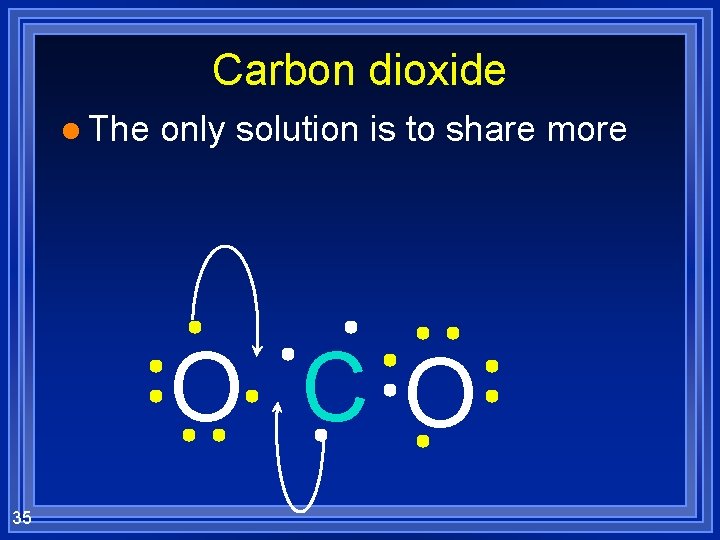
Carbon dioxide l The only solution is to share more O CO 35
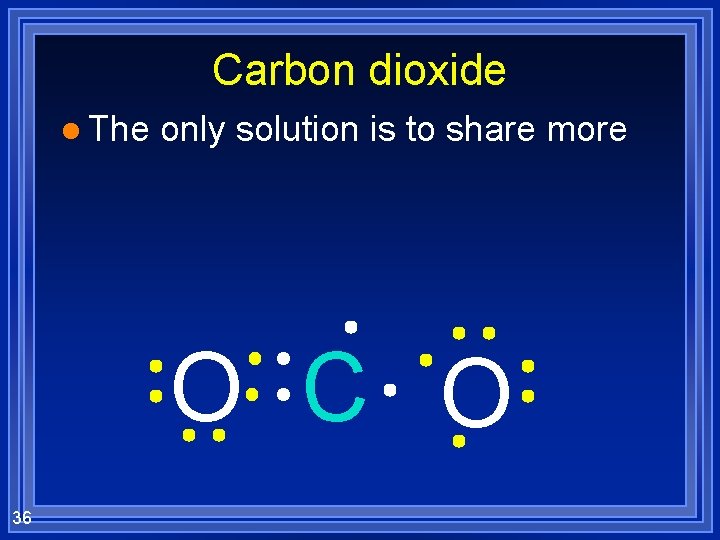
Carbon dioxide l The only solution is to share more O C O 36
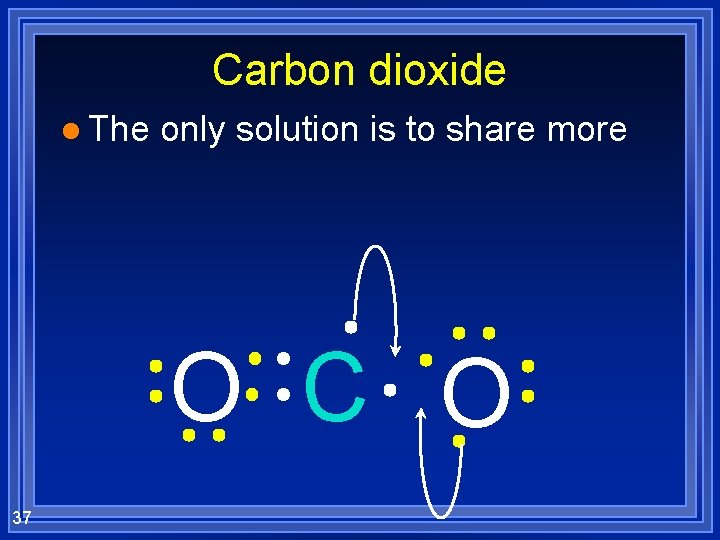
Carbon dioxide l The only solution is to share more O C O 37
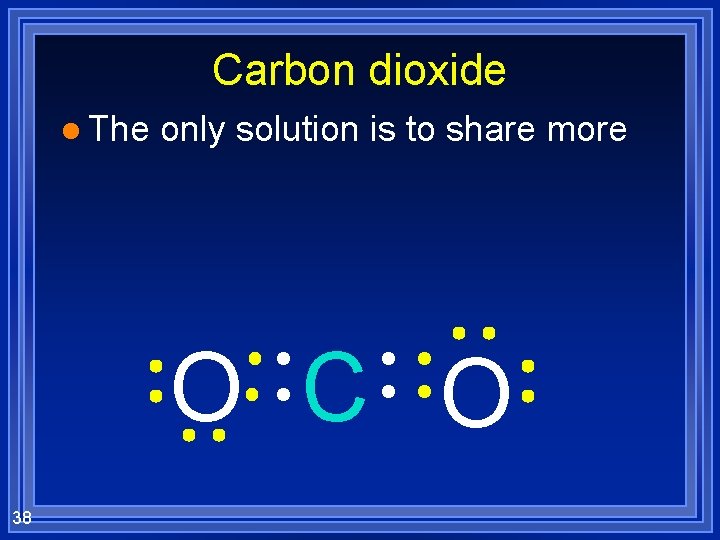
Carbon dioxide l The only solution is to share more O C O 38
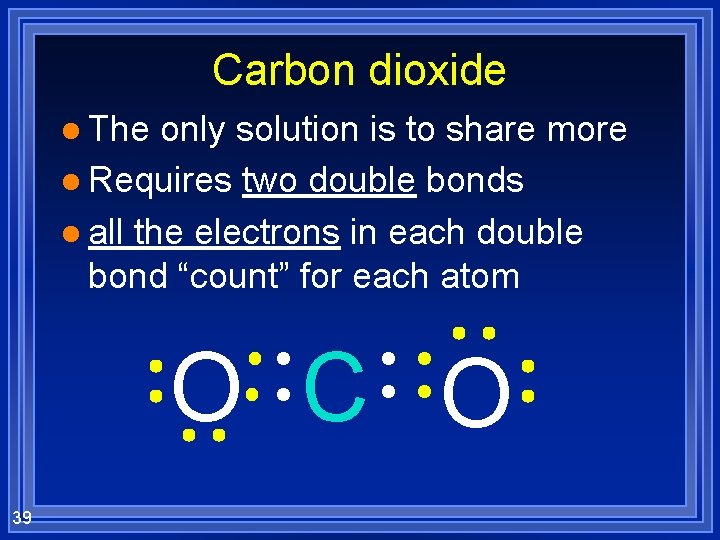
Carbon dioxide l The only solution is to share more l Requires two double bonds l all the electrons in each double bond “count” for each atom O C O 39
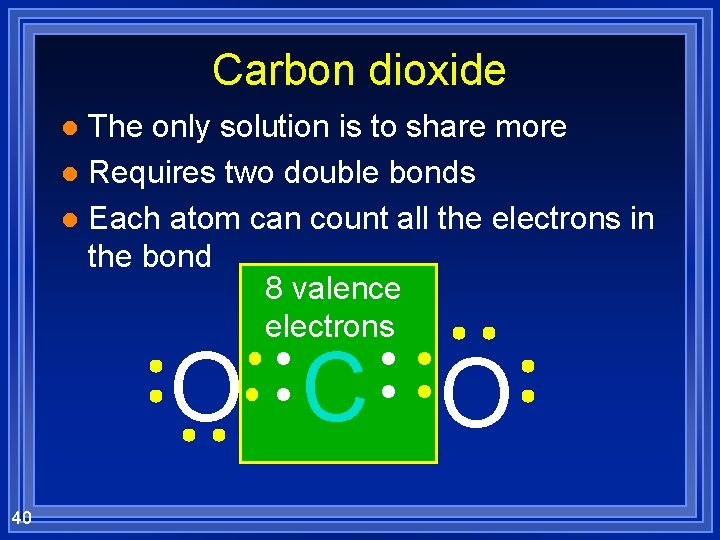
Carbon dioxide The only solution is to share more l Requires two double bonds l Each atom can count all the electrons in the bond 8 valence electrons l O C O 40
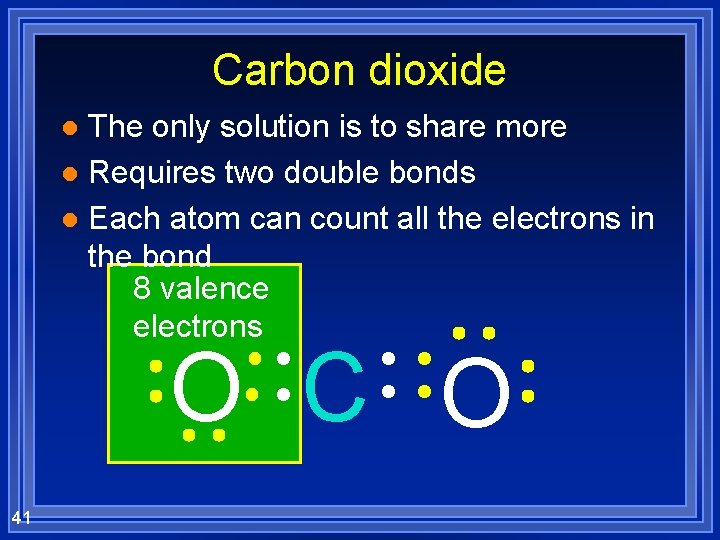
Carbon dioxide The only solution is to share more l Requires two double bonds l Each atom can count all the electrons in the bond 8 valence electrons l O C O 41
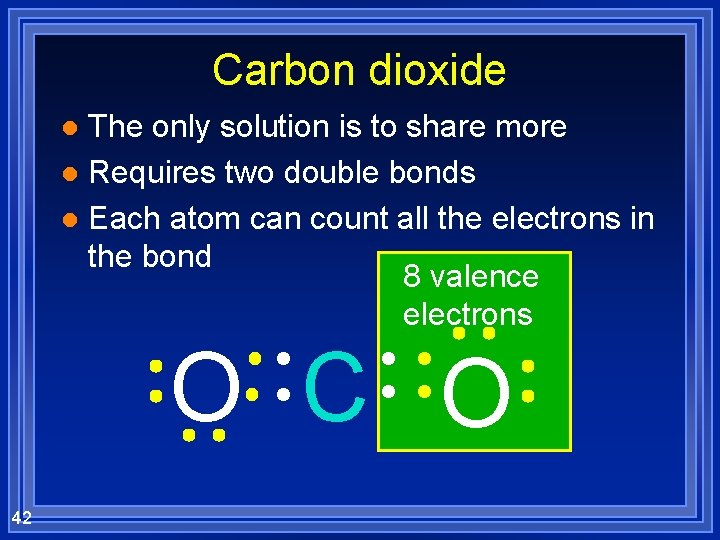
Carbon dioxide The only solution is to share more l Requires two double bonds l Each atom can count all the electrons in the bond 8 valence electrons l O C O 42
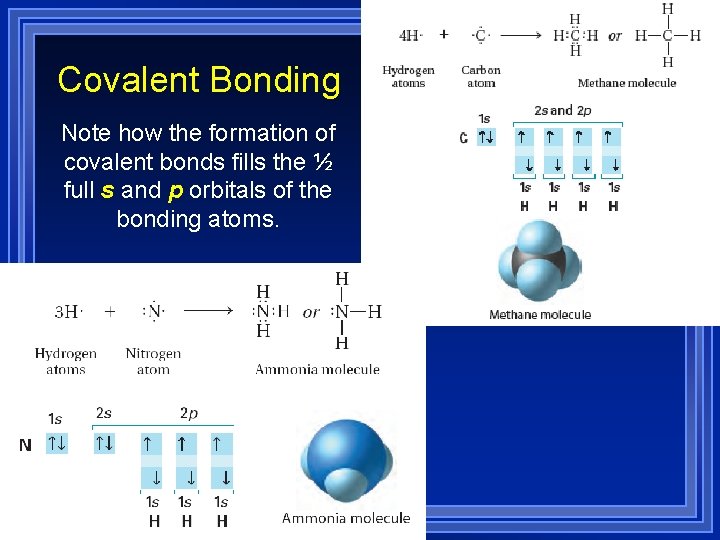
Covalent Bonding Note how the formation of covalent bonds fills the ½ full s and p orbitals of the bonding atoms. 43
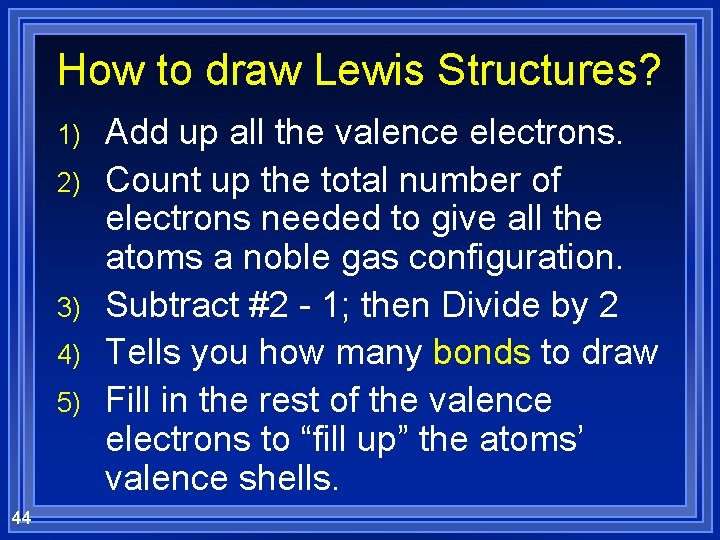
How to draw Lewis Structures? 1) 2) 3) 4) 5) 44 Add up all the valence electrons. Count up the total number of electrons needed to give all the atoms a noble gas configuration. Subtract #2 - 1; then Divide by 2 Tells you how many bonds to draw Fill in the rest of the valence electrons to “fill up” the atoms’ valence shells.
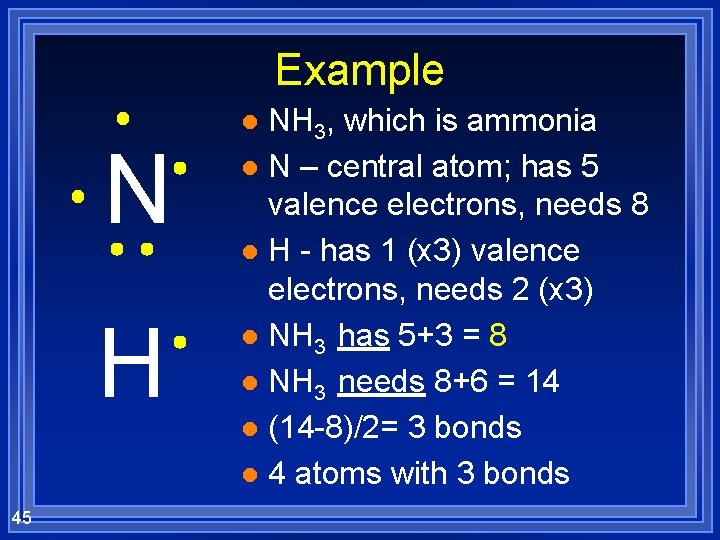
Example NH 3, which is ammonia l N – central atom; has 5 valence electrons, needs 8 l H - has 1 (x 3) valence electrons, needs 2 (x 3) l NH 3 has 5+3 = 8 l NH 3 needs 8+6 = 14 l (14 -8)/2= 3 bonds l 4 atoms with 3 bonds l N H 45
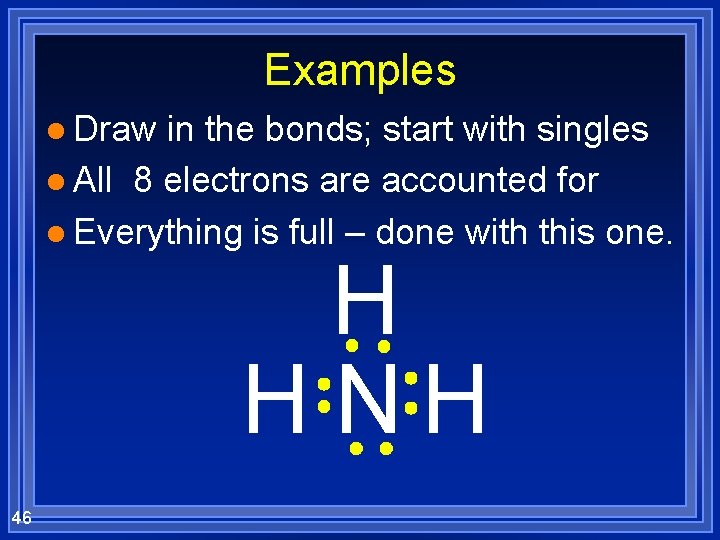
Examples l Draw in the bonds; start with singles l All 8 electrons are accounted for l Everything is full – done with this one. H H NH 46
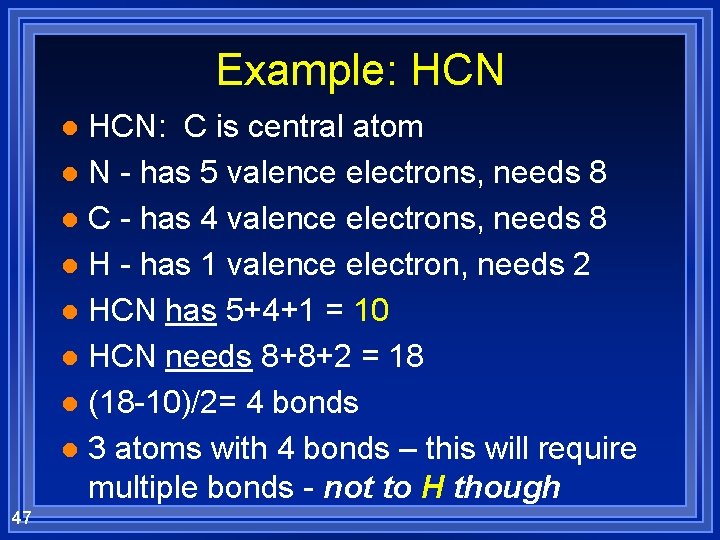
Example: HCN: C is central atom l N - has 5 valence electrons, needs 8 l C - has 4 valence electrons, needs 8 l H - has 1 valence electron, needs 2 l HCN has 5+4+1 = 10 l HCN needs 8+8+2 = 18 l (18 -10)/2= 4 bonds l 3 atoms with 4 bonds – this will require multiple bonds - not to H though l 47
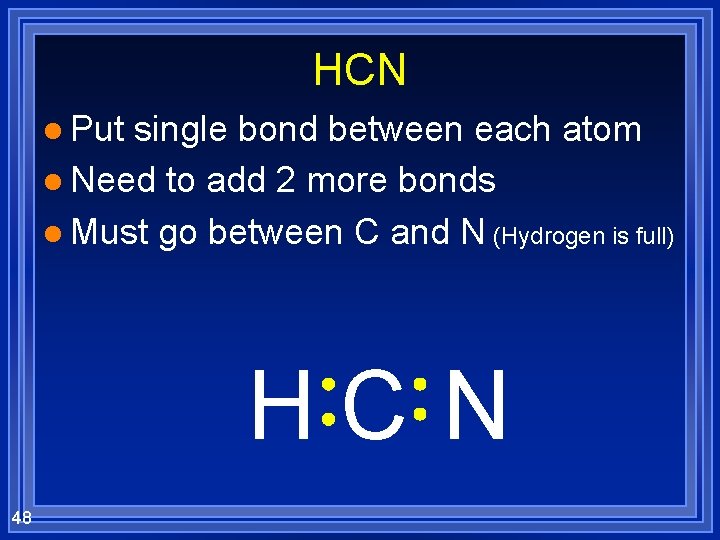
HCN l Put single bond between each atom l Need to add 2 more bonds l Must go between C and N (Hydrogen is full) HC N 48
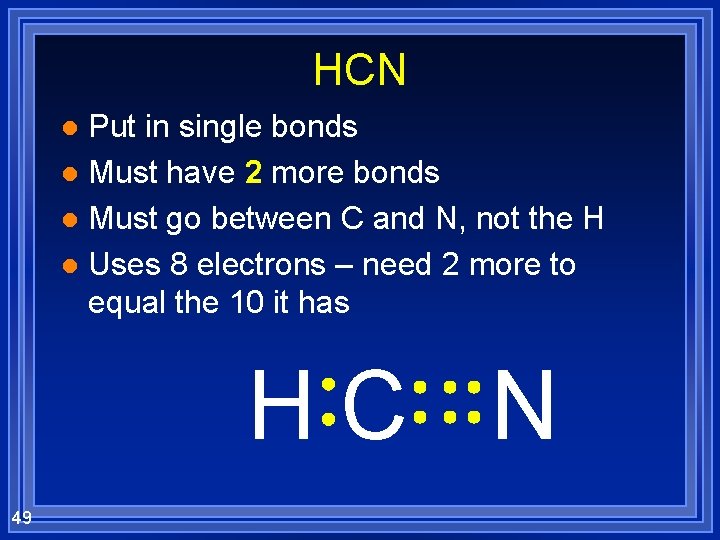
HCN Put in single bonds l Must have 2 more bonds l Must go between C and N, not the H l Uses 8 electrons – need 2 more to equal the 10 it has l HC N 49
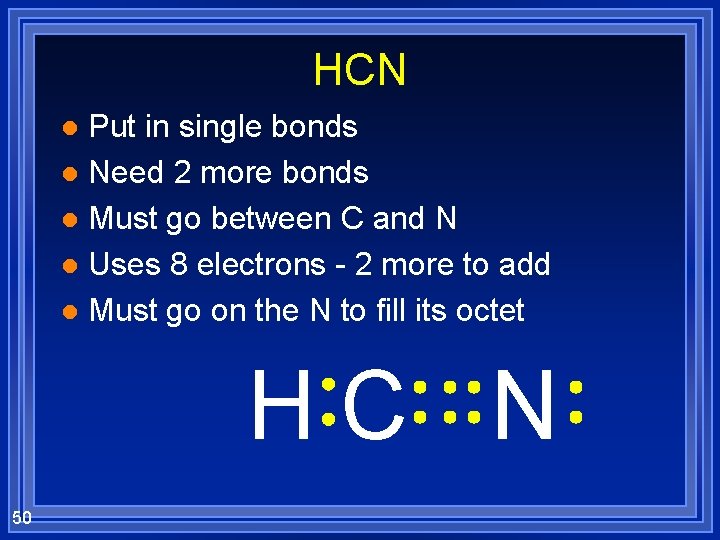
HCN Put in single bonds l Need 2 more bonds l Must go between C and N l Uses 8 electrons - 2 more to add l Must go on the N to fill its octet l HC N 50
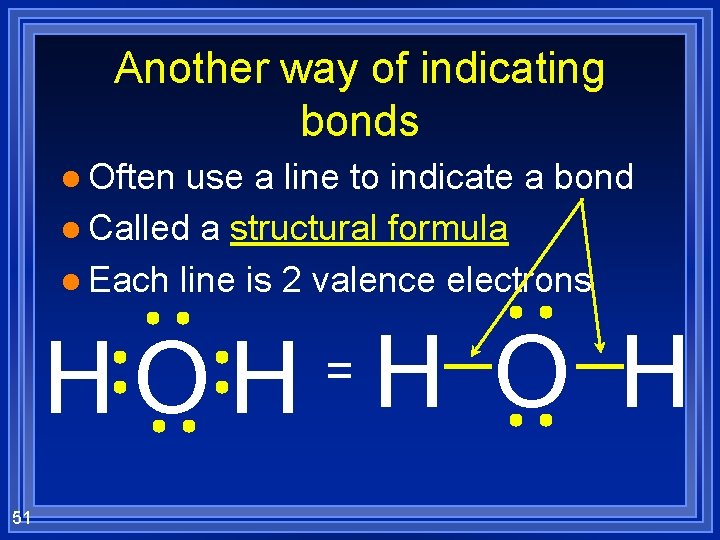
Another way of indicating bonds l Often use a line to indicate a bond l Called a structural formula l Each line is 2 valence electrons HOH H O H = 51
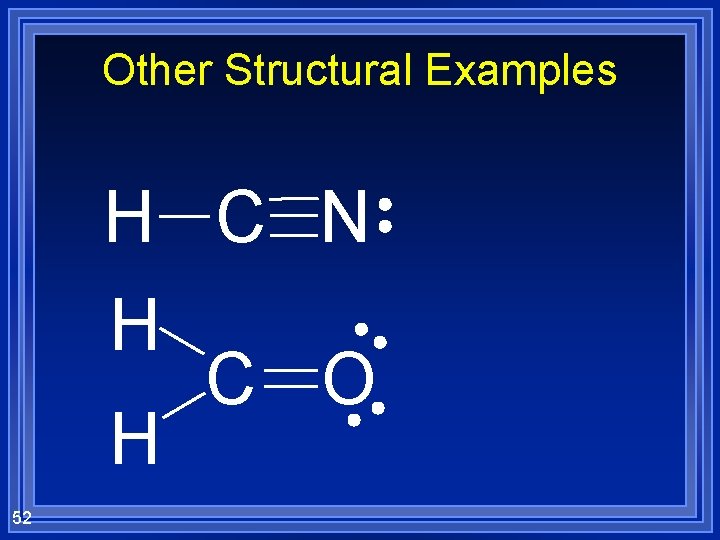
Other Structural Examples H C N H C O H 52
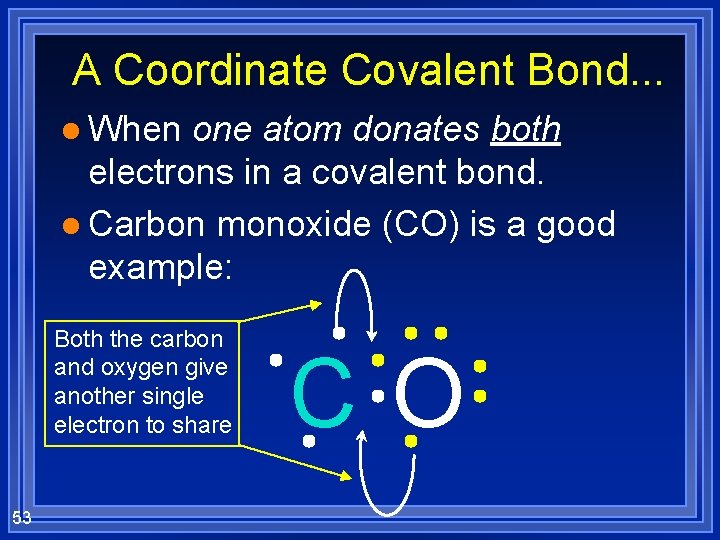
A Coordinate Covalent Bond. . . l When one atom donates both electrons in a covalent bond. l Carbon monoxide (CO) is a good example: Both the carbon and oxygen give another single electron to share 53 CO
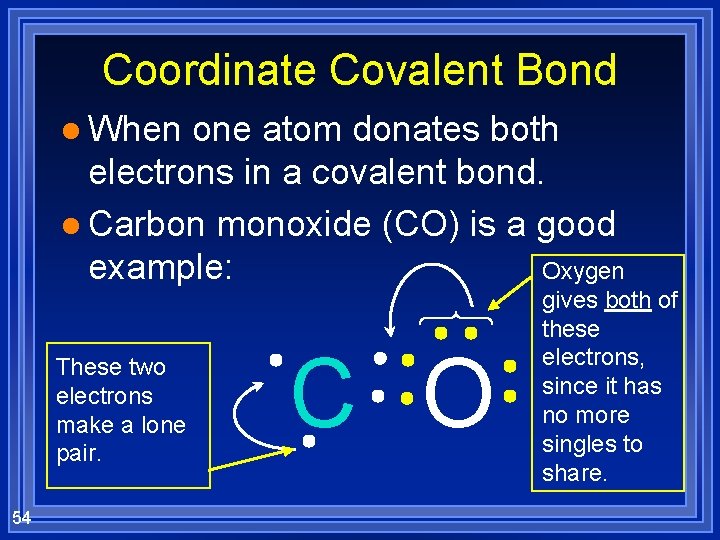
Coordinate Covalent Bond l When one atom donates both electrons in a covalent bond. l Carbon monoxide (CO) is a good example: Oxygen These two electrons make a lone pair. 54 C O gives both of these electrons, since it has no more singles to share.
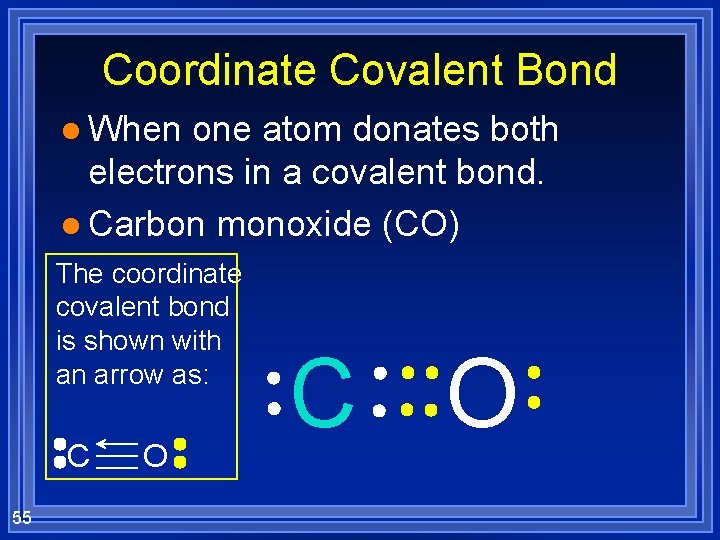
Coordinate Covalent Bond l When one atom donates both electrons in a covalent bond. l Carbon monoxide (CO) The coordinate covalent bond is shown with an arrow as: C 55 O C O
Coordinate covalent bond l Most polyatomic cations and anions contain covalent and coordinate covalent bonds l Table 8. 2, p. 224 l Sample Problem 8. 2, p. 225 l The ammonium ion (NH 41+) can be shown as another example 56
Bond Dissociation Energies. . . l The total energy required to break the bond between 2 covalently bonded atoms l High dissociation energy usually means the chemical is relatively unreactive, because it takes a lot of energy to break it down. 57
l When Resonance is. . . more than one valid dot diagram is possible. l Consider the two ways to draw ozone (O 3) l Which one is it? Does it go back and forth? l It is a hybrid of both, like a mule; and shown by a double-headed arrow l found in double-bond structures! 58
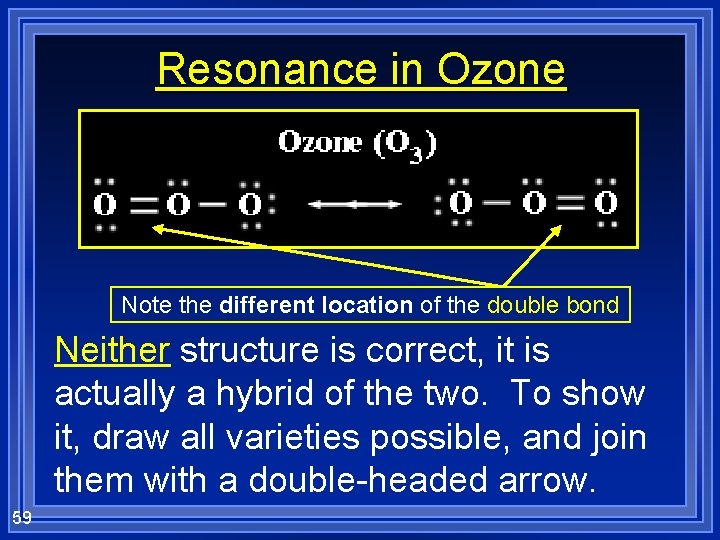
Resonance in Ozone Note the different location of the double bond Neither structure is correct, it is actually a hybrid of the two. To show it, draw all varieties possible, and join them with a double-headed arrow. 59
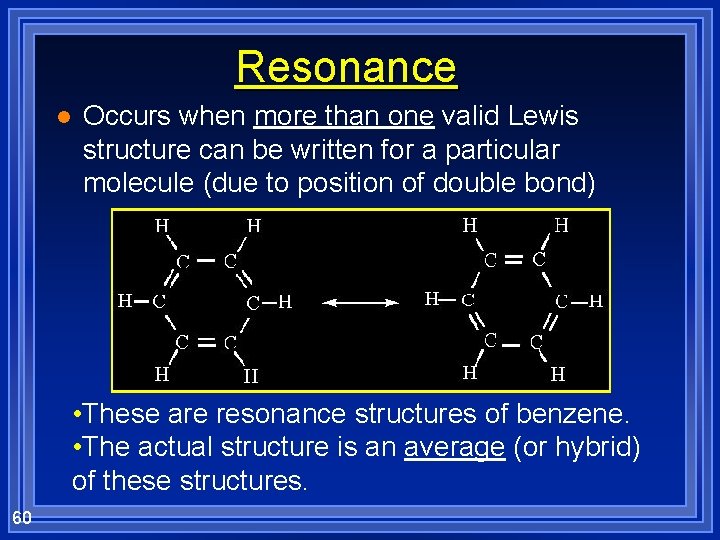
Resonance l Occurs when more than one valid Lewis structure can be written for a particular molecule (due to position of double bond) • These are resonance structures of benzene. • The actual structure is an average (or hybrid) of these structures. 60
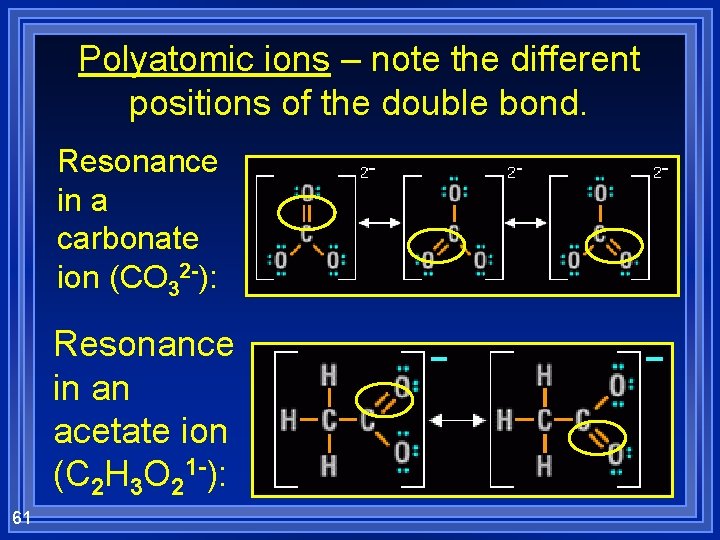
Polyatomic ions – note the different positions of the double bond. Resonance in a carbonate ion (CO 32 -): Resonance in an acetate ion (C 2 H 3 O 21 -): 61
The 3 Exceptions to Octet rule l For some molecules, it is impossible to satisfy the octet rule #1. usually when there is an odd number of valence electrons – NO 2 has 17 valence electrons, because the N has 5, and each O contributes 6. Note “N” page 228 l It is impossible to satisfy octet rule, yet the stable molecule does exist 62
Exceptions to Octet rule • • 63 Another exception: Boron • Page 228 shows boron trifluoride, and note that one of the fluorides might be able to make a coordinate covalent bond to fulfill the boron • #2 -But fluorine has a high electronegativity (it is greedy), so this coordinate bond does not form #3 -Top page 229 examples exist because they are in period 3 or beyond
8. 4 Polar Bonds & Molecules l OBJECTIVES: – Describe how electronegativity values determine the distribution of charge in a polar molecule – Describe what happens to polar molecules when they are placed between oppositely charged metal plates – Evaluate the strength of intermolecular attractions compared with the strength of ionic and covalent bonds – Identify the reason why network solids have high melting points 64
Bond Polarity l Covalent bonding means shared electrons –but, do they share equally? l Electrons are pulled, as in a tug-ofwar, between the atoms’ nuclei –In equal sharing (such as diatomic molecules), the bond that results is called a nonpolar covalent bond 65
Bond Polarity l 66 When two different atoms bond covalently, there is almost always an unequal sharing of the bonding e– the more electronegative atom has a stronger attraction for the bonding e– Thus the bonding pair of e- spend most time near the more electronegative atom acquire a partial (−) charge – called a polar covalent bond, or simply polar bond.
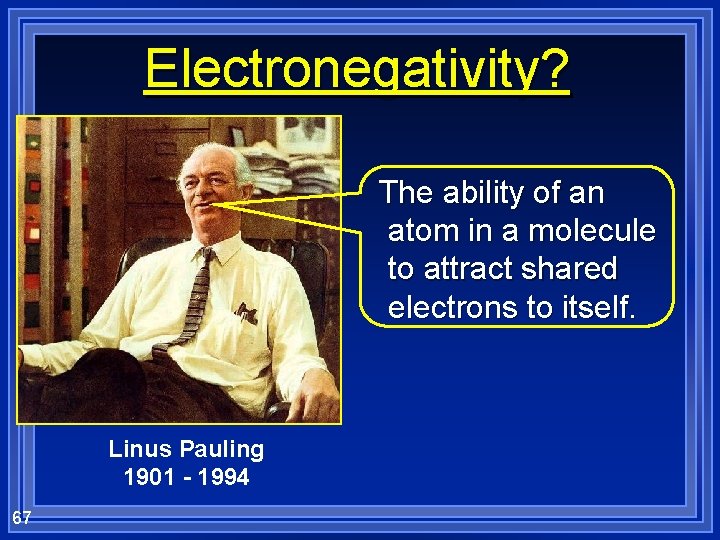
Electronegativity? The ability of an atom in a molecule to attract shared electrons to itself. Linus Pauling 1901 - 1994 67
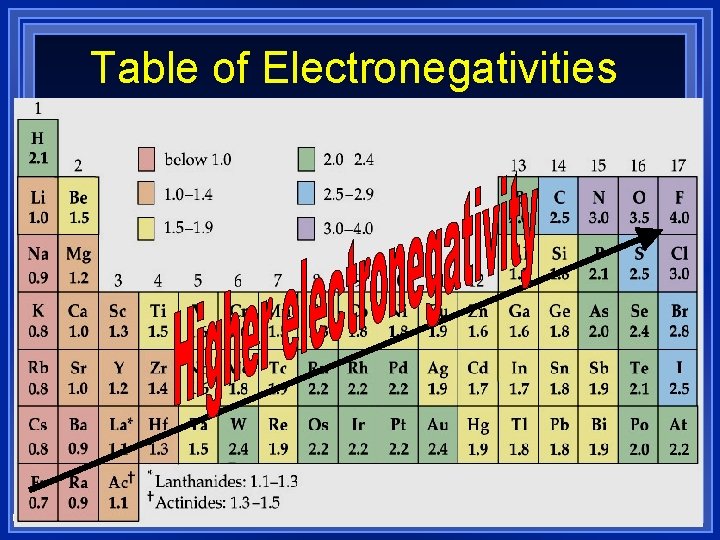
Table of Electronegativities 68
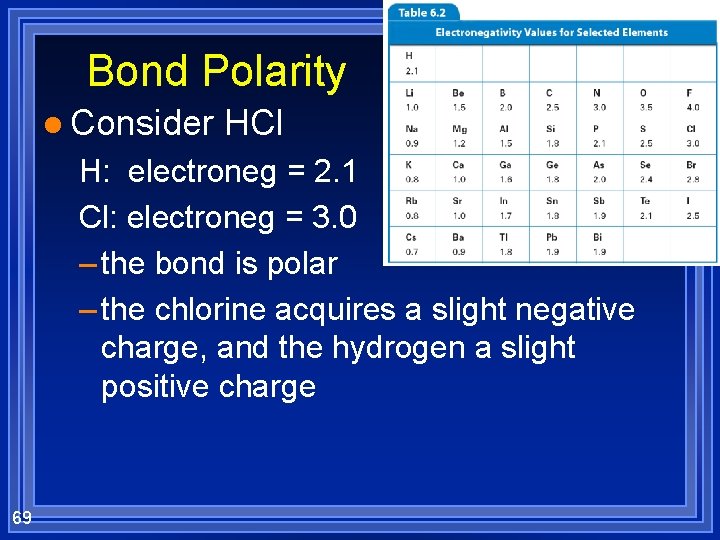
Bond Polarity l Consider HCl H: electroneg = 2. 1 Cl: electroneg = 3. 0 – the bond is polar – the chlorine acquires a slight negative charge, and the hydrogen a slight positive charge 69
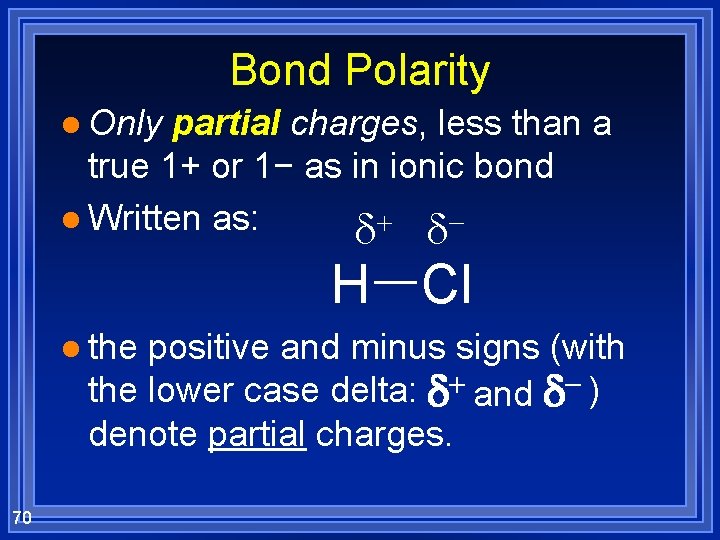
Bond Polarity l Only partial charges, less than a true 1+ or 1− as in ionic bond l Written as: + H Cl l the positive and minus signs (with the lower case delta: + and - ) denote partial charges. 70
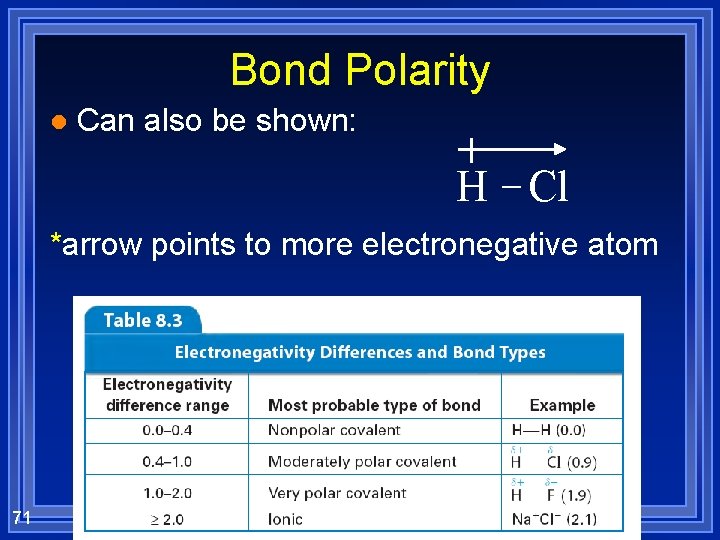
Bond Polarity l Can also be shown: H Cl *arrow points to more electronegative atom 71
Polar molecules Sample Problem 8. 3, p. 239 l A polar bond may make the entire molecule “polar” – Depends on shape of molecule l HCl has polar bonds, and one side is partially +, the other partially –, so the whole molecule is polar – A molecule like HCl that has two poles is said to have a dipole l 72

Practice Problems 73
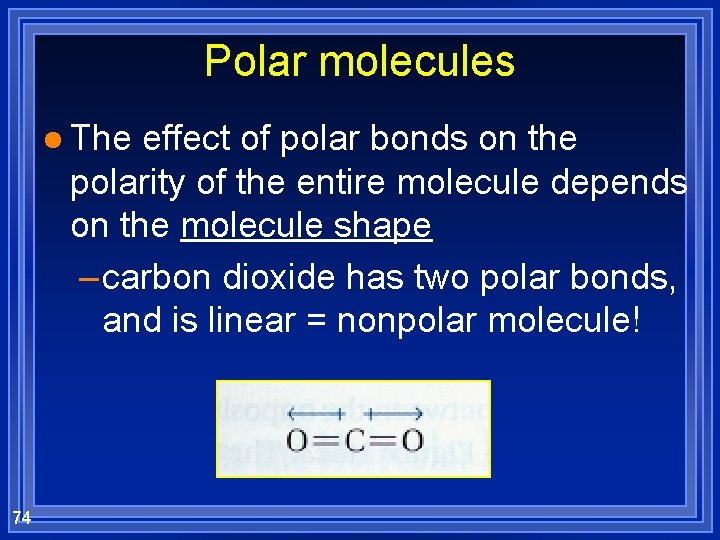
Polar molecules l The effect of polar bonds on the polarity of the entire molecule depends on the molecule shape – carbon dioxide has two polar bonds, and is linear = nonpolar molecule! 74
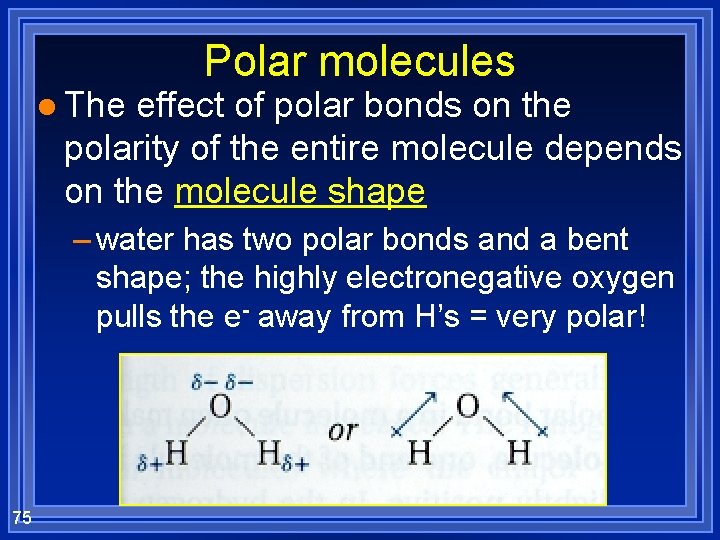
l The Polar molecules effect of polar bonds on the polarity of the entire molecule depends on the molecule shape – water has two polar bonds and a bent shape; the highly electronegative oxygen pulls the e- away from H’s = very polar! 75
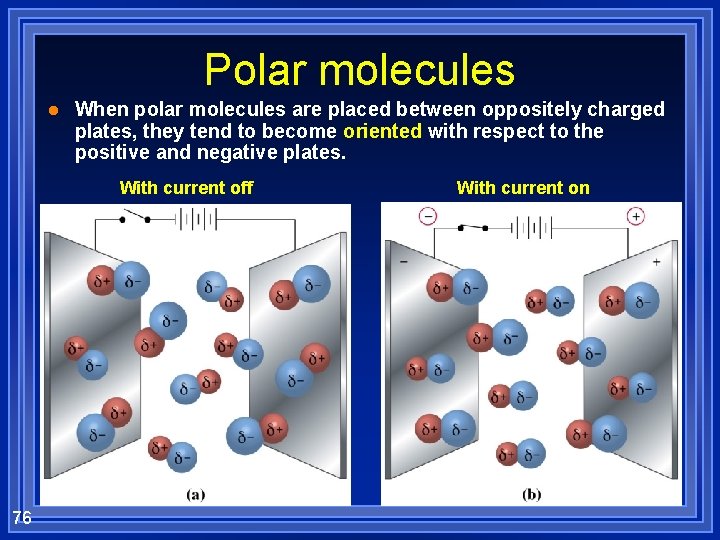
Polar molecules l When polar molecules are placed between oppositely charged plates, they tend to become oriented with respect to the positive and negative plates. With current off 76 With current on
Intermolecular Forces l= attractions between molecules l They are what determine if a compound will exist as a solid liquid or gas at room temperature l The weakest are called van der Waal’s forces - there are two kinds: 77
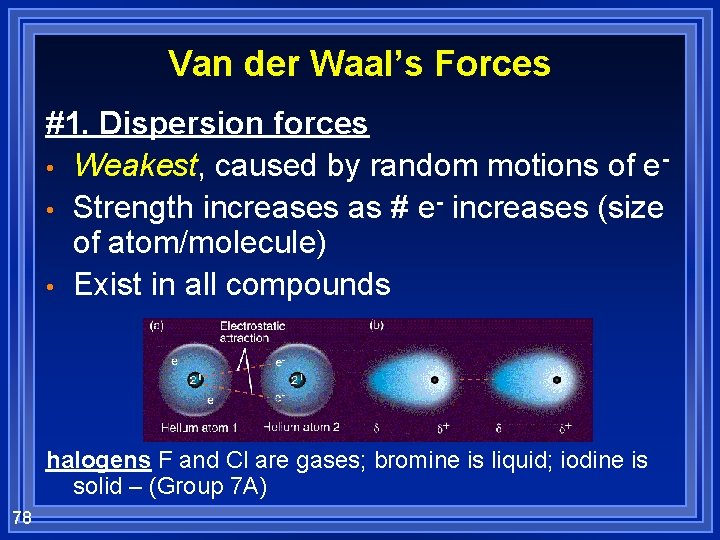
Van der Waal’s Forces #1. Dispersion forces • Weakest, caused by random motions of e • Strength increases as # e- increases (size of atom/molecule) • Exist in all compounds halogens F and Cl are gases; bromine is liquid; iodine is solid – (Group 7 A) 78
Dispersion Forces Animation Link to Dispersion Forces Animation 79
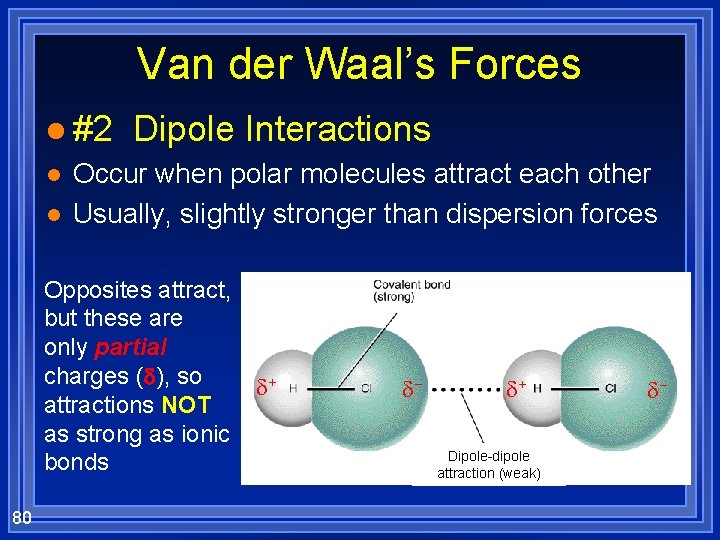
Van der Waal’s Forces l #2 l l Dipole Interactions Occur when polar molecules attract each other Usually, slightly stronger than dispersion forces Opposites attract, but these are only partial charges ( ), so attractions NOT as strong as ionic bonds 80 + − + Dipole-dipole attraction (weak) −
#3. Hydrogen bonding l l 81 …is the attractive force between a strongly + H atom (polar bonded to a N, O, F), and a lone pair of electrons on a N, O, or F atom of another molecule. N, O, F, are very electronegative (so strong – charge) ØStrongest type of dipole attraction The H atom “shares” a lone pair of electrons with an O, N, or F atom in another molecule On average, the strongest of the 3 IM forces.
#3. Hydrogen bonding defined: l l l When a hydrogen atom is: a) covalently bonded to a highly electronegative atom (O, N, or F), AND b) is also weakly bonded to an unshared electron pair of a nearby highly electronegative atom – The hydrogen is very electron deficient (its lone electron is being shared in a covalent bond with a highly electronegative atom) • so it is strongly attracted to electrons on electronegative atoms on other molecules – Hydrogen atom has no shielding for its nucleus, so that proton is strongly attracted to any nearby electrons 82
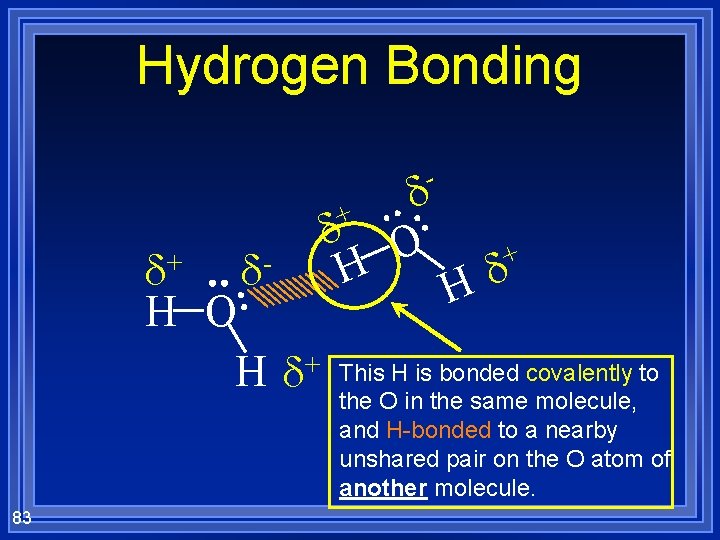
Hydrogen Bonding - + + H O H + 83 H O + H This H is bonded covalently to the O in the same molecule, and H-bonded to a nearby unshared pair on the O atom of another molecule.
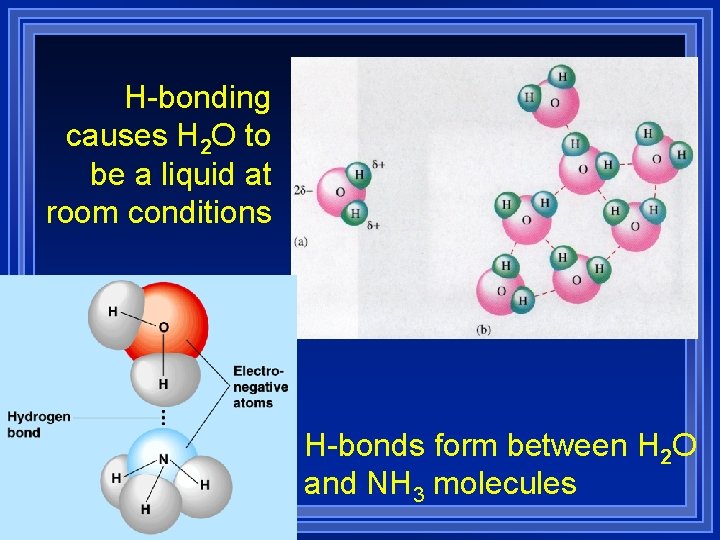
H-bonding causes H 2 O to be a liquid at room conditions H-bonds form between H 2 O and NH 3 molecules 84
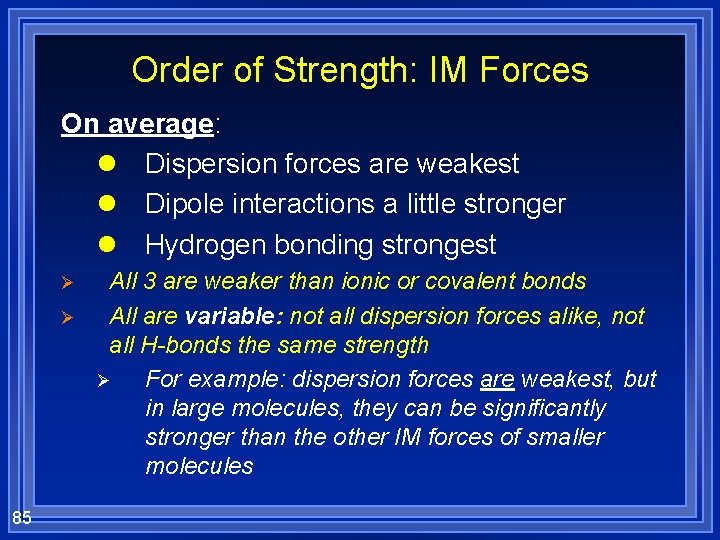
Order of Strength: IM Forces On average: l Dispersion forces are weakest l Dipole interactions a little stronger l Hydrogen bonding strongest Ø Ø 85 All 3 are weaker than ionic or covalent bonds All are variable: not all dispersion forces alike, not all H-bonds the same strength Ø For example: dispersion forces are weakest, but in large molecules, they can be significantly stronger than the other IM forces of smaller molecules
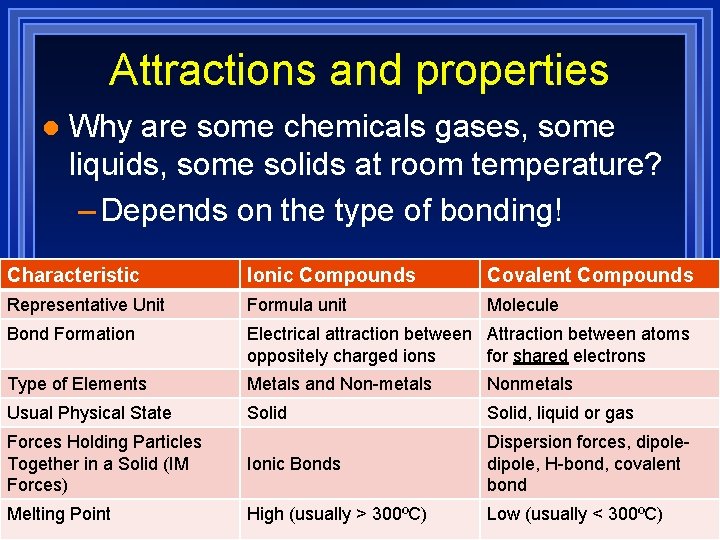
Attractions and properties l Why are some chemicals gases, some liquids, some solids at room temperature? – Depends on the type of bonding! Characteristic Ionic Compounds Covalent Compounds Representative Unit Formula unit Molecule Bond Formation Electrical attraction between Attraction between atoms oppositely charged ions for shared electrons Type of Elements Metals and Non-metals Nonmetals Usual Physical State Solid, liquid or gas Forces Holding Particles Together in a Solid (IM Forces) Ionic Bonds Dispersion forces, dipole, H-bond, covalent bond Melting Point 86 High (usually > 300ºC) Low (usually < 300ºC)
Attractions and properties l Network covalent solids – solids in which all the atoms are covalently bonded to each other l The force holding the particles together in a solid (IM force) is the strongest type of chemical bond! 87
Attractions and properties l Network covalent solids melt at very high temperatures, or not at all (decompose instead) – Diamond does not really melt, but vaporizes to a gas at 3500 o. C – Si. C, used in grinding, has a melting point of about 2700 o. C 88
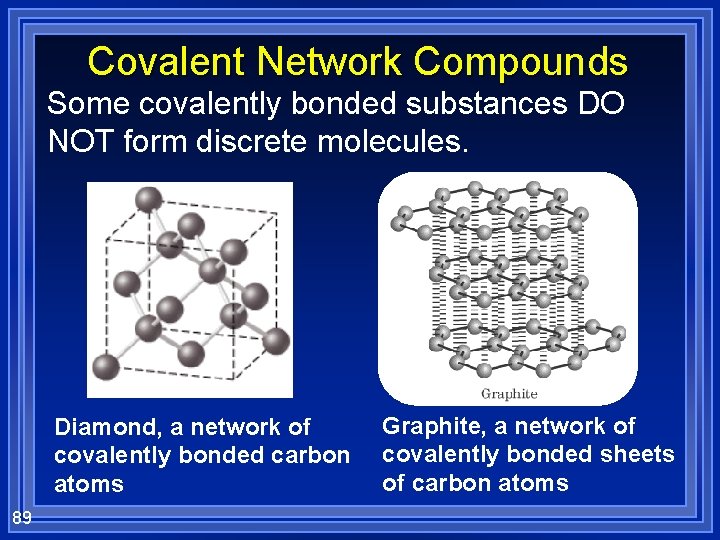
Covalent Network Compounds Some covalently bonded substances DO NOT form discrete molecules. Diamond, a network of covalently bonded carbon atoms 89 Graphite, a network of covalently bonded sheets of carbon atoms
8. 4 Polar Bonds & Molecules l OBJECTIVES (Accomplished? ? ) – Describe how electronegativity values determine the distribution of charge in a polar molecule – Describe what happens to polar molecules when they are placed between oppositely charged metal plates – Evaluate the strength of intermolecular attractions compared with the strength of ionic and covalent bonds – Identify the reason why network solids have high melting points 90
- Slides: 90