
Chapter 8 Covalent bonding 1 Covalent Bonding A
Chapter 8 Covalent bonding 1
Covalent Bonding § A metal and a nonmetal transfer electrons – An ionic bond § Two metals just mix and don’t react – An alloy § What do two nonmetals do? – Neither one will give away an electron – So they share their valence electrons – This is a covalent bond 2
Covalent bonding § Makes molecules – Specific atoms joined by sharing electrons § Two kinds of molecules: § Molecular compound – Sharing by different elements § Diatomic molecules – Two of the same atom – O 2 N 2 3
Diatomic elements § There are 8 elements that always form molecules § H 2 , N 2 , O 2 , F 2 , Cl 2 , Br 2 , I 2 , and At 2 § Oxygen by itself means O 2 § The –ogens and the –ines § 1 + 7 pattern on the periodic table 4
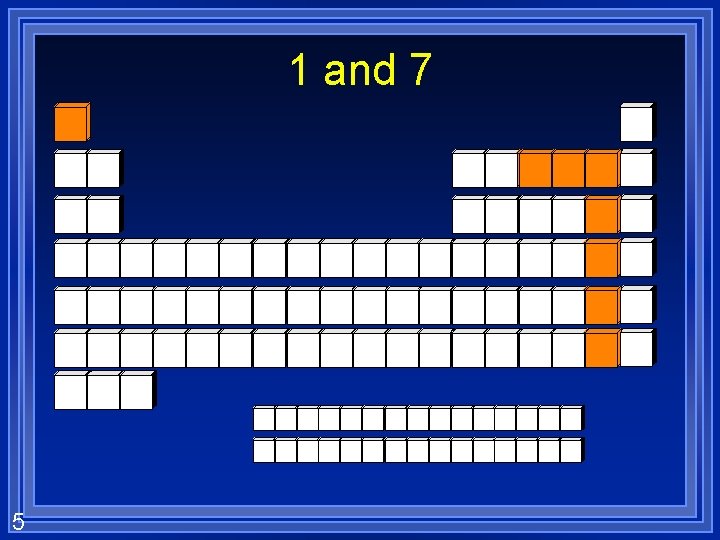
1 and 7 5
Molecular compounds § Tend to have low melting and boiling points § Have a molecular formula which shows type and number of atoms in a molecule § Not necessarily the lowest ratio § C 6 H 12 O 6 § Formula doesn’t tell you about how atoms are arranged 6
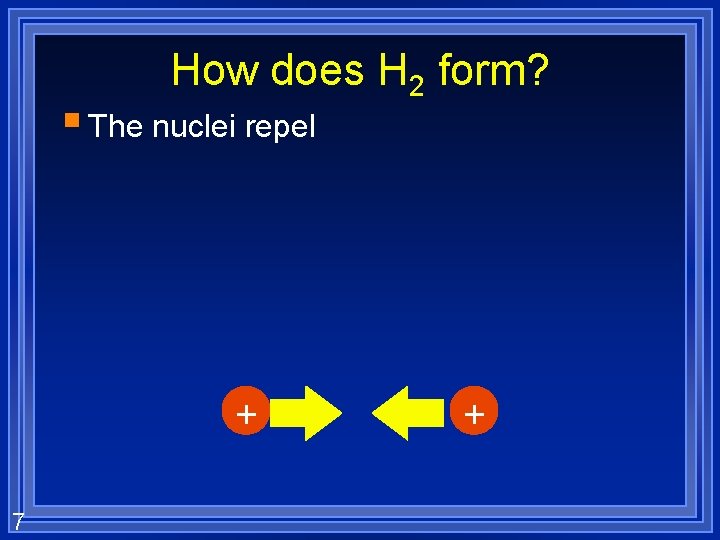
How does H 2 form? § The nuclei repel + 7 +
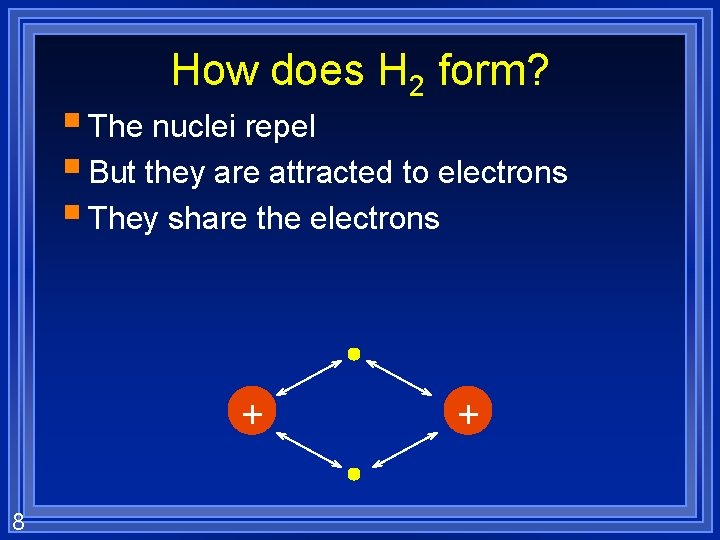
How does H 2 form? § The nuclei repel § But they are attracted to electrons § They share the electrons + 8 +
Covalent bonds § Nonmetals hold onto their valence electrons. § They can’t give away electrons to bond. § Still need noble gas configuration. § Get it by sharing valence electrons with each other. § By sharing both atoms get to count the electrons toward noble gas configuration. 9
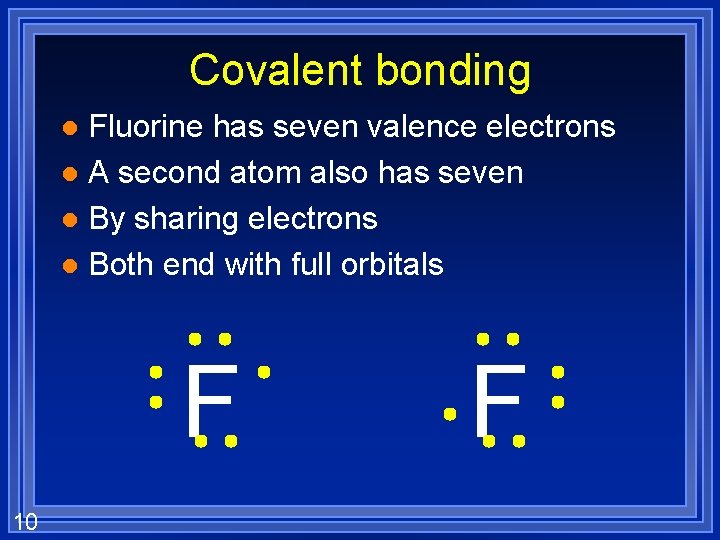
Covalent bonding Fluorine has seven valence electrons l A second atom also has seven l By sharing electrons l Both end with full orbitals l F 10 F
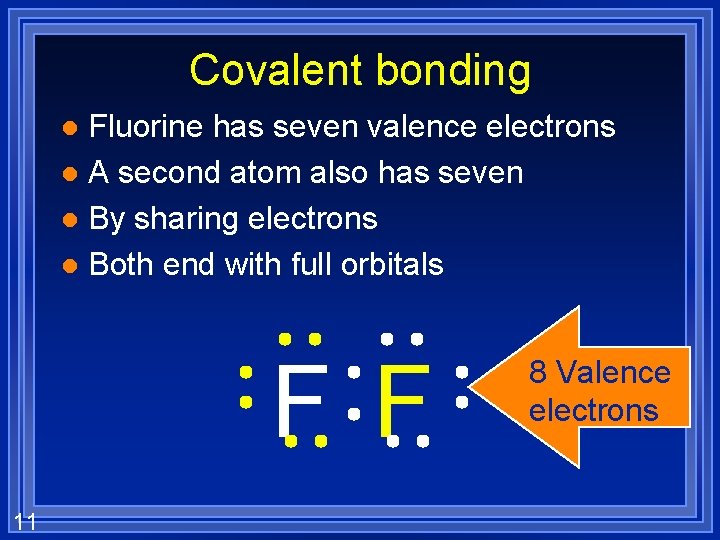
Covalent bonding Fluorine has seven valence electrons l A second atom also has seven l By sharing electrons l Both end with full orbitals l F F 11 8 Valence electrons
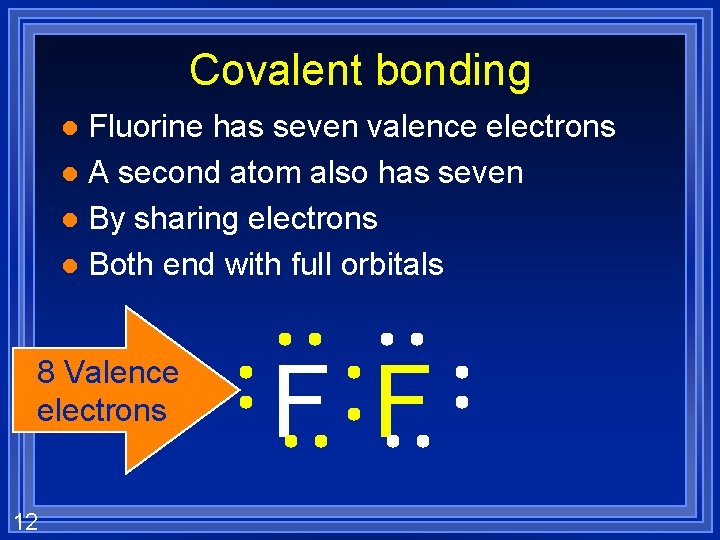
Covalent bonding Fluorine has seven valence electrons l A second atom also has seven l By sharing electrons l Both end with full orbitals l 8 Valence electrons 12 F F
Single Covalent Bond § A sharing of two valence electrons. § Only nonmetals and Hydrogen. § Different from an ionic bond because they actually form molecules. § Two specific atoms are joined. § In an ionic solid you can’t tell which atom the electrons moved from or to. 13
How to show they formed § It’s like a jigsaw puzzle. § I have to tell you what the final formula is. § You put the pieces together to end up with the right formula. § For example- show water is formed with covalent bonds. 14
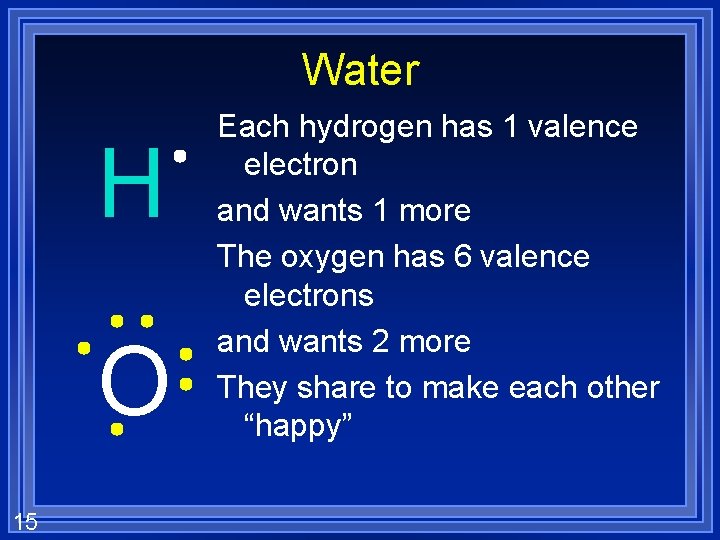
Water H O 15 Each hydrogen has 1 valence electron and wants 1 more The oxygen has 6 valence electrons and wants 2 more They share to make each other “happy”
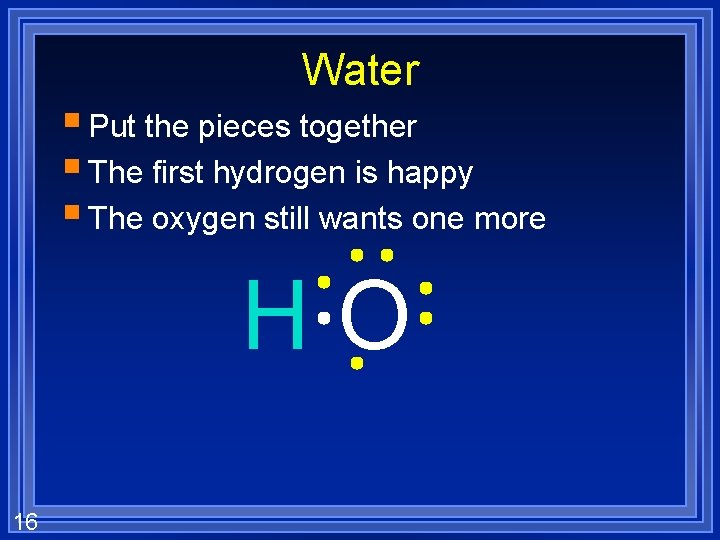
Water § Put the pieces together § The first hydrogen is happy § The oxygen still wants one more HO 16
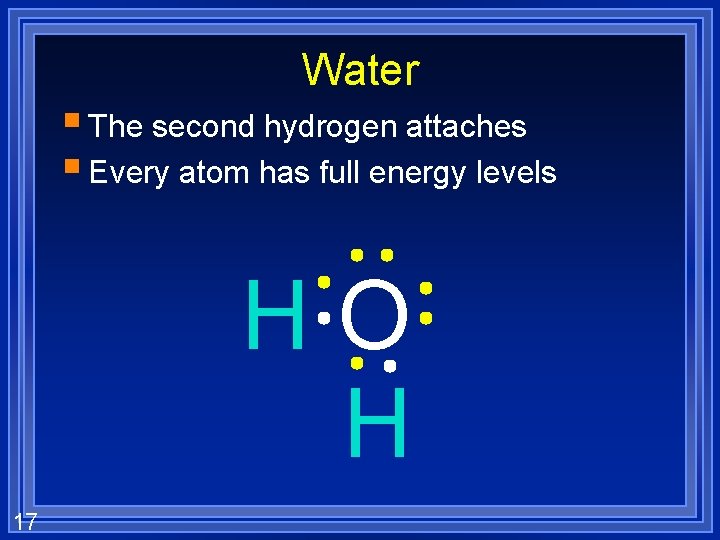
Water § The second hydrogen attaches § Every atom has full energy levels HO H 17
Multiple Bonds § Sometimes atoms share more than one pair of valence electrons. § A double bond is when atoms share two pair (4) of electrons. § A triple bond is when atoms share three pair (6) of electrons. 18
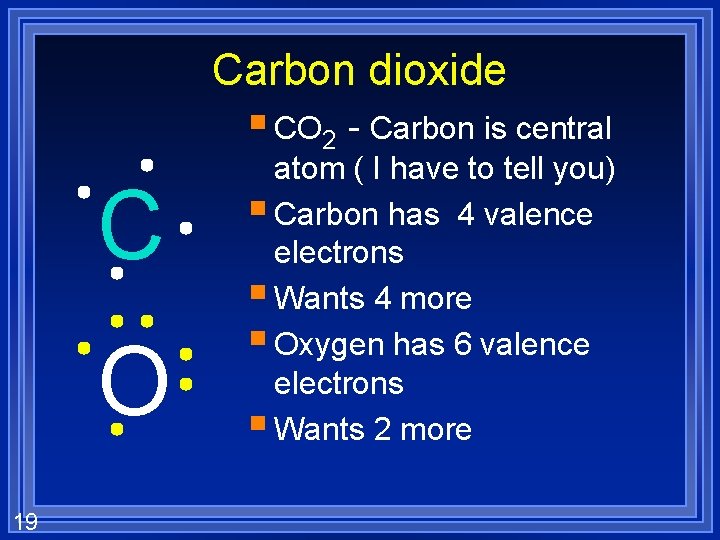
Carbon dioxide § CO 2 - Carbon is central C O 19 atom ( I have to tell you) § Carbon has 4 valence electrons § Wants 4 more § Oxygen has 6 valence electrons § Wants 2 more
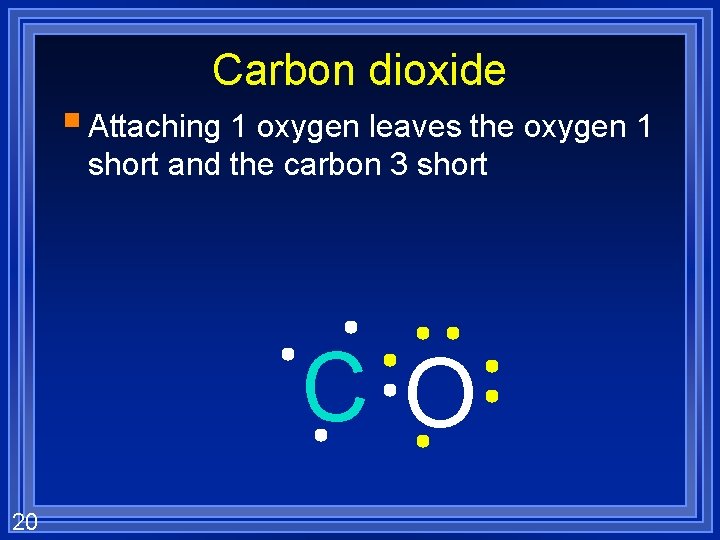
Carbon dioxide § Attaching 1 oxygen leaves the oxygen 1 short and the carbon 3 short CO 20
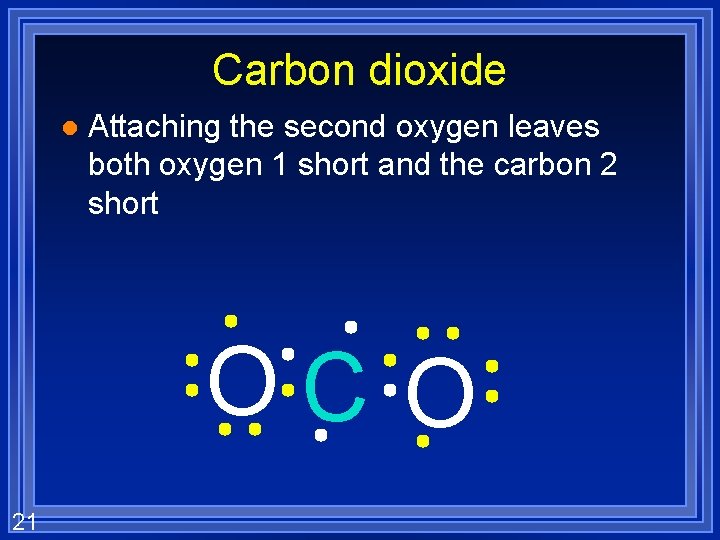
Carbon dioxide l Attaching the second oxygen leaves both oxygen 1 short and the carbon 2 short OC O 21
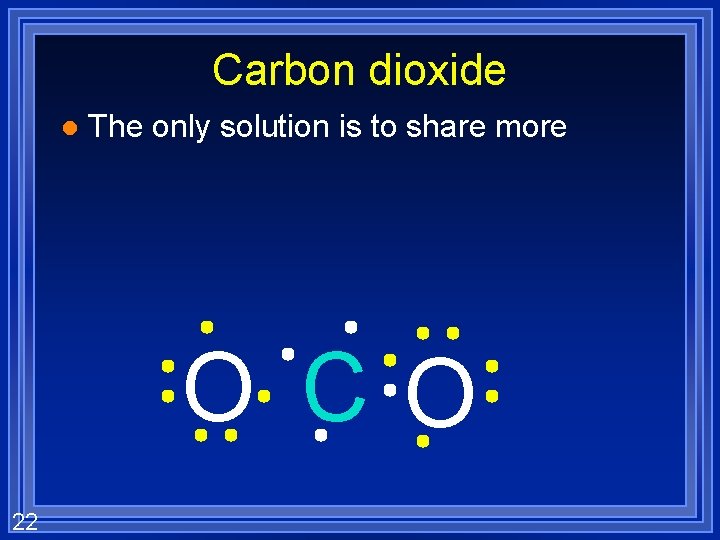
Carbon dioxide l The only solution is to share more O CO 22
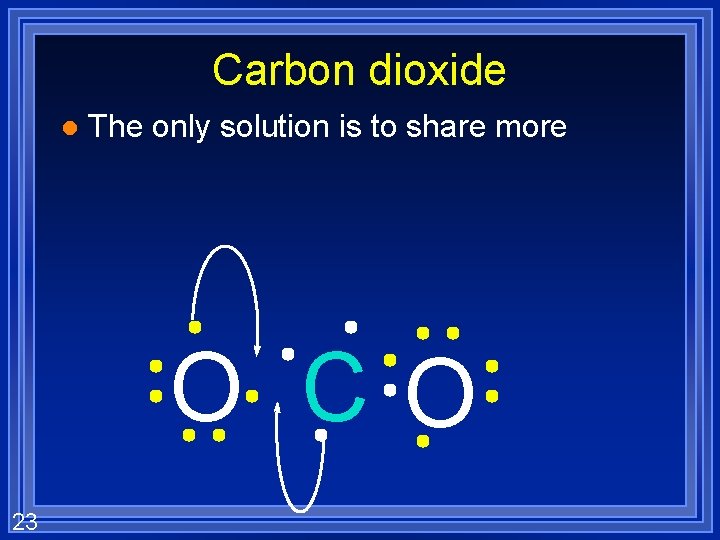
Carbon dioxide l The only solution is to share more O CO 23
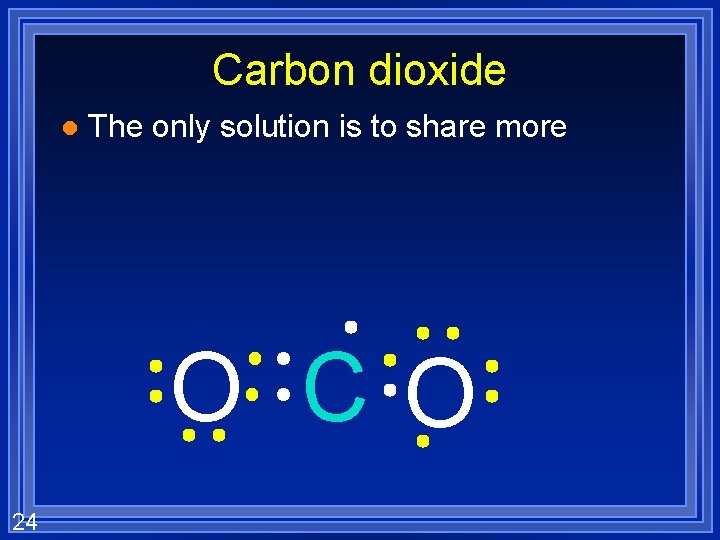
Carbon dioxide l The only solution is to share more O CO 24
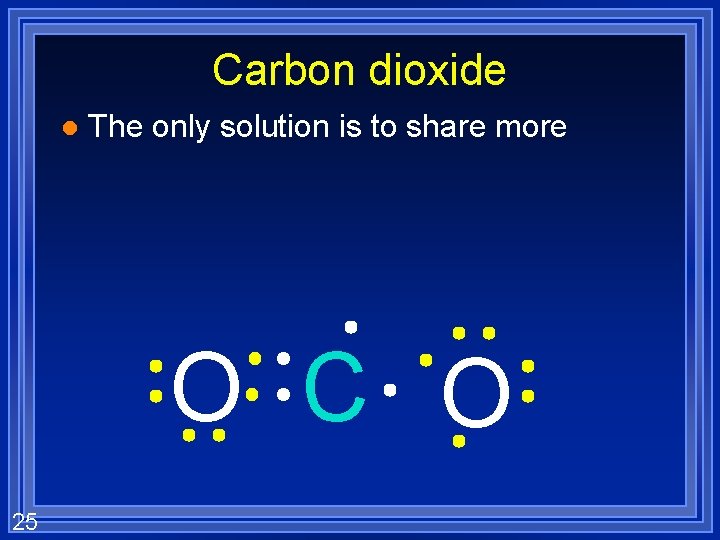
Carbon dioxide l The only solution is to share more O C O 25
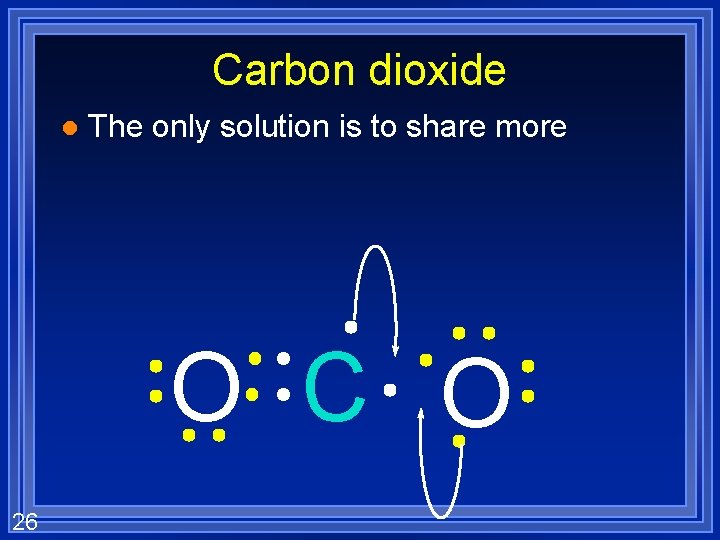
Carbon dioxide l The only solution is to share more O C O 26
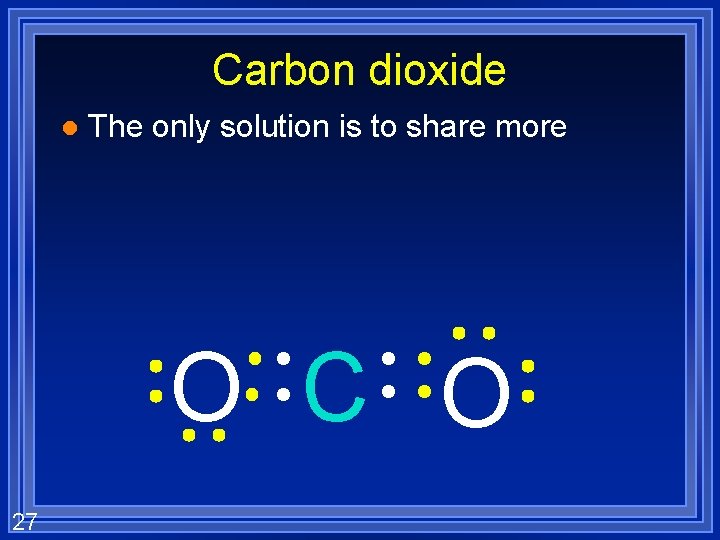
Carbon dioxide l The only solution is to share more O C O 27
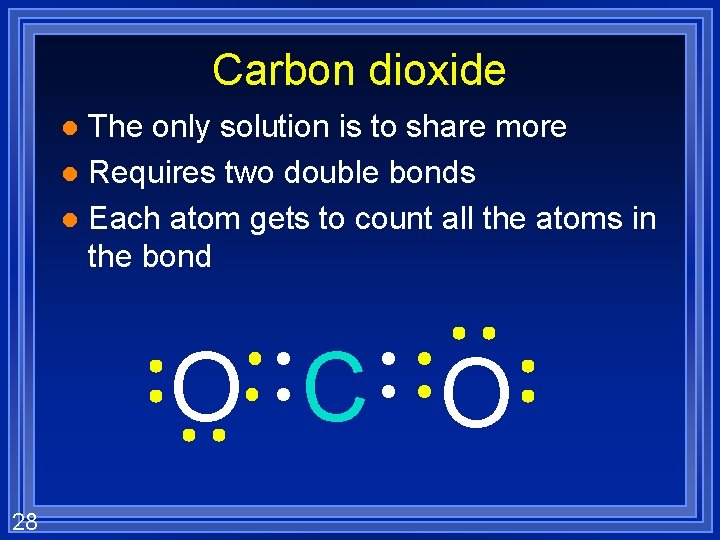
Carbon dioxide The only solution is to share more l Requires two double bonds l Each atom gets to count all the atoms in the bond l O C O 28
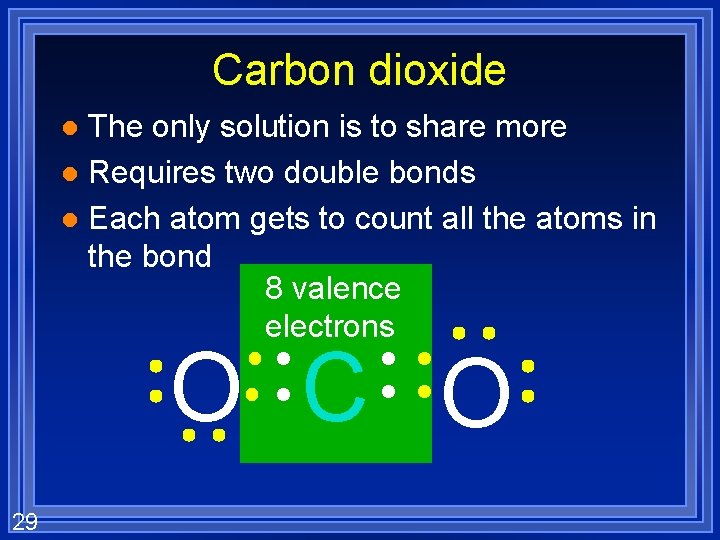
Carbon dioxide The only solution is to share more l Requires two double bonds l Each atom gets to count all the atoms in the bond 8 valence electrons l O C O 29
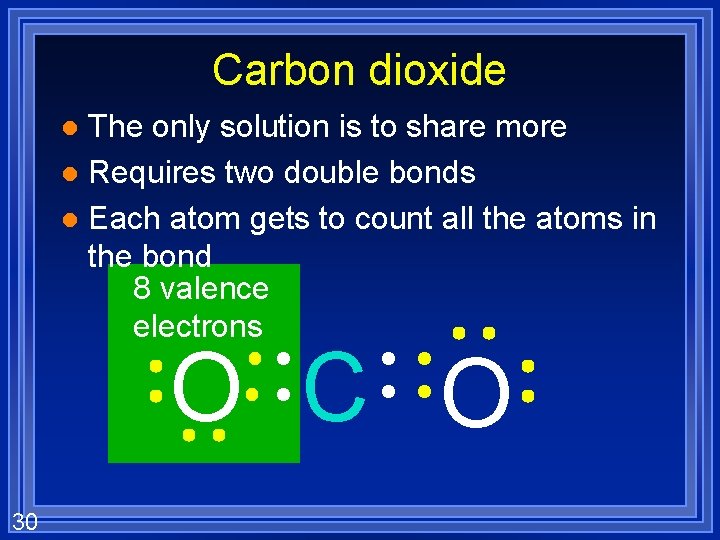
Carbon dioxide The only solution is to share more l Requires two double bonds l Each atom gets to count all the atoms in the bond 8 valence electrons l O C O 30
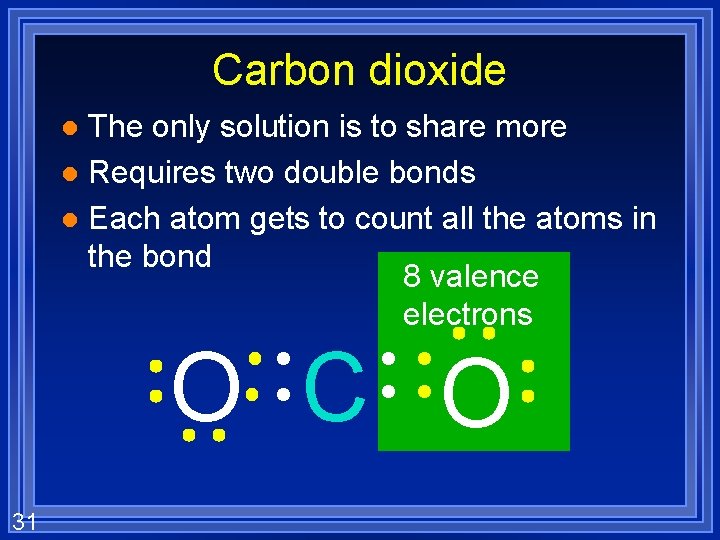
Carbon dioxide The only solution is to share more l Requires two double bonds l Each atom gets to count all the atoms in the bond 8 valence electrons l O C O 31
How to draw them § To figure out if you need multiple bonds § Add up all the valence electrons. § Count up the total number of electrons to make all atoms happy. § Subtract. § Divide by 2 § Tells you how many bonds - draw them. § Fill in the rest of the valence electrons to fill atoms up. 32
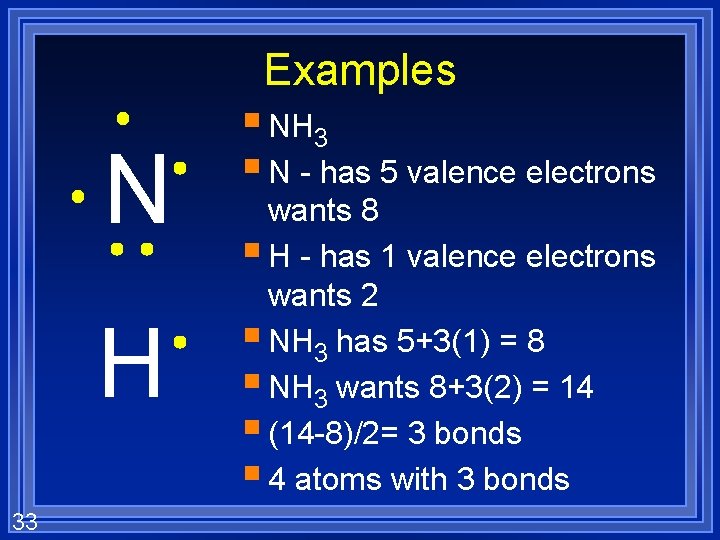
Examples N H 33 § NH 3 § N - has 5 valence electrons wants 8 § H - has 1 valence electrons wants 2 § NH 3 has 5+3(1) = 8 § NH 3 wants 8+3(2) = 14 § (14 -8)/2= 3 bonds § 4 atoms with 3 bonds
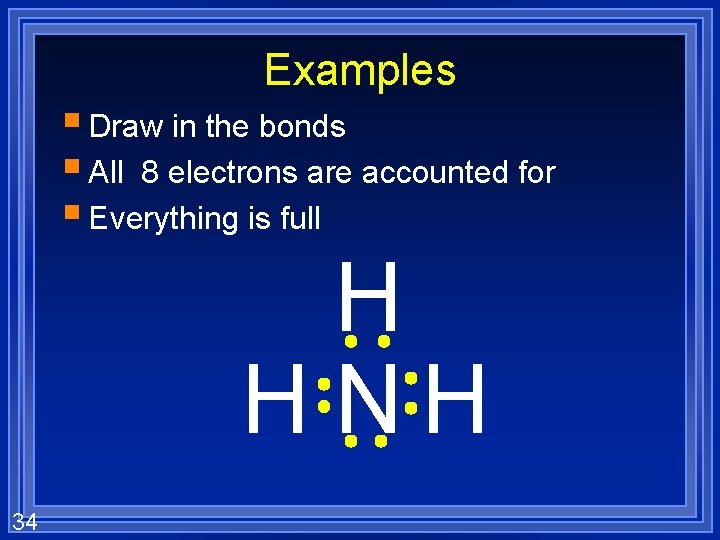
Examples § Draw in the bonds § All 8 electrons are accounted for § Everything is full H H NH 34
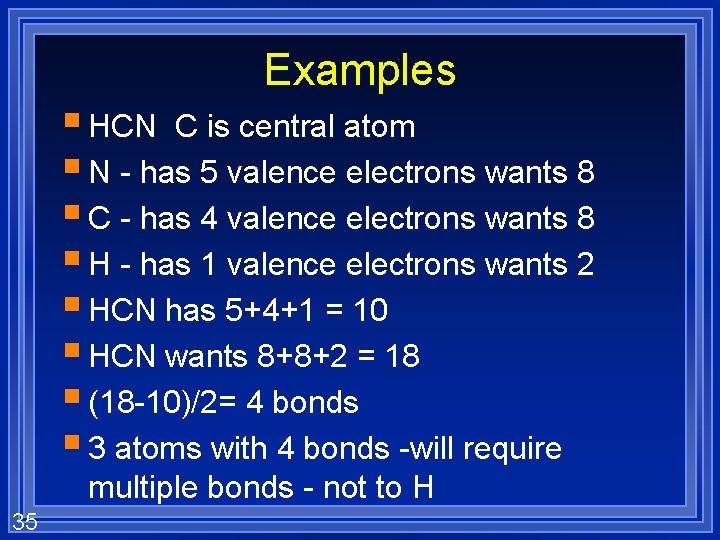
Examples § HCN C is central atom § N - has 5 valence electrons wants 8 § C - has 4 valence electrons wants 8 § H - has 1 valence electrons wants 2 § HCN has 5+4+1 = 10 § HCN wants 8+8+2 = 18 § (18 -10)/2= 4 bonds § 3 atoms with 4 bonds -will require multiple bonds - not to H 35
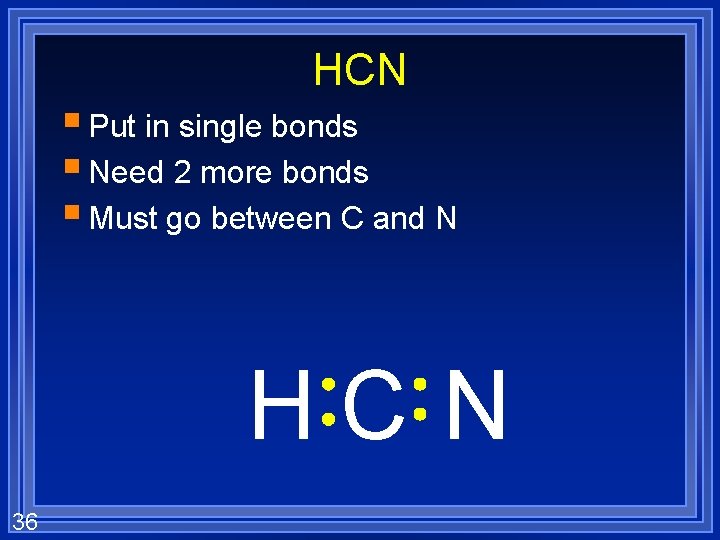
HCN § Put in single bonds § Need 2 more bonds § Must go between C and N HC N 36
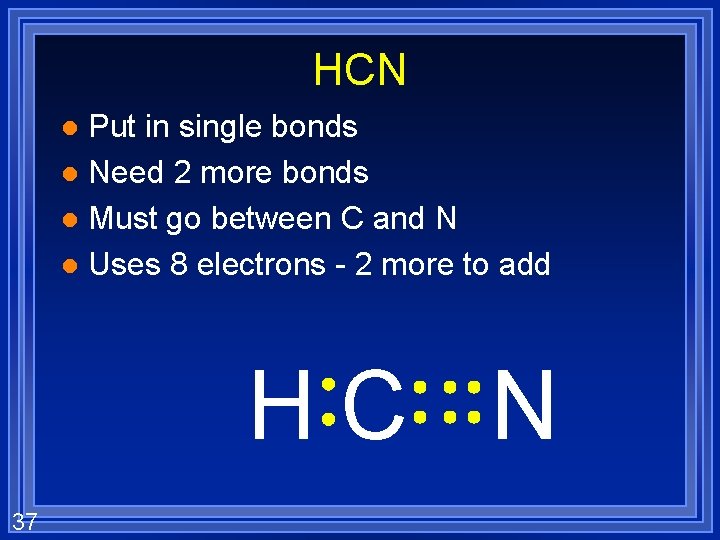
HCN Put in single bonds l Need 2 more bonds l Must go between C and N l Uses 8 electrons - 2 more to add l HC N 37
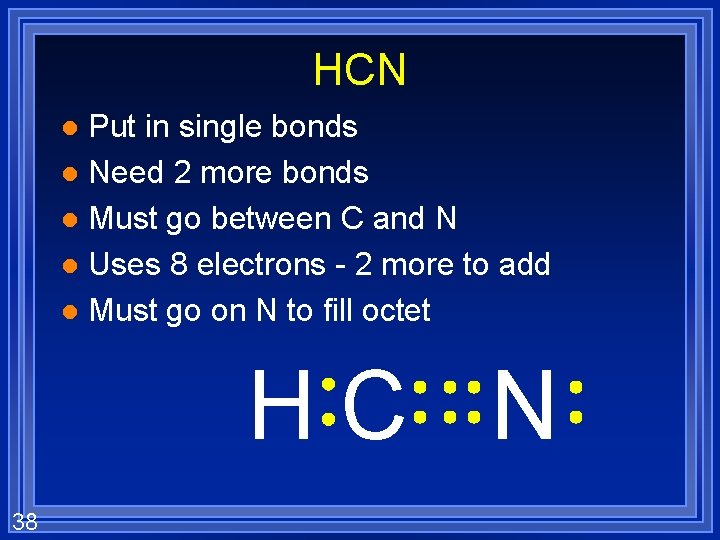
HCN Put in single bonds l Need 2 more bonds l Must go between C and N l Uses 8 electrons - 2 more to add l Must go on N to fill octet l HC N 38
Where do bonds go? § Think of how many electrons they are away from noble gas. § H should form 1 bond- always § O should form 2 bonds – if possible § N should form 3 bonds – if possible § C should form 4 bonds– if possible 39
Practice § Draw electron dot diagrams for the following. § PCl 3 § H 2 O 2 § CH 2 O § C 3 H 6 40
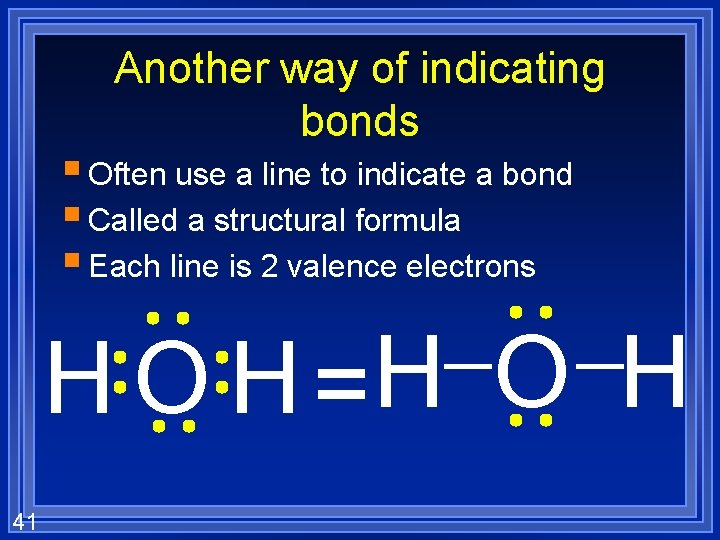
Another way of indicating bonds § Often use a line to indicate a bond § Called a structural formula § Each line is 2 valence electrons H O H =H O H 41
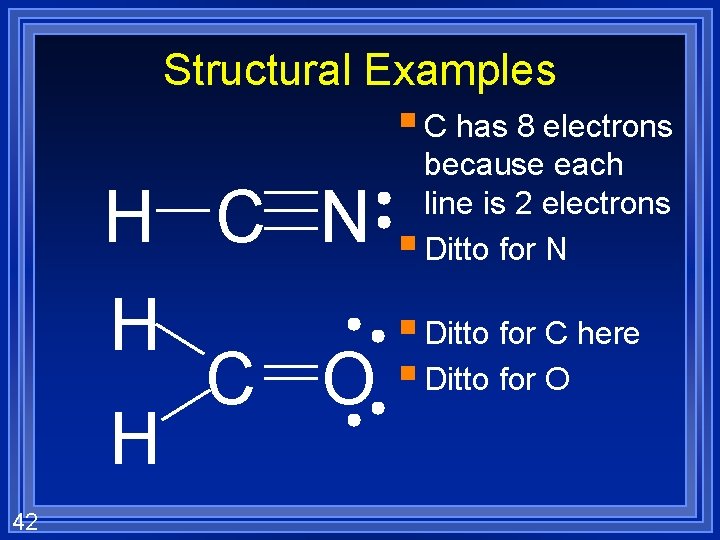
Structural Examples § C has 8 electrons because each line is 2 electrons § Ditto for N H C N § Ditto for C here H C O § Ditto for O H 42
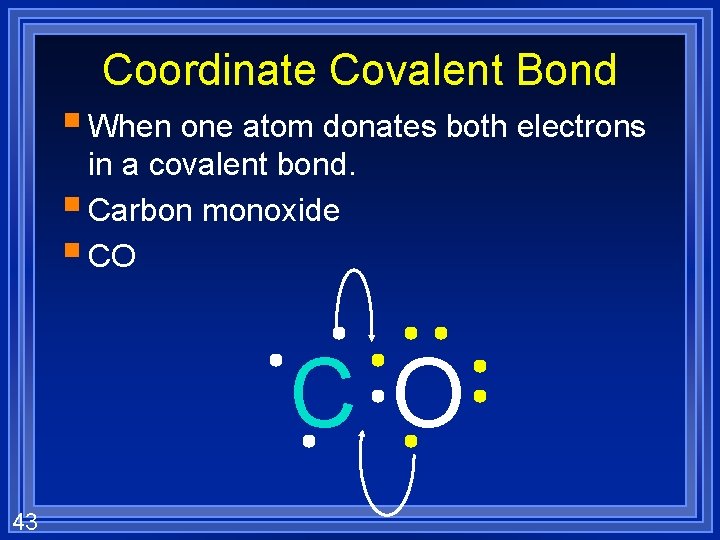
Coordinate Covalent Bond § When one atom donates both electrons in a covalent bond. § Carbon monoxide § CO CO 43
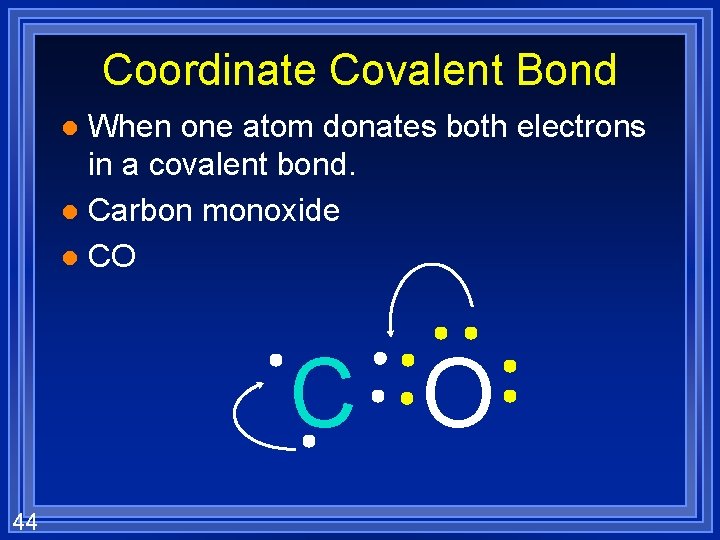
Coordinate Covalent Bond When one atom donates both electrons in a covalent bond. l Carbon monoxide l CO l C O 44
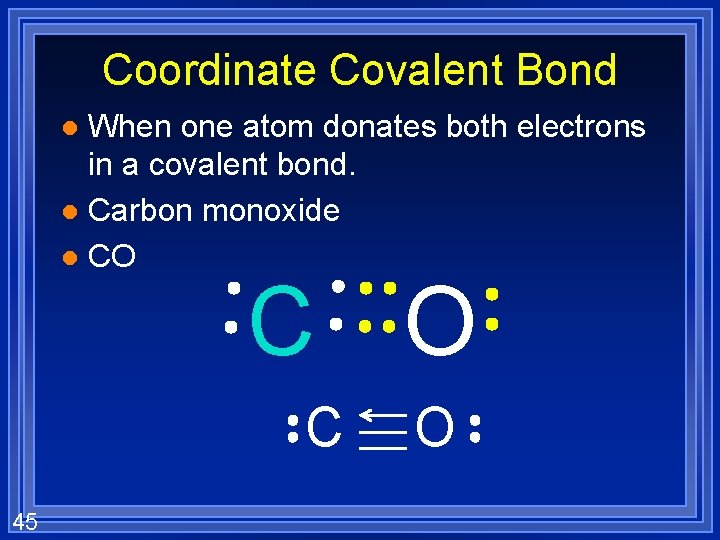
Coordinate Covalent Bond When one atom donates both electrons in a covalent bond. l Carbon monoxide l CO l C O C 45 O
How do we know if § Have to draw the diagram and see what happens. § Often happens with polyatomic ions § If an element has the wrong number of bonds 46
Polyatomic ions § Groups of atoms held by covalent bonds, with a charge § Can’t build directly, use (happy-have)/2 § Have number will be different § Surround with [ ], and write charge § NH 42+ § Cl. O 21 - 47
Resonance § When more than one dot diagram with the same connections is possible. § Choice for double bond § NO 2§ Which one is it? § Does it go back and forth? § Double bonds are shorter than single § In NO 2 - all the bonds are the same length 48
Resonance § It is a mixture of both, like a mule. § CO 32 - 49
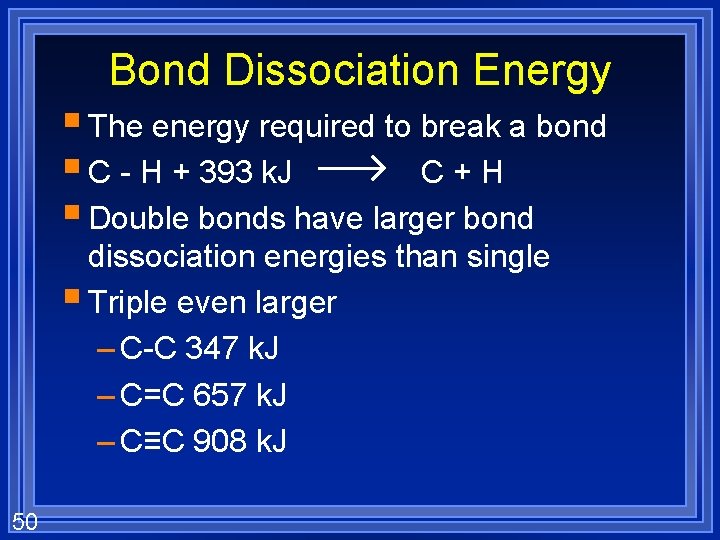
Bond Dissociation Energy § The energy required to break a bond § C - H + 393 k. J C+H § Double bonds have larger bond dissociation energies than single § Triple even larger – C-C 347 k. J – C=C 657 k. J – C≡C 908 k. J 50
Bond Dissociation Energy § The larger the bond energy, the harder it is to break § Large bond energies make chemicals less reactive. 51
VSEPR § Valence Shell Electron Pair Repulsion. § Predicts three dimensional geometry of molecules. § Name tells you theory. § Valence shell - outside electrons. § Electron Pair repulsion - electron pairs try to get as far away as possible. § Can determine the angles of bonds. § And the shape of molecules 52
VSEPR § Based on the number of pairs of valence electrons both bonded and unbonded. § Unbonded pair are called lone pair. § CH 4 - draw the structural formula 53
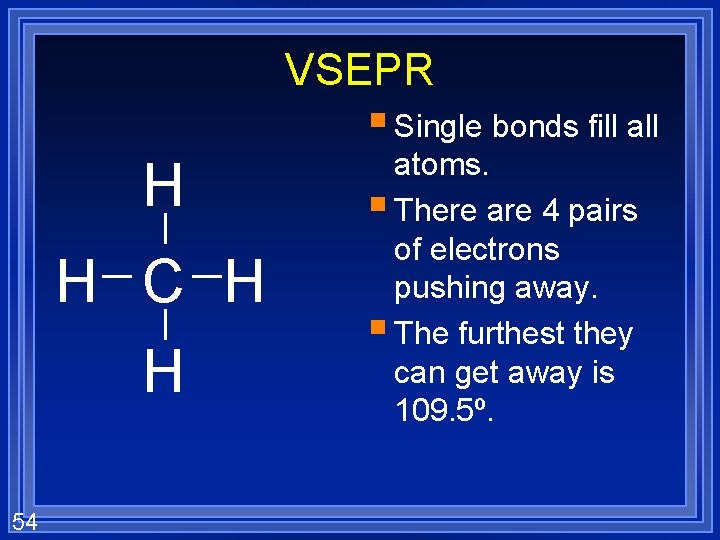
VSEPR § Single bonds fill all H H C H H 54 atoms. § There are 4 pairs of electrons pushing away. § The furthest they can get away is 109. 5º.
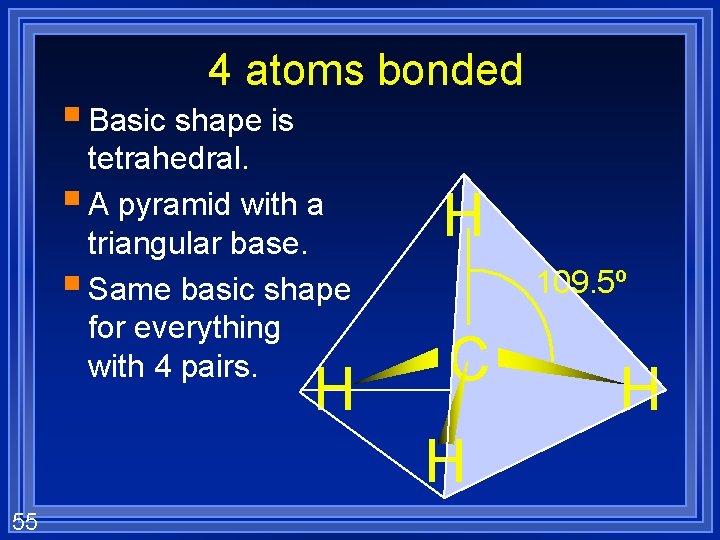
4 atoms bonded § Basic shape is tetrahedral. § A pyramid with a triangular base. § Same basic shape for everything with 4 pairs. H H 109. 5º C H 55 H
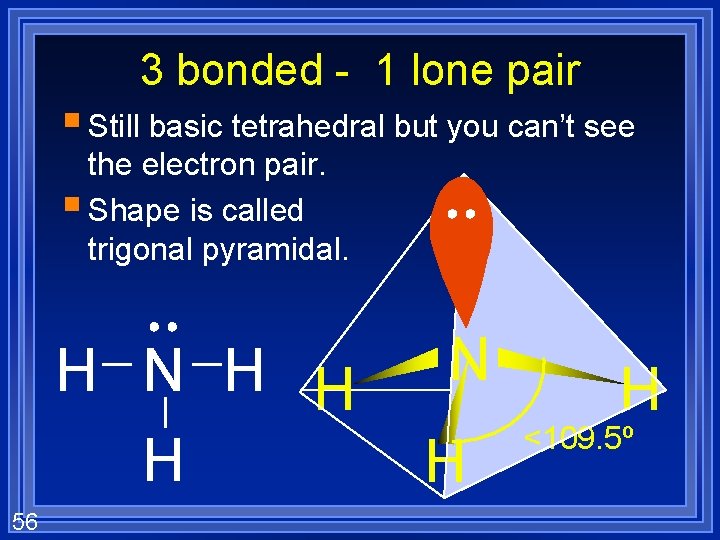
3 bonded - 1 lone pair § Still basic tetrahedral but you can’t see the electron pair. § Shape is called trigonal pyramidal. H N H H H 56 N H H <109. 5º
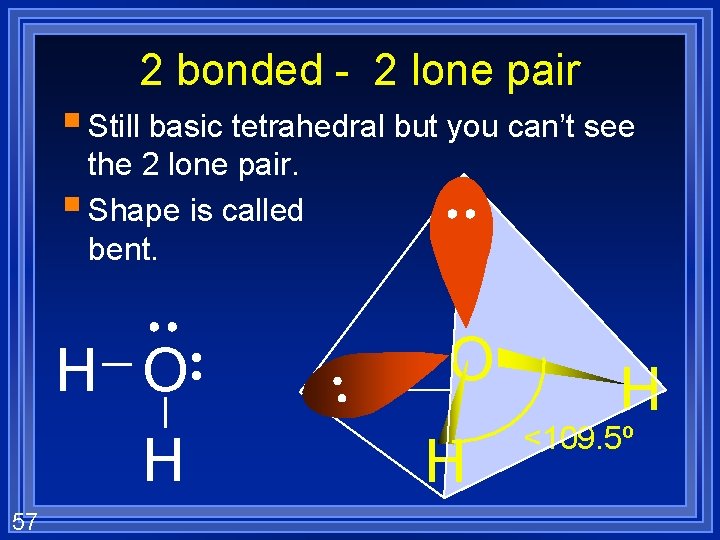
2 bonded - 2 lone pair § Still basic tetrahedral but you can’t see the 2 lone pair. § Shape is called bent. H O H 57 O H H <109. 5º
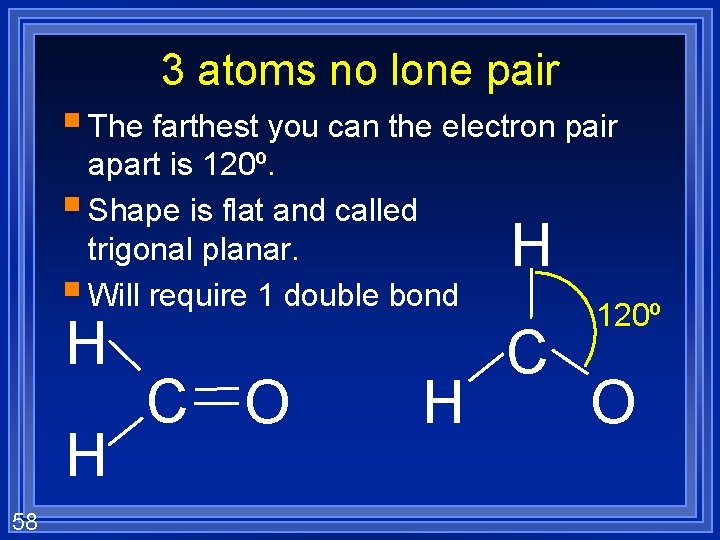
3 atoms no lone pair § The farthest you can the electron pair apart is 120º. § Shape is flat and called trigonal planar. § Will require 1 double bond H H 58 C O H H C 120º O
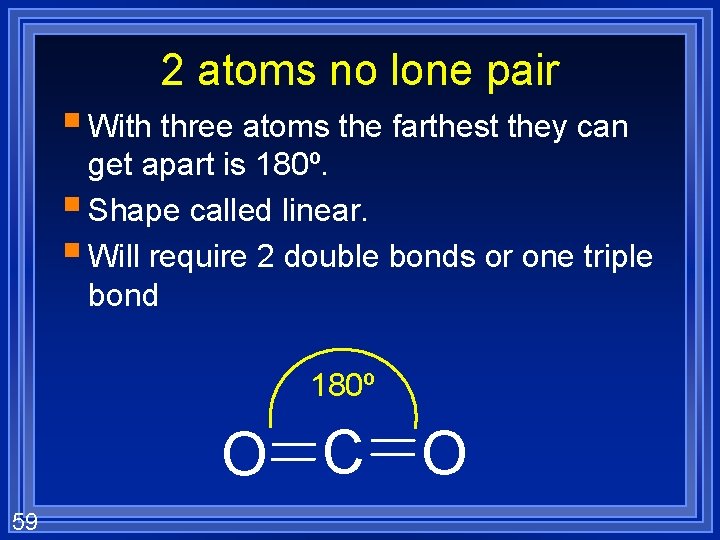
2 atoms no lone pair § With three atoms the farthest they can get apart is 180º. § Shape called linear. § Will require 2 double bonds or one triple bond 180º O C O 59
Molecular Orbitals § The overlap of atomic orbitals from separate atoms makes molecular orbitals § Each molecular orbital has room for two electrons § Two types of MO – Sigma ( σ ) between atoms – Pi ( π ) above and below atoms 60
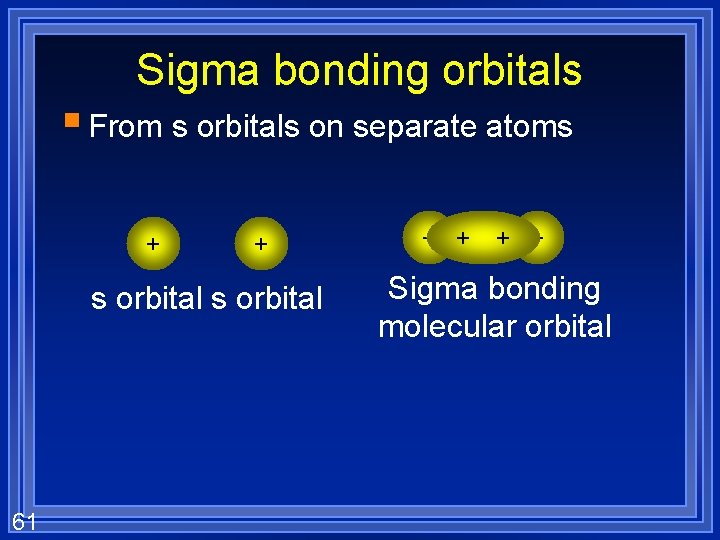
Sigma bonding orbitals § From s orbitals on separate atoms + + s orbital 61 + + Sigma bonding molecular orbital
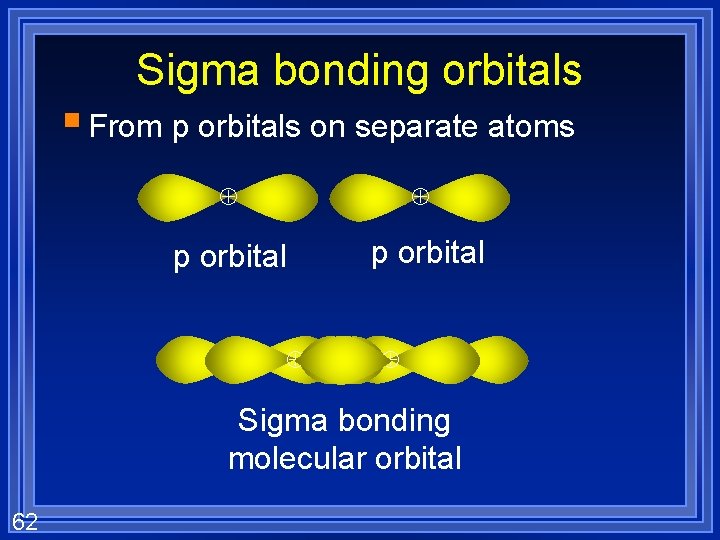
Sigma bonding orbitals § From p orbitals on separate atoms p orbital Sigma bonding molecular orbital 62
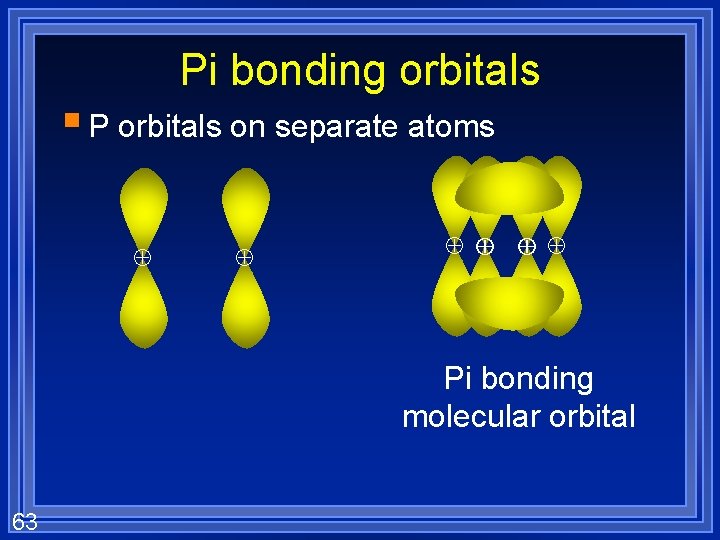
Pi bonding orbitals § P orbitals on separate atoms Pi bonding molecular orbital 63
Sigma and pi bonds § All single bonds are sigma bonds § A double bond is one sigma and one pi bond § A triple bond is one sigma and two pi bonds. 64
Hybrid Orbitals Combines bonding with geometry 65
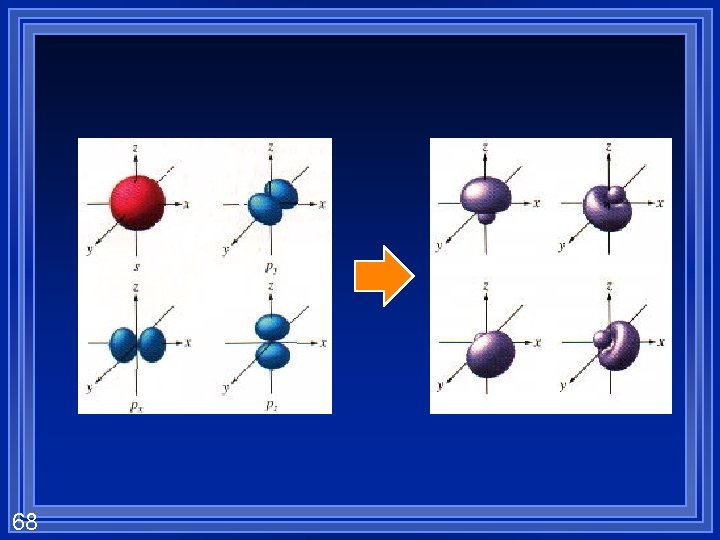
Hybridization § The mixing of several atomic orbitals to form the same number of hybrid orbitals. § All the hybrid orbitals that form are the same. § sp 3 -1 s and 3 p orbitals mix to form 4 sp 3 orbitals. § sp 2 -1 s and 2 p orbitals mix to form 3 sp 2 orbitals leaving 1 p orbital. § sp -1 s and 1 p orbitals mix to form 2 sp orbitals leaving 2 p orbitals. 66
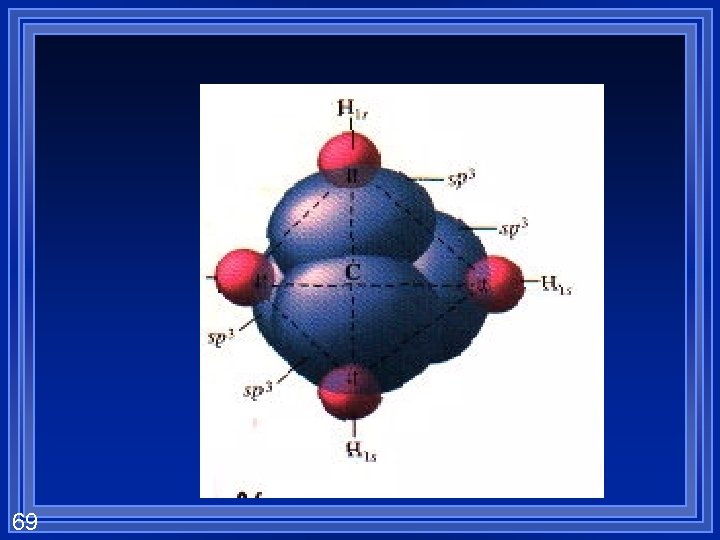
Hybridization § 109. 5º with s and p § Need 4 orbitals. § We combine one s orbital and 3 p orbitals. § Make sp 3 hybrid § sp 3 hybridization has tetrahedral geometry. 67
68
69
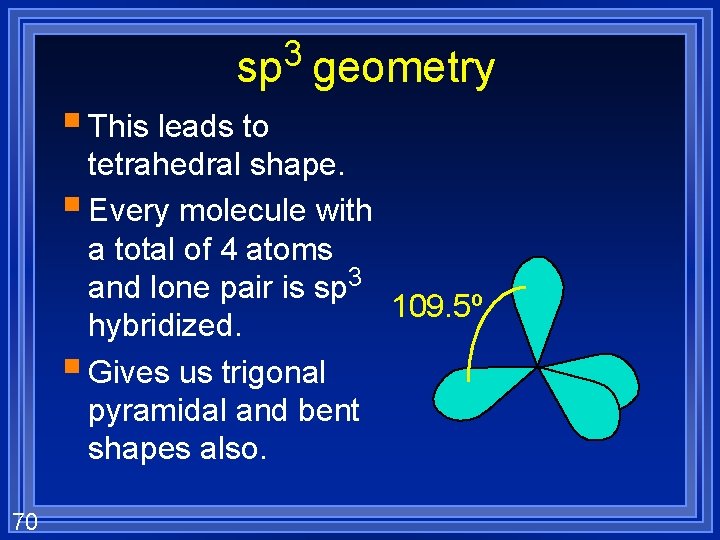
3 sp geometry § This leads to tetrahedral shape. § Every molecule with a total of 4 atoms and lone pair is sp 3 109. 5º hybridized. § Gives us trigonal pyramidal and bent shapes also. 70
How we get to hybridization § We know the geometry from experiment. § We know the orbitals of the atom § hybridizing atomic orbitals can explain the geometry. § So if the geometry requires a 109. 5º bond angle, it is sp 3 hybridized. 71
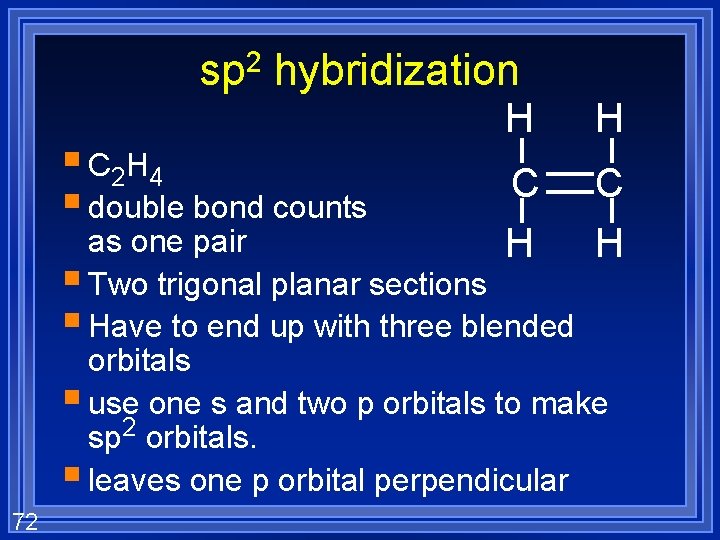
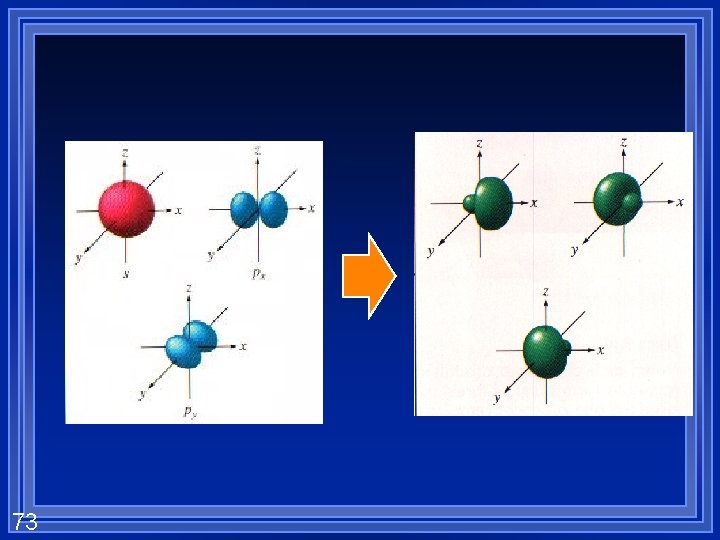
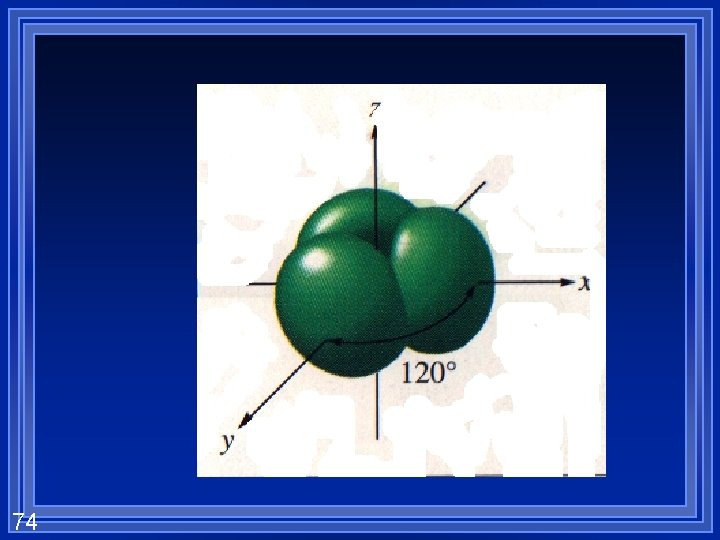
sp 2 hybridization § C 2 H 4 § double bond counts H H C H as one pair § Two trigonal planar sections § Have to end up with three blended orbitals § use 2 one s and two p orbitals to make sp orbitals. § leaves one p orbital perpendicular 72
73
74
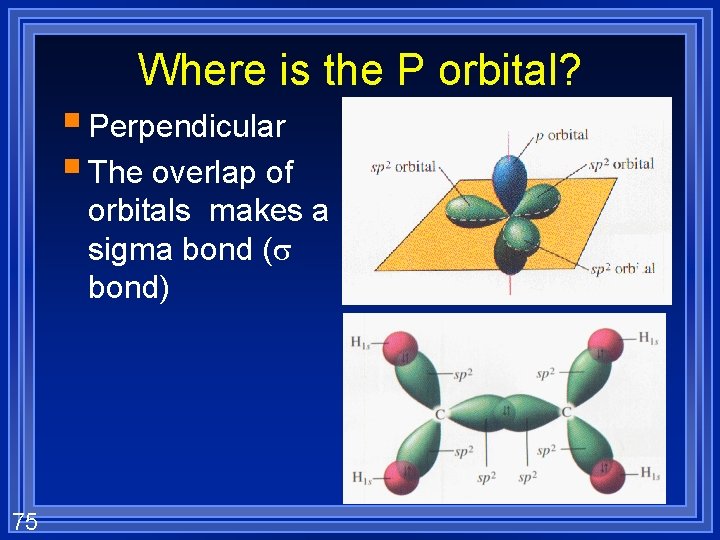
Where is the P orbital? § Perpendicular § The overlap of orbitals makes a sigma bond (s bond) 75
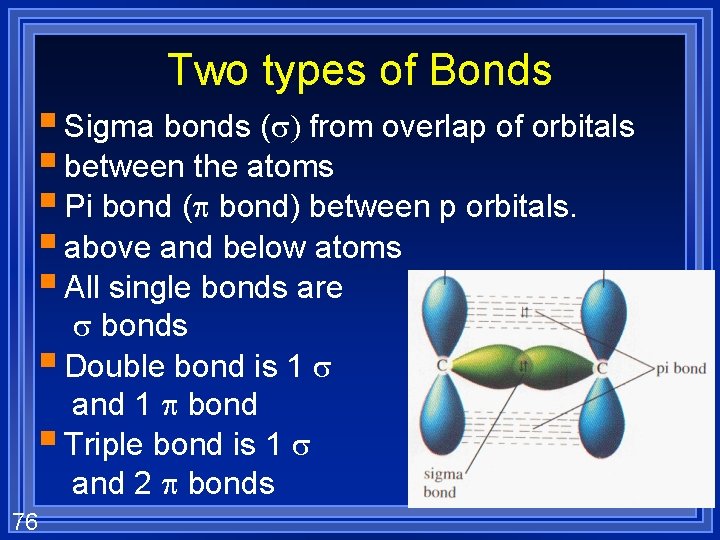
Two types of Bonds § Sigma bonds (s) from overlap of orbitals § between the atoms § Pi bond (p bond) between p orbitals. § above and below atoms § All single bonds are s bonds § Double bond is 1 s and 1 p bond § Triple bond is 1 s and 2 p bonds 76
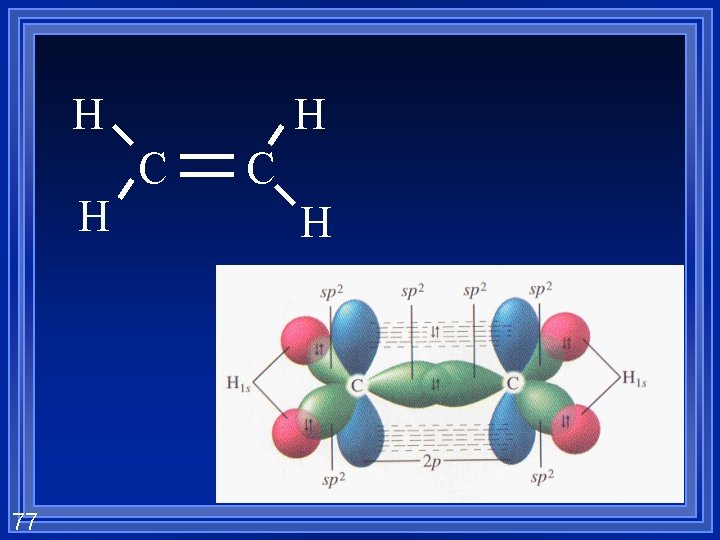
H H 77 H C C H
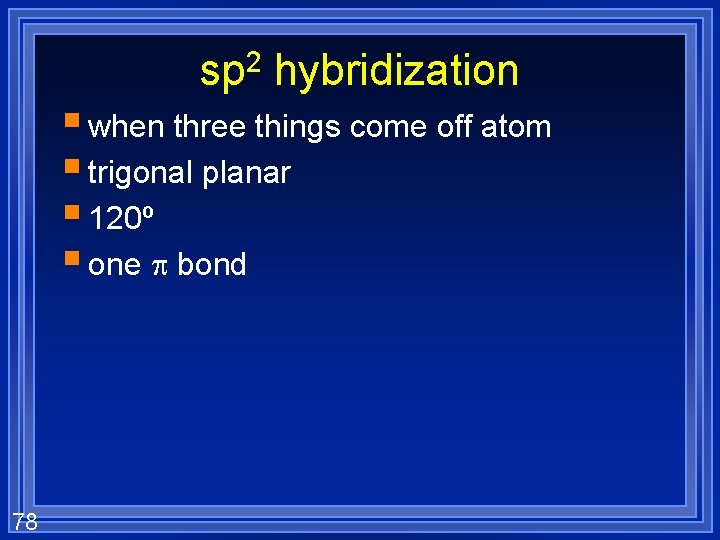
sp 2 hybridization § when three things come off atom § trigonal planar § 120º § one p bond 78
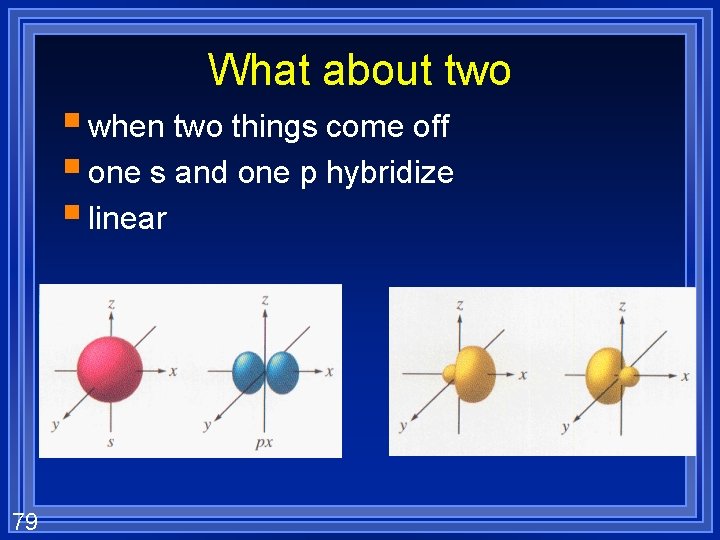
What about two § when two things come off § one s and one p hybridize § linear 79
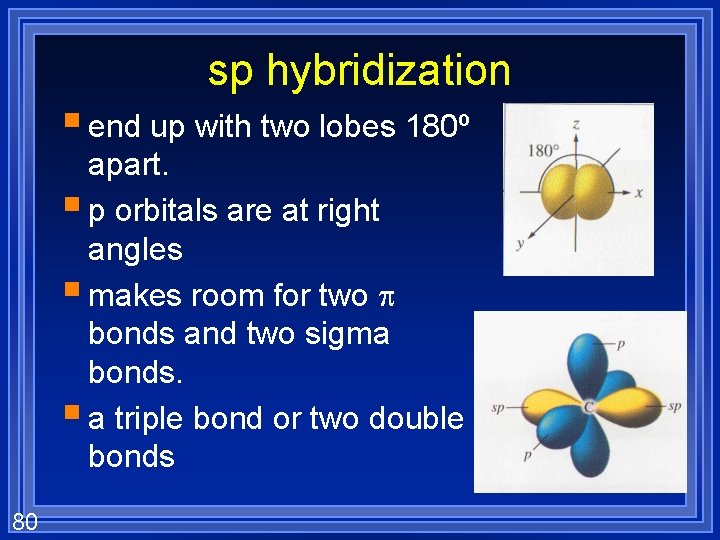
sp hybridization § end up with two lobes 180º apart. § p orbitals are at right angles § makes room for two p bonds and two sigma bonds. § a triple bond or two double bonds 80
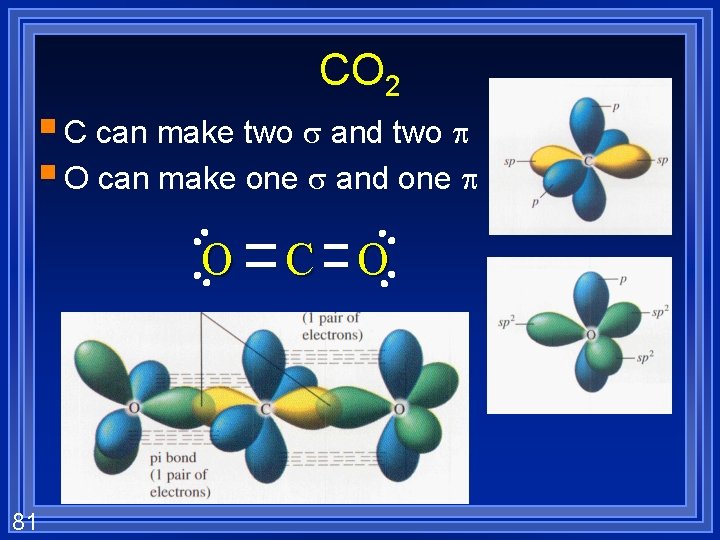
CO 2 § C can make two s and two p § O can make one s and one p O 81 C O
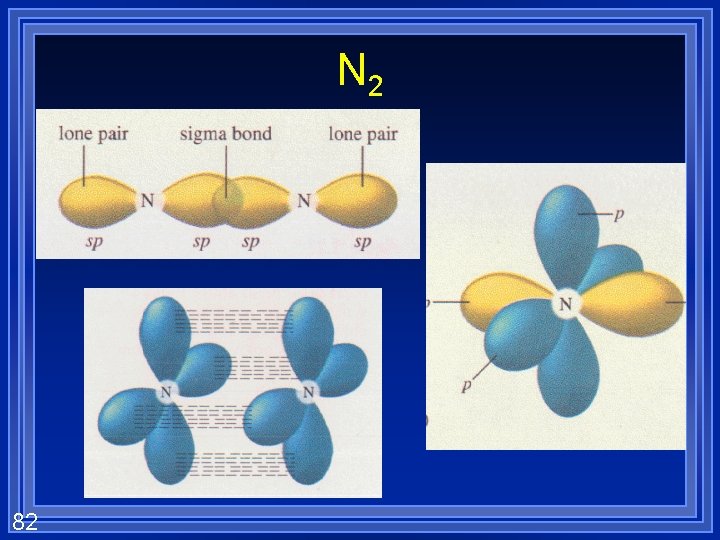
N 2 82
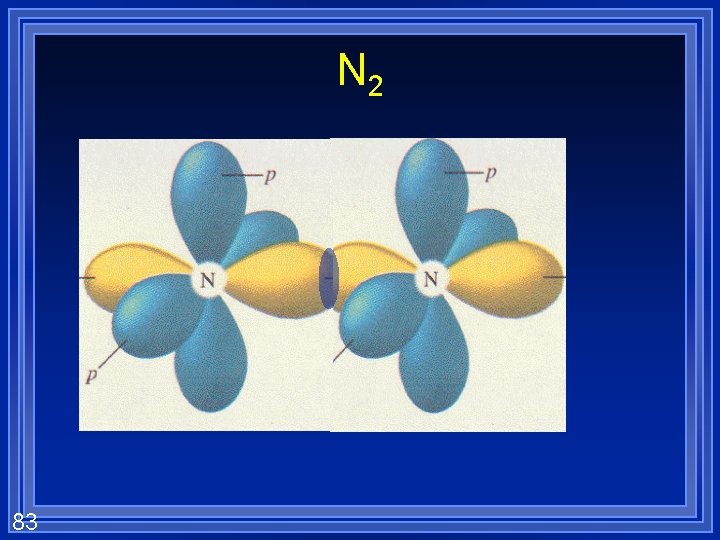
N 2 83
Polar Bonds § When the atoms in a bond are the same, the electrons are shared equally. § This is a nonpolar covalent bond. § When two different atoms are connected, the electrons may not be shared equally. § This is a polar covalent bond. § How do we measure how strong the atoms pull on electrons? 84
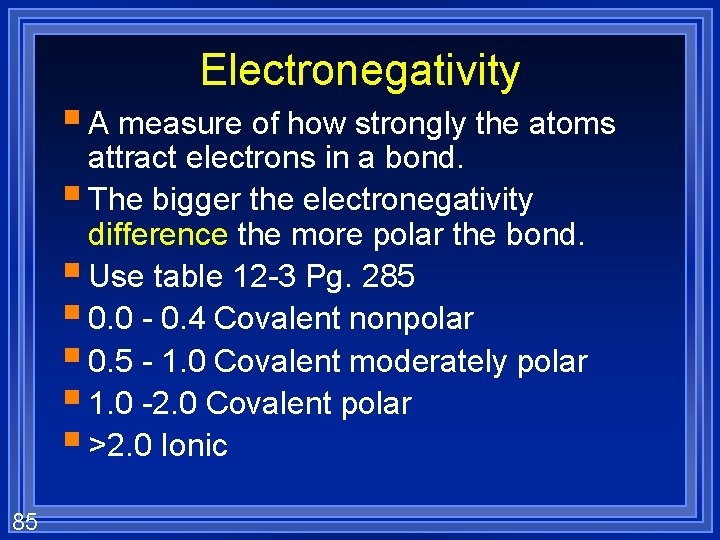
Electronegativity § A measure of how strongly the atoms attract electrons in a bond. § The bigger the electronegativity difference the more polar the bond. § Use table 12 -3 Pg. 285 § 0. 0 - 0. 4 Covalent nonpolar § 0. 5 - 1. 0 Covalent moderately polar § 1. 0 -2. 0 Covalent polar § >2. 0 Ionic 85
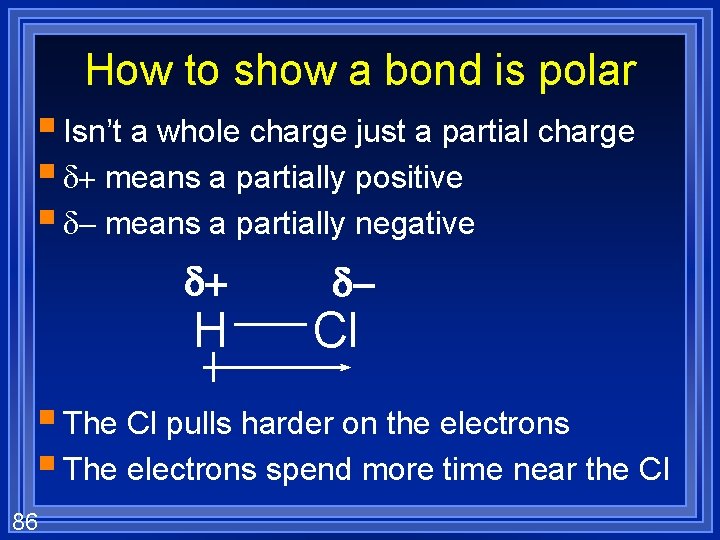
How to show a bond is polar § Isn’t a whole charge just a partial charge § d+ means a partially positive § d- means a partially negative d+ H d- Cl § The Cl pulls harder on the electrons § The electrons spend more time near the Cl 86
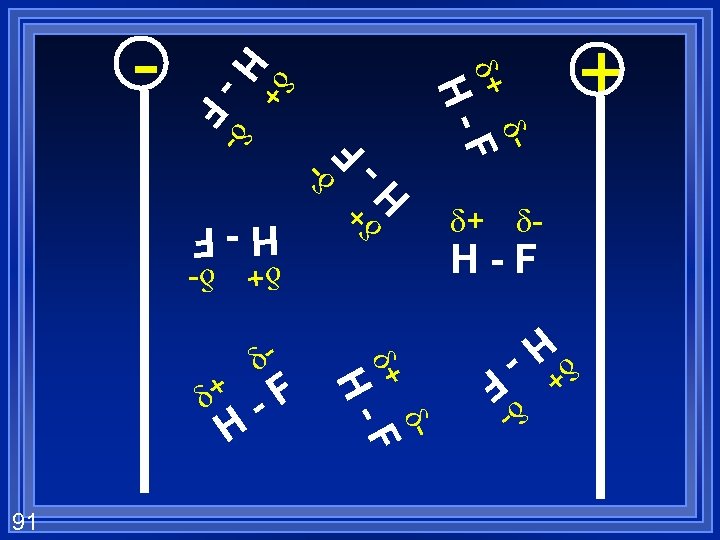
Polar Molecules with ends 87
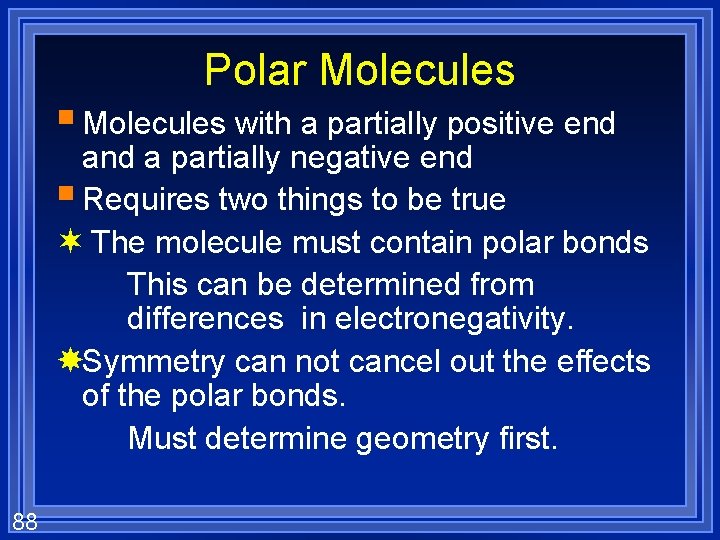
Polar Molecules § Molecules with a partially positive end a partially negative end § Requires two things to be true ¬ The molecule must contain polar bonds This can be determined from differences in electronegativity. Symmetry can not cancel out the effects of the polar bonds. Must determine geometry first. 88
Polar Molecules § Symmetrical shapes are those without lone pair on central atom – Tetrahedral – Trigonal planar – Linear § Will be nonpolar if all the atoms are the same § Shapes with lone pair on central atom are not symmetrical § Can be polar even with the same atom 89
§ HF § H 2 O § NH 3 § CCl 4 § CO 2 § CH 3 Cl 90 Is it polar?
d+ H d- F d- H- d+ -F H F - d- F d+ d+ H- d+ d- H d- 91 F H F d+ d- + - H-F d+ d- H-F
Intermolecular Forces What holds molecules to each other 92
Intermolecular Forces § They are what make solid and liquid molecular compounds possible. § The weakest are called van der Waal’s forces - there are two kinds – Dispersion forces – Dipole Interactions 93
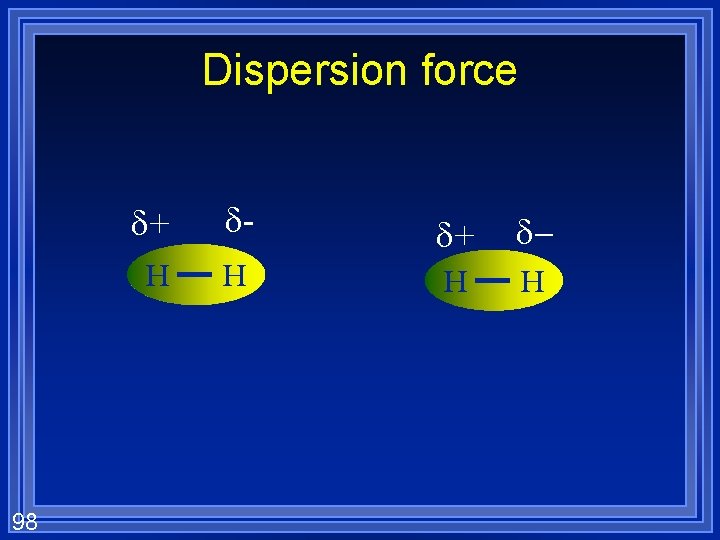
Dispersion Force § Depends only on the number of electrons in the molecule § Bigger molecules more electrons § More electrons stronger forces • F 2 is a gas • Br 2 is a liquid • I 2 is a solid 94
Dipole interactions § Occur when polar molecules are attracted to each other. § Slightly stronger than dispersion forces. § Opposites attract but not completely hooked like in ionic solids. 95
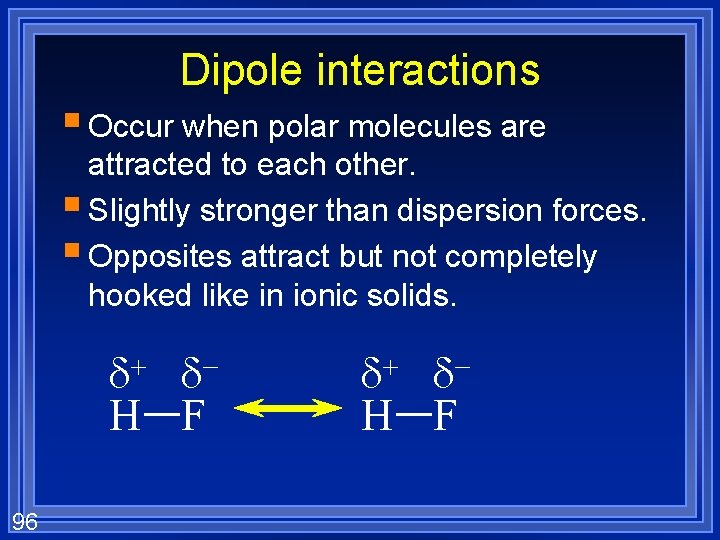
Dipole interactions § Occur when polar molecules are attracted to each other. § Slightly stronger than dispersion forces. § Opposites attract but not completely hooked like in ionic solids. + d d H F 96 + d d H F
Dispersion force 98 d+ d- H H
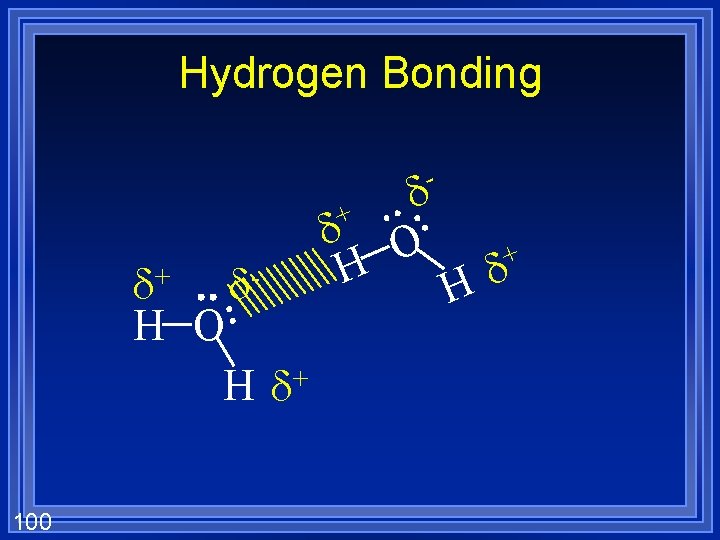
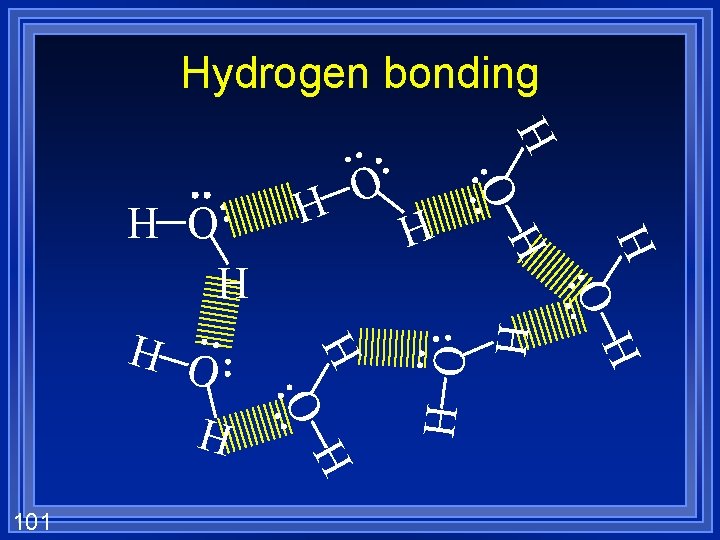
Hydrogen bonding § Are the attractive force caused by hydrogen bonded to F, O, or N. § F, O, and N are very electronegative so it is a very strong dipole. § They are small, so molecules can get close together § The hydrogen partially share with the lone pair in the molecule next to it. § The strongest of the intermolecular forces. 99
Hydrogen Bonding - + d+ d. H O + Hd 100 d H d O + d H
101 H H O H H O O H Hydrogen bonding
Properties of Molecular Compounds § Made of nonmetals § Poor or nonconducting as solid, liquid or aqueous solution § Low melting point § Two kinds of crystals – Molecular solids held together by IMF – Network solids- held together by bonds – One big molecule (diamond, graphite) 102
- Slides: 101