
Chapter 8 Courts and the Quest for Justice


- Slides: 29
Chapter 8 Courts and the Quest for Justice © 2015 Cengage Learning
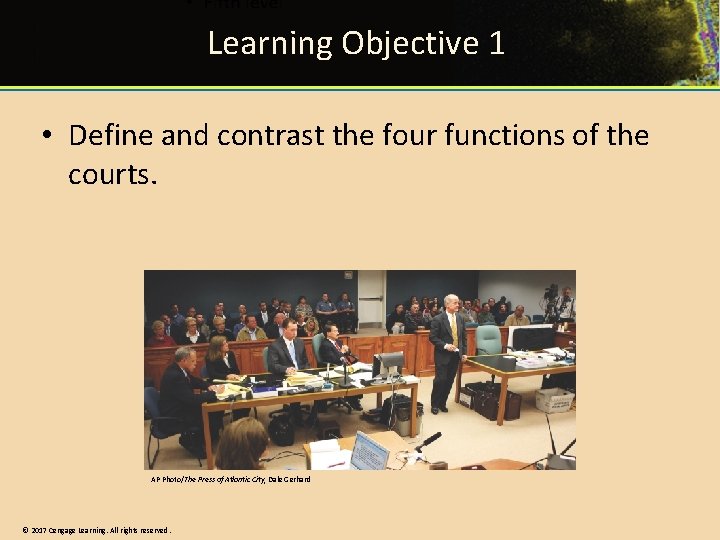
Learning Objective 1 • Define and contrast the four functions of the courts. AP Photo/The Press of Atlantic City, Dale Gerhard © 2017 Cengage Learning. All rights reserved.
Functions of the Court • Functions of the courts: – The due process function • To protect individuals from unfair advantages that the government enjoys in legal battles – The crime control function • Punishment and retribution – The rehabilitation function • Treatment – The bureaucratic function • Speed and efficiency © 2017 Cengage Learning. All rights reserved.
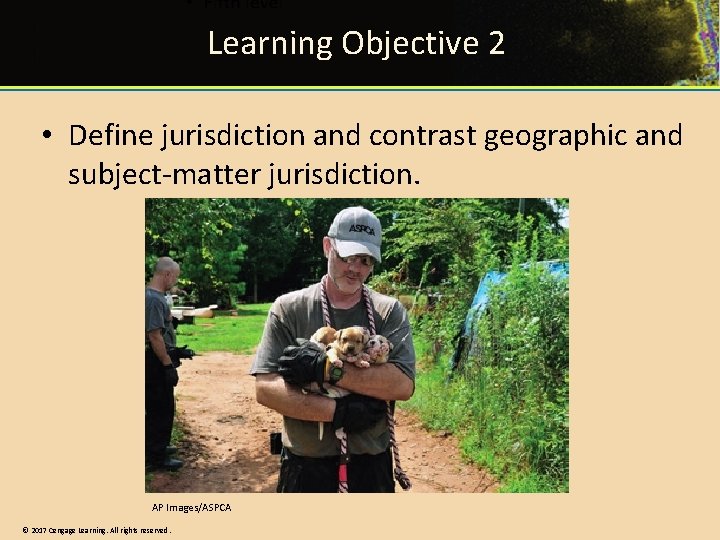
Learning Objective 2 • Define jurisdiction and contrast geographic and subject-matter jurisdiction. AP Images/ASPCA © 2017 Cengage Learning. All rights reserved.
American Judicial System • Jurisdiction: – Geographic jurisdiction – Federal versus state – State versus state – Multiple trials – Tribal jurisdiction – International jurisdiction – Subject-matter jurisdiction • Courts of general jurisdiction • Courts of limited jurisdiction © 2017 Cengage Learning. All rights reserved.
Learning Objective 3 • Explain the difference between trial and appellate courts. © 2017 Cengage Learning. All rights reserved.
American Judicial System • Trial courts: – Have original jurisdiction – Are concerned with questions of fact • Appellate courts: – Courts of review – Hear appeals of one party – Reverses or remands case © 2017 Cengage Learning. All rights reserved.
Discussion Question Local Case • Locate a case in your local community that has been or is in the current appeals process. – What were or are the main issues within this case? – What was the result of the review of this case by the court and what was the end result? • What are the implications, if any, for local law enforcement? © 2017 Cengage Learning. All rights reserved.
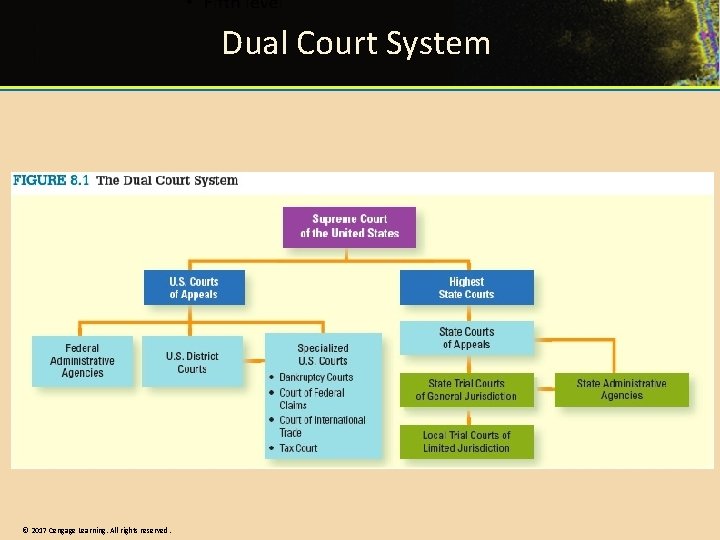
Dual Court System © 2017 Cengage Learning. All rights reserved.
Learning Objective 4 • Outline the several levels of a typical state court system. © 2017 Cengage Learning. All rights reserved.
State Court Systems • The state court system includes: – Lower courts, or courts of limited jurisdiction • Magistrate courts • Specialty courts – Trial courts of general jurisdiction – Appellate courts – The state’s highest courts © 2017 Cengage Learning. All rights reserved.
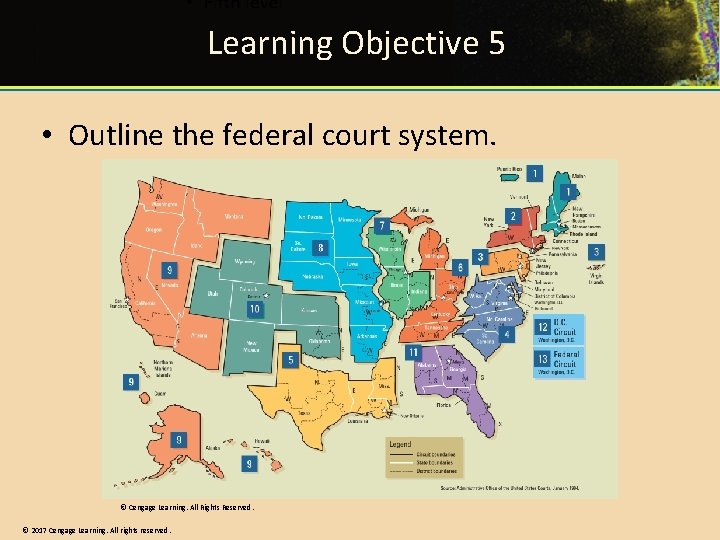
Learning Objective 5 • Outline the federal court system. © Cengage Learning. All Rights Reserved. © 2017 Cengage Learning. All rights reserved.
Federal Court System • Three-tiered model: – U. S. District Court • Courts in which cases involving federal law begin • A judge or jury decides the case. – U. S. Court of Appeals • Decisions are final unless further appeal is granted and pursued. – United States Supreme Court • Court of last resort © 2017 Cengage Learning. All rights reserved.
Discussion Question: A Supreme Court Case • Choose a recent or landmark Supreme Court case to discuss. – What are the facts of the case? – What courts did the case go through to be heard before it reached the Supreme Court? – What was the outcome of the case? © 2017 Cengage Learning. All rights reserved.
Learning Objective 6 • Explain briefly how a case is brought to the Supreme Court. © 2017 Cengage Learning. All rights reserved.
Federal Court System • Judicial review • Statutory interpretation • Writ of certiorari • The Court’s decision is based on the written records, written arguments, and oral arguments. © 2017 Cengage Learning. All rights reserved.
Federal Court System • The United States Supreme Court normally does not hear any evidence. • Decisions are based on: – Written record of case – Written arguments submitted by attorneys – Oral arguments • Justices decide each case in conference, and then the senior justice on the majority side writes the opinion. – Concurring opinions – Dissenting opinions © 2017 Cengage Learning. All rights reserved.
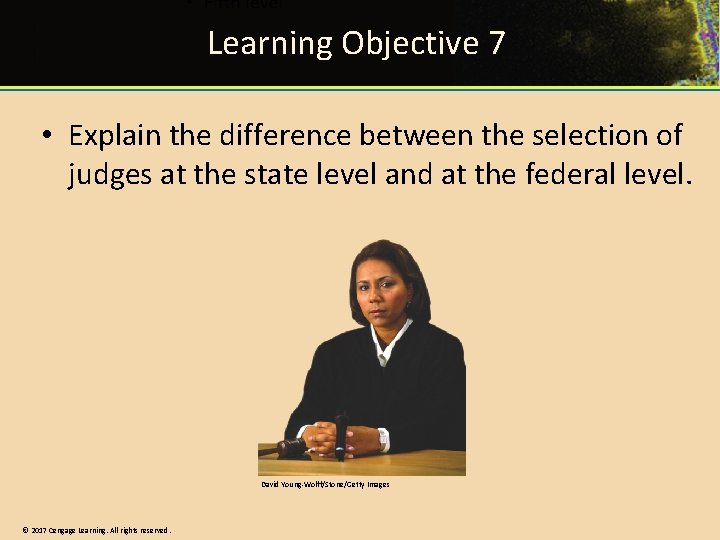
Learning Objective 7 • Explain the difference between the selection of judges at the state level and at the federal level. David Young-Wolff/Stone/Getty Images © 2017 Cengage Learning. All rights reserved.
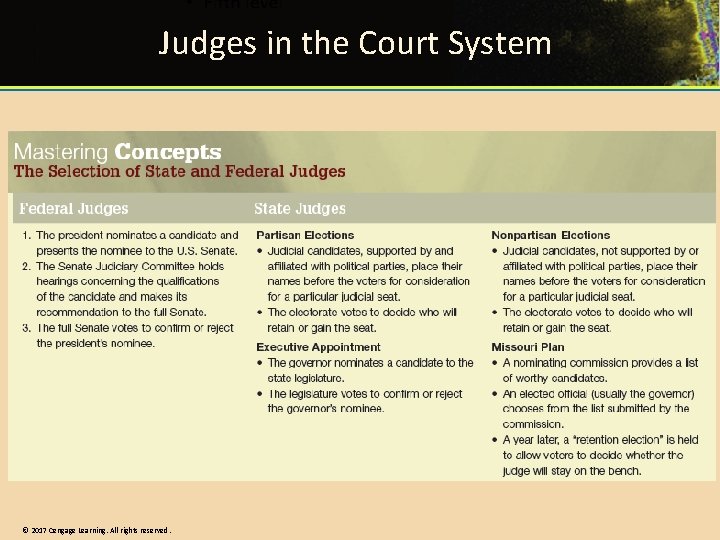
Judges in the Court System • Selection of judges: – Federal court judges • Appointed by the President and confirmed by the Senate © 2017 Cengage Learning. All rights reserved.
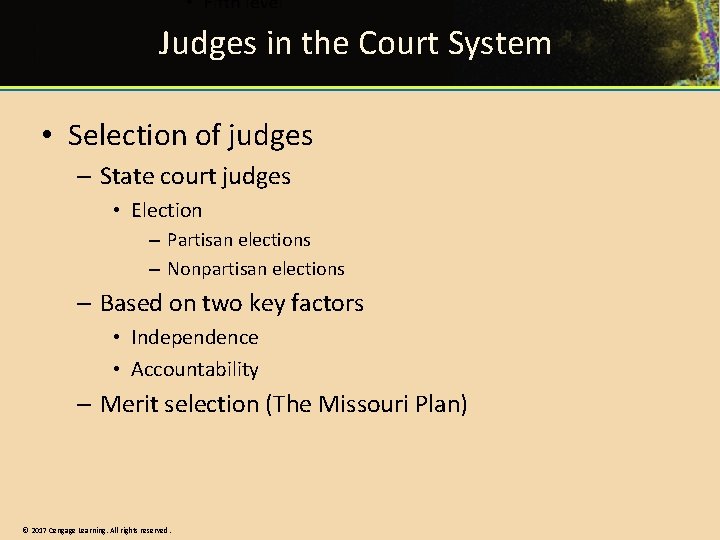
Judges in the Court System • Selection of judges – State court judges • Election – Partisan elections – Nonpartisan elections – Based on two key factors • Independence • Accountability – Merit selection (The Missouri Plan) © 2017 Cengage Learning. All rights reserved.
Judges in the Court System © 2017 Cengage Learning. All rights reserved.
Judges in the Court System • Lack of diversity on the bench • Past discrimination in law schools and “good old boy” system limit opportunities. • Benefits to diversity – People trust judges that look like them. – A variety of voices and perspectives are brought in. © 2017 Cengage Learning. All rights reserved.
Learning Objective 8 • Describe one alternative, practiced in other countries, to the American method of choosing judges. © 2017 Cengage Learning. All rights reserved.
Judges in the Court System • Comparative criminal justice – French judicial candidates must pass two exams. – Those who pass one test enter a two-year program at the École Nationale de la Magistrature, a judicial training academy, where they spend half their time in the classroom and half in the courtroom. – At the end of that period, they are subjected to another examination. © 2017 Cengage Learning. All rights reserved.
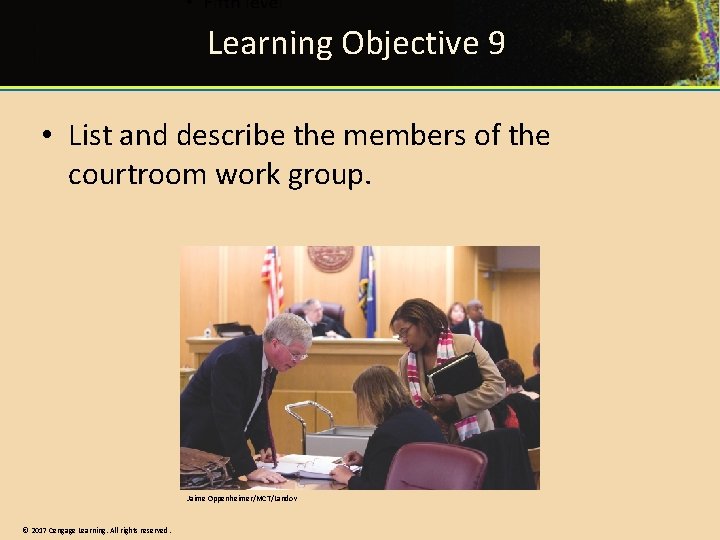
Learning Objective 9 • List and describe the members of the courtroom work group. Jaime Oppenheimer/MCT/Landov © 2017 Cengage Learning. All rights reserved.
Courtroom Work Group • Judges • Prosecutors • Defense attorneys • Bailiffs – Maintain security and order in judge’s chambers and courtroom. • Clerks of the court – Take pleas, motions, and other matters made by the judge. • Court reporters – Record every word in the courtroom. © 2017 Cengage Learning. All rights reserved.
Discussion Question: Courtroom Work Group • Discuss the key players in the courtroom work group. – Could the court function without any of these personnel? Why or why not? – Could you see yourself in any of these positions? © 2017 Cengage Learning. All rights reserved.
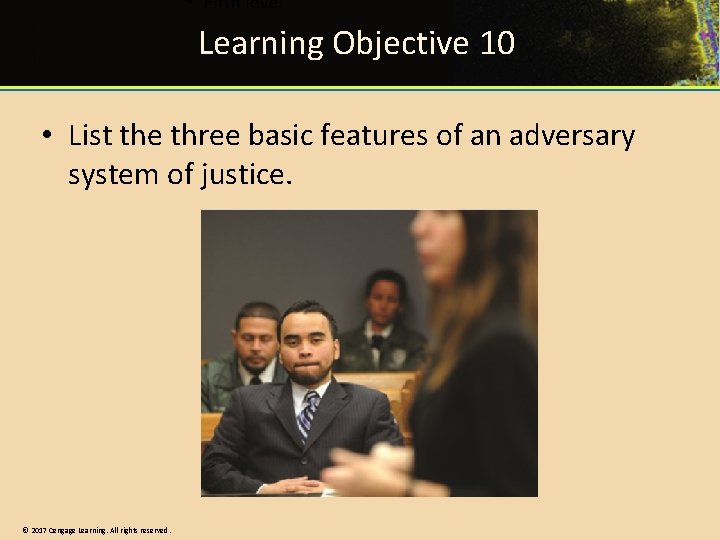
Learning Objective 10 • List the three basic features of an adversary system of justice. © 2017 Cengage Learning. All rights reserved.
The Adversary System • Three basic features of the adversary system – Neutral and passive decision maker, either judge or jury – Presentation of evidence from both parties – Highly structured set of procedures that must be followed in the presentation of evidence • Ritualized aggression • Truth vs. victory © 2017 Cengage Learning. All rights reserved.