
Chapter 8 Contraception and Abortion Copyright 2016 by
Chapter 8 Contraception and Abortion Copyright © 2016 by Elsevier Inc. All rights reserved.
Learning Objectives Compare various methods of contraception. Identify the advantages and disadvantages of commonly used methods of contraception. Explain the common nursing interventions that facilitate contraceptive use. Examine the various ethical, legal, cultural, and religious considerations of contraception. Describe the techniques used for medical and surgical interruption of pregnancy. Discuss the various ethical and legal considerations of elective abortion. Copyright © 2016 by Elsevier Inc. All rights reserved. 2
Contraception Definitions Contraception: the intentional prevention of pregnancy during sexual intercourse Ø Birth control: the device or practice that decreases the risk of conceiving Ø Family planning: the conscious decision on when to conceive throughout the reproductive years Ø Copyright © 2016 by Elsevier Inc. All rights reserved. 3
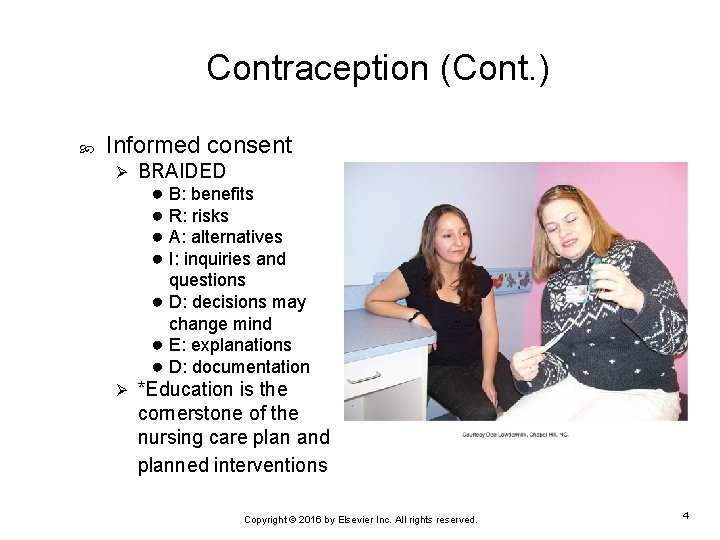
Contraception (Cont. ) Informed consent Ø BRAIDED ● B: benefits ● R: risks ● A: alternatives ● I: inquiries and questions ● D: decisions may change mind ● E: explanations ● D: documentation Ø *Education is the cornerstone of the nursing care plan and planned interventions Copyright © 2016 by Elsevier Inc. All rights reserved. 4

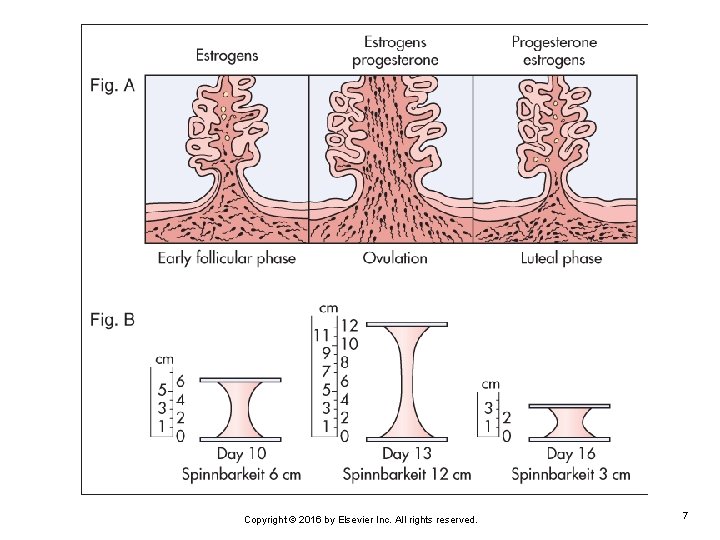
Methods of Contraception Coitus interruptus (withdrawal) Fertility Awareness Based methods (FABs) Ø Natural family planning (NFP) Ø Only contraceptive practices acceptable to the Roman Catholic Church Ø Rely on avoidance of intercourse during fertile periods Ø Combine charting menstrual cycle with abstinence or other contraceptive methods Copyright © 2016 by Elsevier Inc. All rights reserved. 5
Methods of Contraception (Cont. ) FABs (Cont. ) Ø Ø Ø Calendar rhythm method Standard days method Symptoms-based methods • Two-Day Method • Cervical mucus ovulation detection method • Basal body temperature (BBT) method • Symptothermal method Copyright © 2016 by Elsevier Inc. All rights reserved. 6
Copyright © 2016 by Elsevier Inc. All rights reserved. 7
Methods of Contraception (Cont. ) Spermicides and barrier methods Popular also as protective measures against spread of STIs Ø Chemical barriers may reduce the risk of some STIs but are not effective against most STIs Ø Frequent use of spermicides (N-9) may increase the transmission of HIV Ø Male and female condoms provide a mechanical barrier to STIs and HIV Ø Copyright © 2016 by Elsevier Inc. All rights reserved. 8
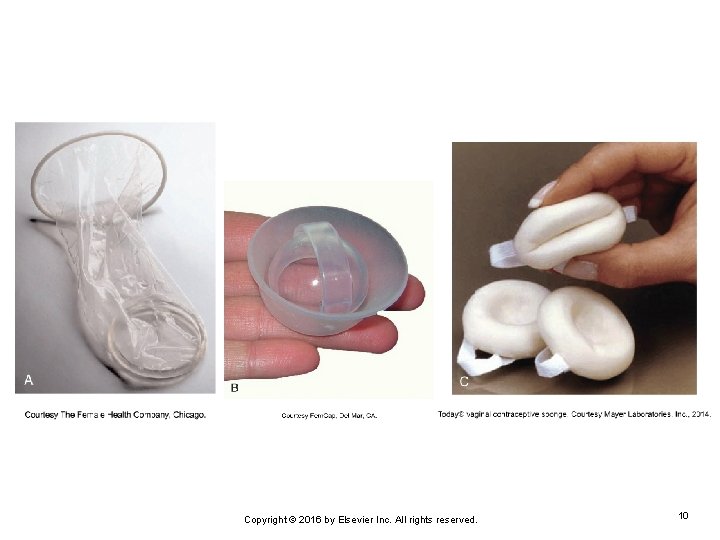
Methods of Contraception (Cont. ) Spermicides and barrier methods (Cont. ) Spermicides Condoms, male Vaginal sheath (female condom) Diaphragm • Toxic shock syndrome (TSS) risk Ø Cervical caps: Fem. Cap available in United States Ø Contraceptive sponge Ø Ø Copyright © 2016 by Elsevier Inc. All rights reserved. 9
Copyright © 2016 by Elsevier Inc. All rights reserved. 10
Methods of Contraception: COCs Hormonal methods Available in varying formulations and administration Ø Combined estrogen-progestin oral contraceptives (COCs) • Oral contraceptives and side effects • Combined estrogen and progestin injection • Oral contraceptive 91 -day regimen • Transdermal contraceptive system • Vaginal ring Ø Copyright © 2016 by Elsevier Inc. All rights reserved. 11
Methods of Contraception: COCs (Cont. ) Warning signs to teach patients starting or taking COCs: A: Abdominal pain may indicate a problem with the liver or gallbladder. Ø C: Chest pain or shortness of breath may indicate possible clot problem within the lungs or heart. Ø H: Headaches (sudden or persistent) may be caused by cardiovascular accident or hypertension. Ø E: Eye problems may indicate vascular accident or hypertension. Ø S: Severe leg pain may indicate a thromboembolic process. Ø Copyright © 2016 by Elsevier Inc. All rights reserved. 12
Methods of Contraception: Progestin-Only ● Progestin-only contraception Oral progestins (minipill) Injectable progestins • Do not massage site after injection. Ø Implantable progestins Ø Ø Copyright © 2016 by Elsevier Inc. All rights reserved. 13
Methods of Contraception: EC Emergency contraception (EC) Ø Ø Used within 120 hours of unprotected intercourse Available in United States • Plan B One-Step—sold OTC, without Rx • Ella • IUD insertion as emergency contraception Copyright © 2016 by Elsevier Inc. All rights reserved. 14
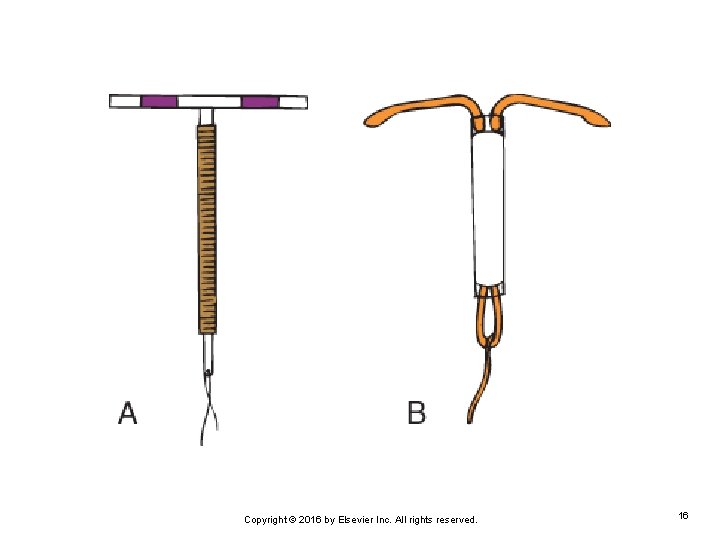
Methods of Contraception: IUDs Intrauterine devices (IUDs) Offer constant contraception Small T-shaped device inserted into the uterine cavity Ø Medicated IUDs loaded with either copper or progestational agent Ø Offer no protection against STIs or HIV Ø Ø Copyright © 2016 by Elsevier Inc. All rights reserved. 15
Copyright © 2016 by Elsevier Inc. All rights reserved. 16
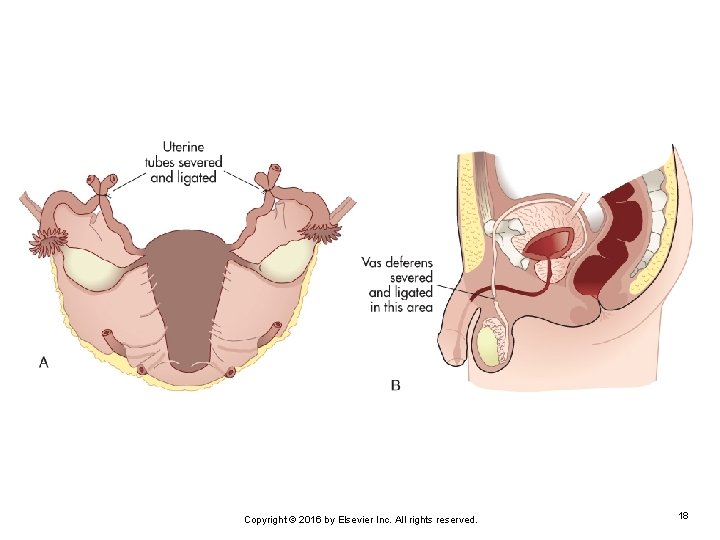
Methods of Contraception: Permanent Sterilization Female • Tubal occlusion • Transcervical sterilization • Tubal reconstruction • Essure Ø Male (vasectomy) • Tubal reconstruction (reanastomose) • Laws and regulations Ø Copyright © 2016 by Elsevier Inc. All rights reserved. 17
Copyright © 2016 by Elsevier Inc. All rights reserved. 18
Methods of Contraception (Cont. ) Breastfeeding Ø Lactational amenorrhea method (LAM) Future trends Ø Ø Lower-dose COCs Female barrier methods New IUDs and spermicidal microbicides Male hormonal methods Copyright © 2016 by Elsevier Inc. All rights reserved. 19
Induced Abortion Purposeful interruption of pregnancy before 20 weeks of gestation Ø Ø Elective Therapeutic Contributing factors The numbers of abortions in the United States have decreased significantly from 2000 to 2009. Legal and moral issues Incidence: Abortion rates tend to be higher in women whose income is below the poverty level. Decisions about abortion Copyright © 2016 by Elsevier Inc. All rights reserved. 20
Induced Abortion (Cont. ) First-trimester abortion Ø Ø Aspiration Medical abortion • Methotrexate and misoprostol • Mifepristone and misoprostol Second-trimester abortion Ø Dilation and evacuation • Can be performed at any point up to 20 weeks of gestation, although more commonly performed between 13 and 16 weeks of gestation Copyright © 2016 by Elsevier Inc. All rights reserved. 21
Key Points A variety of contraceptive methods are available with various effectiveness rates, advantages, and disadvantages. Women and their partners should choose the contraceptive method or methods best suited to them. Effective contraceptives are available through prescription and nonprescription sources. Copyright © 2016 by Elsevier Inc. All rights reserved. 22
Key Points (Cont. ) A variety of techniques are available to enhance the effectiveness of periodic abstinence in motivated couples who prefer this natural method. Hormonal contraception includes both precoital and postcoital prevention through various modalities and requires thorough client education. The barrier methods diaphragm and cervical cap provide safe and effective contraception for women or couples motivated to use them consistently and correctly. Copyright © 2016 by Elsevier Inc. All rights reserved. 23
Key Points (Cont. ) Intrauterine devices can provide long-term (5 to 10 years) protection. Emergency contraception should be taken as soon as possible after unprotected intercourse, but no later than 120 hours. Proper, concurrent use of spermicides and latex condoms provides protection against STIs. Copyright © 2016 by Elsevier Inc. All rights reserved. 24
Key Points (Cont. ) Tubal ligations and vasectomies are permanent sterilization methods used by increasing numbers of women and men. Induced abortion performed in the first trimester is safer than an abortion performed in the second trimester. The most common complications of induced abortion include infection, retained products of conception, and excessive vaginal bleeding. Major psychologic sequelae of induced abortion are rare. Copyright © 2016 by Elsevier Inc. All rights reserved. 25
Question 1. An induced abortion client calls the nurse to report postprocedural symptoms. Which condition is not an indication for the nurse to ask her to come into the office for care? a. Abdominal tenderness when pressure is applied b. Chills and a fever of 101° F c. Return of her period in less than 6 weeks d. Foul-smelling vaginal discharge Copyright © 2016 by Elsevier Inc. All rights reserved. 26
- Slides: 26