
Chapter 8 Consolidated Financial statements Intercompany Transactions ACCT
- Slides: 195
Chapter 8 Consolidated Financial statements: Intercompany Transactions ACCT 501 (All examples are from the textbook by J. Larson)
Objectives of the Chapter n To discuss the accounting and working paper eliminations for related party transactions between a parent company and its subsidiaries for: I. intercompany transactions not involving profit or loss such as loans on promissory notes, leases of property under operating leases and rendering of services; Consolidated FS-Intercompany Transactions 2
Objectives of the Chapter (Contd. ) II. intercompany transactions involving profit or loss such as intercompany sale of merchandise, plant assets, intangible assets and leases of property (under capital/sales-type leases). Consolidated FS-Intercompany Transactions 3
Principle to follow to account for the intercompany transactions for the consolidated financial statements: n The consolidated financial statements should include only transactions resulting from the consolidated group’s dealings with outsiders. Consolidated FS-Intercompany Transactions 4
Principle to follow to account for the intercompany transactions for the consolidated financial statements: (Contd. ) n n Separate ledger accounts are established for all intercompany assets, liabilities, revenue and expenses. These separate accounts clearly identify the intercompany items that should be eliminated in the preparation of consolidated financial statements. Consolidated FS-Intercompany Transactions 5
I. Accounting for Intercompany Transactions Not Involving Profit (Gain) or Loss n loans on Notes or Open Accounts u. The parent company make loans to its subsidiaries. u. The interest rate charged by the parent company usually exceeds the parent company’s borrowing rate. Consolidated FS-Intercompany Transactions 6
I. Accounting for Intercompany Transactions Not Involving Profit (Gain) or Loss (Contd. ) u. Intercompany ledger accounts are used by the parent and the subsidiary to account for these intercompany transactions in order to differentiate intercompany loans and loans with outsiders. Consolidated FS-Intercompany Transactions 7
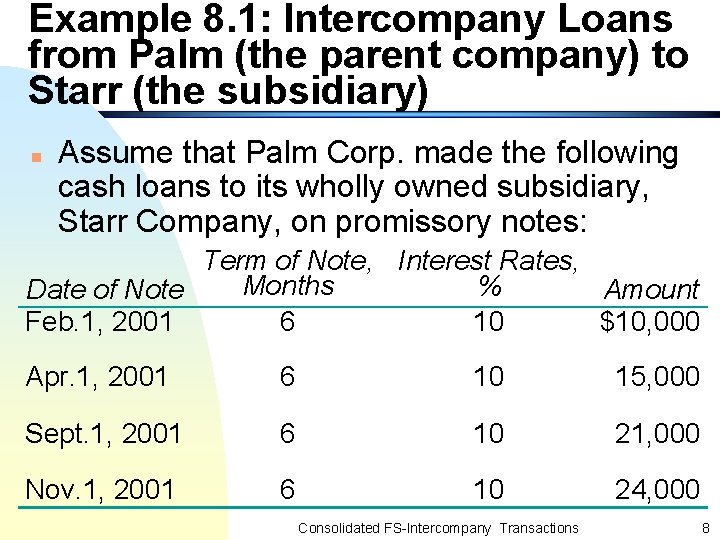
Example 8. 1: Intercompany Loans from Palm (the parent company) to Starr (the subsidiary) n Assume that Palm Corp. made the following cash loans to its wholly owned subsidiary, Starr Company, on promissory notes: Term of Note, Interest Rates, Months % Date of Note Amount Feb. 1, 2001 6 10 $10, 000 Apr. 1, 2001 6 10 15, 000 Sept. 1, 2001 6 10 21, 000 Nov. 1, 2001 6 10 24, 000 Consolidated FS-Intercompany Transactions 8
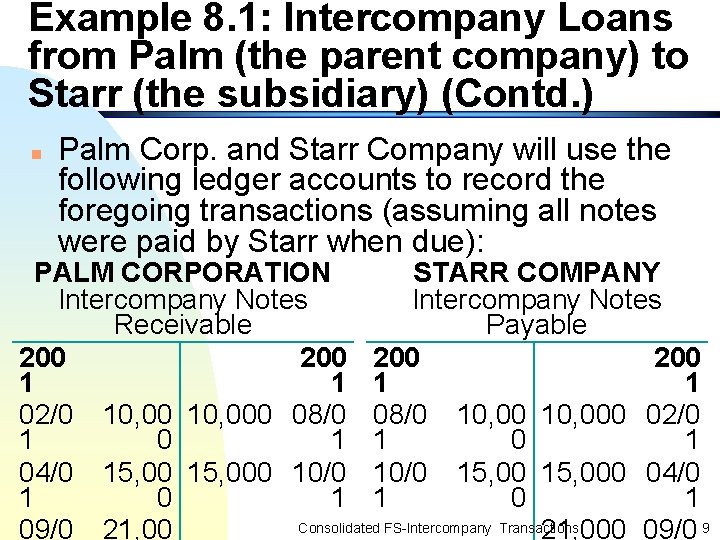
Example 8. 1: Intercompany Loans from Palm (the parent company) to Starr (the subsidiary) (Contd. ) n Palm Corp. and Starr Company will use the following ledger accounts to record the foregoing transactions (assuming all notes were paid by Starr when due): PALM CORPORATION STARR COMPANY Intercompany Notes Receivable Payable 200 200 1 1 02/0 10, 000 08/0 10, 000 02/0 1 1 0 1 04/0 15, 000 10/0 15, 000 04/0 1 1 0 1 Consolidated FS-Intercompany Transactions 09/0 21, 000 09/0 9
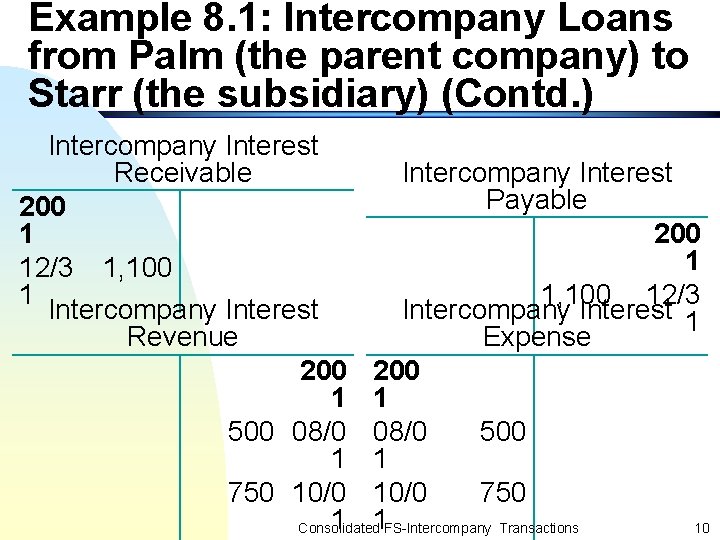
Example 8. 1: Intercompany Loans from Palm (the parent company) to Starr (the subsidiary) (Contd. ) Intercompany Interest Receivable Intercompany Interest Payable 200 1 12/3 1, 100 12/3 Intercompany Interest 1 Revenue Expense 200 1 1 500 08/0 500 1 1 750 10/0 750 1 1 Consolidated FS-Intercompany Transactions 10
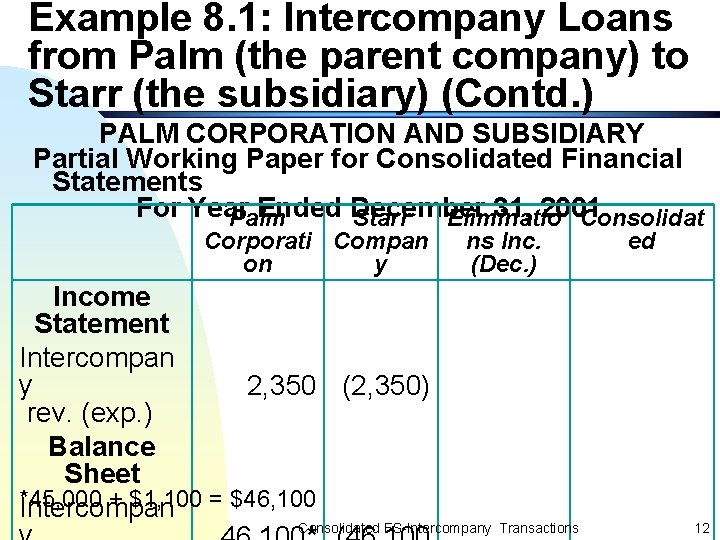
Example 8. 1: Intercompany Loans from Palm (the parent company) to Starr (the subsidiary) (Contd. ) n In the working paper for consolidated financial statements for Palm and subsidiary for the year ended 12/31/2001, the foregoing ledger accounts appear as shown below: Consolidated FS-Intercompany Transactions 11
Example 8. 1: Intercompany Loans from Palm (the parent company) to Starr (the subsidiary) (Contd. ) PALM CORPORATION AND SUBSIDIARY Partial Working Paper for Consolidated Financial Statements For Year Ended December 31, 2001 Palm Starr Eliminatio Consolidat Corporati Compan on y Income Statement Intercompan y 2, 350 (2, 350) rev. (exp. ) Balance Sheet *45, 000 + $1, 100 = $46, 100 Intercompan ns Inc. (Dec. ) Consolidated FS-Intercompany Transactions ed 12
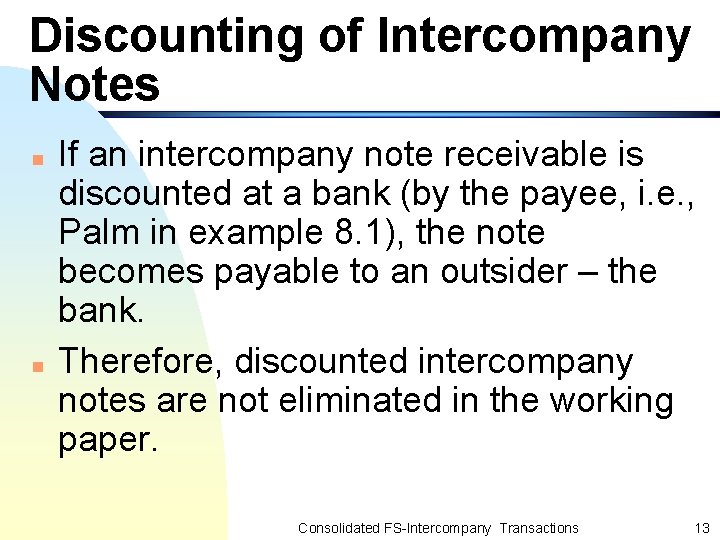
Discounting of Intercompany Notes n n If an intercompany note receivable is discounted at a bank (by the payee, i. e. , Palm in example 8. 1), the note becomes payable to an outsider – the bank. Therefore, discounted intercompany notes are not eliminated in the working paper. Consolidated FS-Intercompany Transactions 13
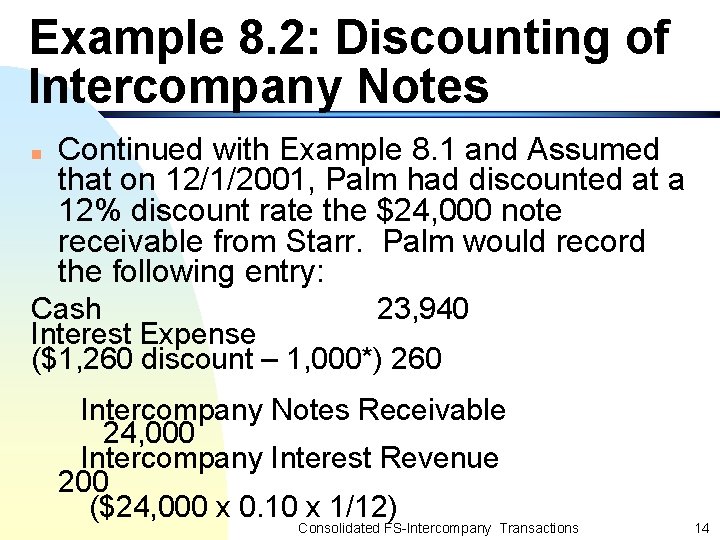
Example 8. 2: Discounting of Intercompany Notes n Continued with Example 8. 1 and Assumed that on 12/1/2001, Palm had discounted at a 12% discount rate the $24, 000 note receivable from Starr. Palm would record the following entry: Cash 23, 940 Interest Expense ($1, 260 discount – 1, 000*) 260 Intercompany Notes Receivable 24, 000 Intercompany Interest Revenue 200 ($24, 000 x 0. 10 x 1/12) Consolidated FS-Intercompany Transactions 14
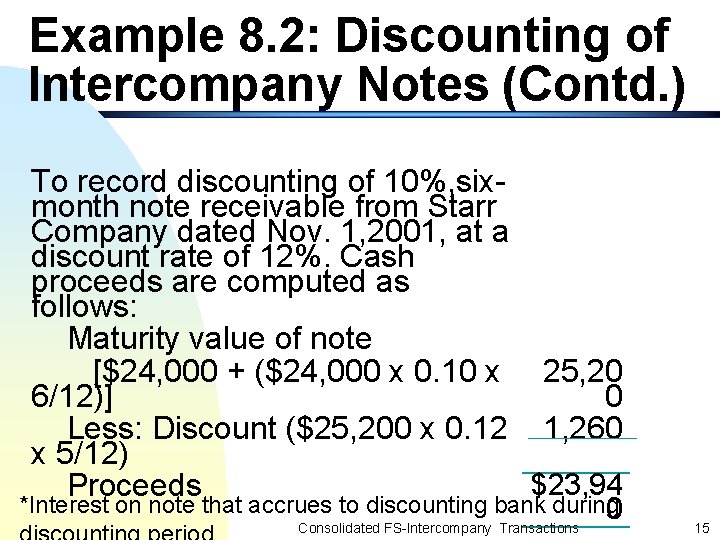
Example 8. 2: Discounting of Intercompany Notes (Contd. ) To record discounting of 10%, sixmonth note receivable from Starr Company dated Nov. 1, 2001, at a discount rate of 12%. Cash proceeds are computed as follows: Maturity value of note [$24, 000 + ($24, 000 x 0. 10 x 25, 20 6/12)] 0 Less: Discount ($25, 200 x 0. 12 1, 260 x 5/12) $23, 94 Proceeds *Interest on note that accrues to discounting bank during 0 Consolidated FS-Intercompany Transactions 15
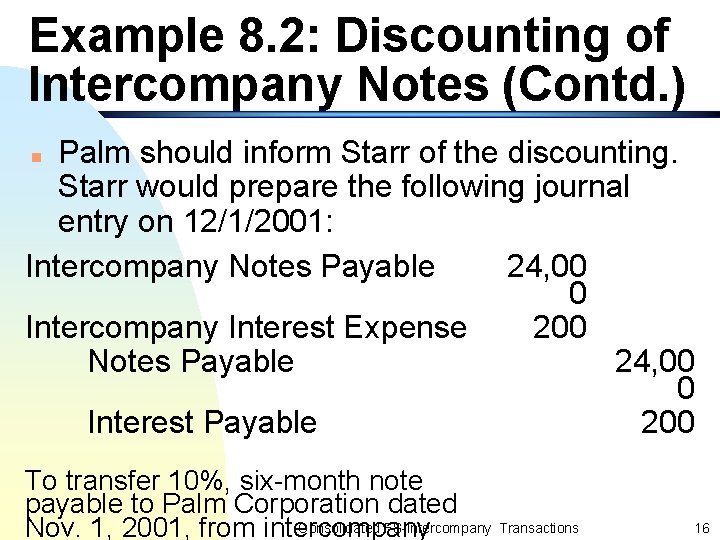
Example 8. 2: Discounting of Intercompany Notes (Contd. ) Palm should inform Starr of the discounting. Starr would prepare the following journal entry on 12/1/2001: Intercompany Notes Payable 24, 00 0 Intercompany Interest Expense 200 Notes Payable 24, 00 0 Interest Payable 200 n To transfer 10%, six-month note payable to Palm Corporation dated Consolidated FS-Intercompany Transactions Nov. 1, 2001, from intercompany 16
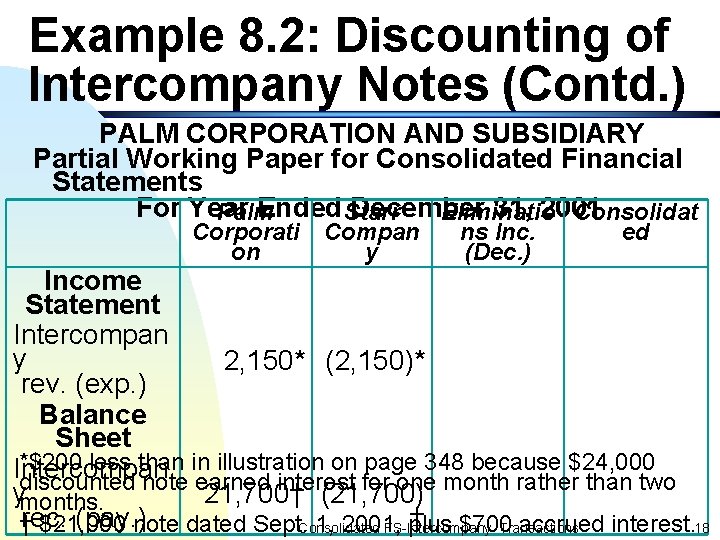
Example 8. 2: Discounting of Intercompany Notes (Contd. ) n Under the note discounting assumption, the ledger accounts related to the intercompany notes would appear in the 12/31/2001 working paper for consolidated financial statements as follows: Consolidated FS-Intercompany Transactions 17
Example 8. 2: Discounting of Intercompany Notes (Contd. ) PALM CORPORATION AND SUBSIDIARY Partial Working Paper for Consolidated Financial Statements For Year Ended Starr December 31, 2001 Palm Eliminatio Consolidat Corporati on Compan y ns Inc. (Dec. ) ed Income Statement Intercompan y 2, 150* (2, 150)* rev. (exp. ) Balance Sheet *$200 less than in illustration on page 348 because $24, 000 Intercompan ydiscounted note earned interest for one month rather than two 21, 700† (21, 700) months. rec. (pay. ) † † $21, 000 note dated Sept. 1, 2001, plus $700 accrued interest. Consolidated FS-Intercompany Transactions 18
Leases of Property under Operating Leases n When both the parent and subsidiary account the lease as an operating lease, the lessee will record the lease payment as intercompany rent expense, while the lessor will record the lease payment received as intercompany rent revenue. Consolidated FS-Intercompany Transactions 19
Leases of Property under Operating Leases (Contd. ) n n For an intercompany operating lease, there is no profit or loss involved. The inercompany rent revenue would be offset against intercompany rent expense in the manner similar to the offset of intercompany interest revenue and expense illustrated earlier. Consolidated FS-Intercompany Transactions 20
Rendering of Services n One affiliate may render services to another and result in intercompany fee revenue and expense (i. e. , management fee charged to subsidiaries by a parent company). Consolidated FS-Intercompany Transactions 21
Rendering of Services (Contd. ) n n The intercompany fee revenue and expense are offset in the working paper. Both the parent company and the subsidiary should record the fee billing in the same accounting period. Consolidated FS-Intercompany Transactions 22
Income Texas Applicable to Intercompany Transactions n n No income tax effects associated with the elimination of the intercompany revenue or expenses since no profit or loss involved in these intercompany transactions. It does not matter whether the parent company and its subsidiaries file separate income tax returns or a consolidated tax return. Consolidated FS-Intercompany Transactions 23
II. Accounting for Intercompany Transactions Involving Profit (Gain) or Loss n For intercompany transactions involving profit or loss, the unrealized profits or losses must be eliminated in the preparation of consolidated financial statements until they are realized. Consolidated FS-Intercompany Transactions 24
The Importance of Eliminating or Including Intercompany Profits (Gains) and Losses n Failure to eliminate unrealized profits and losses would result in consolidated income statements that report not only results of transactions with outsiders but also the results of related party activities within the affiliated group. Consolidated FS-Intercompany Transactions 25
The Importance of Eliminating or Including Intercompany Profits (Gains) and Losses (Contd. ) n n Similarly, no recognition of realized gains (losses) would misstate the consolidated net income. The management can manipulate consolidated net income if unrealized intercompany profits and losses were not eliminated. Consolidated FS-Intercompany Transactions 26
Intercompany Sales of Merchandise n Types of Sales u. Downstream intercompany sales u. Upstream intercompany sales u. Lateral intercompany sales Consolidated FS-Intercompany Transactions 27
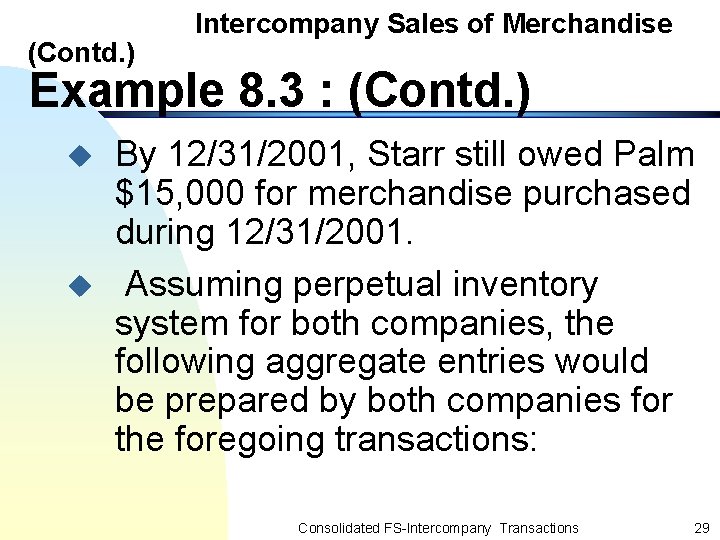
Intercompany Sales of Merchandise (Contd. ) a. Intercompany Sales at Cost n Example 8. 3: Intercompany sale at cost u. Assume that Palm sold merchandise costing $150, 000 to Starr during the year ended 12/31/2001 at a selling price equals to Palm’s cost. u. The ending inventories of Starr on 12/31/2001 included $25, 000 of merchandise obtained form Palm. Consolidated FS-Intercompany Transactions 28
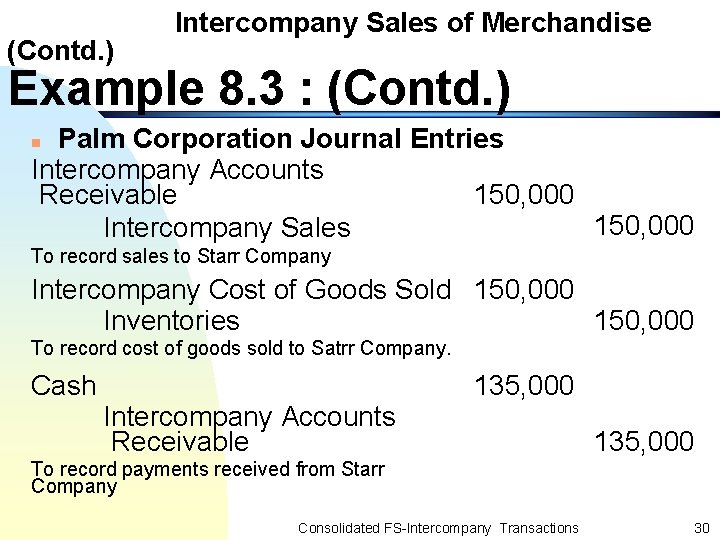
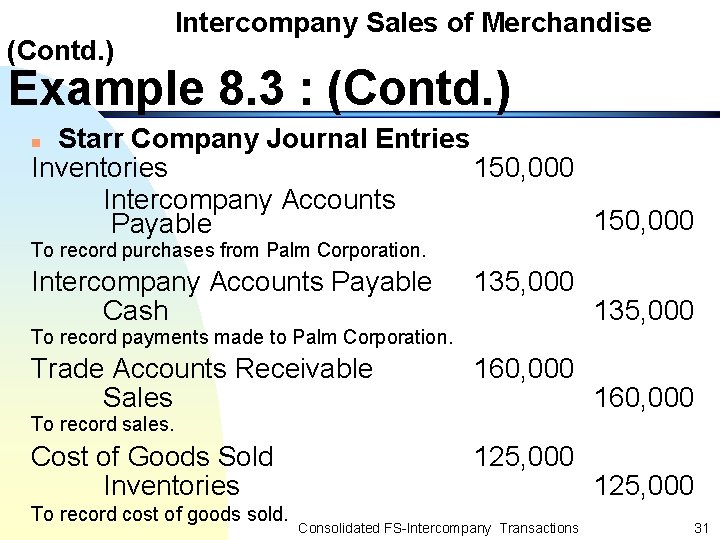
(Contd. ) Intercompany Sales of Merchandise Example 8. 3 : (Contd. ) u u By 12/31/2001, Starr still owed Palm $15, 000 for merchandise purchased during 12/31/2001. Assuming perpetual inventory system for both companies, the following aggregate entries would be prepared by both companies for the foregoing transactions: Consolidated FS-Intercompany Transactions 29
(Contd. ) Intercompany Sales of Merchandise Example 8. 3 : (Contd. ) Palm Corporation Journal Entries Intercompany Accounts Receivable 150, 000 Intercompany Sales n To record sales to Starr Company Intercompany Cost of Goods Sold 150, 000 Inventories 150, 000 To record cost of goods sold to Satrr Company. Cash Intercompany Accounts Receivable 135, 000 To record payments received from Starr Company Consolidated FS-Intercompany Transactions 30
(Contd. ) Intercompany Sales of Merchandise Example 8. 3 : (Contd. ) Starr Company Journal Entries Inventories 150, 000 Intercompany Accounts 150, 000 Payable n To record purchases from Palm Corporation. Intercompany Accounts Payable Cash 135, 000 Trade Accounts Receivable Sales 160, 000 Cost of Goods Sold Inventories 125, 000 To record payments made to Palm Corporation. To record sales. To record cost of goods sold. Consolidated FS-Intercompany Transactions 135, 000 160, 000 125, 000 31
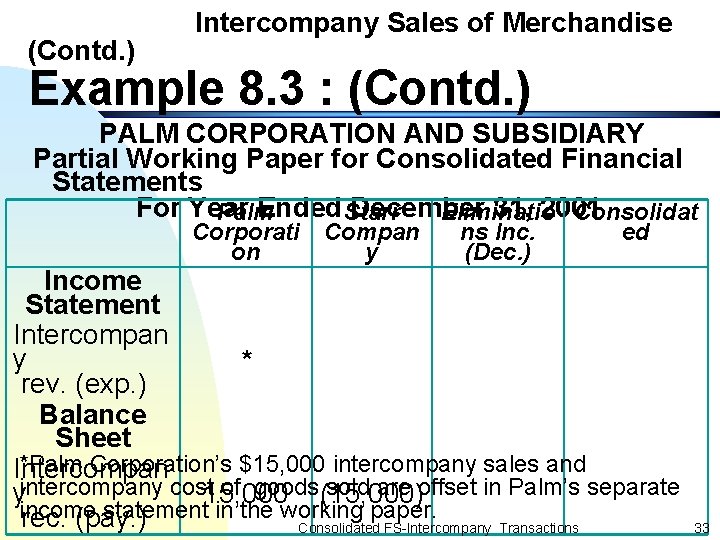
(Contd. ) Intercompany Sales of Merchandise Example 8. 3 : (Contd. ) n The following is a partial working paper for consolidated financial statements of Palm and subsidiary (include only the data related to this intercompany sale of merchandise at cost): Consolidated FS-Intercompany Transactions 32
(Contd. ) Intercompany Sales of Merchandise Example 8. 3 : (Contd. ) PALM CORPORATION AND SUBSIDIARY Partial Working Paper for Consolidated Financial Statements For Year Ended Starr December 31, 2001 Palm Eliminatio Consolidat Corporati on Compan y ns Inc. (Dec. ) ed Income Statement Intercompan y * rev. (exp. ) Balance Sheet *Palm Corporation’s $15, 000 intercompany sales and Intercompan yintercompany cost of goods sold are offset in Palm’s separate 15, 000 (15, 000) income statement in the working paper. rec. (pay. ) Consolidated FS-Intercompany Transactions 33
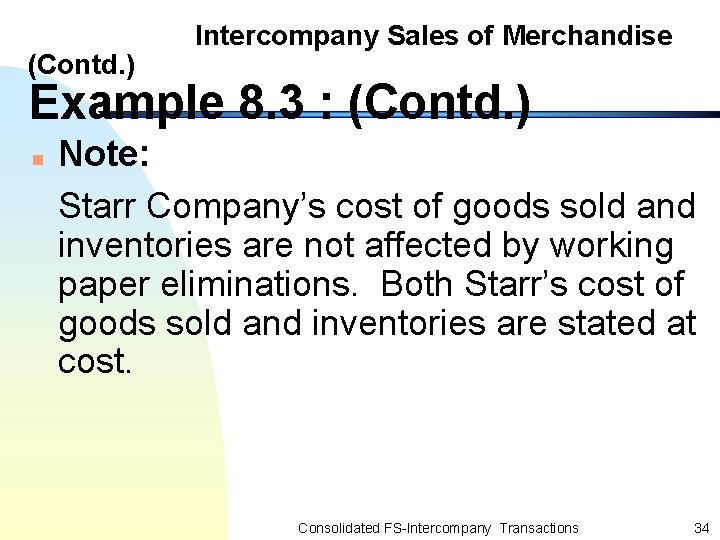
(Contd. ) Intercompany Sales of Merchandise Example 8. 3 : (Contd. ) n Note: Starr Company’s cost of goods sold and inventories are not affected by working paper eliminations. Both Starr’s cost of goods sold and inventories are stated at cost. Consolidated FS-Intercompany Transactions 34
Intercompany Sales of Merchandise (Contd. ) b. Intercompany Sales with Unrealized Intercompany Profit in Ending Inventories n Without the working paper elimination, the consolidated ending inventory and cost of goods sold are both overstated. Consolidated FS-Intercompany Transactions 35
Intercompany Sales of Merchandise (Contd. ) n n The ending inventory is overstated for the mark up of the unsold ending inventory (the unrealized gain). The cost of goods sold is overstated for the mark up of the cost of goods sold (the realized gain). Consolidated FS-Intercompany Transactions 36
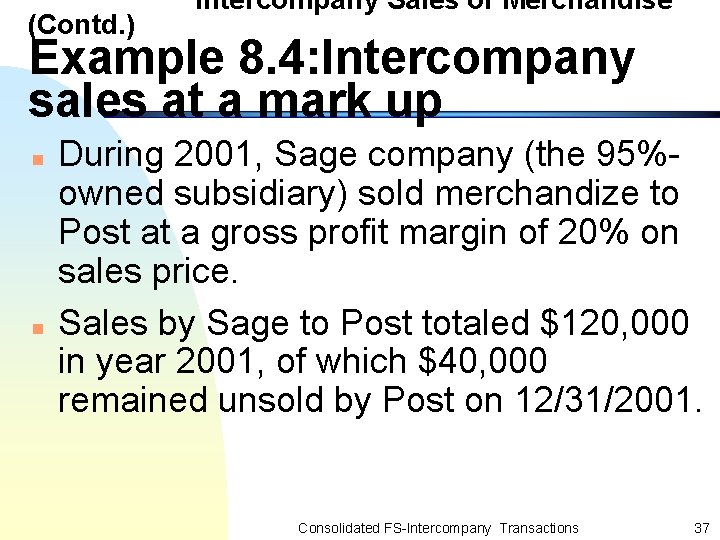
(Contd. ) Intercompany Sales of Merchandise Example 8. 4: Intercompany sales at a mark up n n During 2001, Sage company (the 95%owned subsidiary) sold merchandize to Post at a gross profit margin of 20% on sales price. Sales by Sage to Post totaled $120, 000 in year 2001, of which $40, 000 remained unsold by Post on 12/31/2001. Consolidated FS-Intercompany Transactions 37
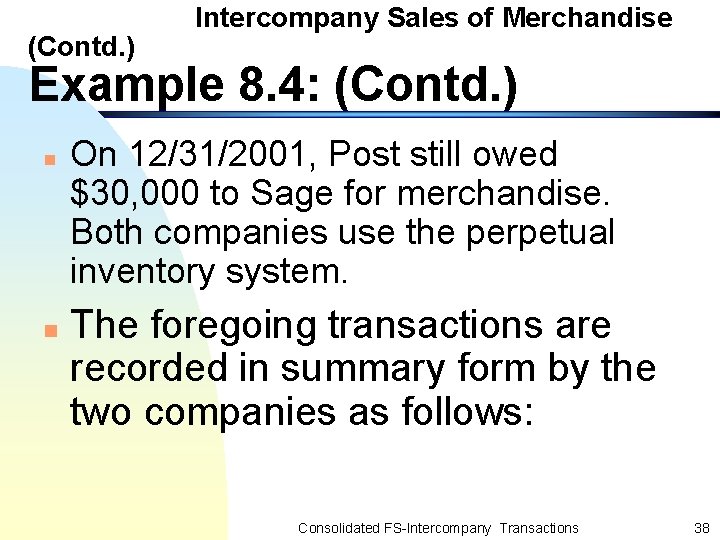
(Contd. ) Intercompany Sales of Merchandise Example 8. 4: (Contd. ) n n On 12/31/2001, Post still owed $30, 000 to Sage for merchandise. Both companies use the perpetual inventory system. The foregoing transactions are recorded in summary form by the two companies as follows: Consolidated FS-Intercompany Transactions 38
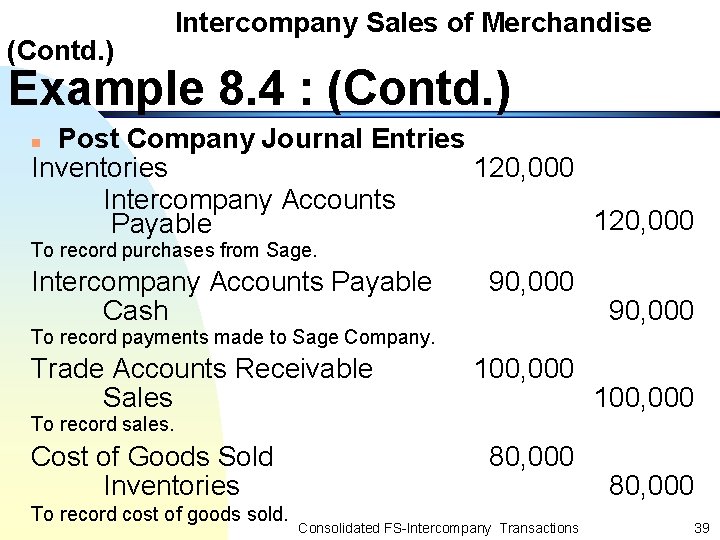
(Contd. ) Intercompany Sales of Merchandise Example 8. 4 : (Contd. ) Post Company Journal Entries Inventories 120, 000 Intercompany Accounts 120, 000 Payable n To record purchases from Sage. Intercompany Accounts Payable Cash 90, 000 To record payments made to Sage Company. Trade Accounts Receivable Sales 100, 000 To record sales. Cost of Goods Sold Inventories To record cost of goods sold. 80, 000 Consolidated FS-Intercompany Transactions 90, 000 100, 000 80, 000 39
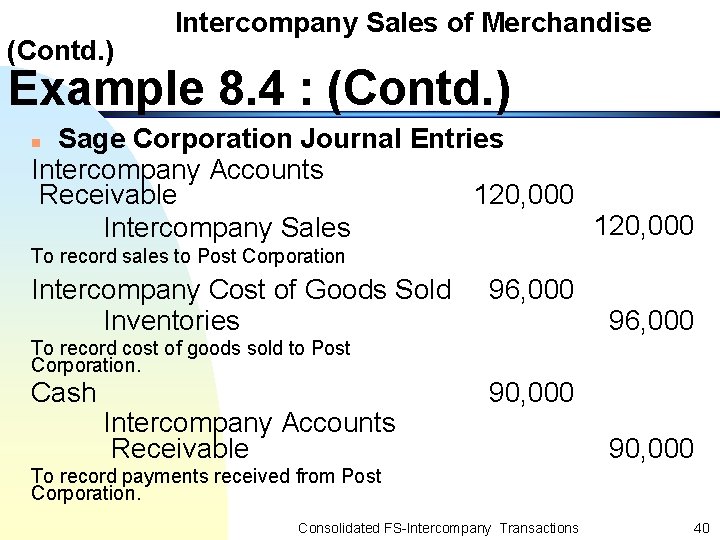
(Contd. ) Intercompany Sales of Merchandise Example 8. 4 : (Contd. ) Sage Corporation Journal Entries Intercompany Accounts Receivable 120, 000 Intercompany Sales n To record sales to Post Corporation Intercompany Cost of Goods Sold Inventories To record cost of goods sold to Post Corporation. Cash Intercompany Accounts Receivable 96, 000 90, 000 To record payments received from Post Corporation. Consolidated FS-Intercompany Transactions 40
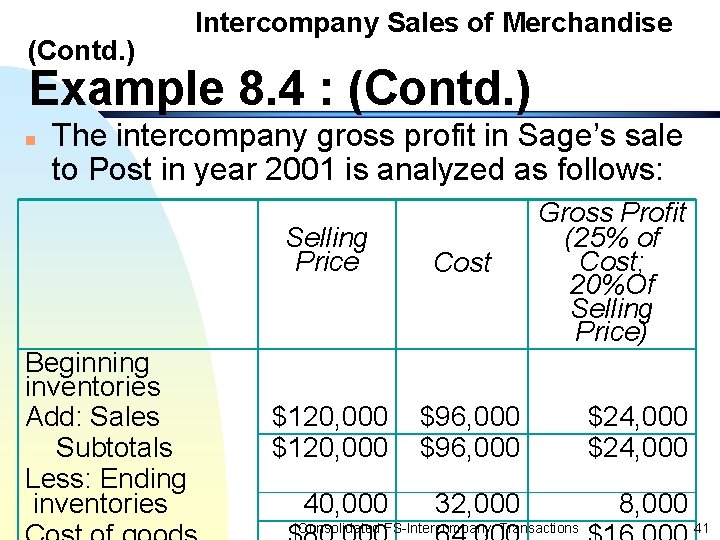
(Contd. ) Intercompany Sales of Merchandise Example 8. 4 : (Contd. ) n The intercompany gross profit in Sage’s sale to Post in year 2001 is analyzed as follows: Beginning inventories Add: Sales Subtotals Less: Ending inventories Gross Profit (25% of Cost; 20%Of Selling Price) Selling Price Cost $120, 000 $96, 000 $24, 000 40, 000 32, 000 8, 000 Consolidated FS-Intercompany Transactions 41
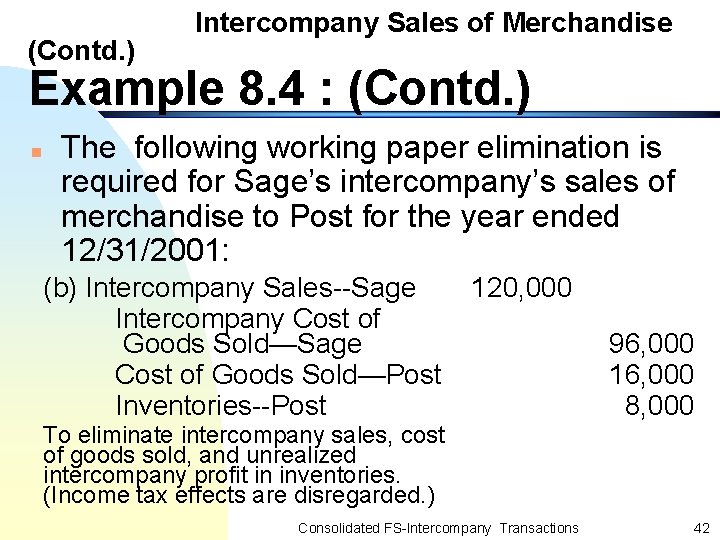
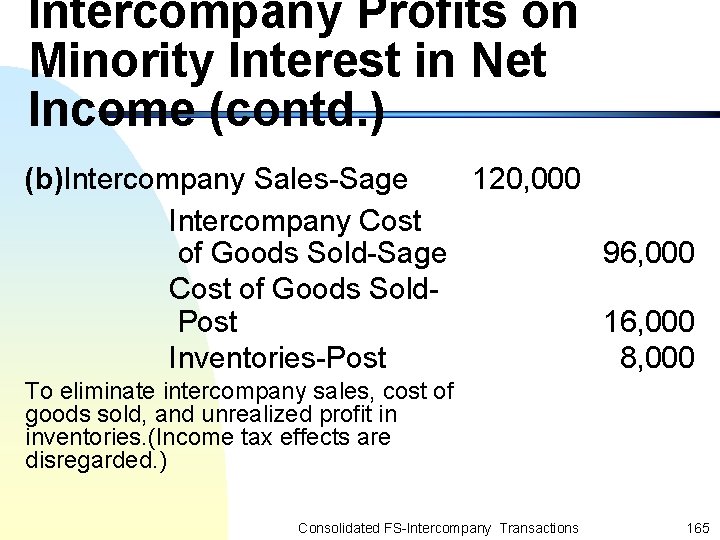
(Contd. ) Intercompany Sales of Merchandise Example 8. 4 : (Contd. ) n The following working paper elimination is required for Sage’s intercompany’s sales of merchandise to Post for the year ended 12/31/2001: (b) Intercompany Sales--Sage Intercompany Cost of Goods Sold—Sage Cost of Goods Sold—Post Inventories--Post 120, 000 96, 000 16, 000 8, 000 To eliminate intercompany sales, cost of goods sold, and unrealized intercompany profit in inventories. (Income tax effects are disregarded. ) Consolidated FS-Intercompany Transactions 42
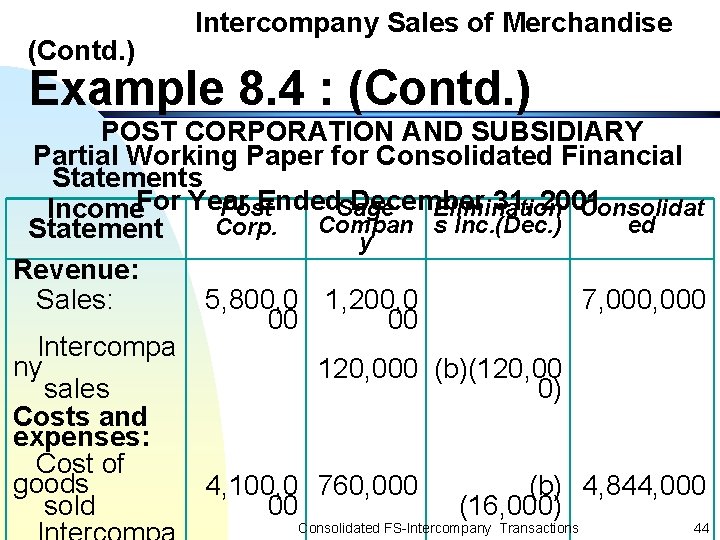
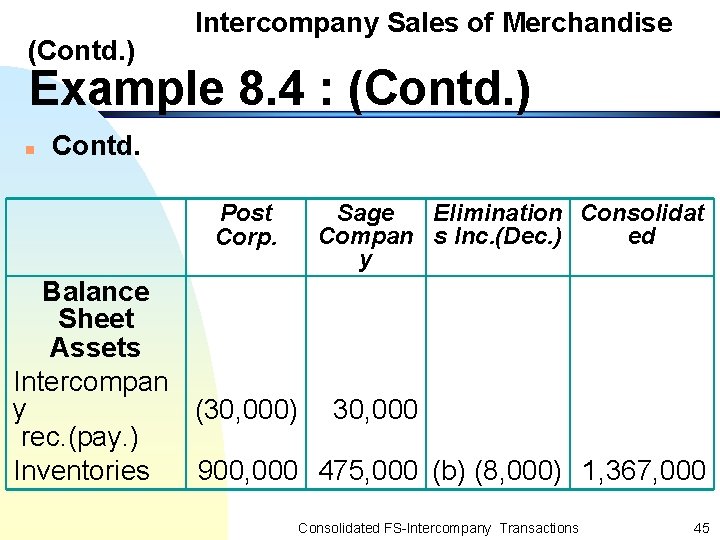
(Contd. ) Intercompany Sales of Merchandise Example 8. 4 : (Contd. ) n Entering the preceding eliminations in the working paper for consolidated financial statements results in the consolidated amounts shown below (amounts for total sales to outsiders and cost of goods sold are assumed): Consolidated FS-Intercompany Transactions 43
(Contd. ) Intercompany Sales of Merchandise Example 8. 4 : (Contd. ) POST CORPORATION AND SUBSIDIARY Partial Working Paper for Consolidated Financial Statements Ended. Sage December 31, 2001 Post Elimination Consolidat Income. For Year Compan s Inc. (Dec. ) ed Corp. Statement y Revenue: Sales: 5, 800, 0 1, 200, 0 7, 000 00 00 Intercompa ny 120, 000 (b)(120, 00 sales 0) Costs and expenses: Cost of goods 4, 100, 0 760, 000 (b) 4, 844, 000 sold 00 (16, 000) Consolidated FS-Intercompany Transactions 44
(Contd. ) Intercompany Sales of Merchandise Example 8. 4 : (Contd. ) n Contd. Post Corp. Sage Elimination Consolidat Compan s Inc. (Dec. ) ed y Balance Sheet Assets Intercompan y (30, 000) 30, 000 rec. (pay. ) Inventories 900, 000 475, 000 (b) (8, 000) 1, 367, 000 Consolidated FS-Intercompany Transactions 45
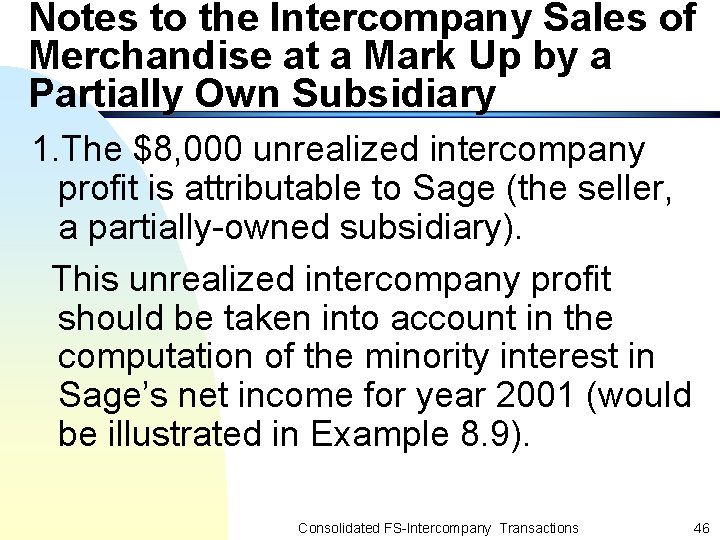
Notes to the Intercompany Sales of Merchandise at a Mark Up by a Partially Own Subsidiary 1. The $8, 000 unrealized intercompany profit is attributable to Sage (the seller, a partially-owned subsidiary). This unrealized intercompany profit should be taken into account in the computation of the minority interest in Sage’s net income for year 2001 (would be illustrated in Example 8. 9). Consolidated FS-Intercompany Transactions 46
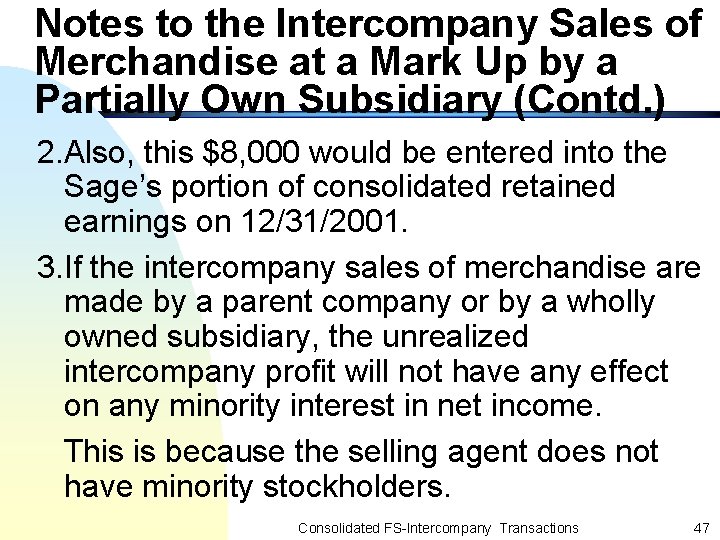
Notes to the Intercompany Sales of Merchandise at a Mark Up by a Partially Own Subsidiary (Contd. ) 2. Also, this $8, 000 would be entered into the Sage’s portion of consolidated retained earnings on 12/31/2001. 3. If the intercompany sales of merchandise are made by a parent company or by a wholly owned subsidiary, the unrealized intercompany profit will not have any effect on any minority interest in net income. This is because the selling agent does not have minority stockholders. Consolidated FS-Intercompany Transactions 47
Intercompany (Unrealized) Profit in Beginning and Ending Inventories n It is assumed that, on a FIFO basis, the intercompany profit in the purchaser’s beginning inventories is realized through sales of the merchandise to outsiders during the following accounting period. Consolidated FS-Intercompany Transactions 48
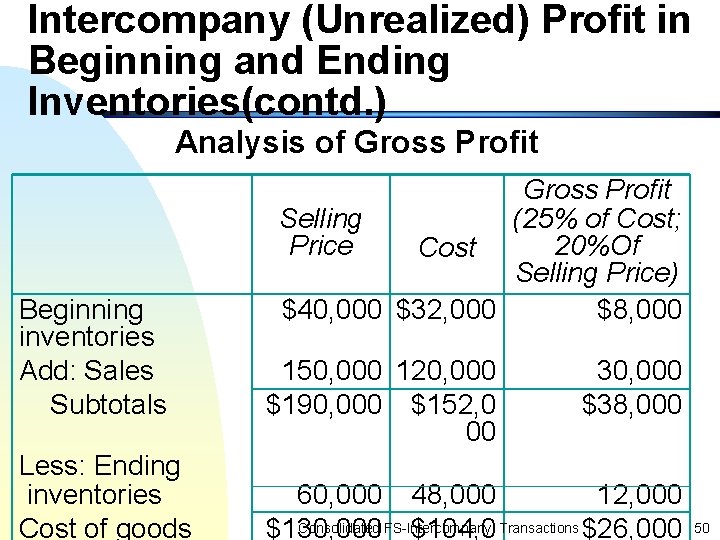
Intercompany (Unrealized) Profit in Beginning and Ending Inventories(contd. ) n n Only the intercompany profit in ending inventories remains unrealized at the end of the period. Continuing with Example 8. 4, assume that Sage’s intercompany sales of merchandise to Post Corporation during the year ended 12/31/2002, are analyzed as follows: Consolidated FS-Intercompany Transactions 49
Intercompany (Unrealized) Profit in Beginning and Ending Inventories(contd. ) Analysis of Gross Profit Beginning inventories Add: Sales Subtotals Less: Ending inventories Cost of goods Gross Profit Selling (25% of Cost; Price 20%Of Cost Selling Price) $40, 000 $32, 000 $8, 000 150, 000 120, 000 $190, 000 $152, 0 00 30, 000 $38, 000 60, 000 48, 000 12, 000 Consolidated FS-Intercompany Transactions $130, 000 $104, 0 $26, 000 50
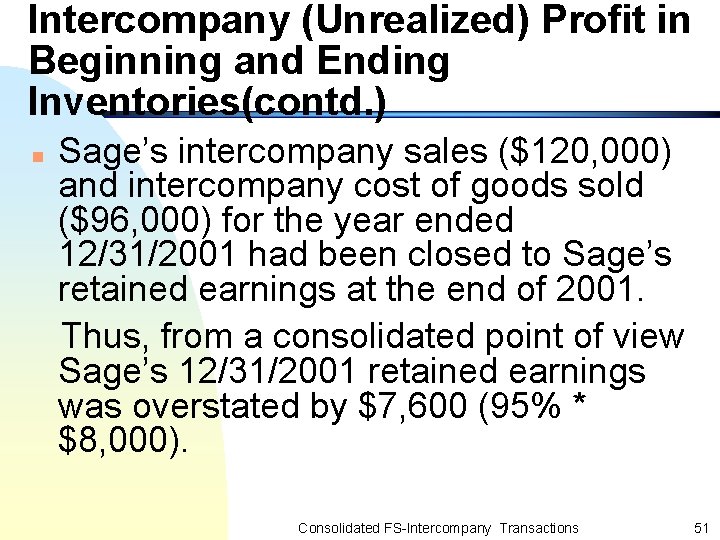
Intercompany (Unrealized) Profit in Beginning and Ending Inventories(contd. ) Sage’s intercompany sales ($120, 000) and intercompany cost of goods sold ($96, 000) for the year ended 12/31/2001 had been closed to Sage’s retained earnings at the end of 2001. Thus, from a consolidated point of view Sage’s 12/31/2001 retained earnings was overstated by $7, 600 (95% * $8, 000). n Consolidated FS-Intercompany Transactions 51
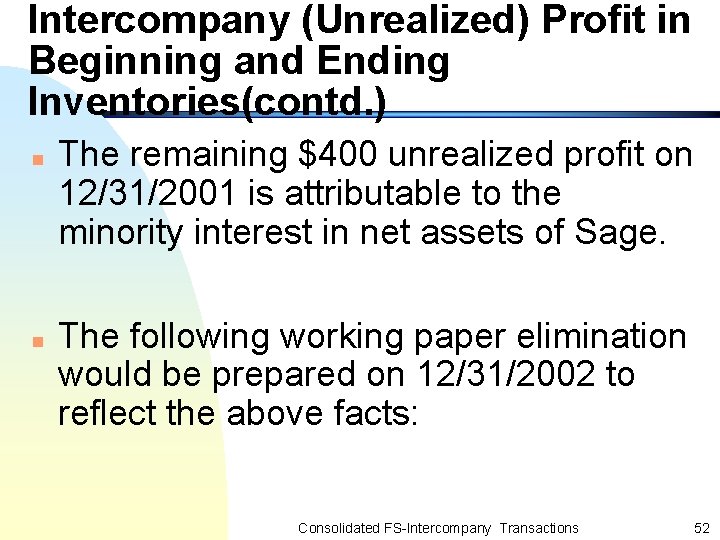
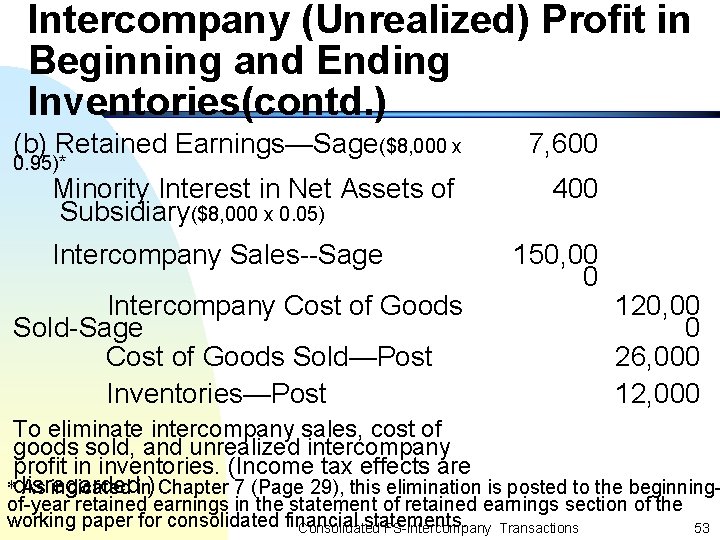
Intercompany (Unrealized) Profit in Beginning and Ending Inventories(contd. ) n n The remaining $400 unrealized profit on 12/31/2001 is attributable to the minority interest in net assets of Sage. The following working paper elimination would be prepared on 12/31/2002 to reflect the above facts: Consolidated FS-Intercompany Transactions 52
Intercompany (Unrealized) Profit in Beginning and Ending Inventories(contd. ) (b) Retained Earnings—Sage($8, 000 x 0. 95)* Minority Interest in Net Assets of Subsidiary($8, 000 x 0. 05) Intercompany Sales--Sage Intercompany Cost of Goods Sold-Sage Cost of Goods Sold—Post Inventories—Post 7, 600 400 150, 00 0 120, 00 0 26, 000 12, 000 To eliminate intercompany sales, cost of goods sold, and unrealized intercompany profit in inventories. (Income tax effects are *disregarded. ) As indicated in Chapter 7 (Page 29), this elimination is posted to the beginningof-year retained earnings in the statement of retained earnings section of the working paper for consolidated financial statements. Consolidated FS-Intercompany Transactions 53
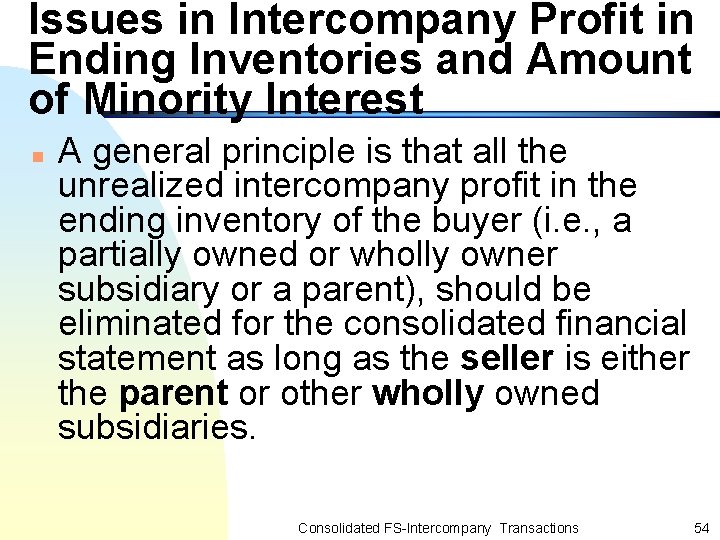
Issues in Intercompany Profit in Ending Inventories and Amount of Minority Interest n A general principle is that all the unrealized intercompany profit in the ending inventory of the buyer (i. e. , a partially owned or wholly owner subsidiary or a parent), should be eliminated for the consolidated financial statement as long as the seller is either the parent or other wholly owned subsidiaries. Consolidated FS-Intercompany Transactions 54
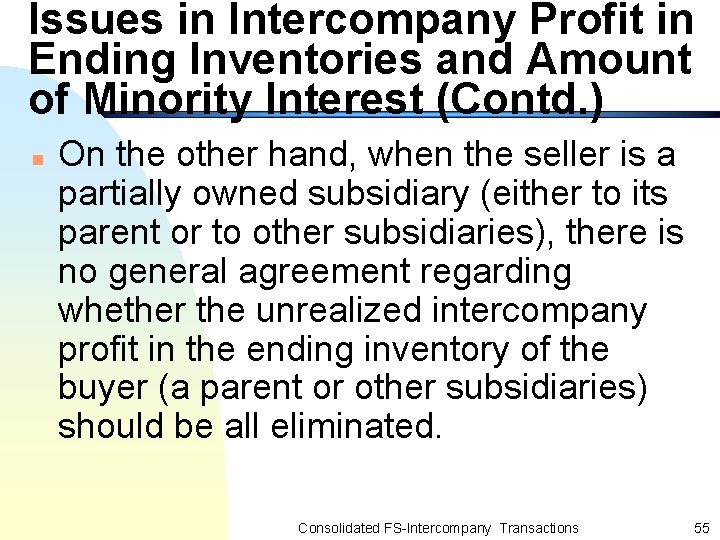
Issues in Intercompany Profit in Ending Inventories and Amount of Minority Interest (Contd. ) n On the other hand, when the seller is a partially owned subsidiary (either to its parent or to other subsidiaries), there is no general agreement regarding whether the unrealized intercompany profit in the ending inventory of the buyer (a parent or other subsidiaries) should be all eliminated. Consolidated FS-Intercompany Transactions 55
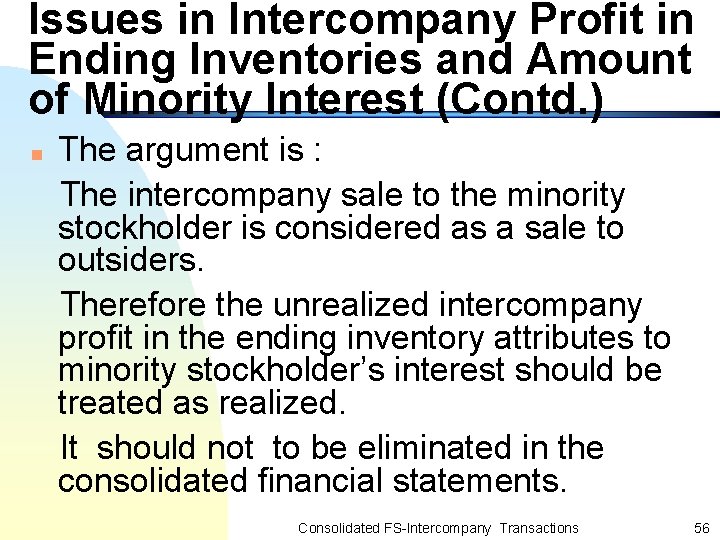
Issues in Intercompany Profit in Ending Inventories and Amount of Minority Interest (Contd. ) The argument is : The intercompany sale to the minority stockholder is considered as a sale to outsiders. Therefore the unrealized intercompany profit in the ending inventory attributes to minority stockholder’s interest should be treated as realized. It should not to be eliminated in the consolidated financial statements. n Consolidated FS-Intercompany Transactions 56
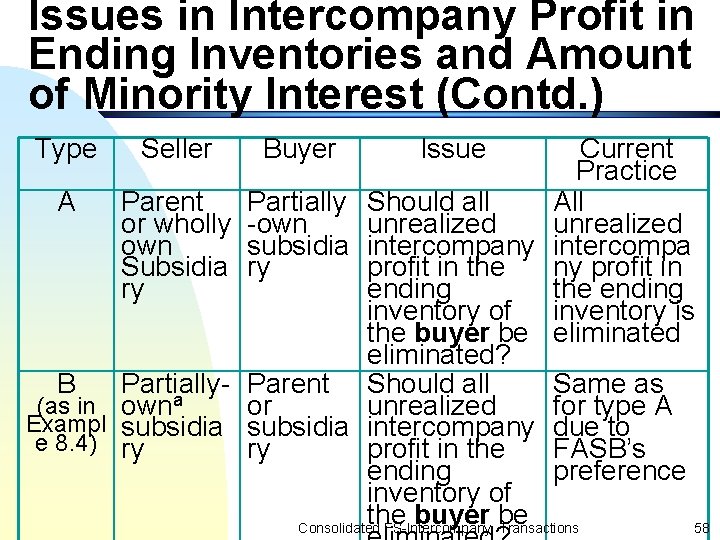
Issues in Intercompany Profit in Ending Inventories and Amount of Minority Interest (Contd. ) n The following table illustrates the types of intercompany sales and the related issues of the unrealized intercompany profit in the ending inventory: Consolidated FS-Intercompany Transactions 57
Issues in Intercompany Profit in Ending Inventories and Amount of Minority Interest (Contd. ) Type Seller Buyer Issue Current Practice A Parent Partially Should all All or wholly -own unrealized own subsidia intercompany intercompa Subsidia ry profit in the ny profit in ry ending the ending inventory of inventory is the buyer be eliminated? B Partially. Parent Should all Same as a (as in own or unrealized for type A Exampl subsidia intercompany due to e 8. 4) ry ry profit in the FASB’s ending preference inventory of the buyer be Consolidated FS-Intercompany Transactions 58
Issues in Intercompany Profit in Ending Inventories and Amount of Minority Interest (Contd. ) Note to the above table: a. The unrealized intercompany profit is attributable to the seller (the partiallyown sub. ) and must be considered in the computation of the minority interest in net income of the partially own sub. of the year (see Example 8. 4 and Example 8. 9). Consolidated FS-Intercompany Transactions 59
Intercompany Sales of Plant Assets n Intercompany sales of plant assets differ from intercompany sales of merchandise in two ways: 1. Intercompany sales of plant assets between affiliated companies are rare transactions. Consolidated FS-Intercompany Transactions 60
Intercompany Sales of Plant Assets (Contd. ) 2. Due to the long economic lives of plant assets, it requires many accounting periods before the intercompany gains (losses) on sales of these assets are realized in transactions with outsiders. Consolidated FS-Intercompany Transactions 61
Intercompany Gain on Sale of Land n Example 8. 5: Assume that on 12/31/2001, Post (the parent company) sold to Sage (the partially owned subsidiary) a parcel of land costing $125, 000 for $175, 000. The two companies would record the following entries: Consolidated FS-Intercompany Transactions 62
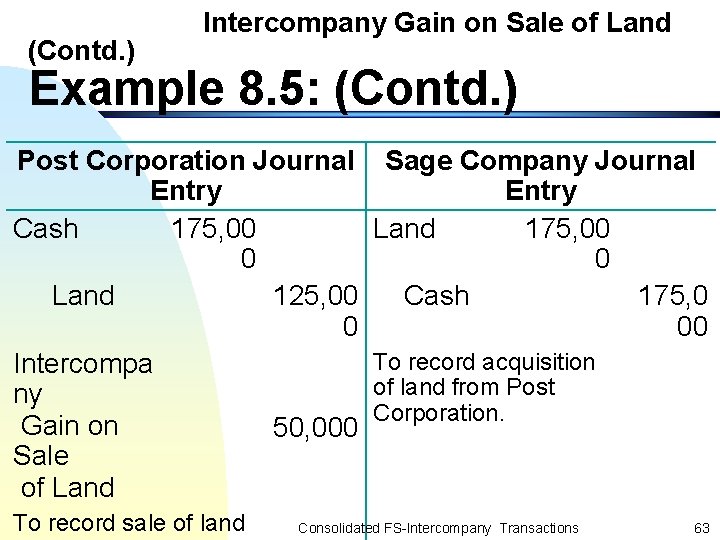
(Contd. ) Intercompany Gain on Sale of Land Example 8. 5: (Contd. ) Post Corporation Journal Entry Cash 175, 00 0 Land 125, 00 0 Intercompa ny Gain on 50, 000 Sale of Land To record sale of land Sage Company Journal Entry Land 175, 00 0 Cash 175, 0 00 To record acquisition of land from Post Corporation. Consolidated FS-Intercompany Transactions 63
(Contd. ) Intercompany Gain on Sale of Land Example 8. 5: (Contd. ) n In the consolidated financial statement, the land should be reported at the historical cost and the intercompany gain should be eliminated until it is realized (i. e. , sold to an outsider by Sage). Consolidated FS-Intercompany Transactions 64
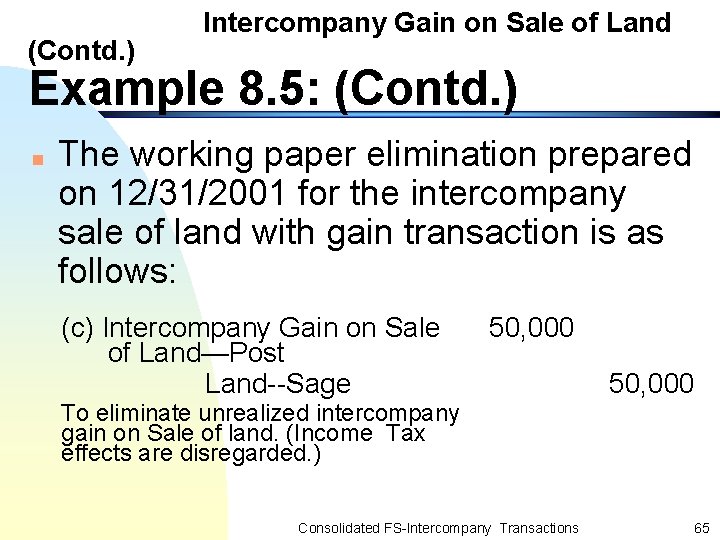
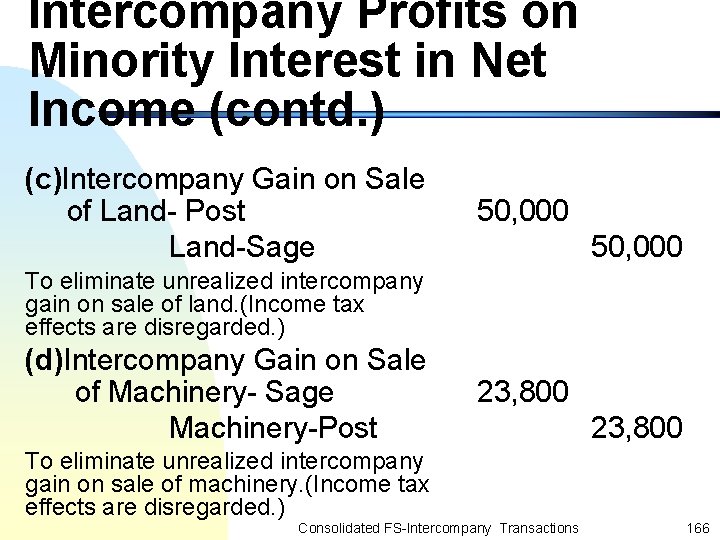
(Contd. ) Intercompany Gain on Sale of Land Example 8. 5: (Contd. ) n The working paper elimination prepared on 12/31/2001 for the intercompany sale of land with gain transaction is as follows: (c) Intercompany Gain on Sale of Land—Post Land--Sage 50, 000 To eliminate unrealized intercompany gain on Sale of land. (Income Tax effects are disregarded. ) Consolidated FS-Intercompany Transactions 65
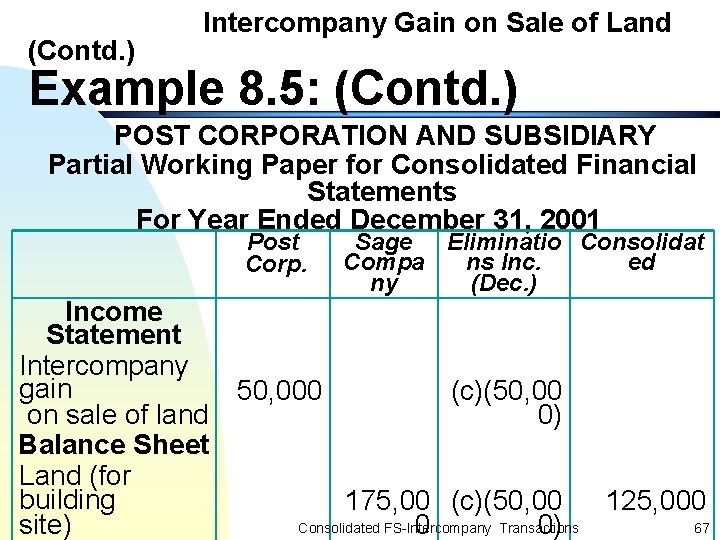
(Contd. ) Intercompany Gain on Sale of Land Example 8. 5: (Contd. ) n The above working paper elimination is entered in the working paper for consolidated financial statements for the year ended 12/31/2001 as follows: Consolidated FS-Intercompany Transactions 66
(Contd. ) Intercompany Gain on Sale of Land Example 8. 5: (Contd. ) POST CORPORATION AND SUBSIDIARY Partial Working Paper for Consolidated Financial Statements For Year Ended December 31, 2001 Post Corp. Sage Eliminatio Consolidat Compa ns Inc. ed ny (Dec. ) Income Statement Intercompany gain 50, 000 (c)(50, 00 on sale of land 0) Balance Sheet Land (for building 175, 00 (c)(50, 00 125, 000 Consolidated FS-Intercompany Transactions 67 site) 0 0)
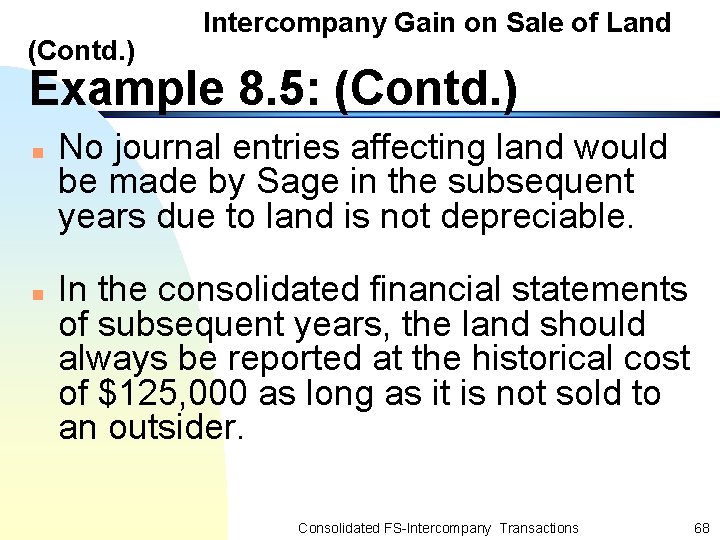
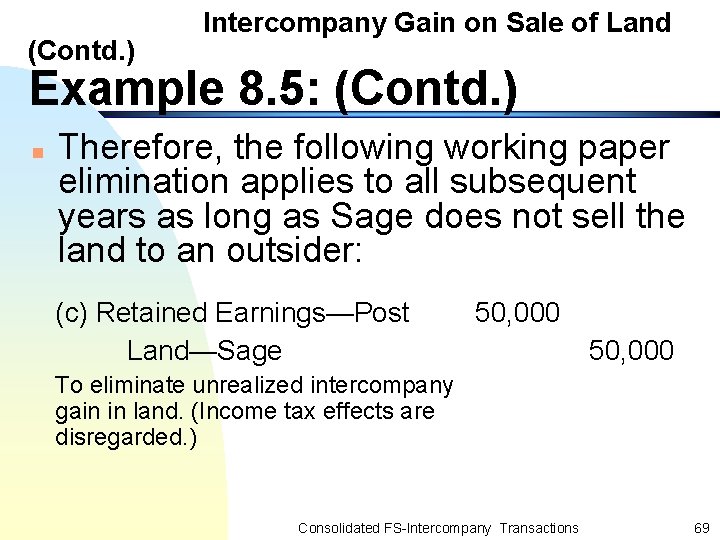
(Contd. ) Intercompany Gain on Sale of Land Example 8. 5: (Contd. ) n n No journal entries affecting land would be made by Sage in the subsequent years due to land is not depreciable. In the consolidated financial statements of subsequent years, the land should always be reported at the historical cost of $125, 000 as long as it is not sold to an outsider. Consolidated FS-Intercompany Transactions 68
(Contd. ) Intercompany Gain on Sale of Land Example 8. 5: (Contd. ) n Therefore, the following working paper elimination applies to all subsequent years as long as Sage does not sell the land to an outsider: (c) Retained Earnings—Post Land—Sage 50, 000 To eliminate unrealized intercompany gain in land. (Income tax effects are disregarded. ) Consolidated FS-Intercompany Transactions 69
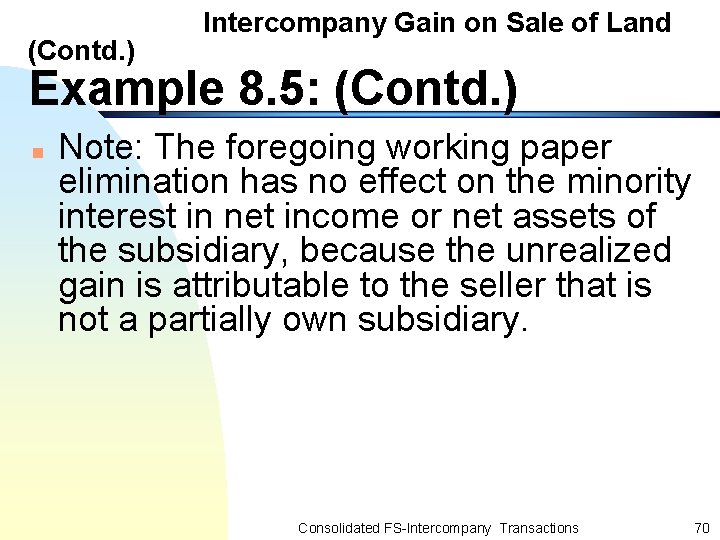
(Contd. ) Intercompany Gain on Sale of Land Example 8. 5: (Contd. ) n Note: The foregoing working paper elimination has no effect on the minority interest in net income or net assets of the subsidiary, because the unrealized gain is attributable to the seller that is not a partially own subsidiary. Consolidated FS-Intercompany Transactions 70
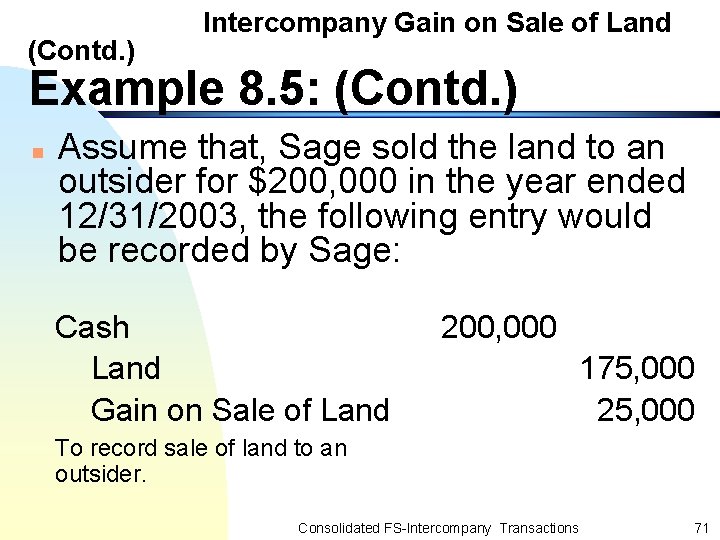
(Contd. ) Intercompany Gain on Sale of Land Example 8. 5: (Contd. ) n Assume that, Sage sold the land to an outsider for $200, 000 in the year ended 12/31/2003, the following entry would be recorded by Sage: Cash Land Gain on Sale of Land 200, 000 175, 000 25, 000 To record sale of land to an outsider. Consolidated FS-Intercompany Transactions 71
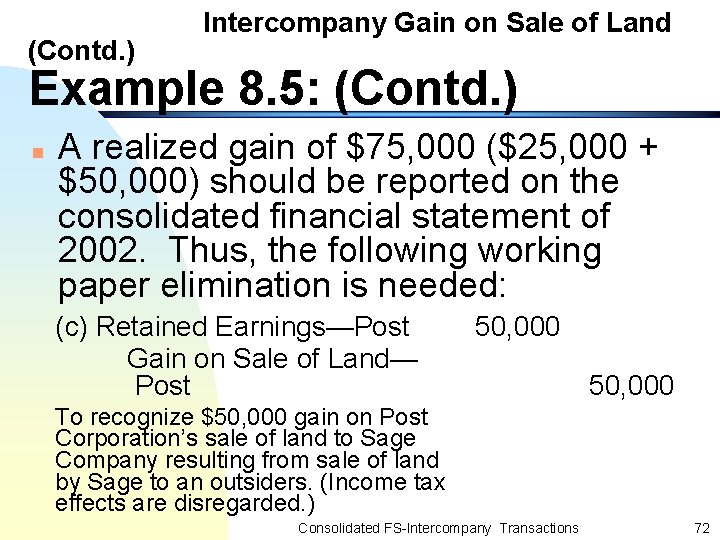
(Contd. ) Intercompany Gain on Sale of Land Example 8. 5: (Contd. ) n A realized gain of $75, 000 ($25, 000 + $50, 000) should be reported on the consolidated financial statement of 2002. Thus, the following working paper elimination is needed: (c) Retained Earnings—Post Gain on Sale of Land— Post 50, 000 To recognize $50, 000 gain on Post Corporation’s sale of land to Sage Company resulting from sale of land by Sage to an outsiders. (Income tax effects are disregarded. ) Consolidated FS-Intercompany Transactions 72
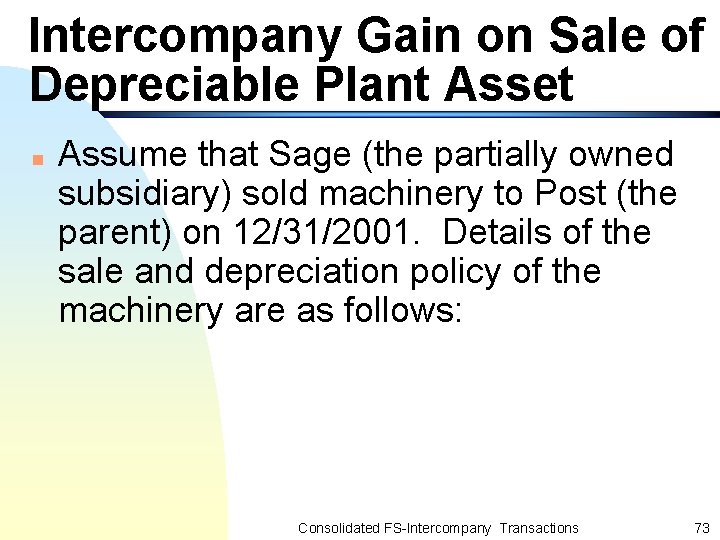
Intercompany Gain on Sale of Depreciable Plant Asset n Assume that Sage (the partially owned subsidiary) sold machinery to Post (the parent) on 12/31/2001. Details of the sale and depreciation policy of the machinery are as follows: Consolidated FS-Intercompany Transactions 73
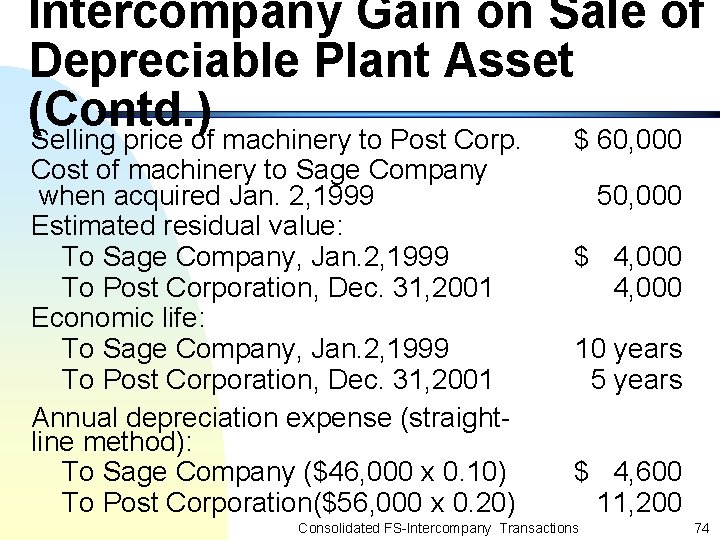
Intercompany Gain on Sale of Depreciable Plant Asset (Contd. ) Selling price of machinery to Post Corp. $ 60, 000 Cost of machinery to Sage Company when acquired Jan. 2, 1999 Estimated residual value: To Sage Company, Jan. 2, 1999 To Post Corporation, Dec. 31, 2001 Economic life: To Sage Company, Jan. 2, 1999 To Post Corporation, Dec. 31, 2001 Annual depreciation expense (straightline method): To Sage Company ($46, 000 x 0. 10) To Post Corporation($56, 000 x 0. 20) 50, 000 $ 4, 000 10 years 5 years $ 4, 600 11, 200 Consolidated FS-Intercompany Transactions 74
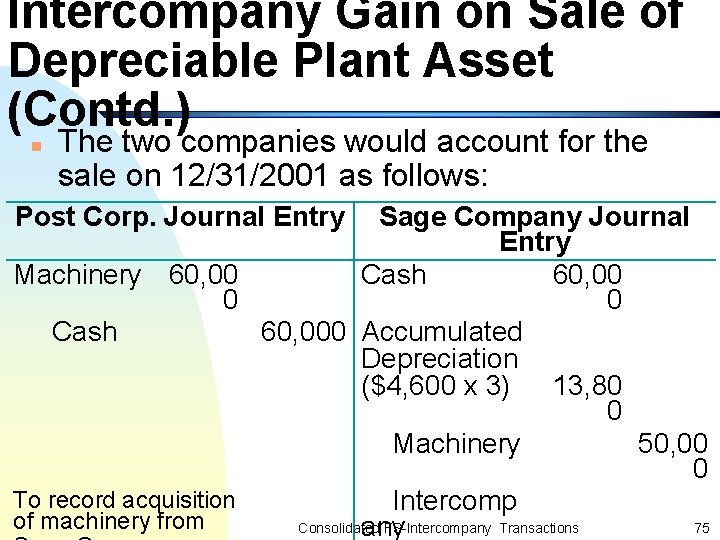
Intercompany Gain on Sale of Depreciable Plant Asset (Contd. ) n The two companies would account for the sale on 12/31/2001 as follows: Post Corp. Journal Entry Sage Company Journal Entry Machinery 60, 00 Cash 60, 00 0 0 Cash 60, 000 Accumulated Depreciation 13, 80 ($4, 600 x 3) 0 Machinery 50, 00 0 To record acquisition Intercomp of machinery from Consolidated FS-Intercompany Transactions 75 any
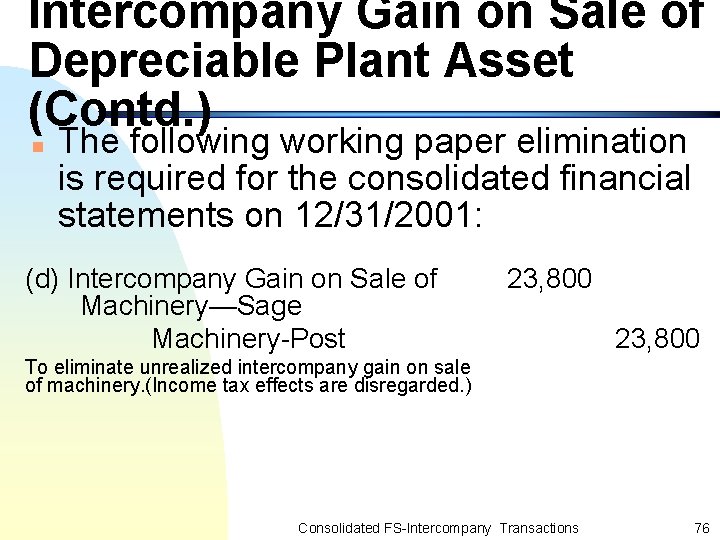
Intercompany Gain on Sale of Depreciable Plant Asset (Contd. ) n The following working paper elimination is required for the consolidated financial statements on 12/31/2001: (d) Intercompany Gain on Sale of Machinery—Sage Machinery-Post 23, 800 To eliminate unrealized intercompany gain on sale of machinery. (Income tax effects are disregarded. ) Consolidated FS-Intercompany Transactions 76
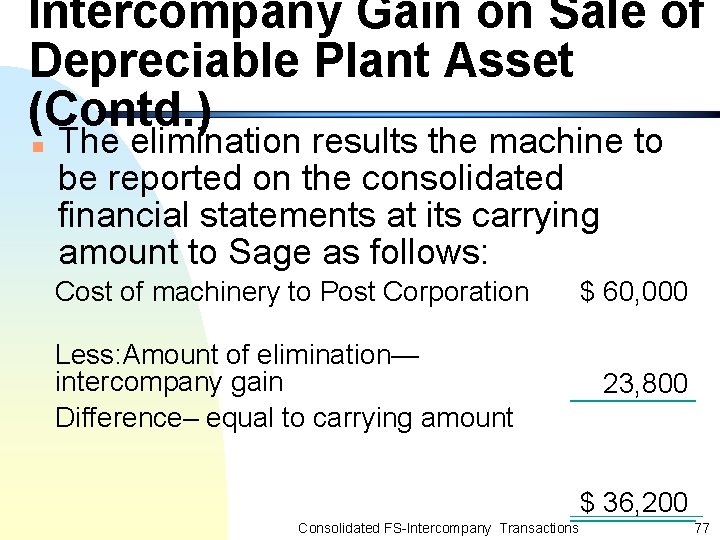
Intercompany Gain on Sale of Depreciable Plant Asset (Contd. ) n The elimination results the machine to be reported on the consolidated financial statements at its carrying amount to Sage as follows: Cost of machinery to Post Corporation Less: Amount of elimination— intercompany gain Difference– equal to carrying amount $ 60, 000 23, 800 $ 36, 200 Consolidated FS-Intercompany Transactions 77
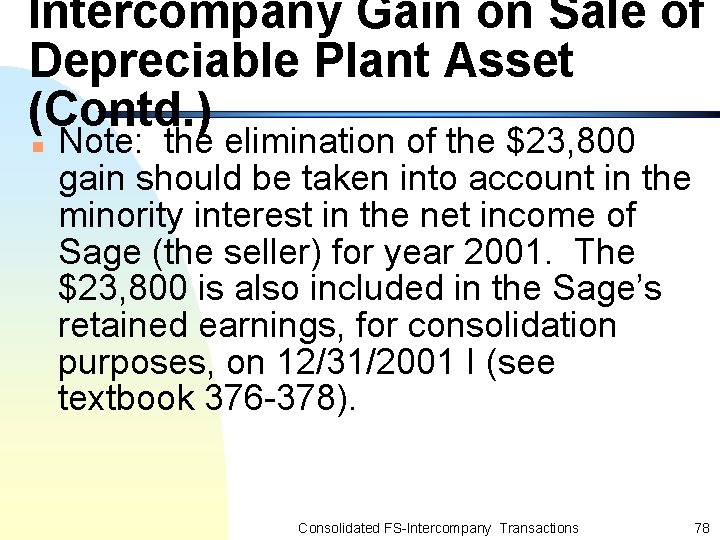
Intercompany Gain on Sale of Depreciable Plant Asset (Contd. ) n Note: the elimination of the $23, 800 gain should be taken into account in the minority interest in the net income of Sage (the seller) for year 2001. The $23, 800 is also included in the Sage’s retained earnings, for consolidation purposes, on 12/31/2001 I (see textbook 376 -378). Consolidated FS-Intercompany Transactions 78
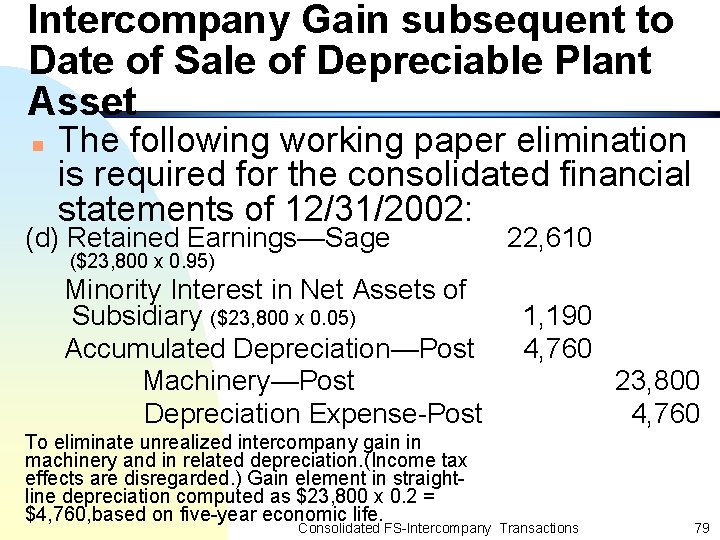
Intercompany Gain subsequent to Date of Sale of Depreciable Plant Asset n The following working paper elimination is required for the consolidated financial statements of 12/31/2002: (d) Retained Earnings—Sage ($23, 800 x 0. 95) Minority Interest in Net Assets of Subsidiary ($23, 800 x 0. 05) Accumulated Depreciation—Post Machinery—Post Depreciation Expense-Post To eliminate unrealized intercompany gain in machinery and in related depreciation. (Income tax effects are disregarded. ) Gain element in straightline depreciation computed as $23, 800 x 0. 2 = $4, 760, based on five-year economic life. 22, 610 1, 190 4, 760 Consolidated FS-Intercompany Transactions 23, 800 4, 760 79
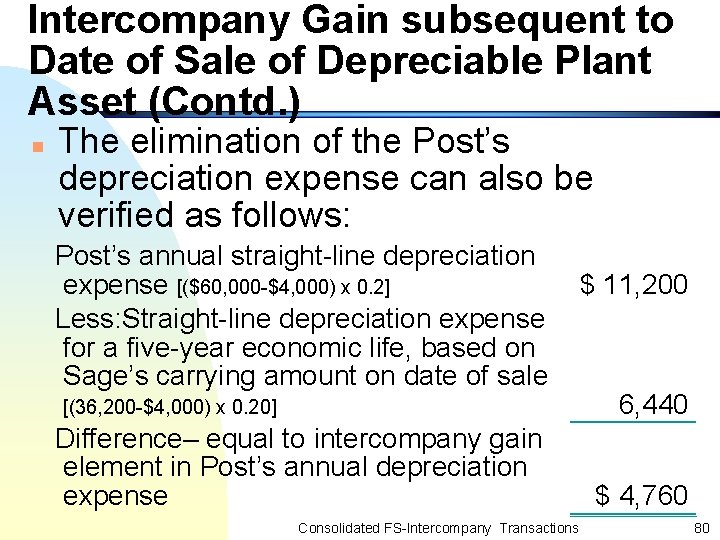
Intercompany Gain subsequent to Date of Sale of Depreciable Plant Asset (Contd. ) n The elimination of the Post’s depreciation expense can also be verified as follows: Post’s annual straight-line depreciation expense [($60, 000 -$4, 000) x 0. 2] Less: Straight-line depreciation expense for a five-year economic life, based on Sage’s carrying amount on date of sale [(36, 200 -$4, 000) x 0. 20] Difference– equal to intercompany gain element in Post’s annual depreciation expense Consolidated FS-Intercompany Transactions $ 11, 200 6, 440 $ 4, 760 80
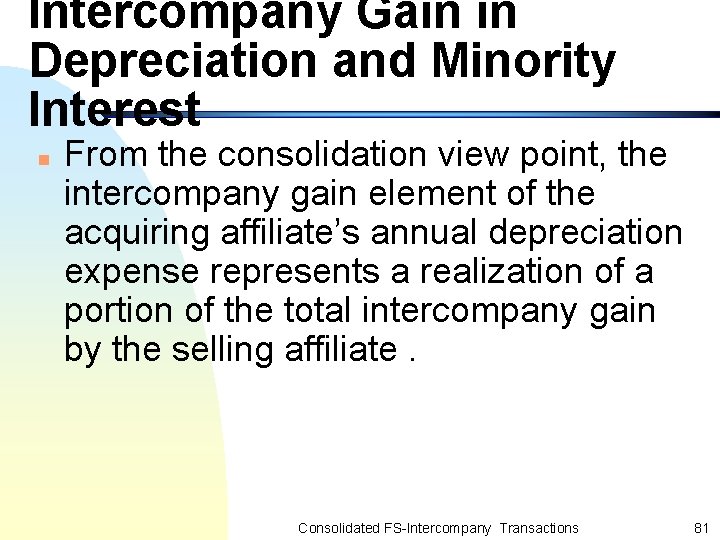
Intercompany Gain in Depreciation and Minority Interest n From the consolidation view point, the intercompany gain element of the acquiring affiliate’s annual depreciation expense represents a realization of a portion of the total intercompany gain by the selling affiliate. Consolidated FS-Intercompany Transactions 81
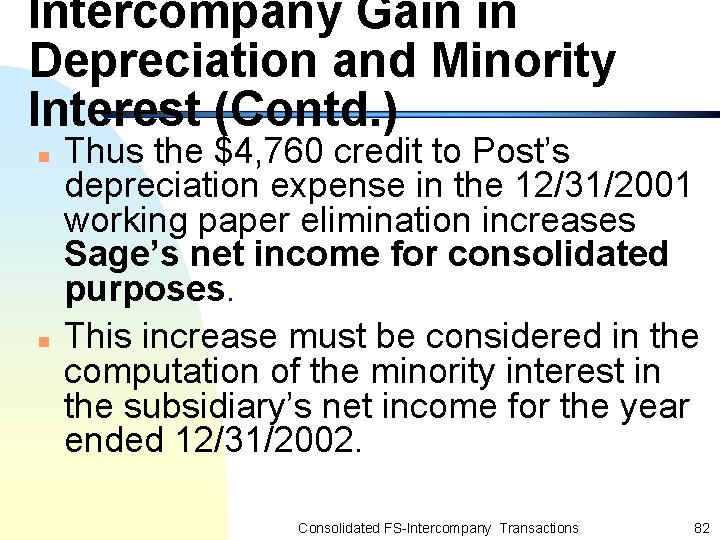
Intercompany Gain in Depreciation and Minority Interest (Contd. ) n n Thus the $4, 760 credit to Post’s depreciation expense in the 12/31/2001 working paper elimination increases Sage’s net income for consolidated purposes. This increase must be considered in the computation of the minority interest in the subsidiary’s net income for the year ended 12/31/2002. Consolidated FS-Intercompany Transactions 82
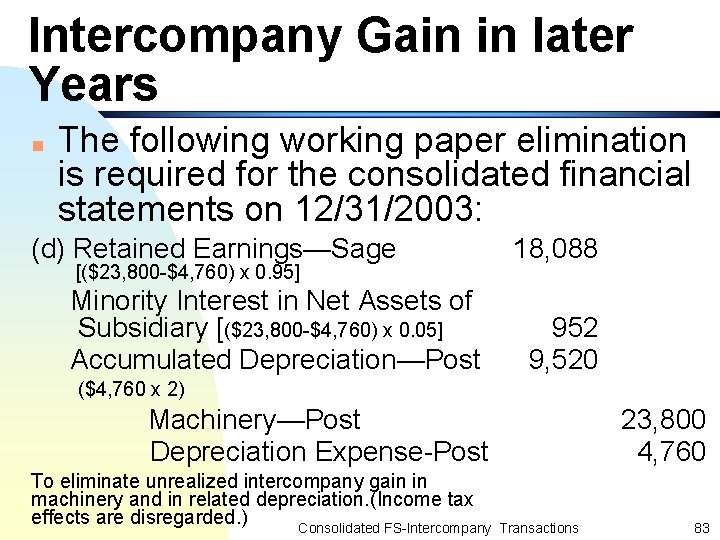
Intercompany Gain in later Years n The following working paper elimination is required for the consolidated financial statements on 12/31/2003: (d) Retained Earnings—Sage [($23, 800 -$4, 760) x 0. 95] Minority Interest in Net Assets of Subsidiary [($23, 800 -$4, 760) x 0. 05] Accumulated Depreciation—Post ($4, 760 x 2) Machinery—Post Depreciation Expense-Post 18, 088 952 9, 520 To eliminate unrealized intercompany gain in machinery and in related depreciation. (Income tax effects are disregarded. ) Consolidated FS-Intercompany Transactions 23, 800 4, 760 83
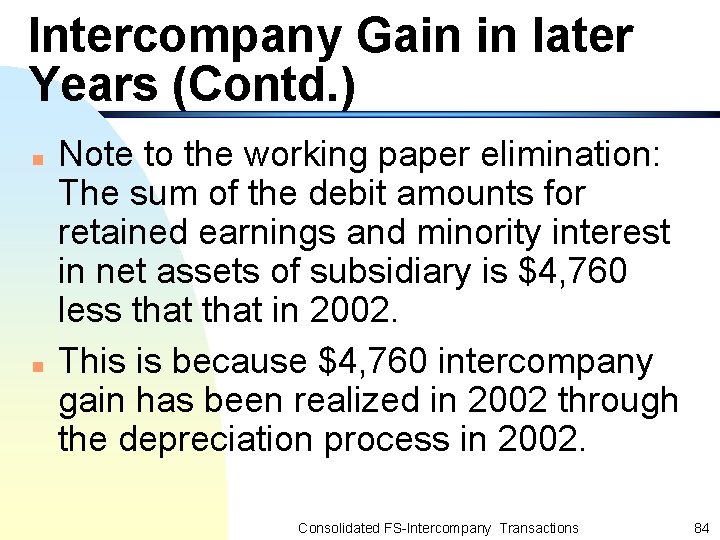
Intercompany Gain in later Years (Contd. ) n n Note to the working paper elimination: The sum of the debit amounts for retained earnings and minority interest in net assets of subsidiary is $4, 760 less that in 2002. This is because $4, 760 intercompany gain has been realized in 2002 through the depreciation process in 2002. Consolidated FS-Intercompany Transactions 84
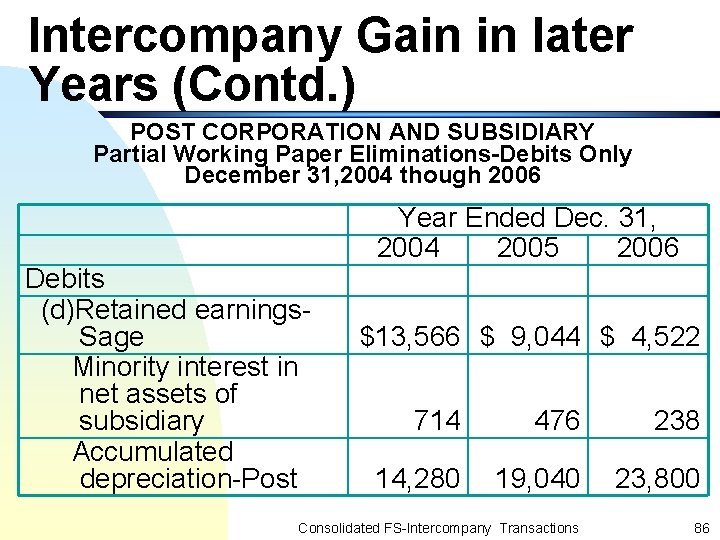
Intercompany Gain in later Years (Contd. ) n n The sum of the debit amounts for retained earnings and minority interest in net assets represents the unrealized portion of the intercompany gain at the beginning of the year. For each succeeding year, the unrealized position of the intercompany gain decreases (in the amount of $4, 760), as indicated in the following summary of the working paper elimination debits for those years: Consolidated FS-Intercompany Transactions 85
Intercompany Gain in later Years (Contd. ) POST CORPORATION AND SUBSIDIARY Partial Working Paper Eliminations-Debits Only December 31, 2004 though 2006 Debits (d)Retained earnings Sage Minority interest in net assets of subsidiary Accumulated depreciation-Post Year Ended Dec. 31, 2004 2005 2006 $13, 566 $ 9, 044 $ 4, 522 714 476 238 14, 280 19, 040 23, 800 Consolidated FS-Intercompany Transactions 86
Intercompany Gain in later Years (Contd. ) n Similar working paper elimination will be prepared for year 2004, 2005 and 2006. The changes are only in the debit accounts as indicated in the above table. Consolidated FS-Intercompany Transactions 87
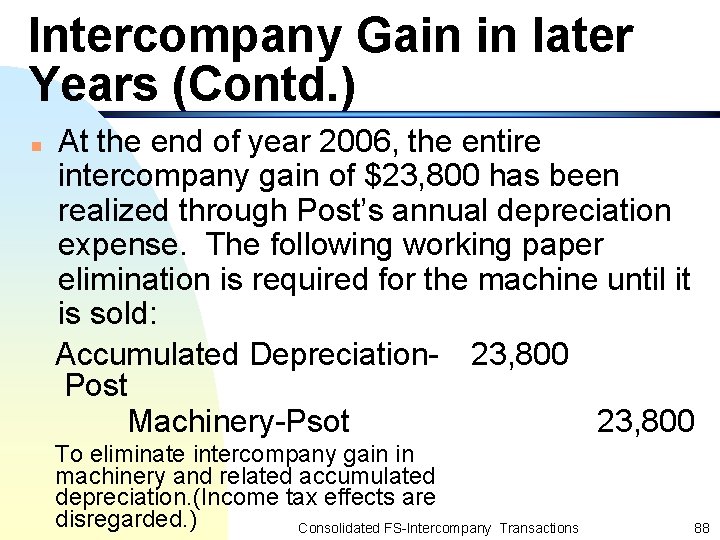
Intercompany Gain in later Years (Contd. ) n At the end of year 2006, the entire intercompany gain of $23, 800 has been realized through Post’s annual depreciation expense. The following working paper elimination is required for the machine until it is sold: Accumulated Depreciation- 23, 800 Post Machinery-Psot 23, 800 To eliminate intercompany gain in machinery and related accumulated depreciation. (Income tax effects are disregarded. ) Consolidated FS-Intercompany Transactions 88
Intercompany Lease of Property under Capital/Sale-Type Lease n Land, building, machinery, equipment and other property may be transferred between affiliate entities in the form of a sales-type lease to the lessor and a capital lease to the lessee. Consolidated FS-Intercompany Transactions 89
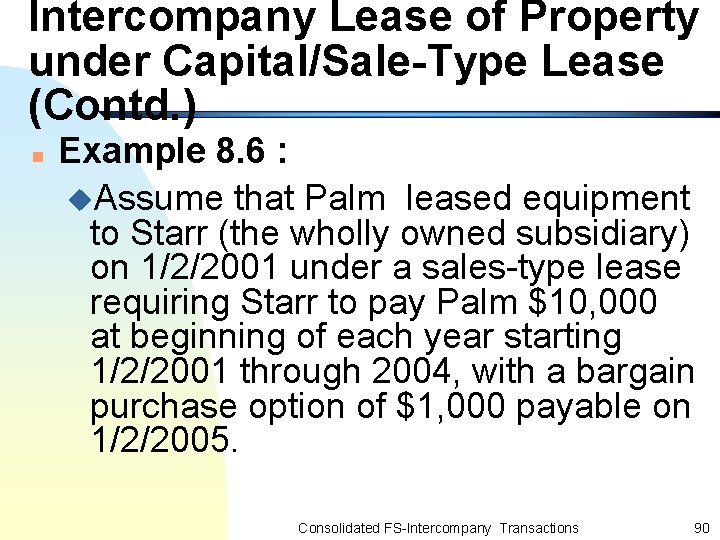
Intercompany Lease of Property under Capital/Sale-Type Lease (Contd. ) n Example 8. 6 : u. Assume that Palm leased equipment to Starr (the wholly owned subsidiary) on 1/2/2001 under a sales-type lease requiring Starr to pay Palm $10, 000 at beginning of each year starting 1/2/2001 through 2004, with a bargain purchase option of $1, 000 payable on 1/2/2005. Consolidated FS-Intercompany Transactions 90
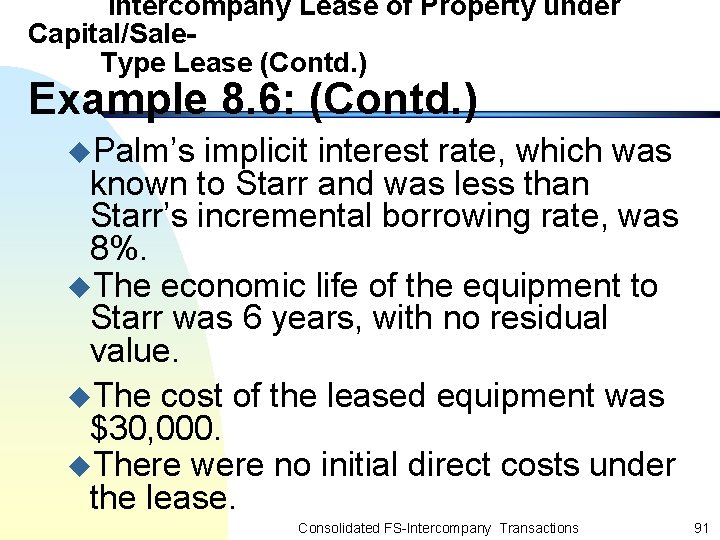
Intercompany Lease of Property under Capital/Sale. Type Lease (Contd. ) Example 8. 6: (Contd. ) u. Palm’s implicit interest rate, which was known to Starr and was less than Starr’s incremental borrowing rate, was 8%. u. The economic life of the equipment to Starr was 6 years, with no residual value. u. The cost of the leased equipment was $30, 000. u. There were no initial direct costs under the lease. Consolidated FS-Intercompany Transactions 91
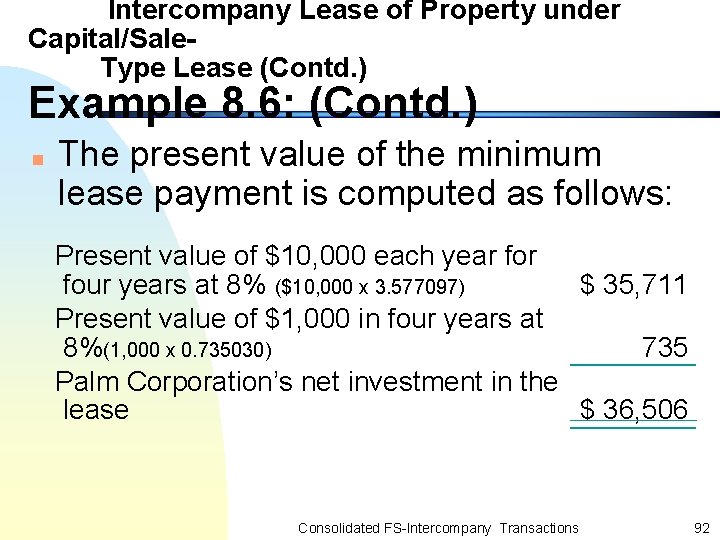
Intercompany Lease of Property under Capital/Sale. Type Lease (Contd. ) Example 8. 6: (Contd. ) n The present value of the minimum lease payment is computed as follows: Present value of $10, 000 each year four years at 8% ($10, 000 x 3. 577097) $ 35, 711 Present value of $1, 000 in four years at 8%(1, 000 x 0. 735030) 735 Palm Corporation’s net investment in the lease $ 36, 506 Consolidated FS-Intercompany Transactions 92
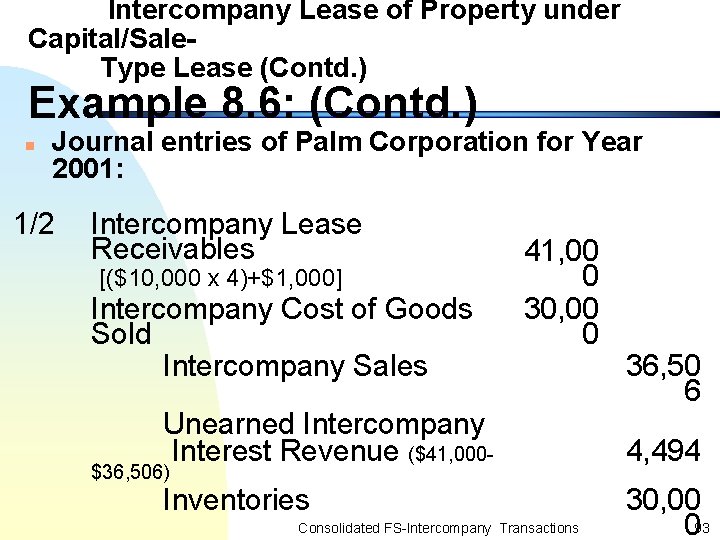
Intercompany Lease of Property under Capital/Sale. Type Lease (Contd. ) Example 8. 6: (Contd. ) n Journal entries of Palm Corporation for Year 2001: 1/2 Intercompany Lease Receivables [($10, 000 x 4)+$1, 000] Intercompany Cost of Goods Sold Intercompany Sales 41, 00 0 30, 00 0 Unearned Intercompany Interest Revenue ($41, 000 - $36, 506) Inventories Consolidated FS-Intercompany Transactions 36, 50 6 4, 494 30, 00 093
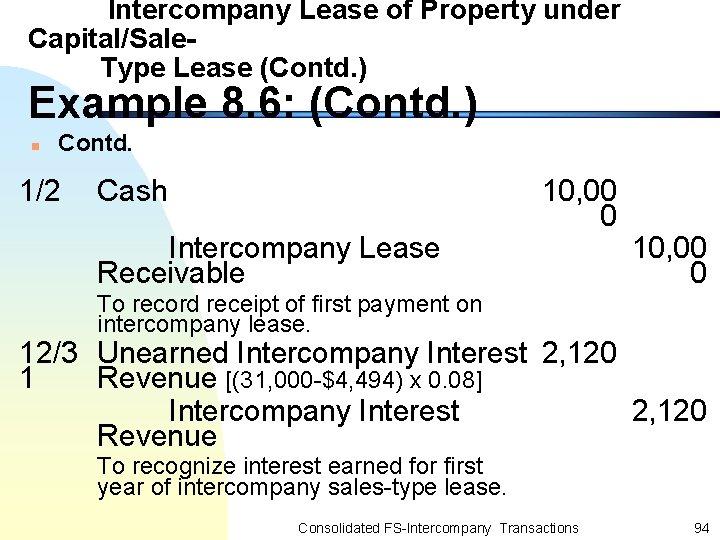
Intercompany Lease of Property under Capital/Sale. Type Lease (Contd. ) Example 8. 6: (Contd. ) n Contd. 1/2 Cash Intercompany Lease Receivable 10, 00 0 To record receipt of first payment on intercompany lease. 12/3 Unearned Intercompany Interest 2, 120 1 Revenue [(31, 000 -$4, 494) x 0. 08] Intercompany Interest 2, 120 Revenue To recognize interest earned for first year of intercompany sales-type lease. Consolidated FS-Intercompany Transactions 94
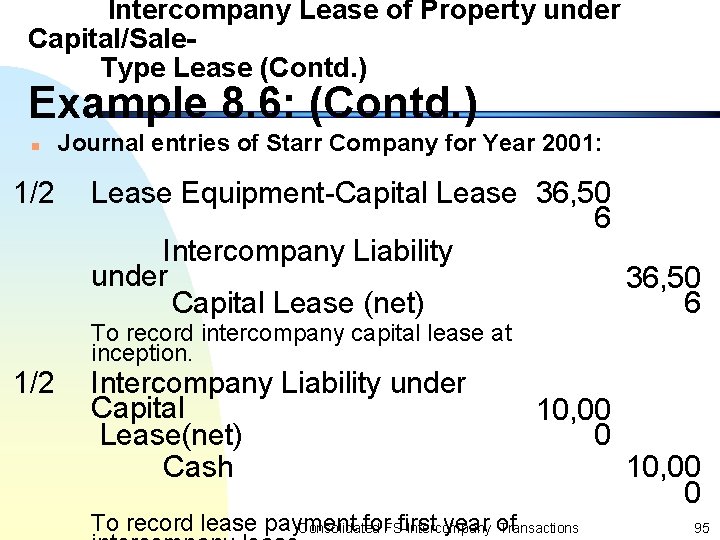
Intercompany Lease of Property under Capital/Sale. Type Lease (Contd. ) Example 8. 6: (Contd. ) n 1/2 Journal entries of Starr Company for Year 2001: Lease Equipment-Capital Lease 36, 50 6 Intercompany Liability under 36, 50 6 Capital Lease (net) To record intercompany capital lease at inception. Intercompany Liability under Capital Lease(net) Cash 10, 00 0 To record lease payment for first year of Consolidated FS-Intercompany Transactions 10, 00 0 95
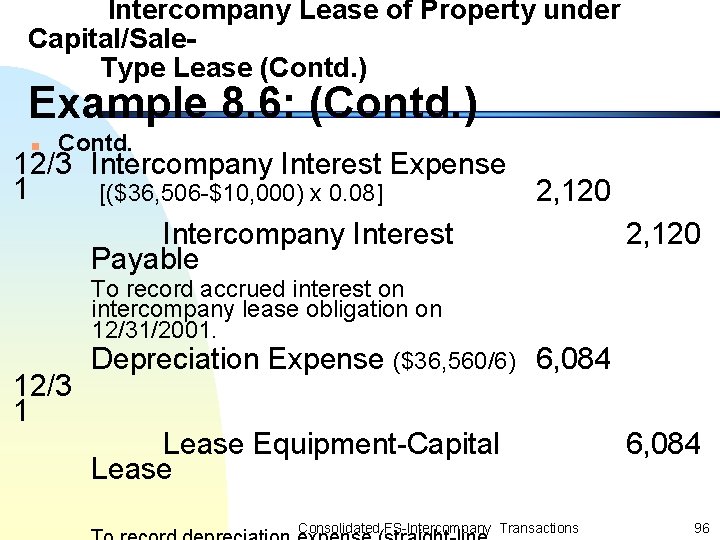
Intercompany Lease of Property under Capital/Sale. Type Lease (Contd. ) Example 8. 6: (Contd. ) n Contd. 12/3 Intercompany Interest Expense 1 2, 120 [($36, 506 -$10, 000) x 0. 08] Intercompany Interest 2, 120 Payable 12/3 1 To record accrued interest on intercompany lease obligation on 12/31/2001. Depreciation Expense ($36, 560/6) 6, 084 Lease Equipment-Capital Lease Consolidated FS-Intercompany Transactions 6, 084 96
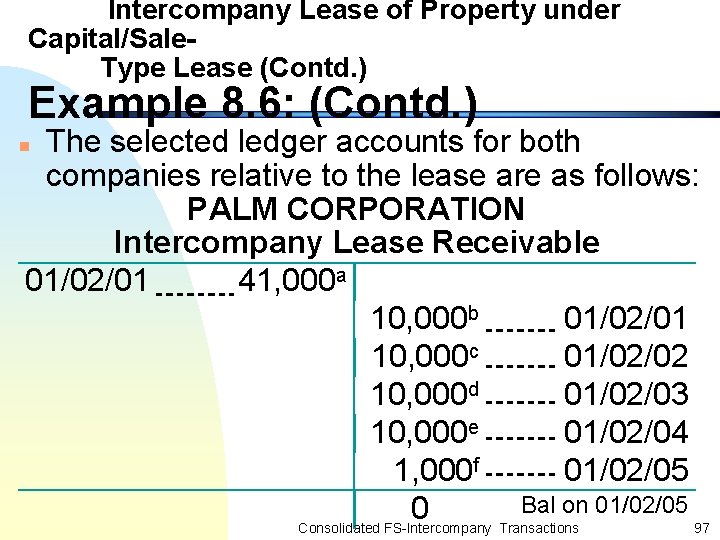
Intercompany Lease of Property under Capital/Sale. Type Lease (Contd. ) Example 8. 6: (Contd. ) The selected ledger accounts for both companies relative to the lease are as follows: PALM CORPORATION Intercompany Lease Receivable 01/02/01 41, 000 a 10, 000 b 01/02/01 10, 000 c 01/02/02 10, 000 d 01/02/03 10, 000 e 01/02/04 1, 000 f 01/02/05 Bal on 01/02/05 Consolidated FS-Intercompany Transactions 0 97 n
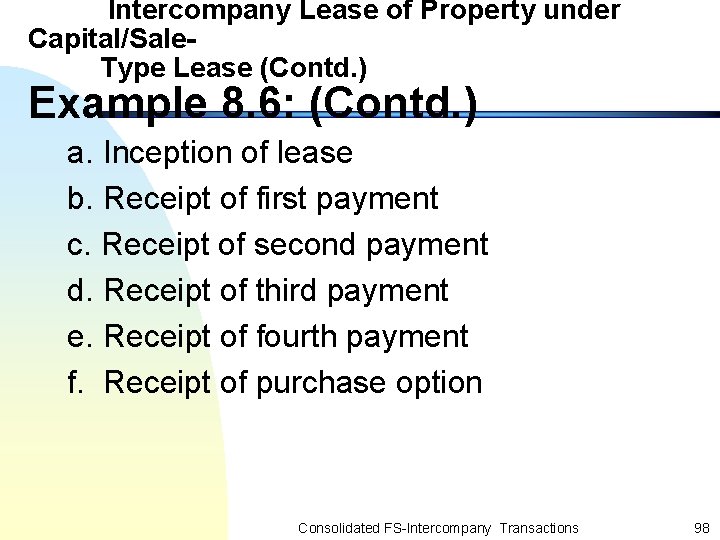
Intercompany Lease of Property under Capital/Sale. Type Lease (Contd. ) Example 8. 6: (Contd. ) a. Inception of lease b. Receipt of first payment c. Receipt of second payment d. Receipt of third payment e. Receipt of fourth payment f. Receipt of purchase option Consolidated FS-Intercompany Transactions 98
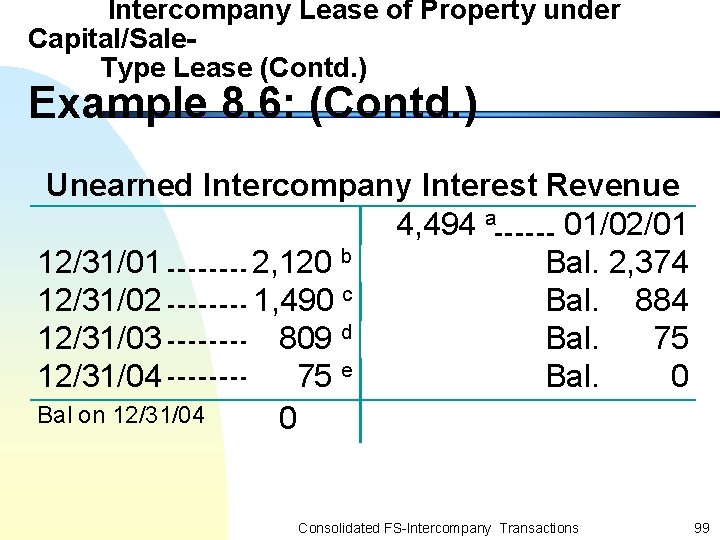
Intercompany Lease of Property under Capital/Sale. Type Lease (Contd. ) Example 8. 6: (Contd. ) Unearned Intercompany Interest Revenue 4, 494 a 01/02/01 12/31/01 2, 120 b Bal. 2, 374 12/31/02 1, 490 c Bal. 884 12/31/03 809 d Bal. 75 12/31/04 75 e Bal. 0 Bal on 12/31/04 0 Consolidated FS-Intercompany Transactions 99
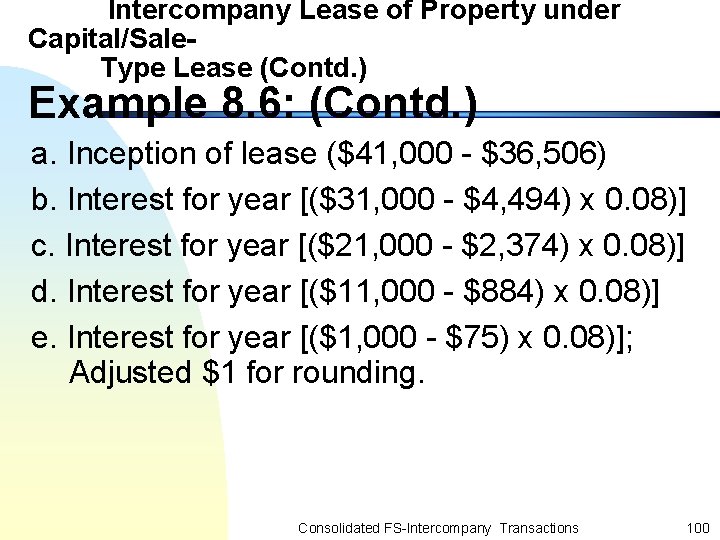
Intercompany Lease of Property under Capital/Sale. Type Lease (Contd. ) Example 8. 6: (Contd. ) a. Inception of lease ($41, 000 - $36, 506) b. Interest for year [($31, 000 - $4, 494) x 0. 08)] c. Interest for year [($21, 000 - $2, 374) x 0. 08)] d. Interest for year [($11, 000 - $884) x 0. 08)] e. Interest for year [($1, 000 - $75) x 0. 08)]; Adjusted $1 for rounding. Consolidated FS-Intercompany Transactions 100
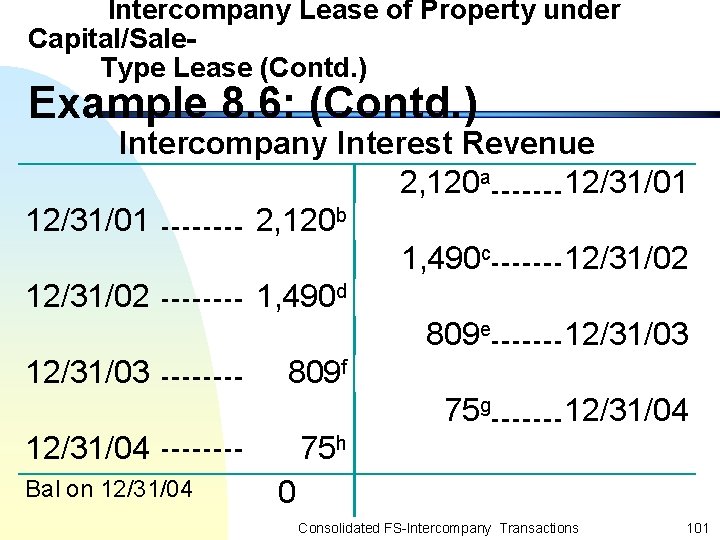
Intercompany Lease of Property under Capital/Sale. Type Lease (Contd. ) Example 8. 6: (Contd. ) Intercompany Interest Revenue 2, 120 a 12/31/01 2, 120 b 1, 490 c 12/31/02 1, 490 d 809 e 12/31/03 809 f 75 g 12/31/04 75 h Bal on 12/31/04 0 Consolidated FS-Intercompany Transactions 101
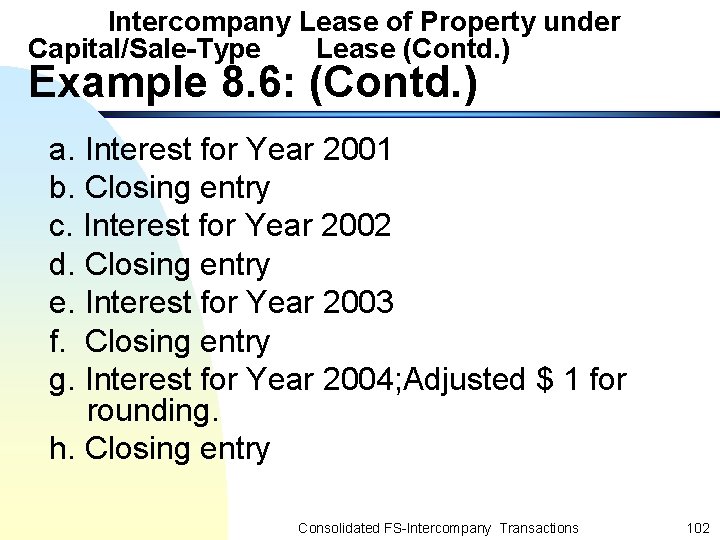
Intercompany Lease of Property under Capital/Sale-Type Lease (Contd. ) Example 8. 6: (Contd. ) a. Interest for Year 2001 b. Closing entry c. Interest for Year 2002 d. Closing entry e. Interest for Year 2003 f. Closing entry g. Interest for Year 2004; Adjusted $ 1 for rounding. h. Closing entry Consolidated FS-Intercompany Transactions 102
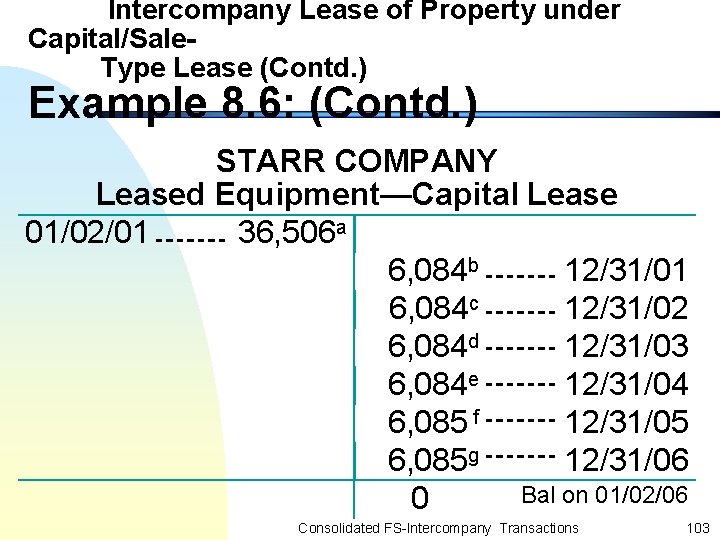
Intercompany Lease of Property under Capital/Sale. Type Lease (Contd. ) Example 8. 6: (Contd. ) STARR COMPANY Leased Equipment—Capital Lease 01/02/01 36, 506 a 6, 084 b 12/31/01 6, 084 c 12/31/02 6, 084 d 12/31/03 6, 084 e 12/31/04 6, 085 f 12/31/05 6, 085 g 12/31/06 Bal on 01/02/06 0 Consolidated FS-Intercompany Transactions 103
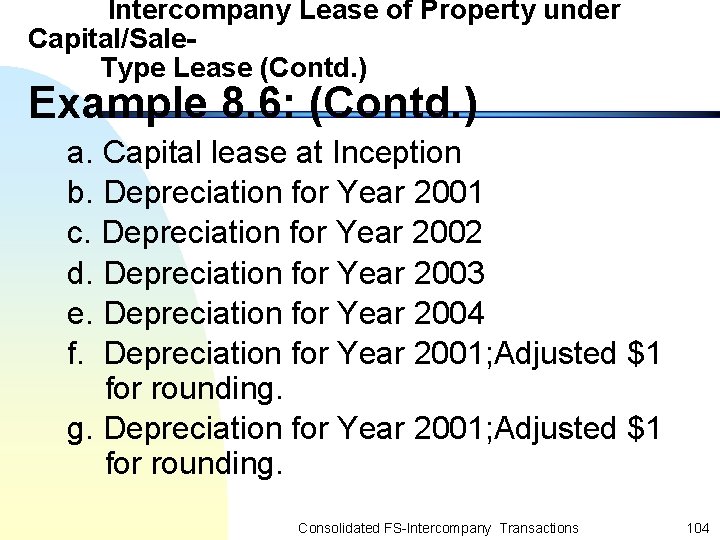
Intercompany Lease of Property under Capital/Sale. Type Lease (Contd. ) Example 8. 6: (Contd. ) a. Capital lease at Inception b. Depreciation for Year 2001 c. Depreciation for Year 2002 d. Depreciation for Year 2003 e. Depreciation for Year 2004 f. Depreciation for Year 2001; Adjusted $1 for rounding. g. Depreciation for Year 2001; Adjusted $1 for rounding. Consolidated FS-Intercompany Transactions 104
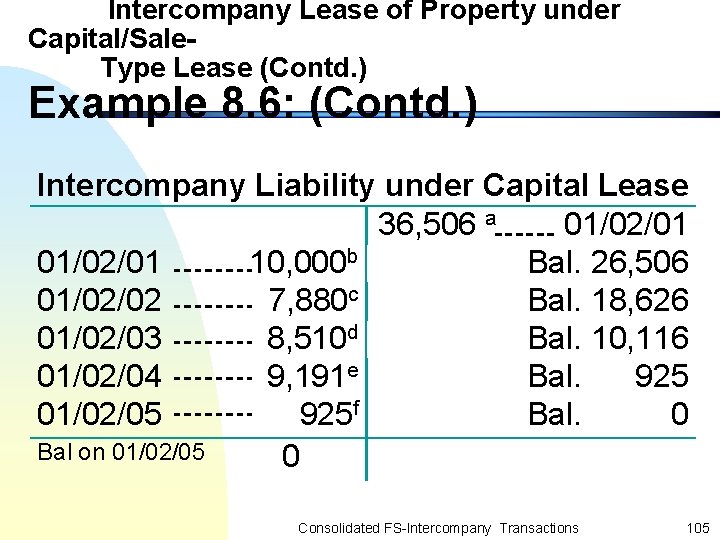
Intercompany Lease of Property under Capital/Sale. Type Lease (Contd. ) Example 8. 6: (Contd. ) Intercompany Liability under Capital Lease 36, 506 a 01/02/01 10, 000 b Bal. 26, 506 01/02/02 7, 880 c Bal. 18, 626 01/02/03 8, 510 d Bal. 10, 116 01/02/04 9, 191 e Bal. 925 01/02/05 925 f Bal. 0 Bal on 01/02/05 0 Consolidated FS-Intercompany Transactions 105
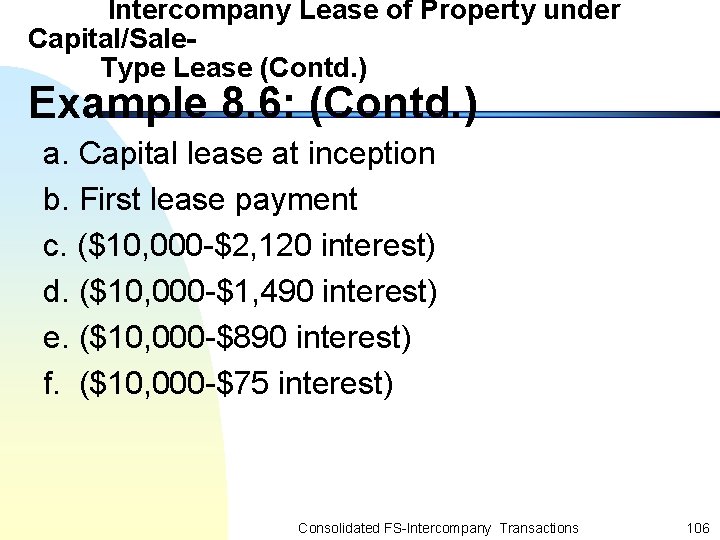
Intercompany Lease of Property under Capital/Sale. Type Lease (Contd. ) Example 8. 6: (Contd. ) a. Capital lease at inception b. First lease payment c. ($10, 000 -$2, 120 interest) d. ($10, 000 -$1, 490 interest) e. ($10, 000 -$890 interest) f. ($10, 000 -$75 interest) Consolidated FS-Intercompany Transactions 106
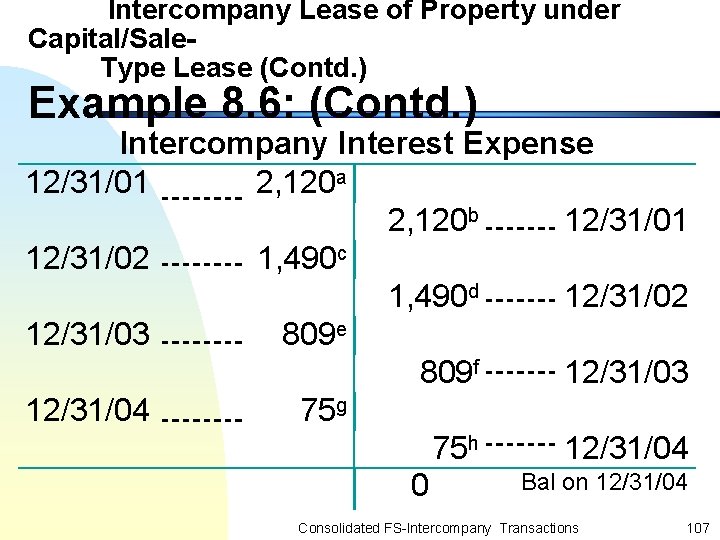
Intercompany Lease of Property under Capital/Sale. Type Lease (Contd. ) Example 8. 6: (Contd. ) Intercompany Interest Expense 12/31/01 2, 120 a 2, 120 b 12/31/01 12/31/02 1, 490 c 1, 490 d 12/31/02 12/31/03 809 e 809 f 12/31/03 12/31/04 75 g 75 h 12/31/04 Bal on 12/31/04 0 Consolidated FS-Intercompany Transactions 107
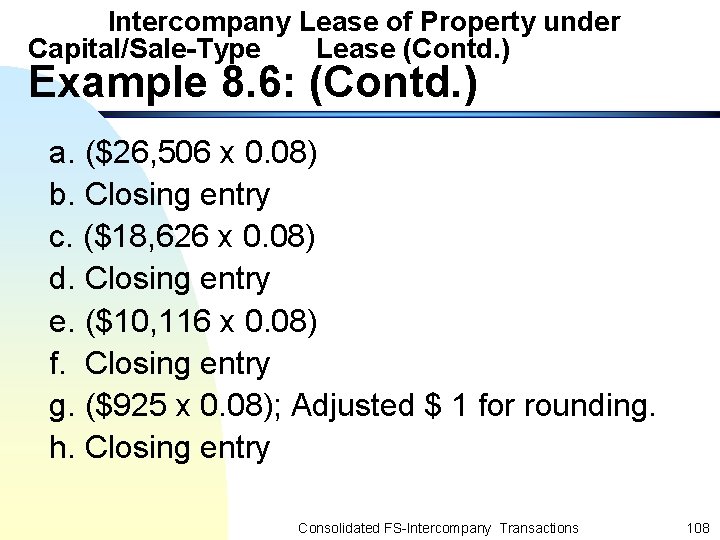
Intercompany Lease of Property under Capital/Sale-Type Lease (Contd. ) Example 8. 6: (Contd. ) a. ($26, 506 x 0. 08) b. Closing entry c. ($18, 626 x 0. 08) d. Closing entry e. ($10, 116 x 0. 08) f. Closing entry g. ($925 x 0. 08); Adjusted $ 1 for rounding. h. Closing entry Consolidated FS-Intercompany Transactions 108
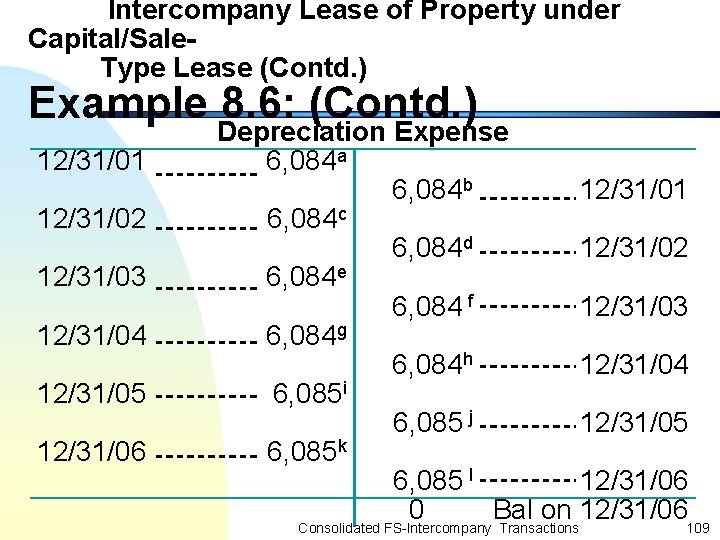
Intercompany Lease of Property under Capital/Sale. Type Lease (Contd. ) Example 8. 6: (Contd. ) 12/31/01 12/31/02 12/31/03 12/31/04 12/31/05 12/31/06 Depreciation Expense 6, 084 a 6, 084 b 12/31/01 6, 084 c 6, 084 d 12/31/02 6, 084 e 6, 084 f 12/31/03 6, 084 g 6, 084 h 12/31/04 6, 085 i 6, 085 j 12/31/05 6, 085 k 6, 085 l 12/31/06 0 Bal on 12/31/06 Consolidated FS-Intercompany Transactions 109
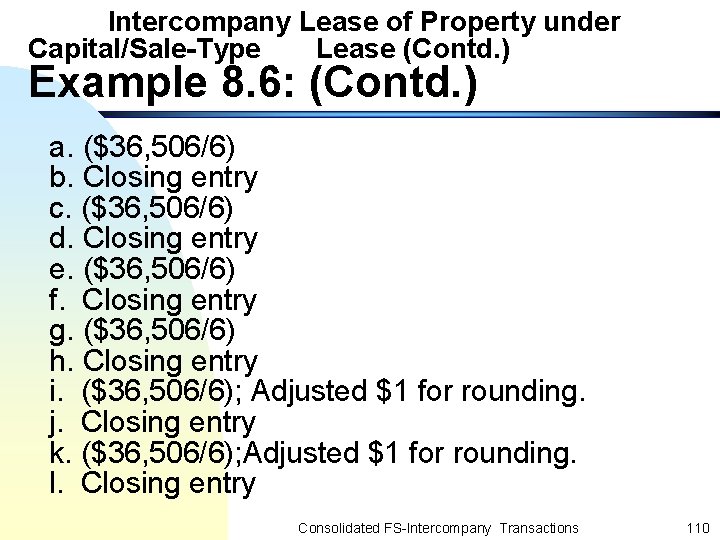
Intercompany Lease of Property under Capital/Sale-Type Lease (Contd. ) Example 8. 6: (Contd. ) a. ($36, 506/6) b. Closing entry c. ($36, 506/6) d. Closing entry e. ($36, 506/6) f. Closing entry g. ($36, 506/6) h. Closing entry i. ($36, 506/6); Adjusted $1 for rounding. j. Closing entry k. ($36, 506/6); Adjusted $1 for rounding. l. Closing entry Consolidated FS-Intercompany Transactions 110
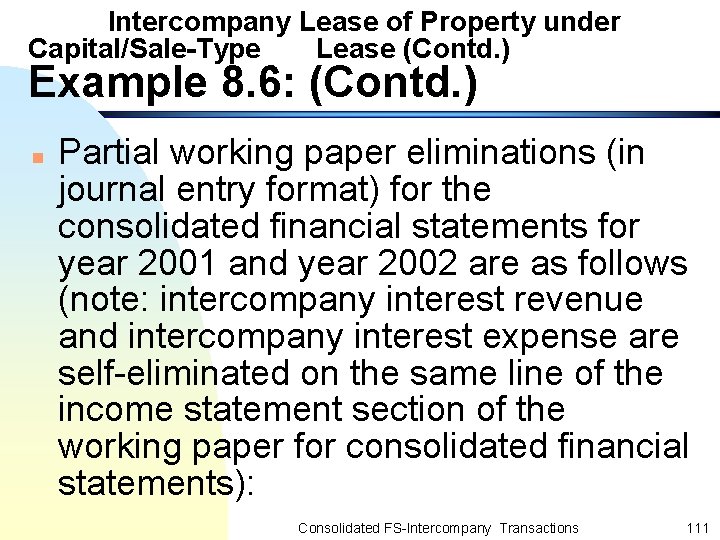
Intercompany Lease of Property under Capital/Sale-Type Lease (Contd. ) Example 8. 6: (Contd. ) n Partial working paper eliminations (in journal entry format) for the consolidated financial statements for year 2001 and year 2002 are as follows (note: intercompany interest revenue and intercompany interest expense are self-eliminated on the same line of the income statement section of the working paper for consolidated financial statements): Consolidated FS-Intercompany Transactions 111
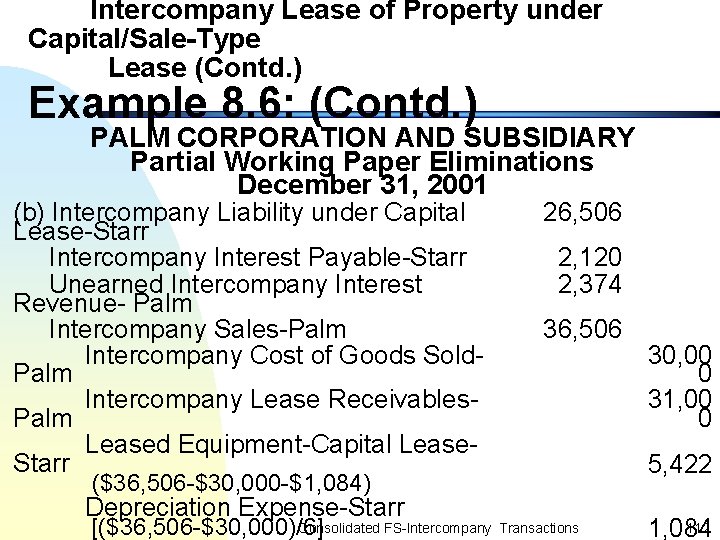
Intercompany Lease of Property under Capital/Sale-Type Lease (Contd. ) Example 8. 6: (Contd. ) PALM CORPORATION AND SUBSIDIARY Partial Working Paper Eliminations December 31, 2001 (b) Intercompany Liability under Capital Lease-Starr Intercompany Interest Payable-Starr Unearned Intercompany Interest Revenue- Palm Intercompany Sales-Palm Intercompany Cost of Goods Sold. Palm Intercompany Lease Receivables. Palm Leased Equipment-Capital Lease. Starr 26, 506 2, 120 2, 374 36, 506 ($36, 506 -$30, 000 -$1, 084) Depreciation Expense-Starr Consolidated FS-Intercompany Transactions [($36, 506 -$30, 000)/6] 30, 00 0 31, 00 0 5, 422 112 1, 084
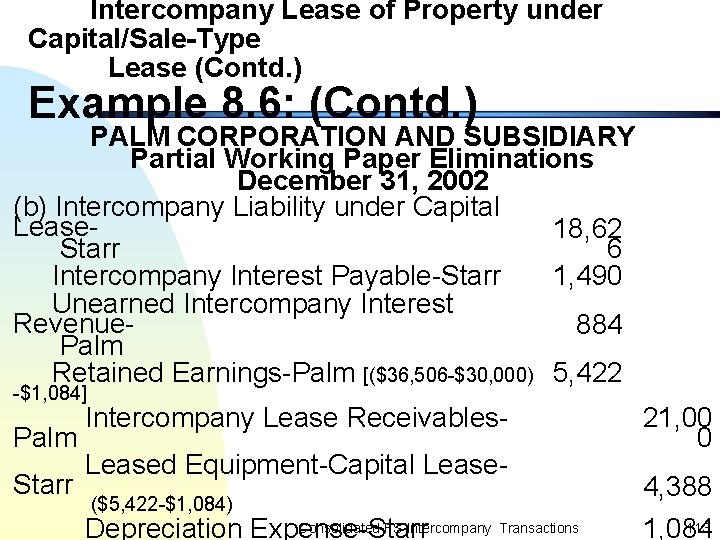
Intercompany Lease of Property under Capital/Sale-Type Lease (Contd. ) Example 8. 6: (Contd. ) PALM CORPORATION AND SUBSIDIARY Partial Working Paper Eliminations December 31, 2002 (b) Intercompany Liability under Capital Lease 18, 62 Starr 6 Intercompany Interest Payable-Starr 1, 490 Unearned Intercompany Interest Revenue 884 Palm Retained Earnings-Palm [($36, 506 -$30, 000) 5, 422 -$1, 084] Intercompany Lease Receivables. Palm Leased Equipment-Capital Lease. Starr ($5, 422 -$1, 084) Consolidated FS-Intercompany Transactions Depreciation Expense-Starr 21, 00 0 4, 388 113 1, 084
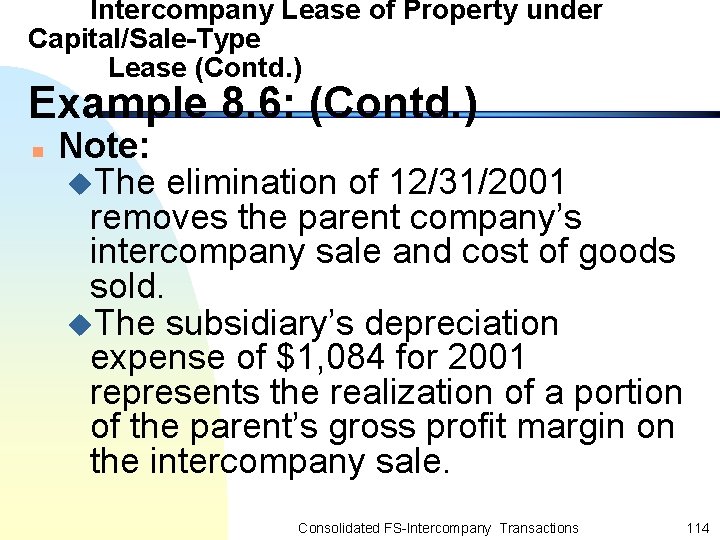
Intercompany Lease of Property under Capital/Sale-Type Lease (Contd. ) Example 8. 6: (Contd. ) n Note: u. The elimination of 12/31/2001 removes the parent company’s intercompany sale and cost of goods sold. u. The subsidiary’s depreciation expense of $1, 084 for 2001 represents the realization of a portion of the parent’s gross profit margin on the intercompany sale. Consolidated FS-Intercompany Transactions 114
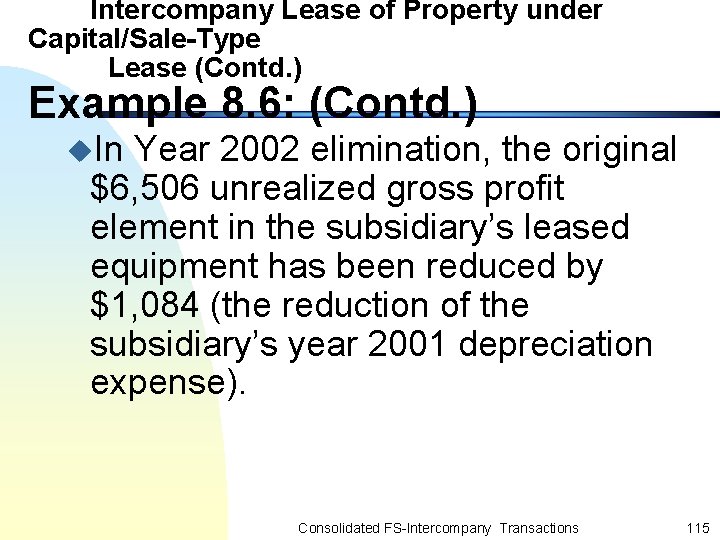
Intercompany Lease of Property under Capital/Sale-Type Lease (Contd. ) Example 8. 6: (Contd. ) u. In Year 2002 elimination, the original $6, 506 unrealized gross profit element in the subsidiary’s leased equipment has been reduced by $1, 084 (the reduction of the subsidiary’s year 2001 depreciation expense). Consolidated FS-Intercompany Transactions 115
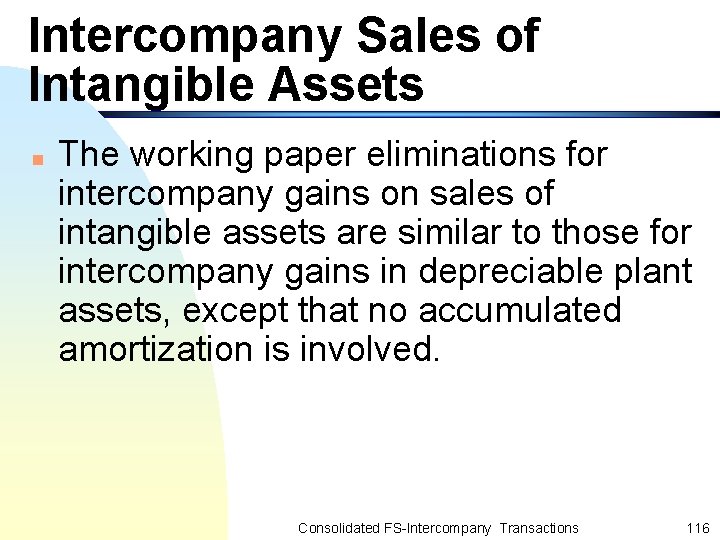
Intercompany Sales of Intangible Assets n The working paper eliminations for intercompany gains on sales of intangible assets are similar to those for intercompany gains in depreciable plant assets, except that no accumulated amortization is involved. Consolidated FS-Intercompany Transactions 116
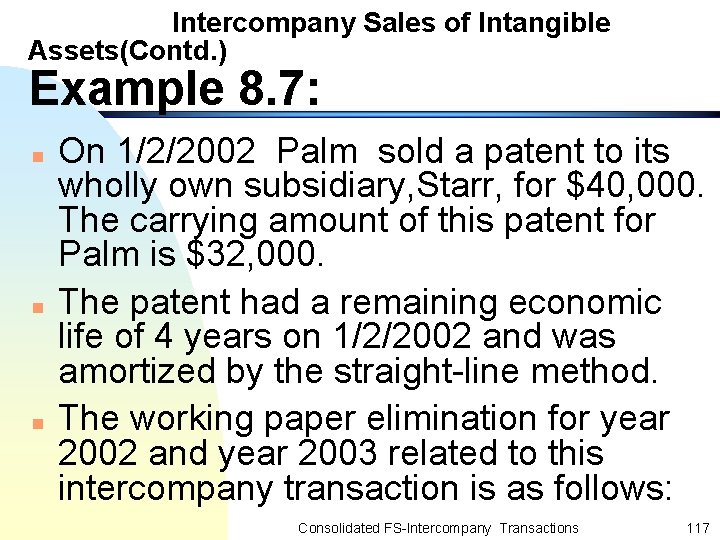
Intercompany Sales of Intangible Assets(Contd. ) Example 8. 7: n n n On 1/2/2002 Palm sold a patent to its wholly own subsidiary, Starr, for $40, 000. The carrying amount of this patent for Palm is $32, 000. The patent had a remaining economic life of 4 years on 1/2/2002 and was amortized by the straight-line method. The working paper elimination for year 2002 and year 2003 related to this intercompany transaction is as follows: Consolidated FS-Intercompany Transactions 117
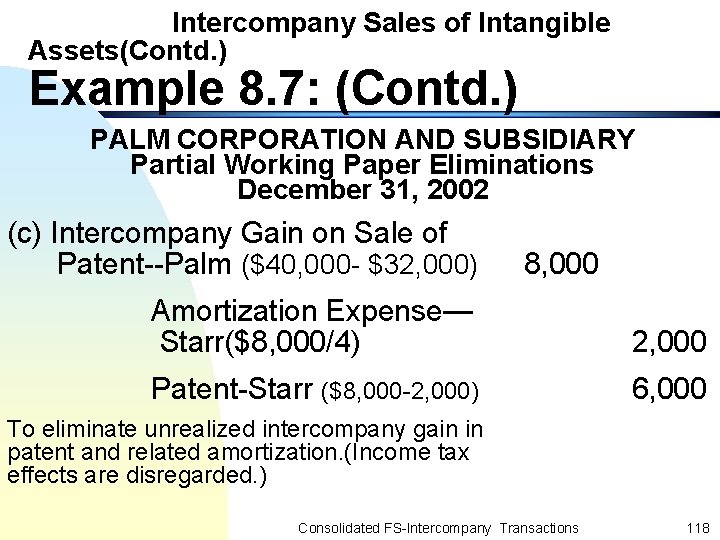
Intercompany Sales of Intangible Assets(Contd. ) Example 8. 7: (Contd. ) PALM CORPORATION AND SUBSIDIARY Partial Working Paper Eliminations December 31, 2002 (c) Intercompany Gain on Sale of Patent--Palm ($40, 000 - $32, 000) 8, 000 Amortization Expense— Starr($8, 000/4) 2, 000 Patent-Starr ($8, 000 -2, 000) 6, 000 To eliminate unrealized intercompany gain in patent and related amortization. (Income tax effects are disregarded. ) Consolidated FS-Intercompany Transactions 118
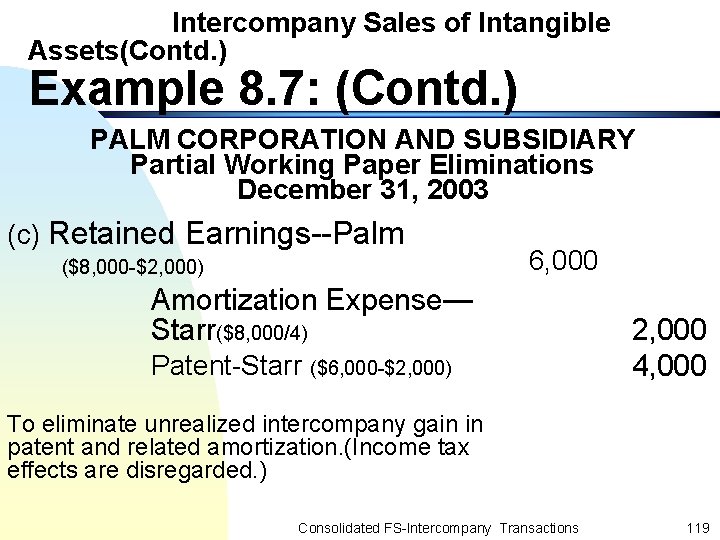
Intercompany Sales of Intangible Assets(Contd. ) Example 8. 7: (Contd. ) PALM CORPORATION AND SUBSIDIARY Partial Working Paper Eliminations December 31, 2003 (c) Retained Earnings--Palm ($8, 000 -$2, 000) 6, 000 Amortization Expense— Starr($8, 000/4) Patent-Starr ($6, 000 -$2, 000) 2, 000 4, 000 To eliminate unrealized intercompany gain in patent and related amortization. (Income tax effects are disregarded. ) Consolidated FS-Intercompany Transactions 119
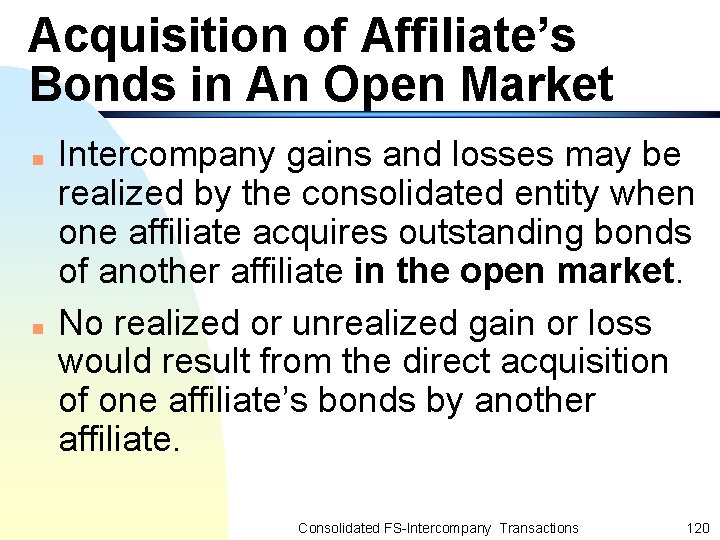
Acquisition of Affiliate’s Bonds in An Open Market n n Intercompany gains and losses may be realized by the consolidated entity when one affiliate acquires outstanding bonds of another affiliate in the open market. No realized or unrealized gain or loss would result from the direct acquisition of one affiliate’s bonds by another affiliate. Consolidated FS-Intercompany Transactions 120
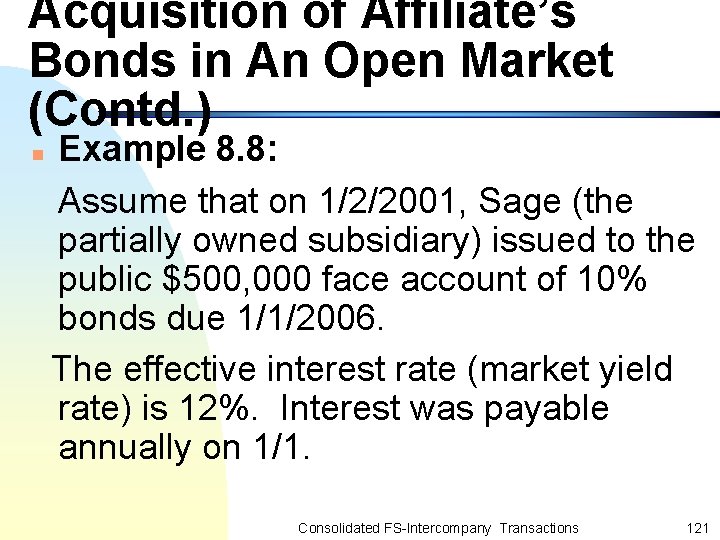
Acquisition of Affiliate’s Bonds in An Open Market (Contd. ) Example 8. 8: Assume that on 1/2/2001, Sage (the partially owned subsidiary) issued to the public $500, 000 face account of 10% bonds due 1/1/2006. The effective interest rate (market yield rate) is 12%. Interest was payable annually on 1/1. n Consolidated FS-Intercompany Transactions 121
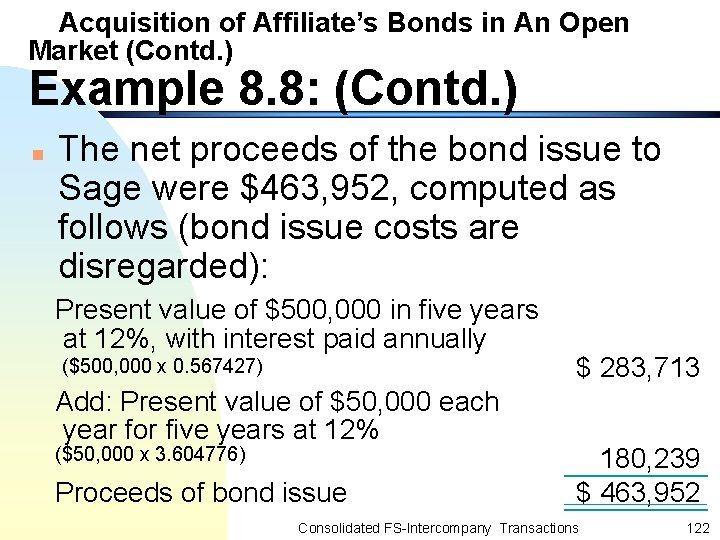
Acquisition of Affiliate’s Bonds in An Open Market (Contd. ) Example 8. 8: (Contd. ) n The net proceeds of the bond issue to Sage were $463, 952, computed as follows (bond issue costs are disregarded): Present value of $500, 000 in five years at 12%, with interest paid annually ($500, 000 x 0. 567427) Add: Present value of $50, 000 each year for five years at 12% ($50, 000 x 3. 604776) Proceeds of bond issue $ 283, 713 180, 239 $ 463, 952 Consolidated FS-Intercompany Transactions 122
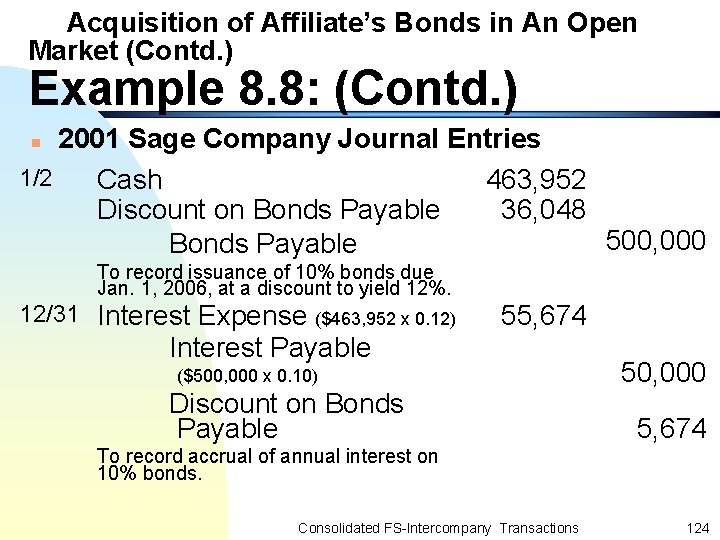
Acquisition of Affiliate’s Bonds in An Open Market (Contd. ) Example 8. 8: (Contd. ) n The following entries were recorded by Sage for year 2001 regarding the issuance of the bond and the accrued interest: Consolidated FS-Intercompany Transactions 123
Acquisition of Affiliate’s Bonds in An Open Market (Contd. ) Example 8. 8: (Contd. ) 2001 Sage Company Journal Entries 1/2 Cash 463, 952 Discount on Bonds Payable 36, 048 500, 000 Bonds Payable n To record issuance of 10% bonds due Jan. 1, 2006, at a discount to yield 12%. 12/31 Interest Expense ($463, 952 x 0. 12) 55, 674 Interest Payable ($500, 000 x 0. 10) Discount on Bonds Payable 50, 000 5, 674 To record accrual of annual interest on 10% bonds. Consolidated FS-Intercompany Transactions 124
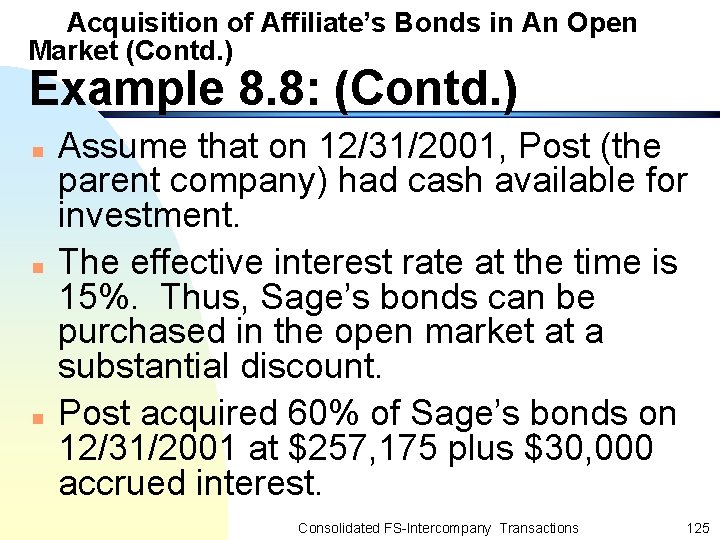
Acquisition of Affiliate’s Bonds in An Open Market (Contd. ) Example 8. 8: (Contd. ) n n n Assume that on 12/31/2001, Post (the parent company) had cash available for investment. The effective interest rate at the time is 15%. Thus, Sage’s bonds can be purchased in the open market at a substantial discount. Post acquired 60% of Sage’s bonds on 12/31/2001 at $257, 175 plus $30, 000 accrued interest. Consolidated FS-Intercompany Transactions 125
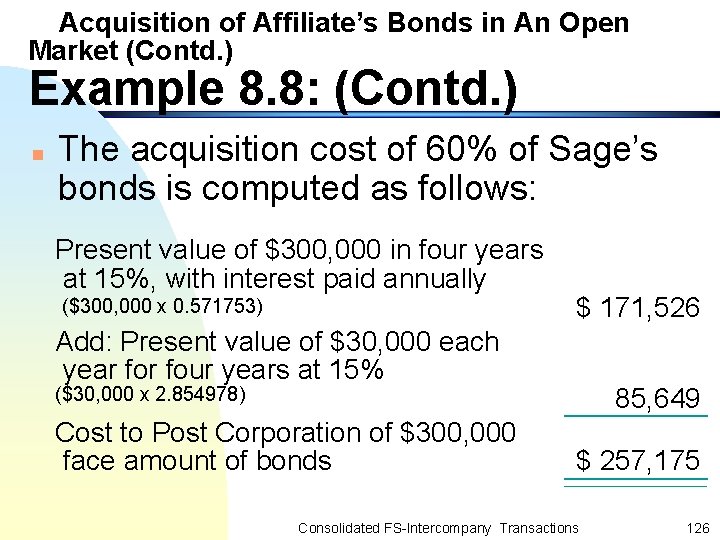
Acquisition of Affiliate’s Bonds in An Open Market (Contd. ) Example 8. 8: (Contd. ) n The acquisition cost of 60% of Sage’s bonds is computed as follows: Present value of $300, 000 in four years at 15%, with interest paid annually ($300, 000 x 0. 571753) $ 171, 526 Add: Present value of $30, 000 each year four years at 15% 85, 649 ($30, 000 x 2. 854978) Cost to Post Corporation of $300, 000 face amount of bonds $ 257, 175 Consolidated FS-Intercompany Transactions 126
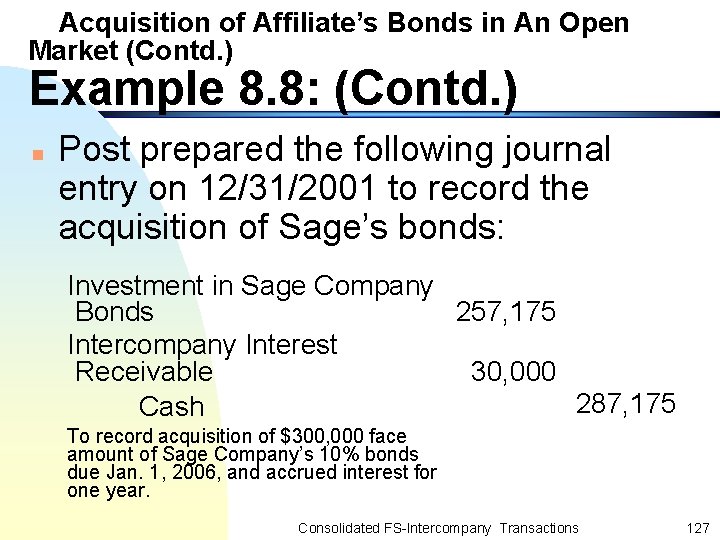
Acquisition of Affiliate’s Bonds in An Open Market (Contd. ) Example 8. 8: (Contd. ) n Post prepared the following journal entry on 12/31/2001 to record the acquisition of Sage’s bonds: Investment in Sage Company Bonds 257, 175 Intercompany Interest Receivable 30, 000 287, 175 Cash To record acquisition of $300, 000 face amount of Sage Company’s 10% bonds due Jan. 1, 2006, and accrued interest for one year. Consolidated FS-Intercompany Transactions 127
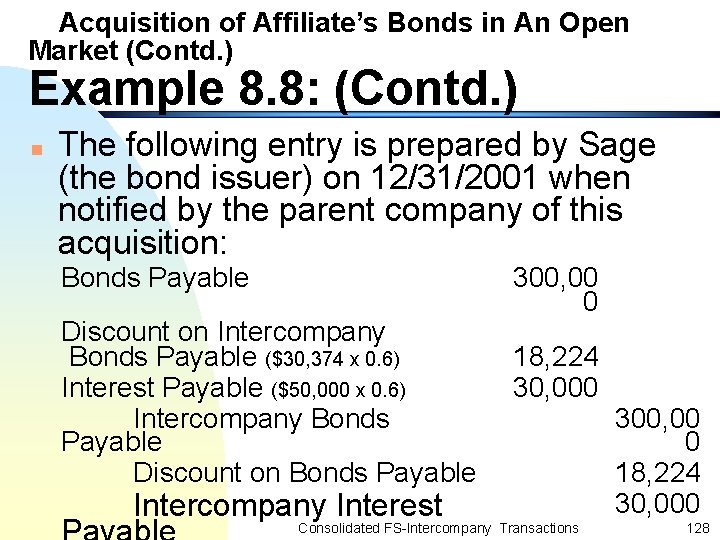
Acquisition of Affiliate’s Bonds in An Open Market (Contd. ) Example 8. 8: (Contd. ) n The following entry is prepared by Sage (the bond issuer) on 12/31/2001 when notified by the parent company of this acquisition: Bonds Payable Discount on Intercompany Bonds Payable ($30, 374 x 0. 6) Interest Payable ($50, 000 x 0. 6) Intercompany Bonds Payable Discount on Bonds Payable Intercompany Interest 300, 00 0 18, 224 30, 000 Consolidated FS-Intercompany Transactions 300, 00 0 18, 224 30, 000 128
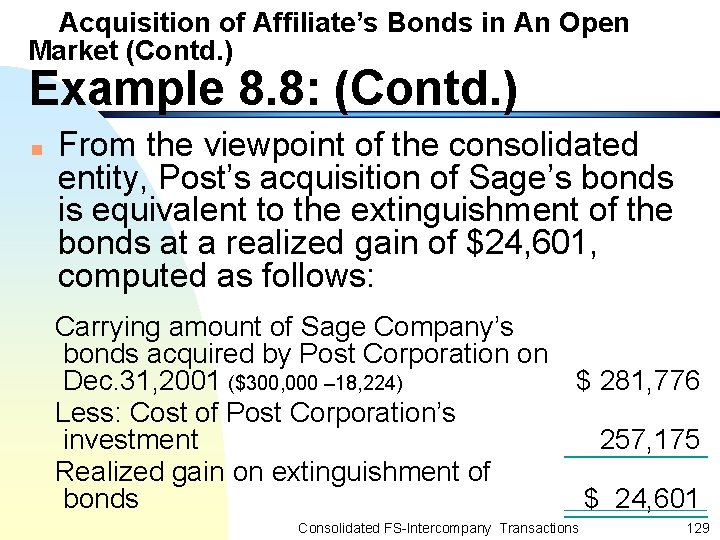
Acquisition of Affiliate’s Bonds in An Open Market (Contd. ) Example 8. 8: (Contd. ) n From the viewpoint of the consolidated entity, Post’s acquisition of Sage’s bonds is equivalent to the extinguishment of the bonds at a realized gain of $24, 601, computed as follows: Carrying amount of Sage Company’s bonds acquired by Post Corporation on Dec. 31, 2001 ($300, 000 – 18, 224) $ 281, 776 Less: Cost of Post Corporation’s investment 257, 175 Realized gain on extinguishment of bonds $ 24, 601 Consolidated FS-Intercompany Transactions 129
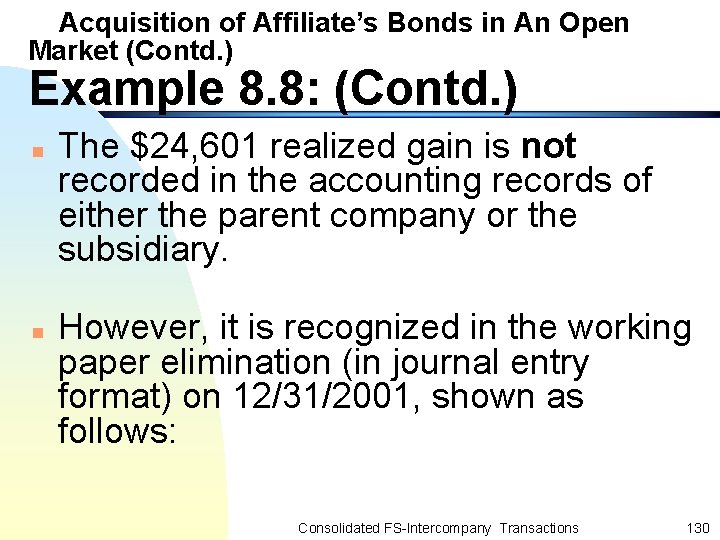
Acquisition of Affiliate’s Bonds in An Open Market (Contd. ) Example 8. 8: (Contd. ) n n The $24, 601 realized gain is not recorded in the accounting records of either the parent company or the subsidiary. However, it is recognized in the working paper elimination (in journal entry format) on 12/31/2001, shown as follows: Consolidated FS-Intercompany Transactions 130
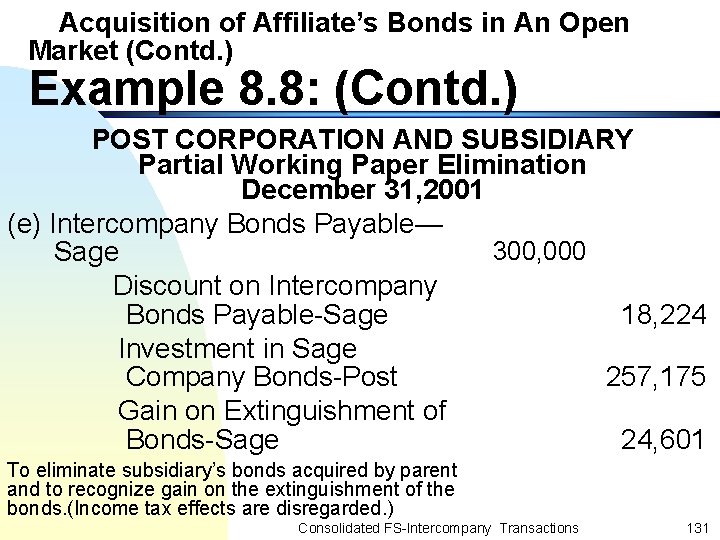
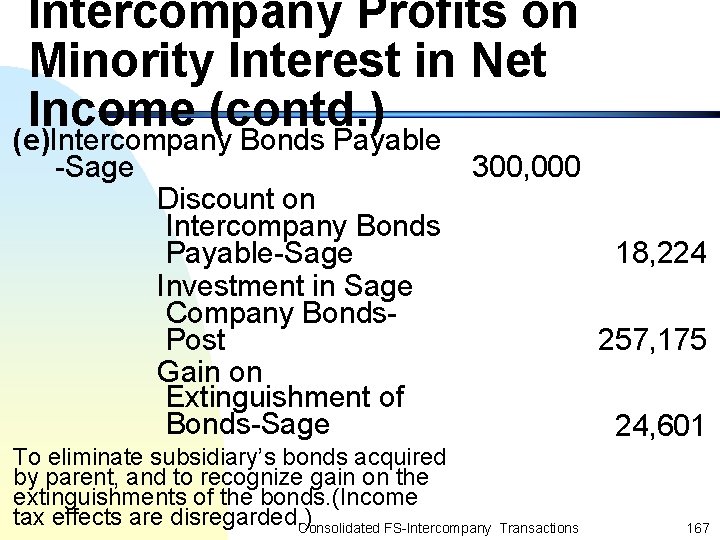
Acquisition of Affiliate’s Bonds in An Open Market (Contd. ) Example 8. 8: (Contd. ) POST CORPORATION AND SUBSIDIARY Partial Working Paper Elimination December 31, 2001 (e) Intercompany Bonds Payable— 300, 000 Sage Discount on Intercompany Bonds Payable-Sage 18, 224 Investment in Sage Company Bonds-Post 257, 175 Gain on Extinguishment of Bonds-Sage 24, 601 To eliminate subsidiary’s bonds acquired by parent and to recognize gain on the extinguishment of the bonds. (Income tax effects are disregarded. ) Consolidated FS-Intercompany Transactions 131
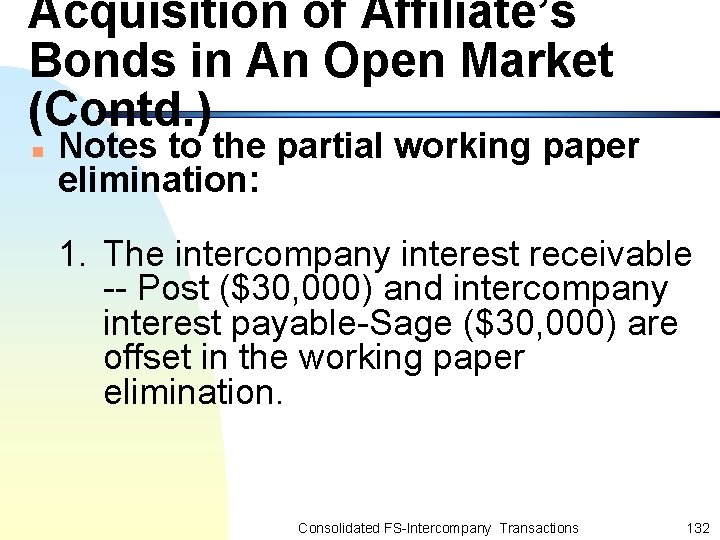
Acquisition of Affiliate’s Bonds in An Open Market (Contd. ) n Notes to the partial working paper elimination: 1. The intercompany interest receivable -- Post ($30, 000) and intercompany interest payable-Sage ($30, 000) are offset in the working paper elimination. Consolidated FS-Intercompany Transactions 132
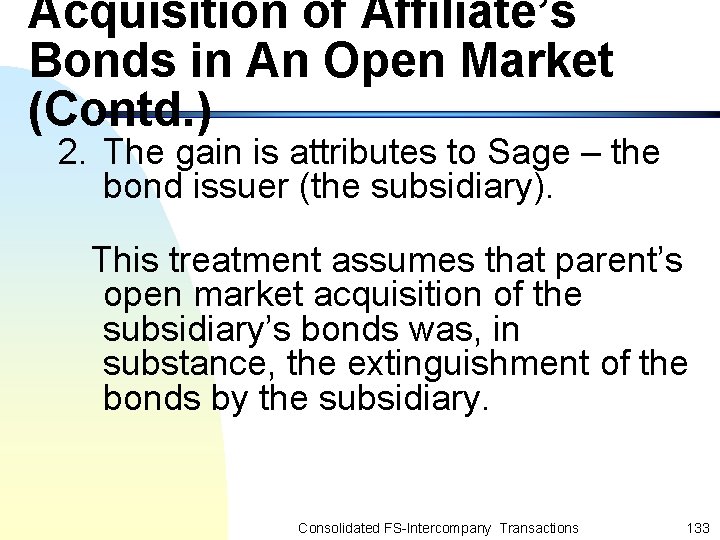
Acquisition of Affiliate’s Bonds in An Open Market (Contd. ) 2. The gain is attributes to Sage – the bond issuer (the subsidiary). This treatment assumes that parent’s open market acquisition of the subsidiary’s bonds was, in substance, the extinguishment of the bonds by the subsidiary. Consolidated FS-Intercompany Transactions 133
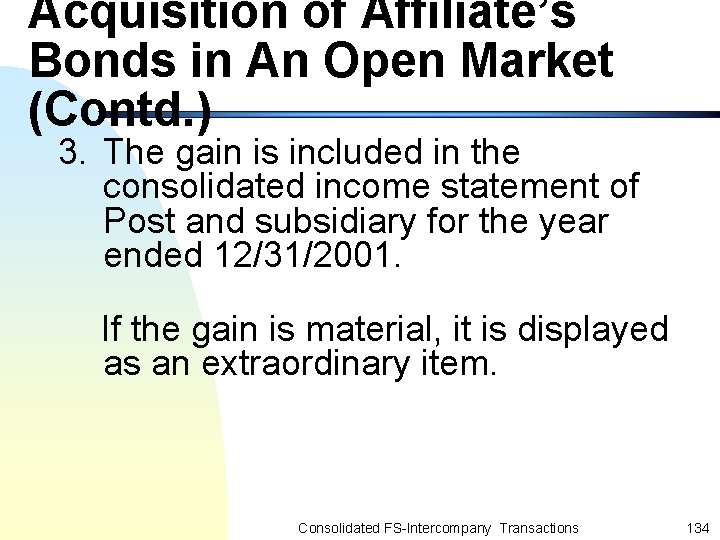
Acquisition of Affiliate’s Bonds in An Open Market (Contd. ) 3. The gain is included in the consolidated income statement of Post and subsidiary for the year ended 12/31/2001. If the gain is material, it is displayed as an extraordinary item. Consolidated FS-Intercompany Transactions 134
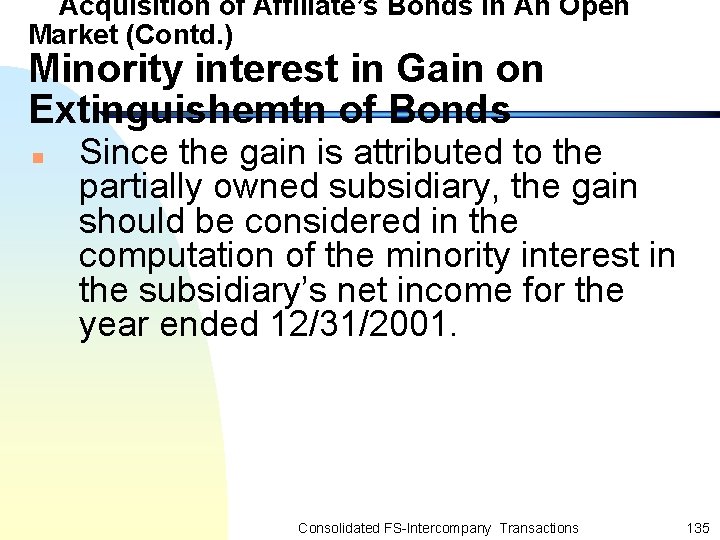
Acquisition of Affiliate’s Bonds in An Open Market (Contd. ) Minority interest in Gain on Extinguishemtn of Bonds n Since the gain is attributed to the partially owned subsidiary, the gain should be considered in the computation of the minority interest in the subsidiary’s net income for the year ended 12/31/2001. Consolidated FS-Intercompany Transactions 135
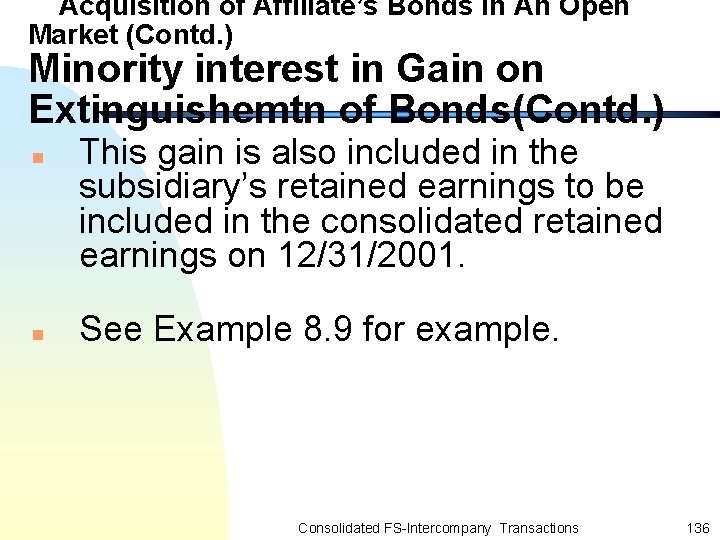
Acquisition of Affiliate’s Bonds in An Open Market (Contd. ) Minority interest in Gain on Extinguishemtn of Bonds(Contd. ) n n This gain is also included in the subsidiary’s retained earnings to be included in the consolidated retained earnings on 12/31/2001. See Example 8. 9 for example. Consolidated FS-Intercompany Transactions 136
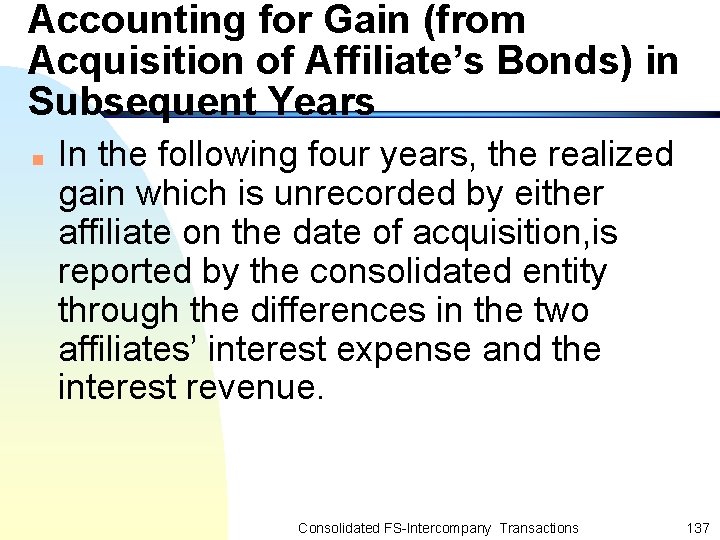
Accounting for Gain (from Acquisition of Affiliate’s Bonds) in Subsequent Years n In the following four years, the realized gain which is unrecorded by either affiliate on the date of acquisition, is reported by the consolidated entity through the differences in the two affiliates’ interest expense and the interest revenue. Consolidated FS-Intercompany Transactions 137
Accounting for Gain (from Acquisition of Affiliate’s Bonds) in Subsequent Years (Contd. ) n The accounting for the bond interest by the two affiliates for the year ended 12/31/2002 and related ledger accounts for four remaining years for both companies are as follows: Consolidated FS-Intercompany Transactions 138
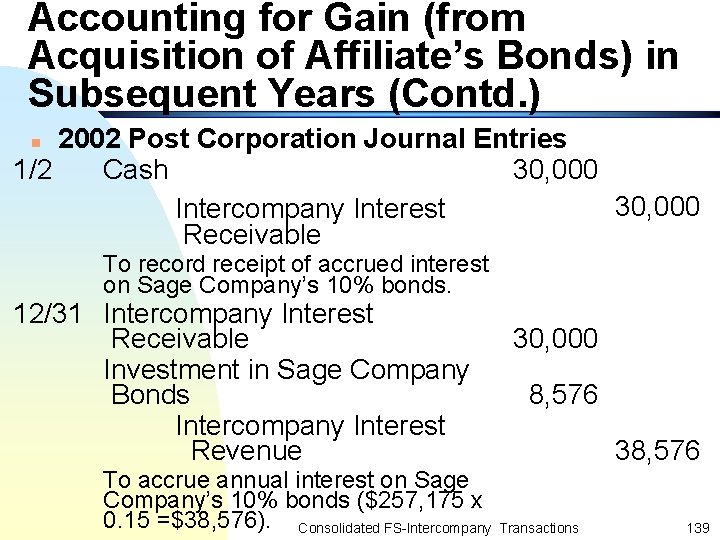
Accounting for Gain (from Acquisition of Affiliate’s Bonds) in Subsequent Years (Contd. ) 2002 Post Corporation Journal Entries 1/2 Cash 30, 000 Intercompany Interest 30, 000 Receivable n To record receipt of accrued interest on Sage Company’s 10% bonds. 12/31 Intercompany Interest Receivable Investment in Sage Company Bonds Intercompany Interest Revenue 30, 000 8, 576 To accrue annual interest on Sage Company’s 10% bonds ($257, 175 x 0. 15 =$38, 576). Consolidated FS-Intercompany Transactions 38, 576 139
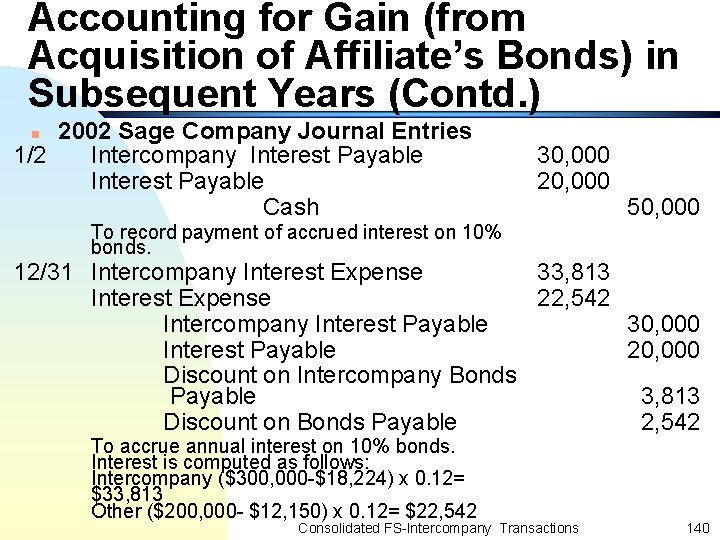
Accounting for Gain (from Acquisition of Affiliate’s Bonds) in Subsequent Years (Contd. ) 2002 Sage Company Journal Entries 1/2 Intercompany Interest Payable 30, 000 Interest Payable 20, 000 Cash 50, 000 n To record payment of accrued interest on 10% bonds. 12/31 Intercompany Interest Expense 33, 813 Interest Expense 22, 542 Intercompany Interest Payable 30, 000 Interest Payable 20, 000 Discount on Intercompany Bonds Payable 3, 813 Discount on Bonds Payable 2, 542 To accrue annual interest on 10% bonds. Interest is computed as follows: Intercompany ($300, 000 -$18, 224) x 0. 12= $33, 813 Other ($200, 000 - $12, 150) x 0. 12= $22, 542 Consolidated FS-Intercompany Transactions 140
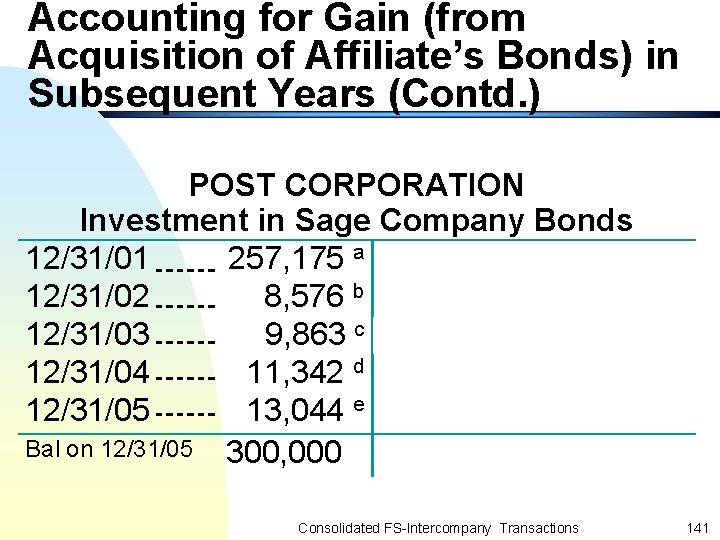
Accounting for Gain (from Acquisition of Affiliate’s Bonds) in Subsequent Years (Contd. ) POST CORPORATION Investment in Sage Company Bonds 12/31/01 257, 175 a 12/31/02 8, 576 b 12/31/03 9, 863 c 12/31/04 11, 342 d 12/31/05 13, 044 e Bal on 12/31/05 300, 000 Consolidated FS-Intercompany Transactions 141
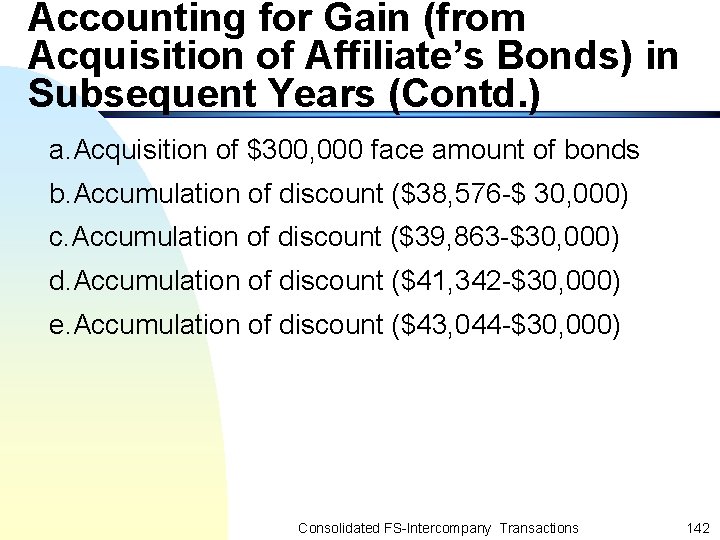
Accounting for Gain (from Acquisition of Affiliate’s Bonds) in Subsequent Years (Contd. ) a. Acquisition of $300, 000 face amount of bonds b. Accumulation of discount ($38, 576 -$ 30, 000) c. Accumulation of discount ($39, 863 -$30, 000) d. Accumulation of discount ($41, 342 -$30, 000) e. Accumulation of discount ($43, 044 -$30, 000) Consolidated FS-Intercompany Transactions 142
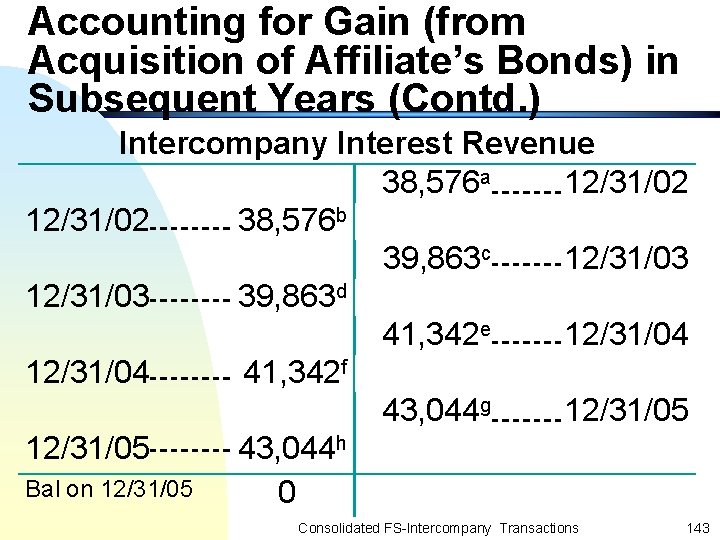
Accounting for Gain (from Acquisition of Affiliate’s Bonds) in Subsequent Years (Contd. ) Intercompany Interest Revenue 38, 576 a 12/31/02 38, 576 b 39, 863 c 12/31/03 39, 863 d 41, 342 e 12/31/04 41, 342 f 43, 044 g 12/31/05 43, 044 h Bal on 12/31/05 0 Consolidated FS-Intercompany Transactions 143
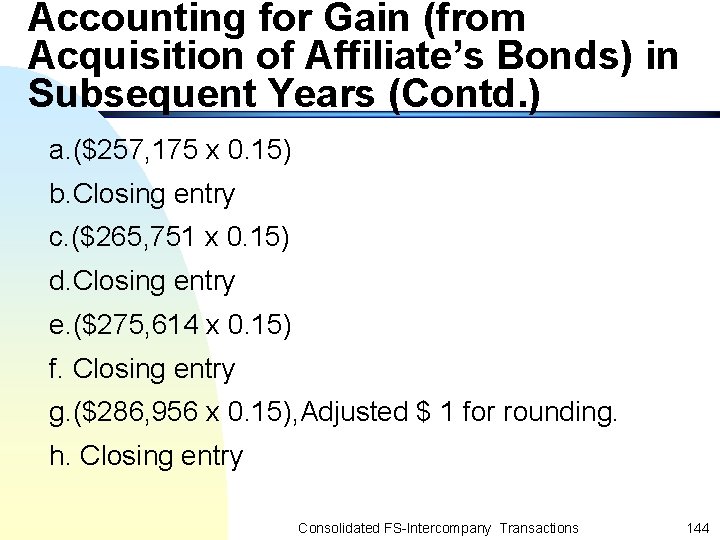
Accounting for Gain (from Acquisition of Affiliate’s Bonds) in Subsequent Years (Contd. ) a. ($257, 175 x 0. 15) b. Closing entry c. ($265, 751 x 0. 15) d. Closing entry e. ($275, 614 x 0. 15) f. Closing entry g. ($286, 956 x 0. 15), Adjusted $ 1 for rounding. h. Closing entry Consolidated FS-Intercompany Transactions 144
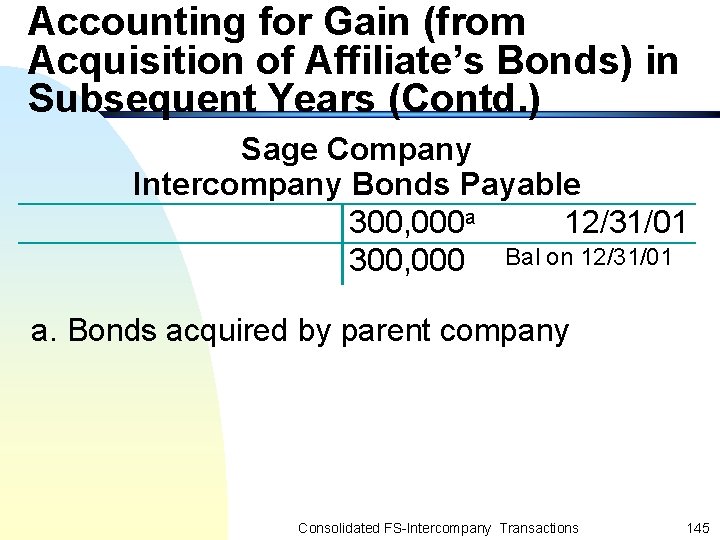
Accounting for Gain (from Acquisition of Affiliate’s Bonds) in Subsequent Years (Contd. ) Sage Company Intercompany Bonds Payable 300, 000 a 12/31/01 300, 000 Bal on 12/31/01 a. Bonds acquired by parent company Consolidated FS-Intercompany Transactions 145
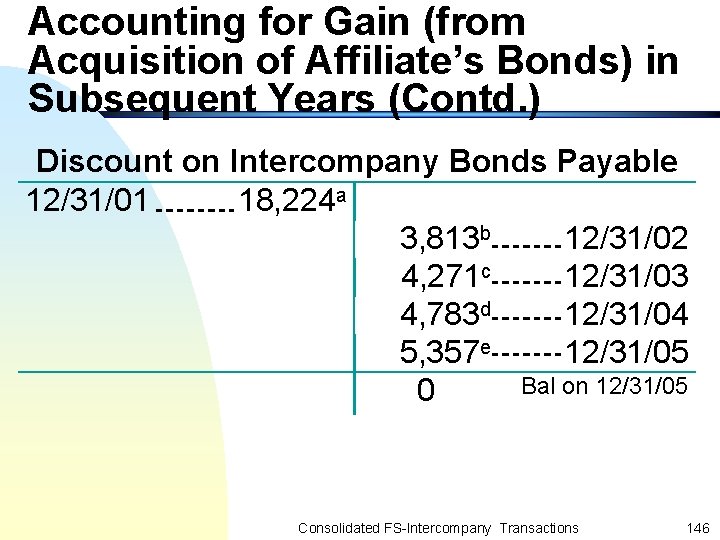
Accounting for Gain (from Acquisition of Affiliate’s Bonds) in Subsequent Years (Contd. ) Discount on Intercompany Bonds Payable 12/31/01 18, 224 a 3, 813 b 12/31/02 4, 271 c 12/31/03 4, 783 d 12/31/04 5, 357 e 12/31/05 Bal on 12/31/05 0 Consolidated FS-Intercompany Transactions 146
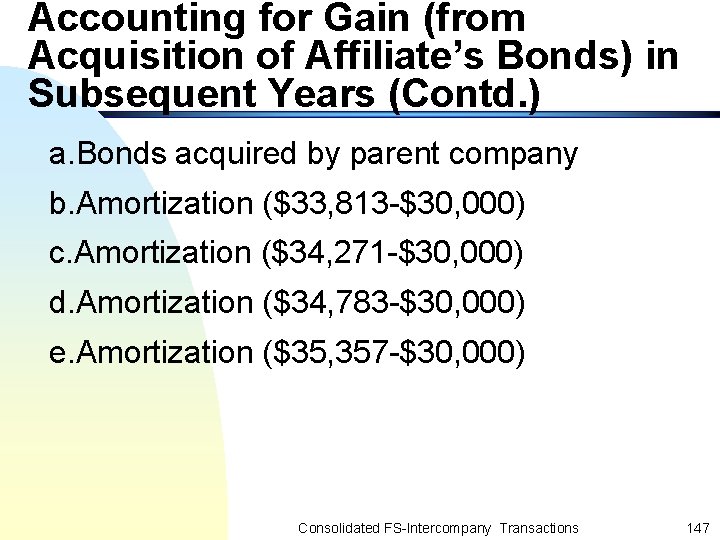
Accounting for Gain (from Acquisition of Affiliate’s Bonds) in Subsequent Years (Contd. ) a. Bonds acquired by parent company b. Amortization ($33, 813 -$30, 000) c. Amortization ($34, 271 -$30, 000) d. Amortization ($34, 783 -$30, 000) e. Amortization ($35, 357 -$30, 000) Consolidated FS-Intercompany Transactions 147
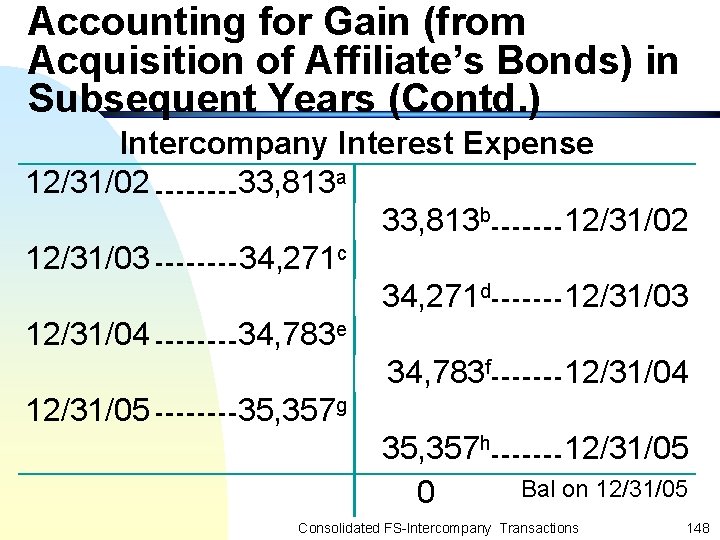
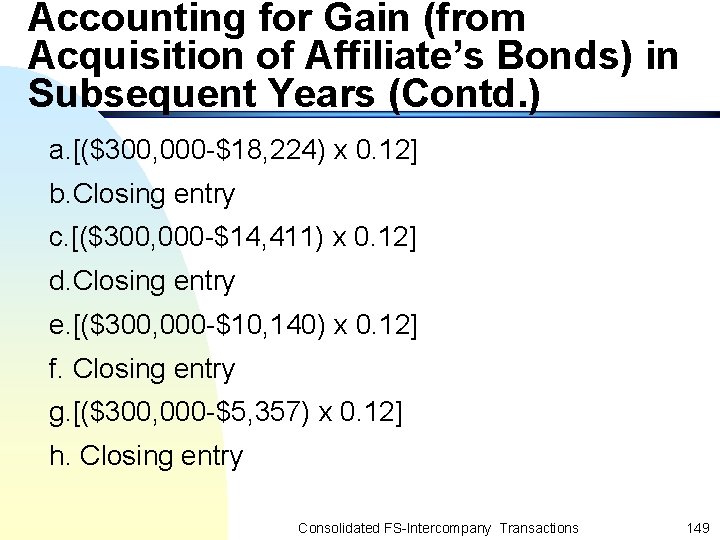
Accounting for Gain (from Acquisition of Affiliate’s Bonds) in Subsequent Years (Contd. ) Intercompany Interest Expense 12/31/02 33, 813 a 33, 813 b 12/31/02 12/31/03 34, 271 c 34, 271 d 12/31/03 12/31/04 34, 783 e 34, 783 f 12/31/04 12/31/05 35, 357 g 35, 357 h 12/31/05 Bal on 12/31/05 0 Consolidated FS-Intercompany Transactions 148
Accounting for Gain (from Acquisition of Affiliate’s Bonds) in Subsequent Years (Contd. ) a. [($300, 000 -$18, 224) x 0. 12] b. Closing entry c. [($300, 000 -$14, 411) x 0. 12] d. Closing entry e. [($300, 000 -$10, 140) x 0. 12] f. Closing entry g. [($300, 000 -$5, 357) x 0. 12] h. Closing entry Consolidated FS-Intercompany Transactions 149
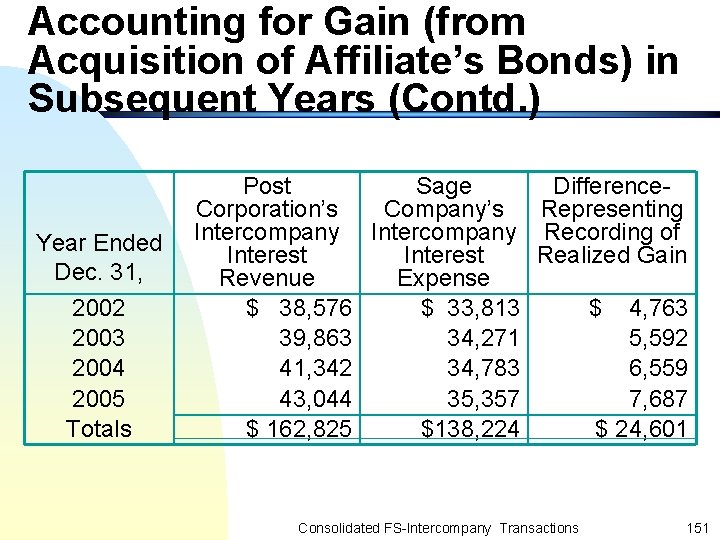
Accounting for Gain (from Acquisition of Affiliate’s Bonds) in Subsequent Years (Contd. ) n A summary of the differences between the intercompany interest revenue – Post and intercompany interest expense – Sage is as follows: Consolidated FS-Intercompany Transactions 150
Accounting for Gain (from Acquisition of Affiliate’s Bonds) in Subsequent Years (Contd. ) Year Ended Dec. 31, 2002 2003 2004 2005 Totals Post Sage Difference. Corporation’s Company’s Representing Intercompany Recording of Interest Realized Gain Revenue Expense $ 38, 576 $ 33, 813 $ 4, 763 39, 863 34, 271 5, 592 41, 342 34, 783 6, 559 43, 044 35, 357 7, 687 $ 162, 825 $138, 224 $ 24, 601 Consolidated FS-Intercompany Transactions 151
Accounting for Gain (from Acquisition of Affiliate’s Bonds) in Subsequent Years (Contd. ) n Notes to the above summary table: 1. Although the acquisition gain is not recognized by either affiliate at acquisition, the gain is recognized by the consolidated entities in the following four years through the differences in the intercompany interest revenue – Post and the intercompany interest expense – Sage. Consolidated FS-Intercompany Transactions 152
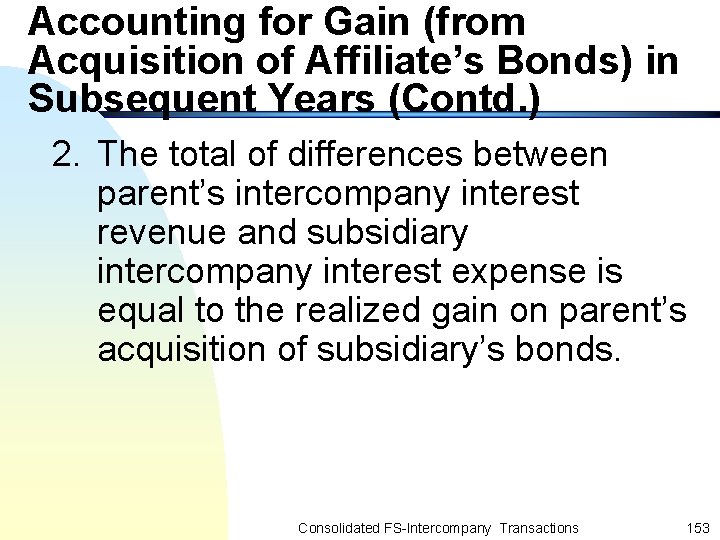
Accounting for Gain (from Acquisition of Affiliate’s Bonds) in Subsequent Years (Contd. ) 2. The total of differences between parent’s intercompany interest revenue and subsidiary intercompany interest expense is equal to the realized gain on parent’s acquisition of subsidiary’s bonds. Consolidated FS-Intercompany Transactions 153
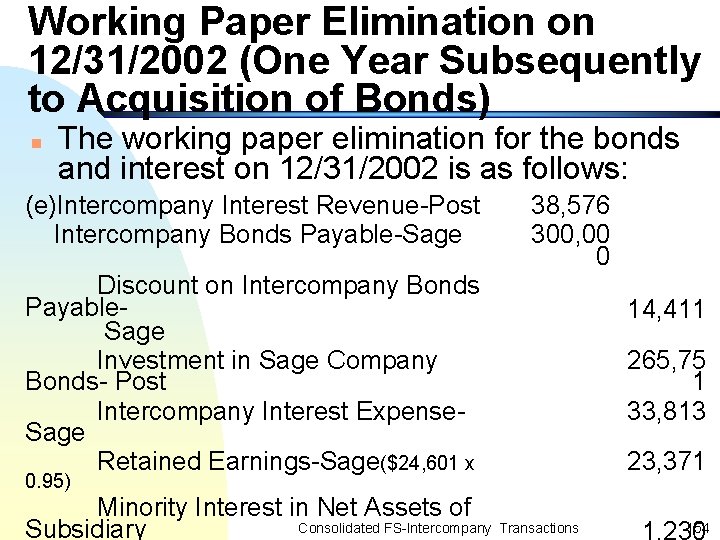
Working Paper Elimination on 12/31/2002 (One Year Subsequently to Acquisition of Bonds) n The working paper elimination for the bonds and interest on 12/31/2002 is as follows: (e)Intercompany Interest Revenue-Post Intercompany Bonds Payable-Sage 38, 576 300, 00 0 Discount on Intercompany Bonds Payable Sage Investment in Sage Company Bonds- Post Intercompany Interest Expense. Sage Retained Earnings-Sage($24, 601 x 0. 95) Minority Interest in Net Assets of Consolidated FS-Intercompany Transactions Subsidiary 14, 411 265, 75 1 33, 813 23, 371 154 1, 230
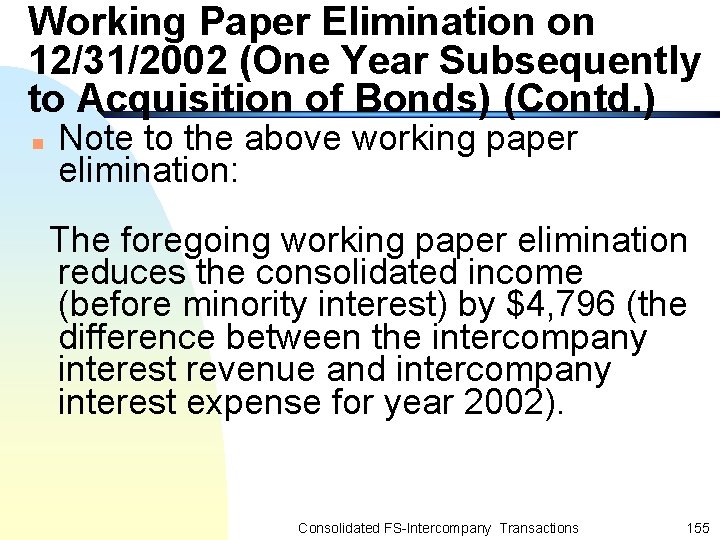
Working Paper Elimination on 12/31/2002 (One Year Subsequently to Acquisition of Bonds) (Contd. ) n Note to the above working paper elimination: The foregoing working paper elimination reduces the consolidated income (before minority interest) by $4, 796 (the difference between the intercompany interest revenue and intercompany interest expense for year 2002). Consolidated FS-Intercompany Transactions 155
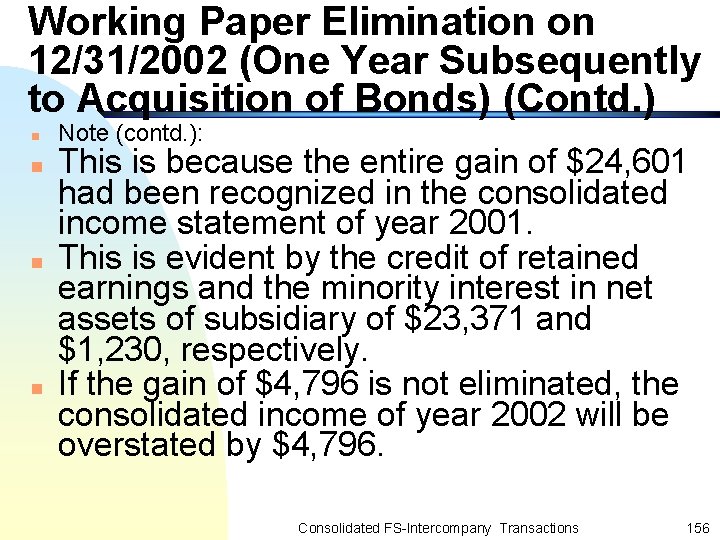
Working Paper Elimination on 12/31/2002 (One Year Subsequently to Acquisition of Bonds) (Contd. ) n n Note (contd. ): This is because the entire gain of $24, 601 had been recognized in the consolidated income statement of year 2001. This is evident by the credit of retained earnings and the minority interest in net assets of subsidiary of $23, 371 and $1, 230, respectively. If the gain of $4, 796 is not eliminated, the consolidated income of year 2002 will be overstated by $4, 796. Consolidated FS-Intercompany Transactions 156
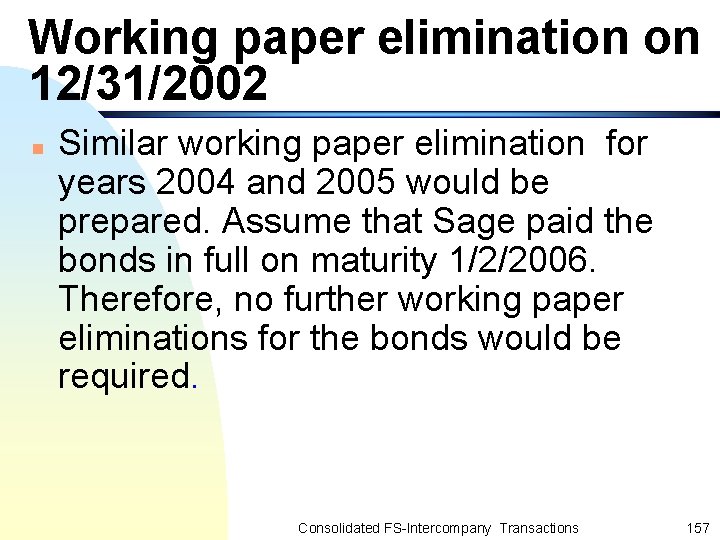
Working paper elimination on 12/31/2002 n Similar working paper elimination for years 2004 and 2005 would be prepared. Assume that Sage paid the bonds in full on maturity 1/2/2006. Therefore, no further working paper eliminations for the bonds would be required. Consolidated FS-Intercompany Transactions 157
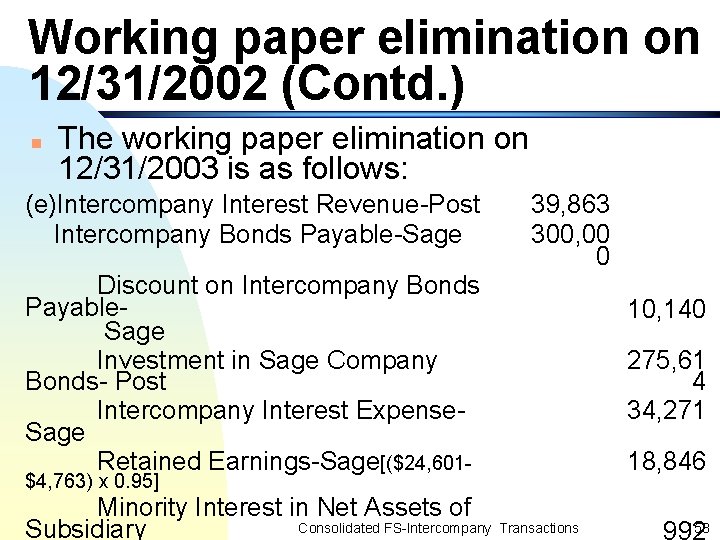
Working paper elimination on 12/31/2002 (Contd. ) n The working paper elimination on 12/31/2003 is as follows: (e)Intercompany Interest Revenue-Post Intercompany Bonds Payable-Sage 39, 863 300, 00 0 Discount on Intercompany Bonds Payable Sage Investment in Sage Company Bonds- Post Intercompany Interest Expense. Sage Retained Earnings-Sage[($24, 601$4, 763) x 0. 95] Minority Interest in Net Assets of Consolidated FS-Intercompany Transactions Subsidiary 10, 140 275, 61 4 34, 271 18, 846 158 992
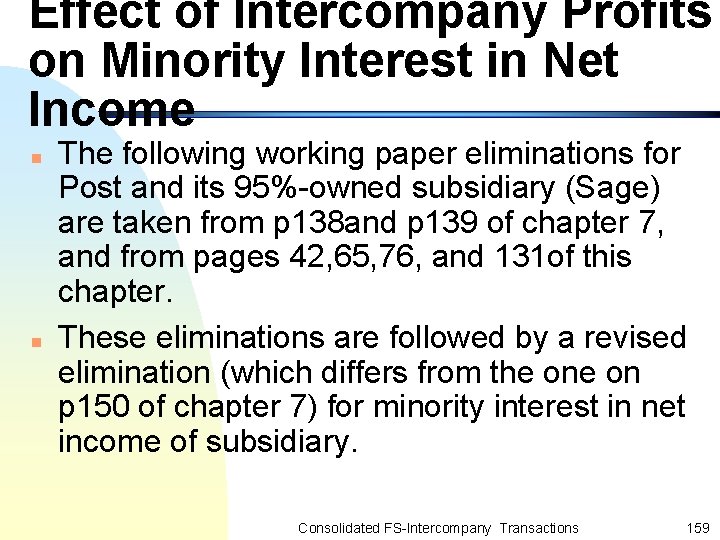
Effect of Intercompany Profits on Minority Interest in Net Income n n The following working paper eliminations for Post and its 95%-owned subsidiary (Sage) are taken from p 138 and p 139 of chapter 7, and from pages 42, 65, 76, and 131 of this chapter. These eliminations are followed by a revised elimination (which differs from the on p 150 of chapter 7) for minority interest in net income of subsidiary. Consolidated FS-Intercompany Transactions 159
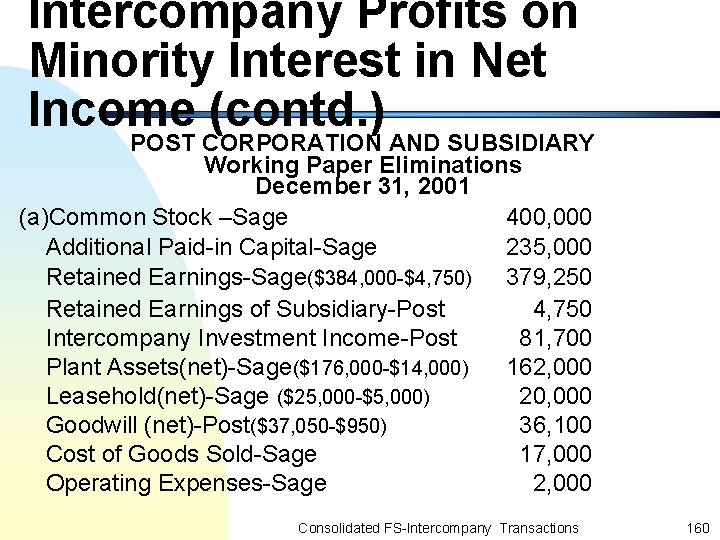
Intercompany Profits on Minority Interest in Net Income (contd. ) POST CORPORATION AND SUBSIDIARY Working Paper Eliminations December 31, 2001 (a)Common Stock –Sage 400, 000 Additional Paid-in Capital-Sage 235, 000 Retained Earnings-Sage($384, 000 -$4, 750) 379, 250 Retained Earnings of Subsidiary-Post 4, 750 Intercompany Investment Income-Post 81, 700 Plant Assets(net)-Sage($176, 000 -$14, 000) 162, 000 Leasehold(net)-Sage ($25, 000 -$5, 000) 20, 000 Goodwill (net)-Post($37, 050 -$950) 36, 100 Cost of Goods Sold-Sage 17, 000 Operating Expenses-Sage 2, 000 Consolidated FS-Intercompany Transactions 160
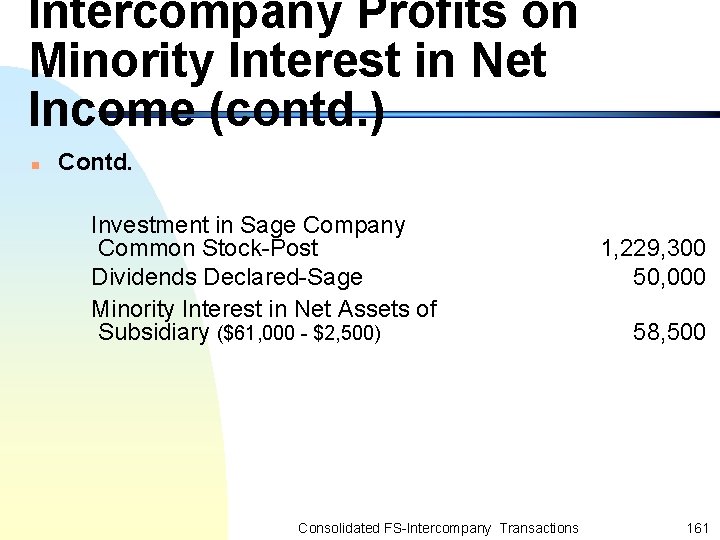
Intercompany Profits on Minority Interest in Net Income (contd. ) n Contd. Investment in Sage Company Common Stock-Post Dividends Declared-Sage Minority Interest in Net Assets of Subsidiary ($61, 000 - $2, 500) Consolidated FS-Intercompany Transactions 1, 229, 300 50, 000 58, 500 161
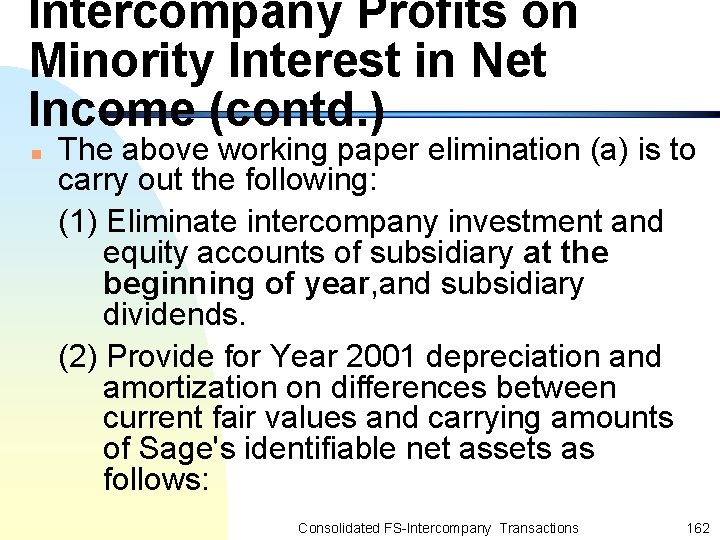
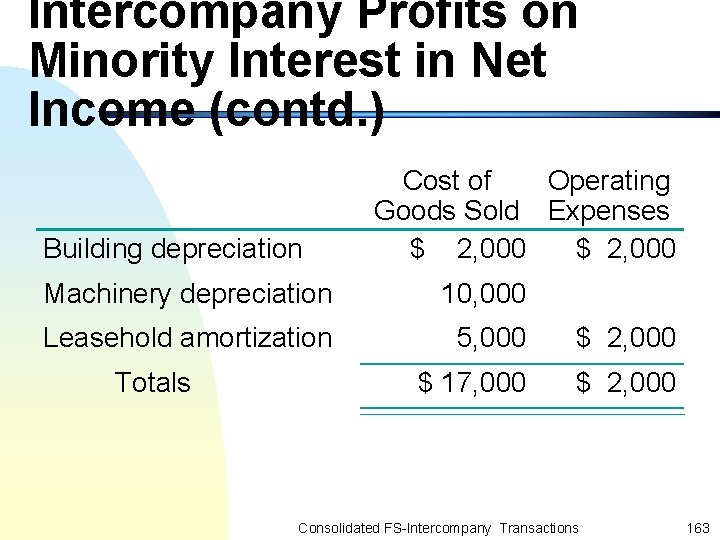
Intercompany Profits on Minority Interest in Net Income (contd. ) n The above working paper elimination (a) is to carry out the following: (1) Eliminate intercompany investment and equity accounts of subsidiary at the beginning of year, and subsidiary dividends. (2) Provide for Year 2001 depreciation and amortization on differences between current fair values and carrying amounts of Sage's identifiable net assets as follows: Consolidated FS-Intercompany Transactions 162
Intercompany Profits on Minority Interest in Net Income (contd. ) Building depreciation Cost of Operating Goods Sold Expenses $ 2, 000 $ 2, 000 Machinery depreciation 10, 000 Leasehold amortization 5, 000 $ 2, 000 $ 17, 000 $ 2, 000 Totals Consolidated FS-Intercompany Transactions 163
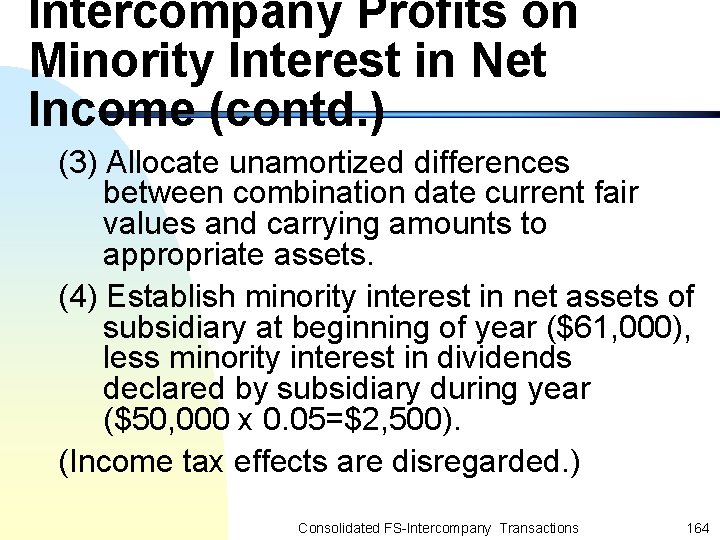
Intercompany Profits on Minority Interest in Net Income (contd. ) (3) Allocate unamortized differences between combination date current fair values and carrying amounts to appropriate assets. (4) Establish minority interest in net assets of subsidiary at beginning of year ($61, 000), less minority interest in dividends declared by subsidiary during year ($50, 000 x 0. 05=$2, 500). (Income tax effects are disregarded. ) Consolidated FS-Intercompany Transactions 164
Intercompany Profits on Minority Interest in Net Income (contd. ) (b)Intercompany Sales-Sage 120, 000 Intercompany Cost of Goods Sold-Sage 96, 000 Cost of Goods Sold Post 16, 000 Inventories-Post 8, 000 To eliminate intercompany sales, cost of goods sold, and unrealized profit in inventories. (Income tax effects are disregarded. ) Consolidated FS-Intercompany Transactions 165
Intercompany Profits on Minority Interest in Net Income (contd. ) (c)Intercompany Gain on Sale of Land- Post Land-Sage 50, 000 To eliminate unrealized intercompany gain on sale of land. (Income tax effects are disregarded. ) (d)Intercompany Gain on Sale of Machinery- Sage Machinery-Post 23, 800 To eliminate unrealized intercompany gain on sale of machinery. (Income tax effects are disregarded. ) Consolidated FS-Intercompany Transactions 166
Intercompany Profits on Minority Interest in Net Income (contd. ) (e)Intercompany Bonds Payable -Sage Discount on Intercompany Bonds Payable-Sage Investment in Sage Company Bonds Post Gain on Extinguishment of Bonds-Sage 300, 000 To eliminate subsidiary’s bonds acquired by parent, and to recognize gain on the extinguishments of the bonds. (Income tax effects are disregarded. ) Consolidated FS-Intercompany Transactions 18, 224 257, 175 24, 601 167
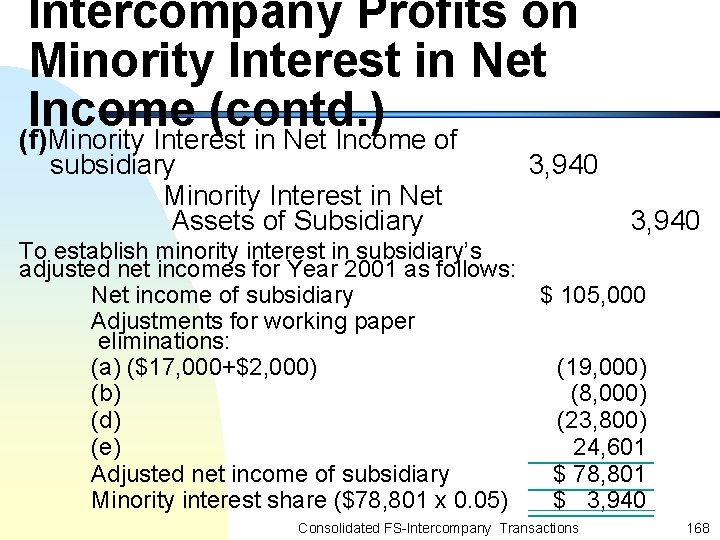
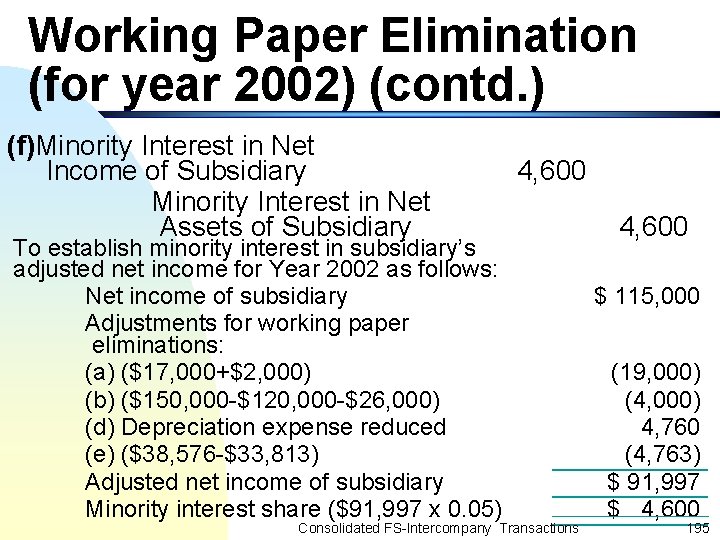
Intercompany Profits on Minority Interest in Net Income (contd. ) (f)Minority Interest in Net Income of subsidiary Minority Interest in Net Assets of Subsidiary 3, 940 To establish minority interest in subsidiary’s adjusted net incomes for Year 2001 as follows: Net income of subsidiary $ 105, 000 Adjustments for working paper eliminations: (a) ($17, 000+$2, 000) (19, 000) (b) (8, 000) (d) (23, 800) (e) 24, 601 Adjusted net income of subsidiary $ 78, 801 Minority interest share ($78, 801 x 0. 05) $ 3, 940 Consolidated FS-Intercompany Transactions 168
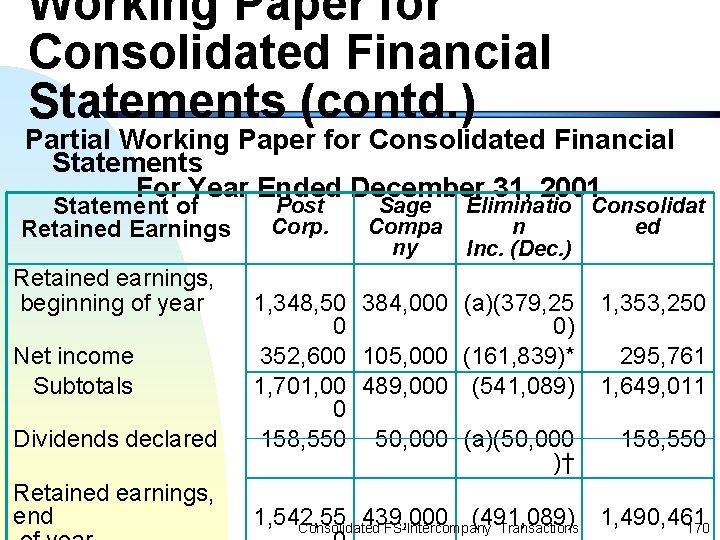
Working Paper for Consolidated Financial Statements (for Year 2001) n n The following is a partial working paper for Post Corporation and subsidiary for the year ended 12/31/2001. The amounts for Post and Sage are the same as those on p 145, 146 of Chapter 7. Consolidated FS-Intercompany Transactions 169
Working Paper for Consolidated Financial Statements (contd. ) Partial Working Paper for Consolidated Financial Statements For Year Ended December 31, 2001 Statement of Retained Earnings Retained earnings, beginning of year Net income Subtotals Dividends declared Retained earnings, end Post Corp. Sage Compa ny Eliminatio Consolidat n ed Inc. (Dec. ) 1, 348, 50 384, 000 (a)(379, 25 0 0) 352, 600 105, 000 (161, 839)* 1, 701, 00 489, 000 (541, 089) 0 158, 550 50, 000 (a)(50, 000 )† 1, 353, 250 295, 761 1, 649, 011 158, 550 1, 542, 55 439, 000 (491, 089) 1, 490, 461 Consolidated FS-Intercompany Transactions 170
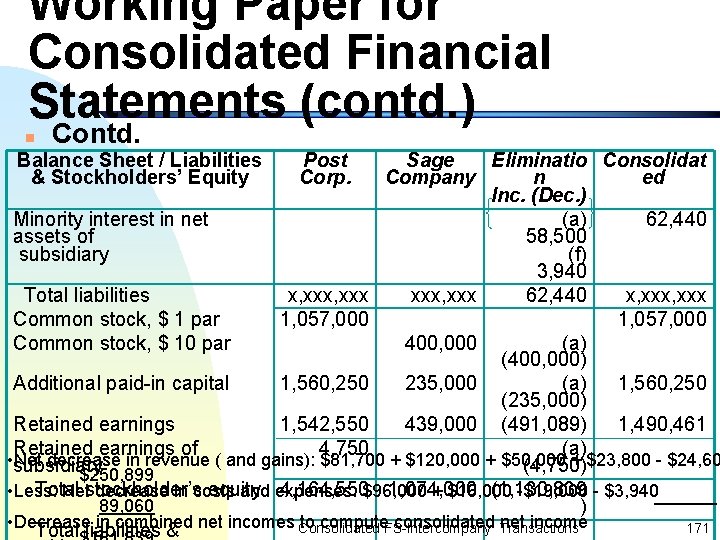
Working Paper for Consolidated Financial Statements (contd. ) n Contd. Balance Sheet / Liabilities & Stockholders’ Equity Post Corp. Sage Eliminatio Consolidat Company n ed Inc. (Dec. ) Minority interest in net (a) 62, 440 assets of 58, 500 subsidiary (f) 3, 940 Total liabilities x, xxx xxx, xxx 62, 440 x, xxx Common stock, $ 1 par 1, 057, 000 Common stock, $ 10 par 400, 000 (a) (400, 000) Additional paid-in capital 1, 560, 250 235, 000 (a) 1, 560, 250 (235, 000) Retained earnings 1, 542, 550 439, 000 (491, 089) 1, 490, 461 Retained earnings of 4, 750 (a) • subsidiary Net decrease in revenue ( and gains): $81, 700 + $120, 000 + $50, 000 + $23, 800 - $24, 60 (4, 750) $250, 899 4, 164, 550 1, 074, 000 (1, 130, 839 • Total stockholder’s equity Less: Net decrease in costs and expenses: $96, 000 + $16, 000 -$19, 000 - $3, 940 89, 060 ) • Total liabilities & Decrease in combined net incomes to compute consolidated net income Consolidated FS-Intercompany Transactions 171
Working Paper for Consolidated Financial Statements(contd. ) n n The foregoing working paper indicates that when intercompany profits exist, consolidated net income is not the same as the parent company's net income The consolidated retained earnings are not the same as the total of the parent company's two retained earnings amounts. Consolidated FS-Intercompany Transactions 172
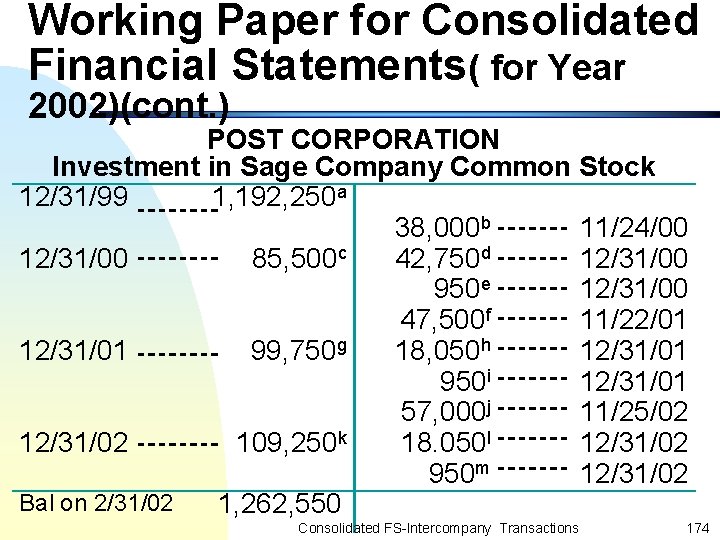
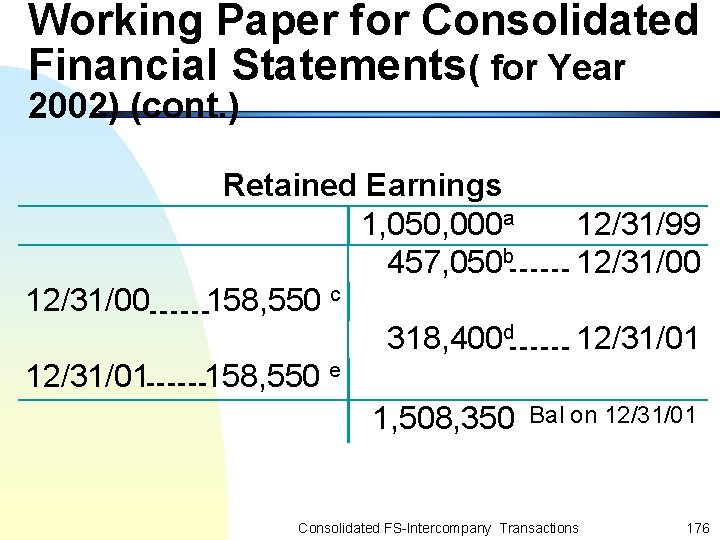
Working Paper for Consolidated Financial Statements( for Year 2002) n n Continued with the example of Post and its subsidiary (Sage), the followings are selected Post's t-accounts(investment in Sage, retained earnings) and Sage's t-account of retained earnings. Review of these accounts will help in understanding the working paper for consolidated financial statements of Year 2002. Consolidated FS-Intercompany Transactions 173
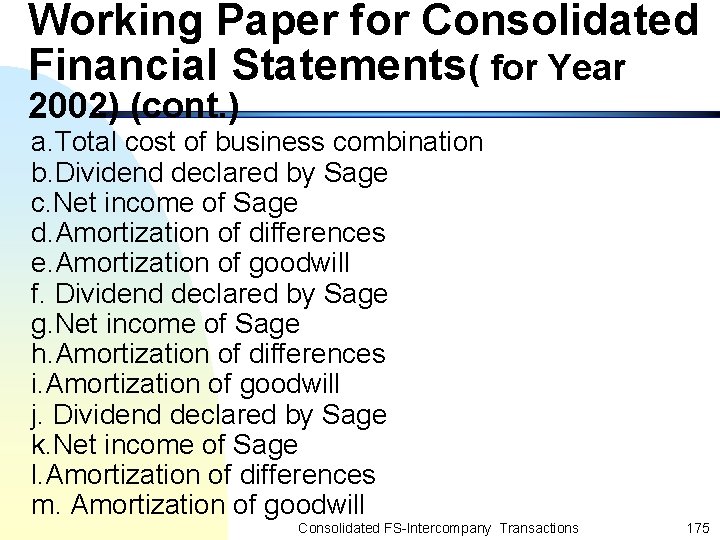
Working Paper for Consolidated Financial Statements( for Year 2002)(cont. ) POST CORPORATION Investment in Sage Company Common Stock 12/31/99 1, 192, 250 a 38, 000 b 11/24/00 12/31/00 85, 500 c 42, 750 d 12/31/00 950 e 12/31/00 47, 500 f 11/22/01 12/31/01 99, 750 g 18, 050 h 12/31/01 950 i 12/31/01 57, 000 j 11/25/02 12/31/02 109, 250 k 18. 050 l 12/31/02 950 m 12/31/02 Bal on 2/31/02 1, 262, 550 Consolidated FS-Intercompany Transactions 174
Working Paper for Consolidated Financial Statements( for Year 2002) (cont. ) a. Total cost of business combination b. Dividend declared by Sage c. Net income of Sage d. Amortization of differences e. Amortization of goodwill f. Dividend declared by Sage g. Net income of Sage h. Amortization of differences i. Amortization of goodwill j. Dividend declared by Sage k. Net income of Sage l. Amortization of differences m. Amortization of goodwill Consolidated FS-Intercompany Transactions 175
Working Paper for Consolidated Financial Statements( for Year 2002) (cont. ) 12/31/00 12/31/01 Retained Earnings 1, 050, 000 a 457, 050 b 158, 550 c 318, 400 d 158, 550 e 1, 508, 350 12/31/99 12/31/00 12/31/01 Bal on 12/31/01 Consolidated FS-Intercompany Transactions 176
Working Paper for Consolidated Financial Statements( for Year 2002) (cont. ) a. Balance b. Close net income available for dividends c. Close Dividends Declared account d. Close net income available for dividends e. Close Dividends Declared account Consolidated FS-Intercompany Transactions 177
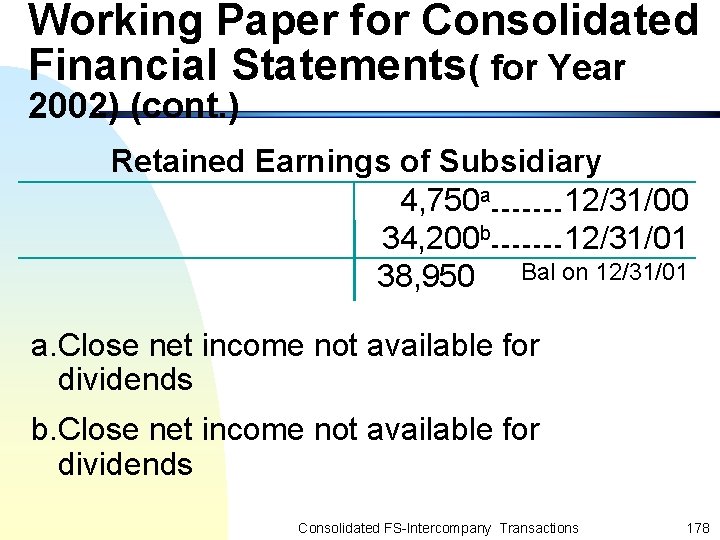
Working Paper for Consolidated Financial Statements( for Year 2002) (cont. ) Retained Earnings of Subsidiary 4, 750 a 12/31/00 34, 200 b 12/31/01 38, 950 Bal on 12/31/01 a. Close net income not available for dividends b. Close net income not available for dividends Consolidated FS-Intercompany Transactions 178
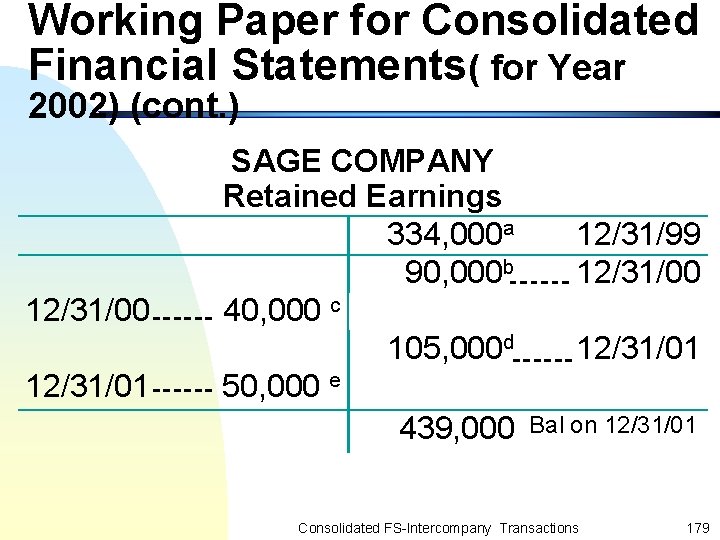
Working Paper for Consolidated Financial Statements( for Year 2002) (cont. ) 12/31/00 12/31/01 SAGE COMPANY Retained Earnings 334, 000 a 90, 000 b 40, 000 c 105, 000 d 50, 000 e 439, 000 12/31/99 12/31/00 12/31/01 Bal on 12/31/01 Consolidated FS-Intercompany Transactions 179
Working Paper for Consolidated Financial Statements( for Year 2002) (cont. ) a. Balance b. Close net income c. Close Dividends Declared account d. Close net income e. Close Dividends Declared account Consolidated FS-Intercompany Transactions 180
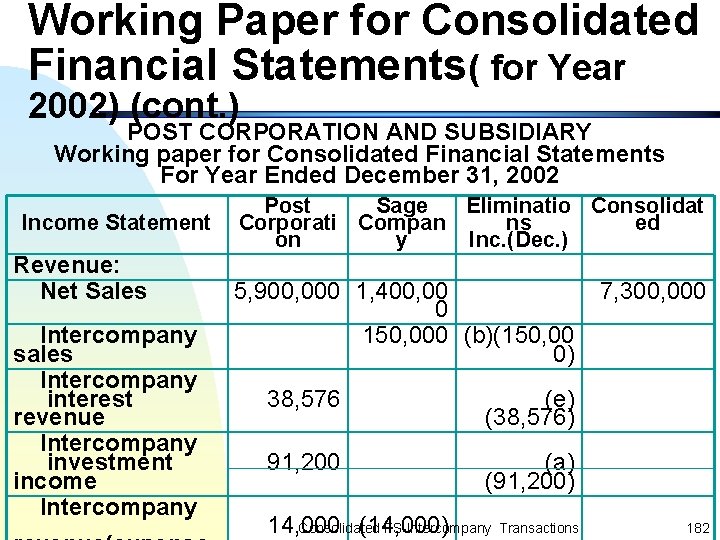
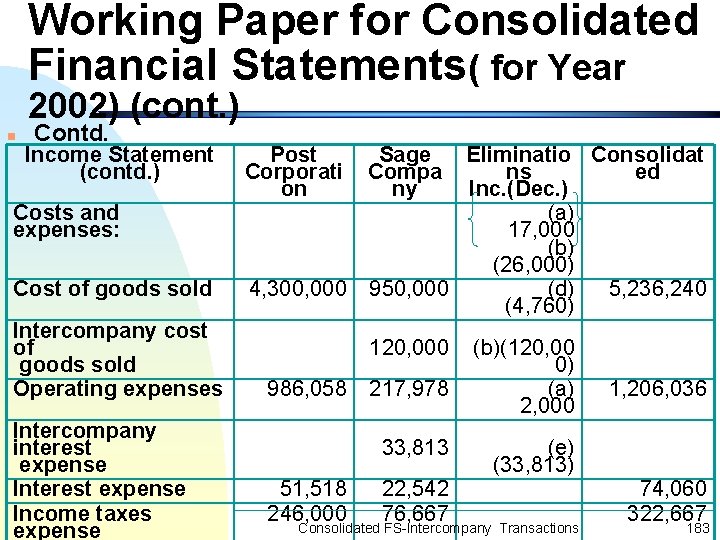
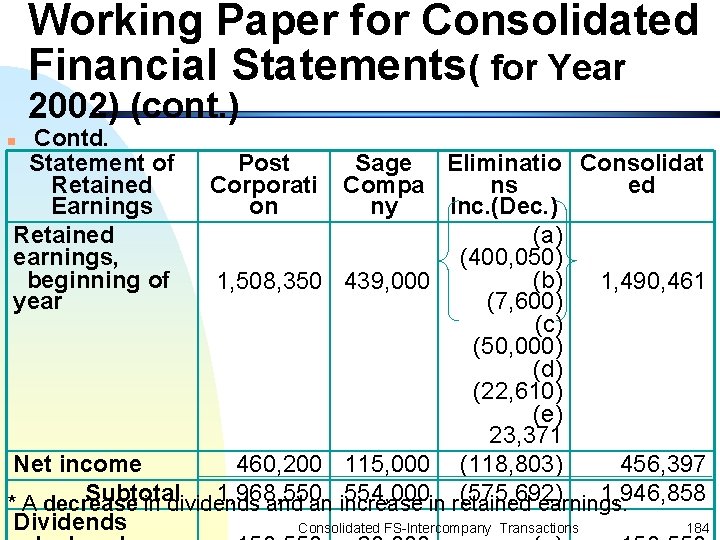
Working Paper for Consolidated Financial Statements( for Year 2002) (cont. ) The following is the working paper for consolidated financial statements for year 2002 of Post and its 95%-partially owned subsidiary: Consolidated FS-Intercompany Transactions 181
Working Paper for Consolidated Financial Statements( for Year 2002) (cont. ) POST CORPORATION AND SUBSIDIARY Working paper for Consolidated Financial Statements For Year Ended December 31, 2002 Income Statement Revenue: Net Sales Intercompany sales Intercompany interest revenue Intercompany investment income Intercompany Post Sage Eliminatio Consolidat Corporati Compan ns ed on y Inc. (Dec. ) 5, 900, 000 1, 400, 00 0 150, 000 (b)(150, 00 0) 38, 576 (e) (38, 576) 91, 200 (a) (91, 200) 14, 000 (14, 000) Consolidated FS-Intercompany Transactions 7, 300, 000 182
Working Paper for Consolidated Financial Statements( for Year 2002) (cont. ) n Contd. Income Statement (contd. ) Costs and expenses: Cost of goods sold Intercompany cost of goods sold Operating expenses Intercompany interest expense Income taxes expense Post Corporati on 4, 300, 000 Sage Compa ny Eliminatio Consolidat ns ed Inc. (Dec. ) (a) 17, 000 (b) (26, 000) 950, 000 (d) 5, 236, 240 (4, 760) 120, 000 986, 058 217, 978 33, 813 51, 518 246, 000 22, 542 76, 667 (b)(120, 00 0) (a) 1, 206, 036 2, 000 (e) (33, 813) Consolidated FS-Intercompany Transactions 74, 060 322, 667 183
Working Paper for Consolidated Financial Statements( for Year 2002) (cont. ) Contd. Statement of Retained Earnings Retained earnings, beginning of year n Post Corporati on Sage Eliminatio Consolidat Compa ns ed ny Inc. (Dec. ) (a) (400, 050) (b) 1, 490, 461 1, 508, 350 439, 000 (7, 600) (c) (50, 000) (d) (22, 610) (e) 23, 371 Net income 460, 200 115, 000 (118, 803) 456, 397 Subtotal 1, 968, 550 554, 000 (575, 692) 1, 946, 858 * A decrease in dividends and an increase in retained earnings. Dividends Consolidated FS-Intercompany Transactions 184
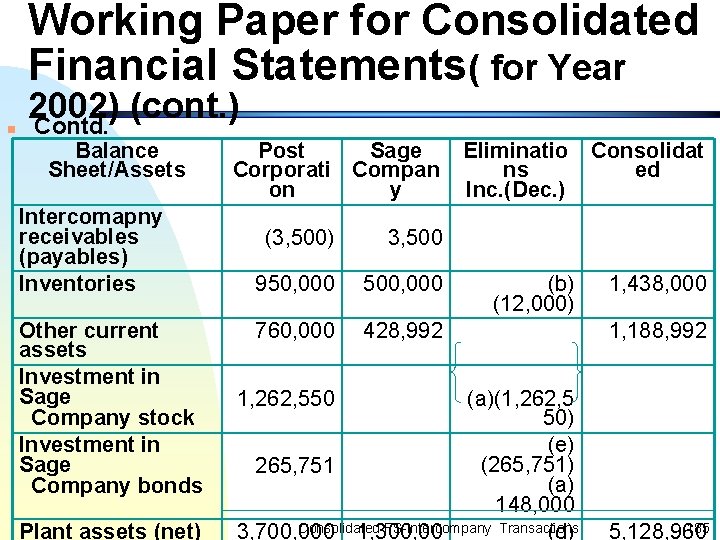
Working Paper for Consolidated Financial Statements( for Year n 2002) (cont. ) Contd. Balance Sheet/Assets Intercomapny receivables (payables) Inventories Other current assets Investment in Sage Company stock Investment in Sage Company bonds Plant assets (net) Post Sage Corporati Compan on y (3, 500) 3, 500 950, 000 500, 000 760, 000 428, 992 1, 262, 550 Eliminatio ns Inc. (Dec. ) Consolidat ed (b) 1, 438, 000 (12, 000) 1, 188, 992 (a)(1, 262, 5 50) (e) (265, 751) 265, 751 (a) 148, 000 Consolidated FS-Intercompany Transactions 185 3, 700, 000 1, 300, 00 (d) 5, 128, 960
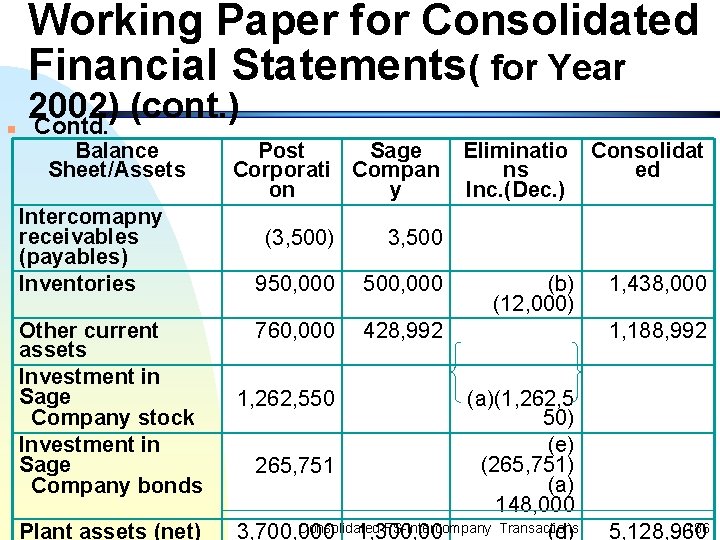
Working Paper for Consolidated Financial Statements( for Year n 2002) (cont. ) Contd. Balance Sheet/Assets Intercomapny receivables (payables) Inventories Other current assets Investment in Sage Company stock Investment in Sage Company bonds Plant assets (net) Post Sage Corporati Compan on y (3, 500) 3, 500 950, 000 500, 000 760, 000 428, 992 1, 262, 550 Eliminatio ns Inc. (Dec. ) Consolidat ed (b) 1, 438, 000 (12, 000) 1, 188, 992 (a)(1, 262, 5 50) (e) (265, 751) 265, 751 (a) 148, 000 Consolidated FS-Intercompany Transactions 186 3, 700, 000 1, 300, 00 (d) 5, 128, 960
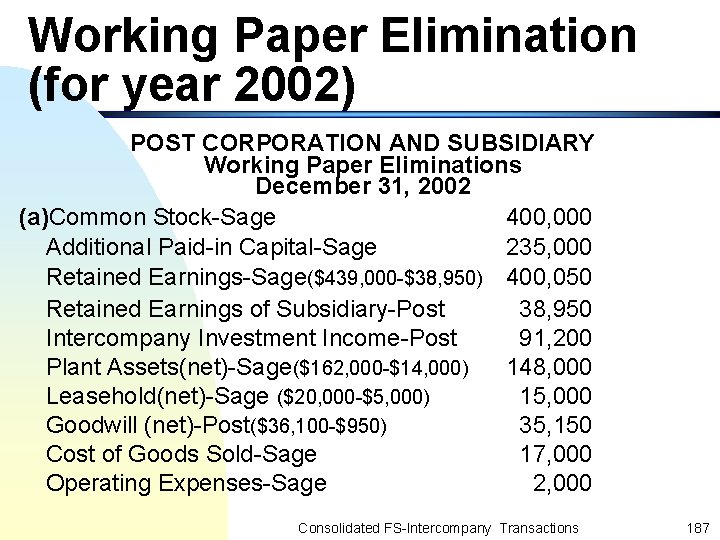
Working Paper Elimination (for year 2002) POST CORPORATION AND SUBSIDIARY Working Paper Eliminations December 31, 2002 (a)Common Stock-Sage 400, 000 Additional Paid-in Capital-Sage 235, 000 Retained Earnings-Sage($439, 000 -$38, 950) 400, 050 Retained Earnings of Subsidiary-Post 38, 950 Intercompany Investment Income-Post 91, 200 Plant Assets(net)-Sage($162, 000 -$14, 000) 148, 000 Leasehold(net)-Sage ($20, 000 -$5, 000) 15, 000 Goodwill (net)-Post($36, 100 -$950) 35, 150 Cost of Goods Sold-Sage 17, 000 Operating Expenses-Sage 2, 000 Consolidated FS-Intercompany Transactions 187
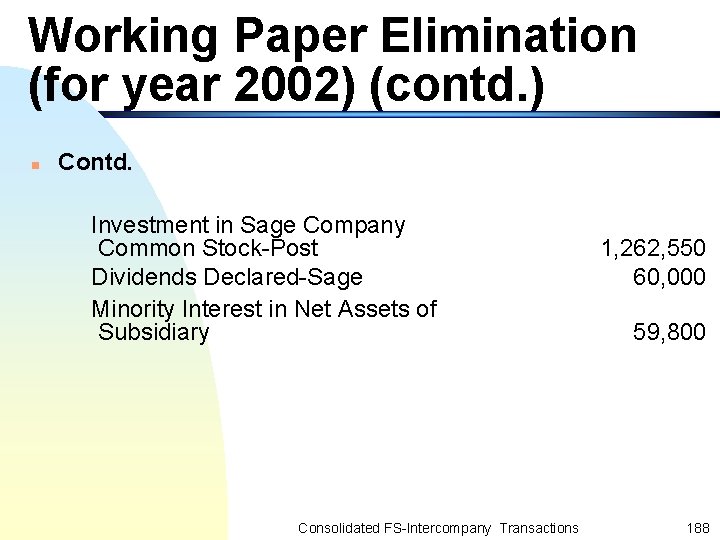
Working Paper Elimination (for year 2002) (contd. ) n Contd. Investment in Sage Company Common Stock-Post Dividends Declared-Sage Minority Interest in Net Assets of Subsidiary Consolidated FS-Intercompany Transactions 1, 262, 550 60, 000 59, 800 188
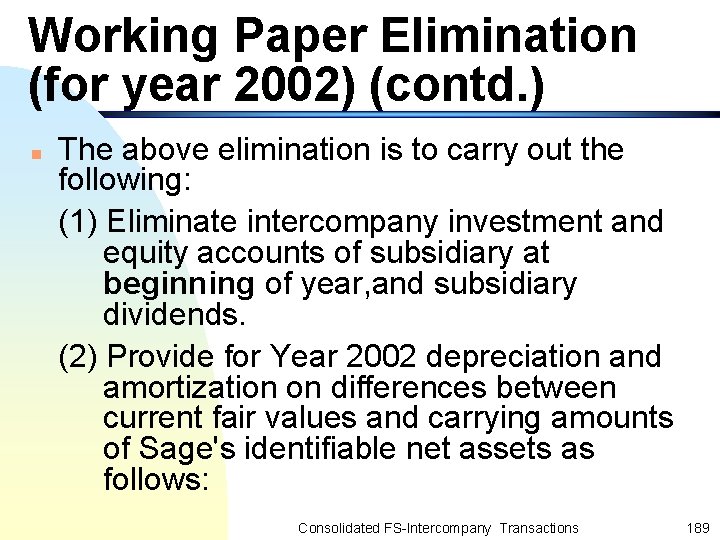
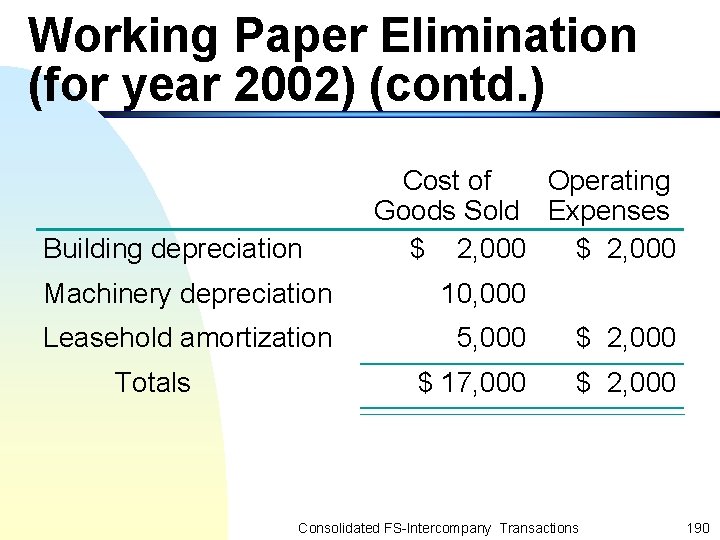
Working Paper Elimination (for year 2002) (contd. ) n The above elimination is to carry out the following: (1) Eliminate intercompany investment and equity accounts of subsidiary at beginning of year, and subsidiary dividends. (2) Provide for Year 2002 depreciation and amortization on differences between current fair values and carrying amounts of Sage's identifiable net assets as follows: Consolidated FS-Intercompany Transactions 189
Working Paper Elimination (for year 2002) (contd. ) Building depreciation Cost of Operating Goods Sold Expenses $ 2, 000 $ 2, 000 Machinery depreciation 10, 000 Leasehold amortization 5, 000 $ 2, 000 $ 17, 000 $ 2, 000 Totals Consolidated FS-Intercompany Transactions 190
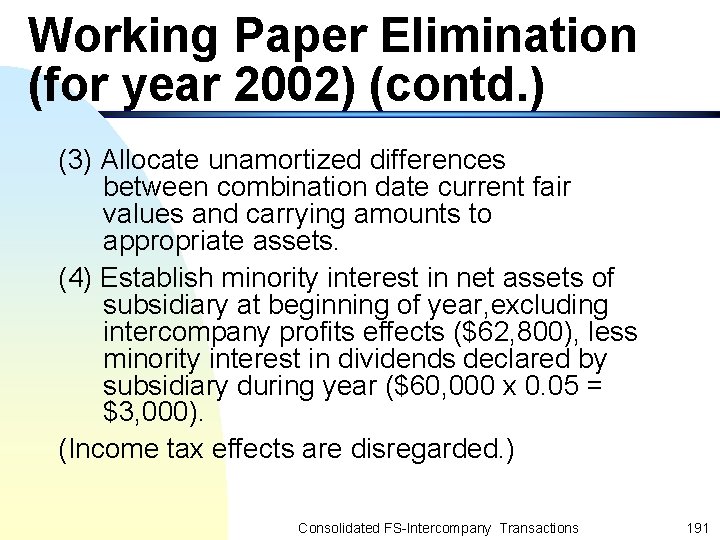
Working Paper Elimination (for year 2002) (contd. ) (3) Allocate unamortized differences between combination date current fair values and carrying amounts to appropriate assets. (4) Establish minority interest in net assets of subsidiary at beginning of year, excluding intercompany profits effects ($62, 800), less minority interest in dividends declared by subsidiary during year ($60, 000 x 0. 05 = $3, 000). (Income tax effects are disregarded. ) Consolidated FS-Intercompany Transactions 191
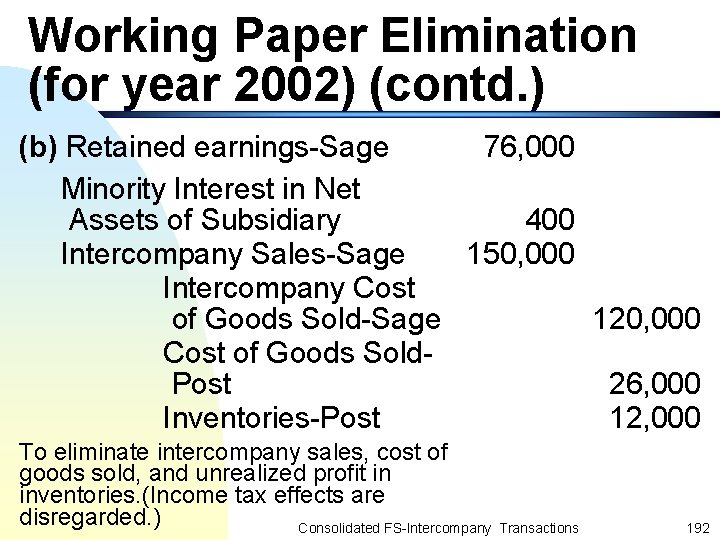
Working Paper Elimination (for year 2002) (contd. ) (b) Retained earnings-Sage 76, 000 Minority Interest in Net Assets of Subsidiary 400 Intercompany Sales-Sage 150, 000 Intercompany Cost of Goods Sold-Sage 120, 000 Cost of Goods Sold Post 26, 000 Inventories-Post 12, 000 To eliminate intercompany sales, cost of goods sold, and unrealized profit in inventories. (Income tax effects are disregarded. ) Consolidated FS-Intercompany Transactions 192
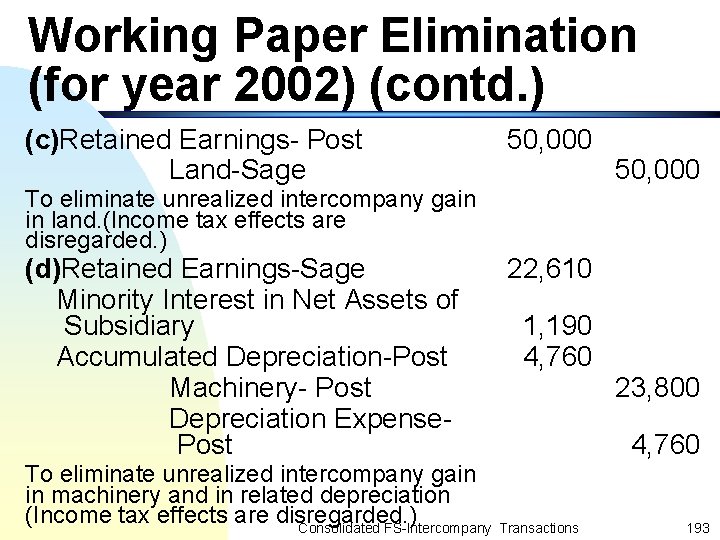
Working Paper Elimination (for year 2002) (contd. ) (c)Retained Earnings- Post Land-Sage To eliminate unrealized intercompany gain in land. (Income tax effects are disregarded. ) (d)Retained Earnings-Sage Minority Interest in Net Assets of Subsidiary Accumulated Depreciation-Post Machinery- Post Depreciation Expense Post 50, 000 22, 610 1, 190 4, 760 To eliminate unrealized intercompany gain in machinery and in related depreciation (Income tax effects are disregarded. ) Consolidated FS-Intercompany Transactions 23, 800 4, 760 193
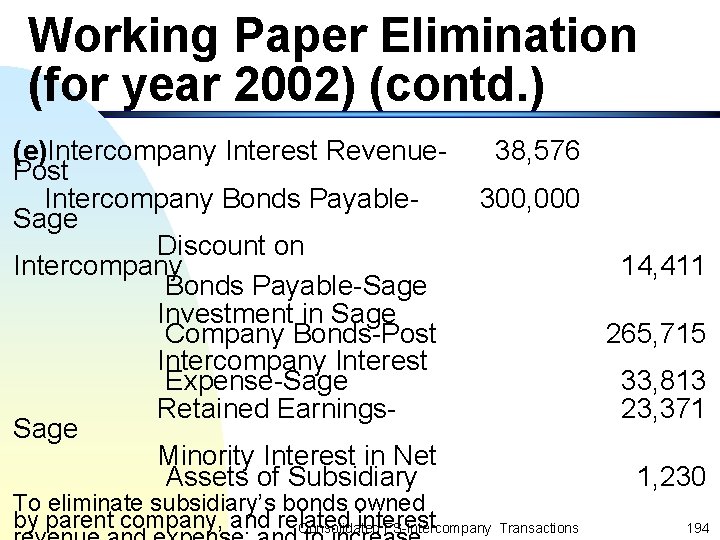
Working Paper Elimination (for year 2002) (contd. ) (e)Intercompany Interest Revenue- 38, 576 Post Intercompany Bonds Payable- 300, 000 Sage Discount on Intercompany 14, 411 Bonds Payable-Sage Investment in Sage Company Bonds-Post 265, 715 Intercompany Interest Expense-Sage 33, 813 Retained Earnings- 23, 371 Sage Minority Interest in Net Assets of Subsidiary 1, 230 To eliminate subsidiary’s bonds owned by parent company, and related interest Consolidated FS-Intercompany Transactions 194
Working Paper Elimination (for year 2002) (contd. ) (f)Minority Interest in Net Income of Subsidiary Minority Interest in Net Assets of Subsidiary To establish minority interest in subsidiary’s adjusted net income for Year 2002 as follows: Net income of subsidiary Adjustments for working paper eliminations: (a) ($17, 000+$2, 000) (b) ($150, 000 -$120, 000 -$26, 000) (d) Depreciation expense reduced (e) ($38, 576 -$33, 813) Adjusted net income of subsidiary Minority interest share ($91, 997 x 0. 05) 4, 600 Consolidated FS-Intercompany Transactions 4, 600 $ 115, 000 (19, 000) (4, 000) 4, 760 (4, 763) $ 91, 997 $ 4, 600 195